
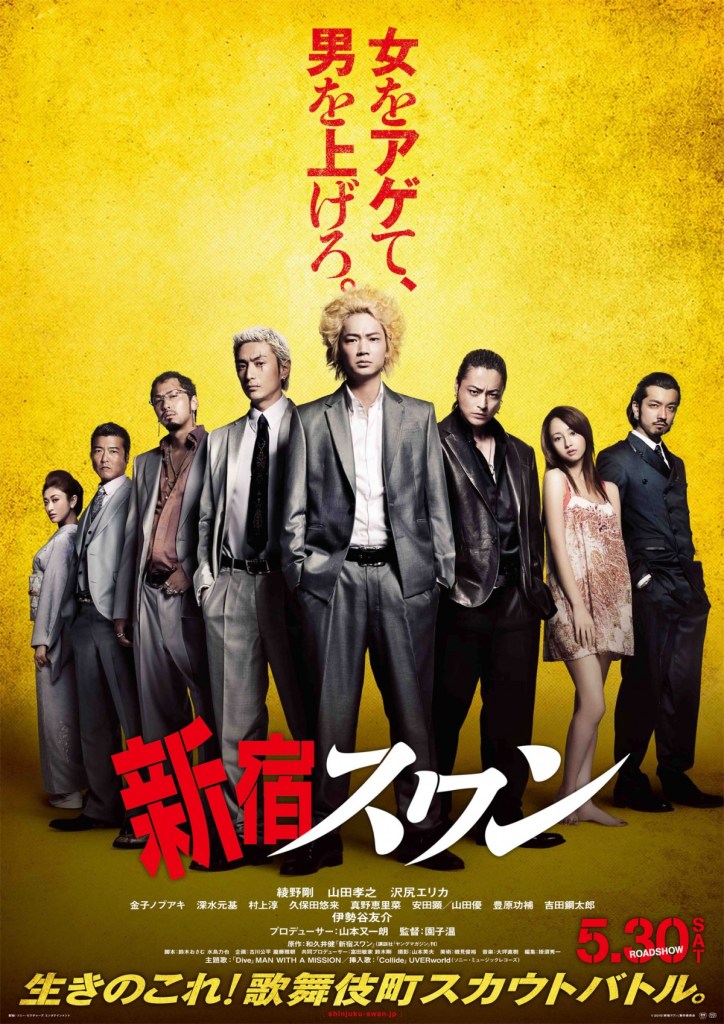
 Enfant terrible of the Japanese film industry Sion Sono has always been prolific but recent times have seen him pushing the limits of the possible and giving even Takashi Miike a run for his money in the release stakes. Indeed, Takashi Miike is a handy reference point for Sono’s take on Shinjuku Swan (新宿スワン) – an adaptation of a manga which has previously been brought to the small screen and is also scripted by an independent screenwriter rather than self penned in keeping with the majority of Sono’s directing credits. Oddly, the film shares several cast members with Miike’s Crows Zero movies and even lifts a key aesthetic directly from them. In fact, there are times when Shinjuku Swan feels like an unofficial spin-off to the Crows Zero world with its macho high school era tussling relocated to the seedy underbelly of Kabukicho. Unfortunately, this is somewhat symptomatic of Sono’s failure, or lack of will, to add anything particularly original to this, it has to be said, unpleasant tale.
Our “hero” is down on his luck loser Tatsuhiko (Go Ayano) who’s come to Shinjuku to make it big. He’s here because it’s the sort of place you can make it happen with no plan and no resources. “Luckily” for him, he runs into low-level gangster Mako (Yusuke Iseya) who spots some kind of potential in him and recruits him as a “scout” for his organisation, Burst. Now dressed in a fancy suit, Tatsuhiko’s new job is stopping pretty girls in the street and trying to talk them into working in the sex industry….
Tatsuhiko is not the brightest and doesn’t quite understand what the implications of his work are. When he finally gets it, he feels conflicted but Mako convinces him that’s it’s OK really with a set of flimsy moral justifications. Before long, Tatsuhiko comes into conflict with a lieutenant, Hideyoshi (Takayuki Yamada), from the rival gang in town, Harlem, and a yakuza style territorial dispute begins to unfold destabilising the entire area.
Sono has often been criticised for latent misogyny and an exploitative approach to his material and Shinjuku Swan is yet more evidence for those who find his output “problematic”. Though based on a manga and scripted by a third party, Shinjuku Swan has an extremely ill-defined take on the sex industry and the people involved with it. After figuring out what happens to the girls he takes to Mako, Tatsuhiko has second thoughts but Mako tells him that the girls are happy and are in this line of work because they enjoy it (leaving out all the stuff about debts, drugs, and violence). So Tatsuhiko vows to make even more girls live happy lives inside the “massage parlours” of Kabukicho.
Noble heart or not, Tatsuhiko is a pimp. Not even that, he’s a middle man pimp. He’s earning his money from the suffering of the women that’s he conned, coerced, and finally exploited. Leaving aside the idea that, yes, some of these women may be perfectly happy with the arrangement, at least one of Tatsuhiko’s recruits displays evidence of previous self harm and is unable to cope with the demands of her new way of life. Another woman, Ageha (Erika Sawajiri), who becomes Tatsuhiko’s primary damsel in distress, escapes into a children’s fairytale picture book in which a prince with crazy hair just like Tatsuhiko’s comes to rescue the heroine from her life of slavery and takes her to a place of love and safety. Tatsuhiko “rescues” her by taking her to a “nicer” brothel…
Tatsuhiko may have convinced himself that he’s somehow a force for good, “helping” these women into employment and providing “protection” for them unlike the other guys from rival gangs who use drugs and violence to keep their girls in line, but his continued belief in his own goodness becomes increasingly hard to swallow as he learns more about how this industry really works. It’s difficult to believe in a “hero” who is so deluded about his own place in the grand scheme of things – he’s not stupid enough to be this oblivious, but not clever enough to be continually unseeing all of the darkness that surrounds the way he makes his living.
All of this is merely background to the central yakuza gang war which later ensues. Tatsuhiko ends up as a pawn in the tussle for territory between Burst and Harlem as double crosses become triple crosses and no one is to be trusted. Predictably, Tatsuhiko and Hideyoshi turn out to have a long standing connection though this revelation never achieves the dramatic weight it’s looking for and the gang war itself is, at best, underwhelming. Notable scenes including a classic battle in the rain could have been spliced in from Crows Zero and no one would have noticed. The main dramatic thread remains Tatsuhiko’s journey as he travels from clueless loser to, admittedly still clueless, assured petty gangster and smooth talking lady killer.
If there’s an overall feeling which imbues Shinjuku Swan, it’s lack of commitment. Though often beautifully photographed and featuring some interestingly composed sequences (including a few Carax-esque musical set pieces) the final effect is one of workman-like competence. Not bad by any means, but this feels like the work of a director for hire and lacks the sense of the personal that a would-be-auteur would usually seek to provide. Moral ambiguity can often be a film’s strong point, inviting comment and debate rather than pushing a pre-defined agenda but Shinjuku Swan takes too many incompatible approaches to the already unpalatable series of questions that it stops short of asking. Distinctly uneven, Shinjuku Swan ends on a note of anti-climax and though a perfectly serviceable, mainstream, commercial effort proves something of a disappointment from a director who has often managed to bring out a sense of mischievous irony in similarly themed work to date.
Unsubtitled trailer:
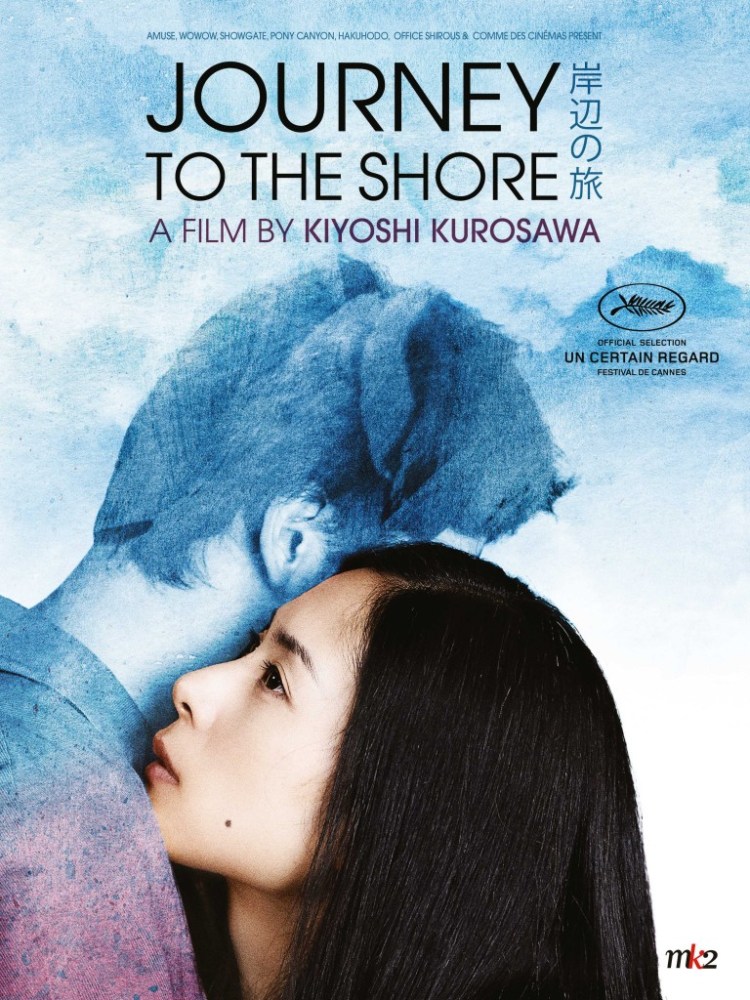 Time is an ocean, but it ends at the shore. Kiyoshi Kurosawa neatly reverses Dylan’s poetic phrasing as his shoreline is less a place of endings but of beginnings or at least a representation of the idea that every beginning is born from the death of that which preceded it. Adapted from a novel by Kazumi Yumoto, Journey to the Shore (岸辺の旅, Kishibe no Tabi) takes its grief stricken, walking dead heroine on a long journey of the soul until she can finally put to rest a series of wandering ghosts and begin to live once again, albeit at her own tempo.
 Ryuichi Hiroki has one of the most varied back catalogues of any Japanese director currently working. After getting his start in pink films and then moving into V-Cinema, Hiroki came to prominence with 2003’s Vibrator – an erotically charged exploration of modern alienation, but recent years have also proved him adept at gentle character drama. Her Granddaughter (娚の一生, Otoko no Isshou), though coming with its own degree of strangeness, is another venture into the world of peaceful, if complicated, adult romance.
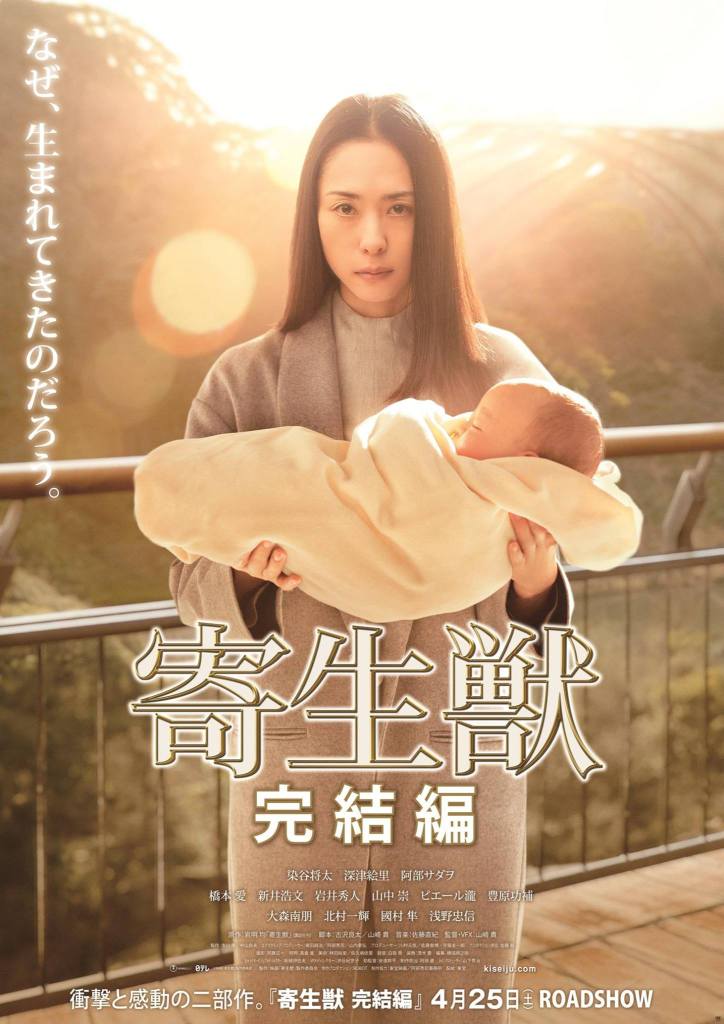 Review the concluding chapter of Takashi Yamazaki’s Parasyte live action movie (寄生獣 完結編, Kiseiju Kanketsu Hen) first published by
  Masamune Shirow’s cyberpunk manga Ghost in the Shell burst onto the scene in 1989 and instantly became a genre classic. Mamoru Oshii then adapted the manga into a much lauded anime movie in 1995 which almost came to define cyberpunk animation even if it emerged towards the end of the genre’s heyday. A sequel, Ghost in the Shell: Innocence followed in 2004 as well as a TV anime spin-off Ghost in the Shell: Stand Alone Complex. Now with the 20th anniversary of the original animated movie, the series has yet again been adapted into a series of entirely new anime OVAs under the name of Ghost in the Shell: Arise. Ghost in the Shell: The New Movie (攻殻機動隊 新劇場版, Kokaku Kidotai – Shin Gekijoban) is the big screen outing of this latest incarnation scripted by Tow Ubukata who also produced the very GITS influenced Mardock Scramble.
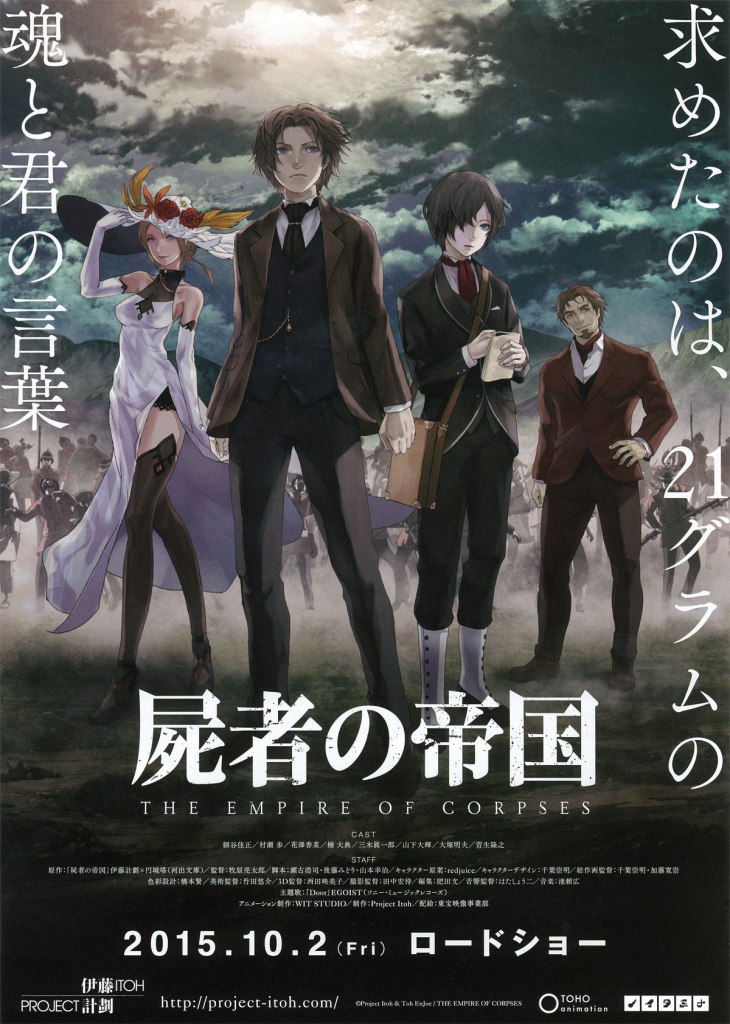 Empire of Corpses (屍者の帝国, Shisha no Teikoku) is what would happen if someone’s vast library of Victorian literature was destroyed in a fire and then someone tried to put all the not too singed pages back together based on their knowledge of international pop culture. Inspired by Project Itoh’s novel of the same name and the first of three planned adaptations of his works, Empire of Corpses is a very specific kind of absurd, boys own action adventure based around the idea of empire supported by a zombified proletariat.
 Harmony – the word itself sounds peaceful. A coalescence of sympathetic sounds, the feeling of wholeness and happiness. However, if given the choice, would you like to live in a world of peace and plenty in which your body is almost government property and your personal freedom is limited in favour of ensuring the survival of the species, or would you rather take your chances with the world as it is complete with its violence, sadness and pain if it meant you could be free to live in which ever way you see fit? Michael Arias’ adaptation of the Project Itoh novel addresses just this question in all its complexity as utopia turns out to have a heavy entrance fee.
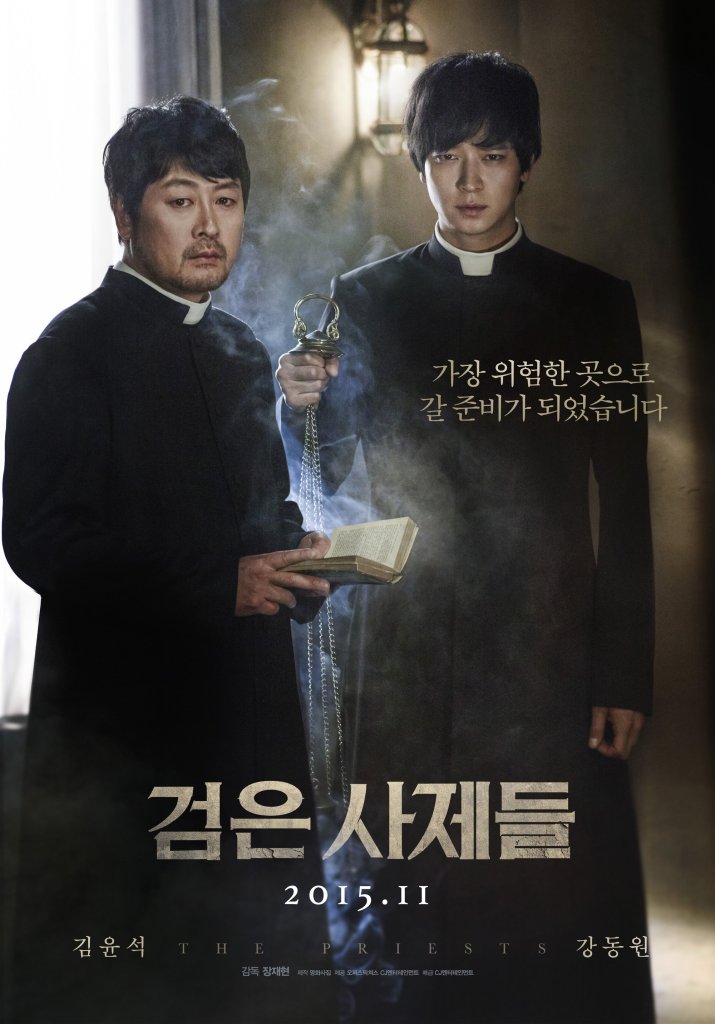 The era of hero priests might be well and truly behind us but at least when it comes to the exorcism movie, the warrior monk resurfaces as the valiant men of God face off against pure evil itself risking both body and soul in an attempt to free the unfortunate victim of a possession from their torment. To many, the very idea sounds as if it belongs in the medieval era – what need have we for demons now that we posses such certain, scientific knowledge? There are, however, things far more ancient than man which are far more terrifying than our ordinary villainy.
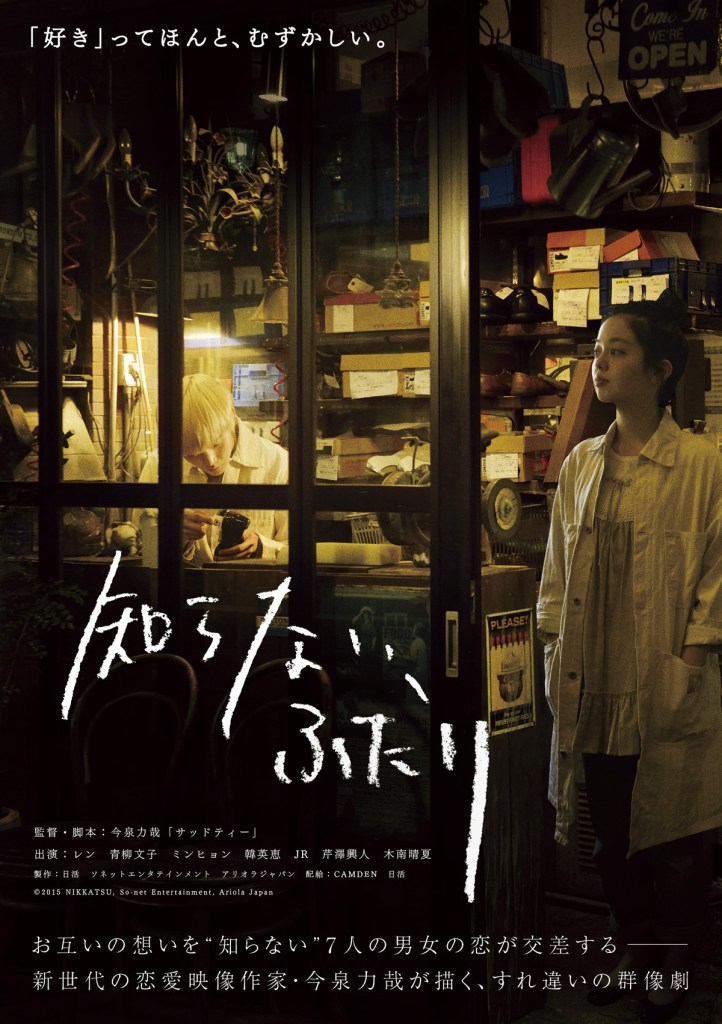 Ah young love! So beautiful, so complicated, so retrospectively trivial. Intrigue engulfs a group of young Koreans living in Japan, their co-workers, and even their English teacher and her fiancee in Rikiya Imaizumi’s indie youth meets boyband quirky romance movie, Their Distance (知らない、ふたり, Shiranai Futari). The aptly named picture paints a vista of misdirected love, miscommunication and misjudged honesty to show how messy romance can be even when it’s intent on being cute.
 Caesium is a chemical element which has the distinction of being one of the very few metals which remains liquid at room temperature. These days you’re most likely to hear about one of its isotopes which is produced as a result of nuclear fission and can pose a serious environmental problem following a nuclear related disaster. Caesium comes to be something of an obsessive concern for the 17 year old heroine of Ryo Saitani’s debut film, Cesium and a Tokyo Girl (セシウムと少女, Cesium to Shojo), as Mimi comes to connect the presence of caesium in the water with the constant soreness she’s been experiencing with her tongue since the disaster hit.
 Windows on Worlds