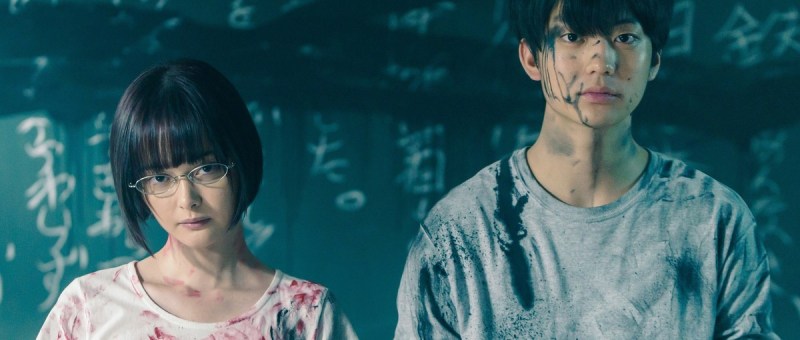
Flowers of Evil (惡の華, Noboru Iguchi, 2019)

Small-town ennui is something familiar to many who’ve found themselves feeling somewhat out of place in the place they’ve always been, but rebellions usually take less obvious forms than the nihilistic rejection of bourgeois respectability enacted by the conflicted hero at the centre of Noboru Iguchi’s Flowers of Evil (惡の華, Aku no Hana). Iguchi is best known as a director of made for export splatter exploitation, so it might come as a surprise to his fans to see him take on the admittedly dark but largely gore-fee adaptation of Shuzo Oshimi’s coming-of-age manga.

Takao (Kentaro Ito), a “regular” high school boy, likes to read “difficult” books such as the poetry collection by Charles Baudelaire from which the film takes its title. He feels himself somewhat above his surroundings, but superficially conforms to the ordinary world around him. Like many of his classmates, he’s developed an adolescent crush on the school’s prettiest girl, Nanako (Shiori Akita), but unlike his friends views her as his “muse”, a pure and untouchable figure of unspeakable desire. Nipping back to the classroom alone to retrieve a forgotten book, he spots Nanako’s gym bag lying on the floor and cannot resist opening it, burying his face in her clothes. Panicked after hearing someone nearby, he takes the bag home with him.

Everyone immediately knows that a “pervert” is responsible for the theft, they just don’t know who it is. Except for the class’ resident strange girl, Sawa (Tina Tamashiro), who apparently witnessed Takao’s descent into perversion in real time. She makes him a deal – write an essay all about what a big pervert he is and she’ll kept his secret in friendly complicity seeing as she is a kind of “pervert” too. Sawa, who is much more obviously “different” than Takao and completely unafraid of embracing it, is convinced that their town is entirely inhabited by “Shit Bugs”, and they are the only elevated beings. Uncomfortable with her own desire, Sawa’s behaviour becomes increasingly intense when Nanako unexpectedly expresses an interest in Takao, apparently impressed that he was so “upfront with his feelings” and willing to stand up for Sawa when she was accused of being a (but not the) thief.

Takao tells Sawa that he just wants to be “normal”, to be the kind of man Nanako could desire. Just another confused teenage boy, he doesn’t yet know who he is or what he feels and is, in a sense, consumed by the sense of emptiness that comes of lacking self-knowledge. He masks his sense of intellectual inferiority by feigning sophistication, spending his free time in second hand bookshops reading the accepted canon with a typically teenage obsession with death and despair. But as he is later forced to admit, he did so largely in order to feel superior. He doesn’t truly understand much of what he read and lacks the maturity to accept his confusion. Nanako challenges him in more ways than one – by calling him on his wilful repression of his desires, and by confronting him about his obsession with Flowers of Evil, a “difficult” book which try as she might she can’t understand. She doesn’t “get” Baudelaire, and she doesn’t “get” Takao because of it, but Takao doesn’t “get” Takao either because he thinks he’s a book filled with blank pages, that if you open the cover there’s really nothing interesting there, just a giant void of emptiness.

Three years after stealing the gym bag, Takao describes his new environment as infinitely grey as if devoid of any sense of life, whereas the climactic summer is coloured by a vibrant greenery he claims to be equally oppressive. Fed up with small-town life, both Takao and Sawa long for a mythical “beyond” on the other side of the mountains which trap them within the claustrophobic environment of their provincial existence. They kick back against small-town conservatism with childish shows of resistance which culminate in a very public act of self-harm dressed as societal attack, but remain unable and unwilling to address the real cause of their frustration in their adolescent inability to accept that desire itself is not “perverse” or somehow sullying some grand romantic notion of pure and innocent love.

Unable to process his desires, Takao remains unable to progress into adulthood and become, as Sawa later chides him, a “regular human”. Normality is, however, what he eventually chooses, reverting to the anxious bookworm he always was only having moved forward in learning to let something go, whereas Sawa perhaps feels that she has no other option that to accept her own “perversion” and be exiled by it. Takao discovers an internal “beyond” and tries to share it with Sawa, but she is looking for something else and cannot join him in the “regular” world to which he is always going to return. Iguchi dedicates the film to all those who are or were tormented by youth, allowing his tortured hero to find his path towards an integrated selfhood, but resists the temptation to belittle his suffering as he strips himself bare to exorcise the emptiness inside.


Flowers of Evil was screened as part of the 2019 Five Flavours Film Festival.

Original trailer (no subtitles)

Height of the Wave (파고, Park Jung-bum, 2019)

Height of the Wave poster“The suspects are all the residents” says the world weary police chief at the end of Park Jung-bum’s uncharacteristically forgiving island drama Height of the Wave (파고, Pago). Island communities are often thought of as innocent idylls, the city’s corruption lying far off over the horizon, but where there are people there is suffering and perhaps there’s nowhere completely free of human cruelty.

Recently divorced maritime police woman Yeon-su (Lee Seung-yeon) has been seconded to a remote island to act as its police chief for two years. She’s brought her deeply resentful teenage daughter with her, and is currently struggling with a “panic disorder” she’s keen to keep a secret. Meanwhile, island’s sleazy foreman, handsy and making inappropriate comments about the scent of Yeon-su’s hair, is hard at work to a get a designation as a “desirable destination” and attract much needed funding. His plans are disrupted, however, when Yeon-su overhears some worrying comments from the island’s only young woman, Yae-eun (Lee Yeon), which suggest she is indulging in sex work (which is illegal). Yeon-su investigates, becoming worried for Yae-eun who is an orphan and seems to be a little different than you might expect for a woman of her age, and contacts the mainland for support. As you might expect, this does not go down well with the foreman who worries that his precious designation might be denied if word got out about the base immorality lurking in his town.

Traumatised by her career as a policewoman on the mainland which mainly involved retrieving the bodies of those who’d committed suicide by drowning, Yeon-su might have come, or been sent, to the island as quiet place to recover. The island is after all a liminal space, between one state and another, where one might pause for reflection before preparing to move forward. Yae-eun, who lost her parents at sea, is trapped because of her fear of water and terror that someday a great wave will swallow everything and everyone. Yeon-su fears something similar, unable to sleep on thinking about all the bodies she never managed to save that sunk to the bottom of the ocean never to be seen again.

Yeon-su’s daughter Sangyi (Choi Eun-seo) recognises the similarities in the anxieties of the two women, bonding with Yae-eun out of a shared sense of betrayal and abandonment but finding it more difficult to forgive her mother for her increasingly strange behaviour, the breakdown of her parents’ marriage, and for bringing her to this barren place. Early on, Sangyi tries to join in with some of the other children, but finds them playing a cruel game in which they’re trying to kill off the sleepy ants on the grounds that they will soon invade and destroy all their houses. Sangyi, perhaps identifying with the “alien” bugs, tries to stop the kids crushing the ants before they’ve even done anything but is then othered herself, ironically put in “jail” with the chickens as a hostile element. “It’s your fault” a boy tells her, “we wanted to be friends”.

From the perspective of the foreman and perhaps others in the village, Yeon-su is a burrowing termite intent on undermining their foundations. This is an island, after all, and they do things a bit differently. What’s normal here, might not be appropriate on the mainland. It seems that Yae-eun has been accepting money in exchange for sex, and that she might not be fully capable of understanding the implications of her actions, but if she’s making a free choice to sell her body and is not in that sense being exploited by a third party then perhaps some might say that is her own business. The situation is complicated, however, when Yae-eun reveals she may have been doing this as young as 17, which means she was underage. Yeon-su wants to protect the young woman, all alone on an island full of possibly predatory old men and cared for only by an “uncle” (Park Jung-bum) and a “grandpa”, but has to accept that her desire to do so may involve short-term harm in that Yae-eun is terrified of getting on boats which means she is unable to escape her present environment even if she wanted to.

Yae-eun immediately recognises something in the other woman. “You look so lonely, chief”, she tells her placing artificial flowers on the altar of a disused church reassured by the fact they never change, “I thought I was the only lonely one”. The foreman tries to get the others on board by referring to Yae-eun as everybody’s child, literally raised by a village, but he wants to forcibly export her to the mainland so that she won’t mess up his desirable island plan by embarrassing him when the inspection committees arrive. Yae-eun’s uncle apologises for not being better able to protect her, complaining that the villagers are “blinded by money”, and have decided to sacrifice her rather than risk destroying their chances of financial gain. Yeon-su’s attempts to help have merely created a different, perhaps more dangerous, set of problems that expose but do not intend to heal a painful hypocrisy. Tellingly, it is Sangyi who eventually proposes the only positive solution in her desire to help Yae-eun overcome her fear of water but even this has its darkness because it is also a path to exiling her from the island possibly against her will to cover up the “scandal” of her existence. The wave may not be so high that it drowns us all, but it’s as well to learn to swim.


Height of the Wave was screened as part of the 2019 London Korean Film Festival.

Short clip (dialogue free)

Scattered Night (흩어진 밤, Kim Sol & Lee Ji-hyoung, 2019)

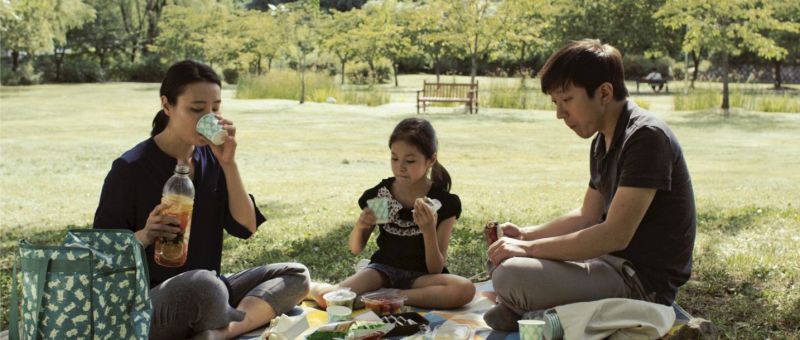
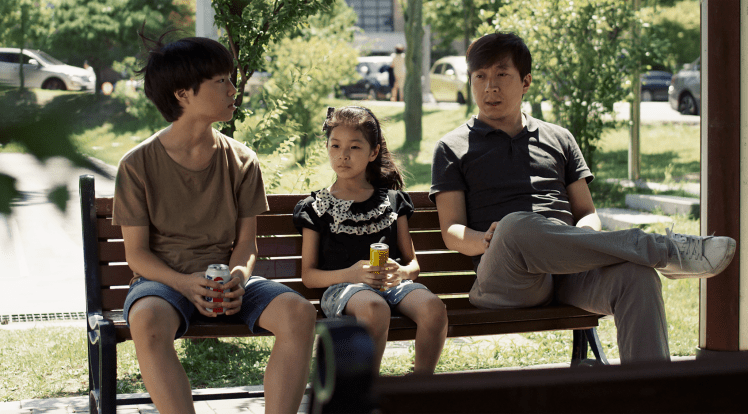
Scattered night still 2Familial collapse has become a major theme in recent Korean indie cinema. Caught in a moment of societal flux, the family itself has come in for question with the young in particular looking for new models and new ways forward. Where Yoon Ga-eun’s The House of Us found an anxious little girl alternately trying to force her warring parents back together and forming a new family of her own as a maternal figure to two neglected sisters, Kim Sol & Lee Jihyoung’s Scattered Night (흩어진 밤, Heuteojin Bam) finds another little girl processing familial failures and pondering her own place in the world unanchored from parental security.

9-year-old Su-min (Moon Seung-a) hasn’t seen her dad in a month, so she’s put out that all he’s done while he’s been home is show some people round their apartment and complain it isn’t clean enough. Unlike her slightly more savvy brother Jin-ho (Choi Junwoo), Su-min hasn’t quite understood that her parents are splitting up and that’s why her dad doesn’t live with them anymore. Perhaps jumping the gun, the parents sit the kids down and try to explain that they’re not getting “divorced” and will still be a “family”, but that mum Yoon-hee (Kim Hyeyoung) and dad Seung-won (Lim Hojun) can’t live together anymore. Quite reasonably asking what’s going to happen to them, the kids get no real reply. Su-min quickly realises that she will definitely be separated from one of her parents, but begins to worry that she may also lose her brother if it ends up that mum and dad are taking one child each.

Already somewhat anxious, Su-min seems to feel disconnected from her mum who is at best undemonstrative, sometimes perhaps resentful of her role as a wife and mother and everything she has been asked to sacrifice in order to fulfil it. Declaring herself bored at home and throwing herself into her career as a teacher at a cram school, Yoon-hee has little time for her daughter but bonds with her son through their shared interest in studying. Too young to join in, Su-min too tries picking up some books to spend “quality time” with her mother only to be dismissed once again and left feeling as if she’s failed some sort of test.

While Su-min agonises over a hypothetical choice of which parent might suit her best, her brother Jin-ho isn’t sure he wants very much to do with the family at all, already thinking of applying to a prestigious grammar school chiefly because it has a dormitory. He skips out on a family picnic to “study” on his own at home, but pushed for an answer always chooses his mother with whom he seems to share a greater affinity. Jin-ho’s clear taking of a side further unsettles his sister who wonders if that means that she will essentially be left with no choice other than to go with her father. Working out all the potential combinations, Su-min asks her brother which he thinks is most likely and gets the response that they will probably both stay with their mother because she will definitely want to stay with them, but remains unconvinced that is really the case. Looking for reassurance, she tells her mum that she’s worried she’ll simply disappear once they sell the apartment, but her mother offers no reply.

Literally displaced in her home environment, Su-min witnesses two children around her own age sitting cheerfully at her family table as if they already owned the place. When she hears her mother tell an estate agent she’s looking for somewhere with two rooms (though preferably one big enough to be divided in two) it fuels her anxiety that she’s being rejected, that her mother only wants one of them and it isn’t her. Meanwhile, her father remains distant, largely refusing to discuss anything but conceding that Su-min ought to have a say in her future and promising to respect her decision.

The sorry truth seems to be that neither parent really wants the kids. Failing to process the end of their marriage, they begin to view the last 15 or so years as a huge mistaken life choice, an embarrassing failure of which the kids are the most obvious proof. They want to start again, but the kids are in the way. Jin-ho overhears his father say that it would have been better if they’d never had him, while his mum regrets that they ever got together in the first place. Despite teaching the children that it’s bad to lie, they make them keep up the pretence of happy families when horrible grandma comes to visit from the US to avoid the disgrace of admitting the marriage has failed.

Neatly mirroring Su-min’s anxiety, Yoon-hee tells grandma that it’s a shame she doesn’t live closer so they could see each other more often, but of course she doesn’t really mean it. Grandma talks up her own faults and professes regret that Yoon-hee couldn’t study abroad because she had to look after her siblings after her father died, but she does so largely as a way of running her daughter down. In any other situation the fact that grandma lives abroad, separated from her daughter by oceans, ought to give Su-min reassurance that familial bonds can overcome geography but the relationship is so obviously toxic as to provide no comfort at all.

Su-min wants agency over her future, to be acknowledged and have some kind of control, but asking her to make such an emotionally difficult decision is an awfully cruel burden to place on a child and one that she is ultimately unwilling to carry. Though the siblings are able to patch up a kind of solidarity, pledging to minimise the “awkwardness” that may arise between them if they are only to see each other once a week, it’s clear that an unscalable wall exists between the generations and the “family” cannot ever be repaired. Su-min and her brother will have to find their own way out of the dark, while their parents remain hopelessly lost looking for the path back to possibility.


Scattered Night was screened as part of the 2019 London Korean Film Festival.

Short clip (English subtitles)

Interview with the directors from Jeonju International Film Festival (English subtitles)

My Dear Liar (受益人, Shen Ao, 2019)

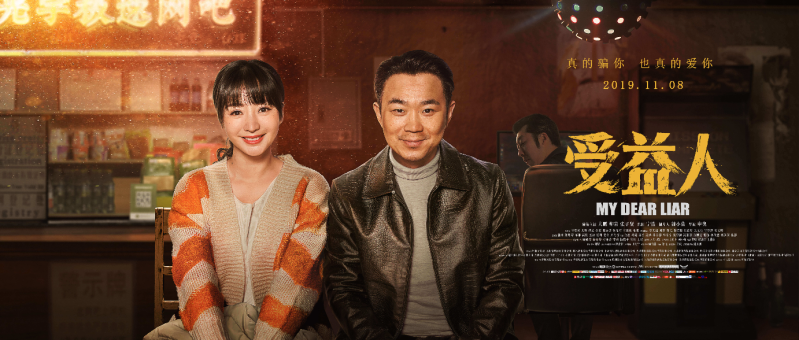
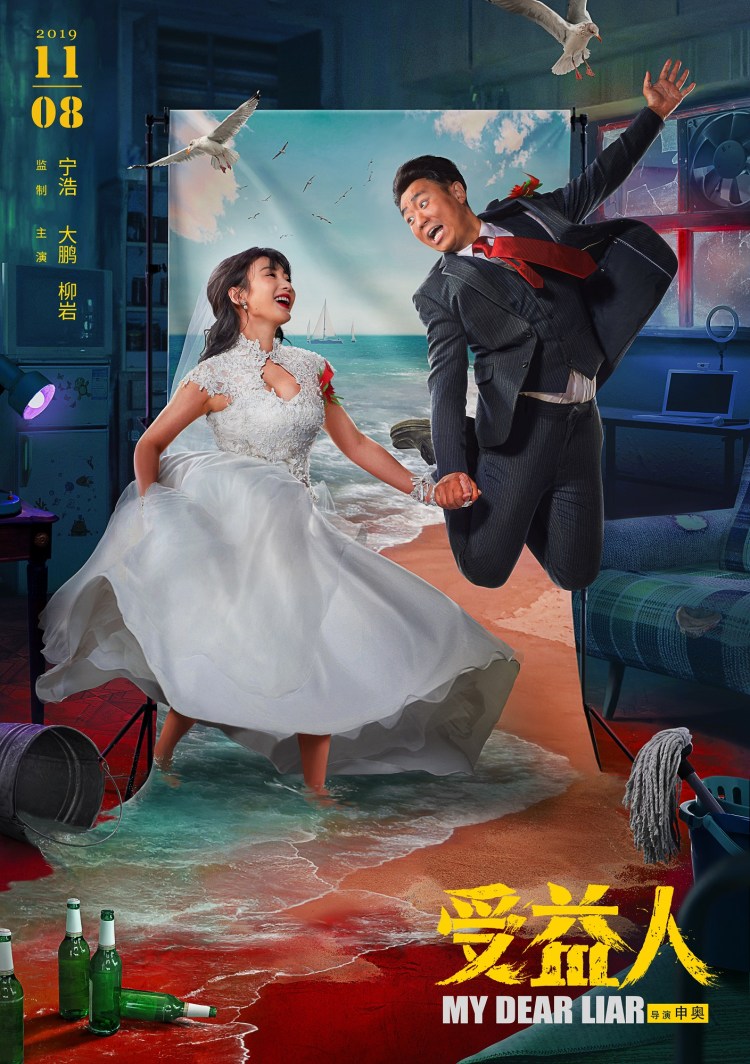
My Dear Liar poster 1The Chinese censors board can sometimes be unpredictable, but the one thing that remains absolutely certain is that crime cannot pay in a contemporary mainland movie. That’s why so many recent films from China end with an incongruous piece of on screen text telling us how long everyone is going to jail for after being convicted of the crimes we just saw them commit, often with a supplementary paragraph expressing their remorse and hope to make it up to the people and the party. All of this merely makes the existence of unconventional, dark rom-com My Dear Liar (受益人, Shòurén) even more improbable than it already seemed seeing as the entire conceit is the murder of an innocent woman for financial gain.

Shen opens with childhood friends Zhong (Zhang Zixian) and Hai (Da Peng) rehearsing the story they will give to the police assuming their plan comes off. Zhong, an accountant, has been part of a large scale embezzlement scam which is currently under investigation. He needs to find a large amount of money quickly to cover up his crimes, getting together with Hai, a widowed single-father to a little boy with severe asthma, to commit small acts of minor extortion. When their random schemes stop paying the bills, Zhong makes a radical suggestion – insurance fraud. He proposes that Hai marry an internet web streaming star named “Foxy Fairy” (Liu Yan) so that he can start an affair and then drive over a bridge with her on the back of his motorcycle to collect the life insurance pay out. This whole plan hinges on the fact that Zhong knows Foxy Fairy can’t swim because she mentioned it on one of her live streams.

As plans go, it could use some work. Neither Zhong nor Hai seem to be particularly worried about the fact that they’re plotting to deceive and then murder a young woman solely for financial gain. Hai, who otherwise seems sweet and naive, is expected to live with and pretend to love a woman he is going to kill for money. One gets the impression he’s been doing Zhong’s bidding since they were kids without really thinking about it, but you’d expect him to at least ask a few more questions about being involved in an elaborate conspiracy to murder aside from clarifying that he won’t be expected to off her himself (except that he might, because Zhong’s plan isn’t as “watertight” as he first thought it to be).

Hai’s motivation for going along with all this, besides wanting to help the sociopathic Zhong, is his son’s health. Perhaps surprisingly, the film makes an implicit criticism of the declining air quality in the modern Chinese city, almost as a sort of metaphor for a moral decline coupled with a critique of increasing social inequality in suggesting that this is a problem which disproportionately affects the poor not least because they cannot afford to buy expensive machinery to improve it. Hai’s wife apparently died of a lung complaint, and his son Yoyo is in constant discomfort because living above the smoky internet cafe where Hai works irritates his asthma. In the park one day, Hai runs into a sales point for a new development, Diamond Bay, built out on the coast where they promise access to clean air. It sounds like a dodgy timeshare pyramid scheme, but it’s the only source of hope in Hai’s wretched life and so he sets his heart on getting enough money together for a luxury condo on the beach where Yoyo could breathe freely.

To get it, he sends his son away and makes an unconvincing attempt to play the part of “Big Ben” – one of China’s new brand of sleazy millionaires and a character apparently played by Zhong online for some time in order to romance the money hungry Foxy Fairy through her live stream channel. Why exactly Zhong picked her isn’t clear, save that he hopes to exploit her greed, justifying the scam with the rationale that she is also a “fraud” extorting money from her deluded fans under false pretences. Lacking the resources and an ill fit for the “Big Ben” mould, Hai struggles to win “Miaomiao’s”, to go by her “real” name, heart, but eventually begins to fall for her after seeing the woman underneath the makeup.

Once married, Miaomiao quickly slides into the conventional roles of wife and mother, even bonding with little Yoyo who makes an unscheduled reappearance mid-scam. Despite her rabidly consumerist online persona, it turns out that what Miaomiao wanted wasn’t riches but the warmth of a family home which is something she’s unexpectedly found living in the cramped apartment above the internet cafe. She remains completely clueless as to Hai’s true motives and desperately tries to make the marriage work, even going on TV to talk about what a good man her husband is.

One begins to wonder if Miaomiao is going to turn the tables on the scheming guys, but her big secret is just that she’s actually “nice” and wants to settle down for a conventional home life she assumed might have already passed her by. Hai hypocritically tells his son who keeps forging his signature on subpar report cards that the most important thing about being a man is “honesty”, but continues lying to Miaomiao right until the very end, getting cold feet only moments before it’s too late. Addressing some fairly subversive themes from the clean air issue to social inequality, institutionalised property fraud, corporate corruption, and organised embezzlement, My Dear Liar nevertheless refuses to engage with the deeply troubling nature of its central conceit even when indulging in the incongruous sweetness of its otherwise “wholesome” romance.


Currently on limited release in UK cinemas courtesy of CMC Pictures.

International trailer (English subtitles)

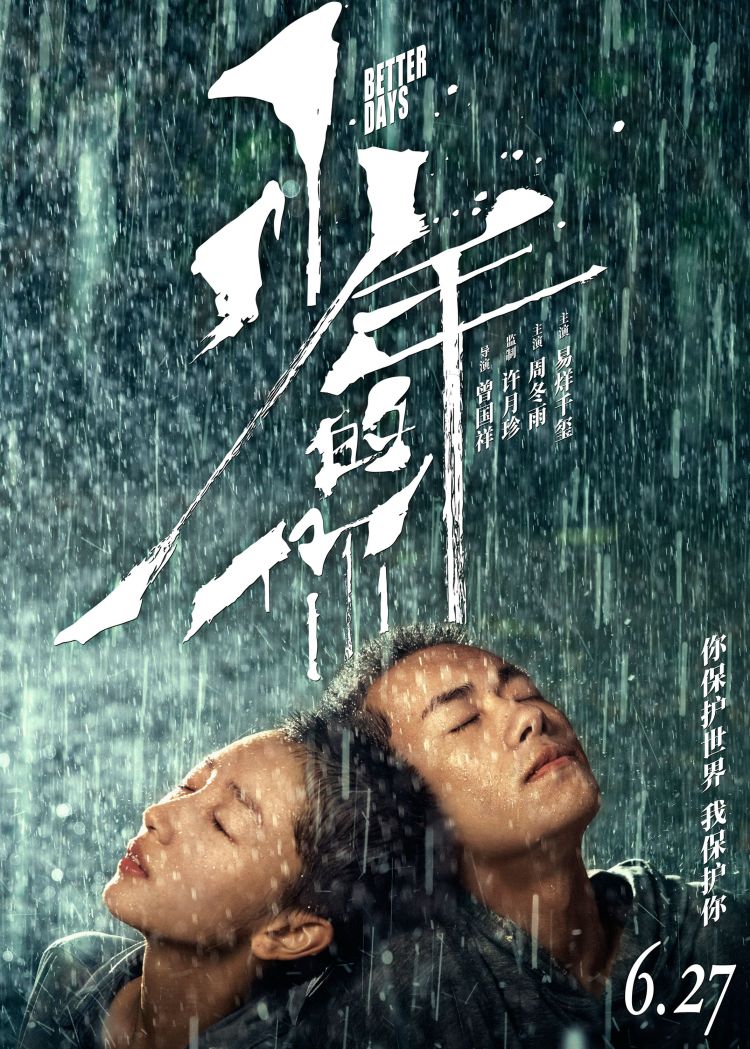
Better Days (少年的你, Derek Tsang, 2019)

Better Days poster high resWith the Chinese censors board seemingly on high alert, the news that yet another highly anticipated film from an internationally acclaimed director has been pulled from its prime festival slot for “technical reasons” comes as no surprise. Derek Tsang’s Better Days (少年的你, Shàonián de Nǐ) proved an early Berlin casualty, missing out on the festival season in its entirety while gaining approval for a regular release in June only to be abruptly pulled three days before the film was set to open nationwide. Finally making its way into multiplexes all over the world (largely thanks to its boyband star), it’s clear that concessions have been made but it’s not difficult to see why the censors might have been nervous given that Tsang, while perhaps coy, is not afraid to paint his two tragic protagonists as bullied by their society, victims of a series of concentric social ills which define the modern China.

Opening with a brief, melancholy framing sequence featuring the older Chen Nian (Zhou Dongyu) teaching English in a small provincial classroom, Tsang flashes back to 2011 when she was a mousey student studying at a top cram school while preparing for China’s gruelling two-day Gaokao university entrance exams. Nian shuts out the rest of the world and buries herself in books, but is jolted out of her trance-like dedication when a classmate, Hu Xiaodie (Zhang Yifan), jumps from the school roof into the courtyard below. Wanting to remain distant yet somehow moved, she attracts the wrong kind of attention with a gesture of kindness, placing her school jacket over Xiaodie’s ruined face to protect her from the cruel gaze of the smartphone cameras trained on her contorted body with a strange kind of hungry triumph.

Questioned by the police, Nian denies that she and Xiaodie were friends, refusing to disclose any information which might explain what led her to take her own life. Nian, however, is perfectly aware of what made her do it, because she too is one of a small group of students terrorised by a trio of rich kids led by the sociopathic Wei Lai (Zhou Ye). Now that Xiaodie is out of the picture, Nian is first in the firing line. Along with a male student apparently also among the bullied, Nian had believed that the bullying was just something she’d have to endure until she’s done with Gaokao and graduates into adulthood, but with the violence and cruelty escalating she decides to try getting help from the authorities.

The authorities, however, are largely absent. Despite concrete evidence that Wei Lai and her friends hounded Xiaodie to her death, the girls are merely given a slap on the wrist, suspended from school still but allowed to take the Gaokao with no further action taken because, after all, they’re still young and have their whole lives ahead of them. The irony is that the tannoys at this expensive cram school blast out the message that life isn’t fair but the Gaokao is, as if it were some great leveller giving equal opportunity to all rather than advantaging those who have the most money to throw at. Wei Lai is a young woman from a wealthy family who feels herself entitled to success and resentful of those who might eclipse her through talent alone while deeply believing that her money gives her the right to do whatever she pleases. She makes Nian’s life a misery in order to assert a power she does not really have, bullied herself at home by a father apparently dissatisfied with her lack of academic results.

Parents, like teachers and policemen, are generally distant figures of authority, bullying their kids into academic success through a combination of shaming and violence. Nian is singled out for bullying partly for being from the “wrong” socioeconomic background, the child of a single mother currently on the run from debt collectors and selling potentially harmful black-market cosmetics to get by. Unlike some of the other parents, Nian’s largely absent mother encourages rather than disciplines her but is too far away to offer much in the way of support or protection and quite clearly views her daughter’s academic success as her own salvation. Nian cannot ask her mother for help, nor can she turn to the school who have already made it clear they’ll bend over backwards to back the rich kids, or to the police who profess they can’t do anything because they always end up looking for someone in loco parentis and finding no one there.

That is perhaps why Nian ends up turning to the unconventional source of protection, bad boy Bei (Jackson Yee). Himself a victim of bullying in being abused and then abandoned by his parents, Bei, a noble street punk, though rough and unpredictable swears to protect her with his fists, willing to take a beating to do it (and eventually far more) if necessary. Bonding in their shared sadness, Bei realises that Nian has one shot but she could still get out and escape the misery of poverty whereas there is no way out for him.   

Nian tells the policemen investigating Xiaodie’s death that there is no room for friendship among those single-mindedly studying for the Gaokao, but slowly opens up to Bei while beginning to address her deep seated feelings of guilt and resentment in her complicity with social oppression. Grateful that it wasn’t her, she let Xiaodie suffer. Meanwhile, another student knowing herself to be a potential victim wilfully joins in with the bullies in the hope they’ll leave her alone only to find herself next in the firing line while Nian is protected by the shadow of Bei. Awakening to her social responsibility now that she is no longer alone, Nian resolves to try and help the other girl by bringing her into her circle of protection but finds herself betrayed by the girl’s failure to overcome her fear in order to reject her complicity.

Nian is repeatedly told that Gaokao is the doorway to adulthood, that all she has to do is endure until it’s over and she’s “free”. Sympathetic police detectives lament that empathy is something you learn only when grownup while simultaneously convinced that only those as young and naive as Nian and Bei would willingly sacrifice themselves for one another. Tsang begins in the realms of moody, achingly cool nihilistic youth drama in which there can be no way out for our doomed lovers, but soon segues into something more palatable to the censors in once again victim blaming the teens, suggesting that their problems are partly of their own making in their resistance to benevolent authority, refusing to trust an earnest, emotionally astute police detective intent on saving them from themselves.

Rather than accept that the tyranny of the Gaokao, increasing social inequality, entrenched authoritarianism, a shame culture, and an epidemic of absentee parenting in the midst of China’s go for broke economic development, are creating a pressure cooker society in which cruelty and violence are the only inevitability, the film ends on an incongruously rosy note which emphasises our collective responsibility to combat bullying (aided by the state whose efforts to tackle it are detailed in an awkward propagandist coda) while uncomfortably implying that it too is something that ends in childhood. Nian resolves to protect the world, as if she could solve all of society’s ills through solidarity alone, but emerges with little more than world weary resignation to its refusal to protect her. Still, in a world of unreliable authority figures and hopeless futures, solidarity’s better than nothing and as likely as anything else to lead to Better Days ahead.


Currently on limited release in UK, Australian, and New Zealand cinemas courtesy of Magnum Films, and in the US from Well Go.

Trailer (English subtitles)

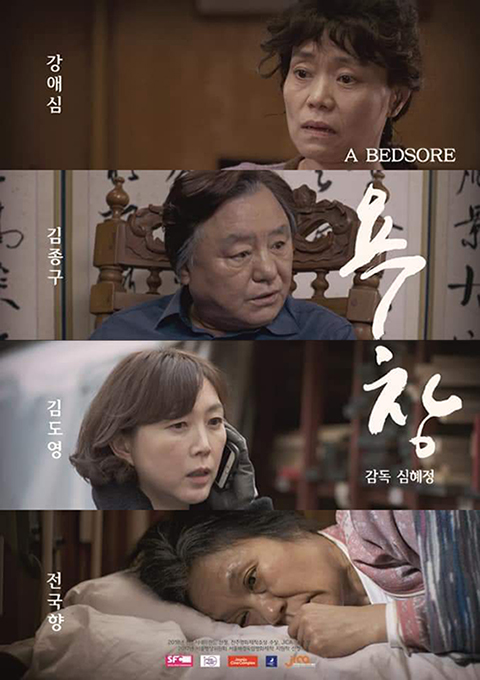
A Bedsore (욕창, Shim Hyejung, 2019)

bedsore posterFamily is supposed to be about mutual responsibility, according to oldest daughter Ji-soo, but in a culture as fiercely patriarchal as Korea’s, there may be differing interpretations of what “responsibility” entails. Shim Hyejung’s A Bedsore (욕창, Yokchang) uses the titular ailment as a metaphor for the festering wounds at the centre of familial relationships, an irritating and potentially dangerous pressure ulcer born of something sitting too long in the same place unaddressed and unresolved. Intensely lonely and unable to connect, the family members struggle with the demands of what it means to be a family and find themselves more often than not guilty and resentful in their filial obligations.

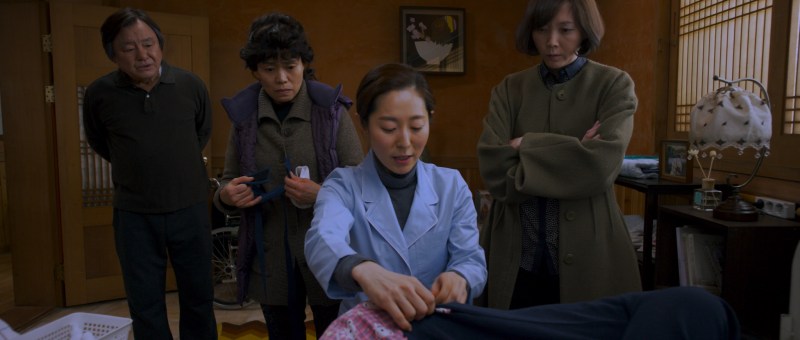
Grandma Gil-soon (Jeon Gukhyang) is bedridden following a cerebral haemorrhage and largely unable to communicate though obviously very much present. The family has hired a live-in carer/housekeeper to look after her as well take care of the domestic tasks because retired patriarch Chang-sik (Kim Jonggu) is a traditional sort which means he’s entirely unable to fend for himself. The trouble starts when Mrs Yu (Kang Aesim) discovers Gil-soon has a nasty bedsore on her back. Rather than deal with it himself, Chang-chik rings his daughter Ji-soo (Kim Doyoung) to come and look in on them, but despite her obvious distress in worrying that perhaps her mother is not receiving proper care and may be in pain, she is also dealing with a moody teenage daughter and a husband who may be having an affair. She wonders why her dad always calls her and not her brother Moon-soo (Kim Jae-rok) or his wife. And then there’s the golden boy middle brother Yong-soo who was the apple of his father’s eye but has made a mess of his life and is currently living as an undocumented migrant in America after doing a midnight flit.

The most obvious problem in the Kang household is that Chang-sik is a product of his times. He does almost nothing to care for his wife and fully expects that a woman will take care of it and him. When there is a problem, he summons Ji-soo and/or his daughter-in-law, never his son, and expects them to take over. He cannot cook or clean and “requires” a woman to fulfil those functions for him so that he can live like a man. This attitude has perhaps contributed to his ongoing confusion regarding Mrs Yu with whom he is on friendlier terms than might be wise for someone who is technically an employee. Somewhere between authoritarian father and jealous suitor, he grows resentful towards her for going out on her days off and irrationally irritated when he realises she may have a boyfriend, eventually leaving Gil-soon on her own to spy on Mrs Yu in a quiet bar where she likes to go dancing.

Though we might initially feel sorry for Chang-sik because he seems so incredibly lonely now that he can no longer communicate with his wife, he quickly loses our sympathy as we realise that it is largely self-pity and that as lonely as he might be, it must be so much worse for Gil-soon who is often left all alone in her room with no stimulation though we can clearly see that she is present and able to engage with the world around her. Mrs Yu does her best to look after her, but is not a trained carer just someone in desperate need of a job. Being an undocumented Korean-Chinese migrant worker also places her in an awkward position with the miserly Chang-sik who, while not a bad man or abusive employer, does perhaps think he has more leverage to exploit her because of her precarious immigration status. We wonder what Gil-soon’s married life must have been like, and if Chang-sik thinks of her as an individual or merely as a woman to be swapped out and replaced now that she can no longer serve him, especially when he announces a bizarre plan to divorce his wife and marry Mrs Yu to make her a legal citizen and ensure she stays in the household.

That particular bombshell obviously does not go down well with the kids, particularly Ji-soo on whom most of the additional burden of care has fallen. She tries to reason with her dad, but he doubles down on the patriarchal norms, telling her it’s all her fault for not pulling her weight as a daughter while she quite reasonably reminds him he had three children but expects her drop everything and sit by her mother’s bedside 24/7. Like her parents and Mrs Yu, Ji-soo is also lonely even within her own family, pushed out by her teenage daughter who keeps bringing her “friend who is a boy” home to play, and her husband who keeps “working late” and takes private phone calls from a young woman. Meanwhile, Moon-soo’s wife does her best to keep the peace between her husband and the father with whom he so obviously does not get on. Though he feels sorry for his mother, Moon-soo seems to be over this whole family thing and ready to sever ties, but that doesn’t stop the couple having a mini panic about the inheritance if their dad goes ahead and marries Mrs Yu after their mum passes away.

The bedsore becomes a metaphor for all the pent up pressures involved with living in a patriarchal social system which expects women to shoulder all domestic burdens. Even Mrs Yu is only working abroad because her husband in China had a stroke and her son can’t find work so she needs to send money home while someone else looks after her grandson. Chang-sik’s first reaction to Ji-soo’s suggestion that perhaps it might be time to think about putting Gil-soon into a home where she can be cared for properly is to ask “what about me?”, not outraged by the suggestion that he is failing in the duty of caring for his wife or seriously concerned for her welfare, but selfish and self-involved. In the end, Chang-sik will discover his house is full of smoke from a fire that’s been smouldering all these long years and dissipating it may take more than merely opening some windows to let it all air out.


A Bedsore was screened as part of the 2019 London Korean Film Festival.

Short interview with director Shim Hyejung from the Jeonju International Film Festival.

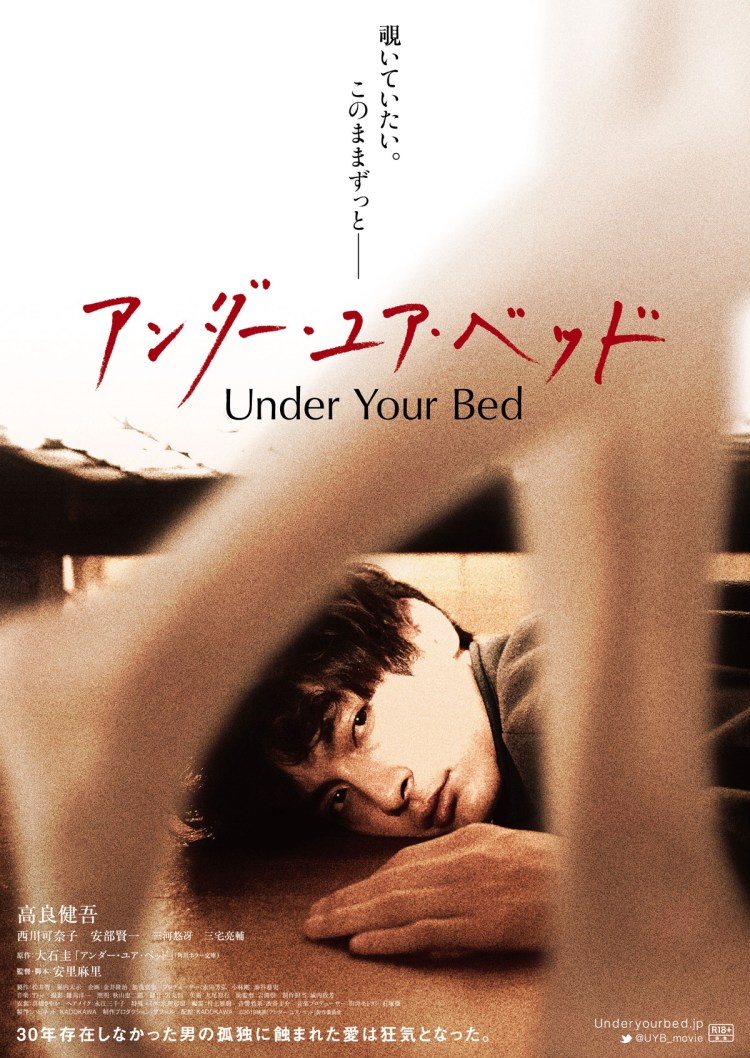
Under Your Bed (アンダー・ユア・ベッド, Mari Asato, 2019)

Under Your Bed poster 1Japanese cinema has something of a preoccupation with invisible men, but there’s rarely been as empathetic an exploration of benign alienation as Mari Asato’s Under Your Bed (アンダー・ユア・ベッド). Asato’s lonely stalker is a creep and a voyeur, but his problem is his innate passivity born of defeatism in which he has, despite his tendency to fantasise, already accepted that he lives in a kind of other world unable to touch his fellow humans from whom he remains painfully separated as if by a sheet of invisible glass.

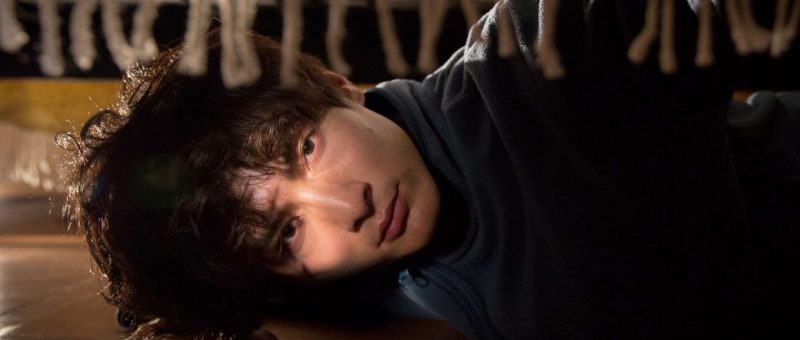
Tropical fish enthusiast Mitsui (Kengo Kora) is one of those people who tend to be forgotten. He doesn’t feature in his high school graduation photo, and nobody, not even his parents, has ever noticed. Harbouring intense feelings of worthlessness linking back to a childhood memory of abandonment after almost dying when his father left him sitting in a hot car, Mitsui has no friends or much of a life to speak of and regards himself as a kind of non-person invisible to others. Longing to be seen, he treasures the precious memory of the only time he has ever heard someone else call his name which occurred 11 years previously when he was a university student.

Mitsui deeply believes that this memory is the only thing that gives his life meaning. Hiring a private eye to track down the woman in question, Chihiro (Kanako Nishikawa), he quits his job and opens a tropical fish store in the town where she lives, apparently now married with a baby. What he discovers, however, is that this Chihiro is quite different from the one of 11 years previously. Hoping to figure out why he begins watching her intensely, swiping a key to the house after she drops into the fish shop by chance and he offers to set her up with a tank full of colourful guppies. What Mitsui eventually discovers is that Chihiro is also living a somewhat invisible life as a victim of domestic violence unable to escape the tyrannical control of her respectable salaryman husband.

Facing a dilemma, Mitsui doesn’t so much want to rescue Chihiro as preserve his peculiar level of access to her even if seeing her subjected to such degrading and inhuman treatment quite obviously disturbs him. Mitsui can’t swoop in and save her because he’d blow his cover and lose the fragile connection to her life he’s convinced himself he has. Never daring to hope he could get her attention through an act of white knight salvation, he nevertheless fantasises about a different version of himself – one that is capable of providing comfort and protection rather than simply sitting and watching while others suffer.

Ironically enough, however, his passive presence seems to make a difference. Shifting to a brief voice over from Chihiro, we discover that the flowers Mitsui has been sending with a card wishing her happiness are the only thing that’s been keeping her going. What some might regard as a cause for concern has given Chihiro strength in proving that there’s someone else out there who cares about her. Yet this change or at least potential restoration also endangers Mitsui’s plan as Chihiro’s growing conviction that she can protect herself, spurred on by the invisible support of the flower sender and others, threatens to dissolve the fragile fantasy world he’s constructed.

Mitsui is forced to wonder if his obsession is equal parts delusion, that perhaps the very events which define his life are part fabrications. His intense conviction that he is a forgettable person is borne out when he realises that Chihiro not only does not recognise him, but apparently does not even remember anything that passed between them 11 years previously. To her, he is probably just a random guy she had coffee with one time, whereas to him she is the woman who changed his life by showing him what true happiness could feel like simply by saying his name. Spotting another invisible person like himself reminds Mitsui what he looks like from the outside and of the potential dangers of those like him when he finds out that the man later went out and stabbed his boss’ wife because she gave everyone except him a holiday souvenir. Yet there is a strange kind of positivity in Matsui’s gentle acceptance of his invisibility. Resenting nothing, it’s not revenge he wants but recognition and though he may eventually figure out that what he really desired was something more, all he needs is the possibility that Chihiro may one day say his name again.

An invisible man, Mitsui longs to “seen” but lives a bug-like existence, hiding in the places no one thinks to look. Proudly telling us that the guppies in his shop are the 34th generation of the guppies his mother once gave him, Mitsui reveals that he flushes the subpar males, with whom he inevitably groups himself, away in order to preserve the beauty of the whole rather than allow it to descend on a path towards mediocrity. Like his beloved fish, Mitsui remains trapped within an invisible tank unable to reach beyond the glass, resigned to looking but not touching. Nevertheless, his presence is eventually felt, unseen but recognised and finally rewarded with a single long-awaited word.


Under Your Bed was screened as part of the 2019 London East Asia Film Festival.

Original trailer (no subtitles)

Astro Gardener (별의 정원, Won Jong-shik, 2019)

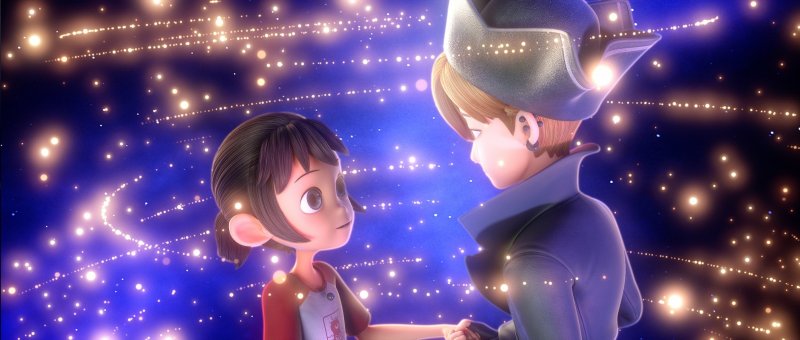
Astro Gardener poster 1Korean cinema is sometimes criticised for its bleakness. Happy endings are indeed something of a rarity, though not entirely absent and, ironically, often rejected for their sentimentality. Cinema for children might be a notable exception with the desire to cushion young viewers from the world’s harshness as a high priority even if it never shies away from the fact that life is sometimes hard and there will be times when you are sad or afraid or lonely. Astro Gardener (별의 정원, byeol-eui jeongwon), a colourful tale of strange creatures making sure the stars still shine, is a film about just those times which makes the very important and always relevant point that there is no light without darkness and that it’s OK to feel sad, or afraid, or alone because your darkness is also a part of you.

12-year-old Suha (Kim Yeon-woo) is excited that her parents are going to leave her alone in the apartment overnight for the first time while they go on a fishing trip. Before he leaves, Suha’s dad gives her a precious necklace which she is not very impressed with because all she wants is a dog. Suha’s dad is broadly in favour of the puppy idea, especially as grandma’s dog is currently pregnant so it would be very easy to adopt one once it’s born. Mum is less convinced, both fearing that she will end up looking after it and worrying that it will be sad when the dog inevitably passes away. While they’re busy discussing all that on the way to the campsite, the car swerves to avoid an oncoming truck and they get into an accident during which Suha’s dad is killed.

A year later, Suha’s mum takes her to stay with grandma during the holidays while she has to get back to work. Suha isn’t very happy about it, but the blow is softened by the fact she’s finally getting a little dog named “Night” who is the last of grandma’s puppies seeing as her own dog passed away shortly after giving birth. Playing on the beach, Suha is drawn to a strange stone and takes it home only for a weird little man with a star on his head to break into her room and steal it. The man, who turns out to be called Om (Jeon Tae-yeol), is an “Astro Gardener” charged with looking after the darkness to ensure that the stars can stay in the sky. It turns out that the planet Pluto (Shin Yong-woo) has gone rogue and left its orbit to become a space pirate hellbent on destroying the darkness to create a universe of light born of the destruction of hundreds of stars.

A universe of light in which there is no more loneliness or pain might sound very attractive, but where there’s no sorrow there can be no joy. Since her father’s death, Suha has been deathly afraid of “the dark”, sleeping with the light on and only venturing out in the middle of the night when her dog chases out after Om, which is how she winds up discovering the Astro Garden. She isn’t terribly invested in the quest to save the darkness but finds herself swept into it when Pluto’s minions show up and kidnap Night’s shadow which means she has to go and get it back or risk loosing him because, as the repeated metaphor points out, you can’t live as light alone. 

Om warns Suha that Pluto is a no-good rebel out to destroy the universe but because she loses a lot of her memory on his ship, Suha is instantly smitten seeing as it just so happens that Pluto looks exactly like the handsome K-pop idol we see on the poster in her bedroom. Realising that the necklace Suha received from her father is the All-Energy capable of controlling all the darkness in the universe (what teenage girl doesn’t think she can do the same?), Pluto sets out to take it but the snag is that the power can only be transmitted to someone you truly love which is the real gift her father was trying to give her.

Learning to remember her father’s love rather than his loss, Suha rediscovers her sense of confidence and is no longer so afraid of “the dark”. Resolving to be kinder to her mother, she can appreciate life’s light and shade but makes sure to keep in touch with her old friends at the Astro Garden to go tend to her darkness to make sure she can still see the stars. A cheerfully animated tale of a little girl figuring out how to live with grief while becoming embroiled in an interstellar battle to save the universe, Astro Gardner is a surprisingly deep meditation on depression and anxiety in which the heroine rediscovers her sense of self while finding the will to fight for others.


Astro Gardener screens on 2nd November as part of the 2019 London Korean Film Festival.

International trailer (English subtitles)

Long Live the King (롱 리브 더 킹: 목포 영웅, Kang Yoon-sung, 2019)

long live the king poster 1Back in the good old days, gangsters used to make a case for themselves that they were standing up for the little guy and protecting those who couldn’t protect themselves. Of course that wasn’t quite the truth, but one can’t deny how closely small town thuggery and political office can resemble one another. Following his breakout hit The Outlaws, Kang Yoon-sung returns with web comic adaptation Long Live the King (롱 리브 더 킹: 목포 영웅, Long Live the King: Mokpo Yeongwoong), another unconventional comedy in which a surprisingly loveable rogue rediscovers his national pride and finds a more positive direction in which to channel his desire to be helpful.

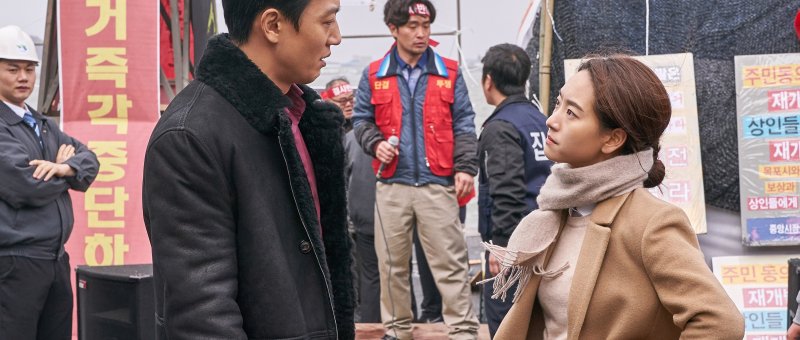
Se-chool (Kim Rae-won) is a notorious thug with a traumatic past currently working with a local gang hired to clear a small protest of stall owners trying to cling on to a traditional market space in working class Mokpo where a developer wants to build a theme park and upscale skyscraper. A feisty young lawyer, So-hyun (Won Jin-a), is working with the protesters on their case and has no problem telling the gangsters where to get off. Impressed, Se-chool is smitten and starts to wonder if he’s on the wrong side but his attempts to get So-hyun’s attention – being strangely nice to the protestors, buying everyone lunch etc, spectacularly backfire. Only when he hears about another man, Hwang-bo (Choi Moo-sung), who used to be a gangster but has now reformed and become a social justice campaigner running a small not-for-profit cafe serving meals to the vulnerable, does he begin to see an opening, vowing to give up the gangster life and commit himself to serving the people of Mokpo.

The irony is that everyone seems to think that Se-chool has a hidden agenda, but his only agenda is the obvious one in that he wants to win So-hyun’s heart even if that means he has to shape up and learn to become a decent person rather than a heartless gangster thug. Known as the king of the nightlife, Se-chool is regarded as a slightly eccentric, good time guy, so his sudden desire to go “legit” is met with bemusement rather than surprise, but old habits are hard to shake and it takes a while for him to realise that trying to help people with his fists is not the best way to go about it. Punching out some punks making trouble in a cafe gets him an earful from the proprietress who explains that she owes a lot of money to the guys’ gang so Se-chool’s chivalry has probably caused her a series of potentially serious problems she assumes he won’t be on hand to help her out with. Nevertheless, he retains his desire to wade in and do his bit, becoming a surprise local hero when he puts himself in danger to ensure the unconscious driver of a crashed bus gets out safely while the other passengers make their escape.

Meanwhile, local politics is starting to heat up. Venal politician Choi Man-su (Choi Gwi-hwa) is up for re-election and running on a platform of making Mokpo great again. It comes as no surprise that Man-su is deep into the corrupt theme park project and outsourcing general thuggery to Se-chool’s arch-enemy which eventually includes taking out potential rivals like Hwang-bo whose approval ratings are soaring while voters are becoming tired of Man-su’s big money tactics and insincere messaging. Soon enough, Se-chool is persuaded to enter the race seeing as his “local hero” persona puts him in good stead to oppose Man-su’s establishment credentials. But, in order to get elected and convince So-hyun he’s really changed, he’ll have to finally face his traumatic gangster past while learning to be open and honest with his feelings.

Kang goes in hard for the business of politics, taking pot-shots not only at corrupt establishment figures in so tight with organised crime that they’re little more than jumped up gangsters, but also at ambitious party hoppers, and misguided mobsters who think they’re onto the big ticket by hooking up with “legitimate” power. Poor Se-chool, meanwhile, actually thought he was doing “proper business” in his persona as a besuited gangster of the new, corporatised school little thinking about the little guy as he unwittingly went about his ultra-capitalist agenda. Heading for broad comedy, Long Live the King misses an opportunity for serious satire but has undeniable heart as the misused hero learns to accept himself in being accepted by others, falling in love not only with a feisty activist lawyer but with community spirit and progressive politics as he vows to fight for a better future for the people of Mokpo while opposing the inherent corruption in the system embodied by men like Man-su who feel themselves entitled to exploit solely by virtue of their own superiority.


Long Live the King was screened as part of the 2019 London East Asia Film Festival.

International trailer (English subtitles)

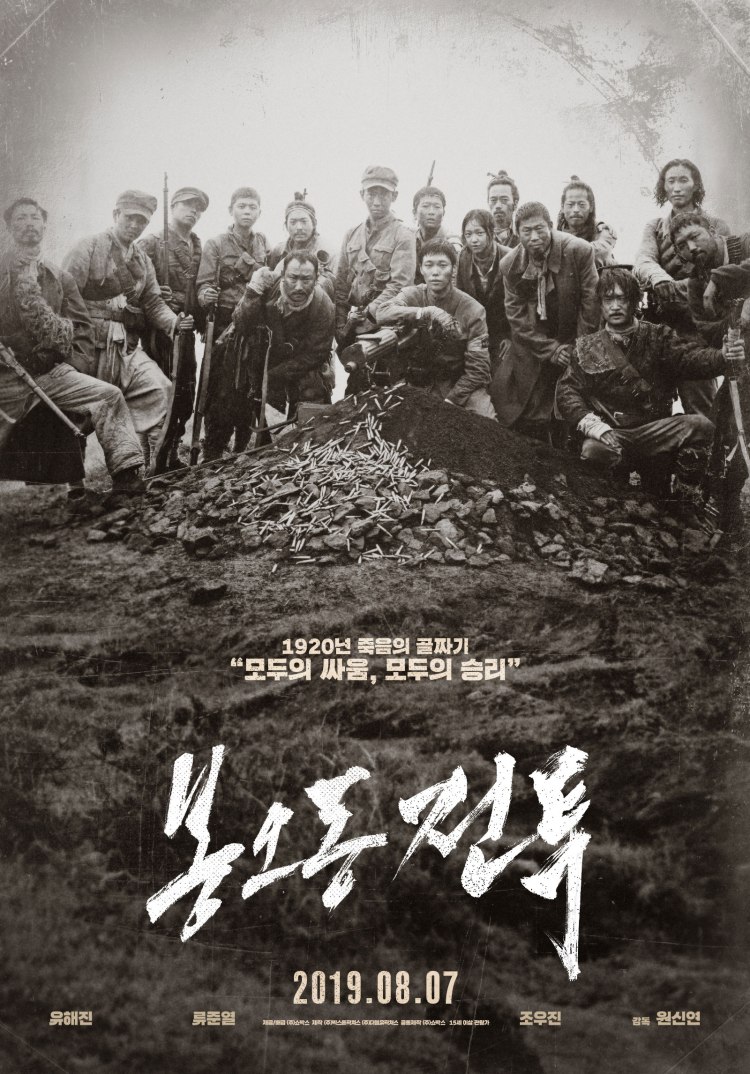
The Battle: Roar to Victory (봉오동 전투, Won Shin-yeon, 2019)

The Battle roar to voctory poster 1Besides seeing the birth of Korean cinema, 1919 was something of a flashpoint in the nation’s 20th century history. Japan had annexed Korea in 1910, thereafter instituting an increasingly brutal colonialist regime. On March 1, 1919 the people rose up in an act of mass protest inspired by the provision for “Self-Determination” included in US president Woodrow Wilson’s 14 Points speech outlining a path towards enduring peace. Though the protest was peaceful, it was quickly suppressed by Japanese troops resulting in thousands of deaths and mass incarcerations.

The Battle: Roar to Victory (봉오동 전투, Bongodong Jeontoo) situates itself a year after the protest as the Independence Movement began to intensify, and is inspired by real life events apparently often absent from the textbooks in which several factions eventually came together to wipe out an “elite’ squad of Japanese troops which had been put together to take down guerrilla Resistance fighters. Our heroes have been charged with collecting money from a fundraiser and conveying it to the Independence Movement in exile in Shanghai but are drawn into a wider battle against Japanese brutality on their way.

The Japanese colonial forces are indeed brutal, if often cowardly. When we first meet crazed commander Yasukawa (Kazuki Kitamura), he’s butchering a tiger in some kind of symbolic act of intense barbarity. To smoke out the Resistance fundraiser, the Japanese military begin razing villages, killing the men and raping the women, even going so far as to shoot small children for sport. When veteran Resistance fighter Hae-cheol (Yoo Hae-jin) raids a command post, he makes a point of taking a hostage who himself seems to be a teenage recruit. Hae-cheol lets the boy live not only out of a sense of compassion, but also because he wants him to take what he’s seen back to Japan, including the aftermath of a Japanese assault on an ordinary Korean village.

Yukio (Kotaro Daigo), as the boy later gives his name, is, unlike his fellow officers, conflicted and confused. Apparently a member of the elite himself, the son of a prominent military figure, Yukio gave up a bright academic future to join the army and find out what it is that Japan does with its advanced weaponry. Asked what he thinks now that he’s seen for himself, he says that he’s ashamed, that his worst fears have been confirmed. According to Yukio, his nation is suffering from an intense inferiority complex which is leading it to commit acts of extreme barbarity in order convince itself it is equal to any other imperial power.

The Japanese officers veer from the crazed, bloodthirsty Yasukawa who views his mission as some kind of hunting expedition, to the merely weak and cowardly. The Independence fighters, however, come from all over Korea speaking many dialects (some less mutually intelligible than others) and with many different motivations but all with the desire to free their country from Japanese oppression. Ace captain Jang-ha (Ryu Jun-yeol) is a born soldier, but those who support him are largely street fighters and “bandits” not always welcomed into the movement by the so-called intellectual “nobles” running the show from a position of social superiority. Then again, as Hae-cheol puts it, no one can be sure how many guerrilla soldiers there are because any farmer is a potential sleeper agent.

In any case, the Resistance fighters pursue their mission selflessly, manipulating the complacent Japanese troops to lure them into a mass ambush while trying to ensure the money still makes its way to Shanghai to preserve the movement. Despite the “Roar to Victory” subtitle, it’s important to note that the Independence Movement was still in a nascent state and would continue opposing Japanese oppression until Korea’s liberation at the end of the war. Covering the legendary battle of Battle of Fengwudong, the film ends with forward motion as the Resistance commander (a late and great cameo from a giant of Korean cinema) points ahead towards the next target, the well known Battle of Cheongsanri, in which the Japanese military reportedly suffered over 1200 casualties at the hands of Independence forces. Overly gory and lacking in subtlety, The Battle: Roar to Victory is unabashedly patriotic but does its best to suggest the costs and compromises of guerrilla warfare as its selfless heroes put aside their differences to fight for a better Korea.


The Battle: Roar to Victory was screened as part of the 2019 London East Asia Film Festival.

Original trailer (English subtitles)