
Baby Assassins 2 Babies (ベイビーわるきゅーれ2ベイビー, Yugo Sakamoto, 2023)

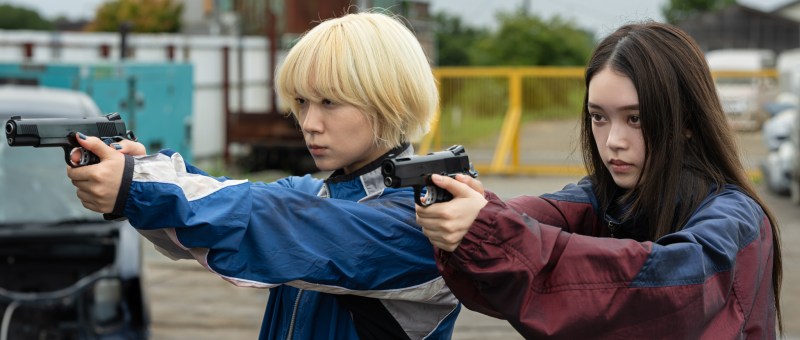
Chisato (Akari Takaishi) and Mahiro (Saori Izawa) continue to struggle with everyday life in Yugo Sakamoto’s sequel to the hugely popular slacker comedy action fest, Baby Assassins, Baby Assassins 2 Babies (ベイビーわるきゅーれ2ベイビー, Baby Valkyrie 2 Baby). A deadpan satire on institutional bureaucracy in the underground hitman society, the film sees the girls targeted by a pair of rivals that in any other film may be the heroes of the story only this time around they’re hapless challengers whose attempt game the system only results in more chaos and misery. 

Beginning to get their act together, the girls are still it seems completely hopeless at managing their money and are suddenly faced not only with a hugely expensive bill for a gym membership they took out five years previously and forgot to cancel, but also reminded that they were upgraded from the “Jolly” insurance scheme to the “Merry” insurance scheme when they graduated high school so their payment information has expired and needs updating. It’s this extreme set of circumstances that lead to them being in a bank at the moment it is robbed by a pair of fugitive thieves. The terms of their assassins contract forbid them from using their skills outside of the job, but they can’t afford to wait any longer and decide to tackle the robbers so they can send their transfer through before the deadline but end up getting suspended for their pains. While suspended they’re forbidden from killing anyone and get no salary so they’re back where they started looking for part-time jobs to help make ends meet. 

Their predicament is mirrored by antagonists Yuri (Joey Iwanaga) and Makoto (Tatsuomi Hamada) who as the film opens end up killing completely the wrong gangsters because of a logistical mixup. The problem is that Yuri and Makoto are subcontractors not yet admitted to the Assassins Guild which means they don’t get access to the best jobs and have no workplace protections. Essentially what they want is to join the union, but they aren’t qualified so their boss, Akagi (Junpei Hashino), comes up with the neat idea of knocking off Chisato and Mahiro to free up their spots in the Guild. 

Sakamoto has great fun satirising Assassin’s Guild bureaucracy as the girls are constantly forced to reference their contract through Mr Susano (Tsubasa Tobinaga) and his little blue book to figure out what is and isn’t allowed in their lives as top hit women. Meanwhile, they’re once again forced to try and live “normally” and find they aren’t very good it at it while having to take quite literally odd jobs as shopping arcade mascots managed by a weird old man (Tetsu Watanabe) obsessed with Masaki Suda and the film We Made a Beautiful Bouquet which becomes something of a running gag. Both Chisato and Mahiro and Yuki and Makoto reflect on the strange cafe hierarchy of being offered a selection of tiered menu sets at escalating prices all the way from basic chicken to barbecued meats as reflective of a wealth-based social system while the boys continue to vacillate over asking out the pretty waitress. 

It’s kill or be killed but the girls know on some level that the guys are just like them and even quite good hitmen for “amateurs” so it’s a shame they have to die for having attacked and nearly killed one of their friends. After sorting out who’s won through a high octane series of shootouts and one on one fights, the four sit down on the ground and share snacks while waiting for the inevitable like they’d just been having a violent picnic while hanging out in a disused warehouse. Even the losers seem to accept their fates, acknowledging that they’ve lost in a fair fight and making no further attempt to resist. 

In any case, adulting is hard even when you’re not a top assassin struggling with when it’s appropriate to put your training to use. As the girls point out, it’s hard to get by on part time work when it would take a hundred days dressed in a humiliating panda outfit to earn what they’d get for one kill while freelancing is strictly forbidden along with strike action and taking one’s grievances to Twitter. Turns out the assassin life is more complicated that you’d think and just as filled with annoying bureaucracy as any salaryman job. Thankfully the friendship between Chisato and Mahiro has only grown stronger as they face off against the twin threats of red tape and adulting in their lives as “contract” killers.


Baby Assassins 2 Babies screens in Frankfurt 10/11th June as part of this year’s Nippon Connection.

Original trailer (English subtitles)

Images: ©2023 “BABY ASSASSINS 2” Film Partners

Egoist (エゴイスト, Daishi Matsunaga, 2022)

If love is unselfish, is it really love at all? Based on a semi-autobiographical novel by Makoto Takayama, Daishi Matsunaga’s deeply moving romantic drama Egoist (エゴイスト) asks if all love is in the end transactional and if to deny its “selfishness” is akin to denying love itself because it would mean denying a basic human need for connection and reciprocity. In the end, perhaps selfish is what we should be with love because we are always running out of time and if we aren’t careful it will slip away from us unnoticed.

An “extreme realist”, fashion editor Kosuke (Ryohei Suzuki) is already full of regrets and many of them linking back to the early death of his mother from illness when he was only 14. It’s clear that his financial wealth helps to fill an emotional void but also that he’s lonely and longs for a sense of family that’s long been absent from his life. He rarely visits the conservative hometown where he was bullied for being different, and seems to have a strained relationship with his widowed father (Akira Emoto) who doesn’t know that Kosuke is gay and continues to ask him about getting married and settling down. Early on in his courtship with Ryuta (Hio Miyazawa), a personal trainer he met through a friend, Kosuke remarks that he’s never met a lover’s mother before hinting at the landmarks of a relationship such as marriage that LGBTQ+ people often miss out on in a conservative culture in which such things cannot always be discussed openly.

Later, Ryuta’s mother Taeko (Sawako Agawa) tells Kosuke that knew from that first meeting that they were more than just friends and was happy that her son had someone he loved who loved him regardless if they were a man or a woman. But just when the relationship had seemed to be blossoming, Ryuta had abruptly tried to break up with Kosuke explaining that he had been involved in sex work since his early teens in order to support his mother who was unable to work due to illness. Now that he’s experienced real romantic love he finds sex work “painful” but has no other means of supporting himself and so gives up love for economic necessity. “I’ll buy you,” Kosuke unironically counters adding a note of literal transactionality to their relationship which is already fraught with disparity in the respective differences in their ages along with Kosuke’s wealth and Ryuta’s poverty. 

Kosuke later describes his gesture as “pure”, something he’d previously called Ryuta while also remarking that he found him too “polite” in bed and would rather he be a little more “selfish”. In a way it’s altruistic, he isn’t really trying to trap Ryuta into a compensated relationship only to help him while simultaneously ensuring that he stays in his life. His wealth fills a void, but it’s by giving pieces of it away that he feels that void decreasing. Kosuke first gives Ryuta gifts for his mother, knowing that it’s easier for him to accept them because doing so is unselfish when the gift is for someone else. Even so as he later acknowledges sometimes the gift is more for himself than the recipient, a means not of manipulation but of healing. Kosuke claims not to know what love is and largely mediates it through money along with additional acts of care, but as Taeko later tells him it doesn’t really matter if he doesn’t know because they felt his love anyway. 

Matsunaga frequently cuts backs to visual motifs such as door numbers, envelopes, and dropped coins to hint at the transactionality of love but eventually reflects that love is an act of exchange in which the desire to be loved is an essential component. Kosuke eventually asks his father how it was for him when his mother was dying and he recalls a conversation in which she said she wanted to leave him because she couldn’t bear to see him suffering for her, a request which could in itself be read as “selfish” even in its “selflessness” with his reply implying that it’s alright to be selfish in love because in way it might be its ultimate expression. Filming with handheld realism, Matsunaga captures the rhythms of contemporary gay life along with the easy giddiness of burgeoning romance and the poignancy of profound loss tempered only by a fleeting feeling of warmth and the jealous memory of a “selfish” love. 


Egoist screens in Frankfurt 9th June as part of this year’s Nippon Connection.

International trailer (English subtitles)

Amiko (こちらあみ子, Yusuke Morii, 2022)

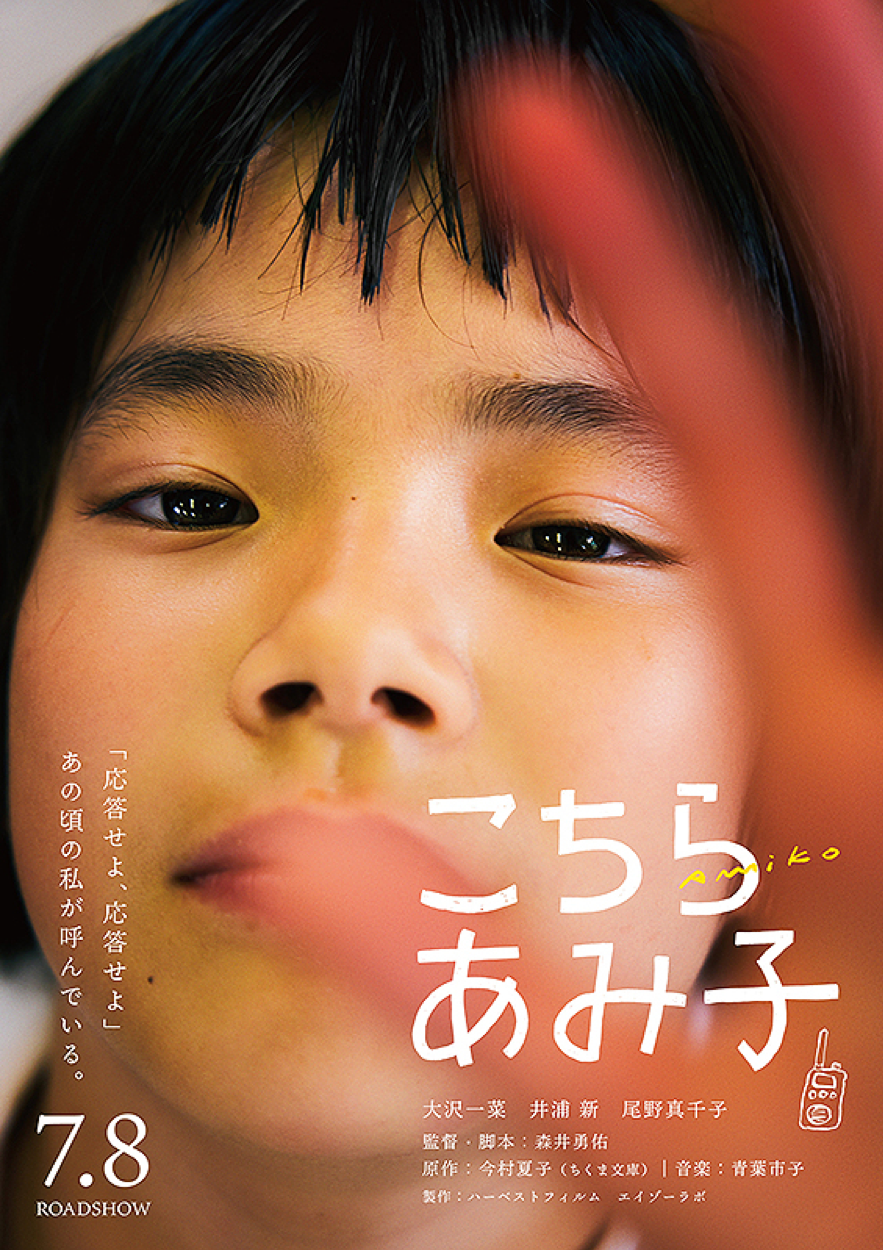
Is there a sadder thing than a solo walkie talkie? The heroine of Yusuke Morii’s quirky dramedy Amiko (こちらあみ子, Kochira Amiko) is given a pair of retro presents for her birthday, a set of toy radios and a disposable camera each intended to help her bond with the baby brother expected to join the family in the immediate future, but the sad fact is that Amiko has no one else to communicate with and largely lives in her own little world like a ghost in her own home. 

Even so, she doesn’t seem to be particularly lonely and is only just beginning to realise that she’s a little different from the other kids. Living in a nice house in tranquil seaside town in Hiroshima, Amiko appears to be a happy little girl with a loving family around her even if her relationship with step-mother Sayuri (Machiko Ono) who teaches calligraphy in a back room may be a little strained. Sayuri disapproves of Amiko’s unusual behaviour and for some reason does not allow her to join the other children at the classes leading Amiko to peer in from a crack in the door until one of the other kids inevitably notices her. 

In an odd way, Amiko’s situation improves when the family encounters a tragedy, losing the baby they’d all been so excited about welcoming. Touched by her attempts to look after her as she recovers at home, Sayuri warms to Amiko and embraces her as a daughter finally inviting her to take part in the calligraphy classes once they resume. But a well-meaning gesture on Amiko’s part that from an adult perspective is insensitive and inappropriate throws Sayuri into a depressive spiral from which she never recovers. The rest of the family describe Amiko’s gesture as a “prank” as if she did it with malicious intent when really it was just her way of dealing with her grief. Of course, everyone else is trying to deal with their grief too and each going about it in their own way so they don’t have time or really the inclination to sit down with Amiko and help process what’s just happened to their family. 

Amiko becomes convinced that there’s a ghost haunting her balcony and it must be that of her younger brother who hasn’t made it to Heaven yet and is trying to come home, though her attempts to ask her father about it see her literally pushed away while he can’t see her confusion as anything other than a hurtful fantasy. There is indeed a ghost haunting her family, but it’s the grief they cannot share with each other or bear to explain. Amiko’s older brother Kota (Kensei Okumura) begins to go off the rails and then leaves the family entirely to join a biker gang instead. Amiko’s father (Arata Iura) doesn’t even bother to look for him, expressing only mild confusion when Amiko points out that Kota doesn’t come home anymore answering only that he’s sure he saw him “the other day”. 

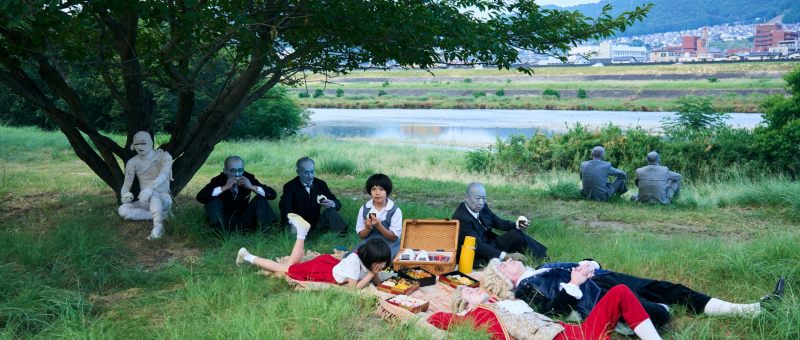
It’s no wonder then that Amiko retreats into a fantasy world, singing a song to herself to ward off ghosts while followed around by several of them including for some reason mummies and people from 18th century Europe. She in turn follows a boy she likes seemingly oblivious to the various ways he attempts to avoid her, while otherwise ignoring a loudmouth kid who is the only other person willing to talk to her despite her classmates’ conviction that she is simply “weird”. Amiko maybe beginning to realise this herself, wondering if her forced courtship may have strayed into the “creepy” and asking directly for advice wanting to know what about her seems to make others uncomfortable or embarrassed. After a period of mild neglect, Amiko even starts walking around school in bare feet because she doesn’t have indoor shoes or clean socks but most seem to just regard it as another expression of her oddness. As the other kid points out, it’s both a symbol of her “freedom” and one of the reasons she gets bullied. Amiko’s story is sad, but Amiko doesn’t know that and simply goes on living in her own little world with its strange logic simply waving to the departing boats of the floating dead with a cheerful “I’m fine” while otherwise abandoned on an unfamiliar shore with only herself to rely on.


Amiko screens in Frankfurt 8th June as part of this year’s Nippon Connection.

Original trailer (no subtitles)

Roleless (宮松と山下, Masahiko Sato, Yutaro Seki, Kentaro Hirase, 2022)

Ever felt like a bit player in your own life? For the hero of Masahiko Sato, Yutaro Seki and Kentaro Hirose’s Roleless (宮松と山下, Miyamatsu to Yamashita), it’s more like he lives ten thousand lives if only for an instant in his life as an extra and may have, in a way, cultivated an image of himself as a blank canvas who no longer exists in an absolute form. In a way you could call it multiverse living, but when confronted with a possible point of origin, a lost selfhood he may have forgotten or wilfully rejected, it presents him with an existential question not so much of who he wants to be but if he wants to be at all. 

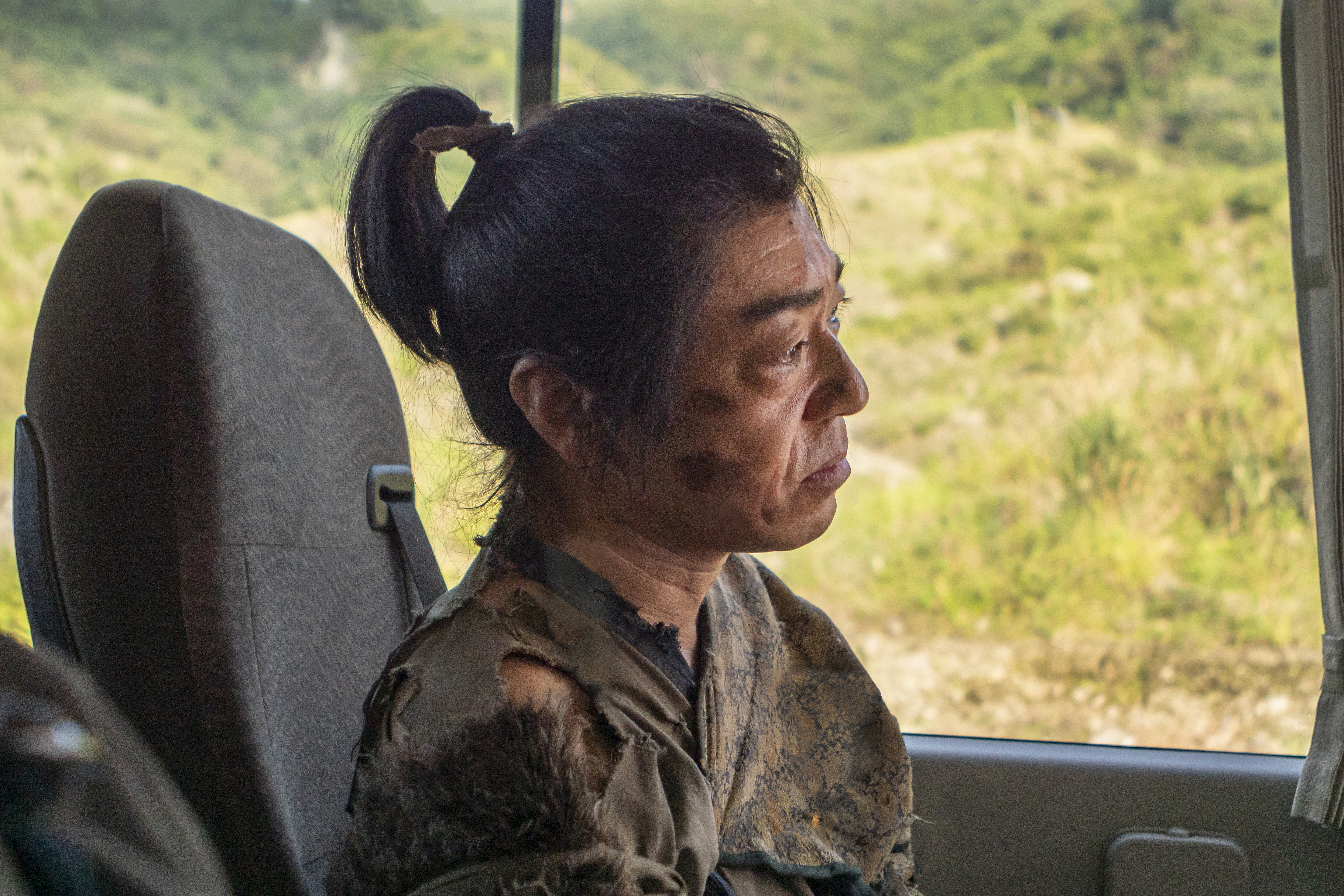
We first encounter him as an unlucky retainer in a jidaigeki who is quickly cut down only to rise again and run around the back to give his name as “Miyamatsu, a samurai” to the prop girl who gives him a different hat so can he go back out there and die a second time. Miyamatsu has an air of perpetual blankness in his often vacant expression as if he were both there and not. The film often wrong foots us and we can never be sure what is “real” and what part of a movie, except that it all obviously part of the movie we ourselves are watching. We see what we think are moments from Miyamatsu’s private life only to realise that the camera was rolling all along when someone shouts “Cut!” and it becomes apparent that Miyamatsu was not its main focus. 

Along the way he gives hints of his loss of selfhood, earnestly replying that he doesn’t know when a fellow extra quizzes him on the watch he’s wearing and how he got it but his discomfort could stem from several places and it’s never quite clear how much of an interior life Miyamatsu creates for his various roles, whether he really does just see them as performers of an action, is playing “himself” as he peers over a police cordon at a crime scene, or is a fully fledged person with an individual history. Later he tells a colleague who admires the way he fills in forms at his part time job working at a cable car that he’s always enjoyed the process of filling in a predetermined frame but also that he likes the floating sensation the cable cars give him. 

All of which might explain why he’s so destabilised when a man (Toshinori Omi) approaches him claiming that they worked together as taxi drivers more than a decade earlier and that his name is Yamashita. He apparently “disappeared” after sustaining a head injury and has been “missing” ever since. The man takes him back to the home of his much younger sister, Ai (Noriko Nakagoshi), who has since married and appears to be incredibly relived to see him even if it seems she might also be hiding something. He wonders if it’s suspicious that there are no photos of him in their family home, but is reminded that with the age difference he hadn’t lived there while she was a child and only came back after their parents died to take care of her because she was still in high school. Her husband, Kenichiro (Kanji Tsuda), seems to be constantly needling him though again, it isn’t always clear whether he actually wants him to remember or suspects that he already does and is choosing to pretend not to. 

Even so, Miyamatsu slides into the life of Yoji Yamashita as easily as any other role finding his way back into the character with unexpected moments of connection such as the muscle memory that grants him a perfect baseball swing, or the strangely familiar taste of cigarettes to a non-smoker. Then again, there’s obviously something sinister going on, a darkness underlying his “personal” history that might have made him want to absent himself from himself or else an oppressive sense of bullying that is reflected in Ai’s hesitant answer when Yamashita remarks on what a good husband Kenichiro seems to be. Miyamatsu claims that he’s ever only played one “real” role, and in a way this is it as he begins to claim something like a backstory even if it’s one he may not ultimately want that nevertheless renders him a little less vacant. Mysterious and unsettling, the film asks some probing questions about the nature of identity, whether it is self-defined or gifted, but also discovers a kind of serenity in Miyamatsu’s free floating life of transient realities.


Roleless screened as part of this year’s Nippon Connection

Clip (no subtitles)

Sakra (天龍八部之喬峰傳, Donnie Yen & Kam Ka-Wai, 2023)

Donnie Yen returns to the (co-)director’s chair in an adaptation of Jin Yong’s classic wuxia Demi-Gods and Semi-Devils, Sakra (天龍八部之喬峰傳, Tiānlóng Bā Bù zhī Qiáo Fēng Zhuàn). 59-year-old Yen also stars as the tragic wuxia hero Qiao Feng who is repeatedly stated to be around 30, though he also appears in a handful of scenes as Qiao’s father which might help to explain the casting choice. Even so, Yen mostly pulls it off while striking an authoritative figure fighting for justice in an unjust world. 

As the opening titles reveal, this was a fairly tragic age in which “those who had feelings were all caught in it”. The Northern Song Dynasty faces invasion by the Khitan-led Liao, while the Yan are also vying to restore their lost power. Discovered as a foundling and raised by a Song couple, Qiao Feng joins the notorious Beggar Gang and becomes a powerful martial artist often defending their territory against Khitan raiders. After rescuing a young man held captive by a monk who describes him as a human sacrifice, Qiao returns to be accused of treachery by the Beggars. His leader, Ma, has been murdered, and Ma’s wife Min (Grace Wong Kwan-hing) claims she saw Qiao do it. Ma had apparently told her that he feared Qiao would kill him because he had come into an incriminating letter which suggests that Qiao’s biological parents were in fact Khitans and he is some kind of treacherous sleeper agent. 

Qiao realises there’s nothing he can really do to counter their suspicion except leave and discover the truth about his origins for himself. Unfortunately, however, everyone he could have asked ends up dead with him framed as the killer. Meanwhile, he wrestles with questions of identity asking himself if he can be both a “good” person and a “Khitan” but later coming to doubt his allegiance to Song after witnessing some soldiers massacre a group a of Khitan peasants out on the road. While investigating he ends up saving the life of mysterious spy Azhu (Chen Yuqi) who like him is looking for her origins, having been told by Yan warlord Murong Fu (Wu Yue) for whom she is working that he would tell her if she stole a scroll from the Shaolin temple. Azhu is the only one continues to believe in him, reassuring Qiao that regardless of his identity he is still a “good person”, and the pair soon fall in love vowing to leave the martial arts world behind to raise cattle in the country once their respective quests are concluded successfully. 

Even so, he later claims not to fight only for his land but for a righteous world against the amoral machinations of the villainous Murong Fu and all those who conspired with him. The Beggar Gang is not entirely innocent either, subject to a struggle for succession that made Liao’s existence inconvenient to some while Qiao is later confronted by the realities of a situation he may have misunderstood. Qiao may learn the secret of his origins, but is also left with a new mission in the necessity of stopping Yan’s despotic bid to reclaim Song, riding straight into battle with only a loyal companion at his side. 

Though struggling under the sheer complexity of Jin Yong’s sprawling novel, Yen and Kam showcase the key incidents such as the opening rescue of Duan Zhengchun’s son, and Liao’s epic battle against the Beggars after wading straight into a meeting knowing he’d likely be killed but looking for a doctor for Azhu. The action scenes are visceral and impressive, making the most of the movie’s high production values with a mixture of CGI and practical effects as Qiao faces off against hundreds of men at once or makes daring wire-assisted leaps from under a dome of enemy shields. There is also a genuine poignancy in the tragic romance between Azhi and Qiao who just want to be free of their legacies and the machinations of the martial arts world to live quiet lives as innocent farmers but are reminded there is no real escape from the political reality. Having covered half of Liao’s arc in Jin Yong’s text, a door is left open for a sequel in which Qiao continues to pursue justice and clear his name while hinting at a battle still to come in world in which “those who have feelings are all caught”.


Sakra is released in the US on DVD & Blu-ray June 13 courtesy of Well Go USA.

Original trailer (English subtitles)

The Cornered Mouse Dreams of Cheese (窮鼠はチーズの夢を見る, Isao Yukisada, 2020)

It’s quite a potent image somehow, a mouse caught in a trap unable to reach out and touch the cheese they’ve risked their life for yet continuing to dream of it as if nothing else really existed. Perhaps love is much the same, at least according to a young woman who warns against falling in love too deeply worrying that in the end you won’t be able to keep it together and so will fall apart. Adapted from a popular Boys Love manga by Setona Mizushiro, Isao Yukisada’s The Cornered Mouse Dreams of Cheese (窮鼠はチーズの夢を見る, Kyuso Wa Chizu No Yume Wo Miru) is in someways in dialogue with his earlier tale of triangulated love between two women Luxurious Bone, if sharing some of that film’s perhaps outdated attitudes towards sexuality. 

The titular mouse is office worker Kyoichi (Tadayoshi Ohkura) who is halfheartedly having an affair with a colleague seemingly just because he can. Unbeknownst to him, his wife has hired a private detective who just happens to be an old friend from university, Wataru (Ryo Narita). Wataru warns him that he’s got pictures of him and his mistress but agrees not to tell his wife, if Kyoichi agrees to accompany him to a hotel for some low level intimacy. The abruptness of the overture seems to hint that the two men had some kind of history in university but this appears not to be the case and Kyoichi continues to struggle with his sexuality partly it seems out of a degree of self-loathing that convinces him he’s not the sort of person anyone should love.

In Luxurious Bone, the problem had been that the two women could not quite accept the validity of their desire for each other and instead ended up having vicarious sex with the same guy. Something similar occurs between Kyoichi and Wataru each in their own way unable to accept the way they feel. Kyoichi repeatedly states that he doesn’t want to cause someone else pain but in fact hurts everyone around him because of his own inability to reckon with his feelings. He continues to womanise, but eventually asks Wataru to move into the grey industrial bachelor pad he gets when his marriage breaks down while keeping him at arm’s length. Wataru is jealous in a direct sense, resenting Kyoichi’s various girlfriends, but also on deeper level lacking faith in his homosexuality or at least ability to accept it fearing he will always in the end choose to be with a woman. 

Both men are imprisoned by an internalised homophobia, Kyoichi most obviously in rejecting his desire for Wataru. “A straight guy can’t handle it” he tells him in an ironic choice of words, earlier having told him that guys like him belonged “in another world”. The film seems to present Kyoichi’s sexuality as a binary choice, men or women, precluding the idea that he might simply be bisexual while inviting the inference that his womanising is an attempt to mask his latent homosexuality and that he is in fact living a lie in betrayal of himself in denying his desire for Wataru. But then Wataru is consumed by insecurity, as if on some level believing he is inherently inferior to a woman and that Kyoichi will always “choose” to be straight while simultaneously certain that he does in fact return his feelings. He tells him that his problem is that he passively accepts love from others but in the end doesn’t trust it and continues to look for it in the next person who shows any interest in him, but it seems Wataru doesn’t have much faith in love either pulling away just as Kyoichi draws closer and unable to accept the validity of his love for him. 

The film maintains some of the more frustrating aspects of BL literature in that it never really considers why Kyoichi rejects his same sex desire nor does it address what the potential complications of his life maybe if he were fully to accept his sexuality and attempt to live openly with Wataru. On the other hand, it perhaps lessons the impact of the darker elements of the interplay between the two men in which Wataru effectively stalks Kyoichi and then blackmails and bullies him into sex which the film justifies on the basis that Kyoichi must on some level want to be liberated from his repressed desire while Kyoichi in turn manipulates and tortures Wataru through his womanising and reluctance to enter a full sexual relationship even while living together. The film’s ambiguous closing scene in which Kyoichi sits on Wataru’s stool and places his yellow ashtray, looking oddly like a wedge of cheese, on his grey coffee table the only splash of colour in his exquisitely decorated yet desolate grey room may also uncomfortably hint that their love is always impossible because it is a love between two men rather than accepting that the only barriers to it lie in internalised homophobia and emotional vulnerability. Even so it is a fairly touching love story of a man learning to accept his sexuality even if in the end it leads to a re-imprisonment rather than a liberation. 


Original trailer (English subtitles)

Delicious Romance (爱很美味, Leste Chen & Hsu Chao-Jen, 2023)

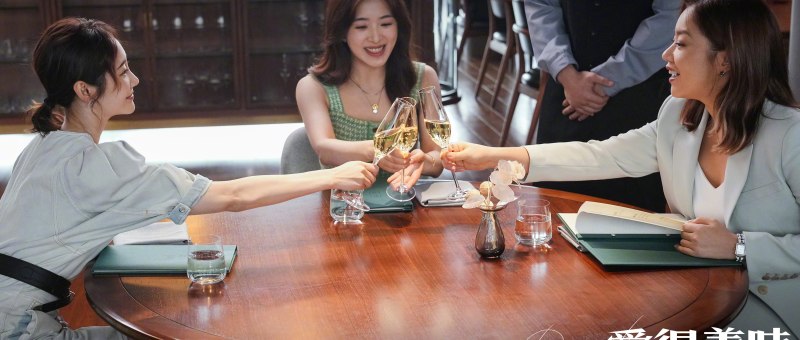
Three “best friends forever” find themselves struggling with happy ever after in the big screen sequel to the hit TV show Delicious Romance (爱很美味, ài hěn měiwèi). Exploring the lives of contemporary women, the often hilarious and infinitely relatable film is both a female friendship drama and a quiet advocation for the right to find one’s own balance in life even amid the series of social expectations each of the women quietly contends with that eventually threaten their friendship.

Meng (Wang Ju), Xin (Baby Zhang Hanyun), and Jing (Li Chun) have been friends since school where they vowed to always remain so. 20 years later, they have each attained a kind of success in both career and romance but are now beginning to flounder as the warm glow of temporary fulfilment starts to wear off. TV producer Meng is happily living with fitness enthusiast Lu Bin (Zhang Fan) but the difference in their social status continues to disrupt the relationship while she encounters workplace strife. Xin works in PR for a wedding company and is expecting a baby with boyfriend Zhang Ting (Ren Bin) but is having second thoughts about marrying him in part because of the failure of her first marriage but also because he’s become worryingly overprotective. Jing, meanwhile, quit her job in IT to open a restaurant but is experiencing difficulty keeping it afloat amid the coronavirus pandemic while she abruptly breaks up with her film exec boyfriend Shanmu (Zhao Chengao) after discovering that he still hasn’t deleted the dating apps on his phone. 

Many of the problems they face are the same given that they all live in a patriarchal society, but each of them faces them slightly differently. Xin, for example, explains that he’s joined a company which has a majority female staff and is run by a progressive female boss who assures her her pregnancy won’t be a problem as they run a flexible workplace geared towards supporting women in society. Yet she soon realises that her boss is run ragged and her image of “having it all” is largely a PR front as Xin discovers when she’s pulled off a campaign to do her boss’ son’s art homework. Feeling professionally sidelined especially as the controlling Ting doesn’t let her attend after work events, Xin starts to wonder if she’s made the right decision doubting that it’s really possible to have fully balanced and fulfilling personal and professional lives. 

Meng finds something similar when her boss gives her a warning and insists she land the TV rights for a popular sci-fi novel by a good-looking author or fire one of her team. Working for a station that specialises in TV drama aimed at a stereotypical female audience, she too looks down on her work but immediately faces sexism from author LuoKK (Patrick Nattawat Finkler) who dismisses her suggesting that a woman won’t be able to do his sci-fi novel justice. In a minor gag, neither he nor any of his obnoxious buddies understand the concept of entropy which is central to the novel though both Meng and LuoKK’s  female agent easily explain it. Having spent a long time abroad, LuoKK appears prefer speaking English and originally claims not to have a WeChat which would make his life near impossible in contemporary China. To land the contract, Meng has to pretend to be into mobile gaming getting her boyfriend Lu Bin to play on her behalf while squaring off against an unpleasant ex who has also befriended LuoKK. 

Jing also takes on alternate personalities while trying to trap Shanmu into exposing himself as a cheat. With her restaurant shut down for a fire system repair, she’s offered the opportunity to become an influencer trashing highly rated restaurants for clicks but is quickly disillusioned with the duplicity of online video culture. Like Xin she struggles with her decision to follow her dreams as she faces both personal loss and professional setbacks while battling parental expectation in her family’s continued disapproval of her desire for independence. 

The women are brought together by Meng’s quest to triumph at the office party with a dance routine just like they did at school, only instead of an inappropriate song about “meeting people for drinks and gossip”, she plans to Fosse it up with All That Jazz. When their respective troubles put their relationship under strain, the trio reevaluate their friendship and realise its greatest quality is the unconditional support they give each other as each of them comes to an accommodation with their various difficulties through coming to understand themselves better. Authenticity really is the key as rammed home both by the skewering of the gimmicky restaurant the girls visit in the opening scene and Meng’s realisation that they should perform their high school dance after all rather than making a bid for an affected sophistication. Charmingly heartfelt and amusingly quirky, Chen and Hsu’s zeitgeisty comedy captures the absurdity of life as a woman in the contemporary society while allowing each of the women to take charge of their own lives and destinies through the power of self-knowledge and female solidarity.


Delicious Romance screened in UK cinemas courtesy of CMC

International trailer (English subtitles)

#Alive (#살아있다, Cho Il-hyung, 2020)

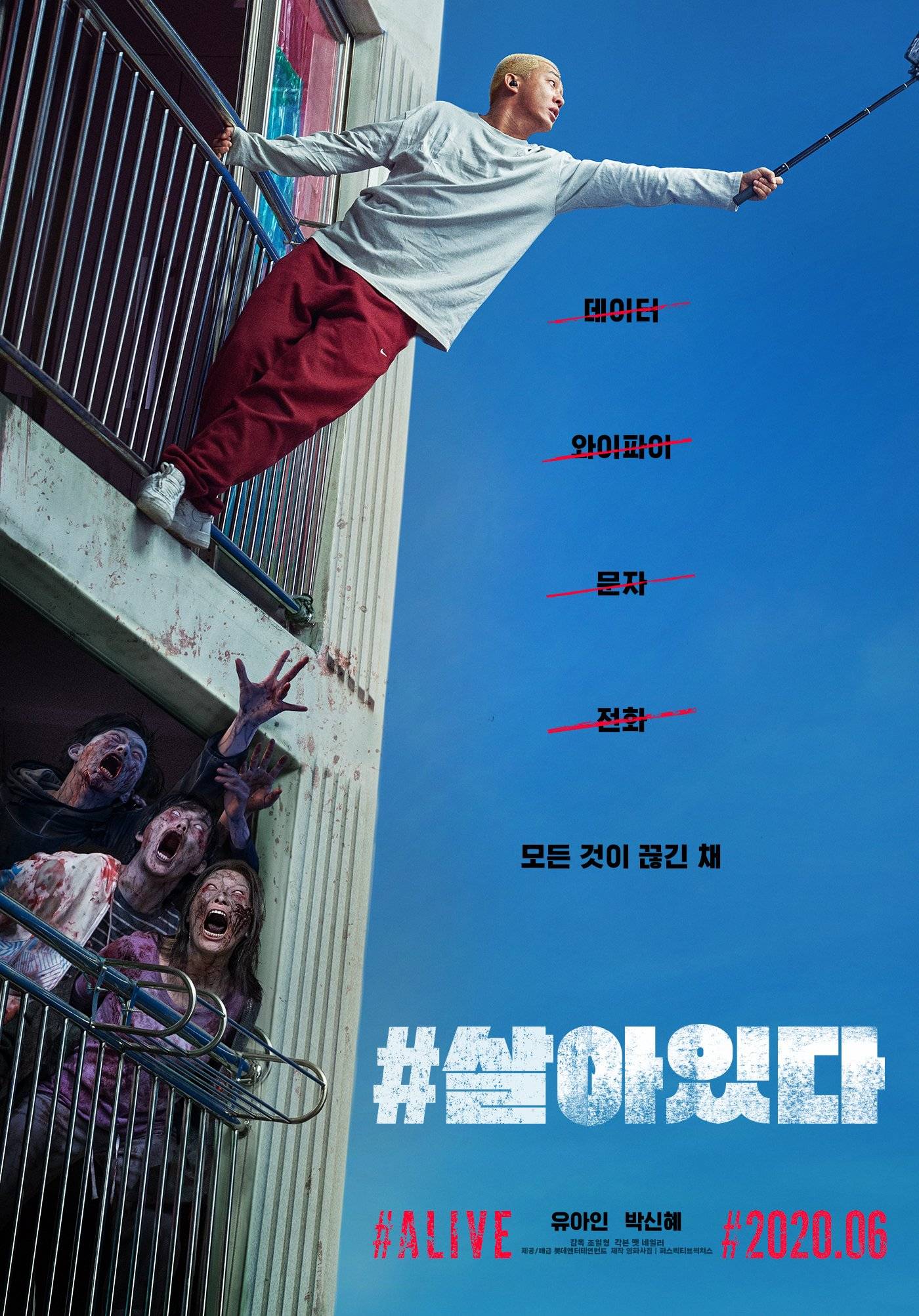
Is solidarity really the answer to alienation? The latest in a short line of zombie-related crisis movies, Cho Il-hyung’s oddly prescient #Alive (#살아있다, #Saraitda) presses directly into what it means to live in a time of isolation as its already introverted hero discovers the existential dread of true aloneness, orphaned by his society and quite literally surrounded by cannibalistic threat only to rediscover the desire for life in the company of others vowing to survive not out of obligation but individual will. 

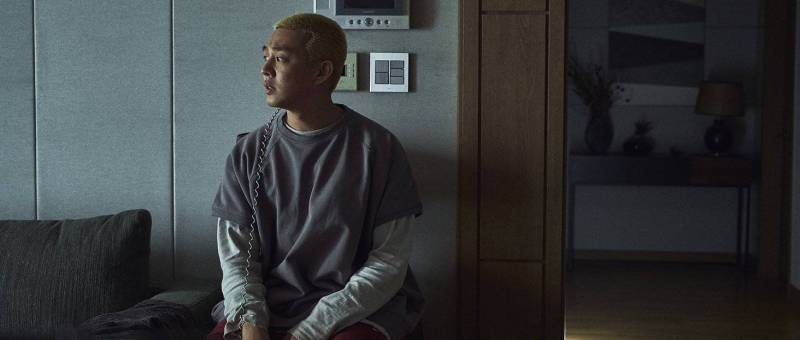
A young man in his 20s, Jun-u (Yoo Ah-in) lives at home with his parents and seems to be a virtual shut-in not quite supporting himself as a pro-gamer/vlogger. He ought to be in his element when he turns on his television one day to discover that a violent riot has apparently erupted all over the city, apparently spreading like a virus which causes aggressive behaviour and cannibalistic frenzy. Unfortunately, Jun-u’s parents left early that morning and didn’t have time to prepare food, leaving him money to go out for groceries but obviously it’s too late for that now and it looks like they won’t be coming home. Jun-u is entirely alone, and all the more so when his usual lines of communication are cut. 

Like the thematically similar EXIT, with which #Alive shares its faith in mountaineering, #Alive concerns itself less with the zombie threat than with youthful alienation and a sense of hopeless despair. Jun-u ought to be in his element, but finds himself ill-equipped for surviving the apocalypse given that he lacks basic adult life skills and those he does possess are now ironically unhelpful. Resourceful as he is, he remembers a smartphone app that would help him communicate via FM radio and all he’d need would be a standard earphone jack only all his earphones are wireless. Making the most of his unstable connection he uploads a single photo of himself holding his address written on the side of a cardboard box with the hashtag #I_MUST_SURVIVE to his Instagram in the hope that someone will see him but becomes increasingly despondent as his food and resources dwindle and he receives a disturbing voicemail which suggests his family may not have escaped the disaster. 

Hitting rock bottom he considers taking his own life but is saved by a literal light in the darkness, a laser shone from an opposing apartment signalling another presence he had previously missed. Believing he was alone in the world, Jun-u lost the will to live and faced with the prospect of waiting to starve to death or venturing out among the zombie hoards chose the only agency available to him in deciding the time and manner of his death. Realising he is not alone restores his desire for life, yet Yu-bin (Park Shin-hye), though much more well prepared, is also dealing with her own trauma in the face of crisis in the memory of a climbing fall that leaves her additionally anxious and fearful of physical risk. Where Jun-u flounders, lamenting as so many of us has in recent years, that no one seems to know what’s going on, the news continually flashing the same info screen while telling viewers only to stay home, Yu-bin has constructed a mini fort complete with a series of booby traps perhaps content in her independence having resolved to live and glad to have discovered she is not entirely alone. 

In contrast to disaster movie tropes, the pair instantly bond in their shared bounce back from despair, developing unconventional means of communication while Yu-bin willingly shares her food stash which in turn gives Jun-u the courage to venture outside for supplies. Eventually reuniting they do their best to withstand the zombie hoards, standing in as they are for the various anxieties which otherwise surround and oppress them, only to find themselves betrayed, worried that perhaps they have after all been abandoned and that no one is there looking out for them. Their salvation lies in their connection, the derided social media proving a lifeline that both affirms their existence and restores a sense of community that returns their safety, airlifting them from the locus of despair finally #Alive and returned to the world secure in the knowledge that they are not alone.


Netflix trailer (English subtitles)

Hachiko (忠犬八公, Xu Ang, 2023)

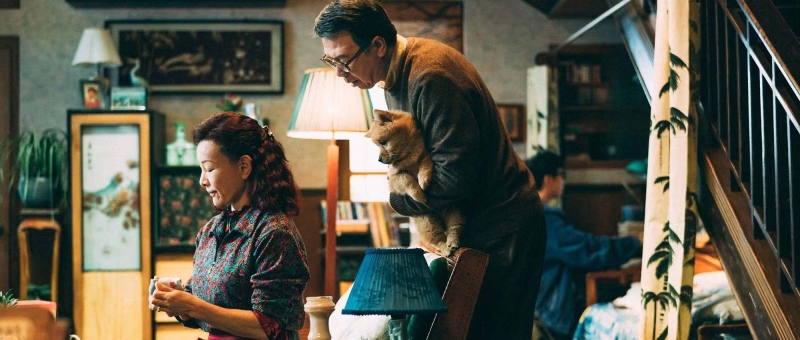
The heartrending tale of a faithful dog who continued to wait for his late owner at a cable car station becomes a poignant symbol for a left behind China in Xu’s Ang’s reimagining of the 1987 Japanese film scripted by Kaneto Shindo, Hachiko (忠犬八公, zhōng quǎn bā gōng). Xu keeps the original title which translates as “faithful dog Hachiko” (Hachiko comprising of the characters for “eight” and “public” which when used in names conveys a note of nobility), but changes the puppy’s name to “Batong” which means “eight dots” and is taken from a mahjong title he naughtily runs off with after being taken in by kindhearted professor Chen Jingxiu (played by film director Feng Xiaogang).

The film opens, however, in the present day with Jingxiu’s wife (Joan Chen) and son (Bai Jugang) returning to Chongqing after many years living in Beijing and remarking on how much the city has changed. These days the cable car system across the Yangtze is a nostalgic tourist attraction with crossing the river increasingly easy thanks to a widescale bridge project. Jingxiu was a professor of engineering working on infrastructure projects, but despite the allure of progress the opening scenes suggest a quiet note of melancholy that runs underneath with constant references to the Three Gorges Dam project which led to mass displacement throughout the region as traditional villages were sunk beneath the reservoir. 

It’s in one of these villages that Jingxiu finds Batong, an abandoned puppy left behind when the village was evacuated. He brings him home with him despite knowing that his wife has an aversion to dogs owing to having been bitten as a child, and attempts to hide him from the rest of the family later suggesting that he’s just waiting to find a suitable owner to rehome him but clearly having no intention of doing so. The callousness with which some people treat animals is fully brought home when Jingxiu’s wife gives Batong away to a man who clearly intends to sell him for dog meat with Jingxiu managing to rescue him in the nick of time. 

In some ways, the professor and dog bond precisely because they are outsiders neither of whom is actually from Chonqing. Jingxiu’s family members often tease him for still not understanding the local dialect despite having lived there for decades while he often seems as if he feels out of place in his own home. When he’s asked to give up the dog, Jingxiu refuses insisting that some of their habits such as his wife’s obsession with mahjong, his son’s newfangled internet career, and his daughter’s grungy boyfriend, annoy him but he respects their right to be happy and would never try to stop them from doing something they love so he’s putting his foot down and Batong stays. This sense of solidarity binds them tightly to each other which might be why Batong often escapes in the morning to chase Jingxiu to the cable car, later returning in the afternoon to welcome him home. 

There is something undeniably poignant in Batong’s waiting at the station for someone who’ll never return in part because the cable car itself has become somewhat obsolete despite having been completed only in the mid-1980s. Jingxiu dies of a heart attack on a boat on the Yangtze circling the site of the dam, disappearing amid its landscape as so many others also did. He left on the train but did not return by it, and so Batong is unable to understand his absence or grasp the concept of death. Displaced himself, the lost dog becomes a melancholy stray trapped in another China and longing for the return to something that no longer exists. 

Jingxiu’s house is soon pulled down too, exiling his wife to the modern metropolis of Beijing now a displaced person herself as these traditional spaces are gradually erased in the name of progress. Batong makes his home in the ruins, continuing to wait like a lonely ghost in the rapidly changing city. Undeniably moving in its unabashed sentimentality in which Batong is finally reunited with Jingxiu as they board the cable car together, the film is also a poignant tribute to man’s best friend and a plea to end animal cruelty, ending with a heartfelt message encouraging the adoption of stray dogs many of whom like Batong are simply looking for a place to belong. 


Hachiko screened in UK cinemas courtesy of CMC.

International trailer (English subtitles)

Goodbye, Bad Magazines (グッドバイ、バッドマガジンズ, Shoichi Yokoyama, 2022)

With the 2020 Olympics on the horizon, Japan began looking for ways to tidy up its image expecting an influx of foreign visitors which for obvious reasons never actually materialised. As part of this campaign, leading chains of convenience stores announced that they would stop selling pornographic magazines in order to create a more wholesome environment for children and families along with tourists who might be surprised to see such material openly displayed in an ordinary shop. Then again, given the ease of access to pornography online sales had fast been falling and the Olympics was perhaps merely a convenient excuse and effective PR opportunity to cut a product line that was no longer selling. 

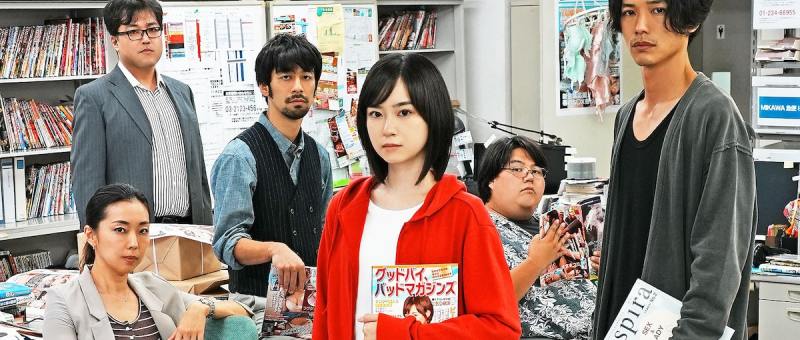
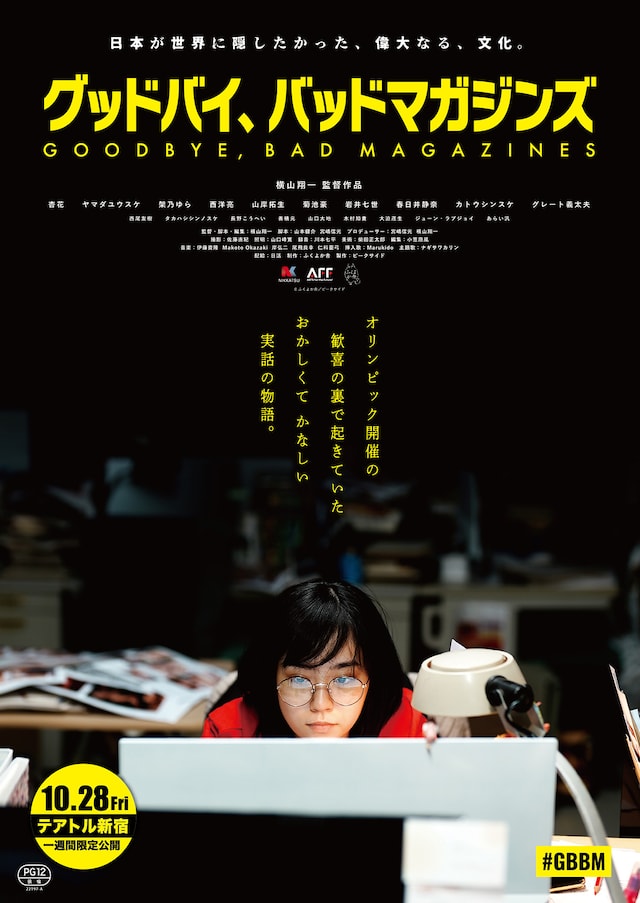
Based on actual events, Shoichi Yokoyama’s Goodbye, Bad Magazines (グッドバイ、バッドマガジンズ) explores the print industry crisis from the inside perspective of the adult magazine division at a major publisher which has just announced the closure of a long running and well respected cultural magazine, Garu. Firstly told they don’t hire right out of college, recent graduate Shiori (Kyoka Shibata) who had dreamed of working in cultural criticism is offered a job working on adult erotica and ends up taking it partly in defiance and encouraged by female editor Sawaki (Seina Kasugai) who tells that if she can make a porn mag she can make anything and be on her way to working on something more suited to her interests with a little experience under her belt. 

Her first job, however, consists entirely of shredding voided pages filled with pictures of nude women which is slightly better than the veteran middle-aged man who joined with her after being transferred from Garu who is responsible for adding mosaics to the porn DVDs they give away with the magazines to ensure they conform to Japan’s strict obscenity laws. Later a mistake is made and mosaics are omitted placing the publishing company bosses at risk of arrest and the magazine closure. Aside from being one of two women in an office full of sleazy men and sex toys, Shiori’s main problem is that she struggles to get a handle on the nature of the erotic at least of the kind that has been commodified before eventually falling into a kind of automatic rhythm. “It’s easy when it does’t mean anything” she explains to sex columnist and former porn star Haru (Yura Kano) who is much franker in her expression but perhaps no more certain than Shiori when it comes to the question asked in her column, why people have sex. 

Shiori asks her sympathetic colleague Mukai (Yusuke Yamada) for advice and he tells her that what’s erotic to him is relationships, but it seems his work has placed a strain on his marriage while his wife wants a baby and he has trouble separating the simple act of meaningless sex with that which has an explicit purpose such as an expression love or conceiving a child. According to Shiori’s editor Isezaki (Shinsuke Kato), the future of erotica will come from women with their boss finally agreeing to an old idea of Sawaki’s to create an adult magazine aimed at a female audience in the hope of opening a new market while handing a progressive opportunity to Sawaki and Shiori to explore female desire, but at the same time magazines are folding one after the other with major retailers canceling their orders and leaving them to ring elderly customers who’ve been subscribing for 30 years but don’t have the internet to let them know the paper edition is going out of circulation. 

The editorial team have an ambivalent attitude to their work, at once proud of what they’ve achieved and viewing it as meaningless and a little embarrassing. Not much more than a few months after working there, Shiori has become a seasoned pro training a new recruit who’s just as nervous and confused as she was but offering little more guidance was than she was given while becoming ever more jaded. When handed evidence that her boss has been embezzling money, she just ignores it though perhaps realising that when he’s found out it means the end for all of them too. Like everyone else, he’d wanted to start his own publishing company but the editor who left to do just that ended up taking his own life when the business failed. Yet, on visiting a small independent family-run convince store near the sea, Shiori hears of an old man who visits specifically to buy the magazines she once published because he can’t get them anywhere else while they have steady trade from fishermen who need paper copies to takes out to sea. The message seems to be there’s a desire and a demand for print media yet, even if it’s not quite enough to satisfy the bottom line. A sympathetic and sometimes humorous take on grim tale of industrial decline, Goodbye, Bad Magazines sees its steely heroine travel from naive idealist to jaded cynic but simultaneously grants her the full freedom of her artistic expression along with solidarity with her similarly burdened colleagues.  


Goodbye, Bad Magazines streamed as part of the 2022 Yubari International Fantastic Film Festival.

Teaser trailer (English subtitles)