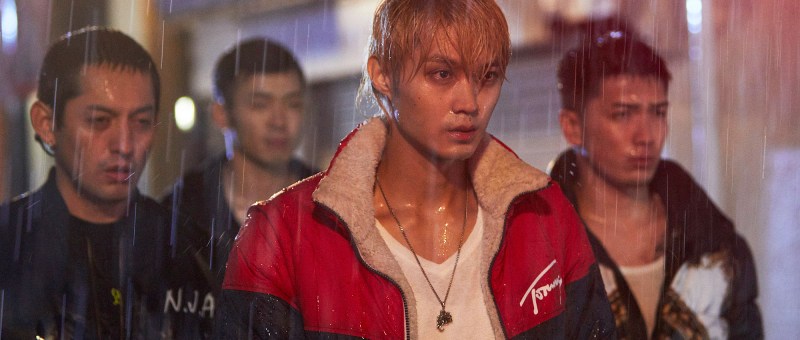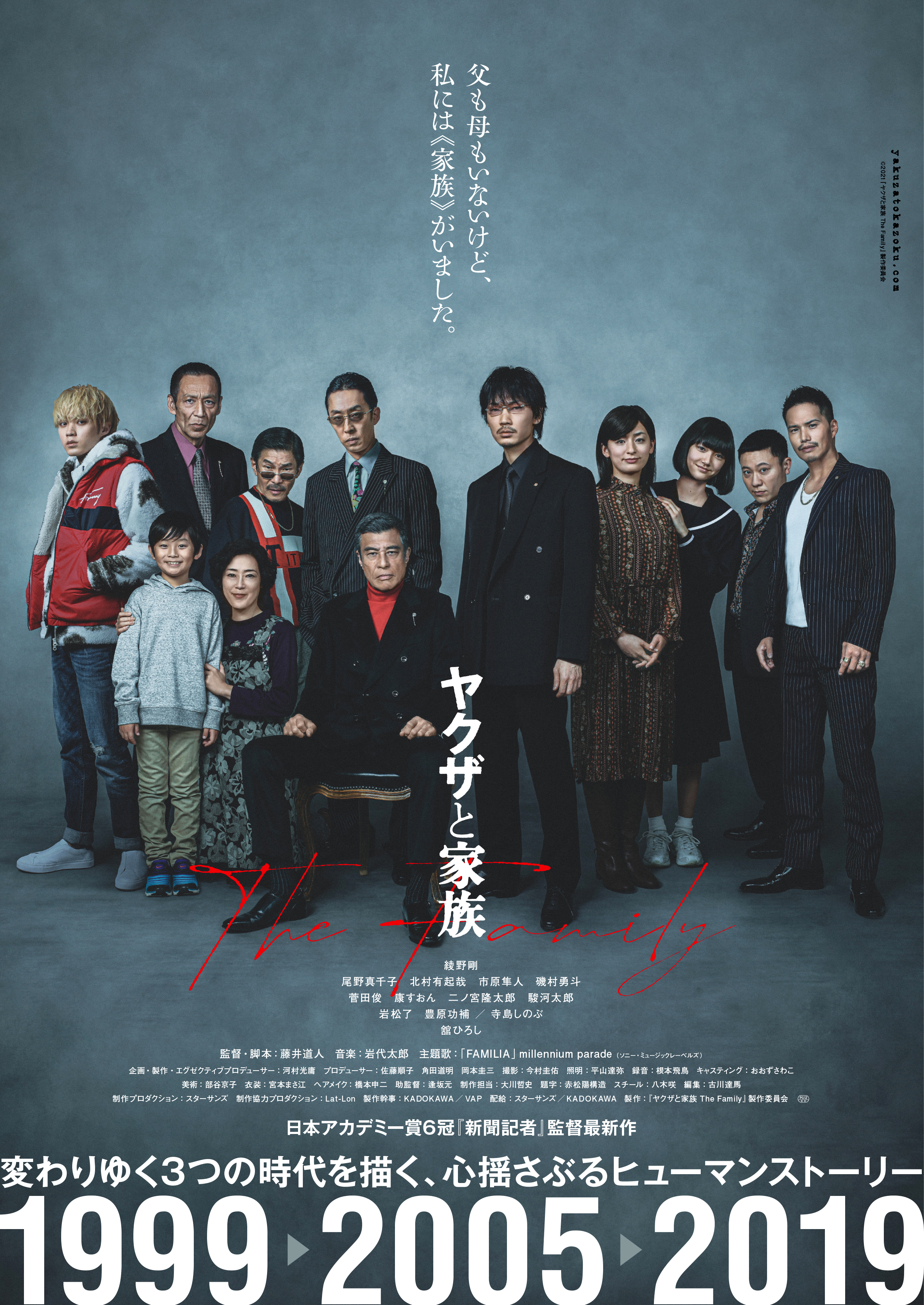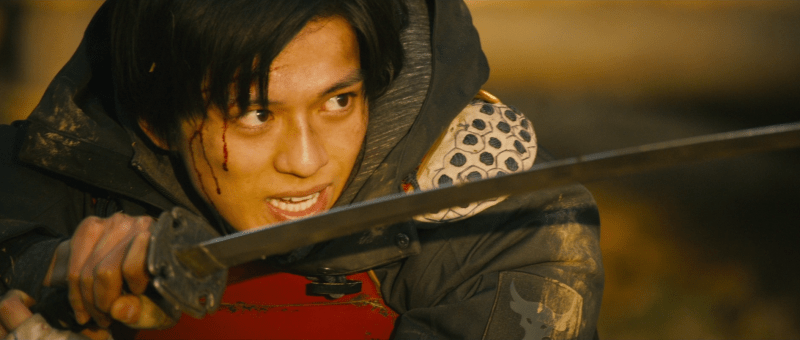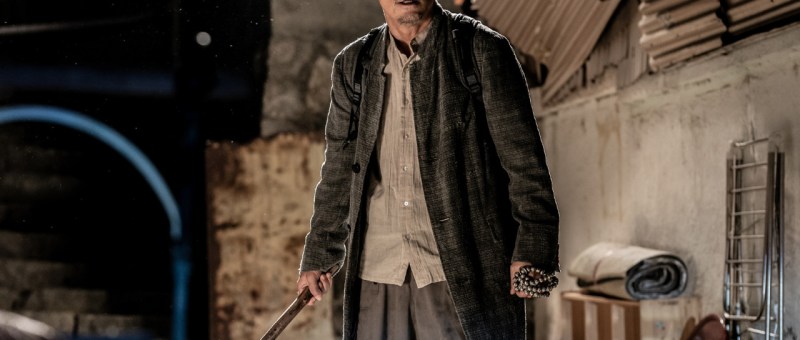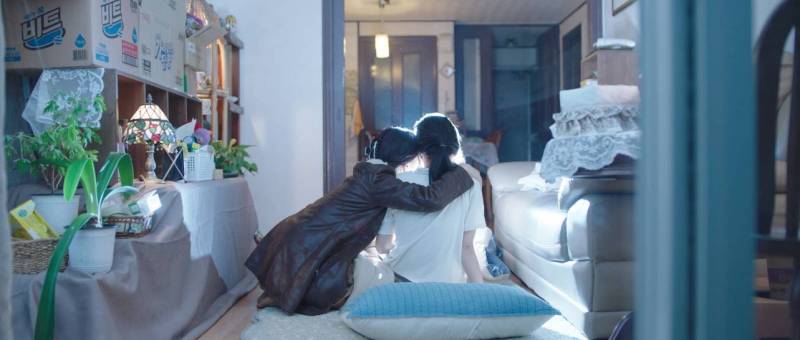
Brave: Gunjo Senki (ブレイブ -群青戦記-, Katsuyuki Motohiro, 2021)

A young man with a total lack of confidence in himself begins discover his inner strength after being sent back to the Sengoku era in Katsuyuki Motohiro’s timeslip drama adapted from the manga by Masaki Kasahara, Brave: Gunjo Senki (ブレイブ -群青戦記-). Fighting a battle for the future, the kids finds themselves at a moment of historical change and caught between the titanic forces of clashing armies but paradoxically discover that they want the same thing, something the kids have always taken for granted, an age of peace in which all are free to live together happily. 

For all those reasons it’s a just as well that Aoi (Mackenyu), a diffident member of the archery club, is a keen history buff even if he declares himself uninterested in winning competitions or becoming a champion. When warriors in 16th century armour begin assaulting the school, he’s well placed to guess what might be going on inferring from some of the names involved that they must have been thrown back to the year 1560 which was something of a turning point in Japanese history marked by the battle of Okehazama in which the outnumbered forces of Oda Nobunaga (Kenichi Matsuyama) scored a significant victory against those of Imagawa Yoshimoto setting Nobunaga on a path towards the unification of Japan. 

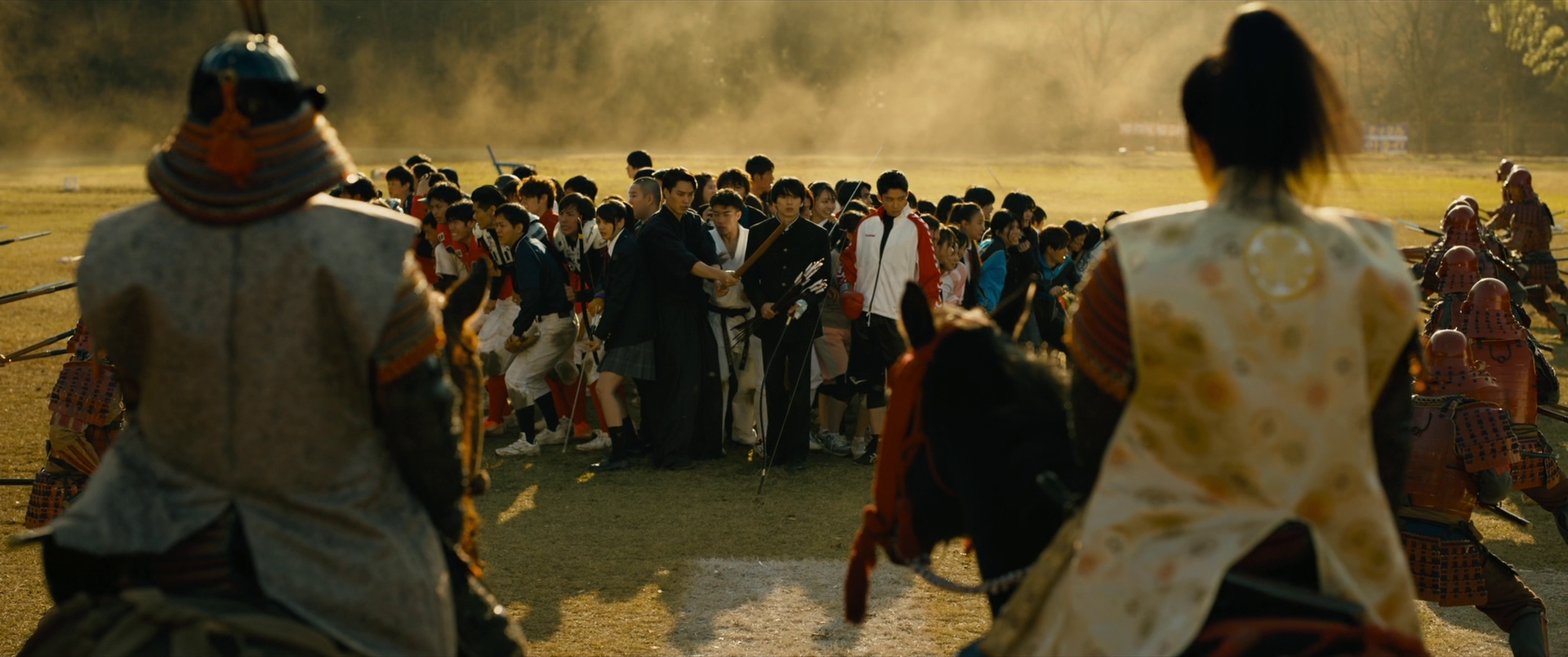
Though armed with foreknowledge, the kids are obviously ill-equipped to cope with the demands of life in the Sengoku era having no combat experience yet this institution happens to be one of the most prominent sporting schools in the nation boasting a host of national champions all of whom discover that their athletic skills can easily be repurposed for warfare from the archers and kendo enthusiasts to the baseball and American football players while those in the various science clubs set about investigating how they got here and how they might get back. 

Despite being thrust into a leadership role after impressing warlord Motoyasu (Haruma Miura) who will one day become Tokugawa Ieyasu and oust Nobunaga as ruler of a unified Japan, Aoi remains diffident and fearful unable to fire his bow often walking away from the fight despite his friends’ encouragement. His problem, as is repeatedly pointed out, is that he has no self-confidence and cannot believe in himself sufficiently to act when the occasion calls. Yet through his gentle mentoring at the hands of Motoyasu, he begins to come into his own as a Sengoku era strategist realising that he has something to spur him on in the desire to protect those close to him.

This is not, however, a wholly positive thing. Despite introducing Aoi’s childhood friend Haruka (Hirona Yamazaki) as a talented archer who is much more willing to step up to the fight, the film quickly relegates her to the role of damsel in distress as it does the majority of female students many of whom are also top athletes with useful skills while the assault squad venturing to rescue students taken hostage by evil retainer Yanada Matsuna is, aside from Haruka, exclusively male. Conversely, the guys are given an opportunity to express their fear and sadness each thinking of their mothers as they prepare to risk their lives to save their friends. 

For Aoi, his friends become the light that show him the way while he remains preoccupied with history realising that nefarious forces are trying to manipulate it so that their age of peace will never arrive and Japan will exist in a state of darkness for all eternity. Though often depicted as cruel dictator this Nobunaga seems to want end the darkness by bringing about an age of peace through the unification of Japan taking solace in the idea that these strange people in their weird castle wearing bizarre clothes are from an age in which war is a distant memory meaning at least that his dream came to pass. At heart, it’s a battle between an emo teen who wants to paint the world with the darkness inside him, and a diffident young man turning away from hate and violence while finding strength in the presence and support of his friends. Boasting some impressive effects and high octane battle sequences imbued with a quirky humour as the kids use their sport skills, kicking footballs armed with bombs or throwing fiery baseballs at the confused retainers, Brave: Gunjo Senki sees its diffident hero not only taking charge of his personal destiny but the national in believing that the best way to support his friends is to make sure the world of peace they’ve always enjoyed will again come to pass. 


Original trailer (no subtitles)
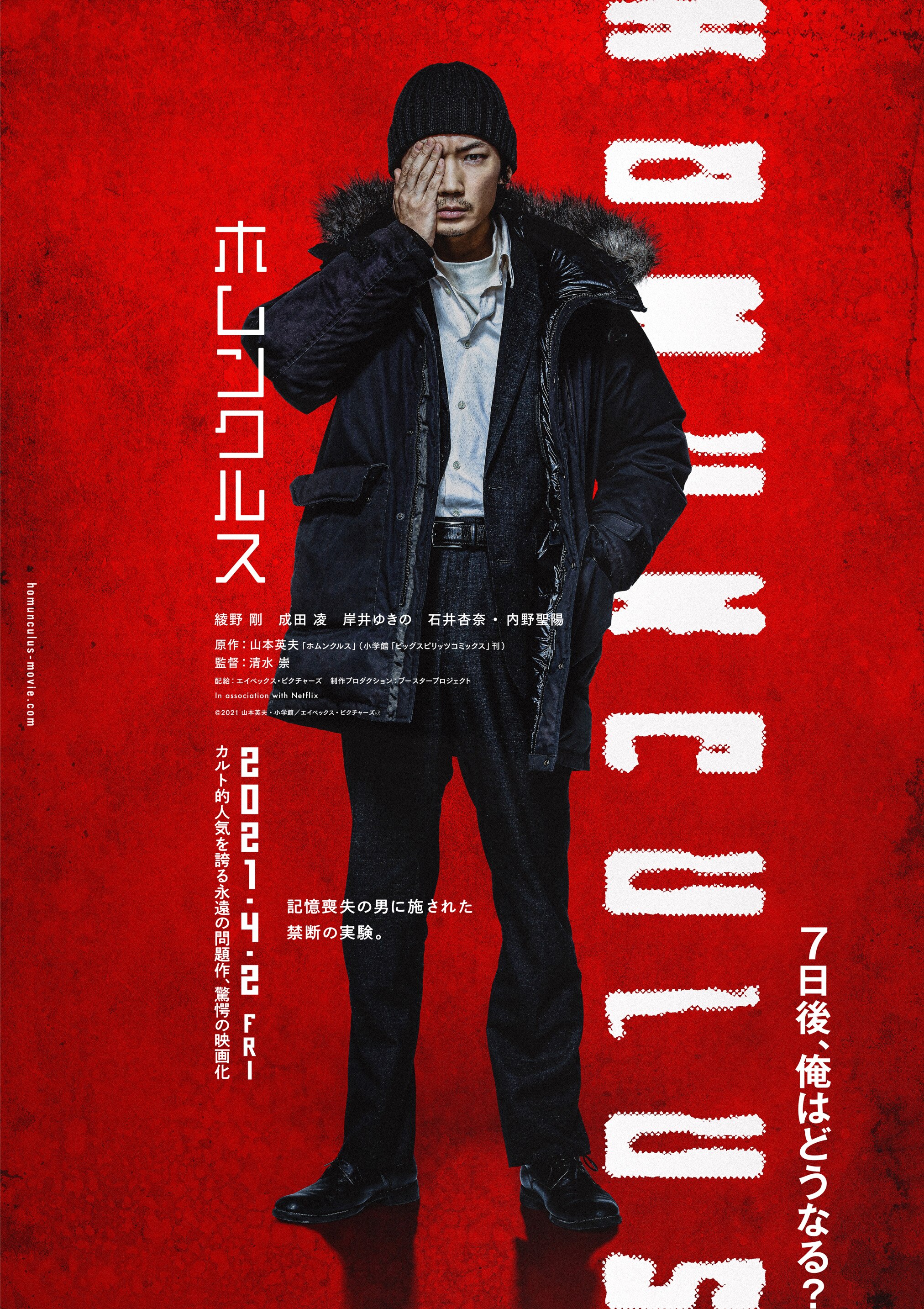
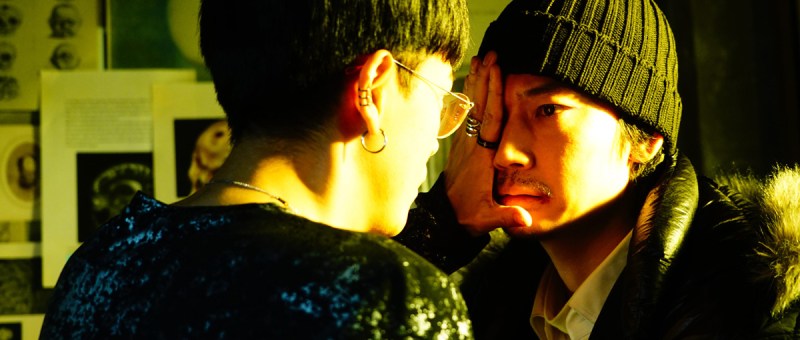
Homunculus (ホムンクルス, Takashi Shimizu, 2021)

Is the world we see merely a self-created illusion, or do we each share a concrete, objective “reality”? It’s a question which seems to obsess the antagonist of Takashi Shimizu’s manga adaptation Homunculus (ホムンクルス), though in the end he’ll perhaps find the answer is less clear cut than he’d been willing to believe. “When you look at the other person you can create the world” is the lesson he’s eventually given by his test subject, echoing the film’s somewhat trite message that it’s connection which gives life meaning, a willingness to see and be seen having moved past unresolved trauma in pursuit of the true self. 

This is something the hero, Susumu Nokoshi (Go Ayano), has apparently been unwilling to do. Formerly a high flying actuary peddling life insurance, literally putting a price on the lives of others, Susumu now claims to have lost his memory and is living in his car next to a park which is home to the local homeless population. One night, a weird young man with strange, staring, goldfish-like eyes knocks on his window and makes him a bizarre job offer. For whatever reason, Susumu allows himself to be convinced by this decidedly odd young man he’s only just met to let him drill a hole in his head which he claims will unlock untold abilities and perhaps even return some of his missing memories. 

Manabu Ito (Ryo Narita), a medical student and the wealthy son of a successful doctor, claims he wants to use the trepanation experiment in order to prove that the world does not exist but is merely a self-created illusion of the human brain. As a result of the operation, Susumu does indeed develop special powers in that he suddenly starts seeing strange things in the middle of Kabukicho. According to Manabu, he’s developed the ability to see the “homunculus” of others, seeing their inner self-image as a reflection of their deeply buried trauma. 

Despite himself, Susumu begins attempting heal the various traumas of the troubled souls he sees but at the same time perhaps oversteps his right to intervene, acting in instinct and compulsion never considering whether not not they actually want their traumas resolved. His first case is that of a violent yakuza whose inner self is a wounded child encased in robot armour, the implication being that he has buried himself in a life of merciless violence in an attempt to mask unresolved childhood guilt. Yet his eventual “freedom” in having faced his younger self entirely ignores the weight of his later years of violent cruelty, as if all of his subsequent “stress” were wiped out in an instant. Susumu’s second case, however, is still more worrying in that is sees him apparently “fix” a young woman’s control and self-esteem issues effectively by raping her while in some kind of trance. 

His own issues meanwhile lead back into his refusal to deal with the painful past, implying his unusual lifestyle is in fact a fugue state born of trauma response. We learn that he was once wealthy and successful but also deeply empty inside, apparently saved from the soul destroying delusion of consumerist fulfilment by a young woman who saw him for what he really was. He resents his new abilities because he is still unwilling to extend the same courtesy to others, trapped in self obsession desperately wanting to be seen but all the while refusing look even as the hole in his head takes the lid off his emotional repression. 

Nevertheless, there’s a curiously homoerotic subtext between the patient and his mad scientist friend whose eventual descent into machiavellian levels of manipulation is never quite convincing even if it perhaps comes from a place of spurned hurt. Manabu’s unresolved traumas are indeed given short shrift and perhaps in themselves fairly banal, failing to live up to his air of strangeness or prove equal to the darkness inherent in his odd obsession with the art of trepanation coupled with his doubts as to the nature of reality. Neither outlandish enough in its surreality nor, ironically enough, willing to engage with its own unpleasantness in its latent misogyny, Homunculus’ central messages of the essentiality of mutual recognition ring somewhat hollow while its heroes remain mired in their own quests for true selfhood in looking for themselves reflected in the eyes of others. 


Trailer (English subtitles)

Every Trick In The Book (鳩の撃退法, Hideta Takahata, 2021)

A down on his luck writer finds himself at the centre of a mystery only how much is truth and how much “fiction”? Based on the novel by Shogo Sato, Hideta Takahata’s Every Trick in the Book (鳩の撃退法, Hato no gekitai-ho) ponders the possibilities of literature as the hero seems to create a fictional world around him in which it is largely unclear whether he is solving a real world mystery or simply imagining one based on his impressions of the strange characters he encounters through the course of his everyday life.

That everyday life is however eventful just in itself. Tsuda (Tatsuya Fujiwara) once won a prestigious literary prize and was destined to become a popular author but hasn’t written anything of note for some time and in fact now largely works as a driver ferrying sex workers around on behalf of his shady boss. The mystery begins when he approaches a man, a rare solo reader in an overnight cafe, and promises to lend him a copy of Peter and Wendy by JM Barrie only to later discover that the man went missing along with his wife and the daughter he had explained was fathered by another man. 

Like many of his subsequent encounters it isn’t entirely clear if this meeting really took place or at least as Tsuda said it did or is only part of the novel he is beginning to write. The man, Hideyoshi (Shunsuke Kazama), asks him if it’s a novelist’s habit to begin imagining backstories for everyone he sets eyes on and there may well be some of that even as Tsuda is fond of claiming that amazing things happen around us every day to which we are mostly oblivious. Still, Tsuda probably didn’t expect to be pulled into the orbit of local gangster Kurata (Etsushi Toyokawa) after accidentally passing on counterfeit currency he found by chance. It’s true that most of what’s happening to him is the result of a series of bizarre coincidences or cosmic confluence which has accidentally united this collection of people in an unintended mystery which Tsuda intends to solve in either literal or literary terms. 

“It’s all a novelist can do” he later claims in trying to write a better ending for “characters” he has come to like than the one he assumes they “actually” met. But then his editor Nahomi (Tao Tsuchiya) chief worry is that, like his previous novel, Tsuda’s story will contain too much of the “literal” truth which could cause his publishers some legal problems. Part of the reason Tsuda left the industry is apparently because his last book was inspired by a real life affair which was then considered somewhat hurtful and defamatory. For that reason it comes as quite a blow to Nahomi as she begins to investigate and discovers that much of Tsuda’s story lines up with “real” places and events, but then again as he says if you can draw connections between known facts then you begin to see a “hidden” truth which may in its own way be merely his invention. 

The film’s Japanese title translates more literally as something like “how to fend off a dove” which does indeed have its share of irony especially considering the meaning the dove symbolism turns out to have in the film but perhaps also hints at the essential absurdity of trying to fight back against something that is otherwise harmless and in fact represents peace. Tsuda may be onto something and nothing, embracing the bizarre serendipity of a writer’s life while trying to recover his creative mojo but embellishing it with more danger and strangeness than it actually has to offer. Then again as his editor discovers, there really is an incinerator it seems anyone can just walk up and use to burn whatever they want including dead bodies, while people in general are full of duplicities all of which keeps the “fake” money circulating as people use it to try to buy things that can’t really be bought. Hideyoshi calls them “miracles”, embracing the strange serendipity of his life as an orphan longing for a family to call his own and unexpectedly finding one which is “real” in someways and “fiction” and in others. Then again, if you believe in something does it really matter if it’s “real” or not? Hideyoshi and Tsuda might say it doesn’t, the publishing company’s lawyers might feel differently, but it seems there really are amazing things going on around us every day if only you stop to look. 


Original trailer (English subtitles)

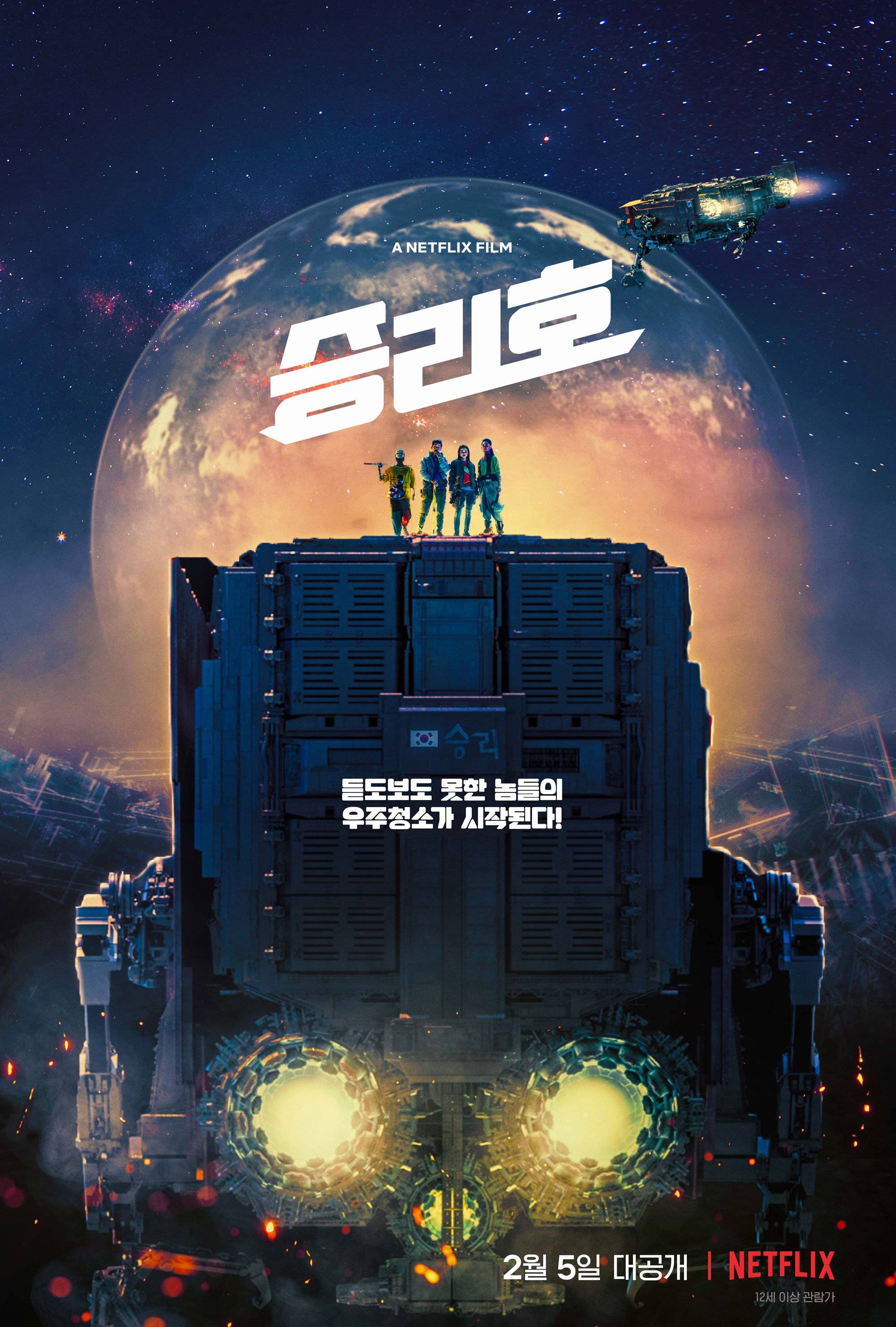
Space Sweepers (승리호, Jo Sung-hee, 2021)

If we’re content to ruin one world, why do we assume our salvation lies on another? Billed as Korea’s first blockbuster science-fiction extravaganza, Space Sweepers (승리호, Seungriho) finds a ragtag gang of junkers quite literally cleaning up humanity’s mess while ironically marginalised into outer space by internecine capitalist consumerism which in insult to injury offers to sell you a cure for the disease it has caused but only to those whom it deems worthy of its dubious promises. 

By 2092, the Earth has become all but uninhabitable. Led by 1952-year-old messianic scientist Sullivan, UTS Corporation has prepared a new artificial orbiting home but only the elite are invited while the remaining 95% linger on the poisoned ground below or else, like the crew of the Victory, wander in space attempting to make a living from clearing the debris left behind after countless sattelltes and space station launches. Yet as jaded space sweeper Tae-ho (Song Joong-ki) remarks, the more you work the more debt you earn. The Victory is a well equipped ship and you’d think that would mean greater earning potential but all it means is that it costs more to maintain while the initial outlay has landed them with unsustainable debt not to mention constant random fines and official interference. All of which is why when they find a little girl hidden in a storage compartment of an abandoned vessel and realise she’s the missing android that’s all over the news, they decide to play off the Black Foxes “terrorist” organisation who kidnapped her and UTC who want her back for all they can get. 

As might be expected for all his claims that “humanity is dirty” in its failure to protect the planet, Sullivan is no pure hearted saviour but an amoral elitist intent on terraforming Mars as some kind of authoritarian “utopia” populated only the “best” of humanity. He claims not to care about money, but cites the false equivalency that those with the deepest pockets must necessarily be those with the greatest capability while privately describing those left below as expendable and not really worth saving. Dressed like a cult leader, even at one point appearing as a giant hologram, Sullivan’s appearance owes a significant visual debt to Neon Genesis Evangelion’s Gendo Ikari, leaving little doubt as to his megalomaniacal intensions as he wilfully sells a solution to a problem he himself helped to cause while continuing to exploit the Earth and the people still on it to hasten its demise and his own enrichment. 

While the central message reinforces the idea that large corporations are not to be trusted while the capitalistic system they uphold is inherently destructive, it also perhaps undercuts that of the impending environmental crisis with which we are faced if we can’t mend our ways fast enough. Even so, it falls to the space sweepers to mount a unified global resistance against the wilful destruction of their homeland in protecting the android, Dorothy / Kot-nim (Park Ye-rin), who of course holds the key to saving the world. Despite having taken in her in with a view to ransoming her, the crew soon bond with the adorable little girl as unofficial daughter while Tae-ho alone remains reluctant in grief over child for whom he continually searches while internalising a sense of resentful failure in the knowledge that he lost her because of his own self-absorbed sense of hopelessness. 

Even so, there may be something a little uncomfortable in the final resolution in which the crew coalesces into a recognisable family unit each of them somehow “improved” as they accept their responsibility for Kot-nim whether in giving up drinking or erasing tattoos. Nevertheless, the film is refreshingly progressive in its depiction of a transgender character who gains the confidence to be their authentic self thanks to the unconditional solidarity among the crew members, though the sudden reversal of UTS from cult-like evil corporate entity to remorseful force for good seems rather optimistic as if the only problem was Sullivan and not the system that gave rise to him.  While the overall aesthetic may be somewhat televisual, Space Sweepers does feature some interesting production design and impressive CGI though its greatest strength lies in the jaded idealism of its space bandit protagonists as they band together to resist their marginalisation with mutual solidarity and compassion.


Original trailer (English subtitles)

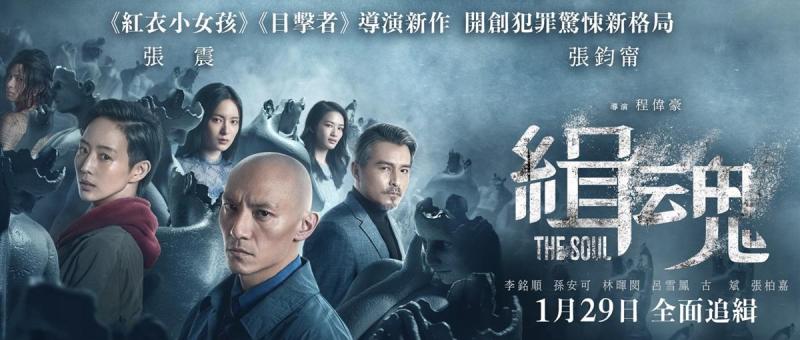
The Soul (緝魂, Cheng Wei-Hao, 2021)

“Affection is the greatest obstacle on the path to success” according to the villain at the centre of Cheng Wei-Hao’s philosophical mystery, The Soul (緝魂, Jī Hún). Adapted from a science-fiction novel by Jiang Bo, Cheng’s near future tale has a series of questions to ask about legacy, family, love, and repression as its earnest investigator tries to come to terms with his oncoming end while living with treatment resistant cancer and trying to decide what is the best way to support his wife and unborn child in his impending absence. 

In 2032, police are called to the palatial estate of a local tycoon only to find him brutally murdered. Perhaps there’s nothing so shocking about that, powerful men have enemies, yet the strange thing is that Wang (Samuel Ku) was already dying of brain cancer and had a very short time left to live so there would seem to be little advantage in bumping him off early. The prime suspect is his disgruntled son Tien-yu (Erek Lin) who was seen leaving the mansion in a hurry and is known to bear a grudge against his father over his mother’s death while Wang’s much younger second wife Li Yen (Sun Anke) also identifies him as the killer. But there are definitely a few things which don’t add up here. Why is Wang’s business partner Wan named as his second choice as heir after Li Yen despite the rumours he had been having an affair with first wife Su-chen (Baijia Zhang), why are there security cameras in Li Yen’s bedroom, and why would a man with so little time left to live opt for an arranged marriage to an orphaned 20-year-old woman from one of the orphanages his philanthropic organisation supports?

Those are all questions which immediately present themselves to veteran investigator Liang (Chang Chen) whose own wife Pau (Janine Chang Chun-ning), also a policewoman, is pregnant with their child while he has just learnt that his cancer has resisted all treatment and may in fact be incurable. Deciding his remaining time may be best spent providing what he can for his family he asks his boss for his job back and specifically to be put on the Wang case, immediately homing in on the company’s radical new treatment for cancer through transplanting rejuvenated neurons directly into the brain. He begins to wonder what comes with it if you begin implanting neurons that belong to someone else but gets no reply from Wan in the middle of his sales pitch. 

Hinted at in the Chinese title the question that arises is that of the connection between soul and flesh and whether it becomes possible to achieve a kind of immortality through colonising brains in healthy bodies, an idea which might of course prove appealing to Liang if he were not so innately incorruptible. Then again as his wife says, perhaps it’s easier to die. It’s the ones left behind who have it hardest, suddenly left to deal with everything on their own. That might be why she finds herself tempted by their rather obvious conflict of interest in compromising her integrity to buy her husband a few more days while he wonders what the point of such a sacrifice might be.

Yet what we discover in the unhappy saga of the Wangs is both a megalomaniacal obsession with control that extends beyond one’s own lifetime and a tragic love story born of internalised shame that led to a lifetime of repression and unhappiness in the inability to be one’s authentic self. Liang describes the RNA treatment as an expression of the living’s obsession with the dead, while others describe it as “modern necromancy” oddly echoing the black magic which Su-chen, herself a neuroscientist, and her son had apparently been practicing in their intense resentment of Wang. Pau insists she’d rather believe a soul exists no matter in what form, but if you make division of yourself you may also face an unexpected existential threat born of your own internal conflicts and mutual desire for survival. A slow burn mystery, Cheng’s eerie drama has its share of hokum but nevertheless asks some pertinent questions about the nature of humanity in an increasingly technological age, what it is we leave behind and how it is we move forward (or not) with the process of letting go even as its ironic final moments provide a kind of justice emotional and literal in restoration of a family. 


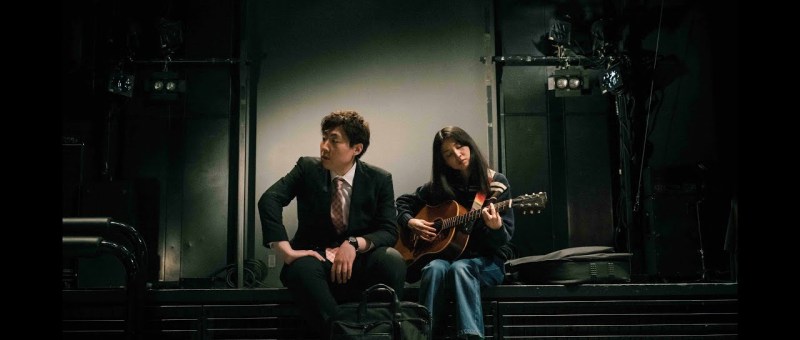
Tsujiura Renbo (辻占恋慕, Daisuke Ono, 2021)

Is there a point at which you should accept your artistic dreams won’t come true, cut your losses, and try to transition into a more conventional life? That’s the dilemma the heroes of Daisuke Ono’s Tsujiura Renbo (辻占恋慕) find themselves contending with while wondering if it’s better to compromise your artistic integrity and surrender to the realities of the contemporary entertainment industry or resign yourself to the idea of your art becoming merely a side gig rather than a full-time occupation. 

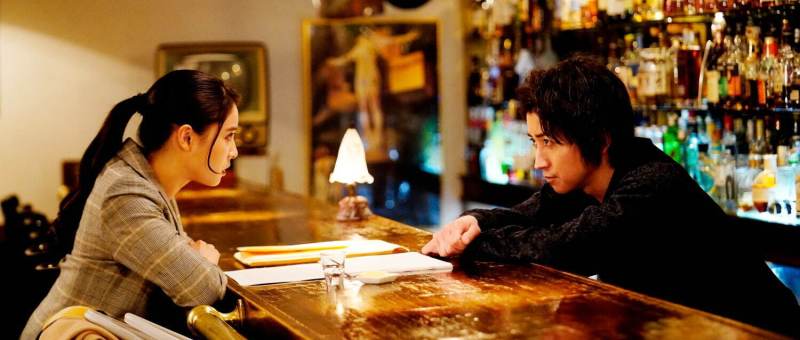
The dilemma is all the more acute for Shinta (Daisuke Ono) because he’s recently turned 30 and is experiencing a moment of existential crisis. The band he’s been in since college has never really got anywhere, and this particular evening his guitarist, Naoya, hasn’t even bothered to turn up. Luckily for him, a sullen young female folksinger, Emi (Saori), offers to accompany him for just the one track so that he can still try and rustle up some interest in a few CDs but it’s clear during their set that Emi has real star power effortlessly outshining him vocalising on his own song. Shinta thinks the gig is up, eventually deciding his efforts might be better placed in helping Emi receive the recognition she deserves becoming her manager after spending a weird night in her apartment which is also the office of her record label which has only one other artist and is essentially the last hurrah of an ancient retiree. 

Part of Emi’s problem is that she’s an old school folksy singer-songwriter with intense Meiko Kaji energy. Even those who support her worry her music’s too old-fashioned for a chart-obsessed industry while her tsundere personality is distinctly at odds with the traditional ways in which female artists are marketed in what is still an incredibly sexist environment. Emi had complained that the club at which she first met Shinta was populated largely by slightly creepy middle-aged men there to see the main act, underground idol star Azuki (Rena Kato) who specialises in upbeat yet bland pop and makes the majority of her money through meet and greet sessions with her top fans who are perhaps sometimes dangerously obsessed with her star persona. These kinds of fans aren’t generally interested in folk music, but even so Emi is repeatedly advised to go down the same path of selling handshakes and autographs to ticket buyers more interested in the fan experience than hearing anything she has to say.

To that extent, it’s odd that neither Shinta nor anyone considers harnessing her tsundere energy to hook a different kind of audience that might be attracted to her defiance rather than the bland cuteness represented by Azuki. Azuki meanwhile may be cynical but perhaps she’s also sensible, explaining to Shinta that after hearing he and the others earnestly discussing music she decided it was better to go in a different direction realising she’d soon age out of the underground idol demographic in which the average career might last only a few months, deciding to turn her idol persona into a marketable brand and more or less ignoring the musical part of her act altogether. Shinta begins to wonder if he’s been marketing her wrong, that he shouldn’t have tried to push Emi towards the mainstream but focus on her unique talent as an old school live act. 

Then again, each 30 years old and already exhausting their budget perhaps it’s simply too late to move beyond the live house circuit. A visit from a colleague of Emi’s at the callcentre where she works to make ends meet, herself an aspiring actress, warns him that Emi may be at her limit but unable to quit in part in fear of letting him down even as their relationship is constantly eroded by the pressures of trying to make their musical dream come true. She has real talent, but doing what it would take to become successful might kill it and her, a music critic from a big paper bluntly telling Shinta that though he can see her newer album is more “commercial” that’s only made it “bland” robbing it of everything that once made it interesting. If playing to crowds of weird old men who’ve only come because Azuki told them to is as good as it gets, maybe it’s best to accept defeat rather than watch Emi tear herself apart. As it turns out the reason Naoya never turned up to the gig was that he won big on pachinko and realised he had much more chance of making a life for himself on that than he ever had with music. Maybe it doesn’t work out in the end and all you have is “nostalgic love” for a period in time, but that might not be so bad in and of itself and the music will always be there for you whether anyone’s listening or not.


Original trailer (no subtitles)
The 8th Night (제8일의 밤, Kim Tae-hyoung, 2021)

“But even the most trivial moments of our predetermined fate are meaningful as pieces of the whole” according to embittered former monk Jin-su having reached a moment of philosophical epiphany after bringing his karmic retribution full circle. Another in the recent series of Buddhist supernatural thrillers from Korea, Kim Tae-hyoung’s The 8th Night (제8일의 밤, Je8ileui Bam) once again turns apocalyptic as an ancient evil is set for accidental revival thanks, largely, to the wounded pride of a bitter old man. 

As the opening voice over explains, thousands of years ago the world was threatened by a powerful demon. Luckily, Buddha managed to vanquish him, tearing out his two eyes, one black one red, and burying them on opposite sides of the Earth in order to prevent them ever being reunited. Some people, however, just can’t resist chaos which is presumably why Professor Kim (Park Hae-joon) insists on retrieving the canister containing the Red Eye from its desert resting place, thereafter releasing its power when his discovery is rejected by both Buddhist and scholarly authorities. Sensing a disturbance in the equilibrium of the world along with the upcoming Blood Moon, priest Hajeong (Lee Eol) realises the prophecy of which he has been a guardian is about to come true. His big, somewhat unethical plan, is to kill off one of the seven pre-ordained victims of the Red Eye which he plans to possess in order to reunite with its partner in and stop it body hopping towards the apocalypse. 

You can make a case for greater good, but murdering an innocent person to put an end to a curse seems at best unfair, not to mention not very Buddhist. Hajeong sends young monk Cheong-Seok (Nam Da-reum) to track down his former pupil, Jin-su (Lee Sung-min) then known as Seonhwa to give him the instruction to assassinate the “Virgin Shaman” with a holy axe to stop Red Eye in its tracks. Jin-su is seemingly unconflicted about the murder but is carrying his own baggage, now living as a resentful construction worker. As it turns out, he and Cheong-seok are also linked by a karmic circle of guilt and trauma that the boy doesn’t remember and Jin-su has been running away from since leaving the temple. Meanwhile, he is also plagued by voices of departed spirits he for some reason refuses to help cross over to the other side. 

Meanwhile, over on the side of the rational, two policemen mirror the monks’ movements as they investigate the strange paper chain of mummified corpses turning up all over the city. Veteran cop Ho-tae (Park Hae-joon) feels responsible for his feckless associate Dong-jin, blaming himself for an accident which has left him physically impaired while resisting instructions from his boss to fire him. Yet the pair are entirely ill equipped to investigate this case of spiritual malevolence, confused by its religious connotations but perhaps filled with suspicion on realising that all of the victims belong to the same “meditation group” for people with suicidal thoughts which has been offering “free” blood tests and apparently paying for attendance. Described by one as more like a cult, the shady meditation group might be one kind of evil but what they’re currently facing is on an entirely different level. 

The irony is that it’s Jin-su who must learn to save the world by finding closure with his own traumatic past, generating a paternal bond with young monk Cheong-seok who is so excited by the world beyond the temple that he accidentally breaks his vow of silence and then can’t stop talking. Cheong-seok’s sense of wonder and confusion, unsure what to do about the meat he keeps finding in his food but also slightly bemused by Jin-su’s willingness to eat it for him, stands in direct contrast to Jin-su’s embittered cynicism as he attempts to resist his destiny only to receive a ghostly reminder that you can’t escape your fate and, in any case, his duty would simply fall on the successor, Cheong-seok. In order to save the world, he has to free not only himself but also Cheong-seok too from the cycle of karmic retribution which binds each of them in the “agony and anxiety” of the monster’s separated eyes, determining to set them to rest once again to restore a sense of balance in a destabilising world. A buddhist procedural, Kim’s supernatural horror may rediscover that hell is a place on Earth but eventually allows its heroes the possibility of escape if only in the willingness to free themselves from the shackles of the traumatic past. 


Original trailer (English subtitles)

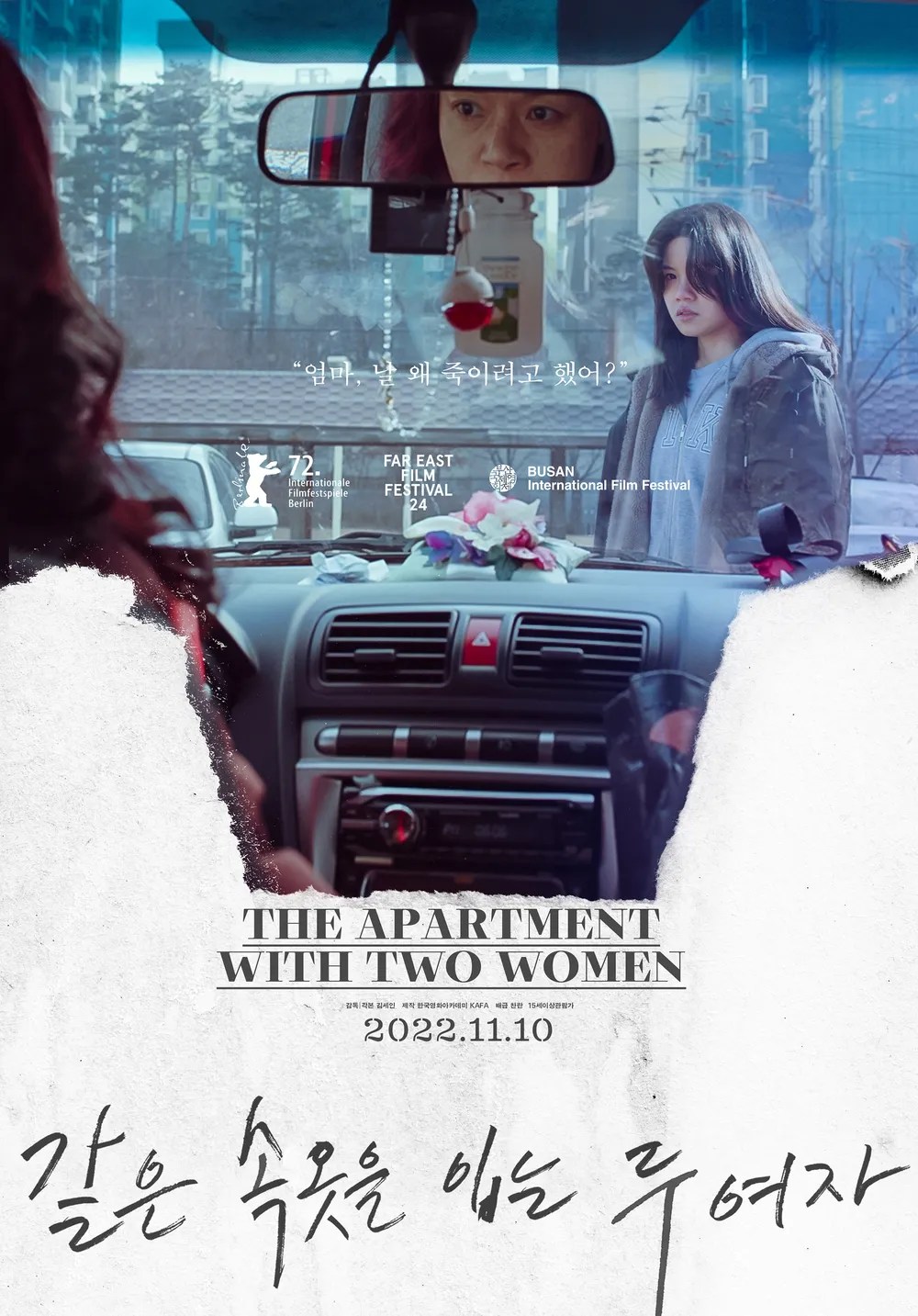
The Apartment with Two Women (같은 속옷을 입는 두 여자, Kim Se-in, 2021)

A mother and daughter remain locked in a toxic cycle of resentment and dependency in the debut feature from Kim Se-in, The Apartment with Two Women (같은 속옷을 입는 두 여자, gateun sogoseul ibneun du yeoja). While the English title may have an unfortunate sexist connotation implying that such a dysfunctional relationship is inevitable when two women live together, the Korean “two women wearing the same underwear” more closely suggests the awkward intimacy between them as they each seem to seek escape from the other but in the end are left with no option than to return or choose independent loneliness.

The awkwardness is obvious from the opening scenes as middle-aged, pink-haired mother So-kyung (Yang Mal-bok) chats to a friend on the phone while using the toilet even as her 20-something daughter Yi-jung (Lym Ji-ho) washes her undies in the bathroom sink. Once done, So-kyung slips off her underwear and simply throws them in with the others for Yi-jung to scrub, taking one of the newly washed but not yet dried pairs as a replacement before breezily leaving for work. So-kyung often becomes angry with her grown-up daughter for no ostensible reason, hitting and slapping her while a defeated Yi-jung can do nothing but cry no longer seeing much point in even asking what it is she’s done wrong. Matters come to a head when the pair argue in the car at supermarket car park. Yi-jung gets out and begins to walk away, but her mother suddenly jumps on the accelerator and hits her. So-kyung tries to claim the car malfunctioned but Yi-jung has long believed her mother would prefer it if she were no longer alive. 

During a blackout towards the film’s conclusion, So-kyung again insists the accident wasn’t deliberate reminding that Yi-jung that it wasn’t the first time she swore she’d kill her and forcing her to admit that she remained so calm because it wasn’t the first time she’d heard it. Later someone asks why she didn’t leave seeing as she is a grown woman with a salaried job capable of supporting herself and she answers that she thought she needed to save more money before making her escape but it’s also true that years of So-kyung’s emotional abuse have eroded her confidence in her ability to survive alone and that finally she is just so lonely that even her mother’s continual resentment is preferable to being on her own with no other friends or family to turn to. 

Yi-jung begins to bond with a woman at work who is in a similarly abusive situation with their employer, disliked by her co-workers and exploited by the boss who often hands her additional tasks to be completed for the next morning when everyone else is about to go home. But So-hee (Jung Bo-ram) evidently has troubles of her own, and in any case Yi-jung simply ends up in another apartment with two women while beginning to realise that So-hee is not interested in a close friendship with her for she too longs for “independence” and is turned off by her obvious neediness. So-kyung meanwhile is in a relationship with a genial man of around her own age, Yong-yeol, who has a teenage daughter, So-ra, to whom So-kyung more well disposed than to own but eventually cannot stand. So-ra is in many ways much like herself and So-kyung’s narcissistic tendencies prevent her from sharing Yong-yeol with another woman. When it comes to picking an apartment for them to live in after they marry, it comes as a surprise to her than Yong-yeol intended to bring So-ra to live with them roundly telling him that the “spare” room is for storage not a daughter. Given this ultimatum Yong-yeol choses So-kyung, agreeing that So-ra will live with her grandmother in a decision that shocks Yi-jung on discovering his letter prompting the realisation that her mother will happily abandon her too. 

Su-kyung is in many ways a narcissistic nightmare, refusing to apologise for who she is and always insisting other people are to blame for the way she treats them. All Yi-jung wants is an apology but what she gets is justification as her mother explains to her that her clients at her massage parlour dump all their negativity on her though she is also living a stressful life and so she dumps all of her negativity on Yi-jung whom she resents for trapping her poverty and loneliness as a reluctant single mother. Yi-jung asks her what she’s supposed to do with that, but her mother simply tells her she should have a daughter too. In any case it appears as if Yi-jung may finally be finding the strength to extricate herself from her toxic familial environment, finally being measured to figure out her correct bra size having presumably been forced to wear whatever her mother wore throughout all of her adult life in a moment which brings us back to underwear once again. At times darkly comic, Kim Se-in’s intense family drama circles around toxic dependency and an inescapable cycle of cruelty and resentment but does at least allow its heroines the glimmer of new beginnings in a more independent future.


International trailer (English subtitles)

Angry Rice Wives (大コメ騒動, Katsuhide Motoki, 2021)

“Even if women try to do something, nothing will change” a condescending husband insists cautioning his wife not to take part in any more protests lest he lose his protected status and the family its source of income. Set in the middle of the Taisho era, Angry Rice Wives (大コメ騒動, Dai Kome Soudo) dramatises a small moment of revolution in which the resistance movement organised by a community of women towards the spiralling cost of rice sent shock waves through a changing society and in its own way provoked a change of course in an increasingly capitalistic society. 

Beginning in April 1918, the small fishing village of Toyama sees an exodus of its young men who must spend the off-season when the catch is low working other jobs in order to make ends meet, This necessarily means their wives and families are left behind and must make do with what they themselves can earn in doing menial jobs such as transporting rice and the little their husbands might be able to send before their return. A farmer’s daughter who married into the fishing community, Ito (Mao Inoue) is one of the few literate women in the village and looked to as a kind of oracle reporting the contents of the morning paper to the other wives who are keenly interested in the continually fluctuating price rice which seems set to rise still more with news that Japan plans to send troops to Siberia. 

As the voiceover relates, with the catch so low rice is the only form of sustenance available but prices have already exceeded what most of the women can earn in a day leaving them unable to feed their feed their families and giving rise to increasing discontent with the inequalities of the contemporary social order. Taking drastic action and led by eccentric old woman Kiyonsa (Shigeru Muroi), they stage a rebellion by intercepting their locally grown rice in order to stop it being sent to Hokkaido which is reported in the newspapers as an “uprising”. The term is indeed a little grand for what actually took place, but it does at least seem to spark a spirit of rebellion echoing around the country even if nothing much as changes in Toyama. Buoyed by a sense of wider support, the women continue their protests merely asking for the rice merchants to sell at a more reasonable rate (which they are perfectly capable of doing) while decrying the immorality of the obvious profiteering by corrupt authorities including local bigwig Kuroiwa (Renji Ishibashi) who are deliberately stockpiling rice to push the price up while planning to sell it to the government for a hefty price to feed their troops. 

Kuroiwa is entirely unsympathetic to the women’s predicament while the local police chief Kumazawa (Junichi Uchiura) believes himself indebted to him and is therefore entirely under his thumb. Neither of them think the women are much of a threat, Kumazawa randomly arresting a middle-aged man close to several of the women the rationale being as the husband of one puts it that women can never achieve anything no matter how hard they try but a man’s involvement in such rebellious activity would be cause for concern. Similarly, Ito is often told that her education is of no use, partly because the other women feel inferior for not having any, but struggles to find the self-confidence to standup to the corruptions of lingering feudalism owing to her liminal status as a non-native villager despite having given birth to three children there. Even so she is often looked to as a local problem solver and potential successor to Kiyonasa as leader of the village women if only she could learn to embrace the courage of her convictions. 

The children, by contrast have no such qualms, Ito’s young son Soichiro directly telling the profiteering proprietress of the rice store Mrs Washida (Tokie Hidari) that it’s her own fault another child stole food because if she hadn’t insisted in pricing her customers out to the point that they were starving she would never have needed to steal. “What exactly has capitalism done for us?” an opportunistic visitor from the workers party asks but receives short shrift from the cynical Kiyonsa who agrees they should rebel but is non-plussed by the flummoxed canvasser’s admission that he has no real plan for what do afterwards. Washida plays divide and conquer, pitting the women against each other and tempting even Ito with offers of under the table rice deals to feed their starving families if only they back down but though the solidarity of the women is temporarily ruptured it is never truly broken as they stand together to fight for fairness in the face of the Kuroiwas and Washidas of the increasingly capitalistic society. Their resistance eventually forces the government to backdown, realising they can’t simply ignore the plight of society’s poor or take their complicity for granted while attempting to starve them into submission. 


International trailer (English subtitles)

My Lovely Angel (내겐 너무 소중한 너, Lee Chang-won & Kwon Sung-mo, 2021)

“You’ve got to be brutal to survive in this world,” according to a coldhearted gangster remonstrating with down on his luck chancer Jae-sik (Jin Goo) for his seeming inability to be as bad as the world around him in Lee Chang-won & Kwon Sung-mo’s touching drama My Lovely Angel (내겐 너무 소중한 너, Naegen Neomu Sojunghan Neo), “You won’t get anywhere the way you handle stuff.” He might have a point, Jae-sik doesn’t really have the heart to be a heartless gangster but for the moment at least has been driven into cynicism by the futility of his life. 

When one of the women in the small troupe of performers at promotional events he drives round in his van doesn’t turn up for work, Jae-sik is irritated and not really all that remorseful on realising that the reason Ji-young hasn’t arrived is that she died in a freak accident. Like most of the other women, he doesn’t know much about her personal life hearing from the police that her family record only lists a seven-year-old daughter. Investigating her apartment he makes two important discoveries. Firstly, Ji-young’s lease is about to expire and there’s a 70,000 won deposit looking for a new owner. Secondly, Ji-young’s daughter Eun-hae (Jung Seo-Yeon) is still in the apartment though she behaves as if she doesn’t know he’s there and seems to survive on packets of bread her mother had left on the kitchen table. 

It takes Jae-sik quite a while to realise that Eun-hae is deafblind, but in any case he ends up moving into the apartment and superficially looking after her in the hope of claiming that he’s Ji-young’s common law spouse and entitled to the deposit money and anything else Ji-young might have to bequeath. But as he discovers, deafblind people find themselves trapped in an awkward limbo of the contemporary welfare system which recognises only deaf or blind people, leaving those who are unable to see or hear without any kind of support. Jae-sik tries to take Eun-hae to school, but she’s put in a class for blind children which is taught through spoken language that she is obviously unable to hear. Jae-sik complains that the classes are no good for her while she becomes obviously bored and frustrated by them, but the teacher’s only suggestion is that she also take the classes for deaf children which are taught in visual media she obviously can’t see. 

Of course, to begin with Jae-sik only accepts Eun-hae as a means of getting the money, otherwise little interested in what will happen to her now. He tries to ring her estranged birth father, but he rejects all responsibility for her presumably having walked out on the relationship because of his reluctance to care for a child with special needs. Jae-sik tells the landlady, who thinks he’s Eun-hae’s dad, that he’s looking for a nanny because he wouldn’t be able to care for her on his own while working only for the landlady to point out that Ji-young was managing it alright hinting at the patriarchal double standards which still see childcare as an inherently female domain. 

Still despite himself, Jae-sik begins to bond with Eun-hae who is after all completely dependent on him. He begins to communicate with her through teaching her words written in hangul by tracing them on her palm, while she seems to blossom in a new world of sensation when the pair embark on a road trip to the country. Though his past chases him, the further Jae-sik travels from the city the less cynical he seems to become no longer interested solely in money but beginning to care about those around him, not just Eun-hae but those he meets along his journey many of whom are also dealing with their own problems which sometimes echo his own as in a single-mother’s attempts to care for her ageing father as his dementia worsens. Lee & Kwon lend a golden glow to the expanses of the rural farmland where Jae-sik and Eun-hae find themselves taking refuge, Eun-hae in thrall to the natural world cheerfully dancing in the rain, smelling the flowers, and befriending animals even as the city snaps at their heels. Avoiding obvious sentimentality, the film nevertheless tells a poignant story of paternal redemption and the blossoming of a little girl finally finding a means to express herself.


My Lovely Angel screened as part of this year’s London Korean Film Festival.

Original trailer (English subtitles)