We’re Both Grooms (僕もアイツも新郎です。Koji Tanaka, 2022)

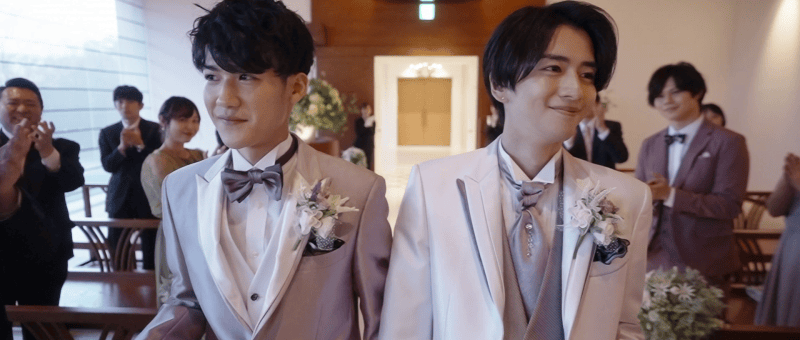
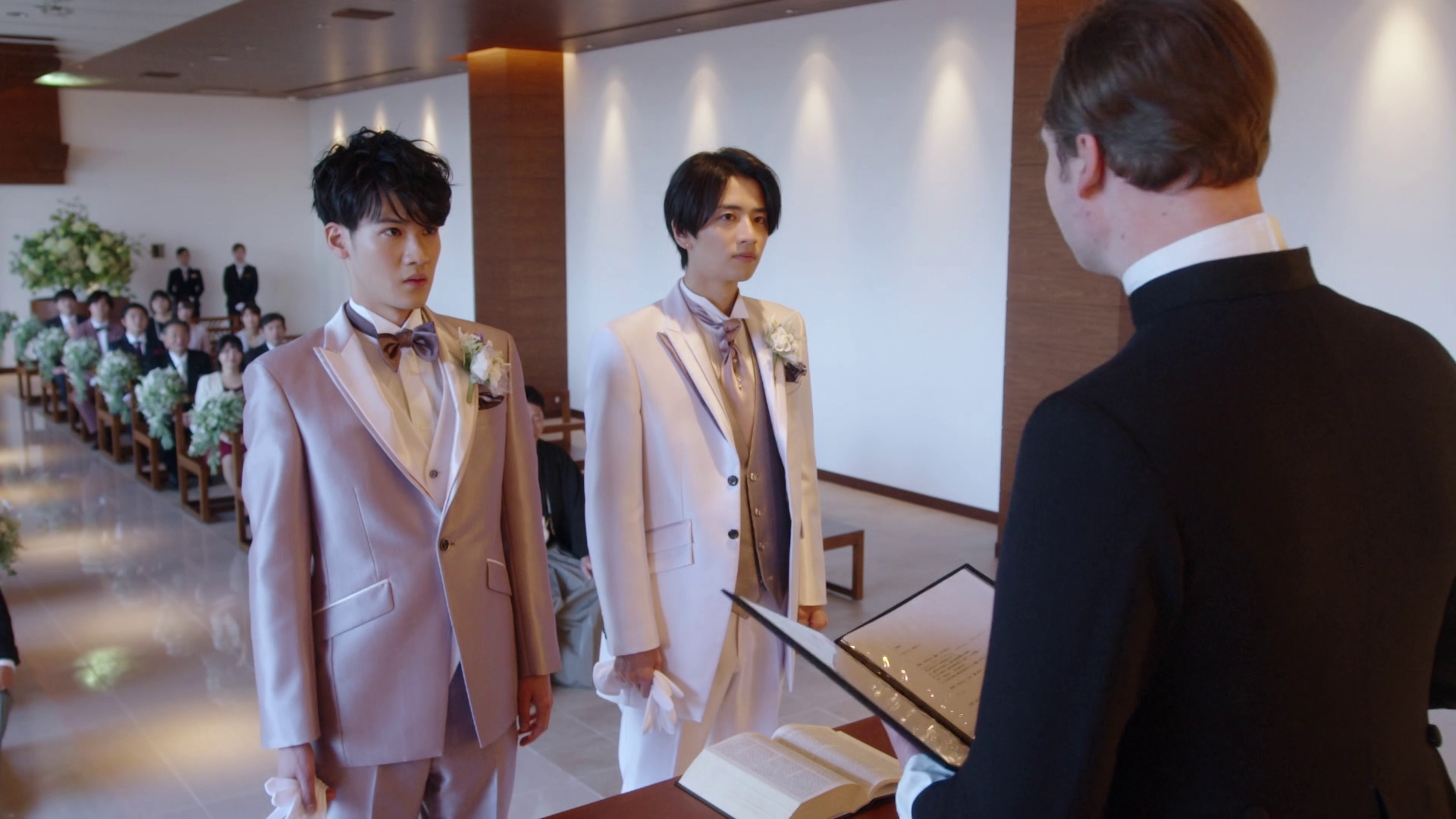
Ryosuke (Shono Hayama) is about to marry the love of his life, Mizuki (Hiroki Iijima), but there’s just one snag. He’s never got round to telling his family or any of his friends that he’s gay, and a sizeable contingent of the wedding party are under the assumption that he’s going to be marrying a woman. A recent addition to the wedding farce genre, Koji Tanaka’s We’re Both Grooms (僕もアイツも新郎です。, Boku mo Aitsu no Shinro desu.) explores both the lingering homophobia in the contemporary society and the internalised shame and fear that prevents people from fully committing to what it is they really want out of life.

It is after all perhaps a little bit strange to meet your child’s intended for the first time at the wedding, but no one really seems to remark on the fact that they have no idea who the groom is supposed to be marrying. But then again, it seems Ryosuke didn’t invite half of these people, they were reeled in by his overzealous mother who, like everyone else, has made a massive assumption. That in itself may imply that Ryosuke doesn’t have many friends. He doesn’t seem to have invited anyone to the wedding aside from his boss, the headmaster of the school where he works, whom he also hasn’t told he’s gay leading to some last minute wedding speech panic. Though his boss is keen to assure him he’s fine with that sort of thing, it’s clear his original speech was full of misogynistic jokes and male banter, while his attempts to correct himself reveal a latent homophobia.

Meanwhile, a childhood friend, again invited by Ryosuke’s mother, is on the one hand hurt he never shared this part of his life with her, and resentful as it seems she had romantic designs on him that prevented her from pursuing other relationships. Mizuki has also invited an ex to the wedding who takes Ryosuke to task for treating Mizuki like a dirty secret, asking how they can live a happy life together if Ryosuke can’t even acknowledge their relationship in public let alone tell the world of his love for Mizuki. Mizuki is also starting to feel guilty and conflicted, realising that he’s insensitively forced Ryosuke into coming out because of his desire to paper over his own anxiety about their relationship through a public commitment ceremony. Japan does not currently legally recognise same-sex marriages, but Mizuki is hoping that the wedding will clarify their relationship status and what they mean to each other, only it seems to have backfired. 

The main obstacle is Ryosuke’s traditionalist, civil servant father (Mantaro Koichi) who outright tries to stop the wedding claiming that his son is just “easily led” and must have been led astray by Mizuki. While all of Mizuki’s family know and accept that he is gay and have also warmed to Ryosuke, Ryosuke’s family do not seem to understand and cannot get their heads around the idea of two men being in a committed relationship despite the grandmother’s public telling off of her son and unexpected announcement that she too is bisexual and that her first love was another woman. Surprisingly, Ryosuke’s father explains that he used to be a delinquent so he faced familial disapproval when he married too but was warmly supported by his wife. Though he confesses that he really just wanted to see Ryosuke marry someone who would make him happy, it takes him quite a bit longer to figure out that he’s trying to do just that. 

The biggest problem remains, however, Ryosuke himself who has evidently not reached the level of self-acceptance that would allow him to fully commit to a romantic relationship, as he’s advised by the ever-helpful wedding planner trying to keep the event on track. Only once he becomes more sure of himself, can tell people proudly that he is gay and that Mizuki is the love of his life, do those around begin to see the authenticity of their relationship and accept it as they would any other. Even Mizuki’s incredibly stiff father eventually comes around with a speech to the effect that the true beauty of life lies in diversity. Despite the farcical comedy at its centre, the film ends on a surprisingly touching note as the couple reaffirm their love for each other and also see it embraced by those around them.


Trailer (English subtitles)
Brave: Gunjo Senki (ブレイブ -群青戦記-, Katsuyuki Motohiro, 2021)

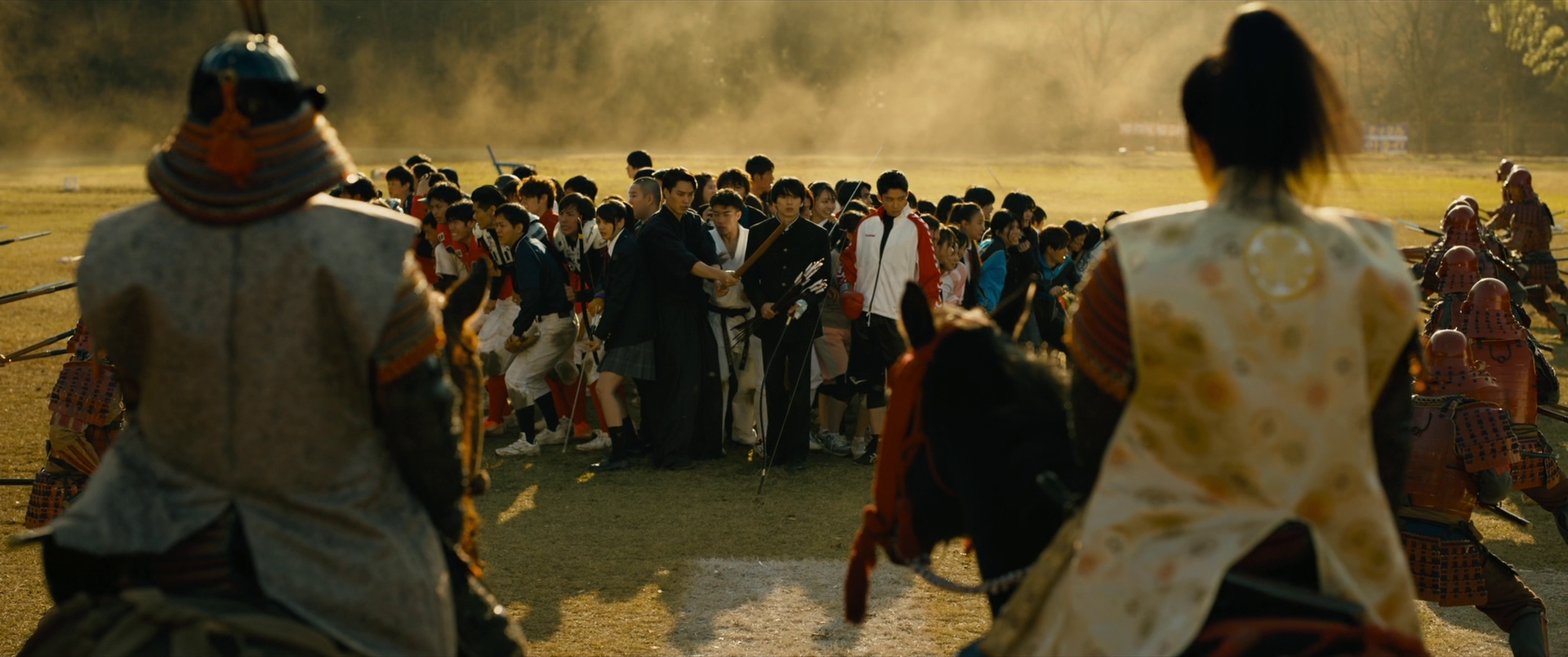
A young man with a total lack of confidence in himself begins discover his inner strength after being sent back to the Sengoku era in Katsuyuki Motohiro’s timeslip drama adapted from the manga by Masaki Kasahara, Brave: Gunjo Senki (ブレイブ -群青戦記-). Fighting a battle for the future, the kids finds themselves at a moment of historical change and caught between the titanic forces of clashing armies but paradoxically discover that they want the same thing, something the kids have always taken for granted, an age of peace in which all are free to live together happily. 

For all those reasons it’s a just as well that Aoi (Mackenyu), a diffident member of the archery club, is a keen history buff even if he declares himself uninterested in winning competitions or becoming a champion. When warriors in 16th century armour begin assaulting the school, he’s well placed to guess what might be going on inferring from some of the names involved that they must have been thrown back to the year 1560 which was something of a turning point in Japanese history marked by the battle of Okehazama in which the outnumbered forces of Oda Nobunaga (Kenichi Matsuyama) scored a significant victory against those of Imagawa Yoshimoto setting Nobunaga on a path towards the unification of Japan. 

Though armed with foreknowledge, the kids are obviously ill-equipped to cope with the demands of life in the Sengoku era having no combat experience yet this institution happens to be one of the most prominent sporting schools in the nation boasting a host of national champions all of whom discover that their athletic skills can easily be repurposed for warfare from the archers and kendo enthusiasts to the baseball and American football players while those in the various science clubs set about investigating how they got here and how they might get back. 

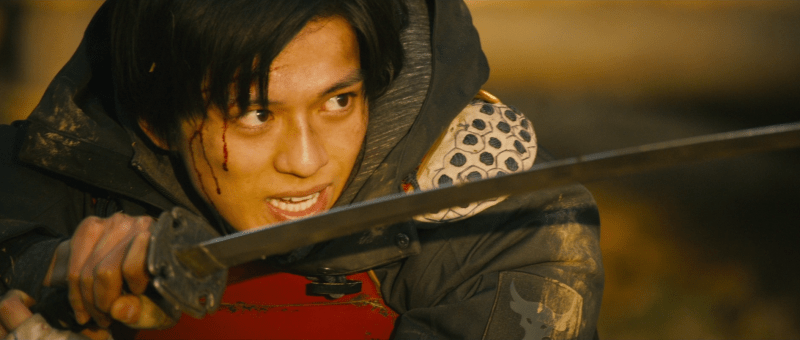
Despite being thrust into a leadership role after impressing warlord Motoyasu (Haruma Miura) who will one day become Tokugawa Ieyasu and oust Nobunaga as ruler of a unified Japan, Aoi remains diffident and fearful unable to fire his bow often walking away from the fight despite his friends’ encouragement. His problem, as is repeatedly pointed out, is that he has no self-confidence and cannot believe in himself sufficiently to act when the occasion calls. Yet through his gentle mentoring at the hands of Motoyasu, he begins to come into his own as a Sengoku era strategist realising that he has something to spur him on in the desire to protect those close to him.

This is not, however, a wholly positive thing. Despite introducing Aoi’s childhood friend Haruka (Hirona Yamazaki) as a talented archer who is much more willing to step up to the fight, the film quickly relegates her to the role of damsel in distress as it does the majority of female students many of whom are also top athletes with useful skills while the assault squad venturing to rescue students taken hostage by evil retainer Yanada Matsuna is, aside from Haruka, exclusively male. Conversely, the guys are given an opportunity to express their fear and sadness each thinking of their mothers as they prepare to risk their lives to save their friends. 

For Aoi, his friends become the light that show him the way while he remains preoccupied with history realising that nefarious forces are trying to manipulate it so that their age of peace will never arrive and Japan will exist in a state of darkness for all eternity. Though often depicted as cruel dictator this Nobunaga seems to want end the darkness by bringing about an age of peace through the unification of Japan taking solace in the idea that these strange people in their weird castle wearing bizarre clothes are from an age in which war is a distant memory meaning at least that his dream came to pass. At heart, it’s a battle between an emo teen who wants to paint the world with the darkness inside him, and a diffident young man turning away from hate and violence while finding strength in the presence and support of his friends. Boasting some impressive effects and high octane battle sequences imbued with a quirky humour as the kids use their sport skills, kicking footballs armed with bombs or throwing fiery baseballs at the confused retainers, Brave: Gunjo Senki sees its diffident hero not only taking charge of his personal destiny but the national in believing that the best way to support his friends is to make sure the world of peace they’ve always enjoyed will again come to pass. 


Original trailer (no subtitles)