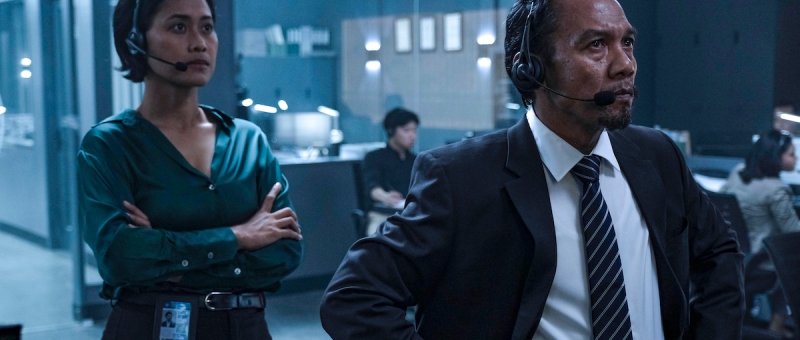
The Moon (더 문, Kim Yong-hwa, 2023)

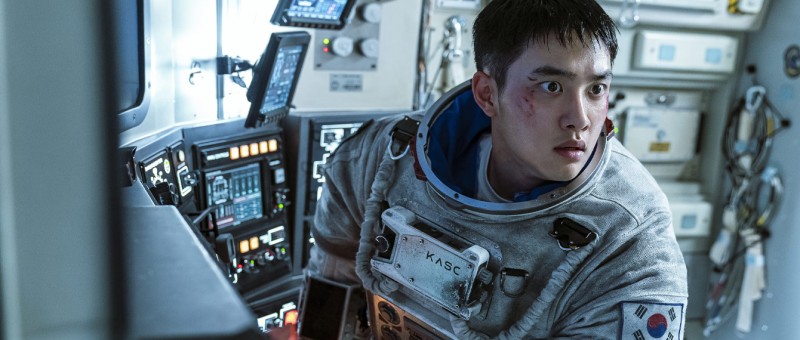
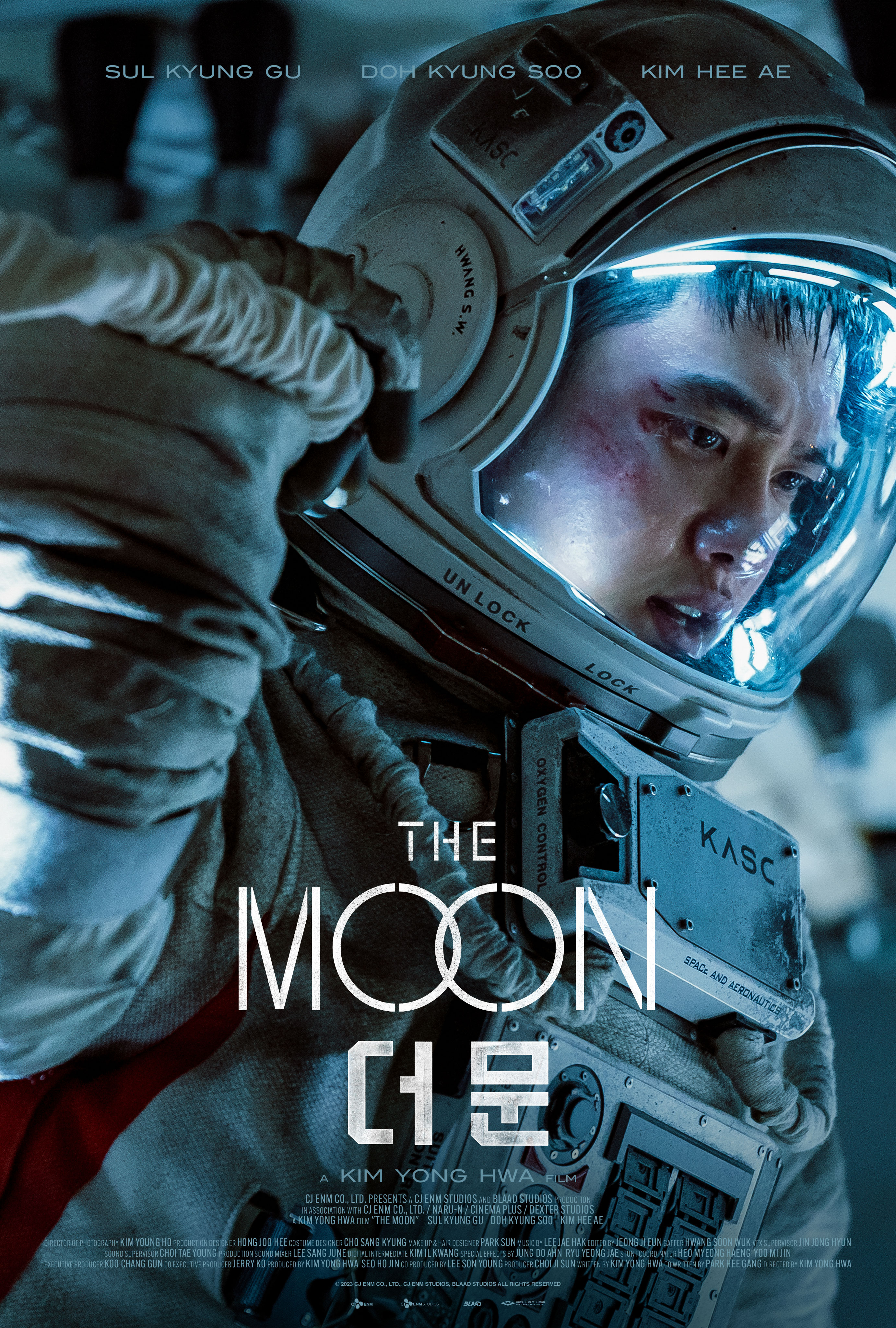
Feeling slighted by the international community, Korea attempts to dominate in space by becoming the second nation to send a man to the moon but does so apparently with egalitarian principles in Kim Yong-hwa’s futuristic science drama, The Moon (더 문). The conceit is that that pretty much everyone, having learnt nothing, is intent on colonising the moon because it is a rich source of a particular mineral that could become a valuable means of sustainable energy for Earth. Of course, Korea wants in but crucially wants to share what it finds with the world unlike the Americans who just want to keep everything for themselves.

A running current of Anti-Americanism is deeply felt early on as NASA and the US initially refuse to help when a Korean spaceship gets into trouble in a solar flare, while the International Space Committee from which Korea is expelled because of “conflicts between nations” also seems to be led by Americans. Moon-Young (Kim Hee-ae), the ex-wife of former flight director Jae-gook (Sol Kyung-gu), also works at NASA and has taken an American name after marrying an American, yet is treated with chauvinistic contempt by her bosses who question her loyalty and qualifications. The implication is that America wants to conquer the moon to secure its bounty for themselves in an ironic act of futuristic colonialism, but that the Koreans are going to the moon in the interests of science hoping to discover something that will benefit all mankind. 

Having been expelled by the committee seems to fuel an exceptionalist drive among the Korean scientists who feel that they aren’t being afforded the respect they deserve internationally. This sense of internalised shame stems from the failure of their first rocket, the Norae-ho, which exploded shortly after taking off killing the three astronauts on board. Introduced to the three members of the Woori-ho, we can immediately sense that their chances of survival can’t be good seeing as the two older members mostly talk about their children, one of them planning to decide on a name for his as yet unborn daughter on the way. The third, Sun-woo (Doh Kyung-soo), has some complicated baggage with the mission and former flight director Jae-gook who was on duty at the time the Norae-ho exploded.

Sun-woo isn’t the only one with baggage as the scientists strive to overcome the traumatic failure of their first attempt. The Science and Technology Minster (Jo Han-chul) has his eyes mostly on his own reputation not wanting to oversee another catastrophic failure in Korea’s space programme. One of the two men in charge of the Norae-ho mission took his own life in atonement, while Jae-gook split up with his wife and retreated to the mountains working in a rural observatory. Perhaps precisely because of this, the quest to save Sun-woo, a former Navy Seal hired for his agility and athleticism who lacks experience and is unable to pilot the spacecraft alone, quickly goes viral pushing the Americans, who had been reluctant to help, to finally pitch in on a joint operation.

It’s this kind of panglobalism that the film eventually advocates as Moon-young sheds her American name of Jennifer and is fired from NASA for trying to help Sun-woo leading her to make a direct appeal to the international crew of the space station who hail from Canada, Australia, and the UK to save him out of astronaut solidarity. A voiceover reminds us that the Moon belongs to everyone, not any one entity, while praising those who were able to transcend nationality and ideology to work for a better world for all. It’s obviously an anti-colonialist sentiment though one that is eagerly pointed at American imperialism and its continuing effects in Korea even if it’s also true that the nation is smarting from being kicked out of the International Space Committee and desperately wants to be readmitted to secure its status on the world stage. Kim throws just about everything he can at Sun-woo and his little lander from solar storms to meteor showers and increasing despair shifting from one set piece to another as Sun-woo tries to overcome yet another disaster and fulfil his mission of returning home with ice samples in an act of redemption not only for the space programme but for himself as its orphaned son. 


The Moon is released in the US on DVD, blu-ray, and Digital on 27th February courtesy of Well Go USA.

US trailer (English subtitles)

Yoko (658km、陽子の旅, Kazuyoshi Kumakiri, 2023)

Sometimes home is the hardest place to go. At least that’s how it is for the eponymous Yoko (658km、陽子の旅, 658km, Yoko no Tabi) in Kazuyoshi Kumakiri’s emotional road movie in which a defeated middle-aged woman is jolted out of her self-imposed inertia on hearing of the sudden death of the father she had not seen in over 20 years. As much about a moment of mid-life reevaluation as one woman’s gradual return to the world through a process of self-acceptance, the film displays a boundless empathy not to mention a sense of warmth out of keeping with a snowbound winter in northern Japan. 

At 42, Yoko (Rinko Kikuchi) lives alone in a one room apartment that she seemingly never leaves. Ironically enough, she works as a customer service assistant operating a remote chat box in which she encourages the customer to try turning it off and on again but otherwise offers little real support. When she accidentally breaks her phone, he first thought is to try contacting the online consumer helpline only to realise the irony of her situation and think better of it. In a moment of cosmic coincidence she receives a visit from her cousin, Shigeru (Pistol Takehara), who explains that her sister Rie has been trying to call but obviously couldn’t get through because of the broken phone. Yoko’s father has passed away suddenly. Shigeru and his family are making the long drive from Tokyo to Aomori and they’ve been instructed to bring Yoko with them for the funeral the day after next. 

We can tell that Yoko is no longer used to interacting with other people. Her voice is almost inaudible and her words tumble out in a half-confused jumble. Shigeru seems sympathetic and we can interpret that she’s been this way a long time, if not all of her life. He asks her if she has clothes for the funeral and is unsurprised when she gives no answer, assuring her they can sort it out when they get there while trying to cajole her downstairs and into the car where his wife and kids are waiting. The kids are, predictably, incredibly noisy and a little insensitive while the mother tries to get some sleep and Shigeru sings a folksong that was a favourite of her father’s. His spectre (Joe Odagiri), not so much a ghost as a manifestation of her memory silently, haunts her throughout the journey reminding of her of her unresolved shame and the reasons she had avoided contact with him for the last 20 years. 

These moments are full of painful melancholy but also an underlying sense of dread as if Yoko were being stalked by her own self-loathing projected onto the figure of father. After becoming separated from Shigeru at a service station and assuming she’s been abandoned with no phone and only loose change, she decides to hitchhike to Aomori and in effect travels backward meeting echoes of herself as she goes. Her first driver is a woman of about her own age (Asuka Kurosawa) in Tokyo for a job interview who reflects her buried cynicism, remarking that she resents the people she sees at service stations who to her at least seem far too happy. On learning that Yoko has no children and never married, she chuckles that she couldn’t imagine a life without out them hinting at another life Yoko might have led and perhaps quietly yearns for in her solitude. 

Yoko answers the woman with only grunts and a shake of the head, unable to communicate and in effect too shy to ask for help from passing strangers. Through her journey she gradually recovers the ability to speak, her words eventually pouring out of her in a voluntary monologue to a stranger on whose kindness she has become dependent. But in a girl she meets at the next rest stop she sees only her teenage self, the girl answering that it’s too hard to explain when questioned about why she’s hitchhiking alone in the middle of the night. When she gives her her scarf, it’s like a gift from her younger self, a small moment of embrace and support. Something similar happens as she approaches the area affected by the 2011 tsunami and meets a kindly older couple who represent her parents as she might have wished them to be rather than as they were. While the man gives her some fatherly advice, not unkindly, the woman (Jun Fubuki) gives her a pair of sheepskin boots in another gift of warmth that further proves to her that the world is full of kindness even if not all of the people who gave her rides were nice.

There maybe something in the fact that Yoko has to travel through the disaster zone in order to emerge from it, journeying towards the site of her trauma and beginning to overcome it as she comes to accept her father’s death and that is simply too late for many things though crucially not for all. What she comes to realise is, as her first driver told her, everyone has their reasons and she wasn’t the only one carrying a heavy burden. She only made it as far as she did because of the kindness of strangers and those, like Shigeru, who are willing to wait for her to come in from the cold. Rinko Kikuchi’s extraordinarily nuanced performance along with the snowbound vistas and melancholy score conjure a poignant atmosphere but one oddly buoyed with warmth in which the world can be a kind place or least as long as we can be kind to ourselves. 


Yoko screens Feb. 22 as part of Family Portrait: Japanese Family in Flux

Original trailer (no subtitles)

Hoyaman (さよなら ほやマン, Teruaki Shoji, 2023)

According to Hoyaman, a kind of superhero in the guise of a mutated sea squirt, the sea squirts’ lifecycle involves swimming around like tadpoles after hatching from an egg and then finding a nice rock to sit on at which point they lose their brains. This is what the hero of Teruaki Shoji’s quirky island comedy Hoyaman (さよなら ほやマン, Sayonara Hoyaman) is becoming afraid of, worried he’s about to lose his brain forever stuck in the home he inherited from his parents but also afraid to leave its safety to venture forth and explore some other rocks before it’s too late.

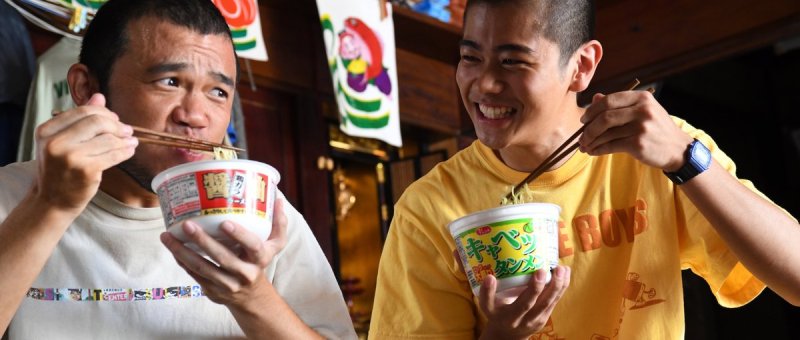
He’s jolted out of his sense of inertia by a mysterious woman, Mahiru (Kumi Kureshiro), who suddenly arrives and tries to buy his house off him though of course Akira (Afro) is not willing to sell despite being so heavily in debt he’s about to lose his fishing boat (and therefore his means of supporting himself) and he and his brother Shigeru (Kodai Kurosaki) are subsisting on a single pot of instant ramen a day. The house itself is like a kind of rock pool where the brothers are trapped in a protracted adolescence having lost their parents in the 2011 tsunami, thereafter floundering around unable to move on with their lives. As their bodies were never found, Akira hasn’t even got round to registering his parents’ deaths or dealt with any of the practical matters surrounding their living arrangements but now realises that he’ll have to something to secure a financial future for himself and Shigeru who seems to have some kind of learning difficulties and is unable to work.

That’s one reason he decides to accept the deposit from Miharu, a manga artist fleeing her life in Tokyo feeling all washed up as she too drifts onto the shore looking for a good rock to sit on. They are all looking for a kind of escape but unsure where to to find it, Akira wondering if it’s time to leave the island just as Miharu arrives. The old woman next door, Haruko (Yoneko Matsukane), who acts like a kind of surrogate mother figure to the boys, confesses that she would have liked to try living off the island and was resentful when their father mentioned the possibility of leaving. She encourages Akira to swim out into deeper waters but he continues to struggle with himself consumed by the trauma of the earthquake, his guilt, and complicated feelings about the responsibility of looking after Shigeru who likely would not be able to adjust to life outside of the island or remain behind on his own.

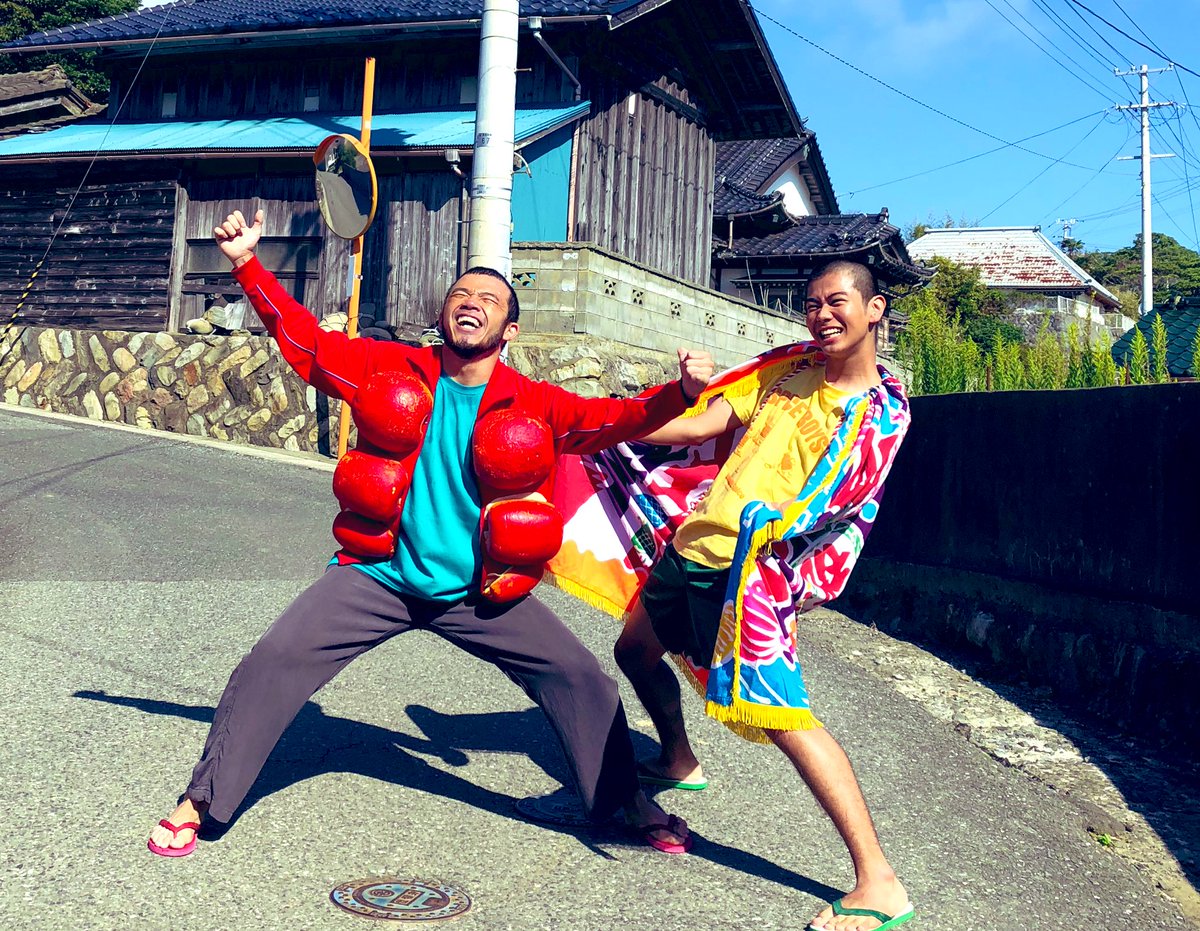
Madcap schemes ensue including an unlikely bid to become YouTube stars by resurrecting a mascot character created by their father to promote the island, Hoyaman. Miharu tries to explain to them that like everything else in the village they’re ten years behind the times, but the boys are naively excited about their prospects while simultaneously trying to recapture the past in the same way Miharu may be in admitting that she based her manga on her own younger brothers of whom Akira and Shigeru remind her. Well meaning gestures eventually backfire, but also lead to a kind clarity that allows each of them to realise who they are and where they want to be or at least what kind of rock they want to be sitting on when it’s time to jettison their brains. 

Even so, it’s not all rainbows on the island as Akira discovers when his bid for YouTube success turns sour and the villagers turn against him for embarrassing them on national scale while Miharu also has her fair share of haters along with a troubled past she’s struggling to overcome. What they rediscover is a sense of community and solidarity among those who wash up on the island whether by virtue of birth or some other happy accident. Meeting his trauma head-on, Akira is able to find an accommodation with his guilt and loss but also a way forward that might not necessarily be the one most would expect as does Miharu though buoyed by her serendipitous connection with the zany brothers, nice old lady, and the gentle rhythms of an island life.


Hoyaman screens Feb. 18 as part of Family Portrait: Japanese Family in Flux

Original trailer (no subtitles)

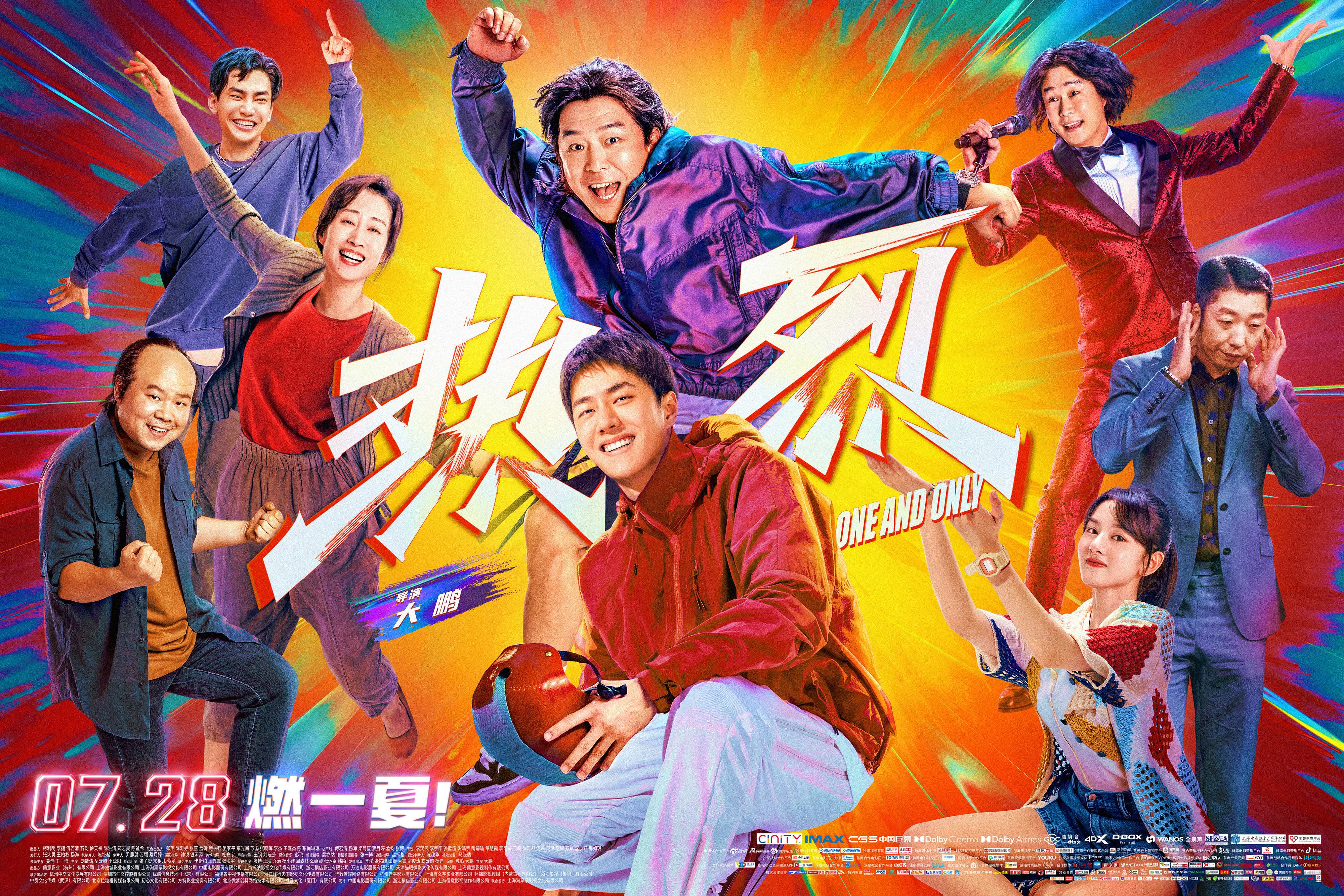
One and Only (热烈, Dong Chengpeng, 2023)

An aspiring street dancer from an impoverished background just can’t seem to catch a break no matter how hard he works in Dong Chengpeng’s inspiring dramedy One and Only (热烈, rèliè). A mild rebuke against a rising fuerdai generation of obnoxious narcissists who don’t think twice about using their money to game the system, the film not only emphasises the virtues of hard work and perseverance but the importance of camaraderie and fellow feeling over an individualistic drive to succeed. 

The conflict is encapsulated in the opening sequence in which hotshot dancer Kevin starts a fight with one of his own team members in the middle of dance competition over a move that didn’t go as planned. The problem is that Kevin is an obnoxious rich kid whose US-based father has been bankrolling the team. He plans to sack most of the other dancers and replace them with foreign ringers, only manager Ding (Huang Bo), who dared to suggest the problem was he doesn’t practice enough with his teammates, isn’t so sure. In an effort to appease him, he hires a ringer of his own in Shou (Wang Yibo), an aspiring dancer who auditioned for the team but didn’t get through, booking him to stand in for Kevin during rehearsals with the caveat that he won’t actually get to perform in any of their concerts or competitions. 

Kevin is not untalented, but his path has been easy wheareas Shou is doing a series of part-time jobs in addition to helping out in his mother’s restaurant while burdened by debts as a result of his late father’s illness. Yet he never gave up on his street dancing dream, working with his uncle doing a series of humiliating gigs at shopping malls and birthday parties never complaining but grateful for the opportunity to dance. The offer from Ding is the answer to all his prayers, but also a cruel joke in that he’s only there to sub in for rich kid Kevin until such time as he feels like showing up again. 

Ding is aware of the choice he faces even as he forms a paternal relationship with Shou whose father was also a breakdancer. To redeem himself and achieve his dreams of national championship glory, Ding thinks he has to choose Kevin and his unlimited resources but is also drawn to Shou’s raw passion and pure-hearted love of dance if also mindful of the “realities” of contemporary China where money and connections are everything and boys like Shou don’t really stand a chance because socialist work ethics are now hopelessly outdated. Ding may be outdated too, even his old friends who got temporarily rich during an entrepreneurial boom have seen their dreams implode in middle age and are currently supplementing their incomes as substitute drivers for partying youngsters. 

Tellingly, after Kevin has them kicked out of the gym he paid for, the team start training in an abandoned factory theatre from the pre-reform days where Shou’s parents used to perform, quite literally resetting their value systems after jettisoning Kevin to focus on team work and unity. Then again in a mild paradox, Ding realises that he shouldn’t lead the team by dominating It but support from within which results in a kind of democracy as he holds a secret ballot to decide whether they should stick with Kevin and a certain, easy victory, or reinstate Shou and take their chances the old-fashioned way. 

Of course, the team choose hard work and perseverance, never giving up even when it seems impossible, leaving the obnoxious Kevin to his self-centred narcissism. Kevin only really wanted backing dancers which is why he couldn’t gel with the team, whereas when challenged one on one Shou does each of his teammates signature moves proving that he’s mastered a series of diverse dance styles along with his own high impact headspring move. Heartfelt and earnest, the film shines a light on a number of issues from middle-aged disappointment and the moral compromises involved in chasing a dream but in the end reinforces the message that there are no shortcuts to success which can never be bought with money but only through sweat and tears along with teamwork and the determination to master one’s craft.


Original trailer (Simplified Chinese / English subtitles)

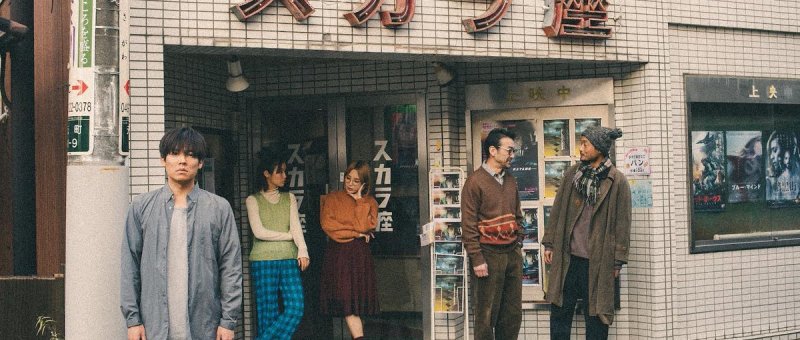
Twilight Cinema Blues (銀平町シネマブルース, Hideo Jojo, 2023)

Japan’s mini theatres have been in a status of crisis since the pandemic. Already struggling under the weight of changing times the immediate restrictions pushed many over the edge unable to entice older regulars back into screens or find a new audience among the young. This is doubly bad news for the industry as a whole as it’s mini theatres that allow indie films the platform they need to succeed and without them there is little avenue for films produced outside of the mainstream. Like Lim Kah-Wai’s Your Lovely Smile, Hideo Jojo’s Twilight Cinema Blues (銀平町シネマブルース, Ginpeicho Cinema Blues) similarly extols the virtues of the mini theatre which is not just somewhere to watch films but a place to belong that has room for anyone and everyone that wants to be there.

That’s more than true for Takeshi (Keisuke Koide), a struggling man approaching middle age who’s become near destitute and is almost sucked into a welfare scam targeting the homeless by a pair of shady yakuza claiming they run an NPO. At the orientation he runs into Kajiwara (Mitsuru Fukikoshi ), the owner of a mini theatre who declines to join the gangsters’ scheme but offers Takeshi the opportunity to bunk in his storeroom while working part-time little knowing that to Takeshi this particular mini cinema is like a return to source allowing him to rediscover his love of film.

But the mini cinema itself is also struggling. They simply don’t get bums on seats and Kajiawa is behind on paying his staff. Though they have a small collection of regulars, they aren’t enough to keep the lights on on their own. Even the projectionist is thinking he’ll probably retire along with the machine. Unable to afford new films, Kajiawara relies on cheap and easily licensable classics such as old favourite Casablanca but is largely unable to see away out of his situation while feeling guilty over ending what was effectively a family business and local landmark. The building’s 60th anniversary, 60 being a symbolic number in Japanese culture as it represents a full turn of the Chinese zodiac and literal new start, presents an opportunity to both Kajiawara and Takeshi to begin to move forward by renewing their faith in cinema.

The faith of Takeshi’s homeless friend Sato (Shohei Uno) needed no renewing. Though he had nothing, the ability to see a film twice a month made him feel human while the community at the cinema is perhaps the only one that still accepts him. He offers a small prayer after every film, and instructs Takeshi that he should the same. But his openhearted faith is also his undoing, allowing him to fall for the yakuza scam little realising they’ll force him to work for them taking half of the social security payments they helped him sign up for in the process. In the outside world, men like Sato find only exploitation and prejudice with cinema their only refuge.

Then again, filmmaking isn’t easy. A young woman who desperately wanted her debut film to play in her hometown cinema has based her first feature on the life of her father, a failed film director who drank himself to death (in a neat allusion to Oshima’s Cruel Story of Youth, her film’s title literally translates as “cruel story of a director”). Similarly, the suicide of a much loved assistant director has prevented those around him from moving on, preoccupied with the shock his death caused them in its suddenness and lack of obvious cause. They blame themselves sending their lives into a downward spiral that results in crushing financial debts and the end of a marriage. In some ways, the film is an ode to the ADs who keep everything running, including on occasions the director, and are in a sense the custodians of filmmaking.

Still, it’s clear that not everything can seamlessly repaired. Times have moved on even if some have been left behind and you can’t always simply reclaim what you’ve lost, but you can always start again with another spin of the wheel and make the most of what you’ve got. It won’t be the same, but that doesn’t mean it won’t be good. Jojo’s heartwarming tale of cinema has an undercurrent of darkness and despair running beneath, but also suggests that the silver screen can be a beacon hope when the world is at its bleakest and not least for those whose existence largely lies behind it.


Screened as part of this year’s Japan Foundation Touring Film Programme.

Original trailer (English subtitles)

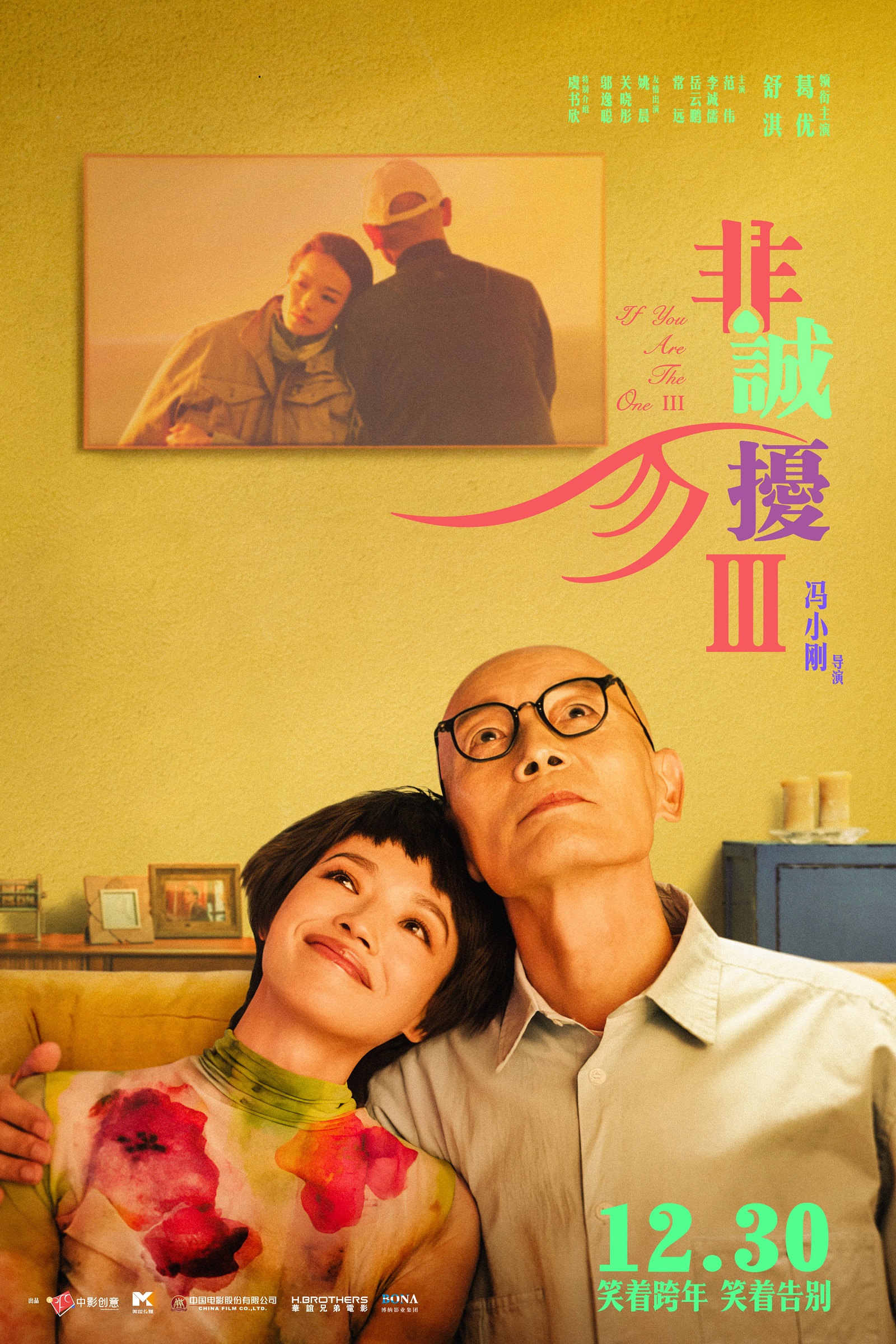
If You Are the One 3 (非诚勿扰3, Feng Xiaogang, 2023)

It’s been 15 years since the release of Feng Xiaogang’s If You Are the One, a phenomenally popular romantic dramedy in which a seemingly mismatched pair of lovelorn souls attempt to build on the spark of connection. A sequel was released in 2010 that turned a little more wistful in meditating on the brevity of life and its circular qualities, but returning all these years later Feng ventures in a surreal direction setting the film, as the sequel promised, in 2030 as Qin Fen (Ge Yu) approaches his 70th birthday in a colourful vision of an AI future.

Qin Fen still lives in the same house as he did in If You Are the One 2 only it’s had a complete redesign. Before it was cluttered and traditional, a comforting cabin overlooking the beautiful Chinese countryside but now it’s fairly minimalist and heavily stylised in a bold colour scheme that echoes the fashions of the mid-20th century. We learn that he has not seen Xiaoxaio (Shu Qi) for 10 years since she abruptly took off with a bunch on cult-like international rubbish collectors but has been patiently waiting for her return. His old friend Lao Fan (Fan Wei) who has launched a successful company selling uncannily real AI robots gifts him one that looks just like Xiaoxaio though it of course lacks her sarcastic character and is programmed to obey him totally which is how he thought he wanted but of course is nothing like the real Xiaoxiao.

At this point, the film seems to open a dialogue about the nature of love and the realities of marriage. Can the lonely Qin Fen be satisfied by this ersatz recreation of the woman he loved, or will it only cause him more pain? The answer seems to be a little of both, especially as she cannot eat or drink with him let alone sleep in the same bed. Meanwhile, unbeknownst to him the real Xiaxiao has returned but is too nervous to approach him having been out of contact for a decade, only now getting bored with rubbish collecting which is being taken over by AI robots anyway. Disguising herself as a upgraded version of the robot, she attempts to figure out how he really feels about her in a strange echo of the trial marriage from the previous film wondering if he’ll be able to figure out which version of her is “real” and which a fantasy of his own projections.

Then again, set largely within this futuristic cabin, now a little more surrounded by other similar dwellings, we might start to wonder if something else of going on and this place doesn’t quite exist in the way we think it does as if Qin Fen were literally living inside a memory. Having jumped on an additional eight years, the timelines and details do not always mesh exactly with a reappearance of Xiangshan’s daughter who should be around 30 but appears more like a sullen college student in the company of Xiangshan’s second wife, Mango (Yao Chen), who was not her mother nor raising her but apparently continued caring for her mother-in-law after her ex-husband’s death. Small splinters in the reality encourage us to doubt it, as if they corrupted files in Qin Fen’s ageing memory.

Feng presumably doubts our memory too, inserting frequent flashbacks to footage from the other movies whenever one of the returning cast allude to them in addition to providing a lengthy recap at the beginning of the film. Playing out a bit like a greatest hits compilation, the flashbacks prove unnecessarily clumsy and largely disrupt the flow of the ongoing drama while perhaps helping to fill in the blanks for those jumping in to part three without having seen one or two given that it has been fifteen years since the first film’s release. A little surprisingly given the tightening censorship regulations, Feng was able to continue the sympathetically presented running gag of Qi Fen’s male admirer, now having undergone a K-pop makeover and looking even younger, who also finds himself contemplating the nature of love after commissioning a Qin Fen robot to cure his own lovelorn desires.

A nod to the present day is given in a Lunar New Year movie-style epilogue (though the film was released around Western New Year) in which Shu Qi and Ge Yu play themselves dressed in matching outfits and nostalgically look back reflecting that young couples who came to see If You Are the One in 2008 might have teenage kids of their own or at least fond memories of an old love that wasn’t to be. Just at the end at they drop in the words that marriage is a commitment worth its weight in gold which feels like an approved message tackling the historically low rates of young people getting married. Nevertheless, it’s a cute and quirky way to bring the series to a close following the surreal absurdity of the two hours which preceded it.


International trailer (Simplified Chinese / English subtitles)

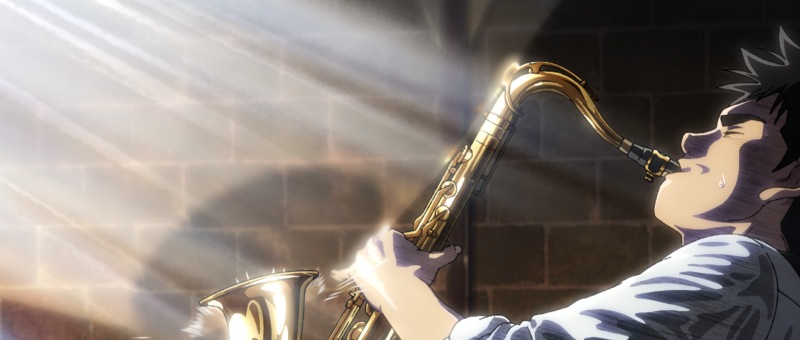
Blue Giant (Yuzuru Tachikawa, 2023)

There’s something quite poignant in the central themes of Yuzuru Tachikawa’s impassioned jazz anime Blue Giant that these very young men have decided to dedicate themselves to art that even they describe as dying. At their earliest meeting, saxophone player Dai (Yuki Yamada) and pianist Yukinori (Shotaro Mamiya) have a minor disagreement with Yukinori critical of the musicians he was previously playing with describing them as old and their lack of innovation as the reason that the art is decline but according Dai they are also the bearers of its legacy and the ensures of its survival.

It’s an ironic moment at least in that Yukihiro will also later be criticised for a “boring” performance style that plays it safe by concentrating on technical proficiency as opposed to the unbridled anarchy embodied by Dai whose determination to become the world’s greatest jazz player comes off as earnest more than arrogant and a mark of his intense self-belief which also generous and kind rather than jealous or petty. Like many anime heroes, Dai is a young man making the journey to the city and struggling to fulfil his dreams amid its various pressures. On arrival in Tokyo he struggles to find somewhere to practice that is both free of city noise and unlikely to disturb those around him but eventually discovers a small oasis not so different from the riverbank he played by in Sendai. 

We’re often reminded that music can be a lonely profession with the implication that Dai has had to sacrifice other areas of his life to dedicate himself to perfecting his art but has achieved surprising skill for only three years experience. Yukinori began playing at four and is envious of an innate talent he doesn’t believe he has or at least to the same extent as Dai. Then again, it may just be that his talent lies elsewhere and he has not yet quite discovered it. Rather than a musical rivalry the pair fall into a mutually beneficial rhythm in which they encourage each other to improve even if as Yukinori said jazz bands aren’t intended to stay together for long and are only ever more like stepping stones to somewhere else.

Their brotherhood is further tested by Dai’s decision to bring in his equally dejected friend Tamada (Amane Okayama) as their drummer despite his never having played the drums before insisting that it would be wrong to frustrate his newfound interest in music. Like the others, Tamada is struggling to rediscover himself after working hard to get into a university in Tokyo but bored by his lectures and disappointed in his fellow students who already seem to be playing the salaryman game. He’s drawn to music in part because of Dai’s love for it and it does seem to be his passion rather than jazz itself that wins over new converts to the supposedly dying art.

Dai claims to have fallen for jazz because it’s “hot” and “intense” and allows him a means to express himself in freely in a way that becomes almost infectious in its dynamism. Adapted from Shinichi Ishizuka’s manga, the animation emphasises the physicality of performance and the strength and stamina required to become a successful musician though the use of rotoscoping for additional authenticity sometimes seems oddly static and uncanny while largely at odds with the more expressive aesthetics with which the background drama is imbued. Even so Tachikawa echoes the freewheeling nature of the medium through drifting off into abstract, psychedelic sequences that attempt to visualise the transcendent and liberating quality of jazz.

Much of that featured in the film is composed by international jazz pianist Hiromi Uehara which lends a kind of irony to Yukinori’s growing realisation that his piano is the weak link as long he remains unable to unlock his potential and express himself freely through music rather than fallback on the safety and security of tried and tested techniques. In any case, it’s the relationships between them that propel the boys forward towards their respective destinies which may or may not coincide but are as much founded on friendship and solidarity as they are on a love of music.


Blue Giant opens in UK cinemas on 31st January courtesy of Anime Limited.

International trailer (English subtitles)

Images: © Blue Giant Partners

Godspeed (人生路不熟, Yi Xiaoxing, 2023)

An earnest young man does everything he can to try and impress his traditionalist father-in-law-to-be but just can’t seem to catch break in Yi Xiaoxing’s charming road trip comedy, Godspeed (人生路不熟, rénshēnglùbùshú). Seemingly a representative of contemporary youth who find themselves facing pressure from above with not only disapproving parents but exploitative bosses breathing down their necks, Yifan (Fan Chengcheng) is a classic mild mannered guy who’s been beaten down and bullied all his life but finally finds the courage to stand up for himself while battling to prove his worth to his girlfriend’s dad. 

The reason Donghai (Qiao Shan) objects to Yifan is at heart the obvious one that he can’t really accept the idea of his daughter getting married and in the end no man will ever be good enough to change his mind. But it’s also true that truck driver Donghai is an old fashioned man’s man with very strong ideas of traditional masculinity that Yifan is never going to live up to. Tall, skinny, and a glasses wearer, Yifan is a programmer at a games studio where he’s exploited by their smarmy boss who instantly turns down the game he’s made himself and tells him to pirate the latest successful games from other companies and rip them off instead. His problem is that Donghai thinks games are “immature” so his girlfriend Weiyu (Zhang Jinyi) has advised him to be economical with the truth when her father inevitably asks about his career prospects. 

It has to be said that it’s not practical to lie about something as fundamental as a job when you’re intending on forging a longterm relationship with someone, but Yifan is very focussed on the present moment and at least making a good impression on Donghai so that he’ll accept him as a son-in-law. In fact, Yifan hasn’t actually proposed yet and was planning on doing it after meeting the parents and attending the 80th birthday celebrations of Weiyu’s grandfather but things get off to a bad start when he accidentally locks Donghai in a butcher’s freezer after minor misunderstanding causing him to become fused with some giant slabs of pork. Donghai doesn’t like his “childish” fashion sense, so Yifai switches to smart shirts and trousers to try to please him but is never really sure if Donghai appreciates the way he’s changing to live up to his idea of “maturity” or in fact thinks less of him for it in his infinite desire to please. 

“You’re going the wrong way,” Weiyu’s mother Meimei (Ma Li) tries to tell Donghai in a more literal sense as she and Weiyu end up taking their car with Yifan and Donghai in the truck because Donghai insisted there wasn’t enough room for Yifan and the family dog. Donghai is afraid that Weiyu will “go the wrong way” with a man like Yifan, but is also going down a dangerous road himself in refusing to accept that his daughter has grown up and can make her own decisions as regards her romantic future. He wanted her to marry childhood friend Guang (Chan Yuen) who has since become incredibly wealthy, but even he is later exposed as a poser who has also “lied” about his financial circumstances in what seems to be an ongoing rebuke of the obnoxious superrich also exemplified by Donghai’s arrogant frenemy and his high tech caravan not to mention spoilt grandson with a Western name. 

Yet what Yifan comes to realise is that there is no “right way” except his own and it’s time for him to stop simply accepting the injustices of the world around him as Donghai has also been doing in appeasing a gang of petrol thieves who’ve been terrorising trucker society for the last few years. Together, they each begin to break free of their decade’s long inertia, Yifan deciding to be his own man and a “company owner” after all and Donghai embracing the freedom of retirement and the open road on going on a second road trip honeymoon with Meimei. The older generation has to learn to let the other one go, stepping back and getting out of the way of their children’s happiness, while simultaneously regaining a kind of independence to start a new life of their own. Flat out hilarious in its improbable mishaps but also poignant and heartfelt in its central relationships, the film’s zany sense of optimism and possibility become a winning combination as Yifan discovers the courage to step into himself and be his own man no longer beholden to a bullying society.


International trailer (Simplified Chinese / English subtitles)

Under the Light (坚如磐石, Zhang Yimou, 2023)

The irony at the centre of Zhang Yimou’s Under the Light (坚如磐石, jiānrúpánshí) is that it takes place in a neon-lit city of eternal visibility, though of course where you have light you’ll also find shadows. Even so, it appears he’s trying to make a point in the plain sight nature of political corruption and it’s connections with organised crime. At heart it’s a tense cat and mouse game between two men who share some kind of sordid past, but also of how it’s the next generation that often pay in the infinitely corrupted paternity of the contemporary society.

Zhang opens with a hostage crisis as a man hijacks a bus and threatens to blow it up if he doesn’t receive a visit from deputy mayor Zheng Gang (Zhang Guoli). Zheng attends but his policeman son Jianming (Lei Jiayin), currently assigned to the tech division, notices that the bomb can be detonated remotely and it doesn’t appear the hostage taker knew that it was real. In any case, all is not as it seems and as Zheng is soon squaring off against shady businessman Li Zhitian (Yu Hewei) who invites Jianming to dinner and puts on a show by blackmailing another business owner with a sex photo before forcing him to put his hand in boiling oil. 

In contrast to his ruthless exterior, Zhitian dotes on his grown up daughter currently pregnant with her first child and about to be formally married to his business heir David (Sun Yizhou). Jianming meanwhile has a complicated relationship with his father by whom he feels rejected in part because he’s adopted. Zheng also appears to be meeting with a mysterious young woman for unclear reasons, later hinting that she’s a kind of daughter figure someone at some point asked him to protect. In a strange and probably unintended way, it’s this parental quality of protection that has been disrupted by ingrained corruption and is then re-channeled in a desire to protect society in general. When it’s all over, Jianming asks his bosses why they trusted him to make the right decision, and they tell him it’s because he told them he wanted to be a “true policeman” for the people.

Apparently stuck in limbo for four years because of censorship concerns, the propaganda thrust of the film centres on the crackdown against political and judicial corruption. Zheng is engaged in a political project to target corrupt officials but is heavily implied to be on the wrong side of the fence himself which would explain his connection with Zhitian, a supposedly self-made man who keeps a heavy pole in his living room to remind him of his roots as a lowly porter in a rural town before taking advantage of the ‘90s economic reforms to make himself wealthy beyond his wildest dreams. 

They each have hidden secrets which Jianming becomes determined to drag into the light while working with the anti-corruption officers in his precinct, as well as old flame Hui-lin (Zhou Dongyu). Zhang adds in some distinctly retro comedy vibes not least in the frustrated romance of Jianming and Huilin who at one point dangle dangerously off a building while she later bites back, “don’t deprive me of the chance to protect you. It’s what they call love” when firing a pistol at a bunch or marauding bad guys. Yet the comedy seems incongruous with infinite bleakness of the resolution in which once again the children are made to suffer as Jianming comes to a greater understanding of his origins. 

In an ironic touch, the villains are later revealed to have been dyeing their hair which is in reality already white though they are not really all that old. Playing into the themes of duplicity, it also hints at the central message that the older generation must recede and the young, like Jianming, learn to find an accommodation with their failures in order to reclaim a sense of justice. Then again, the film itself is quite duplicitous with a series of glaring plotholes including a giant one relating to the DNA identification of a missing woman whose body is finally dragged into the light. Huiling warns Jianming that there are some boxes it’s better not to open. At the film’s conclusion he may wish he’d listened, but his job is to drag truth into the light and not least his own. In any Zhang’s infinitely bright, ever illuminated city of neon and glass has a host of hidden darkness only temporarily exorcised by the unusually lengthy parade of the now standard title cards explaining that the wrongdoers were caught and punished while deprived of their ill-gotten gains no matter how much it might seem that crime really does pay.


International trailer (Simplified Chinese / English subtitles)

Moscow Mission (93国际列车大劫案:莫斯科行动, Herman Yau, 2023)

In the early 1990s, China and Russia were each struggling to accommodate new political and economic realities. This is at least one reason offered in explanation for the nexus of crime that overtook the long distance train connecting the two capitals in Herman Yau’s action drama Moscow Mission (93国际列车大劫案:莫斯科行动, guójì lièchē dà jié àn Mòsīkē xíngdòng). Inspired by a real life train heist in 1993, the film suggests that China was pulling ahead free of the labour protests which appear frequently in Moscow amid the collapsing Russian economy but equally insists that the bandits must be stopped because they not only endanger China’s international reputation but its trading relations with the former Soviet Union.

In truth there’s no real reason given for the mysterious D’s (Huang Xuan) heinous crime spree save a later allusion to a troubled childhood and the sudden death of his sensitive musician father when he was only 13 (which would put it shortly before the end of the Cultural Revolution). In any case, those around him have more complex motivations such as those of Zhenzhen (Janice Man Wing-San), a former sex worker employed by the gang to identify wealthy passengers and inform the rest of the crew by note, who needs the money for a sick relative. In any case, nearly everyone on this train is concealing vast amounts of hard cash, mostly in their underwear. Not content with the money, D also stops to rape a woman who had resisted but was found with a large amount of money stuffed in her bra. 

In short, there’s nothing noble about D’s gang or any implication they’re rebellious outlaws just thuggish crooks taking advantage of a geopolitical vulnerability. Local fixer Vasily (Andy Lau Tak-Wah), however, is otherwise depicted as a victim of circumstance cruelly separated from a then newborn daughter for whom he is continually searching. He made his money digging a tunnel from Shenzhen to Hong Kong and using it to smuggle luxury goods in much the same way many now use the train as is evident by the scenes at Russian station when passengers suddenly start leaning out windows flogging pairs of jeans. Vasily’s in on that trade too, as well attempting to broker a deal for a wealthy man to buy a former Soviet fighter jet, but seems unhappy with his life of petty crime selling fake passports to dodgy people and also has an ongoing non-romance with Zhenzhen who is trapped in an abusive relationship with D’s brother-in-arms Zhiwen (Jason Gu Jiacheng). 

Intense police captain Cui (Zhang Hanyu) is dispatched to catch the train robbers and avenge China’s international reputation by bringing order to the train but also stumbles on another crime in progress in the Russian capital. He has an opposite number in Sergey (Andrey Lazarev), a former KGB now FSB officer who hints at a new world order if also at a society very much in flux. In some ways the film suggests Cui’s inevitable victory is aided D’s hubristic overreach and the cooperation of the Russians rather than his own powers as a Chinese policeman, but also that China will clean up after itself taking down a Chinese gang while technically on foreign soil and making sure they return to China for justice. 

Yau opens strong with the high impact sequence of the original heist as the camera first pans along the inside of the train before finding Zhenzhen and then rest of the gang, while otherwise continuing to escalate the action with a climax at an abandoned rocket base and then a final shootout at the train depot where the carriages must quite literally change the gauge to shift from the old Soviet railways to the modern China. The gang members may implicitly be among those who’ve lost out in the face of new economic realities, though aside from D’s possibly duplicitous musing on the life he might have led if his father had not died leaves them little justification for the cruelty of their crimes. Meanwhile, Cui’s justice is not implacable, taking pity on both Zhenzhen and Vasily and promising to treat them fairly in acknowledgement of their cooperation as opposed to D who had problematic gang members bumped off by the possibly the worst hitman in Moscow and has been using Vasily’s daughter to manipulate him for last few years with no certainly that he actually knows where she is. Making a minor point about empty consumerism in the constant references to stolen watches, Yau goes big on spectacle but also homes in on the smaller stories of trauma and displacement that eventually provoke it.


International trailer (Simplified Chinese / English subtitles)