Hidden Face (히든페이스, Kim Dae-woo, 2024)

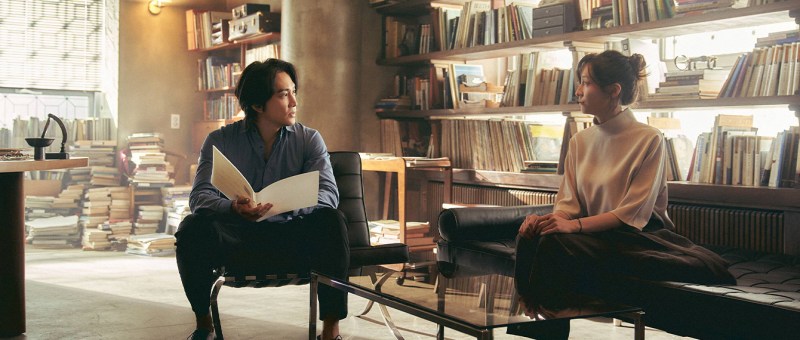
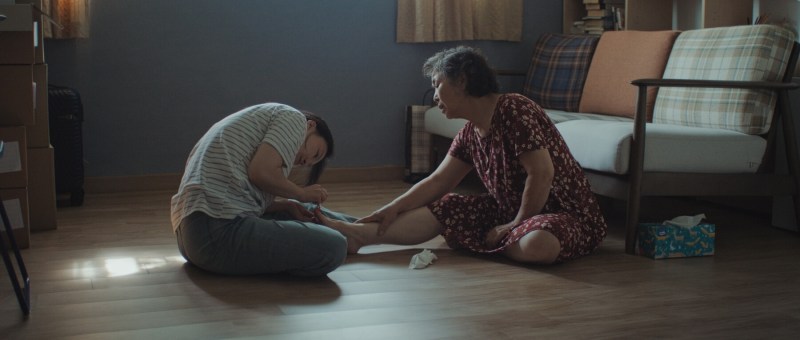
The obvious irony in the title of Kim Dae-woo’s erotic thriller Hidden Face (히든페이스), is that it refers both to the heroine, Su-yeon (Cho Yeo-jeong), who conceals herself within a secret bunker in her home to spy on her indifferent social climber boyfriend Sung-jin (Song Seung-heon), and to the sides of themselves that people choose not to reveal to others. As Su-yeon’s mother (Cha Mi-kyung) says, it’s what people see that matters, but the hidden corridors of Su-yeon’s home symbolise the ways in which she has imprisoned her true self or at least has locked a part of herself away from prying eyes while continuing to pry into the secret lives of others.

It’s in this forbidden space, apparently added to the house by the previous father’s owner who was a member of notorious Japanese Unit 731 during the war and feared exposure, that Su-yeon first kissed fellow student Mi-ju (Park Ji-hyun) with whom she’s been in a long-term, but apparently secret, relationship. While Mi-ju is patiently renovating the house she thinks they’ve bought together, Su-yeon has decided that she wants a “real life that people recognise”, which she evidently doesn’t believe a same-sex relationship can be. The forbidden space of “cold room” is then where she’s locked her queerness, and a manifestation of her fears of the consequences of exposure. The problem is that she doesn’t even like Sung-jin and the points of attraction he seems to hold for her are that he doesn’t like her either and is otherwise easy to manipulate because of the vast class difference between them. 

Part of the reason that Sung-jin keeps Su-yeon at arms’ length is that he resents the power that she holds over him. He resents both her and himself in knowing that he’s really only with her for material reasons, while simultaneously aware that his current success has nothing to do with his own talent and everything to do with Su-yeon’s privilege. Su-yeon’s mother congratulates him on working hard to build an image of himself, while otherwise needling him about his working-class background in which his mother ran a small restaurant and really knows nothing of this elite world of classical music, mansions, and honeymoons to resorts that charge some people’s annual wage for a single night’s stay. But the facade can’t really cover up Sung-jin’s insecurity and the fear that he couldn’t make it on his own though he so desperately wants to be a part of this world and to feel himself worthy of it. He feels emasculated and humiliated in assuming that other people can see that he’s just a puppet while Su-yeon, her mother, and their advisor discuss policy decisions he’s technically responsible for out in the open, he assumes to deliberately embarrass him and keep him under control. 

Yet the truth is that these kinds of hierarchal power structures of class and gender are less relevant when it comes to desire than otherwise might be assumed. Su-yeon refers to Mi-ju as her slave or underling and adopts a dominant role in the relationship yet eventually has the tables turned on her when Mi-ju decides to rebel. The power dynamic of desire is a push and pull between the desire and the desired mediated by the depth of yearning. It may seem to Su-yeon that she is in control, but equally Mi-ju derives power from her willing submission and can overturn the dynamic at any time she chooses upending Su-yeon’s delusion that Mi-ju is a mere plaything, or “tool”, she can take out and put away at will. 

Nevertheless, the question is whether anyone could be content with this shadow life or if Su-yeon, vain, psychopathic, and probably incapable of understanding other people’s feelings, is content to imprison herself within the hidden corridors of her home which come to stand in for the need to conform to the heteronormative, patriarchal, class-based social codes other people see as “real” and “normal”. Sung-jin is apparently all too willing, considering just leaving Su-yeon trapped behind their walls to continue enjoying this life of privilege with a little more freedom without considering that without Su-yeon he has no entitlement to it as her mother later suggests after becoming worried on realising that Su-yeon hasn’t used her credit in days which is extremely uncharacteristic behaviour.

Sung-jin would trade his pride as a man, his sense of self-worth, and even betray his moral code to appear wealthy and successful and deny his working-class origins. Su-yeon would also, it seems, rather be in a conventional marriage to a man for whom she feels only contempt and resents for not liking her, than live an authentic life as a lesbian and face her internalised homophobia along with that of the wider society. Thus she confines Mi-ju to a forbidden space of her mind in an attempt to have her cake and eat it too, while Mi-ju seemingly fulfils herself in wilfully becoming a prisoner of love, even if it may only be in Su-yeon’s fantasy. Perhaps they get what they wanted all along, affirming the primacy of privilege, but only at the cost of their authentic selves and trapped inside the prison of their own self-loathing.


Hidden Face is released Digitally in the US on September 16 courtesy of Well Go USA.

Trailer (English subtitles)

MA – Cry of Silence (မ – Cry of Silence, The Maw Naing, 2024)

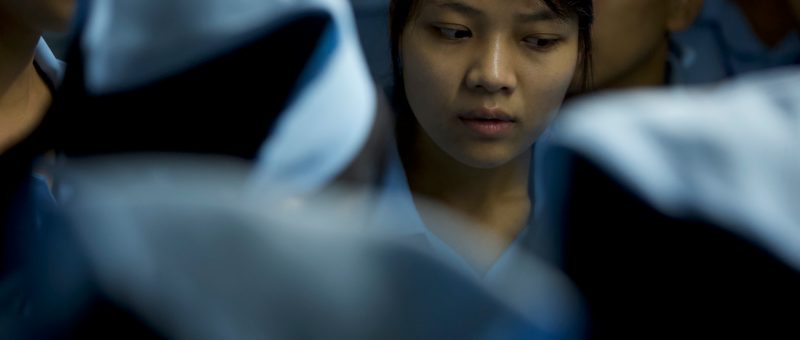
After their factory withholds wages for two months, seamstresses decide they have no other option but to strike in The Maw Naing’s hard-hitting drama, Ma – Cry of Silence (မ – Cry of Silence). As the opening title cards explain, Myanmar has seen a series of military coups over the last few decades and is now in a state of civil war. The military’s burning of villages has forced young people into the cities in search of work and shelter, but also left them in a precarious position and vulnerable to exploitative conditions. 

Mi-Thet, at least,ƒ is haunted by memories of her village burning and lives in a kind of hell where smoke is always on the horizon. She has a job as a seamstress and lives in a dorm with other young women in similar positions, but the factory hasn’t paid wages in two weeks and the landlady is beginning to get fed up. She snaps at the girls and ironically asks if they want her to starve to death, laying bare both the domino effects of this world in collapse and the pervasive heartlessness of capitalism. At the factory, the Forman watches over them, ruler in hand and often strikes them if he thinks they aren’t working hard enough while they’re terrified of taking breaks or visiting the bathroom because he also peeps on them or tries to extract sexual favours which some of the girls grant because they need the money.

The foreman’s face is kept offscreen and even when the women confront him, he appears as a ghostly silhouette behind the plastic sheeting. The factory boss, even when he supposedly arrives by car, is never seen at all. It may be that the political situation makes it impossible to run this kind of business, but at the same time it seems more like the factory just don’t want to pay the women because they think they don’t have to. After all, they have money to hire thugs to break up the protests when the women decide to strike rather than just giving them what they’re owed. The foreman alternately threatens them and makes false promises of payment that the women can’t believe because they’re still owed so much money even though as Mi-Thet says, she spends her days between the factory and the dorm. It wouldn’t surprise her if she died at her machine, while one of the others quips they’d still keep them working after they died.

Mi-Thet remains on the fence about even joining the strike, as do many of the other women afraid of the repercussions and of losing the money they’re owed entirely though it doesn’t seem as if it would be paid anyway. Her neighbour U-Tun who is disabled and is covered in scars from the 1988 protests for democracy remains world-weary and not so much encouraging as fatalistic but offers Mi-Thet a series of books that help her commit to the cause though it’s seeing her friend who works as a maid be badly beaten by her employer that convinces her they have to act now. 

As U-Tun says, the country should have changed but it stayed the same, while Mi-Thet can’t figure out if they’re emerging from the darkness or walking deeper into it. News reports speak of torched villages and refugees but also of the food shortages the destruction has caused. Even the cook at the dorm complains prices have gone up so much she can’t get good food and says she’ll cook better when they pay her more. “Better” doesn’t really matter at the factory as long as the girls hit their quotas, but workers can’t work on empty stomachs and no sleep even as the foreman seems intent in working them to their deaths. Mi-Thet and the others attempt to stand up against this cyclical destruction, but discover that they have almost no power and the factory owners don’t care at all if they live or die because they think there’s an endless stream of displaced girls looking for work. Gunshots and the rumble of fire echo in Mi-Thet’s ears, but ultimately she discovers herself trapped within this historical loop but issuing a rallying cry to the youth of Myanmar to rise up against this continuing oppression.


MA – Cry of Silence screened as part of this year’s New York Asian Film Festival.

Trailer (English subtitles)

To Kill a Mongolian Horse (一匹白馬的熱夢, Jiang  Xiaoxuan, 2024)

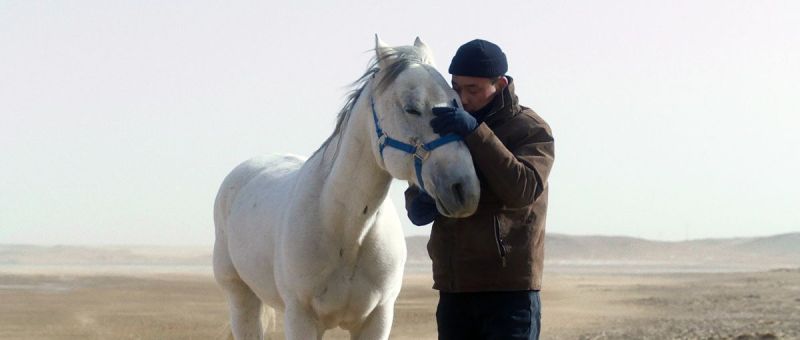
The Mongolian Steppe is known for its vastness and ever-extending horizon, but for Saina it’s shrinking to the extent that seems to be homing in on him and threatening to destroy the only environment in which he feels he belongs. Saina is himself often likened to a runaway horse, though he’s forever catching them and bringing them back, longing for a world in which he could exist within this natural environment just as his ancestors did but finding only futility everywhere.

Once a racer, Saina injured his shoulder and is now relegated to the sidelines while trying to find other ways to work. His father, a broken man who drinks and gambles, has already sold off most of his sheep and is on at Saina to sell the horses too. His friend Hasa has also sold up, first rejoining the circus but then declaring himself sick of being a herdsman. After getting injured he decides to try his luck in the city and ironically ends up getting a job working for the mining company that is quite literally disrupting the foundations of Saina’s life.

The main enemy is modernity, but it’s delivered by the Chinese. Saina finds himself surrounded by Mandarin speakers, while it’s a Chinese mining company that is gradually buying up the Steppe to open a mine and eventually tries to force Saina and his father off their land. Saina’s father keeps telling him a Chinese horse broker could get them a good deal, but he’s also told that his beautiful white horse isn’t worth very much because it’s Mongolian. It’s meat wouldn’t even be worth as much as a cow’s, though that’s the only reason the broker is interested in it.

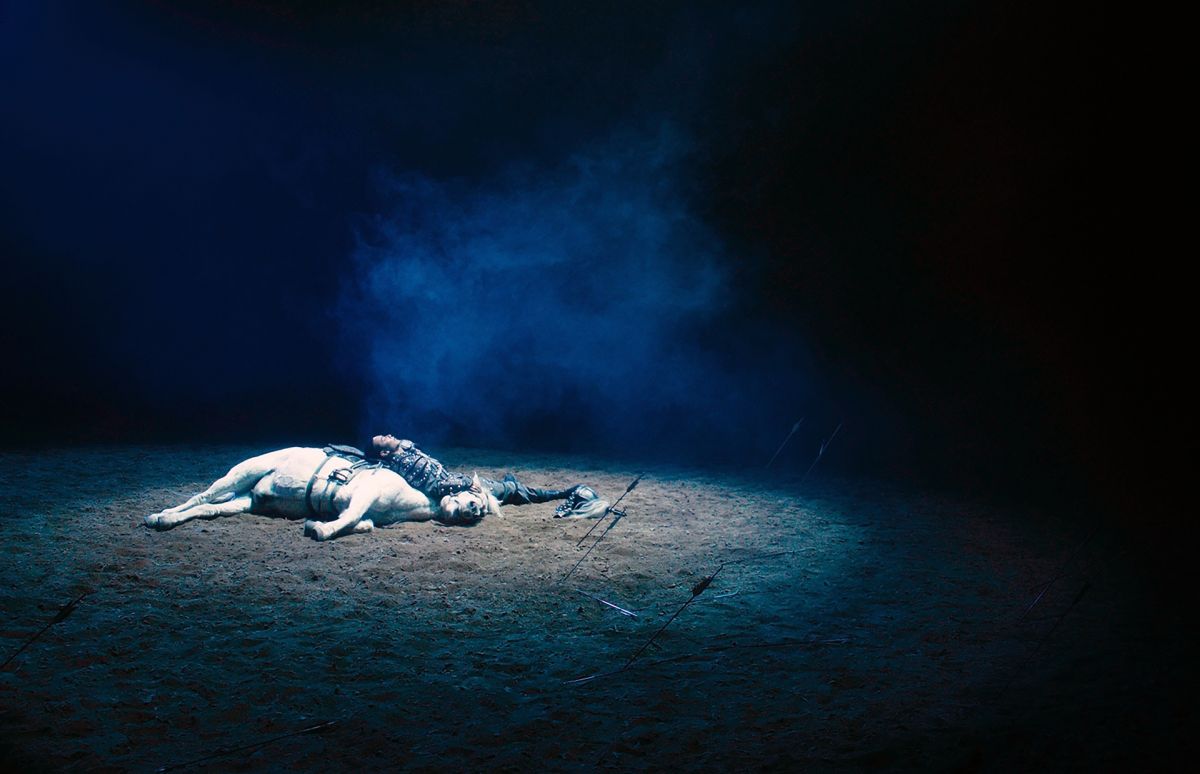
Nevertheless, it’s largely for Chinese tourists that Saina is obliged to parade his culture. He takes part in Medieval Times-style dinner shows where the audience is repeatedly reminded they can buy drinks for their favourite riders and carrots for the horses, though the riders and horses almost certainly don’t see them. Saina rides dressed as a heroic Mongol warrior, but has dreams of himself dying on the battlefield alone with his white horse. His ex-wife Tana encounters something similar, as her Chinese boss makes her serve drinks at dinner parties with Chinese businessmen while insisting she sing a Mongolian song for the local colour. Later Saina gets a job at a ranch where city slickers come to experience life on the Steppe, but complains that the tourists ride the horses too hard and end up injuring them. They don’t have a connection to the land or know how to treat animals, while the ranch owners exploit the horses in the same way they exploit Saina, taking little interest in their physical wellbeing only their ability to work. At the show, Saina discovers his horse is injured and asks to switch to another one to let it rest, but encounters resistance in being told to get higher approval from the boss.

Meanwhile, he applies for a job at a fancy equestrian facility but is basically told he’s too he’s common for this elite, aristocratic Western sport that’s no longer about racing but fine technique. The snooty woman who interviews him says that Mongolian riders don’t ride properly and their skills aren’t needed somewhere like this. Saina could possibly start from the ground up as a stable boy but most of those are teenagers. Meanwhile Saina reflects that his father never actually taught him how to ride, he just placed him in the saddle and left the rest up to him with the natural consequence that it feels like something that is innate and essential. Yet he wonders if his son will ride at all or if these grasslands will still exist when he comes of age. Tana lives in the city and wants to send the boy to a school she thinks is better where they speak Mandarin and English while Saina is worried he’ll lose his Mongolian. When he puts him on a horse, the boy is terrified and asks to get off. All Saina really seems to want is to ride horses and raise sheep, but this way of life is dying out and the grasslands are shrinking all around him. There is something quite sad and defiant in his riding of his horse along a motorway in the juxtaposition between the traditional way of life and the modernity which all but destroyed it even as Saina is seemingly left with nowhere to go and no place to roam.


To Kill a Mongolian Horse screened as part of this year’s New York Asian Film Festival.

Trailer (English subtitles)

Travesty (Гажуудал, Baatar Batsukh, 2024)

“One man’s screams will not fix this social travesty,” according to an exasperated police officer sent in to quell a hostage crisis in a quiet rural town in Baatar Batsukh’s Mongolian crime drama. Led by chapter headings reading The Town, The City, the Nation, The State, the film pushes deeper towards the centre of corruption in an indifferent society in which the lives of citizens are barely valued and the authorities will do little to protect them. Indeed, the hostage taker’s claims that he will kill one person an hour seems to stand in for the slowly ticking time bomb of governmental indifference.

Or at least, that’s how it seems to Davaa whose teenage son keeps ringing him but he can’t help because he’s so far away on a case. His absent paternity seems to echo the ways in which the old have abandoned the young. The hostage taker turns out to be a young man who feels left out and hopeless. Rendered mute during his military service, he tried to sue the government but couldn’t while his mother, who worked for the government her whole life, ruined her health doing so and then was unfairly denied a loan to pay for medical treatment. The boy’s father appears to have been in the military, but is otherwise not around leaving him alone after his mother’s death having lost pretty much everything, which is why he takes revenge by holing up in the hospital with 20 hostages and asking 1 billion Mongolian tugrik a person. He’s clearly putting a price on a human life, but then so is the government when it declares I won’t pay.

The fact that it’s the hospital he takes over obviously has knock on consequences preventing local people from accessing health care, but the government does that too. As the doctor points out, rural hospitals are understaffed and under resourced. They can only offer basic services and send more seriously ill patients to the cities, but there aren’t enough beds there either so those like the hostage taker’s mother are sent back anyway. Meanwhile, a local crook’s ageing wife goes into labour with her fourth child which will earn them a medal from the government. The pregnancy is high risk and the doctor is worried about her because all of her previous births have involved complications which endangered the life of mother and child. But the woman insists she doesn’t care about the risks and is willing to die to get the medal from the government even though it appears they won’t care very much about her child after it’s born and fulfils their aim of expanding the population. 

Her husband is well known to the local police who’ve rounded up two other petty crooks who are listening intently to the unfolding crisis from their place in the cells. These middle-aged men, one of whom is a former nurse, don’t seem to have much to do except get into trouble. The police are doing their best, but like the hospital, they’re also under staffed and under resourced. A hostage crisis in their tiny town is an absurd development they have no idea how to deal with which is why Darvaa is dispatched to deal with it. The town can’t hope to raise the money the hostage taker is asking for, while the government could but it won’t pay despite Davaa’s please that they just give the hostage taker what he wants so he’ll stop executing people. When the authorities eventually turn up, it turns out they’ve lied. They didn’t bring the money and are planning to storm the building to end the crisis quickly without giving much thought to the hostages’ lives. Taken hostage himself, their representative grovels and pleads but refuses to offer the apology Davaa suggests as a last resort to appease the hostage taker with whom he has come to sympathise. 

A late twist makes the situation all the more tragic with the boy another victim of governmental indifference which would rather kill first and then refuse to answer any questions later. They try to fob Davaa off with a promotion in return for his silence, but he refuses while implying that he doesn’t really want to talk about this whole sorry affair either and would rather to get on with his job and looking after his family. In any case, the government representative seems more concerned that Davaa will embarrass him by exposing how he grovelled and begged for his life rather the fact they acted with callous disregard for the lives of the hostages and failed to take into account the fragile mental state of the hostage taker. The travesty is then not the hostage crisis but the state of the nation in which the citizens are themselves taken hostage by an indifferent and oppressive authority which extracts its ransom but offers little in return.


Travesty screened as part of this year’s New York Asian Film Festival.

Trailer (no subtitles)
Seppuku: The Sun Goes Down (陽が落ちる, Yuji Kakizaki, 2024)

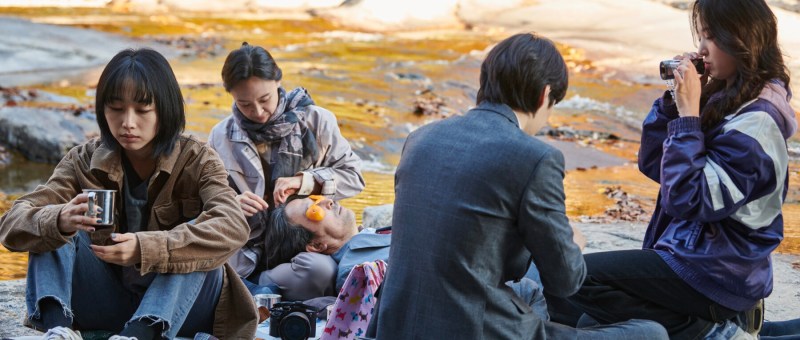
What’s more absurd, that the shogun orders a man to take his own life in atonement for accidentally damaging his favourite bow or that the samurai actually does it without protest? There is something a little uncomfortable about Yuji Kakizaki’s Seppuku: The Sun Goes Down (陽が落ちる, Yo ga Ochiru) as it, unlike many similarly themed samurai dramas, seems to find only nobility in such a senseless death rather than outrage against a word in which a man must die for a careless and inconsequential mistake.

Indeed, the worst outcome Kyuzo envisages is that he’s going to get the sack from his job as a castle guard and his family will suffer both a reputational loss and financial hardship because of it. His wife, Yoshino, is quite prepared for the latter, stating only that they will soon adjust to living more simply. No one seems to be thinking that this is anything other than a minor incident that will soon blow over, which is why it comes as such a shock to Kyuzo’s best friend Denbei that his friend has been ordered to commit seppuku and that he must be the man to deliver the message the next morning. Kyuzo is currently under house arrest, which means that were Denbei to visit him before that, he too would be committing an offence and could end up suffering the same fate. The best thing he can do, as his wife advises, is to go there and sing a song outside conveying the difficult news through poetry while maintaining plausible deniability. 

Alternate forms of communication become a kind of theme with Yoshino deciding to fulfil the dreams of her loyal maid, Shige, by teaching her to read and write explaining that one may say in a letter that which they otherwise could not. Shige is from a peasant farming family and on her return to them after Yoshino decides to dismiss her so that she won’t be caught up in it when they deliver her husband’s death warrant which could, in fact, order everyone in the house to die, Shige’s family remark that they can’t understand these “cruel” samurai who are expected to surrender their lives over something so trivial. Yet Shige’s father who is currently bedridden with illness instructs her to go back knowing that it may mean her death because her duty is serve the family she was indebted to right until the very end. Shige even gives her father the comb and money Yoshino had given her to open a restaurant to pay for medical treatment but he won’t take it until she’s fulfilled her duty which rather undercuts any criticism of the samurai code.

Similarly, Yoshino struggles with the decision of whether to live on or take her own life alongside her husband. Her options are now few. She must either return to her birth family, if they agree to take her, or become a Buddhist nun, while their 10-year-old son Komanosuke would ordinarily be sent to his father’s relatives or placed into a temple as a monk. Denbei and his wife’s offer to adopt Komanosuke in the absence of an heir to their clan provides a neat solution, but leaves Yoshino’s fate in the balance now separated from both her son and husband. Only at the very end in her empty house does her resolve break as she cries out against the injustice and absurdity of it all.

Kyuzo, meanwhile, is expected to make his peace with his death having been given prior warning by Denbei and allowed to enjoy one last night with his family. He says that what he fears is “nothingness”, but as Yoshino tells him even if he were to reject his fate by running away he would endure a life of fear and misery on the run before he was caught and executed as a coward and a traitor. Yet what the film finds in his stoicism that takes on an uncomfortably elegiac quality that he is basically doing the right thing by submitting himself to the samurai code as cruel and arbitrary as it might seem to be with its overly enthusiastic magistrate who seems to relish the prospect of seeing Kyzuo’s head on a tray. He first gives Denbei the opportunity to leave out of consideration of their friendship knowing that he cannot accept the offer without incriminating himself, and then insists he be Kyuzo’s second as if to double down on the sadistic cruelty of ending a man’s life to demonstrate a capricious shogun’s power. Dramatising the submission of these people who seem to be good and kind yet caught in this absurd web of honour and power with sadness rather than anger leaves a slightly sour taste in the mouth in its implication that obedience to such an absurd social code constitutes nobility rather than foolishness and that the situation is merely a misfortune that must be quietly endured rather than an outrageous injustice that no one should defend.


Seppuku: The Sun Goes Down screened as part of this year’s Toronto Japanese Film Festival.

Trespassers (侵入者たちの晩餐, Itaru Mizuno, 2024)

Trespassing. Somehow, it doesn’t sound that serious, does it? You’re always hearing about people being accused of trespassing simply for walking along a footway that someone believes to be on their land. It just means you were somewhere you had no right to be. Not doing anything, just being there. That’s exactly how it is for the heroines of Trespassers (侵入者たちの晩餐, Shinnyuushatachi no Bansan) who basically enter a home without permission, nosy around, then feel guilty and decide to clean the place to make up for it but accidentally find a burglar hiding in a corner! Could happen to anyone, really. 

Of course, there’s a little bit more to it than that. Middle-aged divorcees Akiko (Rinko Kikuchi) and Megumi (Kami Hiraiwa) work for the same exploitative housekeeping company which pays them a pittance while the boss, Natsumi (Mai Shiraishi), a former pin-up model turned influencer and entrepreneur, lives the high life. Though she claims to be an ally to working mothers, she also refuses to hire them because they have additional responsibilities that make it difficult for them to stick to her schedule, apparently. Megumi has heard a rumour that Natsumi is really into tax evasion and is hiding a large amount of undeclared money in her luxury flat, which is a rental in the company’s name that she also writes off. Of course, if someone were to steal that money, Natsumi could hardly go to the cops because then she’d have to admit she’d been cheating on her taxes. Why she wouldn’t just put it in a secret offshore account like everyone else is anyone’s guess, but everyone has their peculiarities and perhaps she just likes to have it handy. 

On entering with a cloned key and joined by Megumi’s yoga friend Kanae (Yo Yoshida) who “knows a lot about criminality”, the trio fail to discover the money or any evidence of tax evasion. Rather, Natsumi seems to have several certificates thanking her for donating large amounts of money to various charities which leaves the ladies feeling guilty for doubting her. Akiko had been the most morally conflicted about taking the money and was only persuaded on the condition that they would be giving the majority of it to worthy causes, so they were “helping people” like Robin Hoods rather than just helping themselves like greedy thieves. Megumi meanwhile had been less so and swayed by the rationale that Natsumi was exploiting them twice over by paying them such low wages and then depleting the public purse by thieving the money that should have been paid in taxes. Kanae, just seems to be along for the ride while hoping to open a yoga school with the money, but in a giant and unfortunate coincidence discovers another reason that Natsumi must pay.

Even the burglar, Shigematsu (Sosuke Ikematsu), a failed businessman with massive debts working as a food delivery guy to pay them off, has a sob story, but as the ladies point out it doesn’t really match the righteousness of their tax evasion whistleblowing mission. There is something quite wholesome about how bad they all are at “crime”, and how good Natsumi secretly is at it. It doesn’t even occur to the ladies that Natsumi’s willingness to forgive them is possibly because they’re right and she doesn’t want the police poking round because they might find something she doesn’t want them to. Meanwhile, it’s a little sad that each of them lament it’s been a while since they ate at home with other people rather than at restaurants and there’s something quite nice about their collective decision to make it a tradition though at one of their own homes rather than that of a suspected tax evader.

Indeed, as Akiko says, the real prize was the friends they made along the way. In many ways, they made everything better. Natsumi gets her comeuppance, they get improved working conditions, revenge, friendship and female solidarity too. What they found in Natsumi’s apartment was a family, though sadly they did not discover her hidden stash of hoarded gold. Bakarhythm’s typically witty script addresses a series of societal problems in a lighthearted way from the difficulties faced by middle-aged women and divorcees trapped in low-paying jobs, to hypocritical and exploitative CEOs peddling positive messages of success and empowerment but actually ripping off an entire society while laughing all the way to the bank. Maybe the ladies weren’t the ones trespassing after all when Natsumi too was where somewhere she had no right be.


Montages of a Modern Motherhood (虎毒不, Oliver Chan Siu-kuen, 2024)

A title card at the end of Oliver Chan’s Montages of a Modern Motherhood (虎毒不) dedicates the film to all women who chose not to become mothers, and it’s true enough that the picture it paints of contemporary child rearing is relentlessly bleak. Governments in much of the developed world are fiercely trying to encourage more couples to have children, but few are really addressing the reasons why they aren’t while the ways people live their lives have undeniably changed rendering commonly held notions about parenting incompatible with the contemporary reality.

A case in point, Jing (Hedwig Tam) lives a long way from her birth family and is not surrounded by a supportive community network of other women in similar positions. Though her mother-in-law lives next-door and offers to help with the baby, it soon proves more trouble than it’s worth as she more or less takes over and runs Jing down in the process. Jing describes her to friends as “conservative,” and it’s clear that she disagrees with Jing’s parenting choices while also trying to exclude her from the family as if the baby were only her and her son’s. Ching, a fussy newborn who cries nonstop from morning to night, isn’t gaining weight and the mother-in-law immediately jumps straight to the conclusion that it’s because Jing’s milk isn’t good enough. According to her she doesn’t eat right, and going back to work may also have somehow caused a problem. Her unilateral decision to switch formula milk, tipping away all the breast milk Jing has been painstakingly expressing, without telling either of the parents is a huge overstepping of the boundaries and a betrayal of the trust Jing placed in her to look after her child, though of course the mother-in-law insists that she was only trying to do what’s best for the baby despite also having bathed her in burnt sutras.

The problem is compounded by the fact the in-laws seem to own the apartment they live in, which is why her husband, Wai, is reluctant to move closer to her family when she suggests it. As the oldest son, he is also supposed to be caring for his parents though in reality this of course also falls to Jing. As Ching’s crying is so loud and piercing, they begin receiving complaints from neighbours which eventually leaves Jing forced to take the baby outside in the middle of the night. This might not have been so much of a problem in the past before urban living environments became so cramped and people began having less children making the noise more obvious, but it’s nevertheless an unavoidable obstacle for the new parents who find themselves additionally pressured by the necessity of maintaining good relationships with their neighbours. 

To make matters worse, Jing’s husband Wai pats himself on the back for “helping” with the baby, which is after all also his responsibility so he should be doing his fair share. He still seems to operate with a patriarchal mindset that tells him the home and flat are Jing’s to take care of while his job is to earn the money. Both he and his mother seem to hold it against Jing that their baby is a girl. She asks him for more help, but he responds by getting a job that pays more but requires further hours. He spends evenings out with his friends and repeatedly fails to get the breast milk pump fixed despite frequent reminders before accusing her of “whining” too much when she tries to tell him how difficult it’s been for her stuck at home all day with the baby. Like his mother, his ideal solution is for her to give up work and devote herself to their home because they don’t “need” her money and her working is perhaps a suggestion that they might which offends his sense of masculinity.

But Jing wants to work for reasons of personal fulfilment and safety. As other women remind her, you need your own money in case there comes a time you need to leave, but also because some men keep a tight grip on the purse strings and often won’t give their wives enough housekeeping money. Jing was paying for a lot of the baby stuff herself out of the money from her job at a bakery, but after she loses it and her savings run out she has to ask Wai who isn’t keen to chip in. Ironically, her boss chooses to make her redundant when the bakery hits a bad patch because her colleague is single and at least she has her husband’s wage to rely on. Jing continues applying for similar jobs, but they all fall through when she reveals she is married with a newborn child. In the end, she lies that she’s single but the job only offers night work which is obviously no good for her situation.  

Her job was the last thing that Jing felt connected her to her old self. With no one to talk to but the baby, she fears the erasure of her identity and tells her mother that she misses the time that she was a daughter rather than a mother. She gets some support from a kind retired lady who looks after Ching and tries to encourage her, reminding her that it was different for their generation because they could just leave the kids in the house and ask a neighbour to check in on them and no one thought anything of it. But Jing still feels herself inadequate, as if she’s failing at motherhood or breaking a taboo by asking to have some sort of life for herself without being completely subsumed by the image of “motherhood”. The in-laws keep a little bird in a cage with which Jing seems to identify, even as its chirping adds to the noise and the constant thrumming of the breast pump raises her stress levels. Left with no real support, there is only really one way that Jing can escape from a world of sleeplessness and anxiety as she tries to find the smallest moment of peace and tranquility free of social expectation and the crushing guilt of maternity.


Montages of a Modern Motherhood screened as part of this year’s New York Asian Film Festival.

Trailer (Traditional Chinese / English subtitles)

Fragment (파편, Kim Sung-yoon, 2024) [Fantasia 2025]

People often think of crime as something linear that ties together villain and victim but is otherwise an isolated event. The truth is that crime reverberates through the world around it, shattering the lives of others in the backdraught of its irrational violence. Son of the murdered couple, Gi-su is fond of saying that he’s the victim as if trying to reclaim this role and make it his identity while it remains to that Jun-gang and his sister Jun-hui are victims too for they have also lost their father who is now in prison.

Indeed, while Gi-su may face overbearing care from his well-meaning relatives, Jun-gang is burdened with the stigma of being a murderer’s son while trying to protect his sister from the fallout of this awful situation. His most pressing problem is that they don’t have any money. His father did not appear to have any before either, but now their utilities are about to be cut off and their landlady’s sick of being strung along. Yet these aren’t problems a 15-year-old boy can fix on his own. He tries to get a job in a local convenience store but is first turned away because boys his age should be in school, and then offered a job but only on parental consent which he can’t get for obvious reasons. His teacher, Mr Park, is one of the few people to know the truth and keen to help him but has few real ways of doing so. As the son of the murderer, most are content to leave him to his fate and believe that he simply doesn’t deserve support because of what his father has done.

Jun-gang too feels guilty, though none of this is his fault. He knew what kind of man his father was and is always eager to prove that he is different. But the fact that he seems nice, honest, and polite doesn’t really matter. He’s still chased and bullied with kids at school going on about killer genes and actively singling him out for a beating. Jun-hui too is ostracised by her friends who’ve been told not to play with her because of what her father did. Gi-su tries to ease his frustration on him, breaking into their apartment and smashing the place up after coming to school to find him. As much as Gi-su tries to insist that he’s the victim, Jun-gang is a victim too and unlike Gi-su has no further family to support him and no one else to turn to for help. He fights back with decency, but largely finds it thrown in his fate.

Gi-su, meanwhile, is broken by his trauma and in the midst of a nervous breakdown exacerbated by exam stress. Like Jun-gang he blames himself as a means of asserting control over the situation and struggles to accept the new world he now inhabits following his parents’ deaths. His sympathetic aunt tries her best to get through to him, but his well-meaning uncle is a font of toxic masculinity screaming at him that he’s wallowed in his grief long enough and needs to man up and get over it. Though they’re cast in the roles of killer and victim, the boys are really much the same, each having lost their homes and families and now being essentially displaced from within their new lives.

The battle is really whether they can hang in there long enough to begin to see the other side and that there are still possibilities in their lives. The reason for the killing is never revealed, nor is it particularly important, if hinting at the constant pressures of the outward society. Jun-gang’s father’s behaviour implies long years of paternal failure, domination, and abuse from which Jun-gang is trying to emerge unscathed while Gi-su must on the other hand come to terms with the implosion of a seemingly perfect family life. That they each come to recognise that none of this is their fault and they’re really just the same is testament the boys’ innate goodness and growing sense of solidarity in the midst of so much acrimony. Hard-hitting though it may be in its exploration of how societal prejudice can allow people to slip through the cracks, Kim Sung-yoon’s film is also in its way uplifting in the presence of those are willing to help and Jun-gang’s refusal to give in to what the world tells him he should be,


Fragment screened as part of this year’s Fantasia International Film Festival.

Noise (노이즈, Kim Soo-jin, 2024) [Fantasia 2025]

There are things you have to put up with if you live in an apartment block, and if you live in a city an apartment is often your only option. The question is, how much is it reasonable to expect someone to accept and what are the limits that can reasonably be placed on your own behaviour. What does it really mean to be a “good neighbour”? It’s clear the “noise” at the centre of Kim Soo-jin’s apartment block horror is not simply the sound of other people living, but a swarming cacophony of societal anxiety and persistent judgement.

There’s a large banner hanging off the side of this particular building that says residents don’t want to die inside their collapsing apartment block. Their fear hints the indifference of a society driven by capitalistic desires in which things like building regulations that ensure people’s safety and quality of life have become a thing of the past. The chairwoman of the residents’ association (Baek Joo-hee) is fiercely petitioning for the block to be knocked down and rebuilt properly, but that won’t happen if they don’t think they’ll be able to sell units in the new build because of untoward rumours about the old one. For those reasons, she doesn’t want people causing trouble or dragging up unpleasantness, which is why she’s not minded to help when Ju-young’s (Lee Sun-bin) sister Ju-hee (Han Su-a) goes missing after declaring that she was going to find the source of the “noise” within the apartment block that’s driving her and others out of their minds.

The interesting thing is that Ju-young is originally not particularly bothered by noise as she has a hearing impairment from a childhood accident and can simply remove her hearing aid to avoid it. Ju-hee asks her if she really can’t hear anything, or if it’s more like she chooses not to hear and goes about her life deliberately avoiding the “noise” of the contemporary society. There may be something in her criticism in that Ju-young, who works in a noisy factory, eventually moves out into the workers’ dorms to escape her sister’s increasingly erratic behaviour rather than stay to help her through her anxiety or actively look for somewhere less “noisy” they could live together in peace.

Hearing noise from above, Ju-hee bangs on the ceiling but inadvertently spreads the noise below as if a great flow of frustration and resentment were trickling down from top to bottom so that those nearest to the ground can barely hear themselves think. But there’s also a great stink rising from below given that the basement is home to a decade’s worth of illegally dumped rubbish. Rather than dispose of it, the security guard has simply chained up the doors but complains that for unclear reasons people are still dumping things through the broken window at the back, which no one is making an effort to fix. There’s so much “noise” that no one is really paying attention to the bigger things like missing women and fugitive killers, in part because they’re inconveniences that would prevent them upgrading their block or being able to sell up and move on. Yet paradoxically, the owner-residents blame everything of the renters insisting that they are inconsiderate because they don’t have a stake in the building’s future. 

The block itself becomes a kind of metaphor for a lingering authoritarianism with constant reminders that everyone can hear what everyone else is saying and is making less than silent judgements about the way their fellow residents live their lives. A woman drives herself crazy believing that she’s being a good neighbour by letting her child play outside so the noise won’t disturb anyone, only for them to be hit by a car and killed. The building has a haunted quality, as if everyone here were already dead and living in a kind of limbo. They complain about the noise, but ignore it when their neighbours are desperately asking for help. As Ju-young later advises, the way to continue living is not to listen and live your own life in your own way rather than give in to the petty demands of those around you who try to control your life because they know they can’t control their own. Driven out of their minds by the constant thrumming of social pressure, acts of violence are inevitable but as Ju-young traverses the dingy corridors and ill-lit stairways in search of her missing sister all while venturing deeper inside her own buried trauma, it becomes increasingly difficult to tell where exactly the threat may lie.


Noise screened as part of this year’s Fantasia International Film Festival.

Trailer (English subtitles)

Somebody (침범, Kim Yeo-jung & Lee Jeong-chan, 2024)

“A mother should do everything to protect her child,” according to one young woman, but are there, or perhaps should there be, limits even to a mother’s love? Adapted from a webtoon, Kim Yeo-jung and Lee Jeong-chan’s Somebody (침범, Chimbeom) is really about what it means to be a family and who it is that gets to be included in one more than it is about its otherwise outlandish premise or how we should deal with young children who have severe mental health issues accompanied by violent tendencies. 

Then again, as So-hyun (Gi So-yoo) herself says she isn’t like the others and in that sense not necessarily good or bad but only what she is. It’s obvious that she has no understanding of conventionally held notions of right and wrong and actively enjoys inflicting pain on others, perhaps because as she later says it’s when she feels people are being most honest. She’s only seven years old, but she’s already been expelled from several schools and nurseries for scaring the other children, and her mother now locks all the sharp implements away at night having previously woken up to So-hyun slashing away at her arms and legs. But in a paradoxical way, it’s abandonment that So-hyun fears the most in knowing that her mother cannot fully accept what she is, while Young-eun (Kwak Sun-young) does her best to “protect” her at the cost of her own mental and physical health. 

So-hyun’s parents’ got a divorce because her father felt she could be better cared for in an institution, while Young-eun was determined to care for her herself despite the fact that So-hyun’s behaviour is not improving even with therapy and she continues to be a threat to those around her. This is particularly true of other girls her age towards whom she becomes jealous when they approach her mother as if they meant to replace her in Young-eun’s affections and So-hyun would lose her home. The film’s Korean title translates more literally as “invasion”, and this fear of being pushed out and excluded that motivates the actions all concerned.

20 years later, we’re introduced to Min (Kwon Yu-ri), who is living with an older woman, Hyun-kyung (Shin Dong-mi), who lost her daughter, it’s implied to suicide, while her own mother lives in a psychiatric institution. Though she is reserved and emotionally distant, Min has taken the place of Hyun-kyung’s daughter only to find it threatened when they take on another young woman, Hae-young (Lee Seol), to help with their business clearing houses after lonely deaths. Min too fears invasion, that Hae-young has come to kick her out and take her place by monopolising Hyun-kyung’s position as their “mother” in this accidental “family” unit. Hyun-kyung too fears abandonment, knowing what it’s like to be left alone and only too happy to become a maternal figure to these two orphaned young women each in search of a place to belong.  

But there’s also a question mark over whether someone like So-hyun whose brain is wired differently can ever be accepted into a conventional family unit. She has no understanding of human empathy, but simultaneously longs to be loved and accepted and is resentful that she doesn’t feel herself to be even by her mother or other maternal figures whom she believes owe her all those things. Min too seems to have a dark past and on discovering that she has become pregnant by an apparently controlling and violent boyfriend struggles with the decision of whether to keep the child. She fears that she may turn out to be like her own mother and does not particularly seem to want to raise it, but at the same time reflects that the baby has done nothing wrong and therefore it’s unfair to prevent it from being born. 

So-hyun also insists that she’s done nothing “wrong,” though her understanding of what “wrong” means is obviously different from most people’s. She expects unconditional love from her mother, and Young-eun gives it to her to the best of her ability despite the fact that she is afraid of her daughter and ultimately at a loss as to how best to protect her and also the outside world. Though at times hamstrung by its webtoon origins, Kim and Lee’s handsomely lensed thriller explores this the irony in this need for maternal acceptance with a genuine sense of poignancy and more than a little sympathy for the “inhuman” So-hyun if also terror of the hell she creates around her in her constant quest to find a place where she can truly be herself.


Somebody screens 20th July as part of this year’s New York Asian Film Festival.

Trailer (English subtitles)