Trespassers (侵入者たちの晩餐, Itaru Mizuno, 2024)

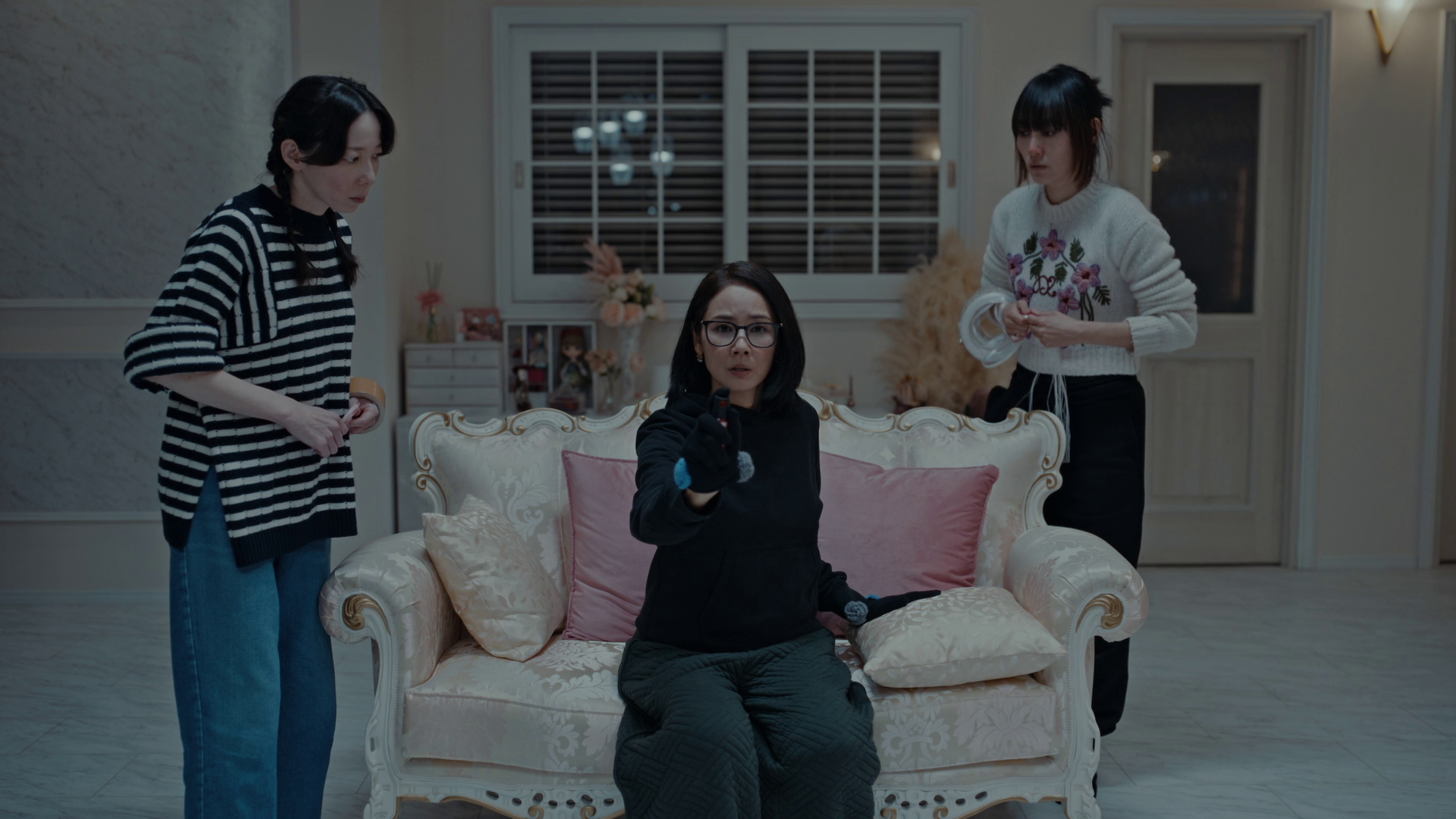
Trespassing. Somehow, it doesn’t sound that serious, does it? You’re always hearing about people being accused of trespassing simply for walking along a footway that someone believes to be on their land. It just means you were somewhere you had no right to be. Not doing anything, just being there. That’s exactly how it is for the heroines of Trespassers (侵入者たちの晩餐, Shinnyuushatachi no Bansan) who basically enter a home without permission, nosy around, then feel guilty and decide to clean the place to make up for it but accidentally find a burglar hiding in a corner! Could happen to anyone, really. 

Of course, there’s a little bit more to it than that. Middle-aged divorcees Akiko (Rinko Kikuchi) and Megumi (Kami Hiraiwa) work for the same exploitative housekeeping company which pays them a pittance while the boss, Natsumi (Mai Shiraishi), a former pin-up model turned influencer and entrepreneur, lives the high life. Though she claims to be an ally to working mothers, she also refuses to hire them because they have additional responsibilities that make it difficult for them to stick to her schedule, apparently. Megumi has heard a rumour that Natsumi is really into tax evasion and is hiding a large amount of undeclared money in her luxury flat, which is a rental in the company’s name that she also writes off. Of course, if someone were to steal that money, Natsumi could hardly go to the cops because then she’d have to admit she’d been cheating on her taxes. Why she wouldn’t just put it in a secret offshore account like everyone else is anyone’s guess, but everyone has their peculiarities and perhaps she just likes to have it handy. 

On entering with a cloned key and joined by Megumi’s yoga friend Kanae (Yo Yoshida) who “knows a lot about criminality”, the trio fail to discover the money or any evidence of tax evasion. Rather, Natsumi seems to have several certificates thanking her for donating large amounts of money to various charities which leaves the ladies feeling guilty for doubting her. Akiko had been the most morally conflicted about taking the money and was only persuaded on the condition that they would be giving the majority of it to worthy causes, so they were “helping people” like Robin Hoods rather than just helping themselves like greedy thieves. Megumi meanwhile had been less so and swayed by the rationale that Natsumi was exploiting them twice over by paying them such low wages and then depleting the public purse by thieving the money that should have been paid in taxes. Kanae, just seems to be along for the ride while hoping to open a yoga school with the money, but in a giant and unfortunate coincidence discovers another reason that Natsumi must pay.

Even the burglar, Shigematsu (Sosuke Ikematsu), a failed businessman with massive debts working as a food delivery guy to pay them off, has a sob story, but as the ladies point out it doesn’t really match the righteousness of their tax evasion whistleblowing mission. There is something quite wholesome about how bad they all are at “crime”, and how good Natsumi secretly is at it. It doesn’t even occur to the ladies that Natsumi’s willingness to forgive them is possibly because they’re right and she doesn’t want the police poking round because they might find something she doesn’t want them to. Meanwhile, it’s a little sad that each of them lament it’s been a while since they ate at home with other people rather than at restaurants and there’s something quite nice about their collective decision to make it a tradition though at one of their own homes rather than that of a suspected tax evader.

Indeed, as Akiko says, the real prize was the friends they made along the way. In many ways, they made everything better. Natsumi gets her comeuppance, they get improved working conditions, revenge, friendship and female solidarity too. What they found in Natsumi’s apartment was a family, though sadly they did not discover her hidden stash of hoarded gold. Bakarhythm’s typically witty script addresses a series of societal problems in a lighthearted way from the difficulties faced by middle-aged women and divorcees trapped in low-paying jobs, to hypocritical and exploitative CEOs peddling positive messages of success and empowerment but actually ripping off an entire society while laughing all the way to the bank. Maybe the ladies weren’t the ones trespassing after all when Natsumi too was where somewhere she had no right be.


Monster (怪物, Hirokazu Koreeda, 2023)

Part-way through Hirokazu Koreeda’s probing drama Monster (怪物, Kaibutsu), a distant headmistress tells one of her teachers that “What actually happened doesn’t matter.” As in The Third Murder, the truth, so far as it can be said to exist at all, is an irrelevance. We need narrative to serve a purpose. Confronted by a worried mother, a teacher accused of using violence against a student claims there’s been a “misunderstanding,” but in many ways there has. We’re so often prevented from speaking our truth by the social conventions that govern us, because of shame, or fear, or simply because when all is said and done is it often easier not to speak.

In may ways this is the internal battle Minato (Soya Kurokawa) finds himself fighting. He sees another boy being bullied, mostly just for being different, and he wants to do something about it but he’s different too and so he’s afraid. He befriends the boy, Yori (Hinata Hiiragi), but also tells him to not speak to him in front of their classmates because he doesn’t want to end up being a target. In the midst of futility all he can do is flail randomly, trashing the schoolroom not to mention his bedroom at home solely because he is unable to voice himself clearly or communicate in any other way.

Because of these lapses in communication, a series of misunderstandings arise. The language we use is often thoughtless and arbitrary. Well-meaning words can still wound. Minato’s mother, Saori (Sakura Ando), tells him that she promised his late father she’d take care of him until he had a wife and family of his own but perhaps that not something Minato will want. Similarly their teacher, Hori (Eita Nagayama), described by one of his colleagues as “shifty-eyed and creepy”, makes a series of throwaway remarks that the boys should act let men, filling their heads with an idea of toxic masculinity echoed in Saori’s insistence that girls prefer boys who don’t know the names of flowers. 

Minato is reminded that the bottom layer of the pyramid holds everything else in place, but it’s a responsibility he doesn’t think he can bear. He knows he can’t be the kind of man his father apparently was, a rugby player who may have been with another woman when he died, and feels an acute sense if failure and inferiority in being unable to live up to the expectations of others. He later tells the headmistress (Yuko Tanaka) who is carrying a burden of her own that he knows he can never be happy and believes himself unworthy of it only to find an unexpected source strength in her advocation that happiness is something anyone can have, otherwise it wouldn’t be happiness at all.

Yet for all that Yori seems to be happy, or at least to affect cheerfulness in all things despite his dismal circumstances living with a troubled father who drinks and refers to him as monstrous and diseased. One of the teachers also brands the parents of his pupils as monsters feeling they unjustly “torture” them while shifting the blame for their own bad parenting. Minato too feels himself to be a monster because he senses that he’s different from those around him and is afraid of them and of himself. Throw away remarks hint at buried prejudice, such as in Hori’s dig at single mothers stating that his own mother was one and exposing a degree of insecurity masked by an outward conservatism.

We judge him for this remark, but it’s also true he’s merely parroting something that was said to him. We can never know all of the truth, and Hori suffers in part because of his “shifty-eyed and creepy” appearance that contributes to our conviction the accusations against him are likely to be true in the same way he misunderstands Minato because of his confusing behaviour and inability to communicate. Gossip weaves itself into a kind of folk truth that becomes difficult to unravel no matter the degree of veracity within it, while we discover we can never know the whole of something only the facets of it that are presented to us and might well result in “misunderstandings.”

Koreeda shifts our perspective and exposes the flaws in our assumptions, illuminating with empathy a sense of a more objective truth that was hidden from us but equally the various reasons we cannot always be truthful even with ourselves nor can we see what others see of us. Obsessed with the idea of rebirth, the boys discover their own kind of paradise in private world in the midst of nature free of social conventions or expectation and free to be exactly as they are. The ambiguity of the ending may subtly undercut its seeming utopianism but nevertheless suggests that the only objective truth may be that happiness is something anyone can have if only they can free themselves from the prejudices and petty social conventions which govern our world.


MONSTER is out in UK and Irish cinemas on March 15th. For more information, go to https://monsteruk.film/ 

Uk trailer (English subtitles)

Dawn Wind in My Poncho (ポンチョに夜明けの風はらませて, Satoru Hirohara, 2017)

Dawn Wind in My Poncho posterThe end of high school might signal impending doom for some, but it also provides a valuable opportunity for one last hurrah before surrendering to the demands of the adult world. That’s more or less how the heroes of Satoru Hirohara’s Dawn Wind in My Poncho (ポンチョに夜明けの風はらませて, Poncho ni Yoake no Kaze Haramasete) feel about it as they set off on an impromptu road trip to track down a Peruvian folksinger making his first visit to Japan in 18 years. Youthful irresponsibility and an openness to all things send our boys on a strange odyssey of self discovery in flight of a future that is almost certain to be disappointing.

Right before graduation, Janbo (Yuma Yamoto) and Matahachi (Taiga) are preparing to celebrate their friend Jin (Aoi Nakamura) getting into Uni. Only, Jin didn’t make the grade which has rather put a damper on the occasion. To make matters worse, new driver Matahatchi seems to have scratched the car belonging to Janbo’s dad which they weren’t supposed to be driving in the first place. Trying to fix the problem, they run into dejected idol Ai (Aimi Satsukawa) who dreams of chart success but is being pressured into a gravure career by her agency. Ai manages to upset some delinquents in a convenience store car park, leaving our guys wondering if they should step in but coming to the conclusion it’s not worth it unless the girl is pretty. Nevertheless, they end up driving off with Ai in the back of the car anyway with the delinquents in hot pursuit.

That’s only the beginning of the boys’ adventure, but they can’t go home yet anyway because by the end of the chase they’ve completely destroyed the car and will be extremely dead when Janbo’s dad finds out. Lovingly showing off a picture of his beloved new (secondhand) car, Janbo’s dad tells a young man coming into the bar owned by Matahachi’s single mother that if he works really hard for a very long time, he too could have a car like this. It’s a fairly depressing prospect, but it does seem like there might not be much more out there for these small town guys as they prepare to leave high school behind. Jin was the guys’ bright hope with his university dreams. Janbo is going to work for his dad and Matahachi is looking for a job. All there is to look forward to now is constraint. A boring low pay job with no prospects, followed by marriage, fatherhood, and death.

You can’t blame them for cutting loose, though in essence our guys are mild-mannered sorts well and truly outrun by Ai’s anarchic flight from her own disappointment with her faltering career. Of course, the boys are all interested in her nevertheless only Janbo is facing an embarrassing problem of his own which has him wondering if he’ll ever be able to have a “normal” sex life, marriage, or family. The problem eventually takes him to the “Banana Clinic” which is actually a front very specific sex services but does introduce him to a nice young lady (Junko Abe) who might be able to cure his sense of insecurity if in a roundabout way.

Meanwhile, the guys have blown off the fourth member of their “band” (Shhota Sometani) who is still hanging around waiting for them to turn up for practice ahead of their graduation show. A poignant radio message attached to a song request in which he reveals how lonely he was until some guys invited him to join their band goes unheard by the gang leaving him to gatecrash graduation all alone with an impromptu performance in which he sings about how school was pointless and no one cares about the future, starting a mini riot among the other kids in the process. The trio are still busy with a series of zany adventures as Matahachi tries to convince the guys to come with him on strange quest to hear the elusive folk singer, only latterly explaining to them why exactly this means so much to him. A typically teenage road trip ends up going nowhere in particular, leaving the guys in limbo as they run from their depressing futures towards the last traces freedom far in the distance. Silly, if endearing, Dawn Wind in My Poncho is a strangely sympathetic tale of youthful rebellion towards impending adulthood which ultimately places its faith in the strength of male friendship as the last refuge from a relentlessly conformist society.


Dawn Wind in My Poncho was screened as part of the 2019 Nippon Connection Film Festival.

Original trailer (no subtitles)

Poetry Angel (ポエトリーエンジェル, Toshimitsu Iizuka, 2017)

poetry angel posterLife is confusing. You think you know what you want, only to realise it wasn’t what you wanted at all. What you really wanted was the very thing you convinced yourself you didn’t want so that you could want something else. The characters at the centre of Toshimitsu Iizuka’s Poetry Angel (ポエトリーエンジェル) are all suffers of this particular delusion, lost and alone in a small town in rural Japan without hope or direction. That is, until they discover the strange sport of “poetry boxing”.

Our hero, Tsutomu (Amane Okayama), is a 21-year-old farm boy with dreams of becoming an author. His illusions are, however, shattered when he checks the board in the community centre and discovers he hasn’t even placed in a local history essay writing contest which appears to have been won by a child. In this delicate state, a pretty girl suddenly approaches him and begs for his help but then drags him into a seminar room where he is forced to listen to a lecture on “poetry boxing”. Almost everyone else leaves straight away but Tsutomu is intrigued – after all, semi-aggressive literary sport might be just the thing to get an aspiring author’s creative juices flowing.

Tsutomu’s problems are the same as many a young man’s in Japanese cinema – he resents having his future dictated to him by an accident of birth. His father owns a large orchard and is a well respected producer of salt pickled plums. As the only child, Tsutomu is expected to take over but he hates “boring” country life and the repetitive business of farming, his thinly veiled jealousy all too plain when an old friend returns from Tokyo on a visit home between university graduation and a new job in the capital. Tsutomu thinks of himself as special, as an artist, but no one seems to be recognising his genius.

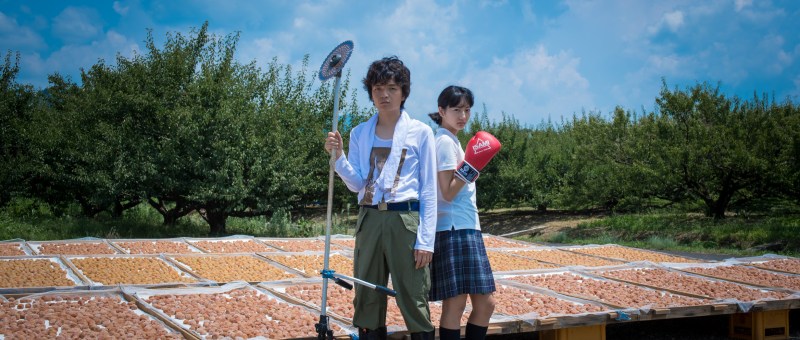
This might partly be because his only “poem” is an alarming performance art piece in which he laments his tendency to destroy the things he loves with his “weed whacker”. The sport of poetry boxing has no physical requirements but it has no limits either. It’s more or less like performance poetry or a less directly confrontational kind of slam, but participants are encouraged to step into the boxing ring and express themselves in whichever way they see fit. Once both participants have concluded their “poems” a panel of judges votes on the winner. Like Tsutomu, the other members of the poetry boxing team are dreaming of other things or claiming to be something they’re not. Rappers who really work in cabaret bars, lonely girls who fear they’re plain and long to be “cute”, civil servants longing to kick back at inconsiderate citizens, and old men who really do just want to write poetry and appreciate the time they have left.

Yet through the endlessly wacky tasks set by Hayashi (Akihiro Kakuta), the leader of the group, each of the participants begins to gain a deeper understanding of who they are and what they really want. Not least among them An (Rena Takeda), a gloomy young girl who spends her life scowling at people and refusing to speak. She’d been into boxing for real and first met Tsutomu when she punched him in the face because his unexpectedly sexist friend from Tokyo was harassing her in the street. Poetry, however, begins to unlock even her deepest held desires which can finally be voiced from the ironically safe space of the poetry boxing ring.

There may be nothing particularly original about Iizuka’s delayed coming of age tale, but it has genuine warmth for its confused no hopers as they look for connection through formalised language and ritual play, discovering new depths to themselves as they do so. As it turns out mostly what you want was there all along, only you didn’t want to look. Annoyingly, other people may have figured it out before you but that can’t be helped and is, after all, only to be expected. Poetry is a doorway to the soul but it’s also one that might need a good kicking to get it open. Maybe the boxing ring is a better place to start than one might think.


Original trailer (no subtitles)