She Taught Me Serendipity (今日の空が一番好きとまだ言えない僕は, Akiko Ohku, 2024)

Akiko Ohku’s quirky dramedies have so far mostly focused on an introverted woman’s quest for love, but with She Taught Me Serendipity (今日の空が一番好きとまだ言えない僕は, Kyo no Sora ga Ichiban Suki to Mada Ienai Boku ha) she moves into new territory in adapting the novel by Shusuke Fukutoku in which an alienated college student is unwittingly caught between two women. Set in the picturesque city of Kyoto, the film echoes the work of Tomihiko Morimi and revels in the power of serendipitous connection but equally the melancholy loneliness that underpins it in the legacy of grief and regret.

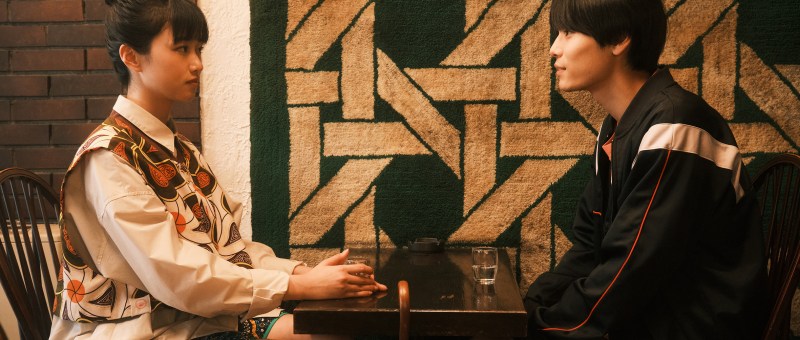
Returning after a six-month absence following the death of his grandmother, Konishi (Riku Hagiwara) is indeed at odds with his environment. He walks as if in a fog and is slightly out of tune with the world around him while often carrying an umbrella, or parasol depending on the weather, as a bulwark to protect him from prying eyes. Unlike his classmates, he speaks in the standard dialect rather than with an Eastern-inflection which his only friend Yamane (Kodai Kurosaki) has taken to extremes, describing his manner of speech as “Yamane Dialect”. It’s on campus that he begins catching sight of a young woman Yamane has dubbed the “solo soba” diner who seems to be just as solitary as he is, though the pair later strike up a connection precisely because of their shared sense of alienation.

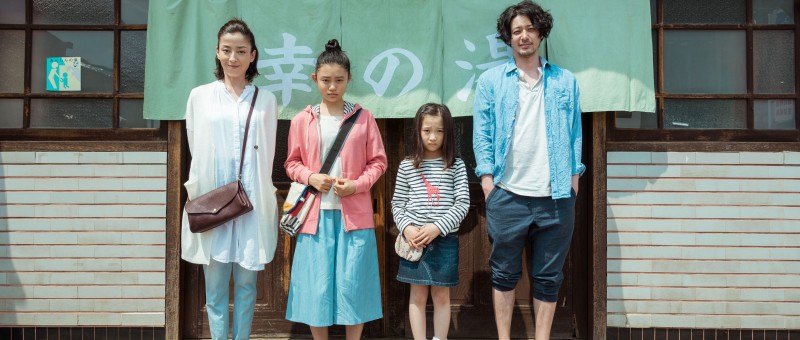
To that extent, it’s not unreasonable that Konishi might doubt his new friendship with his young woman, Hana (Yuumi Kawai), who seems to be tailor-made for him and appeared seemingly from nowhere during his absence. Meanwhile, he’s resumed his old job at a local bathhouse where he cleans after hours with a girl-named Sacchan (Aoi Ito) who, judging by the looks she exchanges with the owner’s daughter Kaho, is secretly in love with him though he hasn’t noticed. While Hana is like him quiet and mysterious, Sacchan is a live wire, a young woman full of life who can’t stop talking and makes each of their cleaning sessions a riot of fun and silliness. 

But in keeping with these kinds of stories, Konishi suffers from extreme main character syndrome and never really sees either woman as a whole person rather than as an extension of himself. As Sacchan says in a poignant monologue movingly delivered by Aoi Ito, he never even bothered to ask her full name. He promised to buy her dinner to make up for missing shifts and needing extra help, but most likely never planned to follow through, nor did he ever listen to the song she recommended to him, though he went and read the short story Hana referenced right away. On the one level, there was nothing he could do to avoid hurting her feelings when he couldn’t return them, but at the very least he’s been self-involved and insensitive, just as he is when Hana suddenly drops out of contact and he convinces himself she was only hanging out with him as a joke. Rather than process his pain, he lashes out at Yamane instead and almost loses his only remaining friend before finally growing up a bit and making the effort to say sorry. 

The Japanese title translates as something like “I, who still can’t say, ‘Today’s sky is my favourite’,” echoing a common phrase repeated by Hana’s late father and Konishi’s grandmother, and hinting at Konishi’s inability to embrace whatever life gives him and find joy within it. Nevertheless, he does perhaps learn the importance of saying how he feels before it’s too late while taking into account the feelings of others even if his final confession comes at an awkward and insensitive moment, though it’s true enough that he’s really talking to himself. On one of their surreal adventures, he and Hana visit an unusual restaurant where all the dishes have quirky codenames except for one. It turns out the proprietor used to have someone to help him, but for whatever reason they’re not around anymore. Playing with aspect ratios and split screen, Ohku often fills the frame with a sense of absence in which characters simply disappear quite abruptly, echoing the fragility of these connections and, in fact, of everything, but makes plain that the main thing is to embrace them when they come rather than live in the shadow of loss or let the chance for love pass you by in fear of its failure.


She Taught Me Serendipity screened as part of this year’s Toronto Japanese Film Festival.

Trailer (English subtitles)
From the End of the World (世界の終わりから, Kazuaki Kiriya, 2023)

Charged with the responsibility of saving the world, a teenage girl wonders if she should in Kazuaki Kiriya’s pre-apocalyptic drama, From the End of the World (世界の終わりから, Sekai no Owari kara). After all, the suffering will continue. People will continue to be cruel and selfish. Maybe it’s better to let humanity fizzle out and least save the planet. But really whether any of this is “real” or not, what’s she’s looking for is an escape from her grief and loneliness and a world that is a little kinder and less self-destructive. 

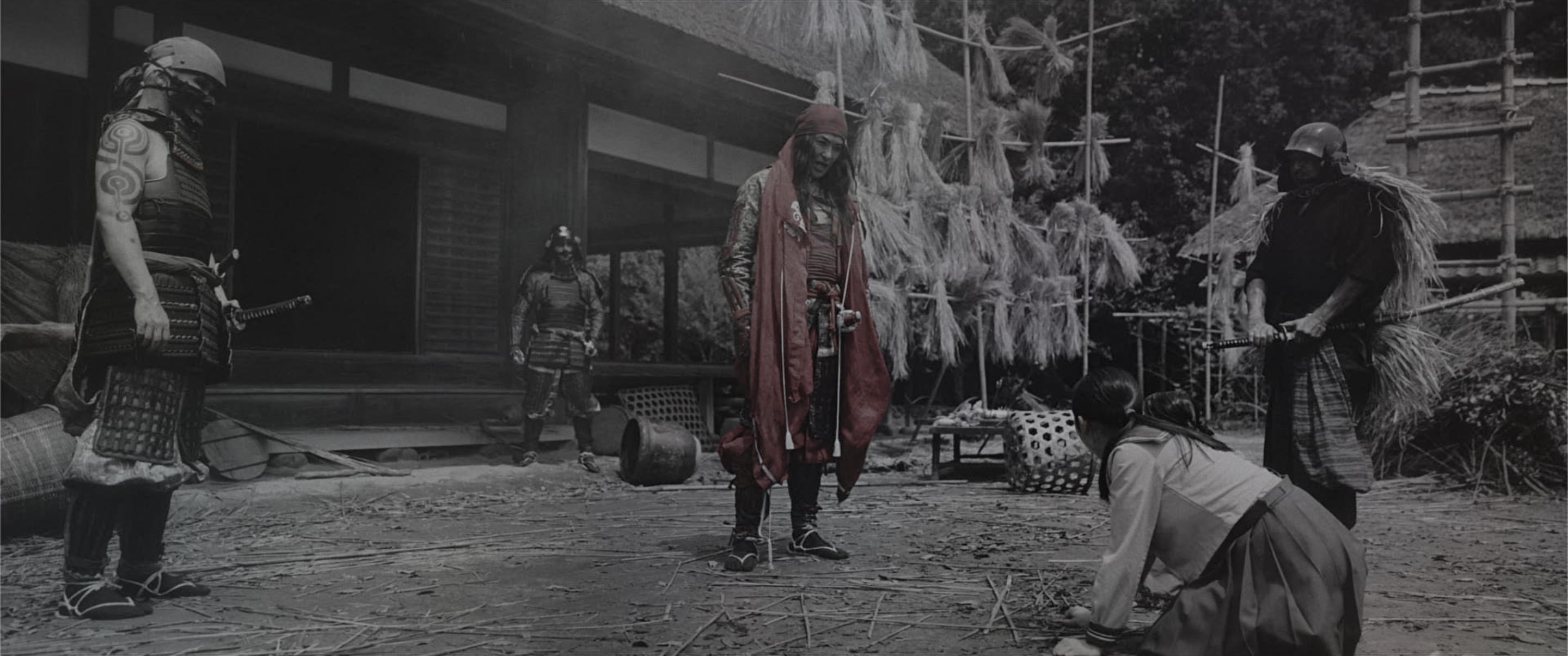
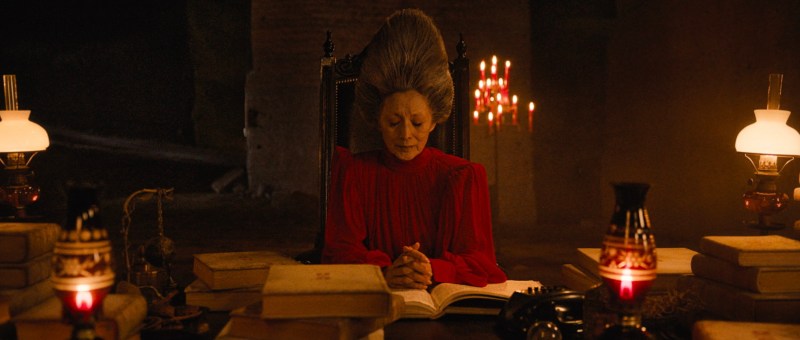
Shortly after losing her grandmother, who had been raising her after her parents were killed in a car accident, Hana (Aoi Ito) begins having strange dreams where she’s cast back to what seems to be feudal Japan where she meets a young indigenous girl whose family have been wiped out by marauding samurai. The girl’s guardian, an older woman (Mari Natsuki), explains to her that her arrival in this place has been foretold by some kind of scripture painted on the ceiling of a cave and that her duty is to deliver a letter to a shrine. Not too long later, she’s accosted by some kind of mysterious authority which seems very interested in her dreams, eventually taking her to a strange base in another cave where she meets an old woman (also Mari Natsuki) who looks exactly like the one saw in her dream. The world will apparently end in two week’s time, though she alone has the ability to alter what has been written through the power of her dreams which allows her to change people’s thoughts and thereby rewrite their destiny. 

She does not do this deliberately, but reacts instinctively to the events she encounters which the old woman claims exist in the “Sea of Sentiment”, a great confluence of human thought on which the world is built. “Understanding things is overrated. Everything’s an illusion. What’s important is your feelings,” another mysterious presence (Kazuki Kitamura) tells her, a man who exists between dream and reality and would rather the world end because as long as it exists he cannot die. In some respects, he may represent Hana’s depression suggesting that to continue to live is only to prolong her suffering and that it’s better for everyone to simply give in and let fate take its course while she weighs up kindness and vengeance using her newfound powers for “selfish” reasons to end the torment she’s been suffering at the hands of a bullying classmate who’s long been blackmailing her in taking advantage of her precarious position as a financially disadvantaged orphan. 

The quest that the old woman sends her on is really into the depths of her own heart which is wounded not only by a medical issue she seems to have forgotten but a pair of childhood traumas buried behind a door she did not want to open. The real message that she’s supposed to deliver has its own paradoxical sense of poignancy, “from the end of the world to you in the future”, which signals her nihilism and despair but also a desire for some kind of continuation or rebirth in a better, kinder world less marked by suffering or selfishness. Then again, the way of achieving that world is still rooted in violence only of a more knowing kind that heads off one particular kind of disaster and allows Hana to save “herself” in all her incarnations, but perhaps doesn’t do very much to change the human “foolishness” to which the old woman ascribes humanity’s destruction.  

Logically, it doesn’t quite hang together and not all of it makes sense (understanding things is overrated), but it has its own kind of internal consistency even if at times somewhat incoherent as it well might be if it were all the dream of a lonely teenage girl who’s given up on the idea of a future for herself because her life has been too full of suffering and unfairness. It’s no coincide the date of the end of the world is set for the same day as her high school graduation ceremony. Her world really is ending if in a less literal way leaving her all alone and forced into a more concrete adulthood while her peers get to chase their dreams a little longer by moving on to higher education while she’ll have to look for work to support herself. She may feel that nothing she does makes any difference and that she is powerless to change her fate, but also realises that she is not as alone as she thought. Featuring top notch production values and some striking production design, Kiriya’s sci-fi action drama is quietly touching in its final resolution that despite everything Hana still wants to love the world even if it’s making it very difficult. 


From the End of the World screens in New York Aug. 5 as part of this year’s JAPAN CUTS.

Teaser trailer (no subtitles)

Intolerance (空白, Keisuke Yoshida, 2021)

At times of tragedy it may be natural to look for someone to blame, as if being able to pin all of this pain and anger on a single source would somehow help you to accept it. But in other ways tragedy is just a confluence of circumstances that are either everyone’s fault or no one’s. How far back can you really trace the blame? There would be no end it. That’s perhaps the conclusion that the protagonists of Keisuke Yoshida’s Intolerance (空白, Kuhaku) eventually come to, realising that their attempts to blame others are often born of a desire to deny their own responsibility or else to protect something else they fear losing. 

At least that’s how it is for grizzled fisherman Mitsuru (Arata Furuta), a man well liked by no one. A rude and violent bully, he terrorises all around him not least his teenage daughter Kanon (Aoi Ito) who is meek and passive with a slightly ethereal quality as if she’s learned that blending into the background is the best way to protect herself. Stopping in to a local convenience store on her way home from school, she’s accosted by resentful store manager Naoto (Tori Matsuzaka) who grabs her by the arm and accuses her of shoplifting nail polish. At some point, Kanon panics and bolts out of the store. Naoto chases her along a busy highway until she suddenly darts out into the road trying to get away from him and is hit first by a car driven by a young woman and then by a truck travelling in the opposite direction. Despite his gruff exterior, Mitsuru is quite clearly destroyed by his daughter’s death but becomes fixated on clearing her name of the shoplifting, insisting that he never saw her wear any makeup and that Naoto is to blame for her death in acting with such a heavy hand. 

Of course, it doesn’t occur to Mitsuru that Kanon may have worn makeup in secret and made sure to keep it from him knowing how he’d likely react. Likewise, perhaps she ran from the store because Naoto would have called her father and she was frightened of what he’d do if he found out she was caught pilfering, and pilfering nail polish at that. He remembers that she wanted to talk to him about something to do with school the night before she died but he didn’t listen, assuming she must have been being bullied and was forced to steal the nail polish only to hear that no one at school really even remembers her. She was a just a vague presence they can’t even quite identify. Her teacher meanwhile begins to reproach herself, realising that she failed in her duty of care repeatedly shouting at Kanon that she had “no motivation” rather than trying to help her find some or to get along in her own way, let alone figuring out what caused her to behave the way she did or if there were problems at home. Sick of Mitsuru’s belligerence the school finally set him on the new target of Naoto who was once accused of molesting a teenage girl he accused of shoplifting. 

Like Kanon, Naoto is a slightly hollow presence who also had a strained relationship with his father. As he lay dying, Naoto failed to answer his calls because he was playing pachinko and felt ashamed, afraid of another lecture from his dad about wasting his life on gambling. He struggles with his role in Kanon’s death, on the one hand guilty feeling he overreacted and inadvertently caused her to stray into harm’s way while otherwise resentful, justifying himself that it’s only natural for a storeowner to chase a shoplifter down the street. Both he and Mitsuru soon fall foul of a media culture that likes sympathetic victims and heartless villains, the media shocked by Mitsuru’s boorish behaviour but more so by Naoto’s callous indifference trimming an otherwise nuanced statement to imply that he feels his supermarket is the real victim as customers stay away or else issue complaints about their obviously heavy-handed shoplifter policy. 

“Imposing your own views on others is nothing more than torture” Naoto tells a well-meaning middle aged woman whose narcissistic cheerfulness is a neat mirror of Mitsuru’s intimidating aggression. Aggressively mothered by Kusakabe (Shinobu Terajima), Naoto carries an additional burden of guilt in realising he’s lost the store his father left to him, but she embarks on a tasteless “real victim” campaign insisting they did nothing wrong and it’s all Kanon’s fault for stealing in the first place. Kusakabe can’t bear to lose the store because it seems there’s not much else in her life. The film’s Japanese title translates as “blank” or “void” and it is indeed a void that Kusakabe is trying to fill in needing to feel needed by centring herself in her various volunteer activities such as working at a soup kitchen in addition to her crusade to save the store. 

It’s this giant abyss of grief and guilt which pulls each of them towards the edge, but in the end there’s really no way to apportion blame. The poor woman who first knocked Kanon down is completely undone by the experience though it really wasn’t her fault, repeatedly approaching Mitsuru asking for his forgiveness only to be cruelly rebuffed. It’s her mother’s (Reiko Kataoka) quiet show of dignity which stands in such stark contrast to his own white hot rage that finally forces him to realise the destructive quality of his intimidating behaviour, accepting his responsibility in his daughter’s death while understanding that in his fierce desire to control he robbed himself of the ability to know her. Really you can’t say whose fault it was, Mitsuru’s for the fear he instilled into his daughter, Naoto’s for his insecurity and misplaced zeal in hunting down a thief, the drivers’ for failing to brake, Kanon’s mother’s (Tomoko Tabata) for remarrying and having another child, the teacher’s for making Kanon feel useless, the other kids’ for rejecting her, or Kanon’s own for darting out into the road. For each of those there are a hundred other branches. There would be no end to it. But then, the strange thing is that Kanon shares her name with Buddhist deity of mercy, Mitsuru beginning to soften now willing to offer an apology where it’s due and to bear his own degree of guilt if not yet entirely able to forgive. In any case, ending in bright sunshine, Yoshida concludes with a return of the gaze between father and daughter that suggests forgiveness may indeed have arrived. 


Intolerance screened as part of this year’s Camera Japan

Original trailer (English subtitles)

Missing (さがす, Shinzo Katayama, 2021)

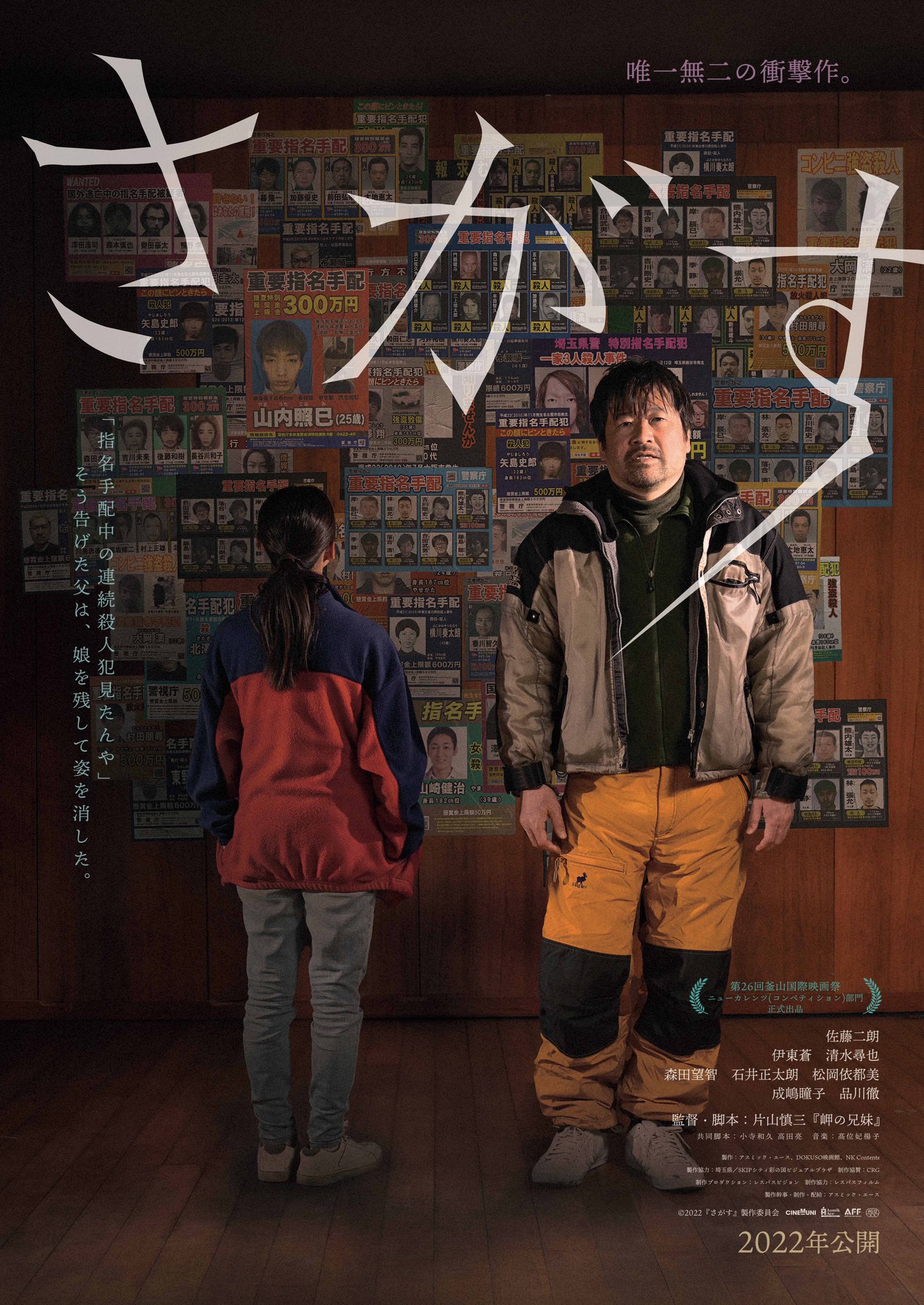
“None of us are needed” claims the nihilistic serial killer at the centre of Shinzo Katayama’s dark mystery drama, Missing (さがす, Sagasu). That he’s wrong is an obvious point, but also one reinforced by the teenage heroine’s determination to find her father not just literally and physically, but spiritually and emotionally as she struggles to reorient herself and find direction in her life in the midst of grief and despair. Drawing inspiration from the so-called “Twitter Killer” case of 2017 Katayama asks some difficult questions about the ethics of life and death and how seemingly ordinary people can be pulled towards the dark side by a mixture of greed and misplaced compassion. 

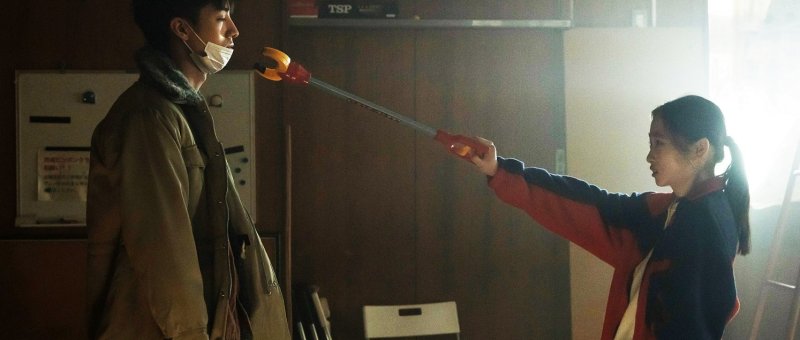
As the film opens, young Kaede (Aoi Ito) is running through the backstreets of Osaka looking for her dad (Harada). What occurs is something of a role reversal as she arrives, breathless, at a convenience store and is forced to apologise because her father has been caught shoplifting having been short the paltry sum of 20 yen which she then has to pay to smooth things over so he won’t actually be arrested. It’s at this point that Satoshi tells her about his big get rich quick scheme which involves claiming the reward for catching a fugitive serial killer, Terumi Yamauchi (Hiroya Shimizu), known as “No Name”, whom he believes to have seen in the local area. Kaede does not take her father seriously, but then Satoshi suddenly disappears. She can’t help but wonder if he was telling the truth and that something untoward has happened to him. 

What she quickly discovers, however, is that no one except herself is very interested in her father’s disappearance. Her teacher tries to help by taking her to the police, but it’s clear that they do not consider Satoshi to be a person worth looking for suggesting that whatever’s happened to him is most likely his own fault for being an imperfect person, implying that he drinks and has debts so most likely has gone missing on purpose. The teacher later comes to the same conclusion, getting a nun from a local orphanage to come and fetch Kaede believing her father has no intention of returning. Probably meaning well, the nun also tells her that her father has abandoned her and there’s no point waiting for him. But even if everyone else thinks that Satoshi is an “unnecessary” person, he is important to her and so she will not stop until she finds him even if that puts her in similar danger hot on the heels of a serial murderer. 

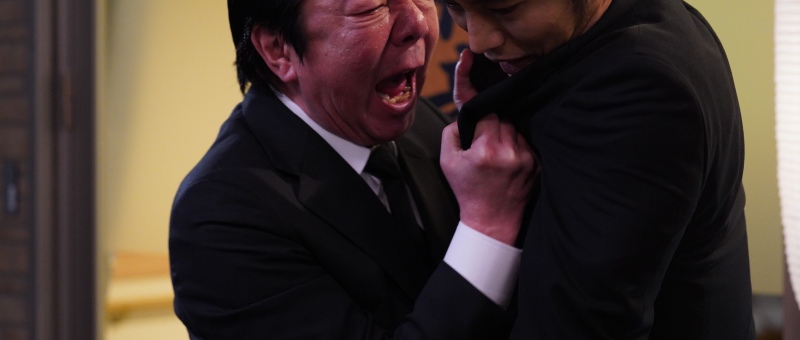
Like the Twitter Killer, Yamauchi disingenuously claims to be helping people, offering “salvation” to those who want to die but cannot bring themselves to end their own lives. By his logic, there are some who are only clinging on to life out of guilt for those who will be left behind while simultaneously blaming themselves that they are “unneeded” and nothing more than a burden to the few who do care about them. His claims are however nothing more than sociopathic justification designed to convince others that what he’s doing is in some way compassionate rather than a sickening attempt to satisfy his own dark desires. As he finally concedes with a repeat customer, in the end none of the people he killed wanted to die but were looking for something else which obviously was not what he wanted to give them. 

Perhaps Satoshi was looking for something too though whether he found it or not only he could say. Katayama hints at the grimness of everyday life in Satoshi’s unsatisfying existence of casual labour, guilt, and loss. When Kaede tries to check whether or not he’s been going to work, no one recognises his picture and it turns out that someone else has been working under his name. A migrant worker urges her to be careful, that the man calling himself Satoshi Harada has bad vibes of the kind he claims you often find “in places like this”. All Satoshi wanted to was to reopen the ping pong parlour he was forced to close in order to care for his wife during a longterm illness which left him with financial debts along with the emotional. It is quite literally a back and fore between father and daughter, a ping pong ball flying across a table until finally hitting its mark as Kaede reveals that she has found the answers she was looking for even if not quite the ones she wanted. Lightened by moments of dark humour, Katayama’s strange procedural grimly suggests that none of us is really so far away from acts of desperate brutality but equally that none of us is ever unneeded no matter how lonely it might feel. 


Missing screens in Chicago on Oct. 30 as part of the 15th season of Asian Pop-Up Cinema. It will also be released in the US on Nov. 18 courtesy of Dark Star Pictures.

US release trailer (English subtitles)

Her Love Boils Bathwater (湯を沸かすほどの熱い愛, Ryota Nakano, 2016)

her love boils bathwater

The “hahamono” or mother movie has gone out fashion in recent years. Yoji Yamada’s World War II melodrama Kabei or Keisuke Yoshida’s more contemplative examination of modern motherhood My Little Sweet Pea might be the best recent examples of this classic genre which arguably reached its golden age in the immediate post-war period with its tales of self-sacrificing mothers willing to do whatever it took to ensure the survival or prosperity of their often cold or ungrateful children. After “Capturing Dad” Ryota Nakano turns his attention to mum, or more precisely the nature of motherhood itself in a drama about family if not quite a “family drama” as a recently single mother is busy contending with financial hardship and a sullen teenage daughter when she’s suddenly caught off guard by a stage four cancer diagnosis.

Futaba (Rie Miyazawa) is an outwardly cheerful woman, the sort who’s always putting a brave face on things and faces her challenges head on, proactively and without the fear of failure. Her husband, Kazuhiro (Joe Odagiri), ran off a year ago and no one’s heard from him since. Having closed the family bathhouse Futaba works part-time at a local bakery and cares for her daughter Azumi (Hana Sugisaki) alone but when she collapses at work one day Futaba is forced to confront all those tell signs that something’s wrong she’s been too busy to pay attention to. Inevitably it’s already too late. Futaba has stage four cancer and there’s nothing to be done but Futaba is Futaba and so she has things to do while there’s still time.

Some people colour the air around them, instantly knowing how to make the world a better place for others if not quite for themselves, except by extension. Futaba is one such person – the personification of idealised maternity whose instinctual, altruistic talent for love and kindness knows no bounds or boundaries. Yet at times her love can be a necessarily tough one as she negotiates the difficult process of trying to get her shy teenage daughter to stand up to the vicious group of bullies who’ve been making her school life a misery. Faced with an accelerated timeframe, Futaba needs to teach her little girl to be an independent woman a little ahead of schedule, knowing that she won’t be around to offer the kind of love and support she’ll be needing during those difficult years of adolescence.

Not wanting to leave her entirely alone, Futaba tracks down Kazuhiro only to find he’s now the sole carer for the nine-year old daughter of the woman he left her for who may or may not be his. Futaba decides to take the pair of them in but little Ayuko is just as sullen and distanced as her older half-sister as she struggles with ambivalent emotions towards the mother who abandoned her with a “father” she hardly knew. Futaba’s big idea is to reopen the family bathhouse to be run as a family where everyone has their place and personal responsibility, working together towards a common goal and supporting each other as they inevitably grow closer.

Unlike the majority of hahamono mothers, Futaba’s love is truly boundless as she tries not only to provide for her own children but for all the neglected, lonely, and abandoned people of the world. Bonding with the little girl of the private investigator she hires to find Kazuhiko, trying to comfort Ayuko as she deals with the fact that her mother is probably never coming back, even taking in a melancholy hitchhiker whose made up backstory she instantly sees through – Futaba is the kind of woman with the instant ability to figure out where it hurts and knows what to do to make it better even if it may be harder in the short-term.

Like the majority of hahamono, however, Her Love Boils Bathwater (湯を沸かすほどの熱い愛, Yu wo Wakasu Hodo no Atsui Ai) can’t escape its inevitable tragedy as someone who’s given so much of themselves is cruelly robbed of the chance to see her labours bear fruit. Nakano reins in the sentimentality as much as possible, but it’s impossible not to be moved by Miyazawa’s nuanced performance which never allows Futaba to slip into the trap of saintliness despite her inherent goodness. She is evenly matched by relative newcomer Sugisaki in the difficult role of the teenage daughter saddled with finding herself and losing her mother at the same time while Aoi Ito does much the same with an equally demanding role for a young actress moving from sullen silence to cheerful acceptance mixed with impending grief. Yet what lingers is the light someone like Futaba casts into the world, teaching others to be the best version of themselves and then helping them pass that on in an infinite cycle of interdependence. Hers is a love of all mankind as unconditional as any mother’s, sometimes tough but always forgiving.


Her Love Boils Bathwater was screened at the 17th Nippon Connection Film Festival.

Original trailer (turn on captions for English subtitles)