
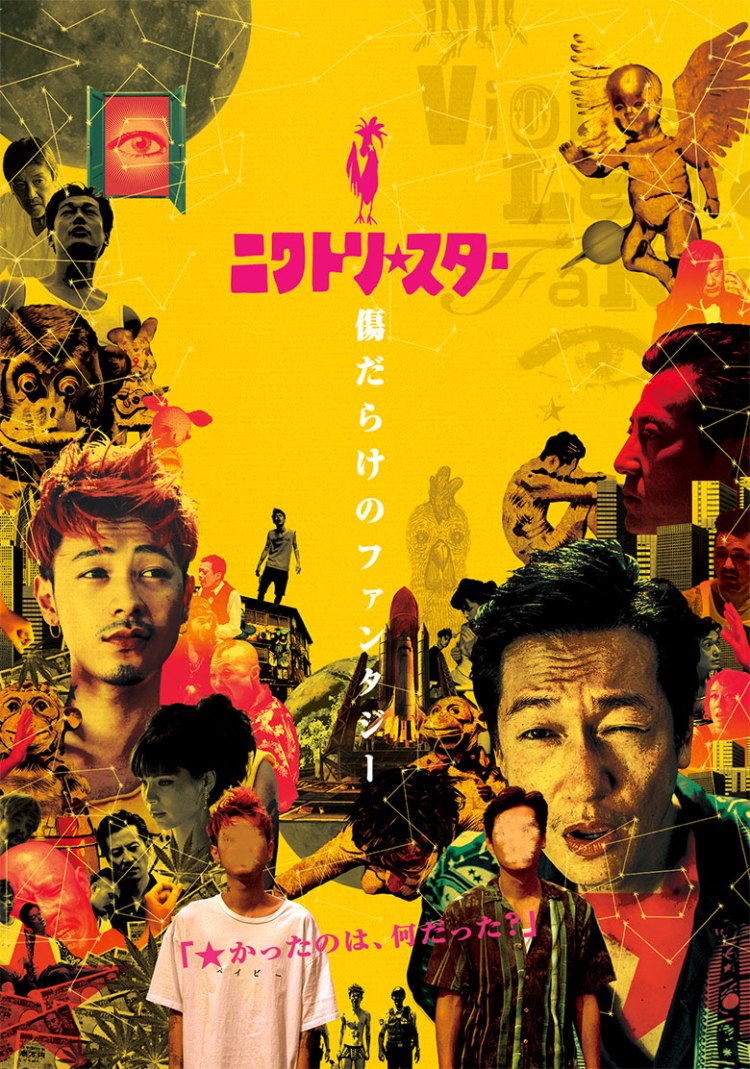
 Slacker drama has become a mainstay of the Japanese indie scene as aimless young men drift freely in a society which promises them little and threatens to take much. Even so they’ve rarely been quite so genially lost as the pair at the centre of Kanata Wolf’s Smokin’ on the Moon (ニワトリ★スター, Niwatori★Star) whose relatively serene life of stoner bliss is radically derailed after a dramatic encounter with a psychotic yakuza drug dealer. Dreaming of escape, a better life somewhere else, the pair find themselves taking very different paths as they reflect on their familial pasts, broken dreams, and future promises.
34-year-old Sota (Arata Iura) and his younger unofficial roommate and official best friend Rakuto (Ryo Narita) live a “simple” life of casual work which pays for rent and getting stoned if not much else. They are broadly “happy” with their aimless drop out lives and determined not to get involved with the shadier sides of their underworld existence by avoiding the pull of hard drugs and gangster hang outs. All that ends up going by the wayside when their dealer, Jay (Peron Yasu), is offed by sadistic yakuza Hatta (Kanji Tsuda) who makes a point of dropping in on the boys to ask them if they know where Jay might be in order to make sure they don’t. Being directly confronted with gangster violence sparks Sota into a series of epiphanies as he suddenly realises that the stoner life is not a good fit for a man of 34, while Rakuto, who has few other options, considers throwing his lot in with Hatta if only to remain on the sidelines of organised crime.
Sota, son of an Osakan okonomiyaki restaurant owner (Eiji Okuda), left home in flight of family legacy, bored with boring small-town life and resentful of his “destiny” as the heir to a family business. Eight years in Tokyo, however, have been largely wasted, squandered away on constant evasion with nothing more to show for his time than a few crazy stories and a deeply held friendship. Sota does at least have a safety net, he can always go home to a family that will welcome him with open arms. Rakuto is not so lucky. Harbouring deep seated resentment towards his mother who was unable to protect him from a violent step-father, Rakuto fled Okinawa to escape the memory of a traumatic childhood which is perhaps why he finds himself becoming a surrogate father to a little boy whose mother, as it turns out an old friend of his, desperately tries to kick a crack habit given to her by an unforgiving city even as it crushed her dreams of musical success.
Discovering an old report card on which he’d written that his greatest ambition was to work hard for his family, Rakuto decides he needs to buck up and become a responsible husband and father who can provide a stable home for a woman and a child. There are, however, few opportunities for middle-school dropouts and even those there are Rakuto has already disqualified himself from thanks to his stoner looks which include fiery red hair and several prominent tattoos (prohibited in almost every conceivable “decent” job in Japan). Thus he feels his only option is to become a kind of errand boy for Hatta, naively believing he will allow him to remain in the shallower end of the gangster pool just dealing weed and making deliveries rather than pushing hard drugs or getting involved in violence. While Sota finds peace in the country, Rakuto begins to build the family life he’d always dreamed of while trying to cope with the constant anxieties of being an underling to a bunch of unhinged crooks.
Wolf shifts registers throughout – starting off in stoner comedy where our heroes inhabit a bohemian world of gay bars and randy landladies, shifting into crime thriller as the nasty gangsters rear their heads, and then finally ending up in masculine melodrama as Sota recounts the sad story of his friend who, despite his good heart, finds himself a victim of fate rather than of himself or even of his society. Mixing strange animation and surrealist diversions with an affecting tale of friendship, Smokin’ on the Moon is another sad story of those unable to find their place in the world taking refuge in each other only to find a melancholy compromise even as fate threatens to rob them of the little joys they’ve found.
Smokin’ on the Moon screens at New York Asian Film Festival 2018 on 10th July at 9.15 pm plus Q&A with director Kanata Wolf
(Kanata Wolf (かなた狼) previously known as Yuichiro Tanaka (たなか雄一狼). Surname is Wolf as per official website).
Original trailer (no subtitles)

 Koji Wakamtasu had a long and somewhat strange career, untimely ended by his death in a road traffic accident at the age of 76 with projects still in the pipeline destined never to be finished. 2008’s United Red Army (実録・連合赤軍 あさま山荘への道程, Jitsuroku Rengosekigun Asama-Sanso e no Michi) was far from his final film either in conception or actuality, but it does serve as a fitting epitaph for his oeuvre in its unflinching determination to tell the sad story of Japan’s leftist protest movement. Having been a member of the movement himself (though the extent to which he participated directly is unclear), Wakamatsu was perfectly placed to offer a subjective view of the scene, why and how it developed as it did and took the route it went on to take. This is not a story of revolution frustrated by the inevitability of defeat, there is no romance here – only the tragedy of young lives cut short by a war every bit as pointless as the one which they claimed to be in protest of. Young men and women who only wanted to create a better, fairer world found themselves indoctrinated into a fundamentalist political cult, misused by power hungry ideologues whose sole aims amounted to a war on their own souls, and finally martyred in an ongoing campaign of senseless death and violence.
 When 21 year old Hitomi Kanehara’s Snakes and Earrings (蛇にピアス, Hebi ni Piasu) was published back in 2003 it took the coveted Akutagawa prize for literature and the country by storm. Its scandalous depictions of the dark and nihilistic sex life of its outsider youngsters outraged and fascinated enough people to get it onto the best seller lists and earn a cinematic adaptation from Japan’s top theatre director Yukio Ninagawa in only his second foray into the world of moving pictures. However, Snakes and Earrings is perhaps that rare instance of an adaptation which clings to closely to its source material as its detached, emotionless and straightforward approach end in something of a miss fire.
 Based on the third of three short stories in Banana Yoshimoto’s novel of the same name, Asleep (白河夜船, Shirakawayofune) is an apt name for this tale of grief and listlessness. Starring actress of the moment Sakura Ando, the film proves that little has changed since the release of the book in 1989 when it comes to young lives disrupted by a traumatic event. Slow and meandering, Asleep’s gentle pace may frustrate some but its melancholic poetry is sure to leave its mark.
 Windows on Worlds