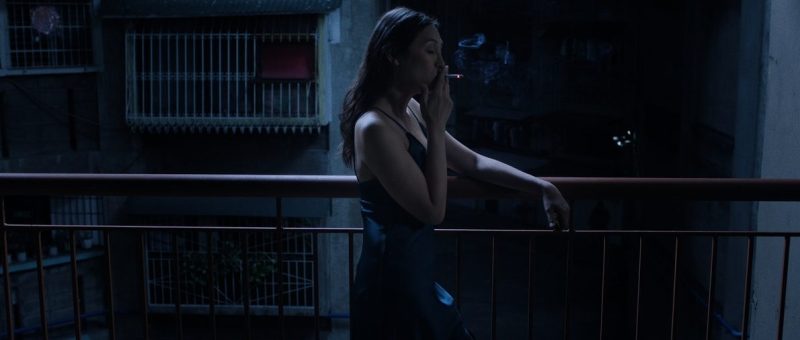

Moonglow (Isabel Sandoval, 2026)

A conflicted policewoman is placed in charge of investigating a crime that she herself committed in Isabel Sandoval’s moody noir, Moonglow. In many ways about the deadening quality of life under authoritarianism, the film contemplates complicity and resistance along with the “paradise of progress” that is touted as the modern Philippines though it faces many of the same problems as in 1979. You may think of yourself as some kind of moral crusader, Dahlia’s aunt warns her, but you’re no match for them.

Sister Therese may have a point. The news is full of stories of abandoned bodies and mysterious fires. Dahlia (Isabel Sandoval) characterises her theft as an act of rebellion and retribution. She does not keep this large sum of money taken from her corrupt boss’ safe for herself, but gives it to her aunt, a nun, with the instruction that it’s to be used to help the victims of a slum fire that later turns out to have been orchestrated by the police chief who is getting kickbacks from construction firms and envisions a bright future for himself in politics. 

Going into politics seems to be the ultimate goal for many. Charlie (Arjo Atayde) was also being groomed for office, but chose to emigrate instead after being confronted by the ugly side of his family’s elite status. The nephew of police chief Bernal, he’s just returned from America to look after his ailing father having become a lawyer rather than law enforcement official. Nevertheless, Bernal appoints him to the investigation presumably assuming he’s a safe person to ask because he’s family and therefore no threat to him. Old flame Dahlia, however, remarks on meeting him again that he now wears glasses, as if signalling Charlie’s ability to see things with more clarity than those around him whose vision has been blurred by continued exposure to life under the Marcos regime.

Dahila, who chose to stay rather than leave with Charlie, has indeed been compromised and is to an extent at least complicit as an agent of authoritarian power and according to some Bernal’s right hand woman. She says herself that she’s summoned in ghost in Charlie’s return and is haunted by the person she was before along with that of lost love. Each of them have repeated flashbacks to a lavish party shortly before Marcos took power which seems to hint at the coming future as Bernal introduces a man soon to be governor who echoes the contemporary radio broadcasts speaking of an era of prosperity hovering the horizon.

Alvaro manipulates Bernal with promises to make him his political successor, while it’s clear that any “prosperity” to come will only be for some. They burn slums to seize the land for shopping malls and luxury apartments leaving hundreds of people homeless and others of them dead. Alvaro later implies that some of the stolen money has been used to get the victims legal representation to challenge the government, a power that he also believes to have been “stolen” in that they have no right to it. Indeed, the authorities silence contrary voices without compulsion offing an investigative journalist reporting on the fires and later coming after Dahlia. Charlie reminds her that Bernal would sacrifice anyone, and indeed later implies he may do so with him when he starts asking the wrong questions about how much money went missing from the safe. 

Yet Dahlia’s tragedy is that in the end she can’t escape herself or her past. She can’t make all of this right through her act of rebellion, but neither can she accept the ways in which she did not resist or leave as Charlie had. That other life is also haunting her. Sandoval’s frequent use of dissolves signals the foggy quality of life under authoritarianism in which it becomes impossible to think or see clearly when every moment is self preservation or active complicity. Past, present, and future come to co-exist with Dahlia stuck somewhere in between, longing for a return to an elusive past while fearing that the future is no longer possible. She and Charlie are now, as she says, different people. Their romance belongs to another era which has now become inaccessible, or perhaps existing only in the realms of memory as a painful reminder of that which could have been.


Moonglow screens in Amsterdam 11th/12th April as part of this year’s CinemAsia Film Festival.

Trailer (English subtitles)

BuyBust (Erik Matti, 2018)

BuyBust posterErik Matti follows Richard V. Somes We Will not Die Tonight with another retro exploitation action fest starring a plucky female lead which turns darker than anyone could have imagined. BuyBust is, on the surface, a gritty B-movie filled with ultra violence and relentless bloodshed, but it’s also the latest in a long line of movies to examine the ongoing legacy of the “War on Drugs” in Duterte’s increasingly hardline Philippines.

Our heroine, Manigan (played by very deglammed rom-com star Anne Cutis), is the sole survivor of an armed police squad whose comrades were all wiped out during an operation led by police Lieutenant Dela Cruz (Lao Rodriguez). Regarded as bad luck, she’s only recently been able to find a new squad to join but thanks to her experiences, is struggling to find team spirit when she knows out in the field it might be every man for himself. She is dismayed to realise that her first mission will once again be led by Dela Cruz who has picked up a low-level trafficker, Teban (Alex Calleja), in the hope of luring local drug lord Biggie Chen (Arjo Atayde). When the meet goes South, Teban is summoned to Chen’s lair deep in the Gracia ni Maria slums where all hell breaks loose once the team are spotted and targeted for eradication by Chen’s henchman Chongki (Levi Ignacio).

Though one might assume the police to be the “good guys” – after all, we came here with them, they are in a sense the invaders wading into totally unfamiliar territory where they perhaps have no right to be. The slums are a maze and deliberately so – the confusing environs are a perfect foil for outsiders and the police are indeed quickly lost with no clear idea of how to find their way out. Inhabited by the poorest of the poor, it’s difficult not to come to the conclusion that this land and the people within it have been largely left behind, forgotten by the surrounding city which regards this makeshift community as little more than a living graveyard. The police certainly have little sympathy for the ordinary residents whom they regard as tainted by association, thinking of the slums as a land of wilful lawlessness existing in direct opposition to their need for order.

The locals are well and truly fed up with both sides. They don’t have anything to do with drugs but are frequently caught in the crossfire. Creeping into the slums, the police pass a vigil for a little girl killed during a previous incursion in a literal murder of innocence caused by the internecine battle between law enforcement and drug traffickers. When the trouble starts the locals rise up in an act of revolution, wanting an end once and for all to the violence on their streets which has already taken from them sons, husbands, and little children. They are as angry with the police who refuse to protect them as they are with the drug dealers who endanger their lives by refusing to take their illegal trade somewhere less populated.

Manigan and her squad are law enforcement, but they are also a part of the ongoing extra judicial killings and it’s clear their tactics go well beyond self defence. Cornered, a prominent drug dealer taunts Manigan with her own side’s complicity – something of which she is painfully aware in having figured out that her previous squad were almost certainly betrayed by Dela Cruz whose relationships with his targets seem overly incestuous. Drug raids have become an industry in their own right. Not just the bounties on extra judicial killings, but the ransoms and kick backs corrupt officers accept in order to continue facilitating the drug trade. Actually arresting drug dealers would be financially disastrous for them, and so there are huge vested interests in protecting an illicit conspiracy of corrupt police even if it means sacrificing a few foot soldiers for the cause.

Matti keeps the tension high and the action furious as his hand held camera follows the extremely complex choreography through long takes across tin roofs and through narrow passages filled with seemingly endless supplies of angry aggressors. An infinitely compromised figure, Manigan wants to survive and then to expose the corruption in her own organisation but her fight will be a hard one. A gritty, old fashioned exploitation B-movie, BuyBust reserves its sympathy not for the heroine but for the ordinary men and women of the streets whose fight for survival is daily in a world which is becoming ever more hostile to their very existence.


Screened at London East Asia Festival 2018. Currently streaming on Netflix UK (and possibly other territories)

Original trailer (English subtitles)