
August in the Water (水の中の八月, Sogo Ishii, 1995)

How does the world, or perhaps the cosmos, attempt to communicate with us? As Douglas Adams once did, August in the Water (水の中の八月, Mizu no naka no Hachigatsu) suggests it maybe through the dolphins who here at least seem to be quasi-mystical beings existing in what is really the lifeblood of humanity. In the film’s opening scenes, we’re told that the hero, Mao (Shinsuke Aoki) whose name means “true fish” and his friend Ukiya (Masaaki Takarai) have taken part-time jobs at a marine part to learn how to communicate with dolphins, but it’s the heroine Izumi, whose name means “spring” who eventually claims to have learned to do so. 

At least, her final words are that the dolphins have taught her “the perfect balance” which has allowed her to open the floodgates both literal and metaphorical to return water to an arid land. We’re repeatedly told that there’s been a lengthy drought and a water shortage leading to rationing and locked pipes though the marine park remains open and the local festival goes ahead  hinting at the ways in which we do and don’t value our natural resources. Izumi’s science teacher tells the kids that humans don’t contribute to the Earth and waste the resources that it gives us which might help to explain the gradual ossification of the planet including a mysterious condition known as the Stone Disease which causes people to collapse in the street as their organs harden. 

Izumi’s sister Yo later remarks that she thinks humanity came from a distant planet long ago and yearns to go home but to do so we must become stone because water is a substance that exists only here on Earth. Turning to stone is however seen as quite a bad thing and also echoes a millennial distrust in increasing technology with TV pundits positing that if human brains were replaced with computer chips we wouldn’t need to worry about water shortages anymore. In Yo’s dream, after people’s brains have become computer chips they become connected to the universe and can transport their minds to the moon enabling them to communicate with anyone anywhere at any time. 

But then despite the potential for communication that computers were only just beginning to offer in the mid-90s, Izumi warns her sister to stay away from them as they leave you vulnerable to the Stone Disease. The boys’ ultramodern friend, Miki (Reiko Matsuo), is a computer addict and it’s she who eventually manages to unlock parts of the mystery but paradoxically as if she were some kind of seer correctly predicting that an accident will befall Izumi on 23rd August and discovering a prophecy that in the year humanity neglects the water god two meteorites will fall in close proximity and drought will follow. Only a ritual conducted by the chosen one under a full moon will be able to cure it. Two child-like old men also warn that nothing’s been the same since they moved the old shinto shrine over which there have also been sightings of UFOs.

After the diving accident in which Izumi plunges meteor-like into the pool, she herself feels as if she’s been split in two almost like the world itself which is divided between these ancient beliefs and modern advancements that have perhaps blocked the flow that once allowed us to communicate with each other and with the universe. A psychiatrist suggests that Izumi may be suffering with sudden onset schizophrenia as a result of her accident and that all of her talk about secret messages from dolphins and mysterious aliens who want to turn the world to stone is nothing but confused delusion though in the film’s closing scenes she herself takes on a supernatural quality as a kind of etherial saviour figure who realises that she may have been dead ever since the accident and is now something different, different and distant as her sister puts it, charged with the mission of rejuvenating a human spirit long since dulled by mechanisation.

In contrast to Ishii’s earlier films which brimmed with punkish energy, August in the Water unfolds at a leisurely pace with eerie yet nostalgic mood music and a new age sensibility speaking to millennial youth with a sense of turn of the century anxiety and human remorse that perhaps we’ve already poisoned our futures. Nevertheless, despite his youthful heartbreak, what Izumi bequeaths to Mao and humanity itself is seemingly the ability to live in the abundant fullness of existence until that existence is done and we return once again to water and the comforting embrace of the Earth.


August in the Water screened as part of this year’s JAPAN CUTS.
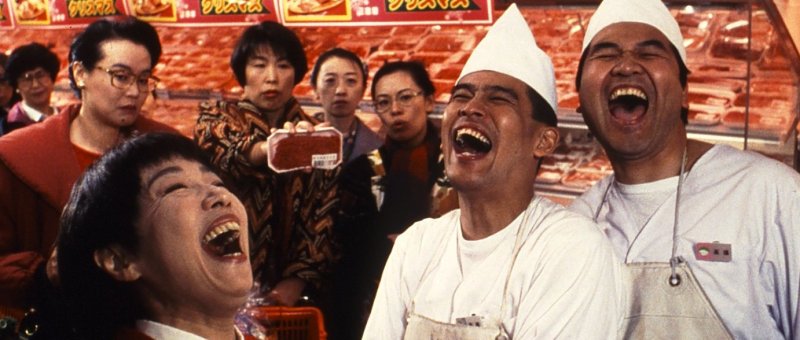
Supermarket Woman (スーパーの女, Juzo Itami, 1996)

By 1996 Japan had entered an extended period of economic stagnation which signalled the end of post-war aspiration but for many at least the false promises of the Bubble era proved hard to dispel. In what would be his penultimate film, Supermarket Woman (スーパーの女, Supa no Onna), Juzo Itami turns his attentions to the insular world of the nation’s family-held, independent supermarkets to ask a few questions about integrity in business which cut straight to the heart of what kind of society post-Bubble Japan intended to be given yet another opportunity to make itself anew. 

As the opening text crawl explains, this is a story not about giant supermarket chains but your friendly indie local. “Honest Mart” is a family-owned, mid-range supermarket in a declining industrial area nominally run by absentee CEO Goro (Masahiko Tsugawa) who was bequeathed the place by his father but is a melancholy drunkard delegating responsibility to his manager. The store has a huge problem in that a rival has recently re-opened under the new name “Discount Demon” and seems primed to steal all their business. On a stakeout of the new place, Goro runs into a childhood friend, Hanako (Nobuko Miyamoto), who is now a widow returning to the area. With her lifelong experience as a veteran housewife, Hanako knows a few things about supermarkets and she’s not very impressed with Discount Demon, doing a few quick calculations to realise the supposed discounts aren’t as enticing as they seem while common gimmicks like the all pervasive red glow that makes their meat look fresher than it really is only irritate her. Goro asks her for a “professional” opinion on Honest Mart without telling her who he is, only to discover she’s even less impressed with them, certain that his place is on the way out thanks to its dated decor, uninviting atmosphere, and low quality produce. 

The irony is Honest Mart is not much better than Discount Demon, both stores are subject to the same industry standards in which a certain degree of obfuscation is permissible. “In business honesty doesn’t pay” Hanako is told by the onsite butcher after she questions his tendency to mix meats to pass them off as more expensive cuts, while she later discovers that the store engages in the practice of repackaging unsold meat and fish with new expiration dates and is not very particular about its suppliers when it comes to buying in ready-made products. Brought on board to save the store, Hanako breezes in with a new mission to win the hearts and minds of her customers, and she can’t do that if she can’t have confidence in her stock. In any case, her the customer is always right policy quickly brings her into conflict with the store manager, an older more conservative man who actively resists innovation and resents having his authority undercut by an interloping woman. 

Meanwhile, we can also see that customer attitudes have changed. There’s a problem with availability of trolleys because, perhaps unusually for Japan, customers are just abandoning them willy-nilly in the carpark instead of retuning them to the trolley point like responsible shoppers. One man is even for some reason intent on stealing a large number of shopping baskets, caught by Hanako loading them into his car. Everybody wants cheap, which is understandable especially given the economic situation, and they might even be a little underhanded when it comes to getting it, but they also expect a reasonable level of quality and to be able to trust that the food they’re buying is safe to feed their families. Hanako is most alarmed that the ladies who work in the kitchen area, who are obviously wives and mothers themselves, do not shop at Honest Mart because they know what goes on at the store and they don’t trust it. 

“A housewife knows” Hanako is fond is saying. Her revolution is in essence a vindication of “the housewife”, perhaps the most maligned and dismissed figure of the mid-90s society, putting to good use all of her veteran experience both of running a home and of working a series of part-time jobs including those in supermarkets which she claims to love. Approaching the problem from the point of view of a consumer, she attempts to help Goro achieve his dream of making Honest Mart number one in Japan not through making it the most financially successful but the most loved by listening to women like her in the form of a focus group of local aunties some of whom had previously been serial complainers. 

Then again, some of her decisions are in a sense contradictory as she attempts to streamline the business along classically capitalistic lines in suggesting that the store doesn’t really need its overqualified butcher and fishmonger because the part-timers could be trained to do a “good enough” job. “Good enough” is in a sense her business philosophy, only not in the sense that somewhere like Discount Demon which falsely advertises regular steak as discount Wagyu means it, rather that her customers are after an everyday level of produce and so it’s not surprising that premium meats don’t sell. She wants to get rid of the butcher, who turns out to be on the fiddle, and the melancholy fishmonger disappointed no one wants his top quality seafood, because their “artistic temperament” is disruptive to the flow of the store and their presence is perhaps emblematic of the bloated, pretentious management style which is holding it back. 

Positioning the “housewife’s choice” as the ultimate seal of approval, Supermarket Woman advocates for a return to wholesome, small-town values, prioritising a sense of integrity as Honest Mart projects itself as a corporate force their customers can trust, perhaps anticipating a trend in dedicating itself to providing good quality fresh produce at fair prices in direct opposition to Discount Demon and its underhanded trickery. “Honest Mart keeps its word” Goro assures, pledging to honour a mistaken ad which promised eggs at prices so good it caused minor riot. In the end, it’s all about trust and integrity. If you don’t have that, you don’t have anything and the housewives of post-Bubble Japan will it seems vote with their feet. 


Currently available to stream in the US via Criterion Channel.

Original trailer (no subtitles)