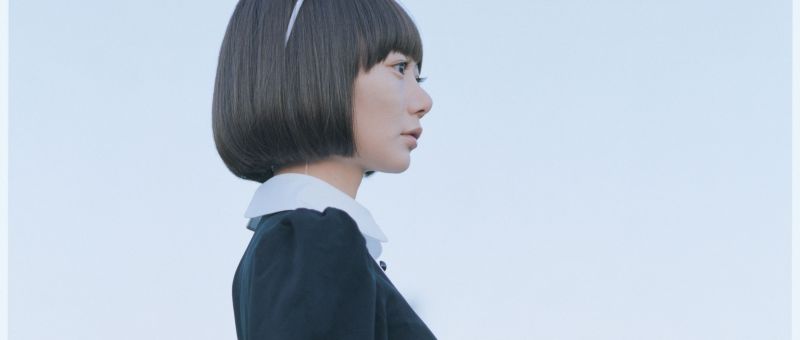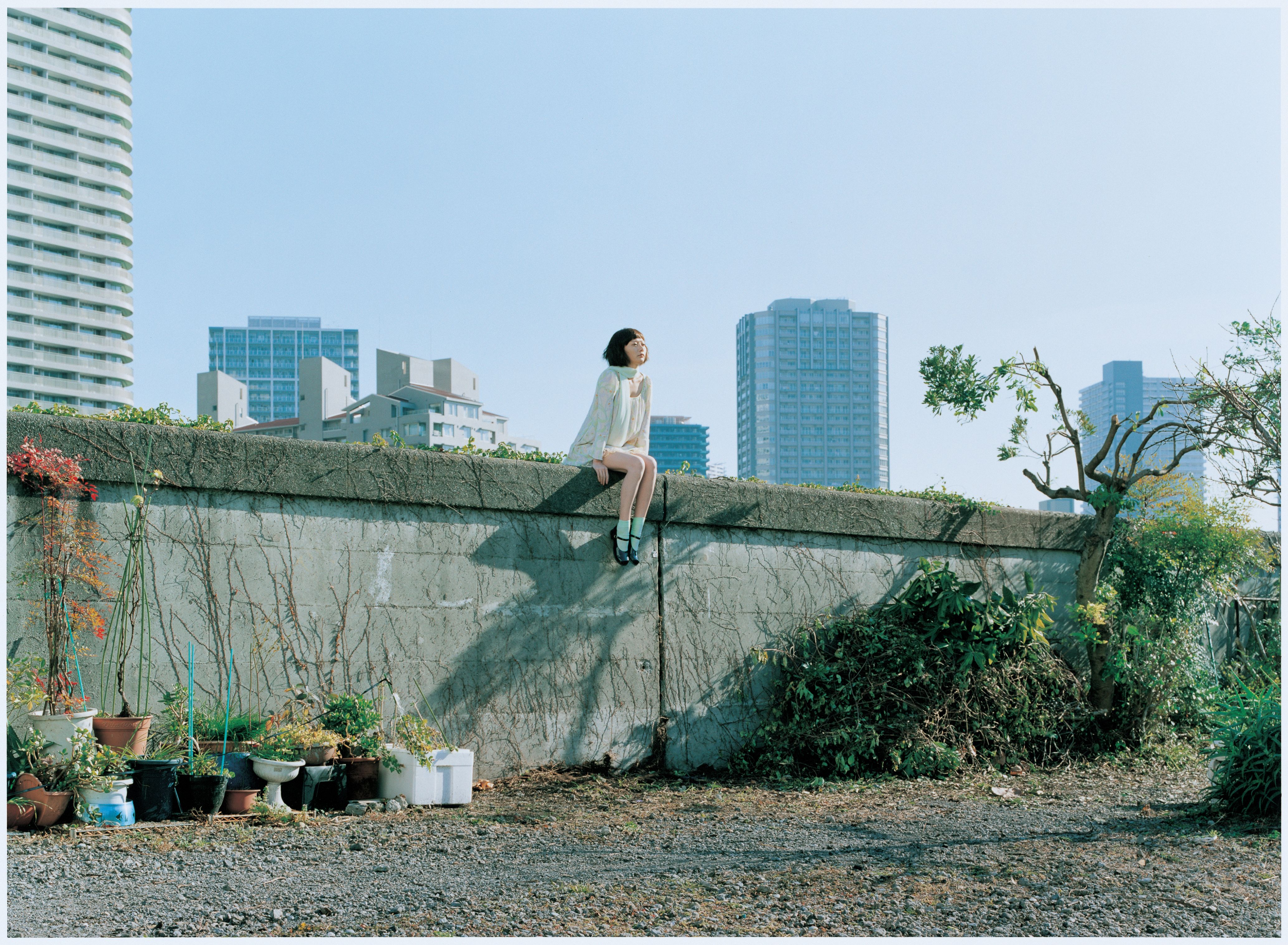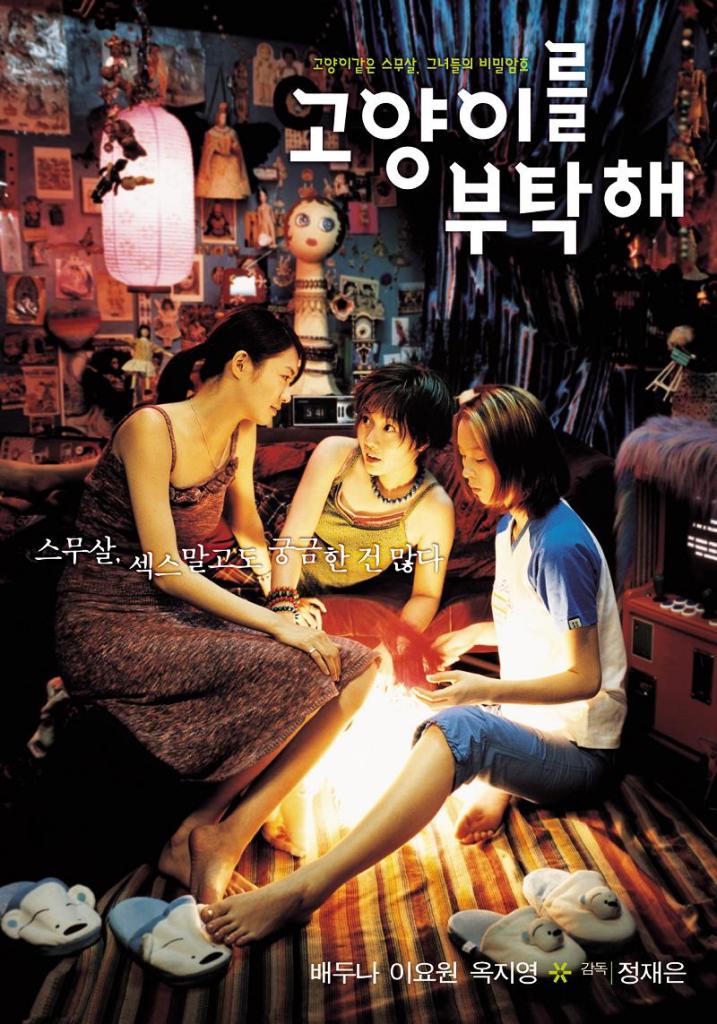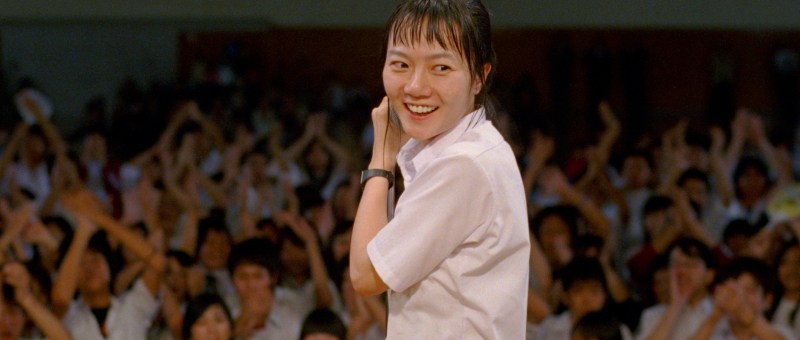
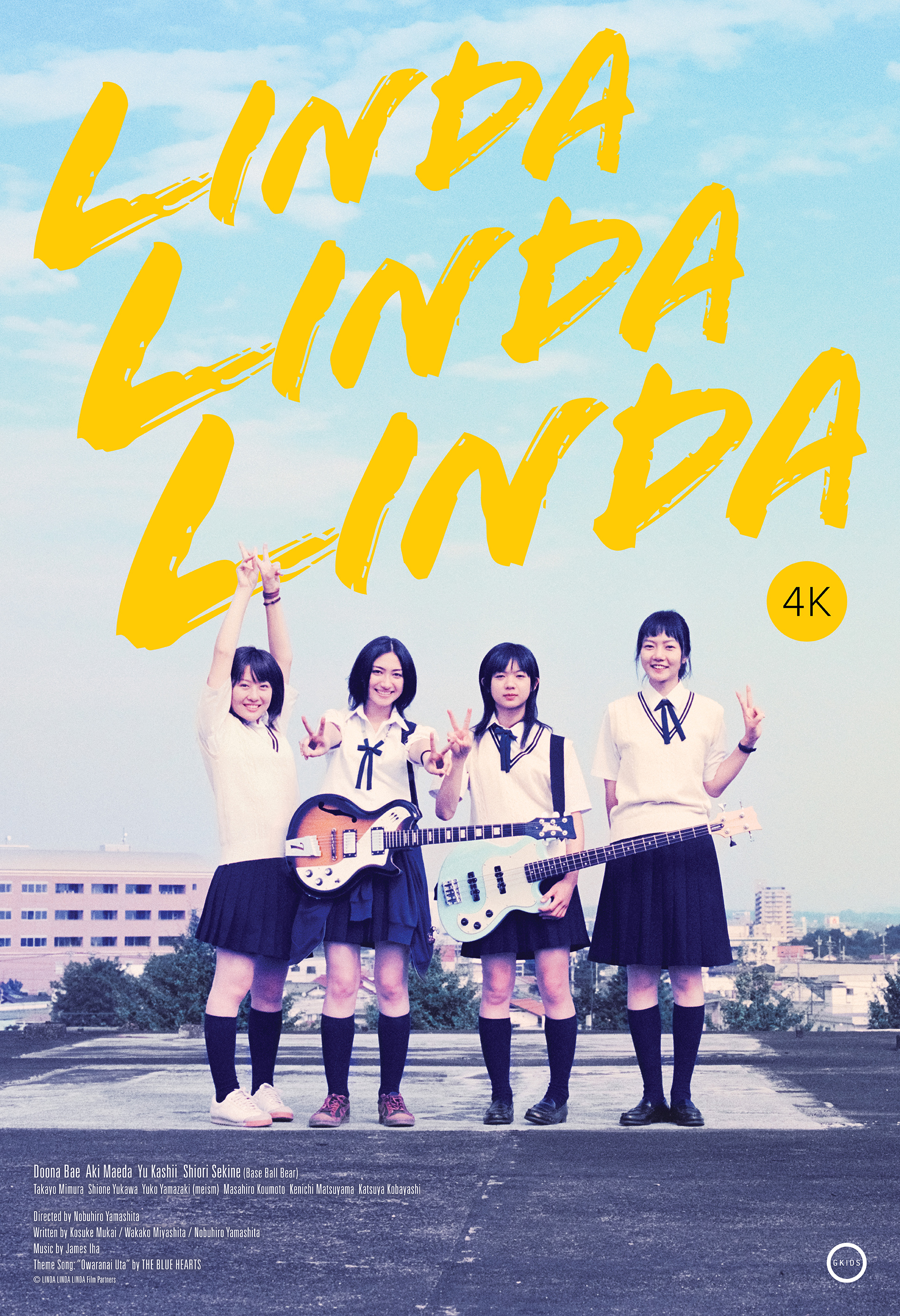
Linda Linda Linda (リンダ リンダ リンダ, Nobuhiro Yamashita, 2005)

“We’ve only got a little more time to be the real us,” according to a young woman making a promo video for the upcoming school festival, but who really is the “real us”? Now celebrating its 20th anniversary, Nobuhiro Yamashita’s wistful high school dramedy Linda, Linda, Linda (リンダ リンダ リンダ) is in many ways about the process of coming into being along with the anxieties of what comes next. “We won’t end here,” the girl later adds, “We won’t let our high school days become a memory,” yet they already are in a kind of contemporaneous nostalgia and elegy for idealised youth.

Or at least, there’s already a kind of reaching back taking place as the tracks the girls pick for a replacement act are by The Blue Hearts, a 1980s punk band that has become a kind of cultural touchstone echoing a sense of youthful alienation and rebellion. “Linda Linda” is the kind of song everyone knows, and even if for some reason they don’t or don’t even speak Japanese, can at least join in with the riotous chorus. It’s this sense of universality that eventually gives it its power as torrential rain brings the entire school inside just in time to see the girls’ belated act and find themselves captivated by its infectious energy and an identification with their own sense of insecure anxiety.

It’s also the serendipitous rain that allows lonely songstress Takako an opportunity to perform having previously declined to do because it’s no fun playing on your own and all her former bandmates graduated the previous year. Moe, the girl who broke her fingers playing basketball in PE leaving the original band members unable to take the to the stage, also gets an opportunity to sing having otherwise been denied a moment of closure in being prevented from taking part in her final school festival. While Moe feels intensely guilty about rendering all their time spent rehearsing somewhat pointless, it’s really the drama between founding members Kei and Rinko that leads to the band’s demise in Rinko’s conviction that it’s “meaningless” to continue while the others decide to go ahead anyway asking Korean exchange student Son (Bae Doona) to be their vocalist because she just happened to come down the stairs at the right moment and said yes because she didn’t really understand what they were saying.

Prior to her involvement with the band, Son had been a rather isolated figure trapped in the “Japan-Korea Culture Exchange Exhibit” which seems to have been more her teacher’s idea than her own and in any case gets no actual visitors. Her Japanese is a bit limited and most of her interactions are with a little girl who lends her manga to help her learn quickly, but becoming part of the band allows her to find her voice both literally and figuratively in taking the lead as the vocalist. A boy who claims to have fallen in love with her (Kenichi Matsuyama) goes to the trouble of learning a long speech in Korean to convey his feelings, yet a bemused Son replies to him in Japanese that she’s pretty indifferent to his existence before switching to Korean to explain that she’s leaving because she’d rather be hanging out with her friends with an expression that implies she’s only just realised that’s what they are. By contrast, she has a bilingual conversation with guitarist Kei (Yu Kashii) in which they seem to understand each other perfectly and each express how glad they are that they got to be in the band together. 

Similarly, it’s the concert itself that seems to heal rifts with a simple “Are you alright?” from Rinko (Takayo Mimura) to Kei whose friendship might, as someone says, essentially be too close for them to really get along. Drummer Kyoko (Aki Maeda) decides to declare her feelings for a longstanding crush before the concert. In the end she doesn’t manage it, but it doesn’t quite matter somehow because their performance is itself a kind of coming into being in which “the real us” comes into focus if also in a moment that itself becomes romanticised or idealised as an encapsulation of youth. Yamashita travels through the school festival as if it were a passage from one state of being to another, from the noodle stalls and crepe stands to haunted houses and the boy creating his own moment through encapsulating them on film, before ending with an unending song “so we can laugh tomorrow,” and the “real us” lives on.


Linda Linda Linda opens in US cinemas 5th September courtesy of GKIDS.

Trailer (English subtitles)
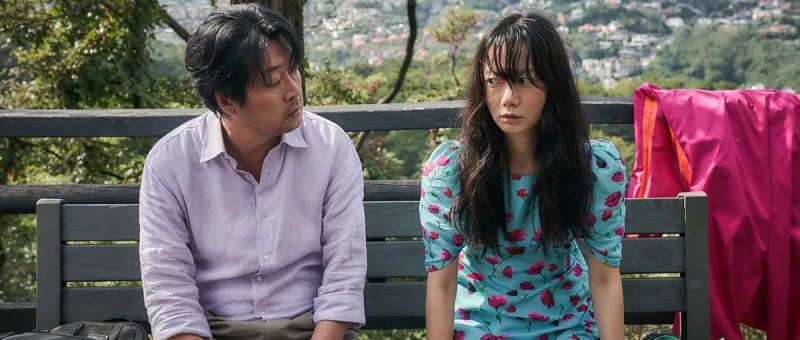
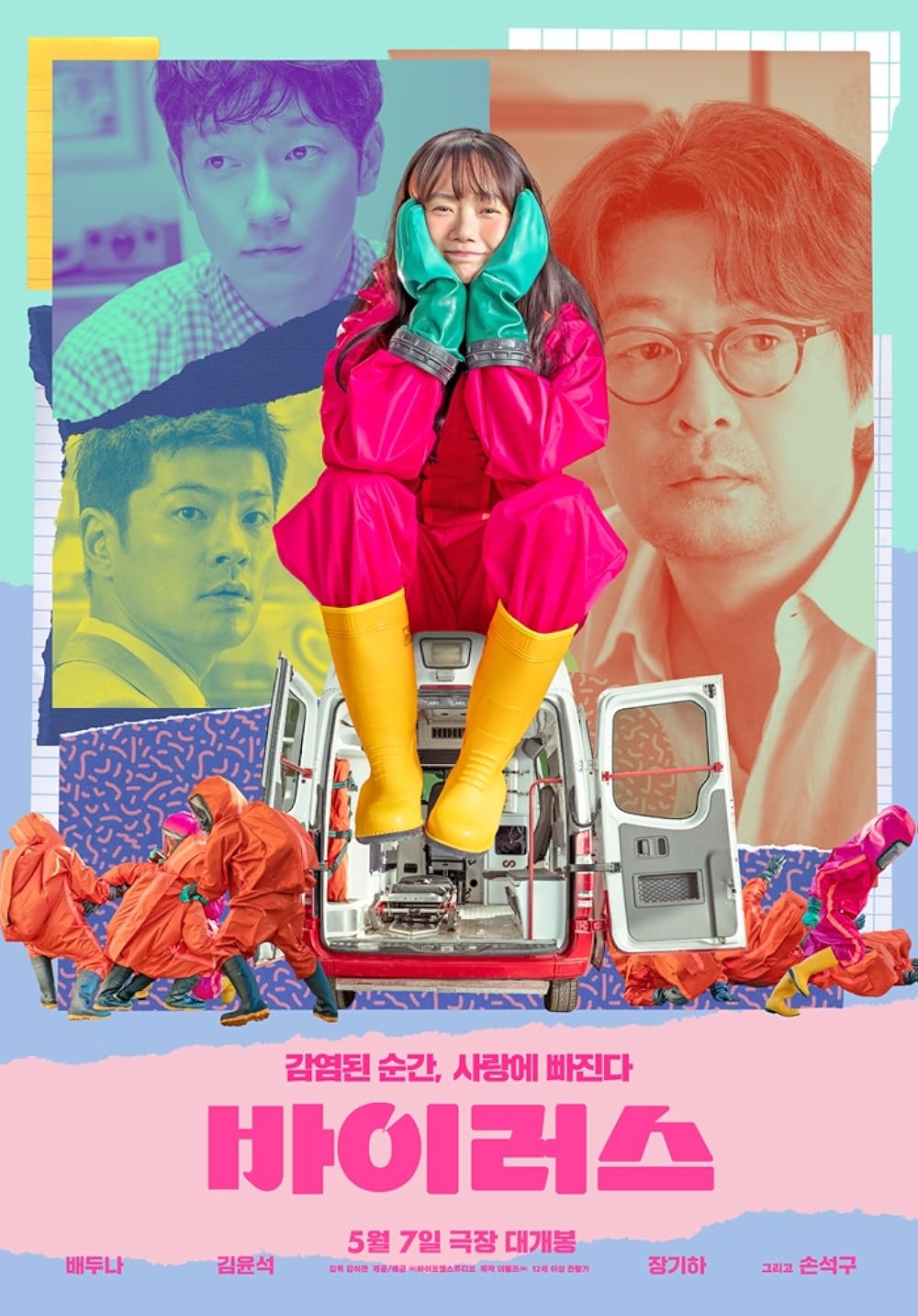
Virus (바이러스, Kang Yi-kwan, 2025)

Falling in love is like catching a virus, according to lonely scientist Gyun (Kim Yoon-seok), but how can you know if your feelings are “real” or just part of a crazy fever dream you won’t even remember as soon as the infection leaves your system? “There are no fake feelings,” lovelorn translator Taek-seon (Bae Doona) counters, which is true, but sometimes people do things they don’t recognise or later understand because they weren’t in their right mind, whether because of the sickness called love or a more literal kind of contagion. 

Anyway, this particular virus makes people incredibly happy for the short period time before they die and was developed as part of a project to create an anti-depressant with no side effects. Taek-Seon gets infected after a disastrous date her sister forces her to go on with socially awkward scientist Su-pil (Son Suk-ku). Su-pil is overly attached to the mice in his lab and is still mourning the death of Masako who appeared to him in a dream and told him to make sure her death wasn’t in vain. In retrospect, perhaps these are symptoms of the infection bubbling away in his body as much as they are of his loneliness, but it’s understandable that Taek-seon wasn’t really considering seeing him again only she’s forced into it when her mother and sister invite Taek-seon over to her apartment as a kind of enforced date. The mother and sister’s insistence on Taek-seon meeting someone and getting married is itself a reflection of a patriarchal society in which being unattached is taboo, while Taek-seon’s sister snaps back that translators won’t be needed soon because of AI implying she should find a husband to support her financially.

But then again, though she might claim to be, it does seem that Taek-Seon isn’t all that happy with her life and later confesses to being “always depressed”. She rarely leaves her apartment and lives a dull and unstimulating existence. Infected with the virus, she suddenly becomes sunnier, more confident, and independent, while chasing romance by approaching a childhood crush she seemingly never had the courage to pursue before. Yeon-u (Chang Kiha) is now a car salesman, and Taek-seon now suddenly has the urge to buy a Mini though she’s never actually driven outside the test centre despite having a license. In one sense, yes, it’s Yeon-u she’s after but the car also represents her latent desires for freedom and a more active life. 

Nevertheless, the corrupting aspects of the virus are all too present as Taek-seon begins to act in ways she may be embarrassed by if she could remember them once she’s better. Her memories seem to have remade themselves more to her liking. She’s forgotten that Yeon-u wasn’t quite the hero she thought he was in her overly idealised vision of the innocent childhood sweetheart that she never had the courage to pursue. On the run from “evil” scientists from the lab where Su-pil worked, she starts to fall for Gyun, the expert that’s helping her, but who’s to say whether her feelings are just a product of the virus, an attachment born of their relationship as doctor and patient, or something deeper. 

For his part, Gyun starts to fall in love with her seemingly before he himself is infected while knowing that she likely won’t remember any of this once she’s been cured. He too is still dealing with the romantic fallout of an improperly ended relationship in which he apparently stepped back because one of his friends liked his girlfriend more. The now-divorced girlfriend seems resentful that he didn’t put up more of a fight for her, and perhaps it’s true that he’s just a romantic coward and it’s a combination of the virus, a sense of responsibility, and the fact that Taek-seon’s natural immunity could hold the key to unlocking his own research that pushes him to try so hard to find a cure for her.

But his research goals are at least altruistic in his desire to find a depression cure without side effects to help people like his brother who took his own life. Dr Seong’s (Moon Sung-keun) lab, however, is entirely focussed on profit and protecting its own reputation. They’re mostly interested in Taek-seon because of her usefulness to them and are prepared to endanger her life if necessary. Even Gyun admits he acted unethically in agreeing to bypass animal testing but otherwise draws the line at anything that puts lives additionally at risk. Taek-seon, meanwhile, later signs over her antibodies so they can be used for free worldwide for the good of all. Even after the fever has cooled, the virus does seem to have made her a happier, more outgoing person who has the courage to pursue her dreams rather than living in lonely defeat. Whether her feelings were ”real” or merely part of her “sickness” and if the distinction really matters either way is up for debate, but that’s not to say she might not catch the love bug again from a less compromised position and actively in the driving seat of her own life.


Trailer (Korean subtitles only)

Spring Bears Love (봄날의 곰을 좋아하세요?, Yong Yi, 2003)

Sometimes it’s nice to think there’s more to life, that that there’s some kind of greater plan or grand adventure in the works but there’s always the danger of falling into the wrong story on a desperate quest for meaning in the mundane. This is in a sense what happens to Hyun-chae (Bae Doona), the quirky heroine of Yong Yi’s charming rom-com Spring Bears Love (봄날의 곰을 좋아하세요?, Bomnalui Gomeul Johahaseyo?) as she comes to believe that someone is leaving her secret messages in a series of art books she’s been borrowing for her hospitalised father from the local library. 

The notes in the books are poetic if a little absurd which Hyun-chae attributes to their nature as a code which she’s come to believe is exclusively for her. She has no real reason for thinking this yet is determined to find the author whom she’s privately called “Vincent”. Meanwhile, she abruptly runs into an old high school friend, Dong-ha (Kim Nam-jin), who has since become a train driver and is currently working as an operator on the Seoul underground (according to Hyun-chae he’s only there as a ringer crossing a picket line). It’s quite clear that Dong-ha has designs on her, in fact he says she’s the whole reason he came to Seoul in the first place. Yet Hyun-chae isn’t really interested, partly because she’s hung up on her illusionary romance with Vincent and partly because it seems she just looks down on him, idly catching sight of his oil-stained fingers as they sit down at a greasy burger bar. 

It has to be said, Dong-ha is his own kind of strange as obsessed with trains as Hyun-chae is with Vincent yet his interest is at least practical and down to earth. As he says, thousands of people travel on the subway every day. It’s a good steady job with a nice salary and drivers’ families can ride for free. By contrast, Hyun-chae’s high school dream was to become an air hostess travelling the world literally with her head in the clouds. Now she’s working a dead end job at supermarket and lamenting that nothing, not even her love life, seems to go her way. Her dilemma is in a sense between fantasy and reality dismissing the wholesome practically of a man like Dong-ha for the ethereal romanticism of Vincent whom she has after all almost entirely constructed in her mind without really even knowing if the messages were actually intended for her in the first place. 

Her taste for fantasy can be seen in her tendency take off on flights of fancy imagining herself in theatre scenes inspired by the paintings in the books and starring her current Vincent suspect. Her more worldly friend, Mi-ran (Yoon Ji-hye), tries to explain to her where she’s going wrong with dating leading to a flashback in which she’s basically Dong-ha on a date with a sophisticated guy who is clearly exasperated with her constant slurping of a soft drink and chattering through the movie (One Fine Spring Day), describing song at a restaurant they go to as reminding him of Bagdad Cafe while she sings loudly and publicly. 

During her search for Vincent, she ends up on a date with the librarian (who later claims to be married) to a zoo where he mainly gives her lectures about bears which had featured in the first note and she tries her best to play the straight woman to his absurdist banter. Uncharitably her journey could be read as one of learning to settle, that she should give up on her dreams and submit to the practicality of Dong-ha, yet for her it is perhaps shaking off her fear of the real letting the idealised vision of Vincent go while coming to accept Dong-ha’s earthiness. Then again, he does hide a few truths from her in order to manipulate her feelings, so perhaps not all that wholesome after all even if he does put it right in the end and can always be counted on for midnight ramen. Replete with zeitgeisty detail and and absurdist humour, Yong Yi’s quirky comedy may not have all the answers in its convoluted mystery but does at least allow its heroine to find her feet finally getting the message and running fast towards her certain destiny.


Broker (브로커, Hirokazu Koreeda, 2022)

Perhaps more than any other contemporary director in Japan, Hirokazu Koreeda has persistently interrogated the concept of the modern family asking what exactly the word has come to mean and how it is or should be defined. In Nobody Knows he showed us a case of parental neglect as abandoned siblings attempted to get by on their own in the absence of maternal care, while the separated brothers of I Wish struggle to define the nature of their relationships in the wake of their parents’ divorce. In Like Father, Like Son, Koreeda asks whether it’s blood relation that defines a family tie or whether it is forged more by mutual affection and shared memories, and in festival hit Shoplifters, he showed us a family who were not related by blood but had found in each other a home and a place to belong. 

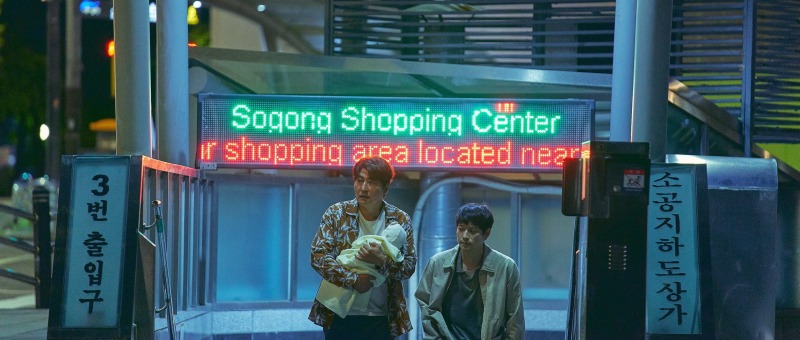
Billed as a kind of companion piece, Broker (브로커) once again features a found family “brokered” by criminal activity but goes a step further, asking once again what the rights and responsibilities are when it comes parenthood and if the choice to abandon a child can ever be justified. Set in Korea where Christian morality has a greater influence, the film opens with a young woman leaving her infant child in front of a church yet abandoning him on the floor rather than placing him inside the “baby box” in the church’s wall. A policewoman staking out the church in the belief that someone is using the baby box to traffic children gently places the infant inside with what looks like maternal care but then we start to wonder, perhaps she only does so in order to see what happens when someone picks up him from the other side. 

Indeed, the policewoman will later concede that perhaps she herself was the one who most wanted the baby, Woo-Sung, to be sold so that she could catch the traffickers redhanded. We might feel a degree of revulsion towards the idea that a baby could be exchanged for money, but then perhaps we don’t stop to wonder who might buy and for what purpose. Sang-hyun (Song Kang-ho), a dry cleaner with gambling debts, and his partner Dong-soo (Gang Dong-won) who himself grew up in an orphanage, later recount selling a baby to two gay men who would otherwise be unable to adopt in the still conservative country suggesting in part that it’s a repressive society that forces people into this morally questionable underground trade in human children. It’s also societal conservatism that necessitates the existence of something like the baby box in that often very young women who bear children but cannot keep them either out of shame or simple economic impossibility have few other options than to abandon their child in the hope that someone will take it in. 

Detective Lee (Bae Doona) nevertheless brands these women as “irresponsible” and blames the baby box for tacitly encouraging their behaviour. An abandoned child himself, Dong-soo also struggles with his attitude towards the mother, So-young (Lee Ji-eun), who against all the odds does come back to reclaim her son after changing her mind. He and Sang-hyun justify their actions that they’re “saving” Woo-sung from being placed into the care system by finding him a loving home with parents who can give him a comfortable life. After taking to the road, the trio arrive at the orphanage where Dong-soo was raised which is less a home for him than a painful reminder of all he’ll never have and will never achieve as someone without a clear idea of a place to belong.

The man running the orphanage even concedes he’s not doing so well after the losing the subsidies for a few of the kids who have left, though few people adopt kids over six and the law makes it more difficult at eight which is a particular problem for football enthusiast Hae-jin (Im Seung-soo) who ends up climbing into Sang-hyun’s van and demanding they take him in. “Blood is thicker than water” the man sighs, explaining that kids are often sent back when it doesn’t work out or even end up suffering abuse despite the supposedly rigorous processes for vetting potential parents which causes some to simply buy a child on the black market instead. 

Despite the image of Dong-soo and Sang-hyun as heartless child traffickers they nevertheless take good care of Woo-sung and are up to a point careful that they should give him to someone responsible, mindful of those who might want a baby for untoward purposes or are intent on selling him on. A visual motif of tangling threads from the cotton on Sang-hyun’s sewing machine to the rope that pulls the busted back door of the van closed hints at the various ways these five dispossessed people are slowly bound together, becoming an accidental family forged through a process of mutual understanding in which Dong-soo is able to re-evaluate his feelings towards his mother through bonding with So-young and realising that in abandoning her child she may only have been trying to protect him and give him the better life that she never had. 

So-young tells Dong-soo that she sometimes has a dream in which the rain washes away her life until now, but on waking she realises it’s raining and nothing’s changed. He tells her perhaps all she needs is an umbrella that’s big enough for two, a metaphor for the protective quality of family he could perhaps have given her. Even she later concedes that had she met them earlier, none of this would have been necessary while Detective Lee’s more sympathetic partner (Baek Hyun-jin) likewise asks why they couldn’t have intervened earlier and done something to help this struggling young woman whose only problem was her aloneness before it came to this. What emerges is an unexpected compassion and the extension of an umbrella from an unexpected source in the acknowledgement that nothing’s ever quite as simple as it might seem. Koreeda leaves us with an outcome that is possibly as happy as it could be in an imperfect world, which might in itself be a little unrealistic but nevertheless in its own way hopeful in having reclaimed a notion of “family” brokered by selflessness and mutual compassion if not quite love for the orphans of an indifferent society.


Broker opens in UK & Irish cinemas on February 24th. For more information head to http://broker.film/

UK release trailer (English subtitles)

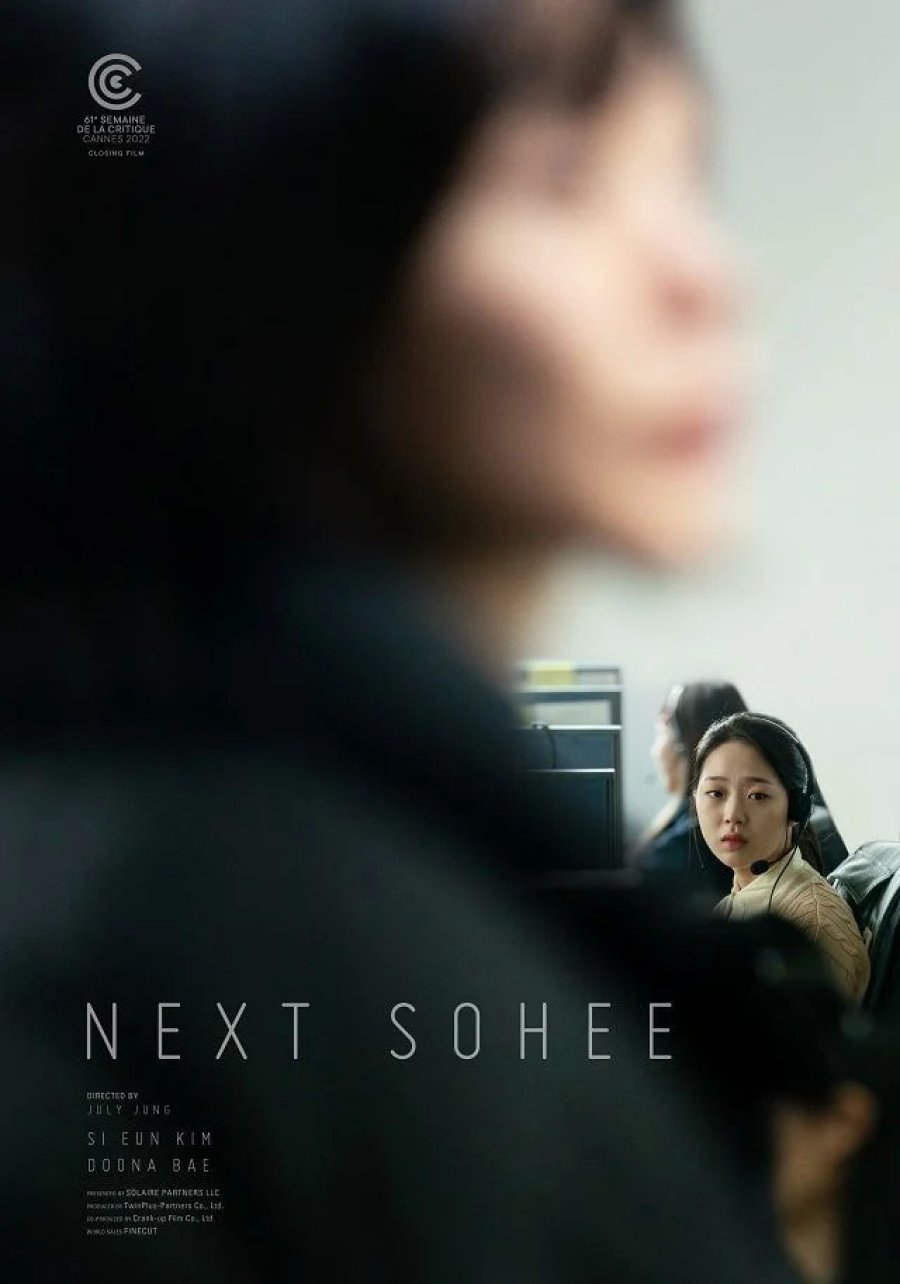
Next Sohee (다음 소희, July Jung, 2022) [Fantasia 2022]

“She just went quietly” an older woman running a cafe explains to a police officer against all advice attempting to investigate the suicide of a young woman in July Jung’s long-awaited A Girl at My Door followup, Next Sohee (다음 소희, Daeum Sohee). In the end, Sohee (Kim Si-eun) did indeed go quietly, cowed into submission by the apparent hopelessness of her life amid the grinding crushingness of contemporary capitalism while even the policewoman who shares her fiery sense of outrage comes to a similar conclusion on uncovering the endemic abuses of the modern society. 

Jung devotes the entire first half of the film to Sohee’s slow burn disintegration as a high schooler selected as an “extern” for a call centre business while dreaming of becoming a dancer. These exploitative work experience programs are technically part of Sohee’s high school education and dropping out of them incurs the possibility of not graduating along with being “red tagged” by the school in a lesson in banishment room tactics which sees the kids forced to perform menial tasks such as cleaning the toilets while wearing clothing that marks them out as a failure who has brought shame on their institution. A proud young woman, Sohee is thought of as mentally strong and academically earnest originally excited by the extern opportunity which the teacher sells to her as being a cut above, she being the first of their students to land a position at a “major” company which is also feather in his own cap. 

Later Yoojin (Bae Doona), the policewoman who briefly met Sohee at a dance class, asks the teacher why he didn’t bother to investigate what was really going on at the call centre but he only tries to shift the blame explaining that he needs to find good jobs for other kids to maintain the school’s rankings which means keeping on the good side of employers. As Sohee sat vacantly and cried having attempted to take her own life, he dismissed her concerns and told her to work harder. Each time Yoojin interviews an authority figure they tell her it’s not their fault, it’s the system, while blaming Sohee for having “attitude problems” and pointing out that she should have just quit if she wasn’t up to the job. 

But Sohee couldn’t quit in part because of the shaming culture that surrounded her in which she’s constantly reminded that her actions have negative consequences for others. Firstly she’s told that her subpar performance brings down their team’s rankings, then shunned by her colleagues because her top scores are pushing up the targets for everyone else. She doesn’t want to let her teacher down by quitting, and even on trying to explain to her parents after her first suicide attempt is simply told to work harder under the fallacy that if you obey all the rules and work hard you’ll be alright. The call centre is almost entirely staffed by externs, in the main teenage girls, who are made to listen to irate customers verbally abuse or sexually harass them while instructed that they must do whatever possible to stop them cancelling their accounts. The call that breaks Sohee comes from a sobbing father who wants to cancel because his child has died so he doesn’t need the service anymore but she still has to try and sell him a new TV package while giving him the run around on the contract cancellation. 

Because the externs have a high turnover, the company defers payment of their bonuses to discourage them from leaving while continuously docking their wages reminding them of the clauses in the contract they signed which state that remuneration is subject to change. Sohee was in fact forced to sign two different contracts so the company could get away with paying her below minimum wage which is a violation of what little labour law actually exists while as these are essentially children who’ve signed contracts they don’t understand because their teachers and parents told them to they have no idea of their rights but are gradually realising they’re being exploited and there’s nothing they can do about it. Sohee was thought of as the type to fight back, and she was, she did, but in the end she went quietly because what else could she have done. 

She went quietly from the dance class where Yoojin first encountered her too, but does not pass so quietly from her mind. Yoojin asks why it was that she danced given there’s no gain to be had by it, she was too old to become a K-pop star and there’s no money in dancing but for her there was perhaps freedom and a small act of rebellion in the use of her physical body for something other than labour. An inspector who calls, Yoojin shares Sohee’s “attitude problems” and refuses to let the case rest realising that the poor kids at the below average schools are being forced into employment that is almost entirely unregulated while the companies that exploit them paint themselves as the victim, pressuring employees and bereaved family members into signing documents denying any wrongdoing. Betrayed by the company, Sohee first refuses to sign but in the end she does so, quietly, and at the cost of her integrity. Yoojin too is eventually forced to sign a form and put her name to something she believes is not quite true. Sohee’s death was as she puts it a workplace accident, or perhaps a slow motion murder, and “nobody gives a damn” because she was just a teenager with a “bad attitude” who went quietly because no one would have listened to her anyway. 


Next Sohee screened as part of this year’s Fantasia International Film Festival.

International trailer (English subtitles)

Air Doll (空気人形, Hirokazu Koreeda, 2009)

“Was everything you saw in this world sad? Was there something, anything, what was beautiful?” the heroine of Hirokazu Koreeda’s exploration of urban loneliness Air Doll (空気人形, Kuki Ningyo) is asked by her creator though he can offer her few answers for the strange mystery of her life. Like a child, she takes beauty where she finds it yet much of what she sees is indeed sad as she reflects on the disconnected lives around her, the emptiness and futility of life in the contemporary society where everything is just a substitute for something else which cannot be obtained. 

As for herself, she is quite literally empty inside, an inflatable sex doll owned by middle-aged family restaurant waiter Hideo (Itsuji Itao) who has given her the name of his ex, Nozomi (Bae Doona), which ironically means hope, wish, or desire though not generally of the sexual kind. Yet one day she suddenly wakes up and begins to explore the world rejoicing in its new sensations feeling the rain on her hands and the wind that sounds the chimes as she watches her neighbours go about their daily routine. Dressed in the French maid’s outfit picked out for her by Hideo she gets a job at a local video store and begins living a more independent life while learning how to operate in human society. She feels herself out of place but is repeatedly told that there are others like her, mistaking her literal emptiness for their spiritual despair. 

Yet that sense of emptiness and futility is evident from Nozomi’s first forays into the human world in that the first act of mundanity she witnesses is the bin men sorting rubbish for disposal. “Unfortunately they’re non-burnable” Nozomi’s creator explains when she visits him in search of answers revealing he throws out the broken dolls that are returned to him once a year, “after all, once we die we’re burnable garbage. It’s not such a big difference” he adds, though as it turns out it is quite a big difference to Nozomi in ramming home to her that she can never become human and will always be something else, an inorganic “substitute” for something perceived as the “real”. 

“Your only flaw is that your body’s so cold” Hideo ironically laments as he warms her up in the bath, something she is told repeatedly to remind her that though she has discovered a heart it does not beat and she is not “alive”. Yet an old man (Masaya Takahashi) seeking a different kind of comfort later remarks that those with cold hands often have warm hearts as he reflects on his own life as a “substitute” teacher while she looks over the pictures of the many dogs he’s had through the course of his life as substitutes for the traditional family that have only left him feeling lonelier through their inevitable absences. There is perhaps in this a slightly conservative and uncomfortable implication that the loneliness we see in everybody that we meet is partly caused by the decline of the traditional family itself partly a consequence of the shifting gender roles of the later 20th century society. When they first meet, Nozomi has been rejected by a group of local mothers for inappropriately cooing over a baby in a pushchair the old man comforting her with a tale of the mayfly which is itself empty inside existing only to give birth and then die its own life defined by futility. Nozomi can never truly be human, but more than that she can never truly be a woman because she cannot reproduce as signalled in her final exchange with a little girl in her neighbourhood who swaps her beaten up and broken doll, a substitute for her absent mother now symbolic daughter to Nozomi, in exchange for her ring, a symbol of adulthood. 

In this way Nozomi becomes herself a symbol of something that is broken, an active barrier to societal happiness in providing a way for men like Hideo to escape the responsibility of the traditional family by satisfying his sexual desire through a fantasy of intimacy with an inanimate substitute. When Nozomi throws her pump away, Hideo buys a new model and when she confronts him he asks her to go back to being a passive doll because he finds all the human stuff “annoying” and only wants a woman who can be a selfless embodiment of his desires, will never talk back, challenge him, or hurt his feelings. Meanwhile, when her boss at the store (Ryo Iwamatsu) who seems have experienced a recent familial breakdown of his own blackmails her into having sex with him in the bathroom he is conversely annoyed by her passivity while tearfully calling out his wife’s name. Even her innocent love for coworker Junichi (Arata Iura) has its darkness, not only does she suspect she’s merely a substitute for his ex, his fetishisation of her revolves around his ability to take control over life by letting out her air and then permitting her to live by blowing his own back into her. 

“I am an air doll. A substitute for sexual desire” is how she introduces herself, preoccupied with her literal emptiness yet along with a heart discovering a sense of self as she interacts with others, beginning to wear her own clothes rather than those purchased for her by Hideo. At a moment of crisis she is surrounded by all the treasures she’s collected which ironically include a number of ornaments intended for a doll’s house including a tiny simulacrum of a cake which reappears in her imaginary birthday party suggesting that the only true happiness is to be found in wishful fantasy while the “real” will only ever disappoint. Nevertheless, she uses her last breath to bring happiness to all she can, uniting the old man with a lonely old woman (Sumiko Fuji) who confesses to random crimes just to have someone to talk to. Shot with unusual fluidity by Mark Lee Ping-Bing, Koreeda captures a society in flux in which the easy convenience of disposable consumerism has begun to replace human relationships and left us all empty inside. 


Air Doll in in US cinemas and on VOD Feb. 4 courtesy of Dekanalog

Trailer (English subtitles)

The Drug King (麻藥王 / 마약왕, Woo Min-ho, 2018)

Drug King posterKorean cinema has been in a reflective mood of late, keen to re-examine the turbulent post-war era in the wake of a second wave of democratic protest and political turmoil. Even so, dealing with the difficult Park Chung-hee era has remained sensitive with the legacy of life under a repressive regime apparently very much still felt. Woo Min-ho’s Drug King (麻藥王 / 마약왕, Mayakwang) is first and foremost a crime doesn’t pay story, but it’s also a subtle condemnation of authoritarianism and the corruption and cronyism that goes along with it. Painting its hero’s rise as a consequence of the society in which he lives, it perhaps implies the new wind of egalitarian democracy made such amoral venality a thing of the past but then again is at pains to show that nothing really changes when it comes to greed and resentment.

Our hero, Lee Doo-sam (Song Kang-ho), starts out as a jeweller dabbling in smuggling in Busan in 1972. Just as the smuggling business starts to take off, Doo-sam’s boss falls out with his friends in high places and decides to throw him to the wolves while he escapes abroad to safety. Doo-sam, not one to be beaten, starts coming up with ideas. Mobilising his wife (Kim So-jin) to get him out of jail through a combination of bribery and blackmail, he teams up with the area’s smuggling king to act on a tip-off he got from a Korean-Japanese yakuza and begins producing popular drug Crank for export to Japan.

As the opening voice over explains, Crank is a dangerous stimulant developed by the Japanese during the war and given to factory workers and kamikaze pilots because of its ability to eliminate both fear and fatigue. It is also highly addictive and provides an extreme high which have made it a popular recreational drug but, crucially, the real value is economic. The rising Japan is keen to make use of foreign labour, and Korea is keen to up its export capability. This, coupled with poor regulation of the workforce, has led to extreme exploitation in which factory workers are encouraged to hop themselves up on stimulants to keep working overtime for the sake of economic expansion. Thus, the influx of Crank is, in many ways, simply another facet of ongoing Japanese imperialism.

Not that Lee Doo-Sam cares very much about that. An honest prosecutor later puts it to him that he’s contributing to the exploitation of ordinary workers who might earn a few pennies extra for working a few more hours but at the cost of their health and wellbeing, while he gets filthy rich off the back of their misery. Doo-sam is, however, unrepentant. In the beginning he just wanted to provide for his wife, children, and unmarried sisters, but perhaps he also wanted to kick back against his reduced circumstances and he certainly did enjoy playing the big man. In any case, it has paid off. Doo-sam too has friends in high places and they won’t want to let him sit in a police cell for long in case he starts feeling chatty.

Times change, however, and whatever standing and influence Doo-sam thought he’d accrued his life is built on sand. When Park is assassinated by a member of his own security team, all those contacts are pretty much useless because the cronies are now out in the cold. There are protests in the streets and the wind of a new era is already blowing through even if it is still a fair few years away. That bold new era will, it hopes, do away with men like Doo-sam and their way of thinking, eradicating corruption and backhanders in favour of honest meritocracy. Naive, perhaps, and idealistic but it is true enough that Doo-sam is a man whose era has passed him by while he, arrogantly, burned all his bridges and gleefully sacrificed love and friendship on the altar of greed and empty ambition.

Hubris is Doo-sam’s fatal flaw, but he remains a weasel to the end only too keen to sell out his associates in order to save his own skin. He may claim he was only trying to live a “decent” life, but his definition of “decent” may differ wildly from the norm. Nevertheless, perhaps he was just like many scrappy young men of post-war years, desperate, hungry, and left with few honest options to feed his family if one who later found himself corrupted by backstreet “success” and the dubious morals of the world in which he lived which encouraged him to disregard conventional morality in favour of personal gain. Much more about life in Korea in the authoritarian ‘70s than it is about crime, The Drug King is nevertheless an ironic tragedy in which its drug peddling hero eventually enables the birth of a dedicated narcotics squad and helps to dismantle system which allowed him to prosper all while grinning wildly and, presumably, planning his next move.


Currently available to stream online via Netflix in the UK and possibly other territories.

International trailer (English subtitles)

Key tracks from the (fantastic) soundtrack:

Jung Hoon-Hee – Flower Road

Kim Jung Mi – Wind

Take Care of My Cat (고양이를 부탁해, Jeong Jae-eun, 2001)

take-care-of-my-catThe time after high school is often destabilising as even once close groups of friends find themselves being pulled in all kinds of different directions. So it is for the group of five young women at the centre of Jeong Jae-eun’s debut feature, Take Care of My Cat (고양이를 부탁해, Goyangileul Butaghae). All at or around 20, the age of majority in Korea, the girls were a tightly banded unit during high school but have all sought different paths on leaving. Lynchpin Tae-hee (Bae Doo-na) is responsible for trying to keep the gang together through organising regular meet ups but it’s getting harder to get everyone in the same place and minor differences which hardly mattered during school grow ever wider as adulthood sets in.
Cheerful scenes of high school mischief give way to the uncertain present as five old friends prepare to celebrate the 20th birthday of the group’s self appointed star, Hye-joo (Lee Yo-won). Hye-joo, however, has moved on to a high level office job in Seoul and is about to blow off her high school friends to hang out with her possibly sleazy boss, only to revert back to plan A when he cancels on her. Too cowardly to ring her friends in person, Hye-joo leaves the business of calling off the party to the chief organiser, Tae-hee, who rings round letting the other three girls – jobless Ji-young (Ok Ji-young), and half Chinese twins Bi-ryu (Lee Eun-sil) and Ohn-jo (Lee Eun-ju), know (and presumably has to then ring them all back to tell them the party’s back on).

Hye-joo moved farthest away from her roots both in terms of location and of her social ambitions through taking a well paid admin job in the city. Increasingly materialistic and status orientated, her friendship with the other girls suffers as she sees herself as transitioning to a higher social class. Ironically, her views are equally deluded as she continues to believe that her dedication and willingness to work hard can make up for her lack of a degree but quickly finds herself displaced when the next batch of newbies arrive.

This growing desire for material status has also contributed to a seemingly unbridgeable rift with Ji-young whose economic status is the most vulnerable. Orphaned and living in a shack with her elderly grandparents, Ji-young has recently lost her job and is having difficulty finding another one precisely because of her circumstances – one firm even point blank refuses her application because both of her parents are dead and they need a direct family member to vouch for her. Hye-joo is insensitive in the extreme and often flashes her money around whilst rubbing salt in Ji-young’s wounds by emphasising her lack of it and pouring cold water over her ideas of saving money to study abroad. Small digs like these and insisting that all the girls leave their home town to visit her in Seoul (leaving aside the additional costs for Ji-young whom she knows is having difficulty making ends meet) point to Hye-joon’s own sense of neediness and insecurity.

As a result, Ji-young distances herself from her friends, ashamed of her desperation and feeling unable to ask them for help. It is she who finds the cat of the title when she hears it mewing whilst trapped behind debris on her way home. The cat becomes almost a mirror of Ji-young – alone and abandoned on the streets with no one to look after her. Originally, Ji-young tries to give the kitten to Hye-joon as a birthday present only to have it immediately returned. The cat is then passed around among each of the friends looking for a more permanent kind of affection, but finding little in the way of stability.

The longest and most devoted guardian turns out to be Tae-hee who is perhaps most affected by the loss of her friends and changing circumstances. Tae-hee is from a moderately well off middle class family and has been helping out in her father’s business since leaving school (apparently without pay). Despite her lack of worry over material comforts, she finds herself feeling restless and increasingly interested in the “foreign” with dreams of taking off alone for adventures overseas. Her desire for freedom is partly down to her domineering father who simply overrules all of her decisions even down to ordering food in a restaurant. Tae-hee is the only one to reach out to Ji-young when she realises she might be in trouble and is the only one still there for her at the end. Their economic and familial circumstances may be different, but in their desire to escape the confines of the rundown Incheon for something outside of what it might have planned for them, the two girls are a perfect match.

Of the group of friends the twins receive the least attention, hovering on the sidelines, separate from the mini dramas erupting between the insensitive and self obsessed Hye-joo and the increasingly desperate Tae-hee and Ji-young. As a unit of two they have their own little world which seems much happier and more solid than that of any of the other girls and arguably have less need for the immediacy of their old friendships. They are therefore the ideal place to deposit them, in the form of a stray cat finally finding a home. The past has its place – in the past, the memories are warm and fluffy and deserve to be taken care of, but there comes a time you have to surrender full custody and be content to visit from time to time.

An extraordinarily well composed debut feature, Take Care of My Cat has a more European feeling than many a Korean coming of age drama but is filled with realistic detail such as the constant ringing of the girls’ ever present mobile phones and the onscreen representation of their straightforward text based conversation. There’s a kind of sadness associated with the transition from carefree adolescence to the difficult journey into adulthood with each of the girls discovering what it is they want out of life, or more aptly what it is they don’t want. Hye-joo emerges as the quasi-villain of the piece as she makes an obvious, superficial choice to follow the consumerist trend over valuing human relationships though it’s hard not to feel sorry for her when it appears she’s being set up for disappointment. Ending on a note of hopeful uncertainty, Jeong’s debut feature is a hymn to the theme of moving on but is careful to admit the bittersweet quality of a new beginning.


International trailer (English subtitles)

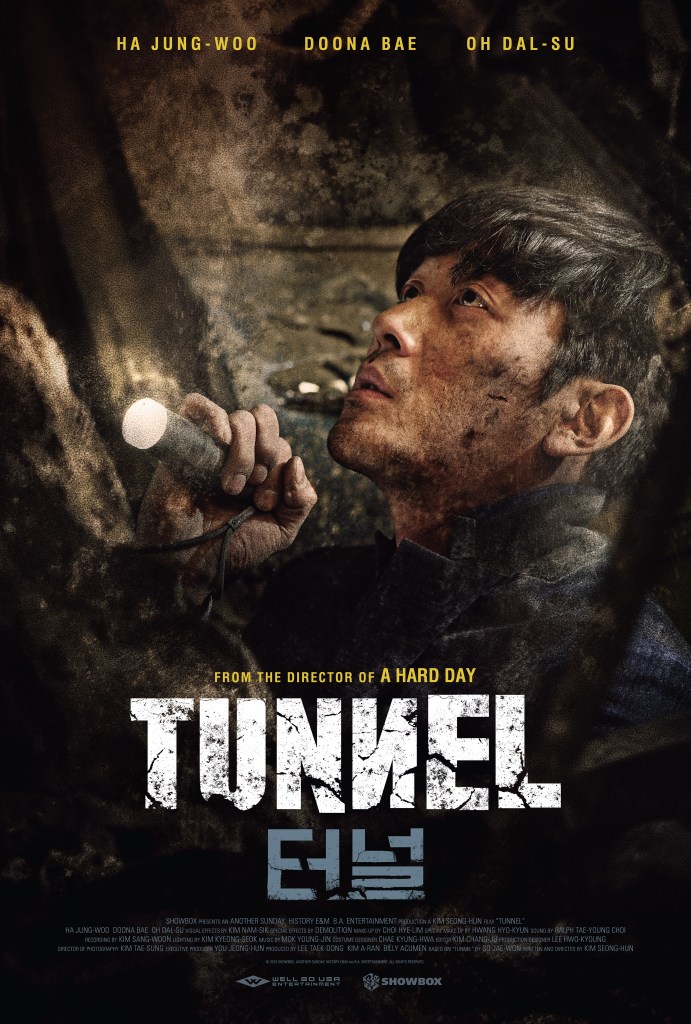
Tunnel (터널, Kim Seong-hun, 2016)

TunnelIn 1925 an avid cave explorer, Floyd Collins, became trapped in a narrow crawl space. Though he was discovered and help came with food and water, a cave in left him sealed off down there and fourteen days later he died of thirst and exposure. As tragic as this obviously is, Floyd Collins is remembered for another reason – his rescue became one of the earliest mass media crazes. The surrounding media furore also inspired the 1951 Billy Wilder classic Ace in the Hole in which a grizzled reporter attempts to manipulate the fate of a man trapped in a cave for the maximum media coverage with the consequence that his delays cost the man his life. Jung-soo, a father on his way home with a birthday cake for his young daughter is about to join the marooned underground club when a shoddily built tunnel collapses sealing him inside. Unfortunately for Jung-soo, he finds that times have not changed all that much.
Jung-soo (Ha Jung-woo) was having a good day. He’d closed an important deal and has a birthday cake in the back of his car ready for his little girl when he gets home. He also ends up with two free bottles of water for not making a fuss when a hard of hearing old timer working at the petrol station gives him a full tank rather the $30’s worth he’d asked for. It all comes crashing down, literally, when he starts hearing strange noises shortly after entering a newly completed tunnel. Driving as fast as he can, Jung-soo is still trapped under falling debris and unable to escape though otherwise uninjured. Luckily, Jung-soo’s phone still works and he’s able to get enough signal to dial the emergency services but as he’ll discover, the matter of coming to his rescue may not be as straightforward as one might hope.

Just before Jung-soo heads into the tunnel which has only been open for around a month, there’s a sign testifying to happy and safe construction. It transpires that the tunnel was completed far too quickly, corners were cut, and public safety not properly respected. Corporate corruption and margin squeezing become a constant theme as more and more faults are discovered with the tunnel’s structure right down to missing manuals and incorrect blueprints. As one sardonic construction worker puts it, who follows the rules these days anyway? In light of recent tragedies, the government can no longer be trusted to assure public safety by insuring that its infrastructure, and the third party companies which run it, are fit for purpose and operating in line with public safety standards. The fact is that the construction of the sister tunnel to this one is already underway and there have also been hundreds of other recorded safety incidents in other facilities around the country. Construction means jobs, and money, and progress – who would want to let a little thing like safety stand in the way?

If money grabbing culture and government laissez-faire are two of the greatest evils, the third leg of the tripod is mass communications who see only the story and not the human. In fact, the first people to call Jung-soo back after his emergency call are the reporters parked in their van directly outside the tunnel’s entrance. Even Jung-soo’s wife, Se-hyun (Bae Doona), only discovers her husband’s fate from a TV displaying breaking news at a supermarket. Once she drops everything to get to him, she’s quickly trotted out for endless photo-ops with government officials and rescue workers to sell the story that the entire country is behind Jung-soo in his horrendous ordeal and working hard to get him out of there. The mouth of the tunnel is now a media circus as reporters parasitically dig in, raking up whatever kind of news they can spin for good copy. When it looks like Jung-soo may be rescued, one reporter even seems upset that he hasn’t quite broken the record set by the survivors of the Sampoong Department Store collapse in 1995 (notably also directly caused by corporate greed).

Jung-soo himself accepts his situation with a stoic calmness. Sensibly rationing out his water and battery life on his cellphone, he beds in for the long haul. Before long, the TV news has even declared him a national hero for maintaining his compassionate humanity even in the face of crisis. More resourceful than most, Jung-soo is making the best of things when all he can do is wait, hoping that the authorities will finally come to his rescue. Unfortunately the authorities he’s waiting on are largely the same ones responsible for this entire mess and aside from the valiant commander of the rescue squad Dae-kyoung (Oh Dal-su) are more interested in being able to resume construction on the sister tunnel (which involves more of the blasting that may have destabilised the tunnel in first place) and deflecting the embarrassment of this high profile infrastructure project having gone so catastrophically wrong.

Kim Seong-hun keeps the tension high as Jung-soo fights for his life by simply trying to survive long enough for someone to reach him. Genuinely fraught and claustrophic, Tunnel is not without a healthy dose of black humour lightening the mood in even the bleakest of circumstances. The political subtext is refreshingly subtle yet perfectly clear as Jung-soo finds himself literally buried underneath a national scandal and branded an inconvenient truth by those whose interests lie in maintaining the illusion of compassionate government anchored by friendly corporations. Tense, thrilling, and frightening on more than one level, Tunnel is an unexpectedly thoughtful disaster movie detailing one good man’s struggles to escape from underneath the destruction caused by pervasive social ills.


US release trailer (English subtitles)

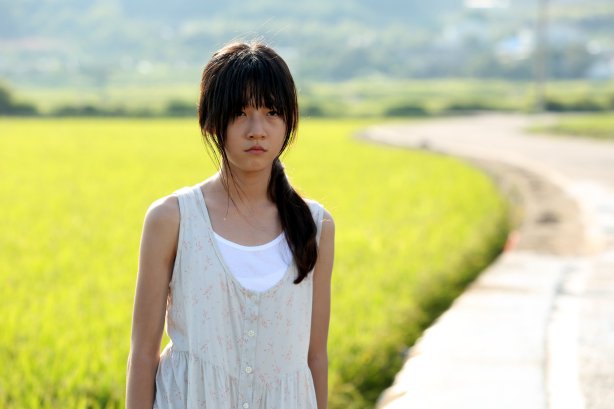
A Girl at My Door (도희야, July Jung, 2014)

fullsizephoto427951Review of A Girl at My Door from the London Film Festival up at UK-anime.net. This is also playing at the London Korean Film Festival which opens today with a gala screening of Kundo: Age of the Rampant. Director July Jung will be at the LKFF screening on 7th November for a Q&A tootickets still available!


You’d never know it, but A Girl at My Door is actually the first feature film from promising new Korean director July Jung. Produced by well regarded Korean auteur Lee Chang-dong (Poetry, Oasis, Peppermint Candy), the film evidently benefits from some of his expertise but it would be a mistake to over emphasise his involvement. Like Lee’s films A Girl at My Door is a tightly plotted character drama that opens up to explore a whole host of social issues but Jung has certainly been able to put her own stamp on the project and if A Girl at My Door is anything to go by, she is very much a talent on the rise.

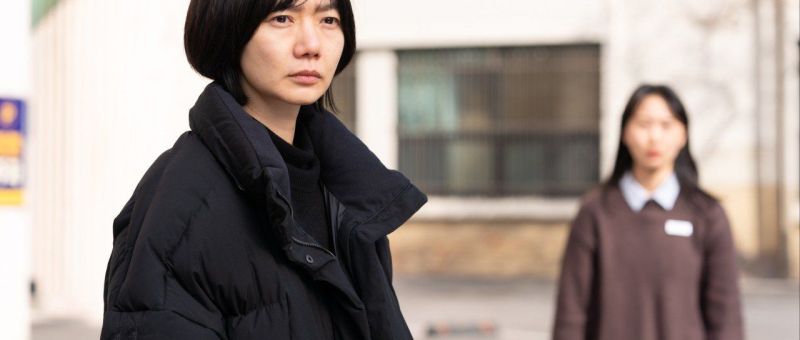
Lee Young-nam (Bae Doona) has just arrived in the little hick town she’s been exiled to thanks to some kind of undisclosed infraction committed in Seoul. As the town’s new police chief, she’s thrust into the largely male world of local law enforcement and forced to acclimatise to small town politics with hardly enough time to breathe. Lee is also a high functioning alcoholic who guzzles soju from refilled litre bottles of water though her colleagues don’t seem to have noticed and her work is barely affected. After catching sight of the same young girl who seems to be constantly running away from someone or other, Lee eventually intervenes when a group of teenagers are picking on her. Do-hee is a troubled teenager from a violent home where, abandoned by her mother, she’s ‘cared for’ by a step father and resentful drunken grandmother. Do-hee quickly fixates on Lee and her superficially fearless attitude and eventually Lee has taken the girl in and offered her a place of solace way from the chaos of her home life. However, no matter how good one’s intentions may be, others will twist the facts to their own advantage and doing the right thing can often prove dangerous.

Possibly one of the benefits of having a high profile producer like Lee Chang-dong is that you’re able to get yourself a high profile cast of talented actors for your first film despite not having a proven track record or industry clout of your own. Bae Doona’s performance of the largely silent Lee is nothing short of extraordinary. There’s a sort of defiance in Lee’s silence, an unwillingness to speak because she knows there’s very little point. All we can glean about what happened in Seoul is that her dismissal has something to do with the fact that Lee is gay – something that is accidentally discovered by exactly the wrong person when Lee’s ex-partner comes to town. It’s not so much that she’s keeping that secret from the townspeople, but more that she knows it’s going to be a problem and she’s unwilling to deny it either. After all, she’s been here before and she knows how this scenario plays out. Taking in someone else’s child can be a dangerous thing for anyone, but as one policeman later puts it “it’s different when a homosexual does it” and even the most innocent, well meaning of gestures suddenly becomes something sordid and dirty. Lee’s world weary attitude seems to imply she half expected this would happen, still – there was a girl at her door, what else could she do?

Bae Doona is equally matched by the already fairly experienced teenage actress Kim Sae-ron as the troubled young girl, Do-hee. A mess of contradictions, Do-hee is both vulnerable and dangerous. One of the villagers refers to her as a monster and she certainly has a dark side which can be selfish and manipulative as well as a tendency towards fantasy. However, at the root of things she’s just a lonely, abandoned, unloved and unwanted child. Of course, as soon as someone shows her the slightest hint of kindness she will latch on and become fearful of losing even that extremely slight glimpse of affection. Perhaps therefore, she says things that aren’t quite true without fully understanding their implications and ironically risks ruining the fragile happiness she’s so desperate to cling to. It is quite an extraordinary performance from such a young actress – Kim Sae-ron manages to unify all of Do-hee’s contradictory sides into a convincing, and ultimately quite moving, whole.

A Girl at My Door does have its social issue dimension – the exploitation of illegal immigrants, small town politics, homophobia, sexism and of course unwanted children are all themes at some point touched on through the film, but what is at heart is a character drama about two lonely women who both find new strengths thanks to their unexpected friendship. Jung has crafted a charming and moving film that is only improved by its tremendous feeling of stillness. Beautifully shot and full of intriguing ambiguities, A Girl at My Door is a fantastically assured debut feature which hints at a very interesting career ahead for director July Jung.