Circus Boys (二十世紀少年読本, Kaizo Hayashi, 1989)

“There’s bad cheating and good cheating,” according to a little boy who will later become “a magician of words and juggler of lies,” in Kaizo Hayashi’s ethereal fable, Circus Boys (二十世紀少年読本, Nijisseiki shonen Dokuhon). Set in early showa, though the early showa of memory in which many other times intertwine, the film positions the transient site of a circus tent as a roving home for all who need it or are seeking escape from the increasingly heightened atmosphere of the early 1930s. Yet where one of the titular boys chooses to stay and earnestly protect this embattled utopia, his brother chooses to leave and seek his fortune in the outside world.

In fact, it’s Jinta (Hiroshi Mikami) who first becomes preoccupied with their precarious position realising that they’ve been hired to look cute riding the elephant, Hanako, but will soon age out of their allotted role and if they can’t master some other kind of circus trick there may no be a place for them in the big tent. For this reason he’s been training in secret with the idea that he can pass off the skills he’s perfected as innate “talent” so the circus will want to keep him on. Wataru (Jian Xiu), his brother, doesn’t quite approve of his plan. After all, aren’t they essentially tricking the people at the circus into thinking they’re something they’re not? But Jinta assures him it’s like “magic,” the kind that will allow them to stay in their circus home which later comes to seem a place of mysticism or perhaps make-believe on its own.

Thus Wataru walks a fine line. His name means “to cross over,” but he never does. He tries to walk the tightrope before he’s ready and is unbalanced by a storm. Jinta breaks his fall, but also in the process his own ankle. Along with it go his dreams. His foot never heals, and he’ll never fly the trapeze with Wataru like he planned though he keeps his injury a secret from his brother. While Wataru flies with new girl Maria (Michiru Akiyoshi), Jinta becomes a clown, a position he’d previously looked down on and later leaves the circus altogether using his talent for magic and performance to become a snake oil salesman tricking what appear largely to be poor farming communities into buying things like miracle soap and coal that burns for a whole month. This is clearly bad cheating, though he tries to convince himself it’s not while essentially remaking the world around him through his lies. 

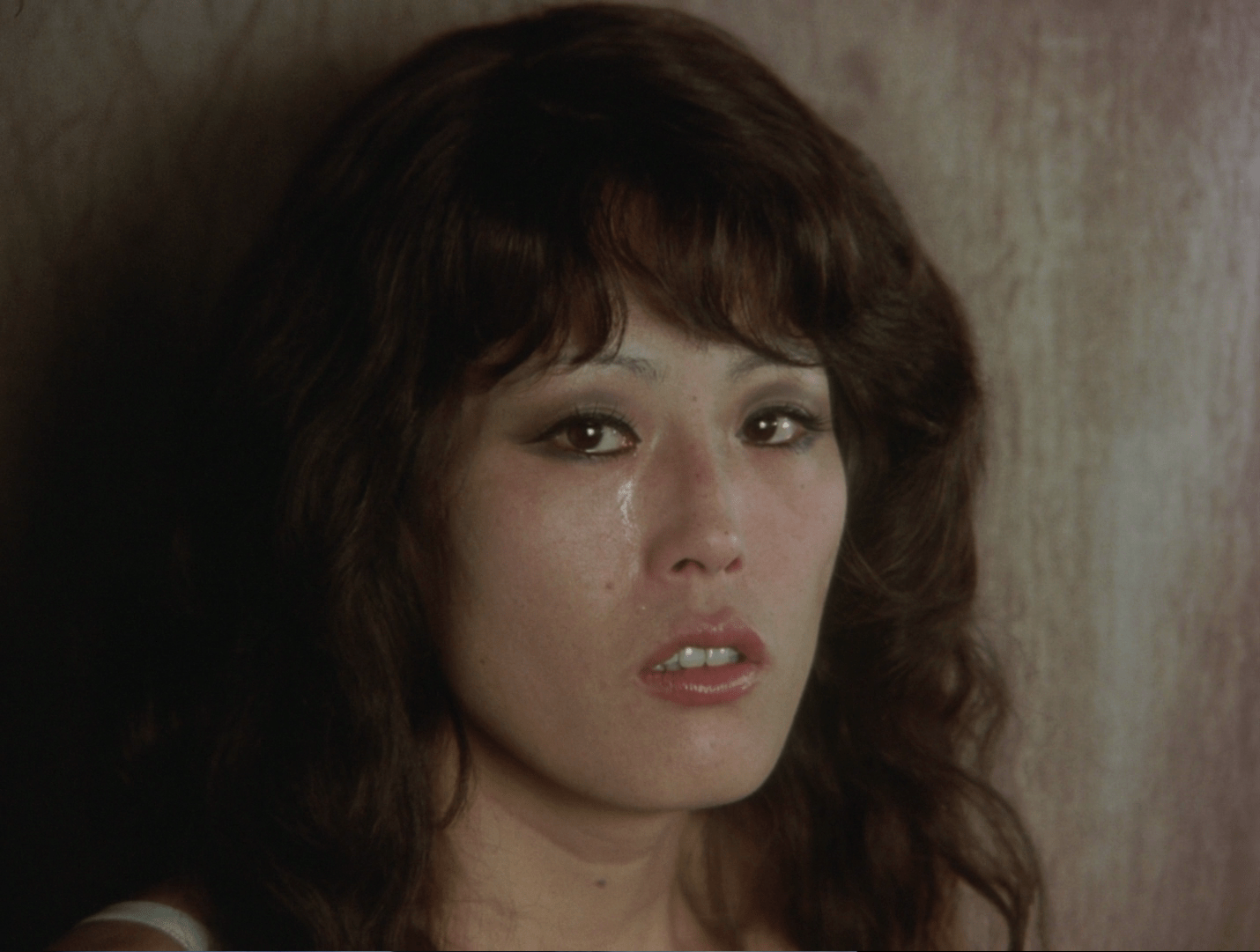
But he retains his integrity in other ways. After being press-ganged into a yakuza-like guild of street pedlars, he gently excuses himself when invited to dine with a boss and confronted by an odd situation in which his wife has purchased another young woman to be his “plaything.” In a comment on contemporary patriarchal norms, the young woman is referred to as “Omocha,” which literally means “toy,” but also sounds a like a woman’s name because it begins with the character “O” which was used as a polite prefix for female names until the practice faded out after the war. The boss of course treats her like a doll, and even the wife refers to her as an “erotic instrument” she got as a way of managing her husband’s sexual appetites fearing he’d otherwise be seeing sex workers and bring a sexually transmitted disease into their home (and also possibly because she simply doesn’t want to sleep with herself any more than she has to). Referred to only as Omocha the woman has almost no agency and finds a kindred spirit in Jinta (whose name contains the character for “humanity”) because like him she also escapes the hardships of the world through lies and fantasy. “Can two lies make one big truth?” Jinta muses, breaking the codes of Guild as he prepares to rescue another man’s plaything, only it may be more like she rescues him. 

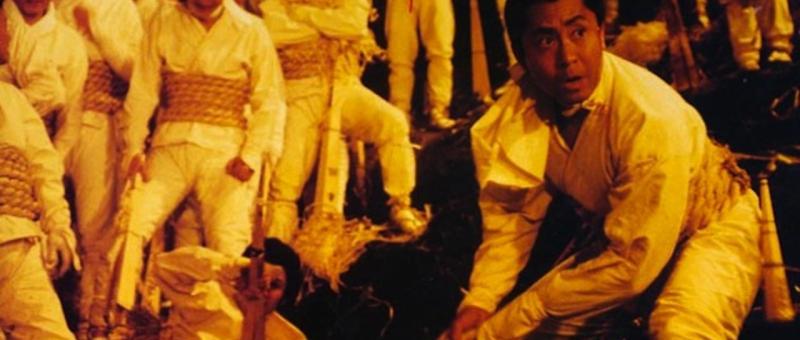
Meanwhile, Wataru tries to save the circus even after their ringmaster dies with visions of Jinta on his mind. They plan a wall of death to bring back the crowds, but Wataru’s plan backfires with tragic consequences and it becomes clear he can’t protect their circus family even if it brings back veteran trapeze artists Koji (Yukio Yamato) and Yoshiko (Maki Ishikawa) who agree there’s no other place for them out in the big wide world. The sense of the circus as a safe space was echoed on Maria’s arrival when Jinta had cruelly said she looked a little foreign with the ringmaster assuring her that in here they’re all artists and do not classify people in terms of their race, appearance or nationality. Its unreality, however, is reinforced by the constant backing of Wataru’s shadowplay which sometimes shows things the way people wish they were rather than the way they are. Omocha is later seen holding one of these puppets just as she and Jinta decide to die to free themselves of this hellish existence before Jinta’s surrogate brother figure Hiroshi (Shiro Sano) is forced to kill them for breaking the rules of the guild.

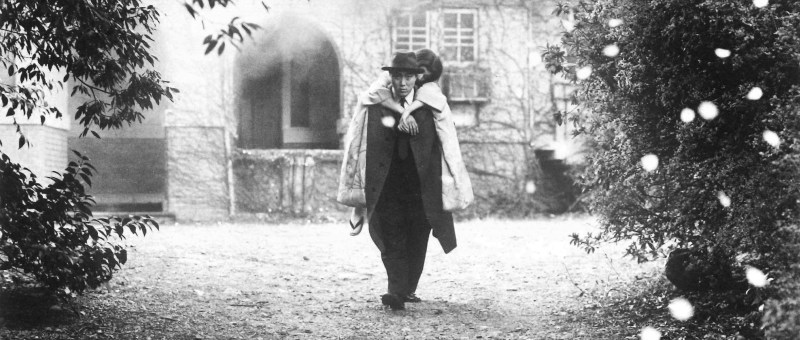
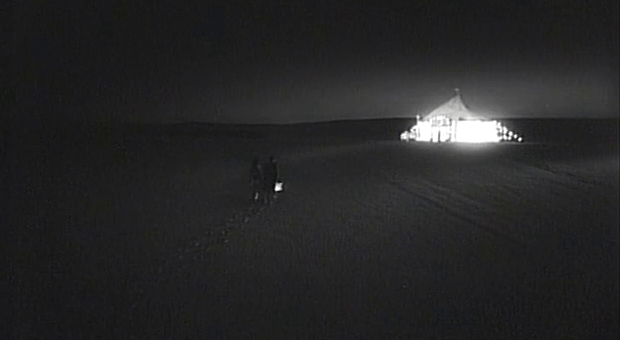
In the ambiguities of the final sequence, we might ask ourselves if they are actually dead and the glowing circus tent they see on the horizon is a path to the afterlife or a kind of heaven represented by the utopia to be found inside it. Then again, perhaps Jinta is merely rediscovering the way home, a prodigal son who now understands he already had a place to belong and there is a place to which he can return. The Great Crescent Circus is now the Sun & Crescent Circus, reflecting the way the two boys inhabit the world like and dark, idealism and cynicism, but comprise two parts of one complete whole. Hayashi waxes self-referential, playfully including a reference to his first film in that the movie playing at the cinema Jinta passes is The Eternal Mystery with Black Mask on his way to rescue Bellflower while indulging in an intense nostalgia for a lost world of travelling shows and hidden magic. Shooting in a beautifully balanced monochrome, he lights on scenes of heart-stopping beauty that are somehow poignant and filled with melancholy but ends with a moment of resolution in which, one way or another, Jinta reaches the promised land as he said with magic.


Circus Boys screens 12th October at Japan Society New York.
The Sea of Genkai (任侠外伝 玄海灘, Juro Kara, 1976)

Juro Kara was an avant-garde playwright and theatre practitioner whose work was a part of the Little Theatre Movement which rejected conventional naturalism and prioritised the physicality of the actor over text and dialogue. Though he performed as an actor in films by other avant-garde filmmakers such as Shuji Terayama and Nagisa Oshima, he directed only one film. By these standards, the The Sea of Genkai (任侠外伝 玄海灘, Ninkyo Gaiden: Genkai Nada), a co-production with the Art Theatre Guild, may seem surprisingly conventional, but is also highly unusual not only in ATG’s filmography but also in its subversions of the yakuza film. 

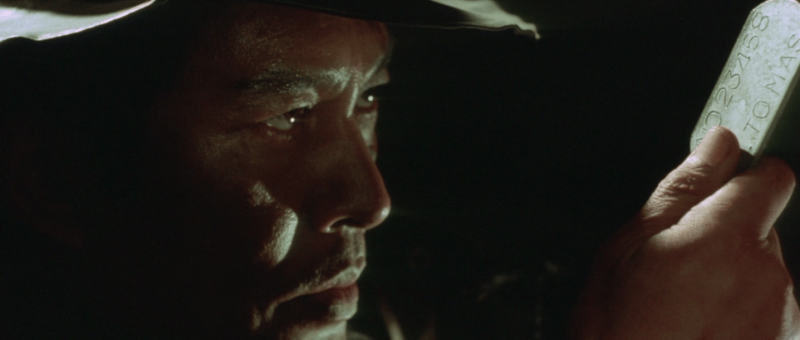
The Japanese title is prefaced by “ninkyo gaiden” which makes it sound like a spin-off to a ninkyo eiga or chivalrous gangster movie, which turns out to be incredibly ironic because there is no chivalry or honour here only cruelty and exploitation. Set in the port of Shimonoseki where boats leave for Korea, the film follows dejected petty yakuza Kondo (Noboru Ando) as fate finally catches up with him. He and his boss Sawaki (Jo Shishido) were once students together and took a job in Busan dealing with the corpses of American soldiers killed in the Korean War. Sent to deliver dog tags to widows, Sawaki spits in a distraught woman’s face and then attempts to rape her, only there is another couple in her home and the man soon wakes to challenge him. Kondo and Sawaki are then drawn into a brutal and ugly fight during which Kondo knocks out the man while Sawaki rapes the widow. The other woman then threatens them with a knife, taking back the dog tag only for Sawaki to pounce and strangle her. Sawaki then flees the scene confused by what he’s done, but Kondo stays behind and rapes the second woman’s corpse before leaving her for dead. 

Kondo later relates that he’s been unable to sleep with women ever since his experience of necrophilia in Korea in 1951. Kura often cuts back to the bundle of dog tags Kondo has been keeping all this time which hang by his window like a wind chime. He watches them sway and hears them jingle with the violent motion of Sawaki’s raping the woman, hanging that of, presumably, a random man around the second woman’s neck as he in turn rapes her body. He later finds a woman who reminds him of the one he raped while dead among a cohort of those he’s in the process of sex trafficking who has unwittingly put on one of the dog tags like an ironic necklace while taking a bath in his apartment on the invitation of his more sensitive associate Taguchi (Jinpachi Nezu). On catching sight of Kojun (Reisen Ri), he’s struck by a literal flashback that is a clear homage to Henri-Georges Clouzot’s Les Diaboliques as he watches a “dead” woman rise from a bath. Later he rapes her too, presumably the first (though not the last) “living” woman he’s had sexual contact with in 25 years. 

The dog tags take on a still more ironic relevance in the Korean song which plays over the opening titles and is sung frequently by the trafficked women. The song is sweet and innocent, narrated by a woman who is preparing a “flower garland” for someone that she loves, but its imagery is subverted in Kondo’s grim necklace of dog tags taken from fallen men. Even Sawaki describes him as someone who has been dead for 20 years while preparing to sacrifice him to curry favour with their creepy Tokyo boss Tahara (Taka Ohkubo) who permanently wears black gloves on both hands even while shirtless, while Kondo later sings a song characterising himself as a “black dog” who never stood a chance in this broken world of ruined dreams. Penned by Kura himself and performed by Ando, this song more clearly reflects his absurdist dialogue style in its deeply melancholy imagery as Kondo fully succumbs to his image of death. 

Kondo’s actions come to emblematise the continued violence inflicted on the bodies of Korean women by Japanese men from the colonial era onwards. The woman from the bath, Kojun, suffers continually throughout the film and is later forced to perform in strip shows by the Sawaki gang. She is clever, and fierce, but the world is all against her and the only answers that she ever gets as to why her “uncle” forced her to stowaway on a smuggling boat to Japan only further deepen the wounds inflicted by a deeply corrupted, imperialistic patriarchy. Kojun develops a fondess for Taguchi because he is the only man who doesn’t try to rape her and in fact saves her from being raped though later said to be impotent and rejected by the other gang members for his refusal to participate in their despoiling of the Korean women. Bloodstained underwear becomes a symbol of sexualised violence countered only by the plain white pairs Kojun later buys for Taguchi after replacing her own ruined clothing.  

She and Taguchi attempt to protect themselves by bringing the receipts, threatening to release the smuggling account books and expose a host of dodgy dealings if the Sawaki gang come for them, but in the end there is no escape. Taguchi finds himself wading through oil-soaked waters with his dreams in ruins before finally breaking the chain though it’s unclear if it will really free him. Bleak beyond measure in its deeply tragic denouement, Kara’s intense drama offers no respite from its nihilistic world of violence and exploitation and leaves us quite literally floundering in a dark sea of inevitable corruption. 


Trailer (no subtitles)

꽃목걸이 – 이영숙 (1972)

(꽃목걸이 = “flower necklace”. There doesn’t seem to be an official romanisation of singer 이영숙 (李英淑)’s name, but it does appear in a few places as “‘Iyeongsuk”, or “Lee Young Sook”. A contemporary romanisation would render it as “Lee Yeong-suk”)

Fire Festival (火まつり, Mitsuo Yanagimachi, 1985)

By 1985 the Japanese economy was approaching its zenith yet along with increasing economic prosperity had come social change of which small-town Japan was either casualty or sacrificial victim. “Nigishima will stay as it is” declares the last holdout of an increasingly obsolete way of life in Mitsuo Yanagimachi’s intense modernity drama, Fire Festival (火まつり, Himatsuri), a manly mountain man and animalistic force of nature by several metrics unsuited to life in the contemporary society into which he is ultimately unable to progress. 

There are many things which it seems have not changed in Nigishima for generations, one being the animosity between the cohorts of its bifurcated community, those who live by land and those who live by sea. Rural depopulation may have forced them to come closer but it has also increased their sense of mistrust while both industries continue to suffer in an economy which no longer prizes their humble rural output. Despite being catapulted into a promised modernity by the advent of the railway to great fanfare in 1959, it now seems that Nigishima cannot survive without a new road which could be paid for by the development of a marine park only mountain man Tatsuo (Kinya Kitaoji) owns the property right in the middle of the earmarked area and has hitherto refused to sell further increasing the tension between the two communities. 

Tatsuo is thought of, and thinks of himself, as a big man in the area quite literally it seems as part of the reason he enjoys this status is down to his being unusually well-endowed. He believes himself to have a special relationship with the mountain goddess, often joking to the other men about having a sexual relationship with her while sometimes describing her as his girlfriend. Several times he is mistaken for an animal, firstly by the boatman bringing his childhood sweetheart and sometime mistress Kimiko (Kiwako Taichi) back to the island who assumed he was a monkey crawling along the cliff edge thoughtlessly throwing rocks at them, while he often gambols through the forest whooping like some kind of Tarzan. Entirely unreconstructed, his worldview is patriarchal and misogynistic. All of his banter with the other men is sexual, constantly referring to his penis while greeting his friends with lewd hand gestures thrusting his fist into his pocket as if waving with an erection. The cure for offending the goddess he tells his young protege Ryota (Ryota Nakamoto) is to drop his trousers and display his manhood, Tatsuo strangely believing this would appease her for taking wood from a sacred tree or killing without permission. 

Smearing the blood of a sacrificial animal over his chest and forearms he dedicates the death to the goddess, a gesture he will repeat in the film’s violent and tragic conclusion yet there is also arrogance in his conduct as if he believes himself above natural law, protected as the goddess’ favourite even as he describes himself as “suffocated” by the women in his life from his mother and five older sisters all of whom indulge him to his wife, kids, and mistresses. He has trained his dogs to hunt wild boar without the use of guns in a method he admits even other hunters describe as “cruel” while breaking a local taboo shooting monkeys in the forest well aware of nature red in tooth and claw. As such, there is little nobility to be seen in his determination to preserve this already obsolete way of life. His virility maybe contrasted with that of the ageing land broker Yamakawa (Norihei Miki) and his failed attempts to bed sex worker Kimiko who tricks him into paying off her debts, but he at least knows the way the wind is blowing explaining to her that towns such as Nigishima survive only through things like marine parks or hotels or even nuclear power plants. Without the road, the town will die. 

Yet in 1959 they were told the railway would save them and it seems it did not. Tatsuo’s love making with Kimiko in a boat borrowed from a treacherous fisherman who later agrees to sail it transgressively into sacred waters is intercut with memories of the rail line’s opening ceremony, two teenagers who might have been them or at least of around the same age ride an elephant on the jetty while the townspeople arrange themselves into the formation of the character for “celebration” captured by the aerial photographer above. For Tatsuo as a boy, was this a rebirth of Nigishima or the beginning of its demise as the coming modernity began to eat away at its foundations? 

The fire festival is “for men”, according to Tatsuo, “to drive out evil spirits”, his manliness getting the better of him as he disrupts the proceedings to attack a man he accuses of having brought “false fire”. These are the lessons he teaches to surrogate son Ryota whose devotion to him borders on the homoerotic, Tatsuo cradling him during the climactic rain storm and he seeming to develop a fascination for Kimiko as a kind of indirect fixation. Ryota has learned Tatsuo’s chauvinism mimicking his lewd hand gestures and swaggering walk, his cruelty in sacrificing 1000 yen to trick Yamakawa into injuring his hand in a bear trap, and his arrogance ensuring that his problematic masculinity will survive into another generation presumably no more capable of halting the march of modernity than he has been. Tatsuo poisons the waters with fuel oil which as one of the greek chorus of fish wives points out does not catch fire, Tatsuo himself smouldering until an inevitable explosion. Receiving some kind of epiphany during a mystical congress with the goddess in the middle of a storm, he knows what he must do and accepts that he cannot progress into the modern society. Smoulderingly intense in its small-town animosity and primeval sensibilities, Yanagimachi’s poetic tragedy of futility and the broken promises of a badly distributed modernity may accept the the sacrifice but mourns it all the same. 


Fire Festival screens at the BFI on 20/27 December as part of BFI Japan.

Clip (English subtitles)

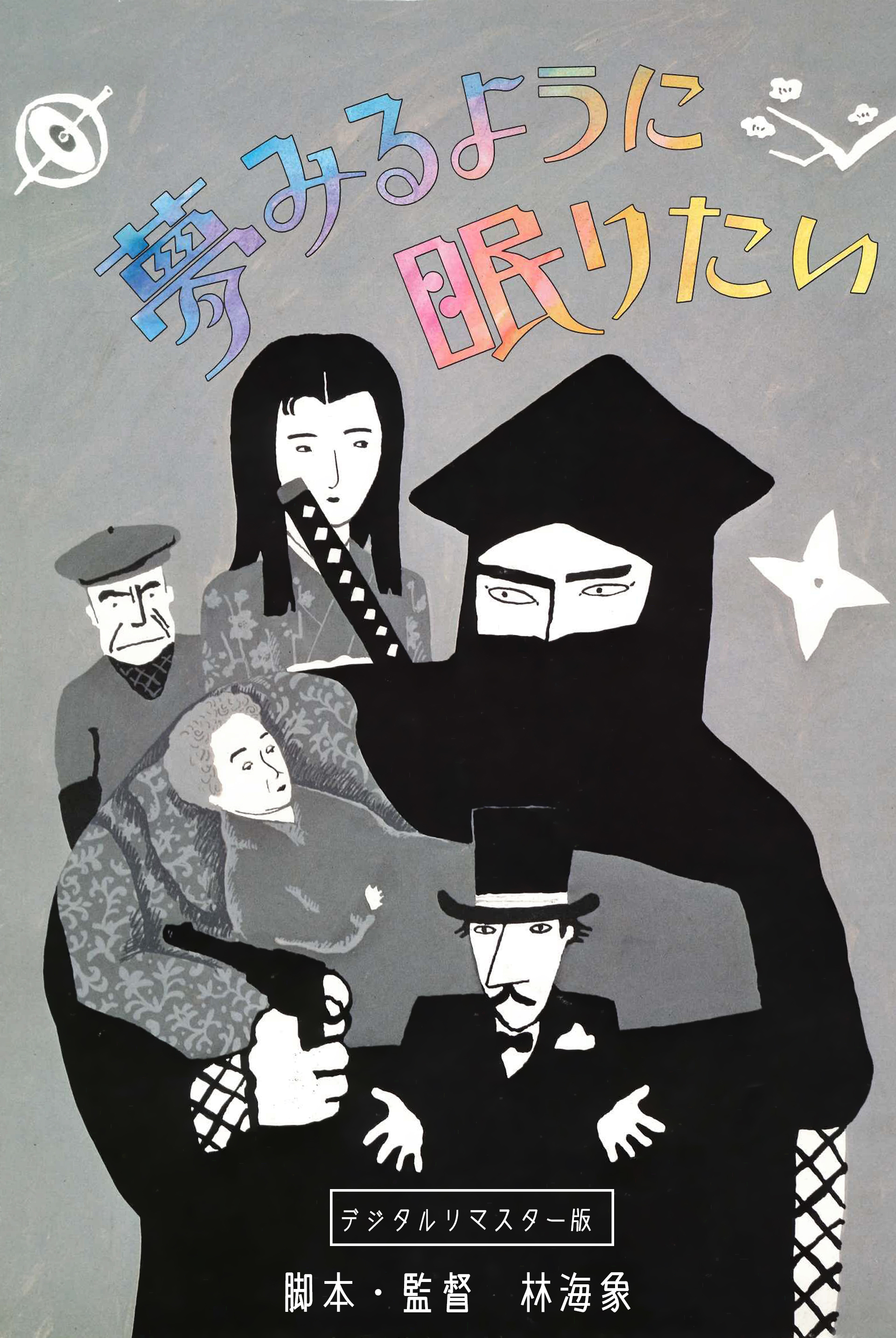
To Sleep So as to Dream (夢みるように眠りたい, Kaizo Hayashi, 1986)

“I feel so well, as though I am dreaming” a ghostly old woman exclaims, having dealt with her unfinished business or perhaps merely becoming one with the silver screen. Released in 1986 but set ostensibly sometime in the 1950s and recalling the golden age of the silent movie, Kaizo Hayashi’s postmodern odyssey To Sleep So as to Dream (夢みるように眠りたい, Yumemiru Yoni Nemuritai) sends a pair of detectives on the hunt for a missing reel, voyaging through an ethereal dreamscape of mysterious magicians, kidnap and conspiracy, in search of the solution to the “Eternal Mystery”. 

Opening in total darkness, Hayashi pans across to a gas lamp and then to the figure of a woman watching a silent film projected on a screen in her living room. We see only her gloved hands, one wearing an ostentatious ring, somewhere between Miss Havisham and Norma Desmond, while the movie seems to be part of an early serial revolving around the Black Mask ninja who is trying to rescue the kidnapped Bellflower (Moe Kamura) only the princess always seems to be in another castle, as detectives Uotsuka (Shiro Sano) and his sidekick Kobayashi (Koji Otake) will discover. In any case, the film bursts into flames and dissolves at the moment of climax just as Black Mask confronts the kidnappers and declares the mystery “solved”. The old lady, Madame Cherry-blossom (Fujiko Fukamizu), then telephones the Uotsuka Detective Agency and requests their help with a kidnapping, sending her manservant Matsunosuke (Yoshio Yoshida) to the office with a tape recording of the kidnappers’ message which includes the clues to a scavenger hunt the pair must solve if they are to arrive at the drop off point with the money in order to retrieve Bellflower. 

Filming in black and white and in academy ratio, Hayashi maintains a silent film aesthetic adding selected sound effects but rendering all dialogue other than recordings as intertitles. We hear the phone ring and the radio playing, but “live” human speech is presented only as text save for that of the Benshi who appears at the film’s conclusion though even he may also be “on tape”. Meanwhile, he adds in random gags at the guys’ expense such as the “hardboiled” detective’s obsession with hard boiled eggs, while his sidekick Kobayashi is forever riding a rocking horse in the corner of their office while wielding a lasso and wearing a cowboy hat. A live chicken completes the home on the range feel while a series of horse shoes decorate the wall. The two men feel as if they emerged from a 20s noir farce, their slapstick antics eventually leading to a confrontation in which Kobayashi proves himself an unexpectedly skilled martial artist.  

Their world is already absurd even as they head into the abstract in order to chase Bellflower while, just like Black Mask, the kidnappers leave them irritating messages at each checkpoint revealing another clue and that the ransom has now doubled. They are plagued by a series of magicians who turn up in different guises from a man performing a kamishibai version of the Black Mask story for children to some guys running a shell game and posing as a trio of “scientists” led by Prof. Jerowski “of the British Empire” showing off their new gyroscope technology. Yet it’s no coincidence that the kidnappers go by the name Pathé & co, having essentially trapped Bellflower inside the celluloid realm and refusing to set her free. 

While Uotsuka falls for the beautiful, elusive image of Bellflower who begs to be released from “this endless story”, fantasy and reality begin to merge as he finds himself cast in the role of Black Mask. The ironically named “Endless Mystery” is a film with no end, the apparently incomplete debut of a faded star not so much ready for her closeup but desperate for closure and the release of her younger self from 50 years of torment in the reassurance that Bellflower will certainly be rescued by Black Mask at the film’s conclusion which is, after all, how such serials are supposed to end. While others slip ghostlike into the darkness, Uotsuka is left behind another prisoner of cinema chasing the romance of the silver screen yet finally saving his princess by extracting her from it. Operating on several levels, Hayashi expertly recreates both the grainy serials of the early silent era and crafts an absurdist, postmodern homage to its more recognisable evolution as his detective becomes wilfully lost in the labyrinths of cinema. 


To Sleep So as to Dream streamed as part of this year’s Japan Cuts.

Restoration trailer (no subtitles)

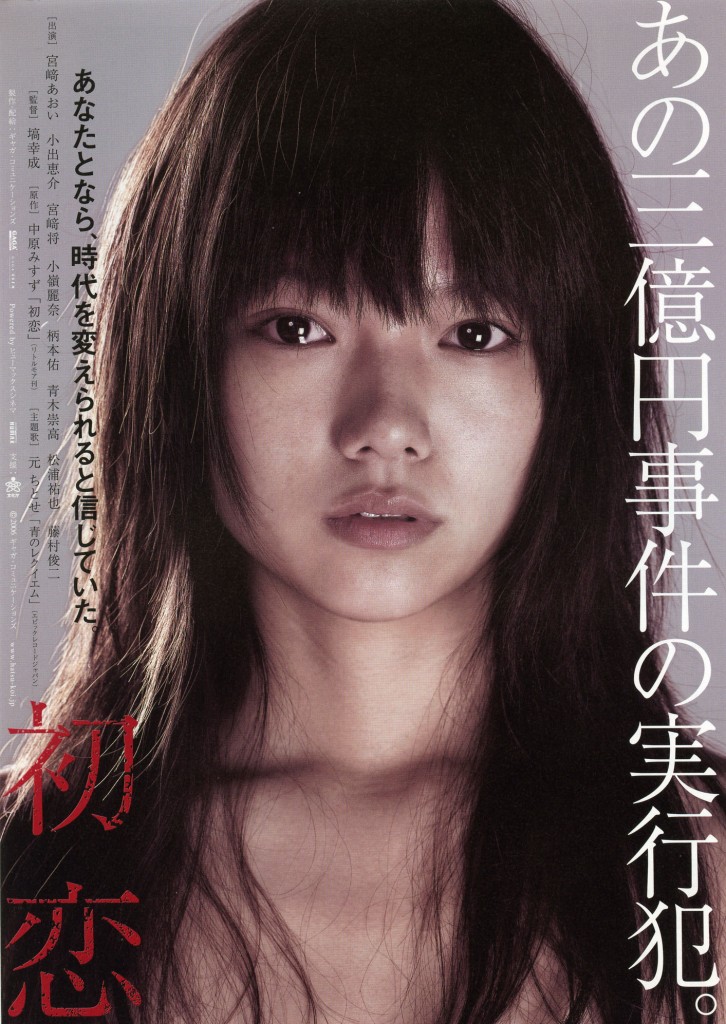
Hatsukoi (First Love) (初恋, Yukinari Hanawa, 2006)

hatsukoiThe 300 Million Yen Affair is one of the most famous and intriguing unsolved mysteries in Japan, not least because the missing cash has been lying dormant somewhere, apparently untouched, ever since that fateful day back in 1968. Seeing as the true story has never been discovered, the crime has taken on legendary status and become the focus of many kinds of fiction. Misuzu Nakahara’s fictionalised autobiography is just one of these as she retroactively claims responsibility for the robbery as a teenage girl in love with a detached revolutionary.

Misuzu (Aoi Miyazaki) begins her tale a couple of years before the crime as she lives a lonely and introverted life in the house of her uncle, her father having died and her mother apparently absconded with her older brother in tow but leaving her behind. It’s her 16th birthday, but no one cares. Soon enough she starts hanging around a shady jazz bar before another woman convinces her to come inside and join their group of layabout beatniks – a group which is actually lead by her estranged older brother, Ryo (Masaru Miyazaki). These are the heady days of students protests – against the old order, against the ANPO treaty, against the war in Vietnam, against just about everything. Misuzu grows closer to one of their number, the quiet and mysterious Kishi (Keisuke Koide), who has a proposition for her….

Hatsukoi (AKA First Love, 初恋) is a film which is thick with period detail from the authentically smokey, sweaty jazz bar and its counterculture denizens to the nostalgic atmosphere and 1960s street scenes. However, evoking Misuzu’s own sense of ennui, director Yukinari Hanawa opts for a detached, dispassionate tone which is entirely at odds with the otherwise searing, youth on fire tension of the time period. Misuzu is always on the edges of things, younger than the other members of the group she feels as if she’s merely being permitted to stay and listen rather than invited to participate. Nevertheless, even if it’s the case that Misuzu is a by nature a passive person, the film pushes the intense nature of the social revolution going on all around her into mere background, squandering its power to bring out the sense of passion that the film feels as if it needs.

At heart, the robbery is something of a mcguffin as the real story is the true love tragedy hinted at in the title. Misuzu and Kishi grow closer through their plotting of the crime which is born of his desire to commit a different kind of revolutionary act. The money is intended to pay the bonuses of Toshiba employees and Kishi feels the best way to make a protest against economic inequality and the power of large corporations is to hit them in the finances. Misuzu plays her part well enough and the robbery comes off OK despite minor hitches allowing only a brief honeymoon period for its would be Bonnie and Clyde before history begins to move forward and eventually rips them apart. For Misuzu the robbery becomes the defining event of her youth and the birth of the love that she seemingly cannot let go. After this the jazz club is over, the protest movement dies as do some of the protestors, or else they move on to more conventional lives. Not quite a coming of age, but a death of youth before it had hardly begun.

Some injuries never heal, says the kindly old man who teaches Misuzu how to drive. A prescient remark if ever there was one. Misuzu seems locked within this brief period of her youth, before her friends died, left, or disappeared once the turbulent atmosphere of protest and revolution gave way to the consumerist 1970s and everyone forgot about the necessity for social change in the hurry to make money.

Hatsukoi becomes less a about the first love itself than about the period that surrounds it. The love was lost, but so was the bubble in which Misuzu had begun to define herself as a young woman. What Hatsukoi lacks is a sense of personal tragedy, of a soul crushing, spiritual death which locks each of the group members into their own tragic fates and seems somehow dictated despite their insistence on defining themselves in the new, youth centric world. Often beautifully photographed, Hatsukoi’s air of desolation and cold, detached tone weaken its ability to engage making its painful end of youth journey all seem rather dull.


Hatsukoi was released with English subtitles on blu-ray in Taiwan, and on DVD in Hong Kong though both editions now appear to be OOP.

Unsubtitled trailer:

https://www.youtube.com/watch?v=k-HTlxRwQPg