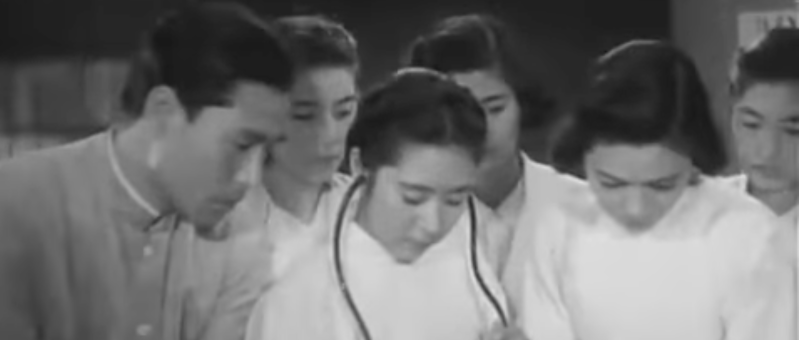
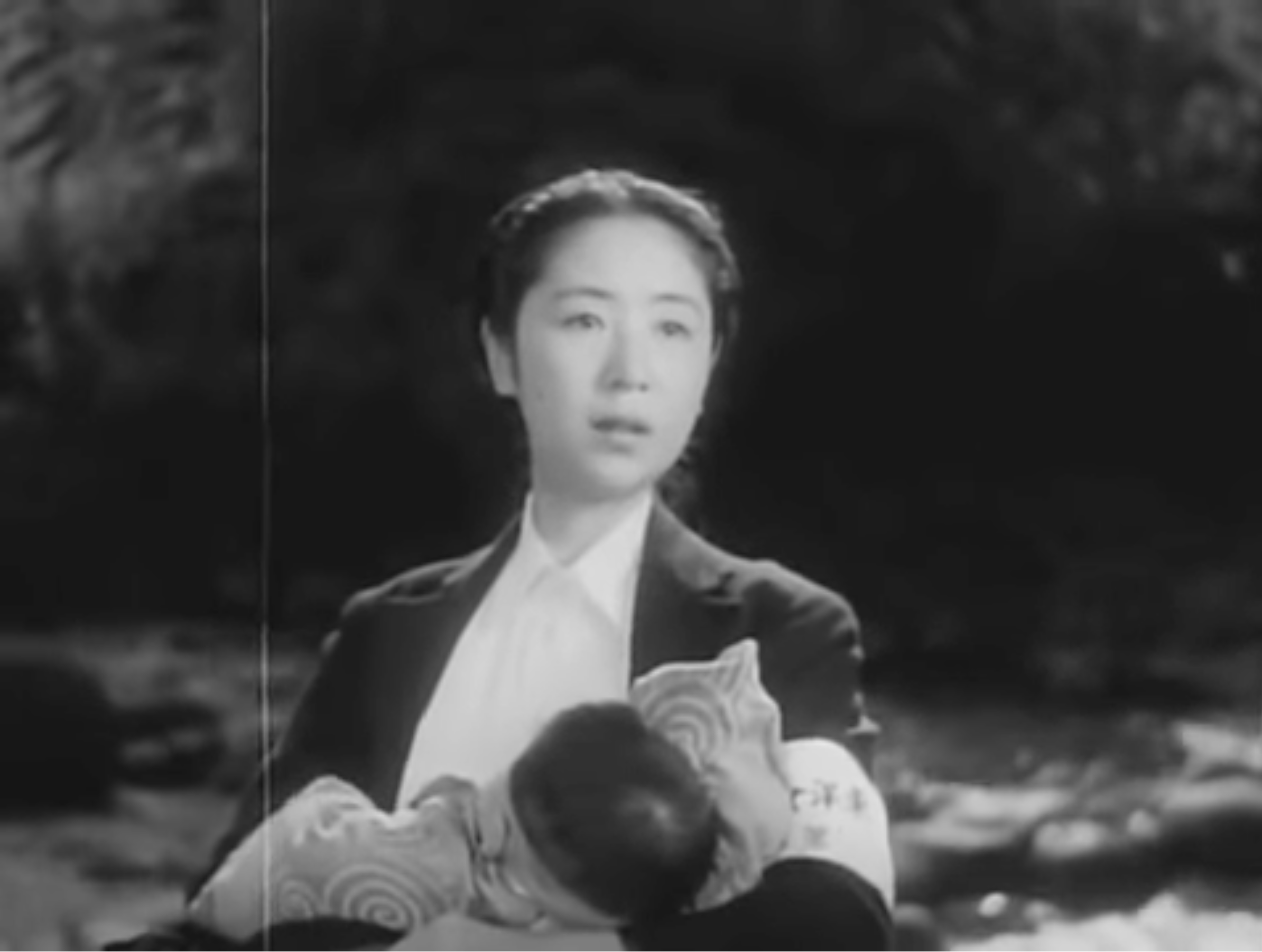
By 1941 it was becoming harder to make films which were strictly apolitical, though many directors were able to circumvent the constraints of a tightening censorship regime in focusing on the kinds of messages they could get behind. Hiroshi Shimizu’s 1941 drama Record of a Woman Doctor (女医の記録, Joi no Kiroku) is in essence a public information film hoping to foster better hygiene practices in rural areas while encouraging those who might have felt mistrust towards modern medical professionals that they need have no fear of doctors, but in its own way presents a challenge to the militarist line in implying that the humanist teacher and female doctor of the title are in a sense “re-educated” though their exposure to the rural poor.
As the film opens, a collection of medical students from Tokyo Women’s Medical University is sent to a small rural village as part of a pop-up free clinic in an area which otherwise has little access to professional healthcare. As the school teacher, Kamiya (Shin Saburi), who is their liaison explains, the the major health problems faced by the villagers are largely those of poverty, i.e. malnutrition, while infant mortality remains high. Each of these is compounded by the contemporary economic and social realities in that the young often leave to work in cities and then bring back with them urban diseases such as tuberculosis to which the locals are especially vulnerable while in the absence of a professional doctor medical emergencies such as appendicitis or complications with childbirth which might be easily treated are often fatal.
Even so, the villagers are not initially grateful for the doctors’ arrival for various interconnecting reasons. The first is obviously their poverty, not realising that the clinic is free and assuming they cannot afford to take advantage of it. Secondly, they have experience of being ripped off by duplicitous conmen calling themselves doctors and fear that they will simply incur a large debt to be paid at a later date, wary that though the consultation may be free the treatment may not be, the doctor suddenly discovering they are actually incredibly ill and must part with a lot of money in order to redeem their health. The third reason, meanwhile, is older still in the intense stigma surrounding sickness and particularly any respiratory condition.
These are all the attitudes the doctors and the film intend to challenge in insisting that modern medicine is both safe and responsible, interested only in helping prevent the onset of sickness rather needlessly meddling in their way of life. All from the city, the conditions in this small mountain village necessarily shock the doctors noting that the villagers have no culture of regular bathing, often wear the same clothes day and night for indefinite amounts of time with no washing, never air their futons, and live in dark and poorly ventilated homes. The authorities have often recommended felling a thick circle of trees which surrounds the village to let more light in and allow the breeze to travel through though the villagers have always refused.
The felling of the trees takes on a symbolic association of freeing the village from primitive superstition, literally enlightening it, as they shift closer towards modernity in learning the importance of proper sanitation. In a sense these ordinary rural people are being patronised, even sympathetic teacher Kamiya describing them as “culturally deprived” while later implying that he himself has been reformed by their simple way of life. Kamiya’s life is certainly not easy, effectively acting as something like a village headman called in to deal with any sort of local problem while often providing childcare to the infants brought in by his pupils who are supposed to be minding their siblings while the parents work in the fields but are not always completely responsible. Earnest doctor Natsuki (Kinuyo Tanaka) is later much the same, touched by the plight of a local girl suffering with TB kept like a secret in the back room by her mother after being sent back from her factory job. The mother is intent on sending the younger sister in her place even though she too is in poor health because the family is without a male earner and unable to support itself.
The fact that the doctors are all female may in itself be somewhat progressive but also speaks of the times, the male medical students presumably diverted to the military ironically reinforcing the idea that “domestic” concerns are women’s concerns, something echoed in the film’s concluding scenes which see Natsuki, a qualified doctor, operating a daycare centre taking care of local infants while Kamiya runs a callisthenics session behind her. Conversely, it’s also implied that Natsuki must give up her womanhood or any sense of personal desire in order to dedicate herself to the village making it quite clear that there is no possibility of a romantic connection with Kamiya. Even so, the secondary message seems to be that the key to inspiring confidence lies in a process of mutual understanding, Natsuki belatedly realising she’s accidentally alienated some of the local children by usurping their position as caregivers to Kamiya, less relieving them of a burden than firing them from a job they were proud to do while the only real way to gain the villagers’ trust is to listen to their concerns and show them they really do care about their welfare. The subtext may be that their health is important because healthy bodies are needed to fuel the war effort, but even so you can’t argue with the humanist message even as Shimizu’s subversive implication that one can learn alot from the simple way of life cuts against the militarist grain.
 Japan’s political climate had become difficult by 1938 with militarism in full swing. Young men were disappearing from their villages and being shipped off to war, and growing economic strife also saw young women sold into prostitution by their families. Cinema needed to be escapist and aspirational but it also needed to reflect the values of the ruling regime. Adapted from a novel by Katsutaro Kawaguchi, Aizen Katsura (愛染かつら) is an attempt to marry both of these aims whilst staying within the realm of the traditional romantic melodrama. The values are modern and even progressive, to a point, but most importantly they imply that there is always room for hope and that happy endings are always possible.
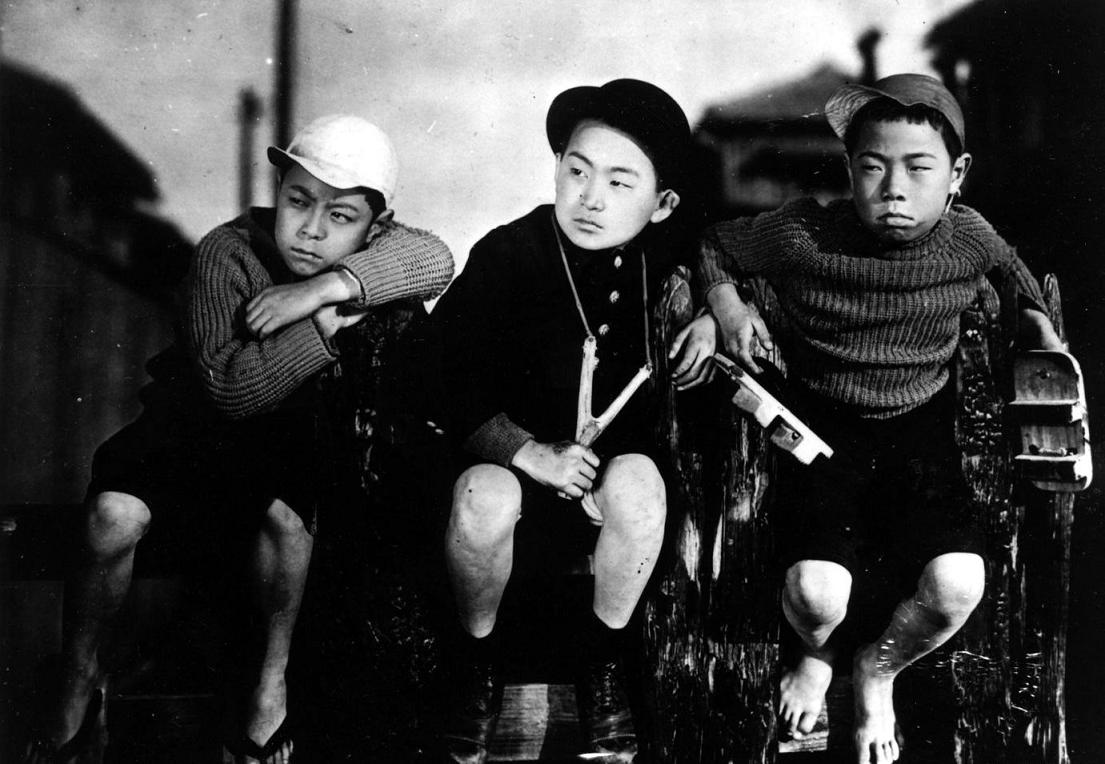 When one thinks of the classic examples of children in Japanese cinema, Hiroshi Shimizu is the name which comes to mind but family chronicler Yasujiro Ozu also made a few notable forays into the genre. I Was Born, But… (大人の見る絵本 生れてはみたけれど, Otona no miru ehon – Umarete wa mita keredo) stars one of the premier child actors of the silent era in Tokkan Kozo (later known as Tomio Aoki) who also worked repeatedly with Shimizu (
 Shimizu, strenuously avoiding comment on the current situation, retreats entirely from urban society for this 1941 effort, Introspection Tower (みかへりの塔, Mikaheri no Tou). Set entirely within the confines of a progressive reformatory for troubled children, the film does, however, praise the virtues popular at the time from self discipline to community mindedness and the ability to put the individual to one side in order for the group to prosper. These qualities are, of course, common to both the extreme left and extreme right and Shimizu is walking a tightrope here, strung up over a great chasm of political thought, but as usual he does so with a broad smile whilst sticking to his humanist values all the way.
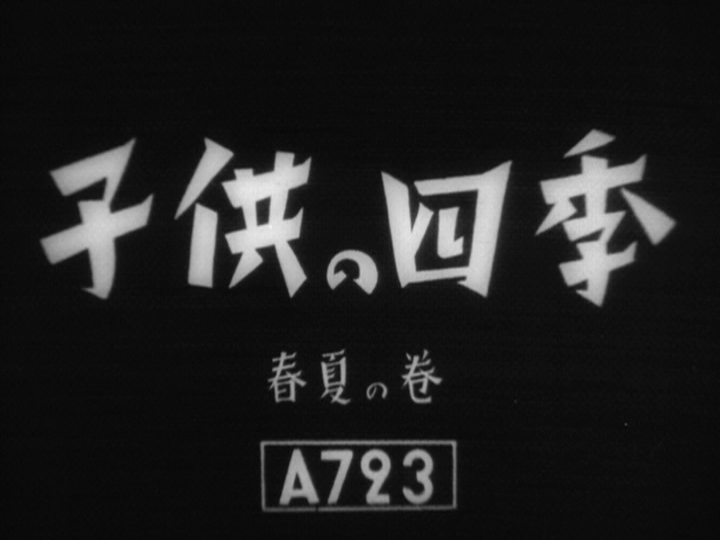 Isn’t it sad that it’s always the kids that end up hurt when parents fight? Throughout Shimizu’s long career of child centric cinema, the one recurring motif is in the sheer pain of a child who suddenly finds the other kids won’t play with him anymore even though he doesn’t think he’s done anything wrong. Four Seasons of Children (子どもの四季, Kodomo no Shiki) is actually a kind of companion piece to
 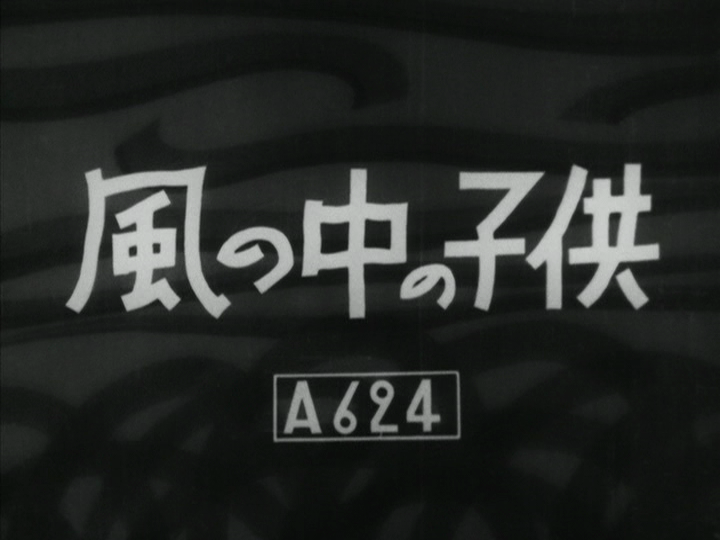 It would be a mistake to say that Hiroshi Shimizu made “children’s films” in that his work is not particularly intended for younger audiences though it often takes their point of view. This is certainly true of one of his most well known pieces, Children in the Wind (風の中の子供, Kaze no Naka no Kodomo), which is told entirely from the perspective of the two young boys who suddenly find themselves thrown into an entirely different world when their father is framed for embezzlement and arrested. Encompassing Shimizu’s constant themes of injustice, compassion and resilience, Children in the Wind is one of his kindest films, if perhaps one of his lightest.
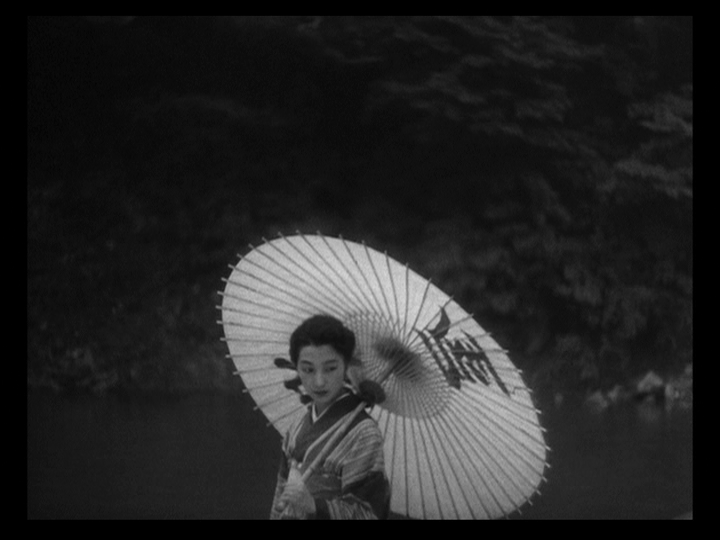 Hiroshi Shimizu takes another relaxing sojourn in 1938’s The Masseurs and a Woman (按摩と女, Anma to Onna), this time in a small mountain resort populated by runaways and bullish student hikers. Once again Shimizu follows an atypical narrative structure which begins with the two blind masseurs of the title and the elegant lady from Tokyo but quickly broadens out to investigate the transient hotel environment with even a little crime based intrigue added to the mix.
 Windows on Worlds