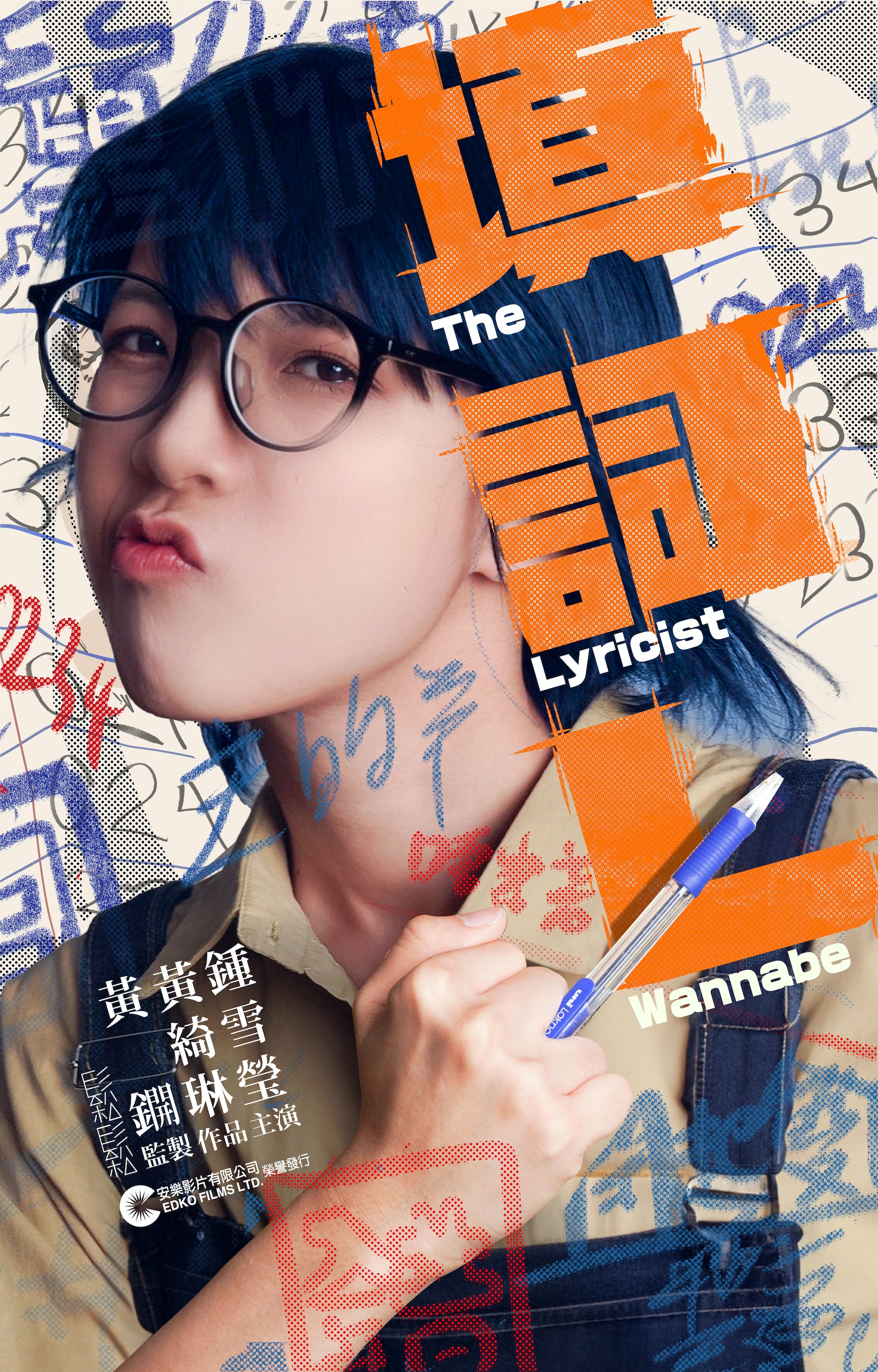
The Lyricist Wannabe (填詞L, Norris Wong, 2023)

Sometimes a dream might have come true only we never really noticed. In Norris Wong’s autobiographically inspired drama The Wannabe Lyricist (填詞L), a young woman battles her way towards becoming a Cantopop songwriter yet perhaps she already is one by virtue of her constant act of lyric writing. What she craves is the validation of having a song published, yet experiences setbacks at every step of the way that encourage her to doubt her talent or the right to continue chasing her dreams.

At a particularly low point after being taken on by a music producer to work with a spoilt influencer who’s getting studio time as some kind of favour, Sze (Chung Suet Ying) is told that her lyrics are no good and that after struggling so hard for six years perhaps she ought to take the hint and accept she isn’t suited to this line of work. It’s an act of intense cruelty, though one in part motivated by a well-meaning faux pas. In her excitement, she told the influencer she’d write lyrics for her album for free just to be published, but the palpable sense of desperation seems to have put the influencer off unable to have confidence in the work that Sze herself has devalued.

She encounters something similar during a partnership with an aspiring pop star who says he likes her lyrics but then drops the bombshell that he plans to sing in Mandarin because it’s a bigger audience. Ironically, on a trip to Taipei to sell his album she’s told that his accent is no good for the local market and while they like the song she worked on she later realises that they hired another lyricist for “real” release without even telling her. What’s more, tones don’t matter while singing in Mandarin whereas lyric writing in Cantonese is a painstaking process of trying to ensure that the tone of the word fits the melody. Aside from its political implications, not only does the pop star’s arbitrary decision to just sing it Mandarin ruin the lyrical flow she spent so long perfecting but entirely disrespects her work.

After deciding to take a break from trying to make it in music, Sze gets a job working at a ridesharing app startup where she’s roped in to create a jingle but once again her hopes are dashed when the business strays into a legal grey area and several of the drivers are arrested. While the app’s creator silently cries in his office, his female colleague ponders going somewhere else, “anywhere that doesn’t punish dreamers” which seems like a nod not only towards an oppressive capitalism that values only marketability but equally the increasingly oppressive atmosphere of the nation’s political realities. In a way this is what Sze ends up doing too, putting geographical distance between herself and the failure of her dreams by returning to the land which as the farmer says never lies to you, you reap what sow.

Yet for all her drive and perseverance there are others who view Sze’s obsession with her dreams as selfish and self-involved complaining that she rarely considers the feelings of others and neither notices nor cares if she may have hurt or inconvenienced them. She’s told that her lyrics are hollow because she lacks life experience but also is incapable of empathising and cannot see anything outside of her quest to become a lyricist. She watches other people move on, her brother getting married, friends enjoying career success etc while she’s still stuck looking for her big break only for something to go wrong just as everything was about to go right.

Wong signals the playful qualities of her fantasies though use of onscreen illustrations and even a karaoke-style video along with the nostalgic quality of the early 2000s setting of Sze’s schooldays with its MSN messenger and ICQ. Sze may be “dragged along by the melody” in more ways than one as she tries to make peace with her dreams and her future and find some way of living in harmony with the rhythms of the world around her but eventually comes to realise that she was a lyricist all along no matter what anyone else might have tried to convince her she was.


The Lyricist Wannabe screened as part of this year’s Osaka Asian Film Festival and opens in UK cinemas 15th March courtesy of Cine Asia.

Original trailer (Traditional Chinese / English subtitles)
Women (女人心, Stanley Kwan, 1985)

Women posterThings are changing in ‘80s Hong Kong, but when it comes right down to it are there really any more choices than there were in the past? Stanley Kwan would become known for his fiercely female led filmmaking and his debut, Women (女人心), is indeed a statement of intent if heeling close to the Shaw Brothers house style and possessed of a particularly mid-80s kind of cynicism. Marriage falls under the spotlight but for all of its minor oppressions and petty aggravations the net seems almost impossible to escape.

Kwan opens with a strangely cheerful family scene which quickly turns sour as housewife Bao-er (Cora Miao Chien-Jen) is excluded by her husband, Derek (Chow Yun-Fat), and son, Dang-dang (Leung Hoi-Leung), who close the bathroom door on her before declaring a pissing contest. Irked, Bao-er finds herself mildly enraged by the sight of her husband’s undies and decides to take this opportunity to tell him she wants a divorce. She’s found out all about Derek’s fancy woman Sha-niu (Cherie Chung Cho-Hung) and has had enough. Decamping to her mother’s with Dang-dang in tow, Bao-er finds herself the latest member of her friends’ “forever happy single women’s club” but remains conflicted when it comes to considering the further direction of her life.

The “forever happy single women’s club” is itself somewhat confused in its outlook in that most of Bao-er’s friends are not really intending to remain single forever but are hoping to find a new partner, if perhaps also enjoying playing the field while they look. None of them are really very happy with the status quo and the various get-togethers at which they enjoy lavish buffets and copious amounts of alcohol are mostly filled with bawdy discussions about men and sex, much to the consternation of the rather uptight Bao-er. 

In fact, Bao-er’s “refinement” seems to be one of the chief issues in her marriage which is perhaps why Derek has found himself intwined with a clingy free spirit who quickly moves into the family home and does her best to stake a claim on little Dang-dang but is unwilling to keep house with the consequence that the apartment is quickly overrun with old newspapers and empty food cartons – a sight which fair breaks Bao-er’s heart when she’s forced to visit only to be presented with some of Sha-niu’s patented “spicy soup”. During a candid conversation with her mother, Bao-er reveals that throughout her married life she’d gone to great lengths to preserve her feminine mystique only for Derek to take off with a woman prepared to let it all hang out. Her mother, broadly supportive of her choices, advises her to think carefully about her future. If the marriage was unhappy then it’s best to call it quits, but if Sha-niu is just a passing fad then perhaps she’s one worth putting up with in the absence of other options.

Bao-er’s mother seems to think that ignorance is bliss when it comes to a healthy marriage, but as a “modern” woman, Bao-er expected more. Even so, despite not requesting alimony (she only wants money to cover Dang-dang’s expensive private school fees), we don’t see Bao-er looking for work though it’s also clear she isn’t looking to remarry in the immediate future. Like many of her friends, Bao-er seems to have her doubts about living as an “independent” woman and continues to be irritated by Derek’s relationship with Sha-niu even while attempting to firmly close the door on her marriage.

The end of the relationship does however give her an opportunity to consider what it is that she wants, even if middle-class conservatism ultimately wins out. This is particularly true of an unexpected attraction to a lesbian friend which she chooses not to pursue seemingly because of the social taboo. Despite being fully out and accepted by the group, Terry (Cheung Yin-Gwan) is also pitied by some of the other members who believe she is locked out of the conventional family life most of them are looking for because she is looking for a woman and not a man. Even if it’s true that Bao-er can only really be fully herself with her female friends, she and the others still hanker after male companionship and do not feel complete without it.   

The major theme which emerges is that marriage and family are essential, if imperfect, and must be maintained even if perhaps superficially as the closing text which conveniently condones Derek’s poor behaviour while allowing Bao-er her “revenge” implies. A slightly cynical point, to be sure but undercut by Kwan’s sense of empathetic irony which asks what other real choices Bao-er has while refusing to condemn her for the ones she eventually makes. Socially conservative as it may be, the fact remains that possibilities are bleak for women of a certain age in ‘80s Hong Kong which remains a playground for men like Derek while women like Bao-er and her friends are left with only complicit means of personal rebellion.


Women screens as part of the 2019 Chinese Visual Festival on 5th May at King’s College London where director Stanley Kwan will be present for a Q&A.

Celestial Pictures trailer (English subtitles)