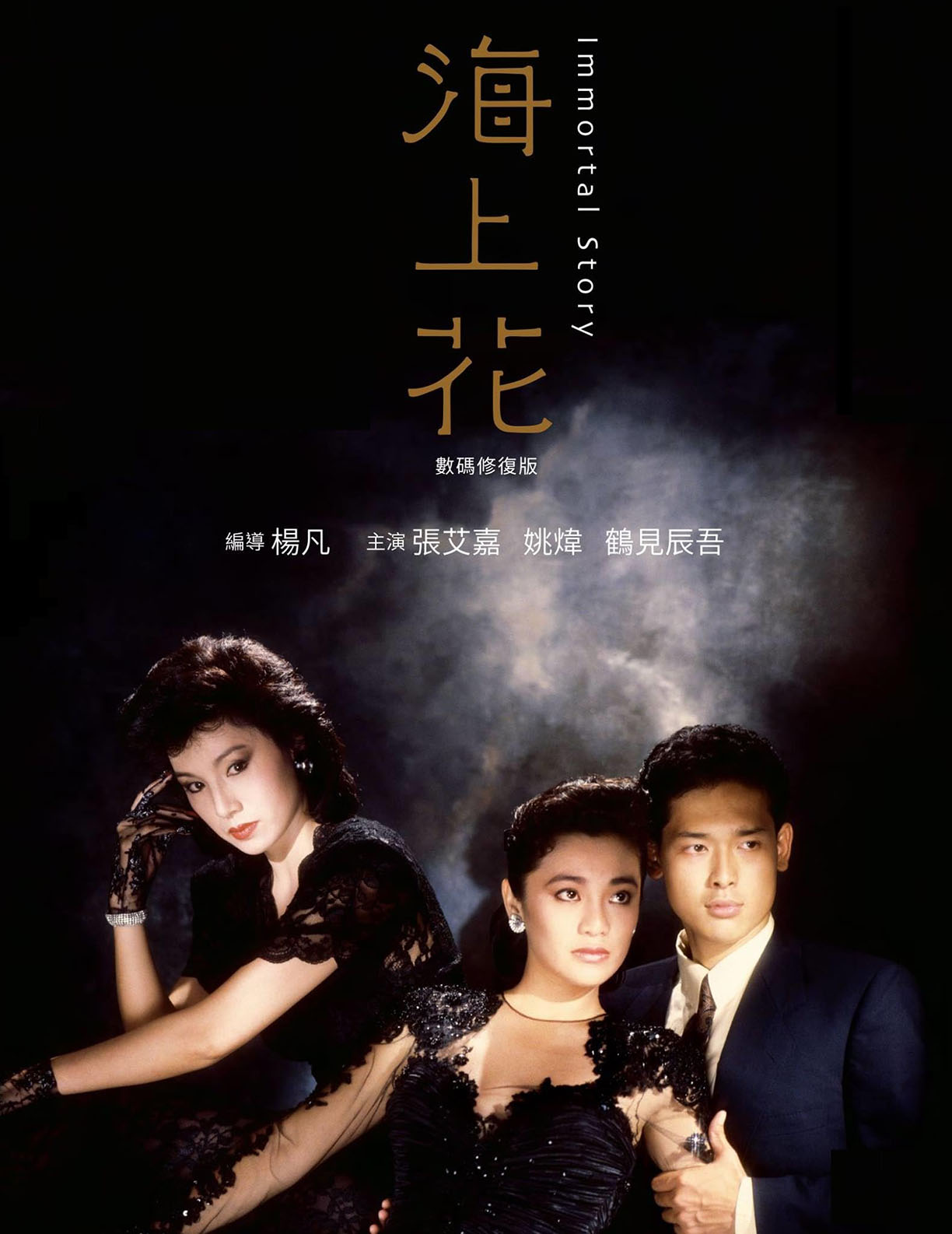
Immortal Story (海上花, Yonfan, 1986)

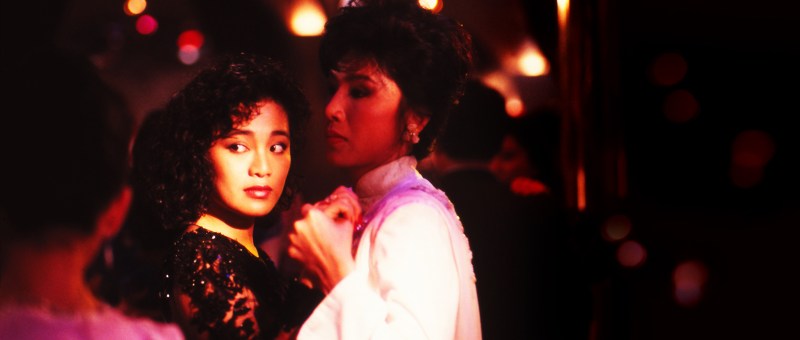
A young woman dreams of romance after meeting a Japanese boy in Macau, but finds that fate has other plans in Yonfan’s romantic melodrama, Immortal Story (海上花). Employing a non-linear narrative, the film opens in the early 1970s and shifts back 10 years as Ling (Sylvia Chang Ai-Chia) meets Nakamura (Tsurumi Shingo) who is in town for a few days while his school baseball team has a fixture in Hong Kong. Though the pair are smitten with each other, Ling never sends the letters she promised to write him, realising that she is corresponding with a romantic fantasy rather than a real person, while Nakamura apparently continues to think of her after returning to Japan.

Ten years later, Ling is discovered cradling Nakamura’s body in a hotel room in Macau and is presumed to have stabbed him with a fruit knife. The film then explores what led to this tragic ending through a series of flashbacks and witness testimonies through which it becomes apparent that both Ling and Nakamura have become somehow corrupted during their time apart. Even during her youth, however, it seems that Ling did not really believe in the reality of romantic salvation and was too afraid to pursue her relationship with Nakamura. After all, she could easily have sent the letters that she continued to write for the full 10 years, but preferred to maintain the fantasy rather than risk it shattering.

Instead, she drifted into an abusive relationship with a local boy who got her pregnant and then dumped her, after which she was rescued by bar owner/madam, Blanche (Yiu Wai). If Ling is caught in a romantic fantasy, then so in a way Blanche is too as it is clear that she is infatuated with Ling who will never return her affections. In fact, when Ling reveals that she plans to leave with Nakamura, she says that she feels indebted to Blanche but also that she has effectively repaid her kindness through the money she has made working for her as an escort. This is in a way Blanche’s tragedy, that in seeking to trap and possess Ling, she ends up ruining her while Ling feels only gratitude rather than affection. To escape the trauma of her life as a sex worker, she ends up turning to drugs from which neither Blanche nor Nakamura is able to save her.

What exactly happened to Nakamura in the intervening 10 years is never revealed, but it seems that he has ironically become involved with the drugs trade and is therefore partly responsible for Ling’s fate. He vows that he will get her off the drugs and take her back to Japan with him, but agrees to help her inject not only after they first reconnect but when they meet again in the hotel room before they’re supposed to leave. Blanche isn’t wrong when she accuses him of feeding on the blood of vulnerable people, though one could say she does the same in pressing them into sex work as she does with Ling. Unsurprisingly, Blanche is against Ling reuniting with Nakamura, but also asks why she allows men to hurt her, rather than accept the care and nurture Blanche is giving her if while, at the same time, harming her through her exploitation. 

The 1970s setting maybe crucial to making the timeline work as Nakamura states the reason he can speak Chinese is that he was born in China, though this “immortal story” feels like something that might have happened much earlier. There is a strong sense of nostalgia for a lost time of innocence and possibility, though Ling already seems to think that her future is out of reach even as a teen. When she reunites with Nakamura, it’s in a ruined building where she once used to live that is about to be torn down, hinting both that their romance has no real future and that it belongs to another time or may really never have existed at all outside of a mutual fantasy. In these early scenes, Ling is entirely dressed in a bright white, as she is in the hotel room, while as a tragic nightclub singer later she wears black like the ironically named Blanche. Their outfits often complement each other in a mix of black and white symbolising both the genuineness of their connection and the corruption stemming from Blanche’s line of work. In the end it maybe Blanche who is trapped within an impossible dream of romance, caught by the futility of her desire, while in a way freeing Ling from the torment of the shadow of an illusionary lover.

Women (女人心, Stanley Kwan, 1985)

Women posterThings are changing in ‘80s Hong Kong, but when it comes right down to it are there really any more choices than there were in the past? Stanley Kwan would become known for his fiercely female led filmmaking and his debut, Women (女人心), is indeed a statement of intent if heeling close to the Shaw Brothers house style and possessed of a particularly mid-80s kind of cynicism. Marriage falls under the spotlight but for all of its minor oppressions and petty aggravations the net seems almost impossible to escape.

Kwan opens with a strangely cheerful family scene which quickly turns sour as housewife Bao-er (Cora Miao Chien-Jen) is excluded by her husband, Derek (Chow Yun-Fat), and son, Dang-dang (Leung Hoi-Leung), who close the bathroom door on her before declaring a pissing contest. Irked, Bao-er finds herself mildly enraged by the sight of her husband’s undies and decides to take this opportunity to tell him she wants a divorce. She’s found out all about Derek’s fancy woman Sha-niu (Cherie Chung Cho-Hung) and has had enough. Decamping to her mother’s with Dang-dang in tow, Bao-er finds herself the latest member of her friends’ “forever happy single women’s club” but remains conflicted when it comes to considering the further direction of her life.

The “forever happy single women’s club” is itself somewhat confused in its outlook in that most of Bao-er’s friends are not really intending to remain single forever but are hoping to find a new partner, if perhaps also enjoying playing the field while they look. None of them are really very happy with the status quo and the various get-togethers at which they enjoy lavish buffets and copious amounts of alcohol are mostly filled with bawdy discussions about men and sex, much to the consternation of the rather uptight Bao-er. 

In fact, Bao-er’s “refinement” seems to be one of the chief issues in her marriage which is perhaps why Derek has found himself intwined with a clingy free spirit who quickly moves into the family home and does her best to stake a claim on little Dang-dang but is unwilling to keep house with the consequence that the apartment is quickly overrun with old newspapers and empty food cartons – a sight which fair breaks Bao-er’s heart when she’s forced to visit only to be presented with some of Sha-niu’s patented “spicy soup”. During a candid conversation with her mother, Bao-er reveals that throughout her married life she’d gone to great lengths to preserve her feminine mystique only for Derek to take off with a woman prepared to let it all hang out. Her mother, broadly supportive of her choices, advises her to think carefully about her future. If the marriage was unhappy then it’s best to call it quits, but if Sha-niu is just a passing fad then perhaps she’s one worth putting up with in the absence of other options.

Bao-er’s mother seems to think that ignorance is bliss when it comes to a healthy marriage, but as a “modern” woman, Bao-er expected more. Even so, despite not requesting alimony (she only wants money to cover Dang-dang’s expensive private school fees), we don’t see Bao-er looking for work though it’s also clear she isn’t looking to remarry in the immediate future. Like many of her friends, Bao-er seems to have her doubts about living as an “independent” woman and continues to be irritated by Derek’s relationship with Sha-niu even while attempting to firmly close the door on her marriage.

The end of the relationship does however give her an opportunity to consider what it is that she wants, even if middle-class conservatism ultimately wins out. This is particularly true of an unexpected attraction to a lesbian friend which she chooses not to pursue seemingly because of the social taboo. Despite being fully out and accepted by the group, Terry (Cheung Yin-Gwan) is also pitied by some of the other members who believe she is locked out of the conventional family life most of them are looking for because she is looking for a woman and not a man. Even if it’s true that Bao-er can only really be fully herself with her female friends, she and the others still hanker after male companionship and do not feel complete without it.   

The major theme which emerges is that marriage and family are essential, if imperfect, and must be maintained even if perhaps superficially as the closing text which conveniently condones Derek’s poor behaviour while allowing Bao-er her “revenge” implies. A slightly cynical point, to be sure but undercut by Kwan’s sense of empathetic irony which asks what other real choices Bao-er has while refusing to condemn her for the ones she eventually makes. Socially conservative as it may be, the fact remains that possibilities are bleak for women of a certain age in ‘80s Hong Kong which remains a playground for men like Derek while women like Bao-er and her friends are left with only complicit means of personal rebellion.


Women screens as part of the 2019 Chinese Visual Festival on 5th May at King’s College London where director Stanley Kwan will be present for a Q&A.

Celestial Pictures trailer (English subtitles)