
Losers never win again, according to some in Sophie Yang & Veronica Bassetto’s e-sports dramedy Gamer Girls (電競女孩). Now in her mid-20s, Summer (Angela Yuen Lai-Lam) gave up her e-sports career after a defeat, disbanding her team, and going back to school to get a regular corporate job instead. But somehow she can’t quite settle into the conventional life her boyfriend and family want for her. Still seeing the world like a video game, she dreams of winning e-sports glory once again but faces several barriers from ingrained societal misogyny to ageism and workplace exploitation.
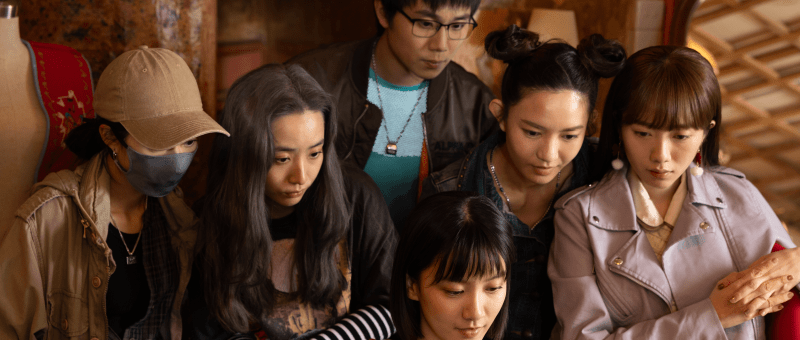
Indeed, it seems that part of the reason the team broke up was the unreasonable expectations of their manager, Ms. Chiu (Cheuk Wan-chi), who now works for the Hong Kong e-Sports Chamber of Commerce. Another reason seems to have been conflict between team captain Summer and fellow player Lilith (Alma Kwok) who became frustrated with what she saw as Summer’s unilateral decision making and inability to take her teammates’ thoughts and feelings into account. Raven (Sabrina Cheung), meanwhile, still resents Summer for abruptly selling out by abandoning them to take a more conventional path despite having promised to carry on playing games together forever.
To that extent, the film seems to be another in a recent line exploring young people’s sense of dissatisfaction with the working environments their parents have railroaded them towards all their lives. Given the economic pressures of the contemporary society in which things like buying a flat and starting a family are out of reach for most, many feel that it’s no longer worth the sacrifice of long hours spent in an office doing a job that probably doesn’t interest them for so little reward. Instead they favour less conventional lifestyles that offer more freedom even if it comes at the cost of economic stability. Summer feels embarrassed around her family having insisted that e-sports could be “a real job” only to end up working in an office anyway, but still isn’t really ready to commit fully to the conventionality being imposed on her not least by her handsome and kind boyfriend who nevertheless can’t understand any other way of living and thinks her decision to quit her job is an act of madness.
But at the same time, it’s clear that she’s fighting an uphill battle in the e-sports world where male players refuse to accept that girls could be real gamers, instead branding them “gamer whores” who are are only there as eye candy to trick men into buying things they don’t need. Ms. Chiu makes it clear that Summer blew her chance and she doesn’t want to work with her as a gamer because losers never win again, but would be willing to collaborate with her in business terms which aren’t so much different from her own job. Summer’s escape from the corporate life is in that way also being swallowed by it as big business seeks to control the world e-sports through things like licensing and sponsorships.
The fact that the Gamer Girls rebel by setting up their own local community tournament in Lilith’s family-run cha chaan teng could also be seen as their desire to defend traditional Hong Kong culture against oppressive external forces. Whatever else happens, the cha chaan teng will still be here, one says as they root themselves more firmly in a local community filled with people who just want to play and not have to deal with any of the corporate rubbish that stands in the way. There is a kind of naivety involved in Summer’s certainty that it’ll be alright despite being warned several times that they don’t have licences to use the games in this way and the only reason they haven’t been shut down yet is because the companies are turning a blind eye. When Ms. Chiu feels threatened and decides to act, the swift deletion of everyone’s accounts, along with years of gaming history, reminds them that their world could be taken away from them just like that.
But their response is one of mutual solidarity, committing to rebuilding and defending the community they have created in the cha chaan teng and competing on their own terms. Even Summer’s online friend Login (Chase Chan Chung Chak) who was “banned for life” after protesting exploitative employment practices in professional e-sports begins to realise that nothing actually prevents him from just playing the game aside from his own sense of disappointment. Which is to say, they took their world back, if only to an extent in that they are still at the mercy of those who own the games and their in-game successes are only ever fantasy projections of battles unwon in their offline lives. Nevertheless, have at least decided to play on their own terms valuing sportsmanship and community over corporate success.
Gamer Girls screened as part of this year’s New York Asian Film Festival.
Trailer (Traditional Chinese / English subtitles)