Bear Man (웅남이, Park Sung-kwang, 2023)

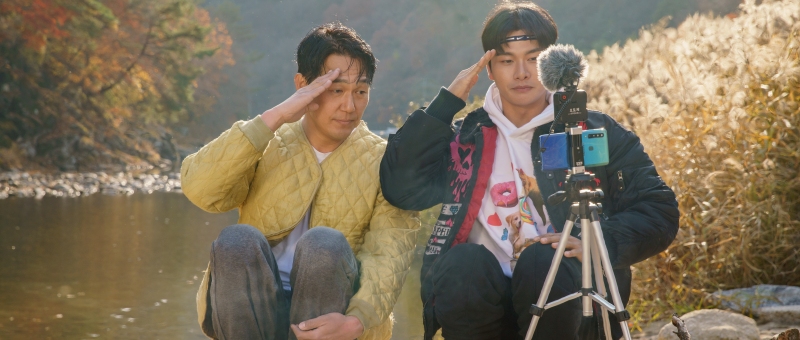
According to an ancient legend, bears who eat garlic and mugwort can become human though it’s not exactly clear why they’d want to. The debut film from Park Sung-kwang, Bear Man (웅남이, Woongnami) as its name suggests follows a pair of bear cubs who decide to give things a go in the human world but with wildly differing results as one is adopted by the researcher who allowed them to escape and the other by a vicious gangster who exploits him for his violent capabilities and shows him little love. 

Love is something Woongnam (Park Sung-woong) got a lot of thanks to his devoted mother and though not exactly the sharpest knife in the drawer had forged a promising career as a local policeman before he was let go after falling into a kind of funk on overhearing his father on the phone suggesting that the life expectancy for a regular bear is only 25 so he might not have much time left. Thanks to his nature as a bear man, Woongnam ages much faster than everyone else and already appears to be middle-aged though he is also blessed with immense strength and agility. After agreeing to bend the law by helping his feckless friend Malbong (Lee Yi-kyung) win in at illegal gambling Woognam comes to the attention of a group of police detectives investigating a shady gangster who notice a man looking just like Woongnam taking out a host of bad guys at the harbour. 

There is something quite poignant in the puppy-like existence of Woongbok (also Park Sung-woong) who keeps looking up to his boss as a father figure with a mixture of fear and longing. He gazes enviously at a family crossing the road in front of him and later visits Woognam’s home where Woongnam’s mother thinks that he’s Woognam and tries to feed him his favourite foods while he just looks on silently without expression. Where Woongnam is basically good, not too bright but heart in the right place, Woongbok has been raised as creature of violence by his intimidating father figure and carries a threatening aura with his slick haircut and tailored suit. 

The police want Woongnam to pose as Woongbok so they can take down the gangsters who have not only been trafficking drugs but also dabble in scientific research into viruses and their cures apparently about to unleash an epidemic in China to profit off the drug sales. It’s not all that clear what the scientists who released the bears were actually researching though there is a kind of parallel in the fact the other pair seemingly settled down, adjusted to their new environment and had a few cubs while Woongnam and Woongbok ended up becoming humans with bear-like abilities. Woongnam has to be prevented from entering hibernation and sleeps flat out like a bear but otherwise keeps his true nature secret even while covertly helping the townspeople out getting rid of beehives and freeing trucks stuck in the mud. 

That would be about the extent of “policing” in this kind of small-town where there’s nothing much to do but catch fish in the river and chat to wild boar. Park builds on the surreality of everyday rural life with mounting absurdities such as the parade of teenagers who troop through the convenience store where Woongnam’s live-streaming friend Malbong works each of whom he is largely able to unmask thanks to his keen sense of smell, and the polytunnel that doubles as a gambling den for down on their luck farmers. Woongnam’s biggest regret is losing his position as a police officer and it’s his desire to get it back to make things up to the people who raised him that encourages him to go along with the detectives’ crazy plan even if means he has to undergo weird martial arts training inspired by Drunken Master and take lessons from a strange movement coach in how to walk like a gangster. Yet in the end it’s Woongbok’s innocent desire for familial love that becomes a source of salvation, turning against his gangster brethren to protect the warmth of Woongnam’s family home. Quirky in the extreme and defiantly absurd, the film nevertheless has genuine heart in otherwise strange tale of wandering sons and bears of men.


Bear Man screened as part of this year’s New York Asian Film Festival

Images: © 2023 KIMCHI PICTURES PRODUCTION. ALL Rights Reserved.
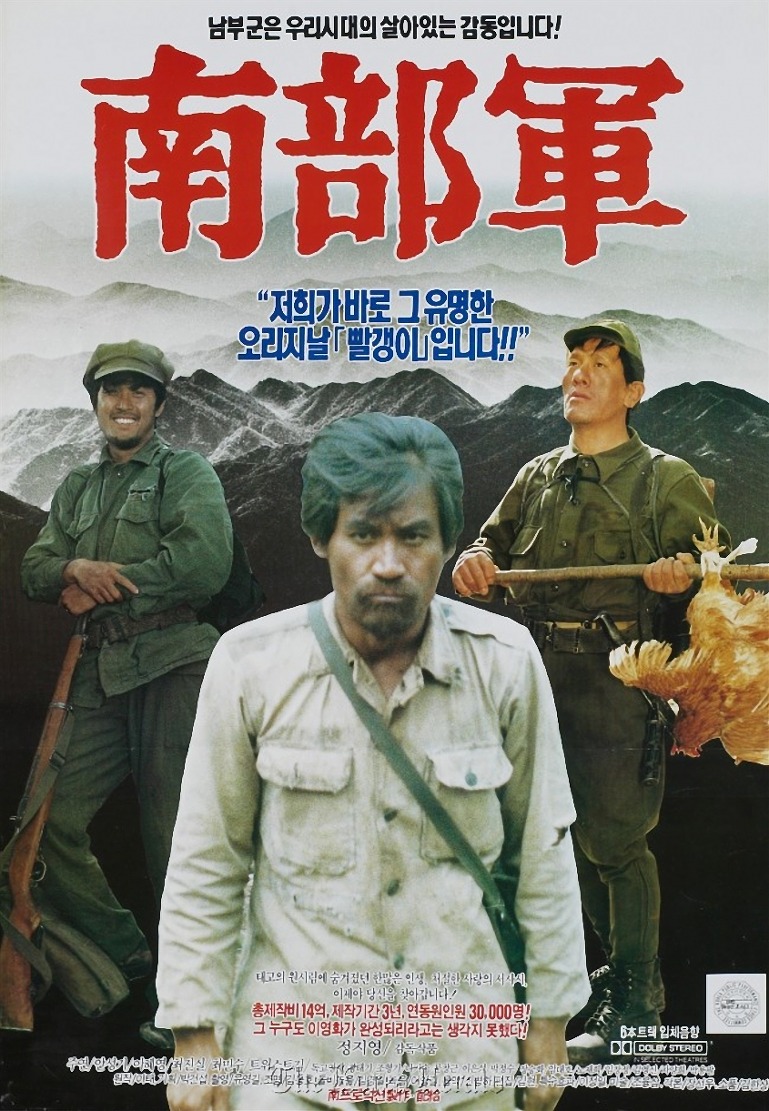
Nambugun: North Korean Partisan in South Korea (南部軍 / 남부군, Chung Ji-young, 1990)

North Korean Partisan in South Korea poster 1Under the intense censorship of South Korea’s military dictatorships, “anti-communism” had become the single most important cultural signifier to the extent that all films were in some sense “anti-communist” even if some were more obviously anti-communist than others. As power shifted away from the dictators and towards a new era of democratic freedom, a more nuanced view of the recent past became possible with the “division film” taking the place of the old-fashioned anti-communist drama. Rather than demonise the North, the division film emphasised the tragedy of partition, painting the two Koreas as equal victims of geopolitical finagling.

Arriving in 1990 shortly after Korea’s democratisation, Chung Ji-young’s Nambugun: North Korean Partisan in South Korea (南部軍 / 남부군, Nambugun) is among the first to directly address the subject of the Korean War from the perspective of the North Korean partisans, albeit obviously from those who eventually came South. Adapting the memoirs of war correspondent Lee Tae, Chung ignores ideology in order to explore the gruelling experience of guerrilla warfare largely being fought by ordinary people with strong convictions rather than by career soldiers or committed revolutionaries.

Lee Tae (Ahn Sung-ki) himself is an “intellectual” North Korean newspaper reporter working as a correspondent in Jeonju which is currently in North Korean occupied territory. When they get word that the Americans and South Korean forces are on their way, the newspaper staff evacuates and eventually ends up heading into the mountains to join the partisans. As he has previous experience, Lee Tae is given command of a platoon and the instruction to try and make up for his bourgeois intellectualism with hard work on the job. To keep them all in one place, Lee is assigned a series of other “intellectual” recruits including conflicted student Kim (Choi Min-soo) who joined the fight to figure out what this “inhuman” war was all about.

One of the reasons Kim is so conflicted is that he brought his hometown, high school-age girlfriend with him and wonders if that was a very responsible thing to do, especially when they are eventually separated by the command chain who decide to send her to headquarters while Kim stays with the troops. Though we are shown that the North Korean soldiers are just ordinary men and women who call each other comrade, the regime itself still comes in for subtle criticism for its oppressive hardline austerity. On the run and separated from his unit, a wounded Lee is accompanied by an earnest nurse, Min-ja (Choi Jin-sil), with whom he falls in love, but when the romance is discovered by a superior officer Lee is taken aside and reminded that here there can be no love, only revolution. He must give all of himself to the cause, reserving nothing for such bourgeois affections as romance. Both Lee and Kim spend the rest of the picture trying and failing to reconnect with their respective women while fantasising about a different kind of life in which they would not have been kept apart.

Yet, despite the fact that we clearly see a world of near total equality among the partisans, it is clear that Lee’s own thinking at least is not quite as progressive as one might assume. Bonding with Min-ja and dreaming of the future, he envisages a life for himself as a reporter in Seoul at which point she asks what she’s supposed to do and receives the answer “have dinner ready for me”.  Min-ja, apparently an orphan whose brother was killed fighting for the South, found herself becoming a field nurse for the North and perhaps has a lower ideological consciousness as a result, freely offering her medical knowledge to anyone who might be in need of it. “Why is it that we’re fighting?” she asks Lee, “you both need me”, embodying the wounded innocence of the one Korea unfairly torn apart by forces beyond its control.

All gusto and determination, Lee and the others start out with pluck and positivity but gradual disillusionment accompanies the shift from the warmth of spring to the dead of winter as the partisans find themselves starving to death on a frozen mountain. Win or lose, the victory belongs to the US or USSR, one particularly dejected soldier intones laying bare his loss of faith in the primacy of North Korean communism and accepting that they are all playthings in a proxy war being fought by Koreans on Korean soil. Kim fails to find “meaning” in conflict and emerges only with shame and regret while others clutch at pamphlets dropped by the Americans promising an amnesty for those who surrender willingly. Lee trudges on alone, frostbitten and starving, encountering only the dead and finally contemplating suicide only to be given one last source of hope and to have that too crushed. Chung humanises the communists, but still they have to lose in the spiritual as well as the literal sense. Ending on a howl of existential despair, the film dedicates itself to all those on both sides who fell on Jirisan or sacrificed their lives for a vision of a better world but does so with pity more than admiration for all that they suffered as victims of their times.


Nambugun: North Korean Partisan in South Korea was screened as part of the 2019 London Korean Film Festival.

How to Steal a Dog (개를 훔치는 완벽한 방법, Kim Sung-ho, 2014)

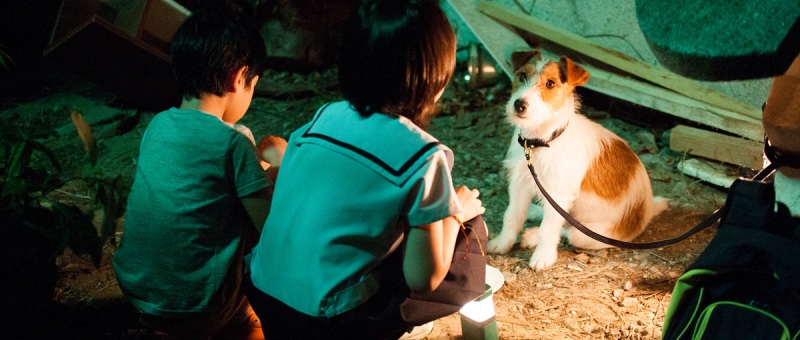
how to steal a dog posterEverything seems so simple to children. The logic maybe surreal, but it is direct. Problems have solutions and there are clear pathways to achieve them even if they seem odd to a more adult way of thinking. Perhaps we’d all be better off if we thought about social issues in the same way children do, though naivety and innocence often prove blindspots in otherwise solid plans. How to Steal a Dog (개를 훔치는 완벽한 방법, Gaereul Hoomchineun Wanbyeokhan Bangbub) is basically a heist movie in which two adorable little girls plan to kidnap a beloved pooch from a rich old lady who will then be only too happy to part with her millions to get it back but it’s also a subtle social satire on class relations and the economic causes of family breakdown in modern Korea.

Little Ji-soo (Lee Re) tries her best to put brave face on it, but at home everything’s gone wrong. In fact, they don’t even have a home any more – Ji-soo’s dad’s pizza business failed and he’s run off and left them. Evicted, the family have been living in the old pizza van while Ji-soo’s mum (Kang Hye-jung) has convinced an old flame (Lee Chun-hee) to give her a job as a waitress in a posh cafe. It’s approaching crunch time because Ji-soo’s birthday is coming up and the other kids are expecting to be invited to a party at a house Ji-soo doesn’t have. When she spots an ad for a lost dog which promises a reward, Ji-soo strikes on an idea. Together with a new found friend (Lee Ji-won), she hatches a complicated plan to steal the beloved dog of the grumpy old lady (Kim Hye-ja) who owns the cafe where her mother works and extort enough money to buy a lovely new house for her family where she can have her birthday in style.

Ji-soo’s worldview is both cheerfully innocent and extremely cynical. Sad and lonely with her dad gone, she blames her mother’s fecklessness for their present plight, berating her lack of practicality and failure to get her kids into a proper home in good time. Playing the sensible one for her family of three, Ji-soo is always on the look out for scams and trickery, assuming most people are up to something especially when it comes to innocent little girls. Hence she quickly has the number of the local pizza boy (Lee Hong-ki) who takes orders for family size pizzas but writes regular on the order slips and then pockets the difference from the unsuspecting customer. When she spots an ad in an estate agent’s window for houses at 5 million won she becomes fixated on gaining exactly that amount of money, thinking “per three square metre” is the name of an area and little knowing that 5 million won won’t even buy you a front porch in Seoul let alone an entire house.

Though living in a van is not exactly pleasant, Ji-soo’s problem is more one of social shame than it is of actual discomfort. All the kids at school have already been indoctrinated with class competitiveness and everyone is still talking about the last birthday party, the subject of which is getting a little nervous in case Ji-soo’s house turns out to be nicer than his. No one knows Ji-soo’s dad has run off and they’re living in a van, even the teacher seems curious enough about Ji-soo’s putative birthday party to actively remind her about it and enquire when she plans to make some kind of announcement to her schoolmates.

Thankfully, Ji-soon does eventually learn that money and status aren’t everything. The mean old lady turns out just to be sad and lonely, filled with regrets about a mistake made in her past. The scary homeless man (Choi Min-soo) turns out to be a goodhearted free spirit, and Ji-soo’s mum finally finds her feet after buckling down in an honest yet low paying job which requires a lot of early morning starts. From Ji-soo’s point of view, adults are still a bit rubbish but everything seems to be working out for the best. Oddly pure hearted for a story about dognapping, How to Steal a Dog is a charming, whimsical adventure in which a little girl’s faith in the goodness of the world is finally rewarded, even if not quite in the way she imagined.


Original trailer (no subtitles)

https://www.youtube.com/watch?v=X87IdmUIPZw