No More Bets (孤注一掷, Shen Ao, 2023)

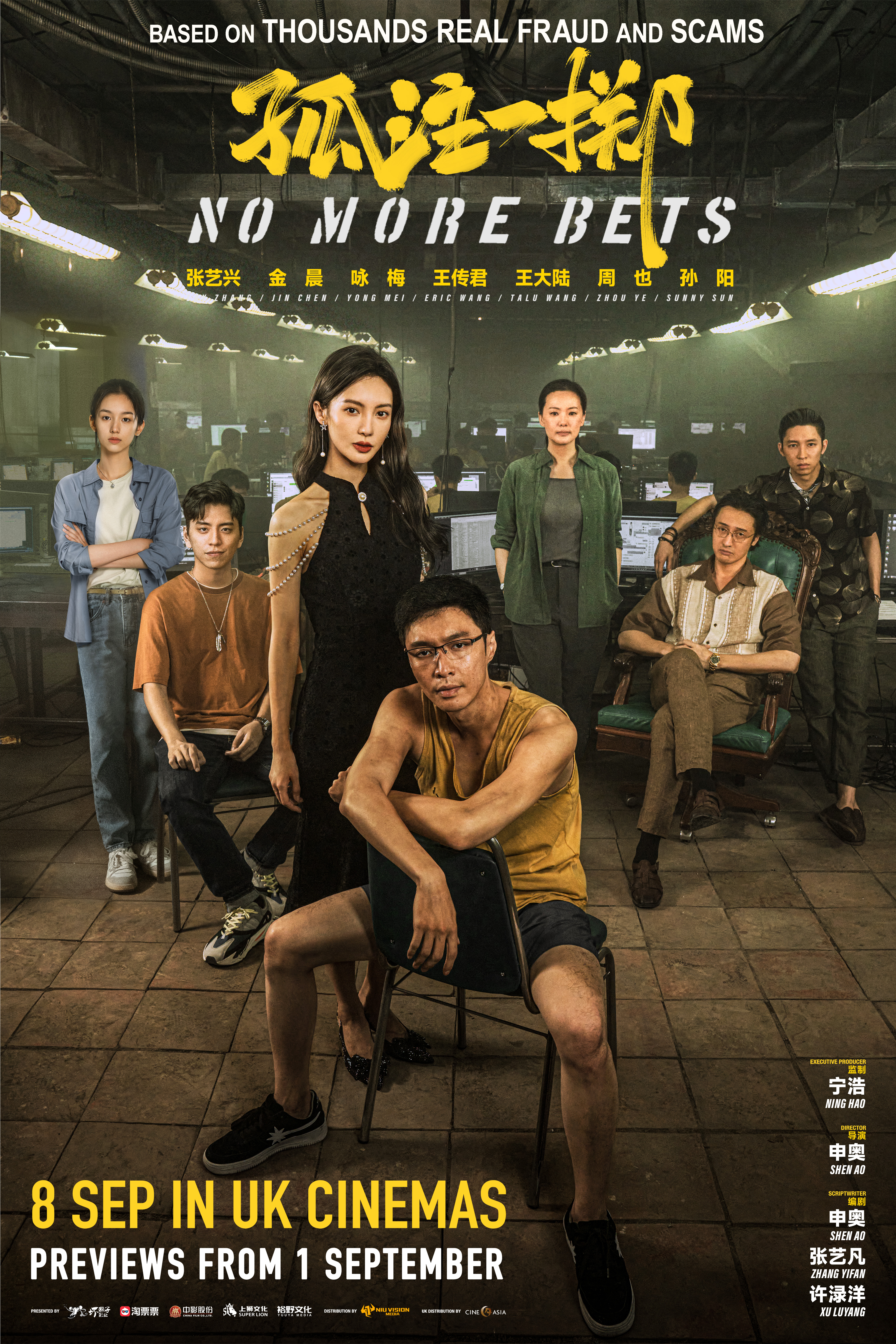
That the two biggest hits at the Chinese box office in summer 2023 both had a strong anti-gambling message perhaps hints at a contemporary anxiety, though No More Bets (孤注一掷, gūzhùyīzhì) is clearly the more direct of the two even if it also shares with Lost in the Stars its echoing of a theme in contemporary mainstream cinema that Chinese citizens are safe nowhere other than China. Then again, that particular message maybe somewhat disingenuous seeing as the villains here are all themselves Chinese if operating abroad to try and evade the law. 

This ambitious programmer Pan (Lay Zhang) learns to his cost when he abruptly quits his job after being passed over for a promotion in favour of someone with an influential father and accepts a too good to be true offer from what he’s been led to believe is a gaming company in Singapore. Soon enough, however, he realises their brief stopover is actually their destination and he’s been trafficked to another South East Asian nation where he is forced to participate in online gambling scams. Pan is however a righteous young man and immediately takes a stand, explicitly telling his captors he won’t do their bidding though they viciously beat him. Eventually he teams up with the slightly less conflicted model Anna (Gina Jin Chen) who vaguely understood the job when she agreed to it but not that they’d confiscate her passport and she’d be unable to leave. 

Like Pan, Anna accepted the job while frustrated by the vagaries of her industry after being unfairly let go by her agency after her photo was used on a flyer advertising sex work without her (or their) consent. Like those who play the games, she was suckered in by the promise of easy money that could be earned quickly and didn’t really think about the implications of what she was doing. That the film positions the victim, Tian (Darren Wang), as an incredibly wealthy young man who had access to vast generational wealth avoids the implication that some are drawn into scams for the same reasons that Pan and Anna were in they feel a sense of impossibility in their lives because of societal unfairness and economic hopeless but nevertheless paints his gradual descent into madness and addiction as a personal failing born of his insatiable greed rather than a misfortune that might befall anyone with a smartphone. Even so, if a highly educated young man can be tricked by such an obvious scam it suggests that it really can happen to anyone. 

At least, the film seems to say that in any case it’s bad to gamble but you should definitely think twice about promises that sound too good to be true, especially if they involve offers of work abroad. A series of talking heads interviews (with blurred faces) from victims of trafficking at the film’s conclusion all advise viewers not to travel to other countries to work, while several remark on how relieved they felt to see Chinese police when they were eventually rescued. Uniformed police also give a press conference during the film insisting that they are doubling down on combatting fraud and other kinds of cybercrimes while Inspector Zhao (Yong Mei), whose speech bookends the film, struggles to get anything done because the crimes are taking place overseas and therefore outside of her jurisdiction. Then again, the entire operation is run by Chinese businessmen who try to engender a sense of loyalty and rebellion among the men whom they’ve essentially enslaved by making them think that they’re merely rebelling against an unfair society by taking the money of the “greedy” people who play their games and redistributing it to their own, downtrodden families. 

Pan is trying to do the right thing, but often does it in the wrong way actively putting others in danger while trying to find a way to blow the whistle on the whole operation in the hope of being rescued while even Inspector Zhao at times seems dismissive, failing to take the claims of Tian’s girlfriend that he’s being swindled out of his entire family fortune by online scammers seriously until it’s too late. Even so, Shen crafts an often tense tale of escape as Pan does his best to send out coded messages under the noses of his kidnappers while unwillingly participating in the fraud hoping that eventually someone will figure out what’s going on and put a stop the cruel cycle of misery once and for all. 


No More Bets opens in UK cinemas 8th September courtesy of CineAsia.

UK trailer (English subtitles)

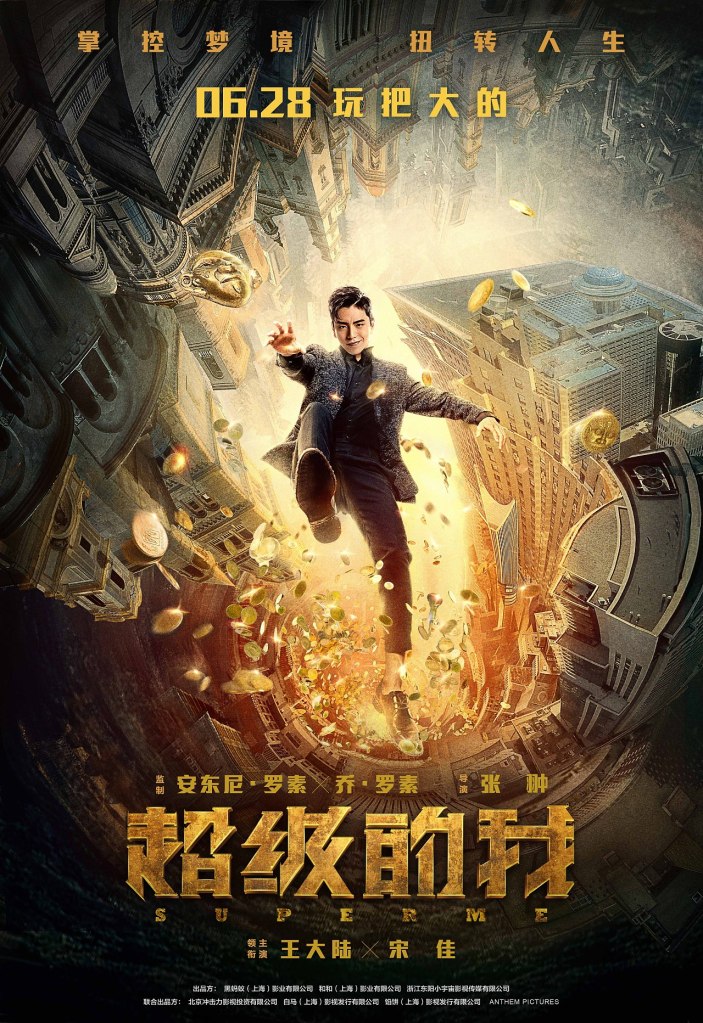
Super Me (超级的我, Zhang Chong, 2019)

Can you dream yourself into a better reality, or should you concentrate on being your best self in this one? That’s a dilemma that the hero of Zhang Chong’s Super Me (超级的我, Chāojí de Wǒ) barely has time to think about as he battles despair-fuelled hopelessness and possibly unrequited love for the beautiful woman who runs his local cafe. If only I were rich, he might well think, but though poverty is undoubtedly a factor in his malaise it’s his sense of inferiority which has him beaten down and all the money in the world won’t change that. 

We first meet Sang Yu (Darren Wang Talu) on a subway train where he recites a mantra to himself about how he’s “not an ordinary man”, he has the ability to work under pressure, and though his parents died and he has no friends those are merely tests from God which he has overcome. He is “brilliant and talented, diligent and motivated”, he expects success will soon arrive only he hasn’t slept a wink in the last six months because of the constant night terrors which plague him such as the one we’re about to witness. Sang Yu is asleep, and a nightmare is stalking him. 

Killed by having his head plunged through the train’s floor, Sang Yu wakes up and we realise his waking life is also quite depressing. A 20-something screenwriter, he’s behind on his rent and in debt to his friend/agent while unable to work because of his insomnia. Wandering around in a daze after being evicted from his apartment and getting his laptop stolen, he writes a note to his friend telling him he’ll have to pay him back in the next life and prepares to jump off the roof opposite the cafe where his true love, Hua (Song Jia), works, only to be saved by the intervention of the jian bing seller (Chin Shih-chieh) from down below who advises him to try waking up from his dreams before he gets killed by reminding himself that he is dreaming. Sang Yu takes him at his word and manages to emerge from the dreamworld unscathed clutching the weapon that once belonged to his attacker. After selling the antique sword to weapons brokers, he realises he’s sitting on a cash cow, routinely looting the dreamworld of many of its treasures and quickly harnessing its power to become a wealthy and successful man. All of which gives him the courage to finally approach Hua, wielding his newfound economic power to invest in the apparently failing cafe. 

A modern day take on Jack and the Beanstalk, Super Me finds its nice guy hero corrupted by his wealth, abandoning his artistic dreams and becoming a debauched playboy living in a five star hotel even if he continues to pine for Hua while his friend, Sangge (Cao Bingkun), reverts to being something like a minion riding on his coattails to enjoy the life of the rich and famous without really having to do anything. The irony is that the money and the fancy clothes give Sang Yu the confidence to talk to Hua, but those aren’t things she particularly cares about and may in a sense actually turn her off. Enjoying romantic evening walks, she guesses he’s a screenwriter from his veiled hints about robbing the dreamworld and is interested more in his artistic self than the wealthy man of mystery, all of which gives Sang Yu the inspiration to finish that screenplay which of course becomes a hit beyond his wildest dreams. 

After a while, Sang Yu starts to suspect there must be a cost involved in all this good fortune, realising that he’s traded some of his life away in return for riches and will perhaps never be free of his nightmares. Yet, as a cruel gangster tells him, everyone’s wealth comes at the sacrifice of life, echoing his earlier thoughts that those who are successful are either those who’ve chosen to sacrifice things that others won’t or are unscrupulous thieves and exploiters. “A person who betrays himself can never control his own destiny”, according to the gangster. Asleep or awake, Sang Yu realises he’s battling himself, that there are no quick fixes, and illusionary success is as hollow and as fleeting as the dreamworld from which he has perhaps failed to learn the appropriate lessons. As the old man told him, perhaps what he needs is to wake up, not only to life’s possibilities but to his own. Echoing his earlier The Fourth Wall, Zhang allows Sang Yu to walk through a door into a “better” reality which is perhaps the one he inhabited before but was too intimidated to actually live in. He hasn’t definitively beaten his demons, but perhaps subdued them while his new life seems determined to reward him for his choice in unexpected ways. Nevertheless, can you trust this reality more than any other? There may be no way to know, but you’ll have to learn to trust it all the same. 


Super Me is represented by Fortissimo Films.

Original trailer (no subtitles)

Fall in Love at First Kiss (一吻定情, Frankie Chen, 2019)

Fall in love at first kiss poster 2Our Times’ Frankie Chen Yu-Shan returns to the tricky world of high school romance with an adaptation of the perennially popular ‘90s manga, Itazurana Kiss. Fall in Love at First Kiss (一吻定情, Yī Wěn Dìngqíng) is in fact the third time the manga has been adapted in Taiwan following a hit 2005 TV drama and a remake in 2016. Updated for the present day, Chen’s adaptation retains the manga’s trademark zany humour and often questionable approach to romance but imbues it with characteristic warmth and mild social commentary.

Our heroine, Xiangqin (Jelly Lin Yun), falls hopelessly in love with high school superstar Jiang Zhishu (Darren Wang Talu) when she accidentally trips and kisses him on her first day. Zhishu is, however, somewhat untouchable to a Class F no hoper like Xiangqin – Class A students like him have their very own building inaccessible to those without the proper credentials. Despite outsmarting the system in order to hand him her letter of confession, Xiangqin is cruelly rejected with a video of Zhishu’s cool response going viral among her friends. However, when Xiangqin’s house is demolished thanks to an extremely localised earthquake, she finds herself moving into Zhishu’s family home (it turns out their dads are old friends) where she might perhaps be able to get to know him better.

Like the original manga, Fall in Love at First Kiss revolves around Xiangqin’s lovelorn existence as she becomes increasingly obsessed with her apparently unrequited love for the sullen Zhishu whose behaviour is often hard to read. Zhishu’s mother (Christy Chung), a highlight of any adaptation, is a woman much like Xiangqin which is to say extremely cute and cheerful. Having long wanted a daughter she is delighted to have Xiangqin move in with the family and is virtually painting a nursery in the hope that Xiangqin and Zhishu might one day end up together. This is however partly because she knows both her sons are objectively awful – a pair of self-centred, emotionless hyper rationalists and overachievers who might be popular thanks to their successes but have few friends owing to not being very nice. She hopes some of Xiangqin’s unsophisticated cheerfulness might help open them up to the pleasures of being alive.

Zhishu, however, blows hot and cold. He ignores Xiangqin’s attentions until the point she vows to move on, at which time he kisses her to prove that despite everything he is still the sun in her mad little solar system. This is obviously not a very healthy relationship dynamic even as it insists that Zhishu’s arrogance is part of his “cool” rather than a symptom of his insecurity. Even his final declaration of love is shot through with “you know you want me” logic rather than a heartfelt explanation of his reasoning for having been so cavalier Xiangqin’s feelings. Nevertheless, like every other “difficult” romantic hero, we eventually discover that Zhishu is just awkward rather than actually cruel as he finds himself continually conflicted in wanting to be nice to people but somehow thinking it would be inappropriate to do so.

This is largely because he and his brother are snobbish elitists who’ve been led to believe that social inequality is the proper order of things. Xiangqin, a proud Class F sort of girl, wants to show him that they are all “on the same page”, equals despite what the “rankings” might say. Nevertheless she does this in a rather odd way by remaining deferent to his supposedly admirable qualities and following him around despite his constant rejections. In any case, Zhishu’s class conflict is at the heart of his emotional repression as he struggles with his filial duty to inherit his father’s company when what he’d really like to do is become a doctor to be able to help people – a choice he doesn’t quite feel he has the freedom to make and one which feels too warm and fuzzy for the ultra-capitalist, success at all costs philosophy he seems to have been brought up with by everyone except his cheerful mother. 

Sadly Zhishu does not undergo much of a humbling and remains annoyingly successful and prince-like, while Xiaoqing does not suddenly discover her own worth or another purpose in life, but they do perhaps begin to find happiness in acknowledging their fated connection. Chen keeps the increasingly absurd action grounded as time moves on at frantic pace from high school first love to awkward grown up confession but manages to find the sweetness in a sometimes problematic romance as her lovestruck heroine does not much of anything at all other than remain true to herself in order to win her man.


Currently on limited release in UK cinemas.

Original trailer (English subtitles)

A Better Tomorrow 2018 (英雄本色2018, Ding Sheng, 2018)

better tomorrow 2018 posterIn the history of Hong Kong cinema, there are few films which could realistically claim the same worldwide influence as John Woo’s 1986 landmark A Better Tomorrow. Commissioned by Tsui Hark, the then jobbing director Woo was tasked with creating a vehicle for a veteran Shaw Brothers star. Casting Cantopop idol Leslie Cheung and TV sensation Chow Yun-fat, Woo mixed traditional melodrama with hyper masculine emotionality to give birth to what would become the “heroic bloodshed” genre which was to dominate the island’s cinematic output well into the ‘90s. A Better Tomorrow, as its title implies, is the perfect evocation of its era and among the first to express an oncoming anxiety for Hong Kong’s “return” to China then only a decade away. Slick and oozing with ‘80s, macho cool, Woo’s film captured the imaginations of young men everywhere who suddenly took to wearing sunglasses and trench coats while chewing on match sticks, dreaming dreams of heroism in a sometimes gloomy world.

Which is all to say, attempting to “remake” Woo’s masterpiece may well be a fool’s errand. It is however one which has been frequently attempted, not least by Wong Jing in 1994 and Song Hae-sung in Korea in 2010. Korean cinema has perhaps become the heir of heroic bloodshed with its inherent love of melodrama which often finds its way into the nation’s bloody gangster epics whose generally high level of homosocial bonding is perfectly primed for male honour drama. Ding Sheng, apparently a huge fan of the original Hong Kong hit, brings the tale north to the Mainland, relocating to Qingdao which serves as a trading post for the drug running route from Japan.

As in the original we have two biological brothers – Kai (Wang Kai), a “sailor” who has fallen into smuggling to support his family who are unaware of his criminal occupation, and Chao (Ma Tianyu) – a rookie policeman. Meanwhile, Kai also has a criminal “brother” in his younger partner Mark (Wang Talu), an orphaned hothead from Taiwan. Kai is a “noble” smuggler who refuses to traffic drugs but a Hong Kong triad boss is hellbent on fishing out his Japanese contacts and after a job goes wrong, Kai ends up getting shot and arrested by his own brother who is heartbroken to discover the truth. Spending three years in prison during which time Kai’s father is killed in a raid on their home by gangsters looking for info on the Japanese, Kai tries to go straight but finds himself pulled back into the underworld after coming into conflict with villainous gangster Cang (Yu Ailei) who has taken over the Japan route (and forced Kai’s old girlfriend into prostitution after getting her hooked on drugs).

Ding’s film, while replicating the plot of Woo’s original, attempts to bring it into the “modern” era in which the stylised, manly melodrama of the ‘80s action movie has long since been replaced by a finer desire for “uncool” realism. Ding does not seem to be making a particular point about modern China, other than in persistent economic inequality which has forced an “honest” man like Kai into a life of crime for the otherwise honourable reason of taking care of his family. Though this itself maybe a subtle reference to the post-90s world, the major anxiety seems to be more with cross cultural interactions and possible pollution of “good” Chinese men like Kai who have been led astray by the false promises of, for example, gangsters from Hong Kong, and the old enemies in Japan. Interestingly enough, the relationships themselves are formalised and superficial. In Japan Kai and Mark are entertained in a “super Japanese” bar of the kind which only tourists frequent, decked to the ceilings with cherry blossoms and staffed with “geisha” girls, while in China they take their guests to a bar which has Peking Opera going on in the background as entertainment.

Kai is fond of telling his sworn brother that everything in the world may change, but brotherhood remains the same. This turns turn out to be an ironic comment in that his natural brother, Chao, disowns him in shame and loathing after his release from prison. Nevertheless, Kai never gives up striving for Chao’s approval even whilst reuniting with Mark who has been crippled and reduced to cleaning boats at the harbour after trying to exact revenge for Kai’s betrayal. The trio’s manly honour code is thrown into stark relief by the amoral Cang who, claiming that “the world has changed” and loyalty no longer means anything, thinks nothing of shooting anyone and everyone who stands between himself and financial gain. If Ding has a comment to make, it’s that the traditional ideas of brotherhood, loyalty, justice and goodness are being eroded by the lure of foreign gold promised by corruption, exploitation, and an absence of morality.

Ding isn’t trying to match Woo’s grand sweep of tragic inevitability so much as aiming for straightforward crime drama but his occasional concessions to melodrama never quite gel with his otherwise gritty approach, nor do his unsubtle his homages to the original film which find Leslie Cheung’s iconic theme song becoming a frequent musical motif as well as prominently featuring at an ultra cool hipster bar located in a disused boat which plays his record on a turntable with a large picture of a grinning Chow Yun-fat behind it. A Better Tomorrow 2018 succeeds as a passible action drama, but one without the heart and soul that made Woo’s original so special. 


Screened at the 20th Udine Far East Film Festival.

Original trailer (English subtitles)