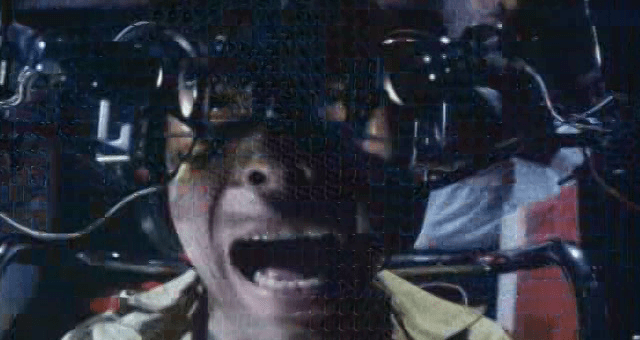

Ryu Murakami was already a prize-winning author who had successfully adapted his own novel for the screen when he began work on 1983’s It’s All Right, My Friend (だいじょうぶマイフレンド, Daijobu My Friend) yet he was perhaps an odd choice for the material. A big budget blockbuster produced by Toho, the film may have been intended to echo the kind of films Kadokawa was making with its teenage starlets and media mix strategy and like them is largely built around the title song performed by star Leona Hirota. But what might have worked as a countercultural piece of punk cinema if made on a shoestring by starving artists could not help but fail when blessed with the production values of a mainstream picture.
A case in point, the film stars Hollywood actor Peter Fonda as an alien, Gonzy, who has lost the ability to fly causing him to plummet into an outdoor swimming pool where the three heroes are hanging out. Fonda delivers all his lines in English, while everyone else replies in Japanese. Gonzy explains that he was raised in the US by a kindhearted scientist who taught him to speak (his first words were “Merry Christmas”) but longs to visit his home planet. Meanwhile, he’s being hunted by a mysterious fascistic group of misogynistic eugenicists who want his genes for their cloning programme which hopes to eliminate the need for human women to exist at all.
Doors have apparently already taken over factories, family restaurants, and psychiatric institutions such as the Tachibana Mental Hospital where they take heroes Monica (Yoshiyuki Noo) and Mimimi (Leona Hirota) and try to brainwash them to recognise a pigeon as an apple and aeroplane as a banana. They also drill into the brain of a young man they describe as a poor delinquent in order to turn him into an obedient drone, the implication being that they wish to turn mankind into a race of automatons and possibly resent women because they pose a threat to their plan. Then again, there is a distantly homoerotic quality to the relationships between the Doors, two of them later dying with clasped hands aside from all their strange musical numbers about how women are inferior and produce only substandard offspring.
Ryuichi Sakamoto is credited as a composer on the film and the Doors’ henchman appear to be closely styled to resemble Yellow Magic Orchestra, often mimicking their dance moves while otherwise faceless and anonymous behind their identical sunglasses and slicked back hair. Murakami signals his intentions in the opening scene in which Mimimi has a dream sequence in the manner of classic Hollywood musical. She dances with an American sailor against a backdrop that strongly recalls the noir cinema of the late 40s until a car full of gangsters turns up and shoots him with a machine gun leaving her kicking around on her own. Music becomes the device that can break through the Doors’ programming, the drones beginning to twitch to Monica’s Harmonica provoking a vision of dancers in gold lamé that finally ends in a mass disco of liberation from the authoritarian thought police that restores Gonzy’s ability to fly.
Even so, the reason he couldn’t was apparently his aversion to his personal kryptonite, tomatoes, whose voices he can hear whispering that they hate him and thereby suppressing his powers in reawakening memories of his childhood trauma along with his low self-esteem. To help him fly again, the gang engage in a series of crazy episodes including hang gliding in Saipan while Gonzy continues as an innocent with an incredibly vulgar sensibility eventually turning his “bazooka-like” ejaculate into a key weapon. There might be something in the echoing of an early ’80s anxiety about dangerous technology and weird techno-cults with shady motivations for their scientific endeavours though the irony is often buried under the swanky blockbuster production values and destabilising presence of Fonda who is quite literally in a different film from the rest of the cast by virtue of speaking his own language and being unable to understand what is going on. Even so, the film like the title song is essentially a kind of tribute to intercultural friendship in the bond that arises between the trio of aimless youths and the middle-aged space alien who’s trying to find his way home. Decidedly strange and defiantly surreal, Murakami’s weird countercultural blockbuster is a forgotten piece of 80s pulp but perhaps exposes something of the anxieties of a Japan heading towards the height of its prosperity and developing a fear of flying if not quite of tomatoes.
 Nobuhiko Obayashi may have started out as an experimental filmmaker and progressed to a lengthy narrative film career but he remains best known for his “what the hell am I watching?” cult classic Hausu. Aside from his 1983 take on The Girl Who Leapt Through Time, very little of his other work has travelled outside of Japan. In the case of 1987’s The Drifting Classroom (漂流教室, Hyoryu Kyoshitsu), this is doubly surprising firstly because it’s based on a hugely popular manga by the godfather of horror comics Kazuo Umezu and secondly because it’s set in an international school so around 80% of the dialogue is in English.
 Windows on Worlds