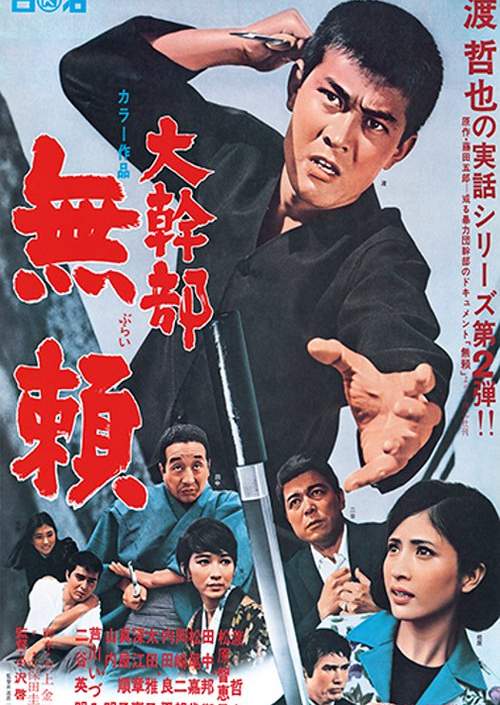
 So, as it turns out the end of Outlaw: Gangster VIP was not quite as final as it might have seemed. Outlaw Gangster VIP 2 (大幹部 無頼, Daikanbu Burai) picks up not long after the end of the first film when Goro (Tetsuya Watari), having recovered from his injuries, takes a train to go and find Yukiko (Chieko Matsubara) with the intention of starting an honest life with her away from the temptations of the big city. However, as often happens, his past follows him.
Like the first film, Outlaw: Gangster VIP 2 also begins with a black and white flashback sequence reminding us of Goro’s childhood only this time with a voice over from Goro himself who goes on to include the first film’s events in his recap. Goro might have come to the country to get away from the gangster life but as soon as he steps off the train he gets himself into trouble with a local gang by interfering with a few tough guys who are trying to entrap a group of actresses and force them into their employ. One of the leading actresses is just as taken with Goro as Yukiko was in the first film and gives him her red scarf as a thank you. Goro is still very much with Yukiko though and trudges off through the snow to find her.
She and Yumeko, Sugimoto’s former girlfriend, are living in a small hut but Yumeko has fallen ill and is refusing to see a doctor out of fear of the expense. Goro gets a legitimate logging job but before long the company hits trouble and he’s let go. All the while Yumeko’s condition is weakening and the three are in desperate need of money. One of the local gangsters Goro runs into trouble with turns out to be an old friend who offers him a job. Goro was hoping to leave the Yakuza world behind forever but it seems it isn’t finished with him yet…
In many ways this second instalment in the Outlaw: Gangster VIP series is very much more of the same as noble outlaw Goro battles the ever more cruel and corrupt forces of the Yakuza underworld in defence of women folk and underdogs everywhere. Directed this time by Keiichi Ozawa the film is disappointing only where it begins to feel like a rehash by following the familiar story beats of the first film with its betrayed underlings and treacherous bosses yet still manages to feel fresh and exciting for most of the running time.
The action this time around takes place in the vast snowy expanses of Northern Japan and has a much more open feeling overall with greater use of location shooting rather than the studio bound atmosphere of the first film. Ozawa follows Masuda’s lead but angles for a few expressive sequences of his own such as attempting to cut a flamenco dance sequence (starring a young Meiko Kaji acting under her original name) with a potential stand off and less successfully by playing a high school girl volleyball game against the final fight to the death which is going on in the waterway below.
The concept of home and having a home town is once again emphasised as a recurring motif where the desire for a normal life and family can get a man killed – the recurrent message being that a yakuza is a man without ties to the normal world. Such relationships are now denied him by his bond to his gangster brothers and will not only place in danger those you most love, but will ultimately lead to your own downfall too. Once again Goro wrestles with his desire to build a more normal life with Yukiko and the self knowledge that his yakuza past will never let him rest and perhaps the best thing for her is to make her go.
Outlaw: Gangster VIP 2 can’t quite match the power of the first film’s finale and often feels as if it’s retreading the same ground yet it is quite interesting ground to retread. Even if there weren’t another four films in the series, one gets the feeling that fate hasn’t finished toying with Goro yet and even if the yakuza world continues turning in the same ancient cycles of violence and revenge, Goro at least will be standing on the side of right, perpetually and ironically fighting in an attempt to put an end to it all for good.
Outlaw: Gangster VIP 2 is the second of six films included in Arrow films’ Outlaw: Gangster VIP The Complete Collection box set (which is region free on DVD and blu-ray and available from both US and UK).
English subtitled original theatrical trailer:
 Sogo (now Gakyruu) Ishii was only 20 years old when Nikkatsu commissioned him to turn his smash hit 8mm short into a full scale studio picture. Perhaps that’s why they partnered him with one of their steadiest hands in Yukihiro Sawada as a co-director though the youthful punk attitude that would become Ishii’s signature is very much in evidence here despite the otherwise mainstream studio production. That said, Nikkatsu in this period was a far less sophisticated operation than it had been a decade before and, surprisingly, Panic High School (高校大パニック, Koukou Dai Panic) neatly avoids the kind of exploitative schlock that its title might suggest.
 Windows on Worlds