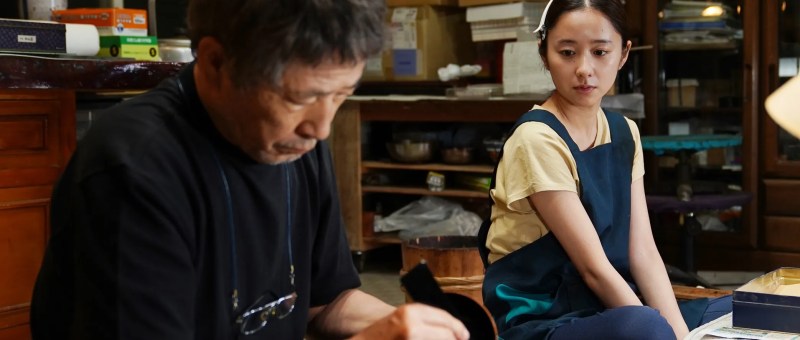

Tsugaru Lacquer Girl (バカ塗りの娘, Keiko Tsuruoka, 2023)

Which traditions should we keep and which should we lose? A young woman finds herself frustrated by outdated gender norms in her desire to take over the family lacquerware business in Keiko Tsuruoka’s gentle rural drama, Tsugaru Lacquer Girl (バカ塗りの娘, Bakanuri no Musume). While her family, save older brother Yu (Ryota Bando) who has already rejected lacquerware, do nothing but run her down and claim she’ll never be a success at anything all she wants to do is devote her life to a traditional craft her father no longer believes has any kind of future. 

Even so, Seishiro (Kaoru Kobayashi) is dead set on Yu taking over the business to the point that they have become semi-estranged. He calls Miyako (Mayu Hotta) “clumsy” and complains that she has no aptitude for anything unlike Yu who was always good at anything he tried. Miyako too later suggests that she was her brother’s opposite, while he was cheerful and outgoing she is shy and melancholy but then perhaps it’s hard to be cheerful when everyone’s always telling you you’re useless and doing everything wrong. In an interesting parallel, Yu is also trapped by outdated social codes in that he is gay and he and his partner have decided to move to London where they can legally get married and live their life out and proud in a way they feel they cannot do in contemporary Japan. 

Lacking other direction in her life, Miyako has been working a part-time job in a local supermarket which she hates while her father occasionally allows her to help him finish big orders though it’s clear her salary is now their main source of financial support. A local inn keeper who is a good customer of theirs explains to some of his guests that craftsmen rarely construct large pieces such as tables because they are no longer cost effective while fewer young people are willing to take up apprenticeships leaving the traditional art in danger of dying out despite the frequent remarks that everything tastes better out of a lacquerware bowl which is after all in the modern parlance “sustainable” in that it will last for many decades and can easily be repaired if damaged. 

Seishiro doesn’t seem to have a reason for rejecting the idea that Miyako might take over aside from basic sexism in preferring to hand the business over to his first born son. It might be tempting to think that he dissuades her because he thinks there isn’t a future in lacquerware, but if that were the case he could simply retire. Her mother (Reiko Kataoka), who left the family some years ago in part it seems because of her own animosity towards lacquerware and its lack of financial promise, seems to feel much the same comparing Miyako to a more successful cousin who has kids and a high powered job at an international trading firm, telling her that she should be settling down and getting married suggesting that she is simply incapable of becoming a successful lacquerware artist and should at best keep it as a hobby. 

Her mother had also shut down her desire to learn piano as a child by telling her there was no point because she’d never be good at it. Miyako’s decision to prove herself by re-laquering an abandoned piano in her disused school is then an act of rebellion against both parents showing them what she can and will achieve along with the direction she has chosen for her life. Not everyone respects it even if her father begins to come around but really it doesn’t matter because the decision is hers alone whatever anyone else might have said. Far from being insular, the embrace of traditional culture gives Miyako new opportunities and allows her to grow in confidence until she’s finally ready to set off along her own path. Even so, it seems there are some traditions she thinks it would be better to lose, such as her father’s sexism and the homophobia that has forced her brother to emigrate in order to live a happy life just as he is. They call it “fools lacquer” because no one but a fool would go to all this trouble to make a bowl but in many ways that’s the point. Miyako pours all of herself in to the lacquer, piling layer on layer dotted by handfuls of thrown rice that give it its pattern much as she herself is slowly tempered by the world around her.


Tsugaru Lacquer Girl screened as part of this year’s Camera Japan.

Original trailer (English subtitles)

Fukushima 50 (フクシマ50, Setsuro Wakamatsu, 2020)

The “Fukushima 50” (フクシマ50), as the film points out, was a term coined by the international media to refer to the men and women who stayed behind to deal with the unfolding nuclear crisis at the Fukushima Daiichi Nuclear Power Plant. Loosely inspired by Ryusho Kadota’s non-fiction book On the Brink: The Inside Story of Fukushima Daiichi which featured extensive interviews with those connected to the incident, Setsuro Wakamatsu’s high production value film adaptation arrived to mark the ninth anniversary of the devastating earthquake and tsunami which occurred on 11th March, 2011 and closes with a poignant callback to the plant’s role in Japan’s post-war reconstruction as the nation once again prepares to host the (now postponed) Olympics with a torch relay beginning at Fukushima as a beacon of hope as the country continues to rebuild in the wake of the disaster. 

Though inspired by real events Wakamatsu’s dramatisation is heavily fictionalised and while surprisingly frank for a mainstream film in its criticism of the official reaction to the disaster, is also quietly nationalistic while doing its best to pay tribute to the selfless sacrifice of the plant workers who stayed behind to do what they could many of whom had little expectation of surviving. Chief among them would be Izaki (Koichi Sato), an imperfect family man and veteran section chief, and the plant’s superintendent Yoshida (Ken Watanabe) who are both local men and old friends. Local, it seems, is later key with multiple appeals to the furusato spirit as each is at pains to point out that they stay not only to prevent a catastrophic meltdown that would leave most of central Honshu including Tokyo uninhabitable, but because they feel a greater duty to protect their hometown and the people in it. 

Meanwhile, they find themselves burdened rather than assisted by official support as government bodies’ political decision making undermines their attempts to avert disaster while the boardroom of TEPCO who operate the plant reacts with business concerns in mind. A few hours in the prime minister (Shiro Sano) decides to make a visit, in political terms he can’t not national leaders who don’t visit sites of crisis are never forgiven, but his presence actively hinders the recovery efforts. Referred to only as the PM, Wakamatsu’s film presents the man leading the nation as an ignorant bully overly obsessed with his personal image. He has little understanding of nuclear matters or the implications of the disaster, refuses to abide by the regular safety procedures required at the plant, and mostly governs through shouting. Beginning to lose his temper, Yoshida does his best to remain calm but resents the constant interference from those sitting in their offices far away from immediate danger while he does his best to contend with the increasingly adverse conditions on the ground, mindful of his responsibilities firstly to his employees and secondly to those living in the immediate vicinity of the plant who will be most at risk when measures taken to prevent meltdown will lead to an inevitable radiation leak. 

Yoshida’s hero moment comes when he ignores a direct order from the government to stop using seawater to cool the reactors, knowing that he has no other remaining options. Meanwhile, the government refuse offers of help from the Americans, who eventually make a strangely heroic arrival with Operation Tomodachi, discussing plans to move their families to safety while their commander reflects on his post-war childhood on a military base near the site of the nuclear plant. Japan’s SDF also gets an especial nod, granted permission to leave by Yoshida who is beginning to think he’s running out of time but vowing to stay and do their duty in protecting civilians in need. 

In essence, the drama lies in how they coped rather than the various ways in which they didn’t. The conclusion is that the existence of the plant was in itself hubristic, they are paying the price for “underestimating the power of nature” in failing to calculate that such a devastating tsunami was possible. They thought they were safe, but they weren’t. Perhaps uncomfortably, Wakamatsu mimics the imagery of the atomic bomb to imagine a nuclear fallout in Tokyo, harking back to ironic signage which simultaneously declares that the energy of the future is atomic while the plant workers reflect on the sense of wonder they felt as young people blinded by science back in the more hopeful ‘70s as the nation pushed its way towards economic prosperity. Frank for a mainstream film but then again perhaps not frank enough, Fukushima 50 is both an urgent anti-nuclear plea and an earnest thank you letter to those who stayed when all looked hopeless, suggesting that if the sakura still bloom in Fukushima it is because of the sacrifices they made.


Fukushima 50 is available to stream in the US until July 30 as part of this year’s Japan Cuts.

International trailer (English subtitles)

Masquerade Hotel (マスカレード・ホテル, Masayuki Suzuki, 2019)

The thing about hotels is, people often go to them when they want to be someone else, so how can you be on the look out for suspicious behaviour when everyone is to some degree acting out of character? Keigo Higashino is one of Japan’s best known authors particularly praised for his elaborately plotted mysteries. In contrast to some of his famous detective novels, Masquerade Hotel (マスカレード・ホテル) leans into his softer side, taking its cues from Agatha Christie in its ultimately cheerful exploration of the strange world of hotels while praising the detective acumen both of cynical policemen and eager to please hoteliers. 

The police are hot on the trail of a serial killer and, due to clues found at the previous crime scenes, have concluded the next killing will take place at the Hotel Cotesia Tokyo. To scout out the potential crime scene, the detectives have co-opted the hotel’s basement as an incident room and are preparing to go undercover to keep an eye on things upstairs. Dishevelled detective Nitta (Takuya Kimura) has been assigned to the front desk because of his English skills apparently honed while living abroad in his youth, and is to be paired with earnest hotelier Naomi Yamagishi (Masami Nagasawa) who will do her best to turn him into a first rate hotelman. 

As might be expected, Nitta and Naomi do not exactly hit it off. Gruff and given to giving everyone in 50m radius the hard stare, Nitta is a shaggy haired middle-aged man in creased suits and shiny shoes. The first thing Naomi makes him do is get a haircut which does wonders for his image, but also plays into the peculiar art of masquerade which defines hotel life. Nitta is in the habit of calling the guests “customers” which instantly irritates Naomi who has spent the entirety of her professional life learning to be deferent. She reminds him that in here the guests are in charge, they make the rules and therefore can never break them. Her job is to provide the best service, which means she often has to set her personal pride aside and allow the sometimes unpleasant clientele, the ones who like to come to posh hotels to throw their weight around and abuse the staff, to get away with being obtuse because that’s just part of her job. 

That’s a big ask from Nitta who is both a proud man and a justice loving policeman to whom the idea of letting people act badly is almost anathema. To do his job, however, he’ll have to learn to bear it or risk letting a potential serial killer slip through his fingers. What Naomi realises is that they’re more alike than they first seemed. Both of their jobs rely on an astute assessment of their targets, even if they come at it from opposite ends. Naomi knows that each of her guests is wearing a kind of mask, taking on a slightly different persona when they enter her hotel, but her job is to see past it without ever letting on. A good hotelier knows what the guest wants before they do and is always ready to provide it, that’s the nature of service. So Naomi trusts her guests and is careful not to judge them. Nitta, meanwhile, is a policeman so he’s trained to question everything and suspect everyone. His job is to unmask and confront his suspects with who they really are. 

They both, however got into this game essentially because they want to protect people even if she wants to protect them inside and he out. Which means of course that they can work together after all, learning a little something from each other along the way. Naomi, well versed in the liberties often taken by her guests, is nearly taken in by an obvious scam that only Nitta is quick enough to catch thanks to his cynical policeman’s logic. He’s also first to suspect that there’s something not quite right with a harmless little old lady, and though Naomi senses it too she’s minded to let it go and doubles down on being the perfect servant thanks to her animosity towards Nitta. That “not quite right”, however, proves to be a slight misreading of the guest who, like many Nitta encounters, is pretending to be something they’re not for reasons that prove perfectly understandable once revealed. 

But then, Higashino characteristically pulls the rug out from under us and asks if we haven’t been suckered in buying all those reasonable excuses. Thanks to his conversations with Naomi, Nitta begins to get a grip on the crime, while she struggles with her conscience after learning that her guests may be in much more danger than she thought. Staking all on justice, the pair of them vow to abandon their respective professions if a guest gets hurt, but fail to realise that the crime may hit far closer to home than they’d anticipated. Nevertheless, what we’re left with is a strangely whimsical admiration for the weird world of hotels where no one is quite the same person they were before they walked through the revolving doors.


Original trailer (no subtitles)