Shintoho had arisen as a new studio during the labour disputes that engulfed the film industry in the late 1940s and to begin with specialised in artistic fare by orphaned filmmakers such as Kon Ichikawa and Kenji Mizoguchi, but faced with several box office failures it was in red right from the very beginning. After several attempts at relaunches and reorganisations, the studio appointed Mitsugu Okura to work his magic. The owner of a chain of cinemas and a former benshi, Okura had a reputation for being able to turn failing businesses around. His ethos was, however, decidedly populist. He shifted the studio’s focus from artistic films towards the low-budget genre fare with which it became most closely associated such as racy dramas and ghost films.
To that extent, you could say that Shintoho was ahead of its time. Most of the other studios would shift in the same direction as the studio system went into decline, and many of the stars at Toei in the 1960s such as Bunta Sugawara, Tetsuro Tamba, and Tomisaburo Wakayama had their start at Shintoho. Michiyoshi Doi was one of the studio’s key directors, though he often worked on its higher-bow output of literary adaptations. All of which might help to explain the seeming mismatch between the salacious Japanese title of 1958’s Impure Nuns, “Holy Women with Sullied Flesh” (汚れた肉体聖女, Kegareta Nikutai Shojo), and its content, which turns out to be a rather sensitive, sympathetic love story set in a Catholic Convent.
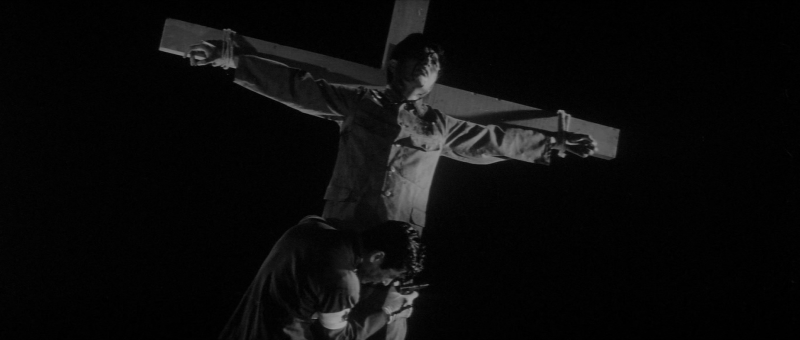
Eri (Miyuki Takakura) is the daughter of the aristocratic Taira family which apparently has a long history of Christianity. She is particularly devout and shortly after we meet her, she genuflects in front of a statue of the Virgin Mary. Throughout the film the welcoming arms of Mary seem to be contrasted with violent images of Christ on the cross, a presence that seeks to oppress the women in the free embrace of their desire. While her brother’s friend, Tsuyama (Toshio Mimura), is visiting, Eri suggests going into town to get something, but her mother is against it due to reports of some kind of “trouble” plaguing the streets. Tsuyama offers to accompany her, and they are actually beset by a gang of street toughs intent on raping Eri. Tsuyama does his best to fight them off until a policeman eventually arrives and chases them away. But then he ends up raping Eri himself, after which she becomes pregnant and undergoes an abortion at the urging of her parents.
While her father is scandalised and angry, Eri’s mother is sympathetic, but still each of them decide that the best thing to do is send Eri to a nunnery where she can be reborn in Christ. Due to her experiences, Eri seems to have developed a fear of men, but is also known as the strictest and most severe of the nuns. As the captivating Anna (Mayumi Ozora) enters the convent, another woman is being kicked out apparently by Eri for an undisclosed indiscretion with another woman. The mild implication is that Eri’s frustrated sexual desires have been channelled into authoritarianism in the insistence on discipline and punishing its breaches. It may be this that first attracts Anna who, to begin with, seems to be trying to initiate a sadomasochistic relationship by continually doing things to get Eri to punish her, such as singing while working which is, contrary to expectations, considered very bad form for a nun.
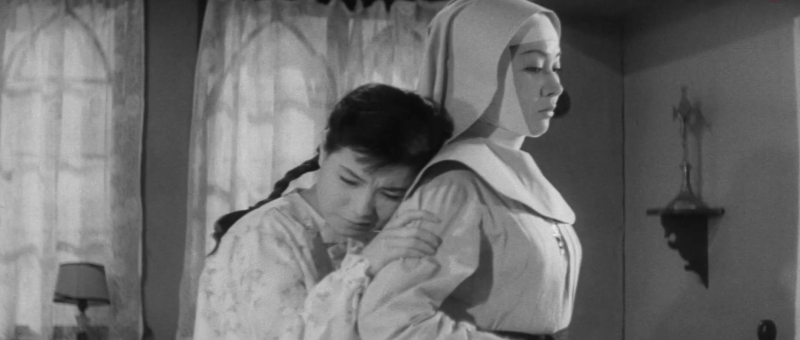
Anna is, however, hardly a typical bride of Christ and is forever dancing and being cheerful. Her influence seems to break Eri out of her asceticism, as she too begins to ignore the rules and become more of herself again. After the convent bizarrely agrees to organise a dance, Eri gives in to her desire for Anna and the two fall in love, sharing a passionate kiss. But Sister Kashiwagi (Junko Uozumi) is watching, not so much because of the scandalous nature of their relationship, but because they are rivals for a coveted opportunity to study abroad in Rome with Eri currently the front runner. The trip to Rome is positioned as the antithesis of Eri’s freedom in her relationship with Anna as a symbol of repression in committing herself to religion.
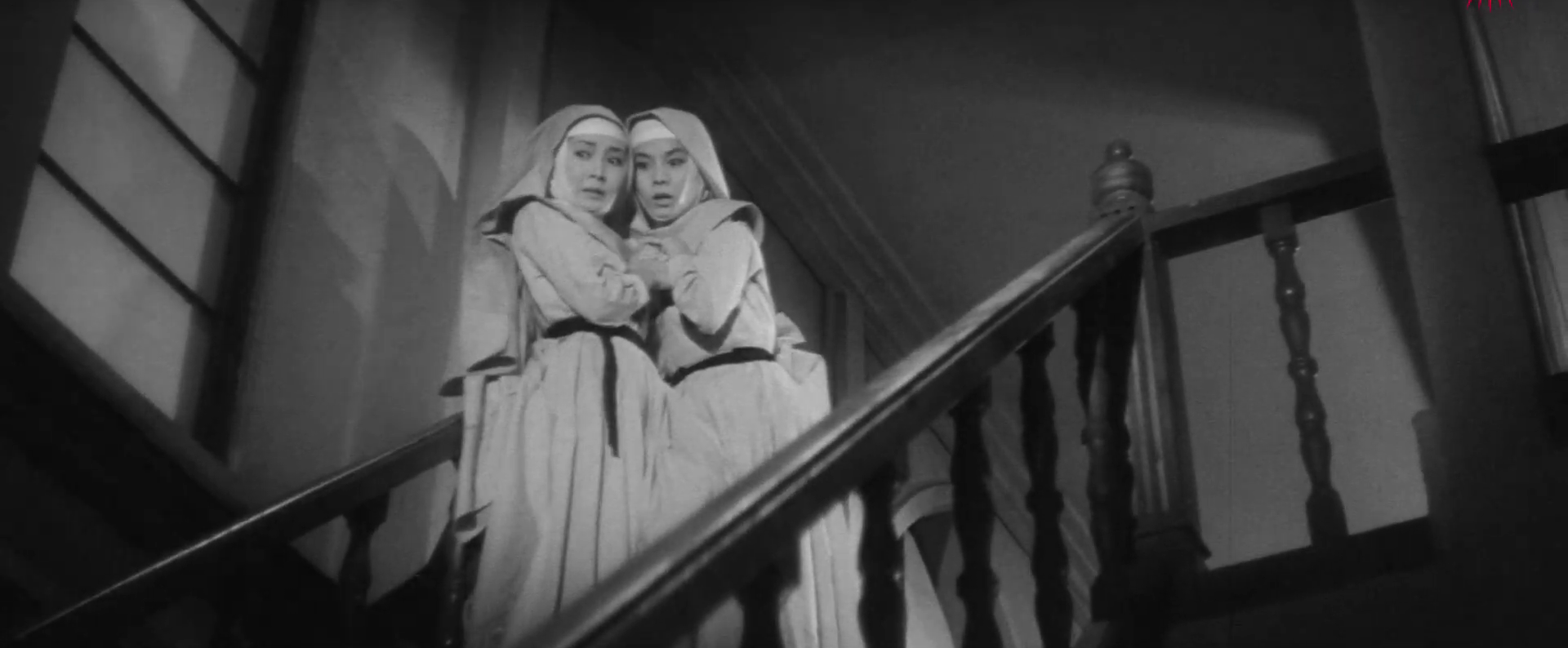
But Anna also disrupts the convent as she becomes the centre of a love triangle, while another nun later declares her love for Eri, only to be rebuffed. Sister Kashiwagi is killed by falling down the stairs while physically fighting over Anna, whose affections sometimes seem to wander, while Sister Sone similarly falls in a bottomless swamp that seems to stand in for obsessive desire. The love between the two women begins to amass a body count as they struggle to maintain it. Though it might seem as if the arrival of male policemen might further disrupt the convent, they simply declare their work done when Anna tells them she was asleep when her roommate left and didn’t see anything. But for her part, Anna has already described herself as cursed, abruptly revealing that her mother killed her father and then herself and that everyone in her family meets a bad end. Even her brother (Shuntaro Emi), who turns out to be a rapist and eventually takes his own life, describes her as a kind of demon that ruins everyone around her, and there is something of that in the way that she seems to attract so much attention at the convent.
Yet even when the script seems to want to paint this same-sex love as something dark or evil, Doi resists the impulse and largely depicts the relationship between the two women as something real and true that has beauty and delicacy. There’s something poignant in Eri’s final plea to run away together, and Anna’s reply that there isn’t any point because there’s nowhere they could go where they could live happily together. It’s Anna who now seems unable to break free of the convent, unexpectedly turning on Eri and going back to her bell ringing. The bell may represent a kind of order, but it’s also ironically reminiscent of the original Shintoho logo. In any case when they eventually fall from the tower, the other nuns arrive with flowers and encircle them with sorrow as if in recognition that it wasn’t the love that was a tragedy, but its impossibility. Though its frankness may have shocked audiences at the time, the film avoids the exploitative content suggested by the title, featuring little nudity beyond a silhouette of bared breasts, and embraces overt melodrama, a touch of gothic horror, and the beauty of this love rather attempt to censure or constrain it.
Impure Nuns screened as part of this year’s BFI Flare.
Original trailer (no subtitles)

 Windows on Worlds