Ghost Stories of Wanderer at Honjo (怪談本所七不思議, Goro Kadono, 1957)

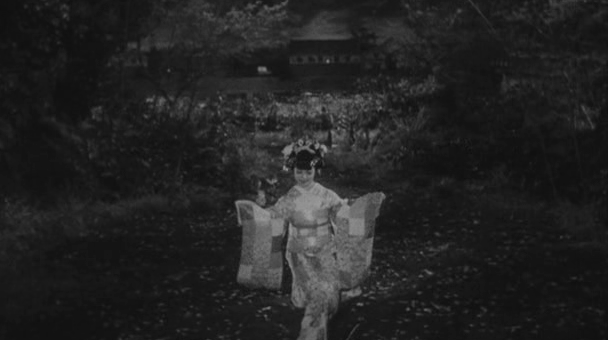
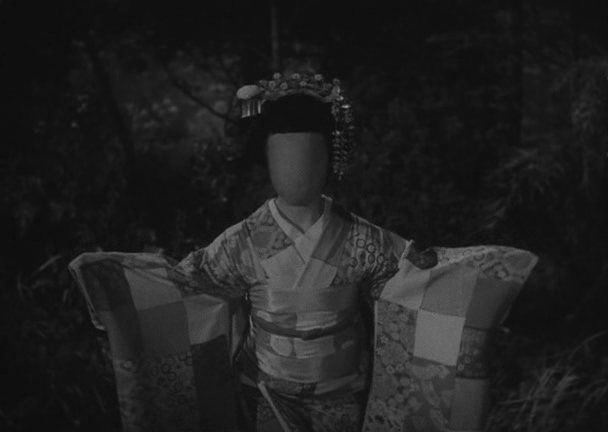
Ghost Stories of Wanderer at Honjo (怪談本所七不思議, Kaidan Nana Fushigi) seems to have become mistitled somewhere along the line seeing as the Japanese is something more like The Seven Wonders of Honjo, an area of Tokyo that had a reputation for gloominess during the Edo era. The “seven wonders” are a collective name for a series of local ghost stories, of which there may actually be more than seven, which were popular fare for rakugo tales and other forms of storytelling. Though the film opens with a brief rundown of the seven wonders which it weaves into the tale, it is more of a revenge drama that throws in the appearance of popular yokai such as Rokurokubi, Kasa-obake, and Hitotsume-kozo.

The yokai emerge to scare a pair of fishermen who were about to ignore a ghostly voice telling them to leave the fish they’d just caught in the river behind, but what the fishermen really seem to object to is the presence of a tanuki who makes a habit of tricking the local people. After becoming fed up with them, the locals hunt down the tanuki and are about to turn it into soup when a wealthy nobleman, Komiyama (Hiroshi Hayashi), arrives and buys the tanuki from them which he then frees. Komiyama tells the tanuki to stop bothering the villagers in return and continues home after marking the anniversary of his wife’s passing and the departure of his son who is going out into the world.

The tanuki later appears in the form of a beautiful young woman to tell Komiyama that she is grateful for his saving her life and will always protect him. Unfortunately, however, Komiyama gets into trouble on the night of a tanuki ritual, so she doesn’t make it in time to save him from a dastardly plot by his disinherited nephew to murder him for his money. She can, however, help his son Yumenosuke (Juzaburo Akechi) exact revenge and put a stop to the amoral Gonkuro’s (regular Shintoho villain Shigeru Amachi) reign of terror.

As in many tales like these, it’s Gonkuro who is real terror threatening chaos in the ordered Edo society while being unable to conform to his proper role in life. Before the film begins, Komiya has already disowned his nephew for being a wastrel. Gonkuro says that he’s come to pay his respects to his late aunt, but Komiyama suspects he’s after money again which he’ll spend on drink, women, and gambling. There is a direct contrast being drawn between the good son Yumenosuke and Gonkuro, though it’s Yumenosuke who apparently becomes seriously ill while on his travels preventing his speedy return until his desire for revenge enables him to overcome his illness. 

Meanwhile, Komiyama has recently married again to a younger woman, Sawa (Akiko Yamashita), who turns out to be a former lover of Gonkuro’s. Though she at first resists, she’s bullied into resuming a sexual relationship with him which she then carries on enthusiastically. She and Gonkuro seem to be symbols of the evils of the age in their lack of properness and humanity. Not only does Sawa cheat on her husband, but even goes along with Gonkuro’s murder plot to kill him and inherit his money.

Though the tanuki fails to save Komiyama and is generally depicted as an untrustworthy trickster, it is a kind of guardian of these virtues in standing behind Yumenosuke as a source of righteousness. Komiyama’s act of kindness will eventually be repaid, while Gonkuro’s attempt to triumph over the moral order represented by Komiyama will be denied. Having dispatched Komiyama, Gonkuro occupies an awkward class status as a usurping lord and even tries to rape Yumenosuke’s betrothed Yae during an expressionist storm as a means of asserting his triumph over his cousin. Sawa meanwhile does something similar by flirting with and then potentially entering a sexual relationship with their servant Gosuke (Saburo Sawai) in full contravention of the social order. Their attempts to get rid of the tanuki by praying her away are a means of reasserting control and dissolving the rules of human morality that they feel constrain them.

In that sense, the tanuki and yokai are not particularly frightening but a constant presence that enforces a moral order defined by humanity and compassion. The two fishermen are only spooked because they ignore the disembodied voice telling them to leave the fish, not because they heard it in the first place. The tanuki, meanwhile, are mainly seen dancing as part of their ritual rendered as ghostly figures not quite of this world. They appear not to do anything that could be considered more than irritating even when messing with locals and definitely don’t deserve to get made into soup. The message seems to be that being good and kind might not save you personally, but it will eventually pay off, and is after all, the right thing to do as man can only thrive when living in harmony with nature and the supernatural world rather than attempting to transcend it through immorality like the selfish and thoughtless Gonkuro.

The Military Policeman and the Dismembered Beauty (憲兵とバラバラ死美人, Kyotaro Namiki, 1957)

The Military Policeman and the Dismembered Beauty (憲兵とバラバラ死美人, Kenpei to Barabara Shibijin) was apparently a substantial hit on its release, though to modern eyes at least it doesn’t quite live up to the salaciousness of its title. In fact, it seems a little more interested in reassessing the militarist past while attempting to rehabilitate an authoritarian power and reframing it as good and compassionate unlike the corrupted killer who is selfish and ambitious to the extent that he’s literally poisoning the militarist wells. 

What we’re first introduced to, however, is a rather familiar tale of a soldier who’s gotten a girl pregnant but now won’t marry her mainly because he’s onto a good thing with a pretty girl from a prominent family so his girlfriend’s in the way. Though we see a prelude to the murder, we don’t get good a look at the soldier’s face (though we do hear his voice) which on one level hints at the generalised violent threat of the militarist machine but is also a neat plot device that allows us to into the crime but still maintains the mystery. When we do see the actual killing, it’s surprisingly frank for the time period and disturbing in its sexual charge though there is no gore involved save a grisly discovery in yet another well. 

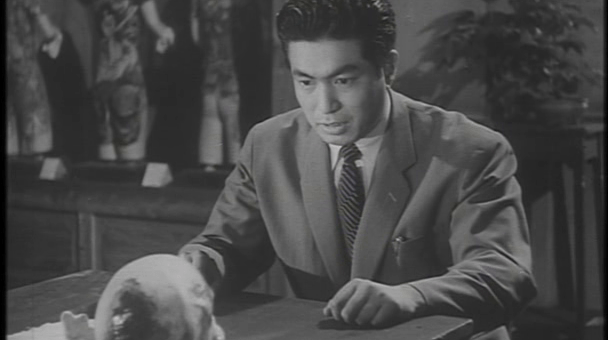
The killing occurred shortly before the regiment left for Manchuria, which seems to be one way the killer sought to move on and leave his crime behind. The first hint of the corruption is discovered by a gang of new recruits as yet unused to the militarist machine. They notice that the water in the well in the barracks is bad, but are at first bullied and insulted by another soldier who’s been there longer and gives them a rather priggish speech about the sanctity of the regimental water. What they discover is that the water tastes bad because there’s a dismembered torso in there and has been for the last six months. One has to wonder why the culprit would think this a good place to hide a body given the risk of discovery and increasing suspicion but as it turns out no one is all that interested. The Military Police aren’t that keen on investigating themselves, and then we get the familiar conflict between the local cops and the specialists as a top investigator, Kosaka (Shoji Nakayama), is assigned to investigate the crime and insists on doing so thoroughly rather than just beating their favourite subject into a false confession. 

Kosaka is then posited as a nice Military Policeman, an emissary of legitimate authority rather than bumbling provincials who are ridiculous and self-serving not to mention incompetent and resentful. We’re told repeatedly that Kosaka is prepared to work with the civilian police unlike the other military policemen who insist on militarist primacy and refuse to allow the detectives onto the base to investigate. He’s a representative of a less authoritarian age that looks forward to the democratic future, but he is also a part of that organisation himself no matter how different he may seem to be and cannot escape the overarching structures of militarism. Nevertheless, his edges are further softened by a nascent romance with the middle-aged innkeeper at his lodging house while his assistant is after her sister, a childhood friend who can’t stop calling him by his old nickname. 

The two of them investigate scientifically, making frequent trips to the pathologist to discuss theories and evidence though Kosaka is eventually guided towards the solution after seeing the young woman’s ghost. The local military police meanwhile fixate on another soldier who has a reputation for using sex workers, one of whom has recently disappeared, though Kosaka thinks the man is a just a crook with what modern viewers make think of as a sex addition that sees him steal supplies from the kitchen to sell in order to finance his visits to the red light district. The military police whip him in an oddly sexually charged manner to try to get him to confess, but he maintains his innocence. One of the motives for the murder was seemingly that the victim planned to expose the affair, taking her concerns to the killer’s superior officer in an effort to force him to marry her which would have ruined his career prospects in what is supposed to be an organisation of honourable men. Unlike Kosaka who shares his name with the writer of the novel the film is based on which may have been inspired by true events, the other military police are largely like the killer, arrogant, selfish and unfeeling though all Kosaka himself represents is a supposedly more benevolent authority that for his niceness may not actually be all that much nicer.


3 Seconds Before Explosion (爆破3秒前, Motomu Ida, 1967)

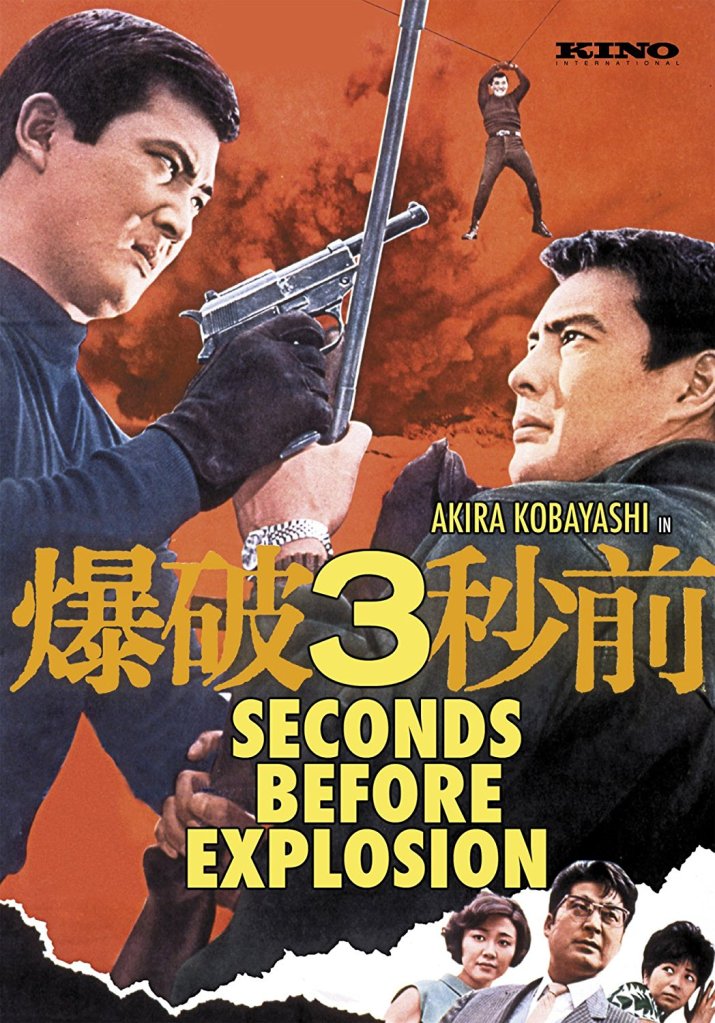
three-minutes-before-explosionIf Nikkatsu Action movies had a ringtone it would probably just be “BANG!” but nevertheless you’ll have to wait more than three rings for the Kaboom! in the admittedly cartoonish slice of typically frivolous B-movie thrills that is 3 Seconds Before Explosion (爆破3秒前, Bakuha 3-byo Mae). Once again based on a novel by Japan’s master of the hard boiled Haruhiko Oyabu, 3 Seconds Before Explosion is among his sillier works though lesser known director Motomu Ida never takes as much delight in making mischief as his studio mate Seijun Suzuki. What he does do is make use of Diamond Guy Akira Kobayashi’s boyish earnestness to keep things running along nicely even if he’s out of the picture for much of the action.

Like most of the more outlandish Nikkatsu action fests, 3 Seconds Before Explosion has a complicated relationship with narrative but we begin with former boxer Yabuki (Akira Kobayashi) in the middle of being brainwashed with flashing lights and high pitched noises until he agrees to become a shady government (?) assassin. Perhaps in an effort to save our sanities too, he relents and his first job is ensuring some jewels which were stolen during in the war don’t get into the hands of an evil nazi who will presumably be wanting them for evil nazi business. Anyway, Yabuki does his ninja stuff and thinks he’s tracked the jewels down but runs into a former colleague, Yamawaki (Hideki Takahashi), who is working for a businessman who already has the jewels and wants to keep them. Yamawaki quit being a super spy because he fell in love, which Yabuki thinks is a bit lame but still knows his friend has right stuff and would rather not have to kill him or anything.

Somewhere between the less serious yakuza/gang movies Nikkatsu were making in the late ’60s and a spy spoof, 3 Seconds Before Explosion has its fair share of oddness from strangled dogs to the mini Chinese theme in which one of the henchmen, Yang, wanders around in traditional Chinese garb while another girl at the club enjoys flirting in Mandarin for no apparent reason. It also goes without saying that the evil Nazi is played by an American spouting unconvincing German whilst chewing the scenery to a pulp. Realism is not where we are, but there’s something a little old fashioned about the way Ida chooses to stage his weirdness even if the film is filled with crazy contemporary youth touches such as in the achingly hip Club Casba.

The interpersonal drama comes as Yabuki and Yamawaki face off about their life choices much more than the case at hand. Yamawaki grew tired of the spy life and decided to leave it behind for his lady love, only to get mixed up in all of these petty gangster shenanigans. Still, if he can keep Yabuki away from the jewels until the time limit he’ll be free forever. Nothing is really said about Yabuki’s brainwashing at the beginning of the film, but Yamawaki’s choice does seem to prompt him into a consideration of his own lifestyle. That said, life as a government assassin doesn’t seem so bad – Yabuki doesn’t even really kill people much, just spends his life sneaking into places and leaping heroically between rooftops whilst making use of clever gadgets to evade his foes. The gangsters, however, are pretty evil and keep killing people after claiming to let them go which offends Yabuki’s sense of honour.

Yabuki may not kill, but the film does seem to make a point of killing off all the female characters in case they get in the way of the manly stuff like fighting and making bombs. An innocent kidnapped secretary who had nothing to do with anything is machine gunned down, another girl is murdered by the evil Nazi, and a final one gets marched into a mine field by her boyfriend before returning for revenge and getting unceremoniously taken down anyway. To lose one woman is careless but to kill off (all) three in a short time seems a step too far or perhaps too “realistic” for this otherwise cartoonish approach to violence.

Lacking the visual flair of other Nikkatsu efforts, 3 Seconds to Explosion is never as exciting as its title promises. Despite the athletic displays of the slightly bulkier Kobayashi, there’s a kind of clumsiness to the action and a straightforwardness in approach which does not gel with the ridiculousness of the premise. On lower end of Nikkatsu’s B-movie output, 3 Seconds to Explosion does not stint on the silliness but could do with enjoying itself a little more rather than trying to corral its non-sensical plot into something with serious intent.