The Ghost Cat of Otama Pond (怪猫 お玉が池, Yoshihiro Ishikawa, 1960)

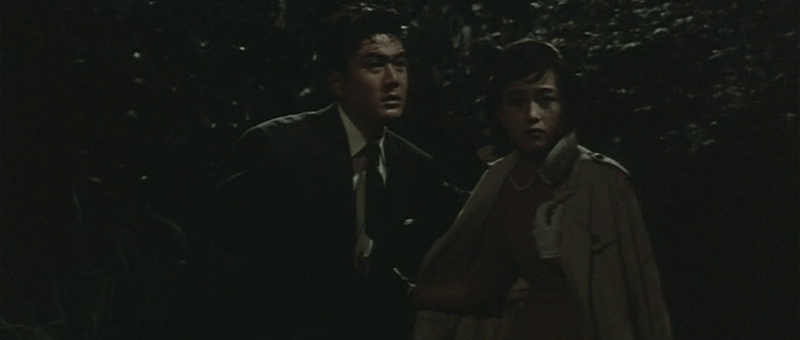
Ghost cat films can often be about the ways in which the unresolved past continues to echo in the modern era. The curse is not lifted by vanquishing the evil spirit, but only by coming to an accommodation with and making recompense for wrongdoing in the distant past. This is especially the case when the film involves bookending sequences set in the modern day as in Yoshihiro Ishikawa’s Ghost Cat of Otama Pond (怪猫 お玉が池, Kaibyo Otama-ga-ike) in which a young couple accidentally become trapped within the orbit of a vengeful spirit after stopping off on their journey to get their parents’ approval for their marriage.

To that extent, the fact that they keep walking in circles and always end up back at the lake might hint at their mutual sense of anxiety about their decision to marry. “What will marriage be like if you’re like this now?” Tadahiko (Shozaburo Date) asks in exasperation, accusing Keiko (Noriko Kitazawa) of being “difficult” as she blames him for the decision to come to the lake in the first place and insists she’s too tired to continue walking. Their relationship is further strained by the lingering possibility that the parents may object to the marriage and that arriving late for their visit might not help their chances.

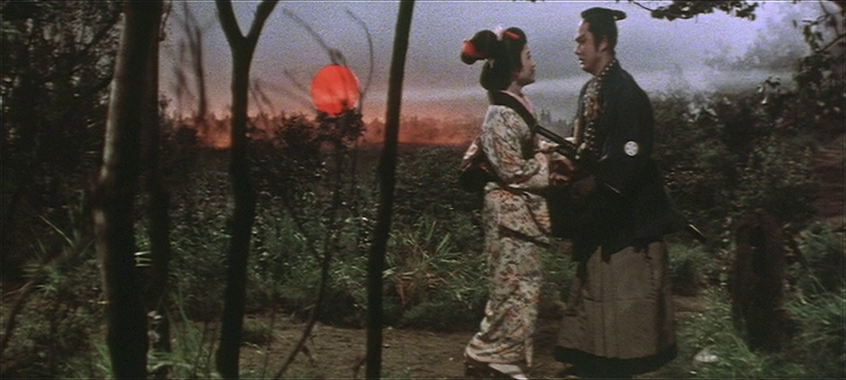
Their situation is mirrored in the circumstances that led to the creation of the ghost cat as related to Tadahiko by a local priest whom he consults after Keiko falls into a coma near the ruined house where they take shelter. Long ago, their ancestors Yochimaru (Shozaburo Date) and Kozasa (Noriko Kitazawa) were in love and wanted to marry, but their families were sworn enemies who strongly opposed the union. When Yachimaru was sent to serve in the capital swearing to call for Kozasa once he’d established himself, her villainous father Gensai (Yoichi Numata) moved against Yachimaru’s father Shinbei (Akira Nakamura) who had been attempting to protest the unreasonable taxes levied against local peasants who were on the verge of causing unrest. Consequently, they killed him and dumped his body in the pond. Shinbei’s beloved cat Tama drank some of his blood and became a ghost cat hellbent on avenging its master.

Tama is quite a popular name for a cat, but in this case it seems to be that it got its name from the lake where it was found which hints at a deeper origin story for this vengeful spirit. Unlike that in other similar films, it seems to have the power to manipulate people physically, at least to a degree, and also to pull them into an alternate reality as happens to Keiko during her coma when she is transported back to the Edo era before the house fell into ruins. It also seems to collect and unify various desires for vengeance though all against Gensai and his allies including the corrupt magistrate and entitled son Gorota (Hiroshi Shinguji). Though it originates with the death of Shinbei, the ghost cat later mainly takes the form of Kozasa after she drowns herself in the pond having been bewitched and seen the ghost of Yachimaru. 

In the end, this curse is only resolvable through the relationship between Keiko and Tadahiko. The ghost cat is vanquished by natural forces putting an end to the curse and releasing Keiko from her coma. After undergoing this experience, they are able to find their way back from the lake as Tadahiko resolves that they will still get married no matter what their parents say in direct contrast with Yachimaru and Kozasa who were constrained by samurai mores and unable to defy their families. In the modern era, they are free to live in the city and do as they please without needing to pay much attention to these outdated rituals, and so the ghost cat’s curse is no longer necessary as the rift is healed with their union just as if Yachimaru and Kozasa were finally united. Ishikawa conjures a suitably gothic, eerie atmosphere around the misty lake achieving ghost effects mainly through lighting in which they take on a familiar greenish hue. Away from the lake, however, it becomes more difficult to tell who is a ghost and who alive, while the ghost cat manipulates those that have wronged it into harming those they love and by extension themselves until finally laid to rest by a new generation resolving to leave the past behind.


Trailer (no subtitles)
Ghost in the Regiment (憲兵と幽霊, Nobuo Nakagawa, 1958)

A treacherous military police officer comes to embody the evils of war in Nobuo Nakagawa’s eerie psychological horror, Ghost in the Regiment (憲兵と幽霊, Kenpei to Yurei). Kyotaro Namiki’s The Military Policeman and the Dismembered Beauty (憲兵とバラバラ死美人, Kenpei to Barabara Shibijin) had been a big hit the previous year so studio head Mitsugi Okura tasked Nakagawa with producing something similar at which point he proposed a film centring on “treachery and patriotism”. The Japanese title closely resembles that of Namiki’s film in beginning “the military policeman and…” as if it were a continuation of an ongoing series but is otherwise unrelated and could even be interpreted to suggest that the protagonist is both malevolent supernatural entity and military policeman. 

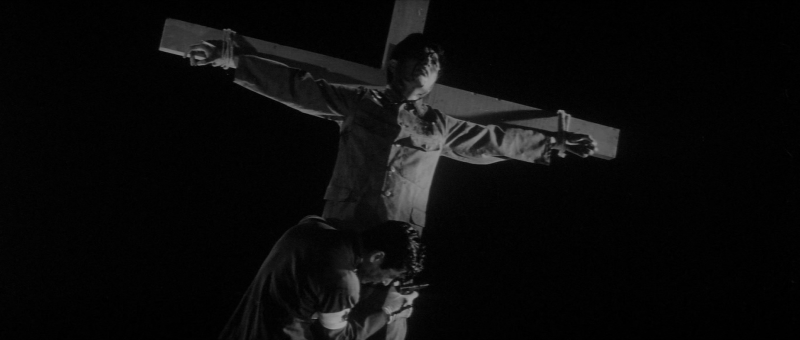
Lieutenant Namishima (Shigeru Amachi) is indeed later described as “the embodiment of evil” and his desire for conquest, in this case of a woman about to marry another man whom he will eventually win and discard, is reflective of the destructive lust for imperialist expansion. When Akiko (Naoko Kubo) marries another member of the military police, Tazawa (Shoji Nakayama), in the autumn of 1941, Sergeant Takashi (Fujio Murakami) jokes with Namishima that he has “failed to win the girl”, but Namishima merely smirks and explains that he’s playing a long game, “The true spirit of a warrior is found in the final victory.” Soon after he frames Tazawa for having stolen secret documents he himself has sold to Chinese spy Zhang (Arata Shibata), subjecting him to heinous torture and having both Akiko and his mother (Fumiko Miyata) tortured in front of him to force Tazawa to confess. Thereafter he has him executed by firing squad but Tazawa, strung up on a cross, continues to protest his innocence until the final moment issuing a curse on all those that have wronged him. 

Unlike some of Nakagawa’s other films, the ghosts here are less supernatural than they are psychological. Namishima has frequent flashbacks and visions that remind him of his crimes and is quite literally haunted by his guilt while refusing to admit that he feels any. It seems that he harbours strong resentment towards the military and implicitly towards the militarist regime and emperor having been rejected by the military academy because his father had committed suicide. His treachery is revenge but also equal parts self-destruction and a wilful bid to assert himself through his transgressions marvelling at his success in becoming the sort of person who could betray his own country and kill his own people. Both Tazawa and his brother (also played by Shoji Nakayama), who later joins the military police hoping to investigate the circumstances of his death, were graduates of the military academy and therefore idealised cogs in the military machine. 

Somewhat uncomfortably, the righteousness of Tazawa’s brother effectively legitimises the militarists in suggesting that a man like Namishima is an aberrance unreflective of the militarist ideal. “Ignoring the innocent goes against all the military police stand for”, Tazawa earnestly tells Namishima when he attempts to cut corners framing another suspect for his own ends, lending the military police an air of legitimacy they may not have had in reality when we might ask ourselves what exactly it was that they “stood for” which is more likely the nihilistic amorality to which the narcissistic Namishima subscribes. As he said, women lose their lustre once he’s got them. Having pretended to be a friend to Akiko in her widowhood, he rapes her during an air raid and it’s at this point that Japan begins rapidly losing the war as Namishima’s moral decline mirrors the fortunes of his nation. Having got what he wanted, he callously discards her and is transferred to Manchuria where he continues to work with Zhang and his wife, Ruri/Honglei (Yoko Mihara), with whom he has something like a more genuine romance.

His crimes will, however, catch up with him and it’s in Manchuria that his schemes begin to unravel not least because of the unsettlement that the presence of Tazawa’s brother, who has been seconded to his unit, causes him. The film’s surreal conclusion takes place in a Christian graveyard with Namishima surrounded by crosses which align with the crucifix on which Tazawa was executed. The crucifix itself would have no particular religious connotation in Japan and is simply a convenient way of constraining someone for execution but here takes on a symbolic dimension in confronting Namishima with his sins of transgression. Soon he is surrounded by hundreds of Tazawas on crosses, echoing the many men who were in effect murdered by the imperialist regime in a war fuelled by the same lust for conquest that motivated Namishima. Nakagawa’s camera takes on the role of an observer, sometimes comically swooping between talking heads as if following an ongoing conversation while later rocking in unsteadiness as Namishima begins to lose his grip on reality, finally confronted with the “ghosts” that surround him. 


Original trailer (no subtitles)

Death Row Woman (女死刑囚の脱獄, Nobuo Nakagawa, 1960)

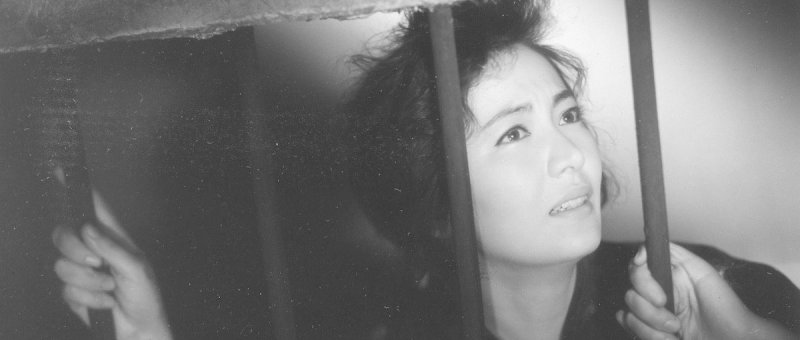
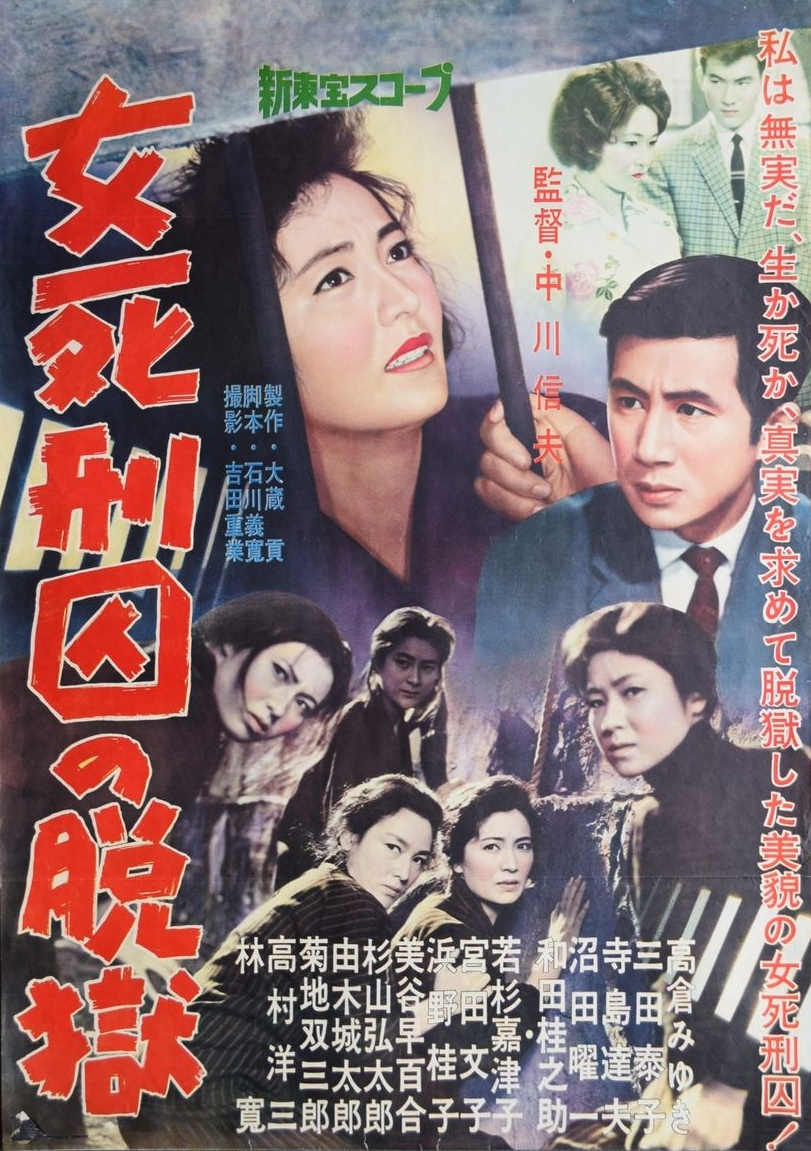
How far does freedom extend in the complicated post-war society? Best known for his eerie horror films, Nobuo Nakagawa takes a stab at B-movie crime in a tale of wronged femininity as a woman’s attempt to escape her father’s authority ends in a death sentence. Death Row Woman (女死刑囚の脱獄, Onna Shikeishu no Datsugoku) sends its wrongfully convicted heroine on the run, literally, from a cruelly patriarchal society, but there is something quite perverse in its ambivalent conclusion which at once frees and vindicates but also suggests that perhaps daddy knows best after all. 

As the film opens, patriarch Imai (Hiroshi Hayashi) is engaging in a bonding ritual with his prospective son-in-law, Aoki (Keinosuke Wada), teaching him how to hunt. Meanwhile, his daughter, Kyoko (Miyuki Takakura), has wandered off with another man, Soichi (Tatsuo Terashima), with whom she is in love. Soichi is obviously worried about Aoki, but she tells him that the marriage is her father’s idea and she’s no intention of going through with it, not least because she is pregnant with Soichi’s child. The pair embrace, engaging in a clinch in the woods, but are spotted by Kyoko’s step-sister, Minako (Yasuko Mita), who apparently doesn’t like someone else hunting what she’s got her eye on, pointing her shotgun right at the loved up couple before her mother (Fumiko Miyata) arrives and knocks it out of the way sending a shot into the air in the process. 

Soichi is a spineless sort of man, telling Kyoko that he “can’t talk to old people” and refusing to go with her to see her father. She’s confident Imai will have to give in seeing as her pregnancy makes this a fait accompli, but he tells her to get an abortion and if she doesn’t like it she can get out. Imai wanted her to marry Aoki because he picked him out as a son, an heir to leave his company to. As Kyoko points out, he never considered her feelings, only seeing her as a tool to be manipulated for his own ends in securing his business interests. Imai objects to Soichi not only because he resents having his authority undercut, but because Soichi is a “nobody” and he finds the idea of his daughter marrying someone from a different social class distasteful in the extreme. All of that is about to become moot, however, because seconds after Kyoko storms out vowing to marry Soichi even if it means severing ties with her family, Imai drops dead, not of an apparent heart attack as it first seems but of poison! As the last person to see him alive and with the entire household having heard their row, Kyoko is arrested for her father’s murder and sentenced to death. 

Jumping on over a year, Kyoko’s son is seven months old and apparently living in a children’s home rather than being cared for by any of her family while she languishes in prison still proclaiming her innocence. Nakagawa flirts with woman in prison tropes, putting Kyoko in a room of four women including a predatory lesbian, but eventually allows her to find female solidarity with a “habitual criminal” who helps her escape in order that she might prove her innocence and be reunited with her son. Kyoko’s decision to escape is prompted by an awkward visit from Soichi who has neglected to bring the picture of their baby he’d promised her while claiming to be working hard on her case. He tells her that he’s engaged a lawyer who has turned up evidence implicating Aoki who has made several attempts of his own to visit her all of which she has turned down. Unbeknownst to her, he’s even transferred to the town near the prison and is living in a company dorm not too far away. Coming to the conclusion that Aoki is the architect of all her misfortune, she determines to pay him a visit and either get a confession or take her own life. 

Aoki, however, turns out to be a good guy after all. He didn’t kill Imai and has been living near by because he’s sure Kyoko didn’t either and is determined to crack the case. Aoki helps her hide from the authorities and manages to get her on a train to Tokyo daringly defying the police dragnet, while the case’s original investigator begins to smell a rat in staking out the Imai home. Soichi seems to have become awful close with the two Imai ladies, so perhaps he really was the odious social climber old Imai feared him to be. So far, Kyoko’s attempts to take charge of her own future in rejecting her father’s authority have not gone well. She has ended up with a death sentence for daring to challenge the social order by advancing her own agency and has escaped from the literal prison, but is once again locked up for her own safety while Aoki does all the investigating on the outside. Her desire to reassume her role as a mother to a child technically born out of wedlock is what eventually gets her caught, leaving her at the mercy of the magnanimous police who, thankfully, decide that the duty of law enforcement is to act in the best interests of justice, admitting their mistakes rather than covering them up to save face. 

So, Aoki turns out to be good and Soichi bad. Kyoko is vindicated, proving herself innocent of the crime of patricide, but is punished fiercely for her attempt to escape her father’s control. It’s tempting to think that the message is that her father knew best after all and if she’d only done as she was told and married Aoki without making a fuss all of this could have been avoided. Amoral post-war ambition has been unmasked, everyone has been shuffled back into their original class boxes with order seemingly restored. Kyoko has “escaped” her imprisonment, but is she truly “free”? “That’s all in the past now”, Aoki reassures her, “but hang on tight anyway”.