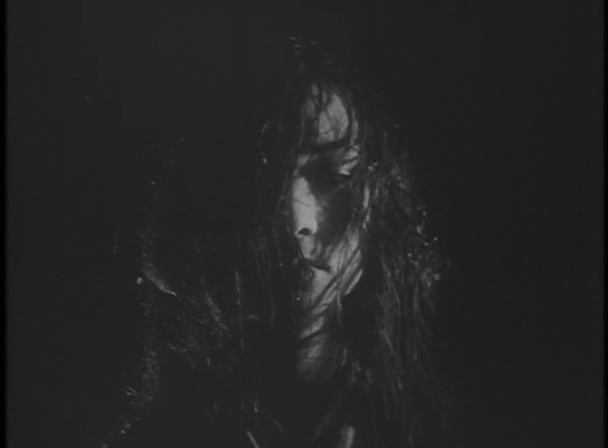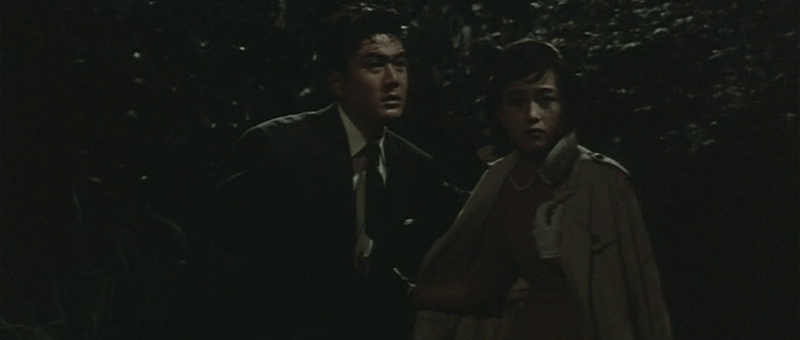
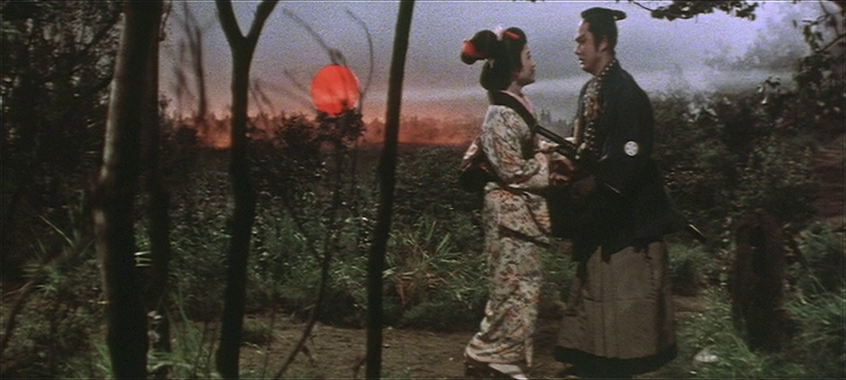
The Ghost Cat of Otama Pond (怪猫 お玉が池, Yoshihiro Ishikawa, 1960)

Ghost cat films can often be about the ways in which the unresolved past continues to echo in the modern era. The curse is not lifted by vanquishing the evil spirit, but only by coming to an accommodation with and making recompense for wrongdoing in the distant past. This is especially the case when the film involves bookending sequences set in the modern day as in Yoshihiro Ishikawa’s Ghost Cat of Otama Pond (怪猫 お玉が池, Kaibyo Otama-ga-ike) in which a young couple accidentally become trapped within the orbit of a vengeful spirit after stopping off on their journey to get their parents’ approval for their marriage.

To that extent, the fact that they keep walking in circles and always end up back at the lake might hint at their mutual sense of anxiety about their decision to marry. “What will marriage be like if you’re like this now?” Tadahiko (Shozaburo Date) asks in exasperation, accusing Keiko (Noriko Kitazawa) of being “difficult” as she blames him for the decision to come to the lake in the first place and insists she’s too tired to continue walking. Their relationship is further strained by the lingering possibility that the parents may object to the marriage and that arriving late for their visit might not help their chances.

Their situation is mirrored in the circumstances that led to the creation of the ghost cat as related to Tadahiko by a local priest whom he consults after Keiko falls into a coma near the ruined house where they take shelter. Long ago, their ancestors Yochimaru (Shozaburo Date) and Kozasa (Noriko Kitazawa) were in love and wanted to marry, but their families were sworn enemies who strongly opposed the union. When Yachimaru was sent to serve in the capital swearing to call for Kozasa once he’d established himself, her villainous father Gensai (Yoichi Numata) moved against Yachimaru’s father Shinbei (Akira Nakamura) who had been attempting to protest the unreasonable taxes levied against local peasants who were on the verge of causing unrest. Consequently, they killed him and dumped his body in the pond. Shinbei’s beloved cat Tama drank some of his blood and became a ghost cat hellbent on avenging its master.

Tama is quite a popular name for a cat, but in this case it seems to be that it got its name from the lake where it was found which hints at a deeper origin story for this vengeful spirit. Unlike that in other similar films, it seems to have the power to manipulate people physically, at least to a degree, and also to pull them into an alternate reality as happens to Keiko during her coma when she is transported back to the Edo era before the house fell into ruins. It also seems to collect and unify various desires for vengeance though all against Gensai and his allies including the corrupt magistrate and entitled son Gorota (Hiroshi Shinguji). Though it originates with the death of Shinbei, the ghost cat later mainly takes the form of Kozasa after she drowns herself in the pond having been bewitched and seen the ghost of Yachimaru. 

In the end, this curse is only resolvable through the relationship between Keiko and Tadahiko. The ghost cat is vanquished by natural forces putting an end to the curse and releasing Keiko from her coma. After undergoing this experience, they are able to find their way back from the lake as Tadahiko resolves that they will still get married no matter what their parents say in direct contrast with Yachimaru and Kozasa who were constrained by samurai mores and unable to defy their families. In the modern era, they are free to live in the city and do as they please without needing to pay much attention to these outdated rituals, and so the ghost cat’s curse is no longer necessary as the rift is healed with their union just as if Yachimaru and Kozasa were finally united. Ishikawa conjures a suitably gothic, eerie atmosphere around the misty lake achieving ghost effects mainly through lighting in which they take on a familiar greenish hue. Away from the lake, however, it becomes more difficult to tell who is a ghost and who alive, while the ghost cat manipulates those that have wronged it into harming those they love and by extension themselves until finally laid to rest by a new generation resolving to leave the past behind.


Trailer (no subtitles)
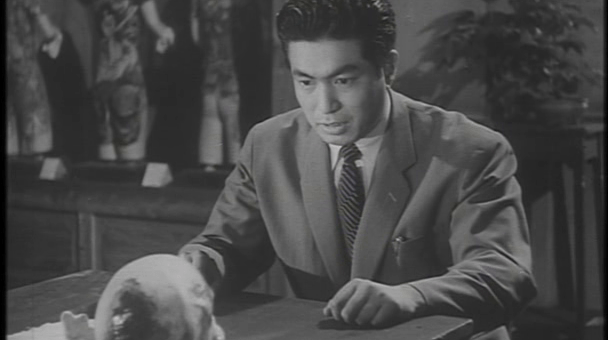
The Military Policeman and the Dismembered Beauty (憲兵とバラバラ死美人, Kyotaro Namiki, 1957)

The Military Policeman and the Dismembered Beauty (憲兵とバラバラ死美人, Kenpei to Barabara Shibijin) was apparently a substantial hit on its release, though to modern eyes at least it doesn’t quite live up to the salaciousness of its title. In fact, it seems a little more interested in reassessing the militarist past while attempting to rehabilitate an authoritarian power and reframing it as good and compassionate unlike the corrupted killer who is selfish and ambitious to the extent that he’s literally poisoning the militarist wells. 

What we’re first introduced to, however, is a rather familiar tale of a soldier who’s gotten a girl pregnant but now won’t marry her mainly because he’s onto a good thing with a pretty girl from a prominent family so his girlfriend’s in the way. Though we see a prelude to the murder, we don’t get good a look at the soldier’s face (though we do hear his voice) which on one level hints at the generalised violent threat of the militarist machine but is also a neat plot device that allows us to into the crime but still maintains the mystery. When we do see the actual killing, it’s surprisingly frank for the time period and disturbing in its sexual charge though there is no gore involved save a grisly discovery in yet another well. 

The killing occurred shortly before the regiment left for Manchuria, which seems to be one way the killer sought to move on and leave his crime behind. The first hint of the corruption is discovered by a gang of new recruits as yet unused to the militarist machine. They notice that the water in the well in the barracks is bad, but are at first bullied and insulted by another soldier who’s been there longer and gives them a rather priggish speech about the sanctity of the regimental water. What they discover is that the water tastes bad because there’s a dismembered torso in there and has been for the last six months. One has to wonder why the culprit would think this a good place to hide a body given the risk of discovery and increasing suspicion but as it turns out no one is all that interested. The Military Police aren’t that keen on investigating themselves, and then we get the familiar conflict between the local cops and the specialists as a top investigator, Kosaka (Shoji Nakayama), is assigned to investigate the crime and insists on doing so thoroughly rather than just beating their favourite subject into a false confession. 

Kosaka is then posited as a nice Military Policeman, an emissary of legitimate authority rather than bumbling provincials who are ridiculous and self-serving not to mention incompetent and resentful. We’re told repeatedly that Kosaka is prepared to work with the civilian police unlike the other military policemen who insist on militarist primacy and refuse to allow the detectives onto the base to investigate. He’s a representative of a less authoritarian age that looks forward to the democratic future, but he is also a part of that organisation himself no matter how different he may seem to be and cannot escape the overarching structures of militarism. Nevertheless, his edges are further softened by a nascent romance with the middle-aged innkeeper at his lodging house while his assistant is after her sister, a childhood friend who can’t stop calling him by his old nickname. 

The two of them investigate scientifically, making frequent trips to the pathologist to discuss theories and evidence though Kosaka is eventually guided towards the solution after seeing the young woman’s ghost. The local military police meanwhile fixate on another soldier who has a reputation for using sex workers, one of whom has recently disappeared, though Kosaka thinks the man is a just a crook with what modern viewers make think of as a sex addition that sees him steal supplies from the kitchen to sell in order to finance his visits to the red light district. The military police whip him in an oddly sexually charged manner to try to get him to confess, but he maintains his innocence. One of the motives for the murder was seemingly that the victim planned to expose the affair, taking her concerns to the killer’s superior officer in an effort to force him to marry her which would have ruined his career prospects in what is supposed to be an organisation of honourable men. Unlike Kosaka who shares his name with the writer of the novel the film is based on which may have been inspired by true events, the other military police are largely like the killer, arrogant, selfish and unfeeling though all Kosaka himself represents is a supposedly more benevolent authority that for his niceness may not actually be all that much nicer.