The Heart of Hiroshima (愛と死の記録, Koreyoshi Kurahara, 1966)

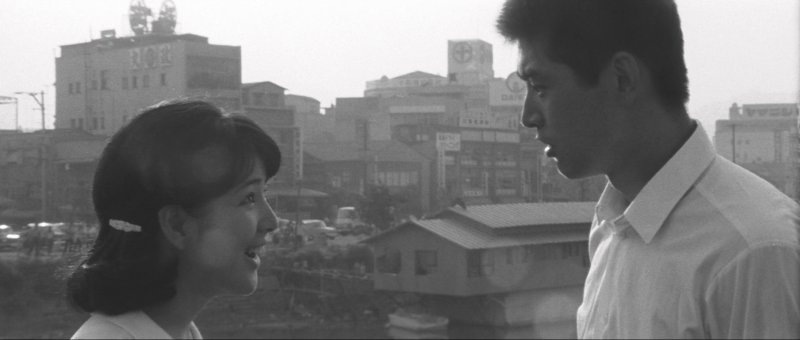
Sayuri Yoshinaga was the top female star at Nikkatsu in the mid-1960s. Together with her regular co-star Mitsuo Hamada, she starred in a series of hit youth romances such as The Mud-Spattered Pure Heart, The Sound of Waves, and Gazing at Love and Death which was Nikkatsu’s biggest box office success at the time. The Heart of Hiroshima (愛と死の記録, Ai to Shi no Kiroku) was intended as the latest in the series, but Mitsuo Hamada was attacked by a drunk customer at a bar shortly before filming after which he needed surgery to save his eyesight. Normally, the film would be postponed, but Nikkatsu was having financial difficulties at the time and refused to wait despite pleas from Yoshinaga and even from the actor who replaced him, Tetsuya Watari, who was a good friend of his. 

At the same time, Yoshinaga was now 21 years old and uncertain how long she could convincingly go on performing in Nikkatsu’s typical teen dramas. The studio was also worried about the possibility of losing their top star if she decided to move into more serious dramatic roles while they did not believe they had a suitable replacement. They were currently on bad terms with Ruriko Asaoka who ended her exclusive contract that year and moved to Ishihara Pro, and were worried that their other popular actresses such as Chieko Matsubara weren’t ready to take on that kind of responsibility. To try to convince Yoshinaga that the film would be more artistic in nature they hired New Wave director Koreyoshi Kurahara rather than studio stalwarts like Buichi Saito who’d directed Gazing at Love Death, but when she again tried to refuse insisting they wait for Hamada, they forced her hand by simply beginning to shoot the film on location in Hiroshima without her. Casting Tetsuya Watari may have also been an attempt to shake up the franchise as at that point he was known more for action and hadn’t really played this kind of very intense, romantic role before.

Though it follows a familiar pattern in exploring a doomed romance between a boy and a girl whose pure love is obstructed by social division, the film does deal with some quite controversial themes in touching on the discrimination faced by those who were affected by the atomic bomb. Yukio (Tetsuya Watari) lost his whole family in the blast and was taken in by Mr Iwai (Asao Sano) after being released from a long-term hospital stay. He’s doing well working at Mr Iwai’s print shop and has no current health worries when he has a meet cute with Kazue (Sayuri Yoshinaga) knocking into her on his bike and smashing some records she was carrying which he insists he compensate her for, though he doesn’t know she works in a record shop so it doesn’t really matter. After a comical misunderstanding in which Yukio mistakenly thinks Kazue is dating his friend, and she thinks he’s a creep who’s coming on to her while dating another girl from the shop, they fall in love and want to get married.

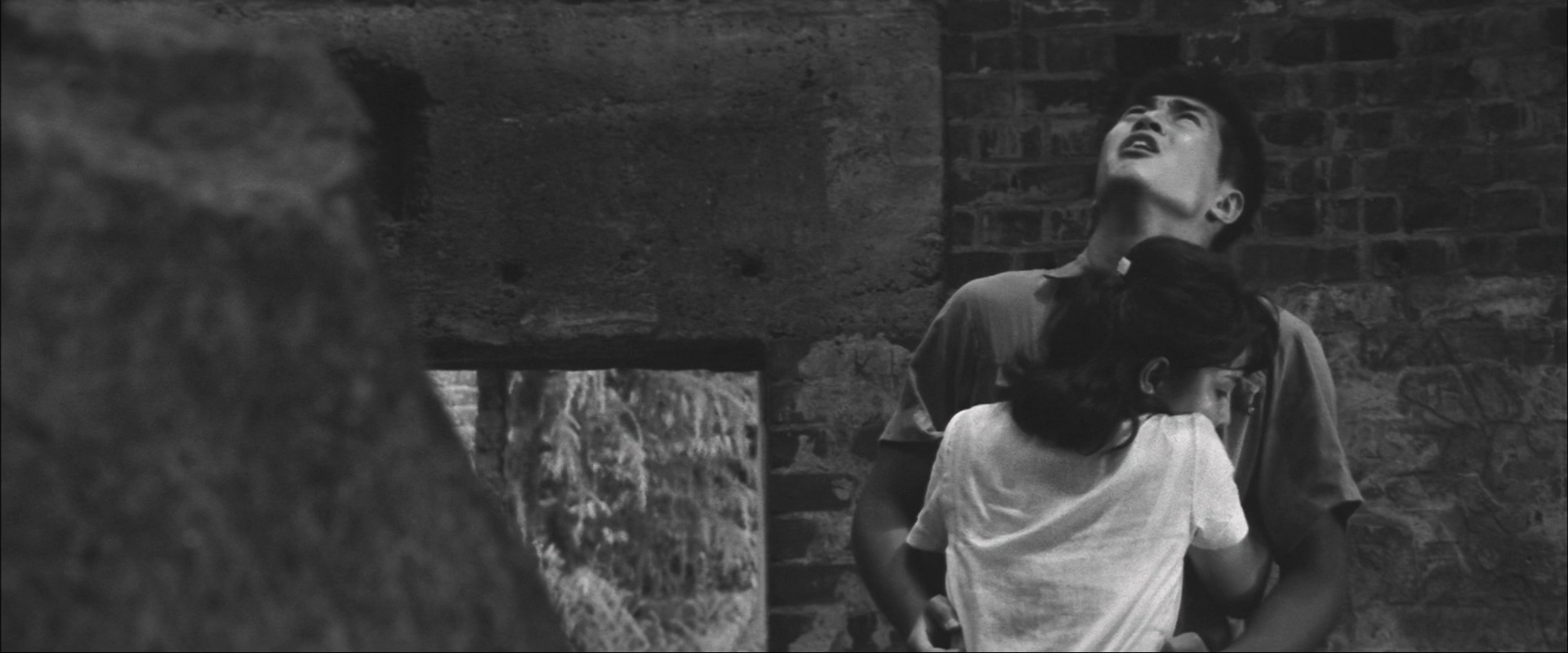
However, Yukio’s symptoms start to resurface and he asks himself if he really has a right to start a romantic relationship and get married, especially as there’s a risk any children he may have could be born with genetic abnormalities. Because of the stigma directed towards those who were affected by radiation from the bomb, he feels he can’t explain any of this to Kazue and continues to blow hot and cold, while she too is close to a young woman (Izumi Ashikawa) who seems to have had a romantic past with her brother but once tried to take her own life because she has a large radiation scar on her face. She has since resigned herself to living for her parents, suggesting that she will not marry. When Yukio eventually has to tell Kazue, he does it inside the dome at the Hiroshima Peace Memorial Park where she, of course, says it doesn’t matter and is only hurt and upset that he suggested they break their engagement.

The underlying suggestion is that those who were affected by the atomic bomb are being denied love by an unforgiving society that has avoided fully processing its traumatic past. Though it’s strongly suggested to her that Yukio will not survive his leukaemia, Kazue remains devoted to nursing to him but is also placed into an impossible position. She tells Yukio that she is already his wife and will stay with him, but is persuaded to leave by her mother and sister-in-law who tell her it’s “improper” for her to be with him overnight in the hospital despite the fact he’s in a communal ward with several other people there all the time as well as the medical staff. Her friend advises her to leave permanently, but then also calls her heartless knowing Yukio has no one else when Kazue begins to waver and suggests he may give in to the pressure given the emotional toll the whole experience is already taking on her. Nevertheless, she never really gives up on Yukio and is ultimately unable to reconcile herself to a world in which he would become “a man that no one could love”. The film ends on a rather bleak and ghostly note as a group of school children walk past the dome, suggesting that to some these comparatively recent events have already become history rather than a living memory and lingering trauma hanging over a rapidly changing society.

Escape from Japan (日本脱出, Kiju Yoshida, 1964)

Like many directors of his generation, Kiju (Yoshishige) Yoshida began his career at Shochiku working on the studio’s characteristically inoffensive fare before being promoted as one of their youth voices through which they hoped to capture a similar audience to that attracted by Nikkatsu’s Sun Tribe movies. Yoshida’s films may have spoken to youth but they were perhaps not quite what the studio was looking for nor the kinds of projects that he really wanted to work on, which is one reason why 1964’s Escape from Japan (日本脱出, Nihon Dasshutsu), an anarchic B-movie crime thriller of intense paranoia all maddening angles and claustrophobic composition, was his last for Shochiku, the final straw being their decision to change the ending without telling him and release the film while he was away on honeymoon. 

Set very much in the present, the film opens with a young man miming to American jazz which turns out to be part of the floor show being performed by the band on the stage below for whom he is a reluctant roadie. Tatsuo (Yasushi Suzuki) dreams of going to America to rediscover “real jazz” and subsequently bring it back to Japan. He has the strange idea that America is a true meritocracy where his talent will be recognised, unlike Japan where it is impossible for him to succeed because he is not particularly good looking or possessed of “star quality”. Feeling himself indebted to the band’s drug-addled drummer Takashi (Kyosuke Machida) for helping him get the roadie gig with the false promise of becoming a singer, Tatsuo agrees to help him commit an elaborate robbery of the “turkish bath” (low level sex services and precursor to the modern “soaplands”) where his girlfriend Yasue (Miyuki Kuwano) works. Only it all goes wrong. The guys kill a policeman during the escape, and the other hotheaded member of the gang becomes convinced that Yasue may talk now that they’ve got involved with murder so they should finish her off too by forcing her to take an overdose of sleeping pills. 

Absolutely everyone is desperate to escape Japan for various different reasons. Tatsuo because of his obsession with American jazz and the freedom it represents to him coupled with the sense of impotence he feels in an oppressive society which refuses to recognise his talent because he doesn’t look the part. He jokes with his next-door neighbour, a sex worker who has redecorated her apartment in anticipation of impressing the tourists arriving for the Olympics, that he envies women and wishes he could find a “sponsor” to take him to the States, but later can offer only the explanation that Japan doesn’t interest him when probed over why he was so desperate to leave. 

“Korea or anywhere else, it’s better than Japan” Yasue later adds, consoling Tatsuo as she informs him that their escape plan won’t work because all of the US military planes are being diverted to Korea to bring in extra help for the Olympics. Bundled into a van filled with chicken carcases as a potential stowaway, he discovers another escapee – a Korean trying to go “home”, or rather to the North (presumably having missed out on the post-war “repatriation” programs) where he claims there are lots of opportunities for young people only to lose his temper when Tatsuo explains that he wants to become a jazz singer. He doesn’t want decadent wastrels in his communist paradise and would rather Tatsuo not mess up his country. Yet they are each already dependent on the Americans even for their escape, making use of military corruption networks and getting Yasue’s friend’s GI squeeze into trouble through exposing his black-marketeering. 

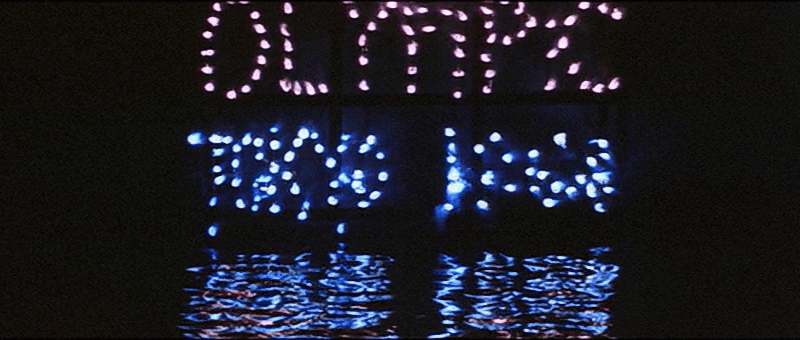
Tatsuo and Yasue find they have more in common than they first thought, both “deceived” by those like Takashi who turned out to be a feckless married man and father-to-be risking not only his own future but that of his unborn child solely to fuel his escapist drug habit (which was perhaps the reason for the lengthy hospital stay from which he had just returned). Yasue was just trying to save up enough money to open a hairdresser’s in her hometown, but Takashi told her he was a “famous jazz drummer” and presumably sold her the same kind of empty dreams as he did Tatsuo. Giving up on her own future, realising that even in America the sex trade is all that’s waiting for her, Yasue tries to engineer Tatsuo’s escape but he, traumatised by his crimes, descends further into crazed paranoia, eventually finding himself right in the middle of the Olympics opening ceremony. This is event is supposed to put Japan back on the map as a rehabilitated modern nation, but perhaps all it’s doing is creating an elaborate smokescreen to disguise all the reasons a man like Tatsuo and a woman like Yasue might want to be just about anywhere else. Yoshida seems unimpressed with the modern nation and its awkward relationship with the Americans, perhaps a controversial point in the immediate run up to the games. Shochiku neutered his attempt to depict a man driven to madness by the impossibilities of his times, but a sense of that madness remains as Tatsuo finds himself on the run and eventually suspended neither here nor there, trapped in a perpetual limbo of frustration and futility.


Original trailer (no subtitles)

At Noon (正午なり, Koichi Goto, 1978)

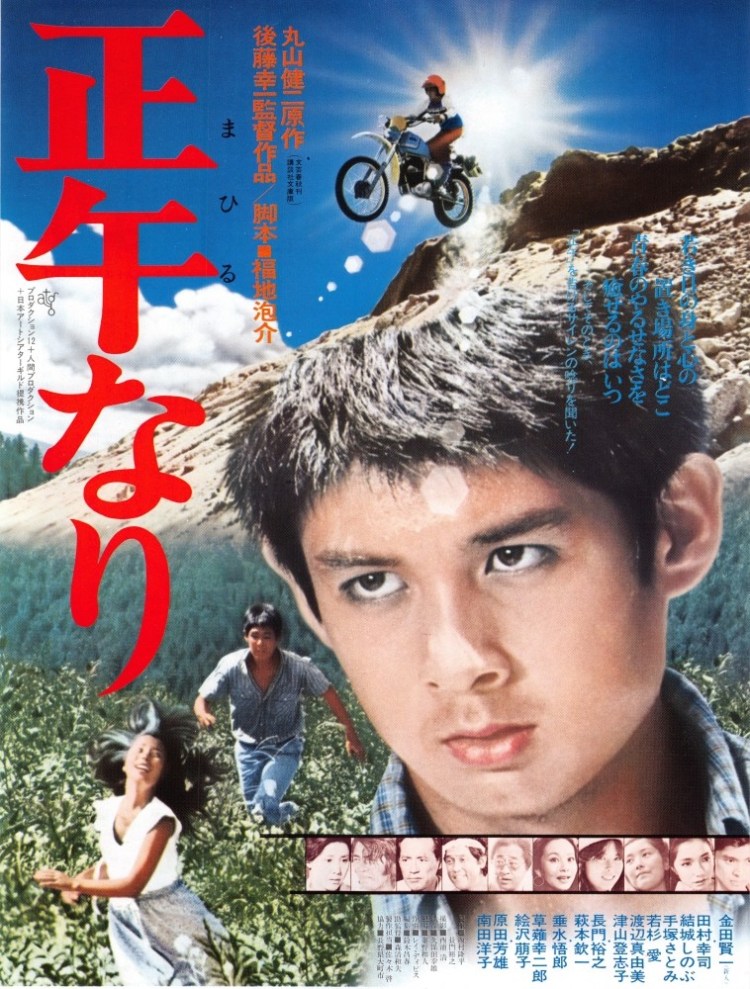
at noonKoichi Goto’s Art Theatre Guild adaptation of Kenji Maruyama’s 1968 novel At Noon (正午なり, Mahiru Nari) begins with a young man on a train. Forlornly looking out of the window, he remains aboard until reaching his rural hometown where he makes a late entry to his parents’ house and is greeted a little less than warmly by his mother. The boy, Tadao, refuses to say why he’s left the big city so abruptly to return to the beautiful, if dull, rural backwater where he grew up.

There’s little work here for a young man, which is why Tadao left in the first place. After using some family connections to try and find a job, he finally decides to make use of his abilities by fixing radios and TV sets for a local electronics store. To begin with he doesn’t want to see his old friend, Tetsuji, perhaps out of a sense of shame at having returned home but the pair later strike up their old friendship – that is, until Tetsuji suddenly announces his plans to run away with a local bar hostess.

It’s never quite revealed what happened to Tadao in Tokyo but it seems to have been something serious enough to change the course of his entire life and send him reeling back home depressed and angry. In many ways he’s a typical young man, if slightly sullen, but he’s developed a serious number of sexual hangups which have turned him into some kind of repressed, misogynistic, pervert. He appears to have made a deliberate decision to dislike the idea of women, or at least the idea of women with sexual appeal. He thinks women are trouble, that no good comes of love, but can’t stop himself from spying on the female tourists staying in an upper room. He’s always looking, staring invasively, but resolved not to touch.

Tadao has already been to the city and evidently found it not quite to his liking but his friend, Tetsuji, feels bored in the village and trapped by his parents who need his help in their orchards. When Tadao realises Tetsuji is taking the hostess with him when he skips town, he asks for the money he just agreed to lend him back and tells him to forget about running away and just to go home. Unfortunately for Tetsuji, Tadao’s advice proves sound as his city dreams don’t work out the way he planned either. To end his frequent attempts to escape, Tetsuji’s family float the idea of an arranged marriage which originally horrifies both boys but after meeting his prospective bride, Tetsuji changes his mind. Tadao doesn’t approve, but after meeting the girl in question and seeing that she is quite lovely changes his mind too and is happy for his friend – that is, until he realises Tetsuji has only introduced him to her as a pretext of getting her on her own to enact his marital rights a little ahead of schedule. This breach of morality proves the final straw for Tadao who does not like the idea of his wayward friend deceiving and then ruining this innocent young flower who’s far too good for him anyway.

Tadao’s fascination with another damaged bar girl, Akemi, continues as the two find themselves both looking at the sad figure of a tethered eagle imprisoned at the local zoo. Akemi says she likes to look at the bird as she feels perhaps somehow that helps him escape. She feels like a caged bird too – trapped in a bad relationship with a useless boyfriend who has a vague plan of turning manure into an energy source while she supports them both by working at a hostess bar and hating every second of it. Tadao feels trapped in a hundred different ways, by his town, by his parents, by whatever happened in Tokyo, and by his own pent-up frustrations. By this point, he’s a one man powder keg ready to explode and after blowing his final safety caps, tragedy is the only possible outcome.

At Noon begins with its epilogue, but uncomfortably frames its protagonist’s despicable final actions with an odd kind of heroism as his head eclipses the sun leaving him with a radiant halo. He may have satisfied himself in some way, put to rest some of that inner turmoil, but what he’s done is something truly dreadful and driven by an intensely animalistic instinct. At Noon may have something to say about the dangers of frustrated young men with no work to go to, no ambition to follow, and no luck with the ladies but displays an oddly ambivalent attitude to its deranged protagonist that makes for often uncomfortable viewing.


By the way, After Noon has music by Ray Davis of The Kinks!

Unsubbed Trailer: