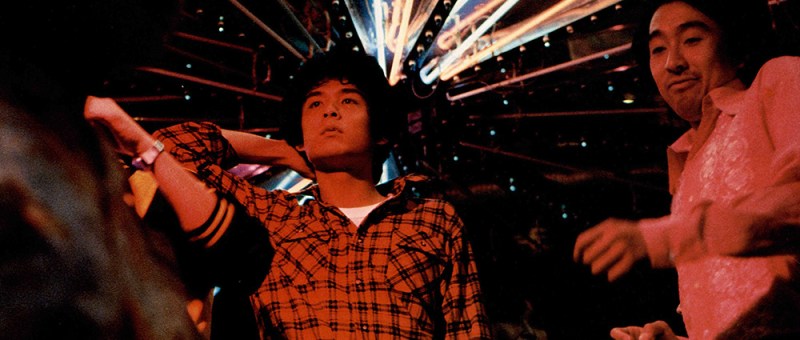

In the mid-1950s, a moral panic erupted as the wartime generation found themselves horrified by the world of post-war youth. They resented a generation of bright young things who listened to jazz music in cafes they saw as living hedonistic lives filled with sex and drugs. The irony is that the so-called “Sun Tribe” movement was crystallised in the writings of Shintaro Ishihara, a conservative who later became a very right-wing governor of Tokyo. His brother Yujiro, one of the biggest stars of the post-war entertainment industry, was the face of the Sun Tribe onscreen starring in several of the short-lived genre’s key titles including Ko Nakahira’s Crazed Fruit.
Chusei Sone’s Scars of the Sun (太陽のきずあと, Taiyo no Kizuato) is a reinterpretation of the Sun Tribe movie for the era of high prosperity. Almost an adaptation of Nakahira’s film, it co-opts its central love triangle and ends with a similar sequence in which the hero, Shuhei (Kenichi Kaneda), uses his speedboat to attack a former associate who has stolen his younger brother’s girlfriend and humiliated him by exposing his impotence, both literal and figural. This time, however, Shuhei’s rival isn’t his biological brother but his best friend. Shuhei thinks that this is his gang, but in reality Karasawa (Satoshi Sadanaga) is running it. They just let Shuhei play the gang boss to make use of his wealth and status.
There is also, however, a degree of homoerotic tension between Karasawa and Shuhei with the implication that Shuhei’s impotence with women is due to homosexuality. When Shuhei arranges for his father’s bar hostess lover (Yuko Katagiri) to be gang raped, Karasawa declines to participate. He says that he does this out of sympathy for Shuhei, sitting on the sofa with him and turning down the attentions of the gang’s moll Kanako. The pair later put a record on and slow dance around the room. Karasawa’s decision to take up with Kaori (Mirai Hayashi), the apparent girlfriend of Shuhei’s estranged brother Koji (Koji Tanaka), is then a triple betrayal. Not only does he defy the longstanding rule of the group that women be shared, but ignores Shuhei’s authority and deliberately wounds him to assert his own superiority.
In a way, Shuhei did something similar in having Mayumi raped, only it doesn’t really bother his father from whom he may have learned his lack of respect for women. Mogi (Ken Ogata) is an Ishihara-esque award-winning novelist who has written screeds about the youth of the day and claims to have a special educational method for raising his son while secretly using his money to cover up all of Shuhei’s indiscretions. Shuhei’s actions are then in some part rebellions against his hypocritical father whom he resents. His unexpected reunion with Koji, his younger brother whom he hasn’t seen for 11 years since his parents’ divorce, reawakens his desire to lead a more conventional family life, though he can’t resist the urge to sabotage it by bringing Koji into his seedy gang boss life as a means of pushing him away.
The implication is also that all of Shuhei’s problems are due to a lack of maternal input and his father’s many failures as a man and a parent. He doesn’t know how to deal with a corrupted parental legacy and is essentially looking for a way back to his mother (Kyoko Enami). When he finally decides to see her, he tidies himself up and puts on a smart suit, making a point of telling his mother not to worry about him because he’s doing okay and will visit again soon, though all the evidence suggests he may be planning to go somewhere from which there is no return. He says that he has erased his other self, in one sense meaning Karasawa as an embodiment of his dark side while seemingly wanting to escape his father’s hypocrisy and corrupted morals to return to a more wholesome domesticity represented by his absent mother. With a lack of parental boundaries or guidance from his father, Shuhei is ultimately thrown into the arms of another authority figure in the form of the police force, signalling the futility of his rebellion. Sone seems to set Shuhei apart in this world, creating vistas of emptiness around him that he childishly tries to fill with violence and transgression amid the vacuity of an age of excess only to discover nothing but loneliness and desperation.
Scars of the Sun is available as part of the Chusei Sone Double Feature box set.
Trailer (English subtitles)
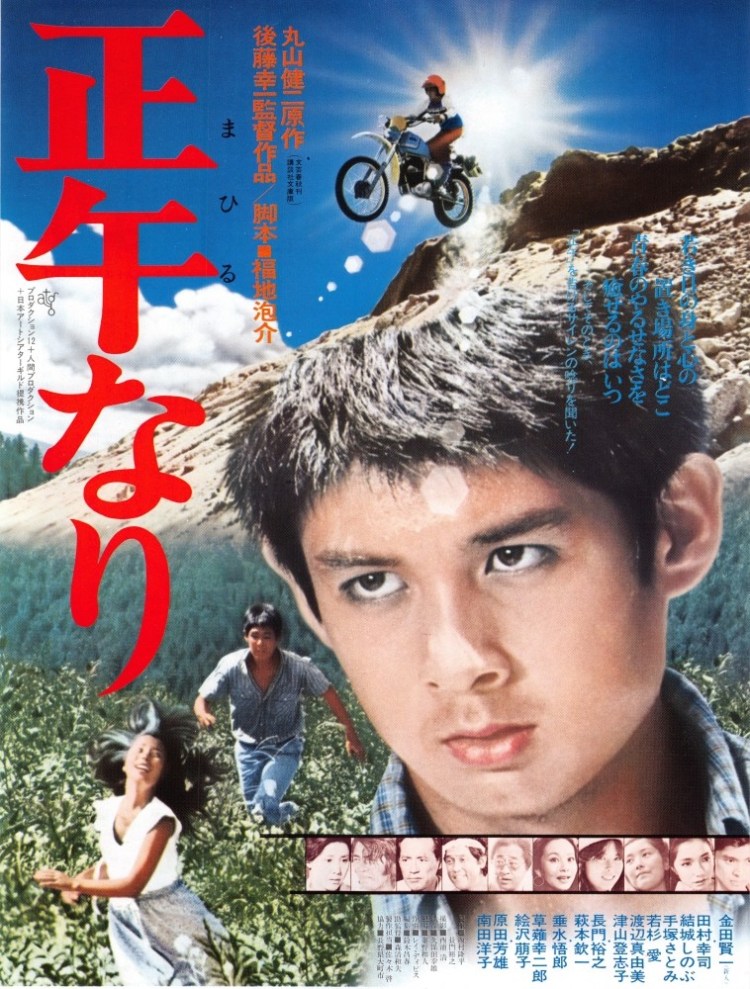 Koichi Goto’s Art Theatre Guild adaptation of Kenji Maruyama’s 1968 novel At Noon (正午なり, Mahiru Nari) begins with a young man on a train. Forlornly looking out of the window, he remains aboard until reaching his rural hometown where he makes a late entry to his parents’ house and is greeted a little less than warmly by his mother. The boy, Tadao, refuses to say why he’s left the big city so abruptly to return to the beautiful, if dull, rural backwater where he grew up.
 Windows on Worlds