The Hut (피막, Lee Doo-yong, 1981)

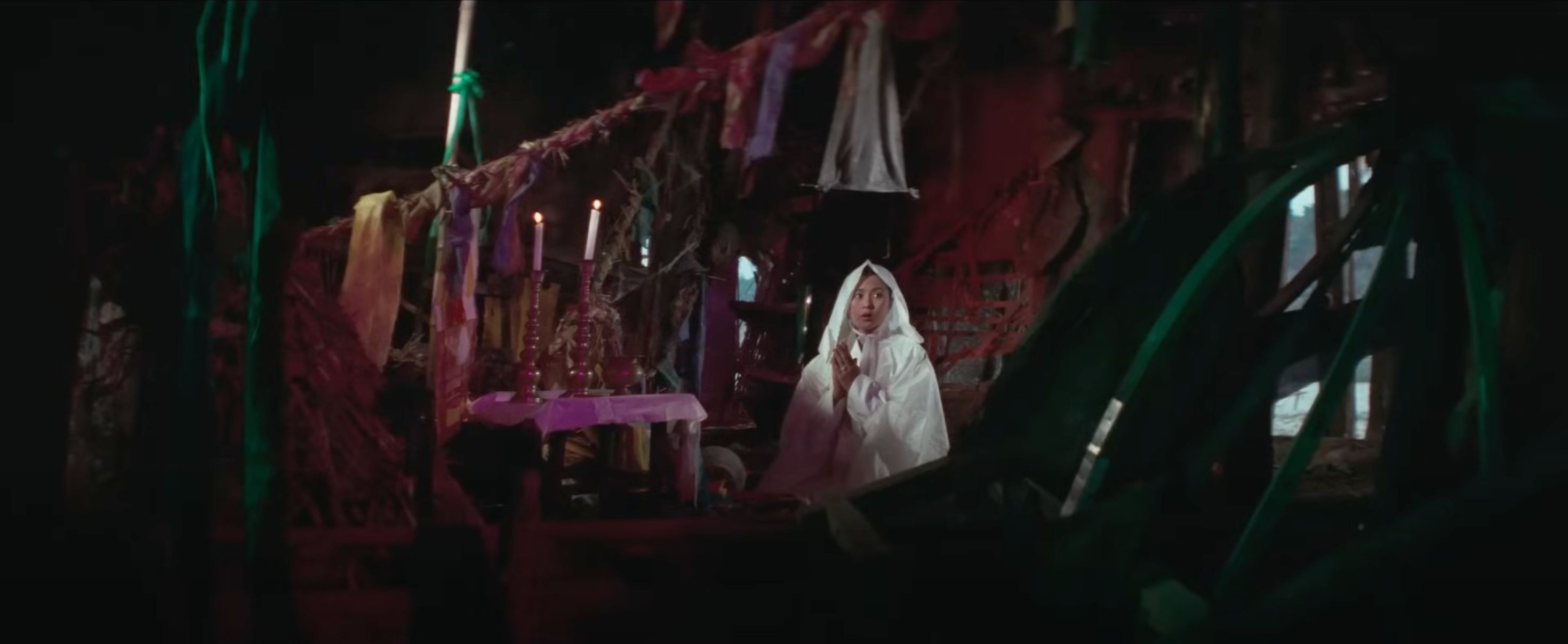
We’re told that the titular hut in Lee Doo-yong’s 1981 shamanism drama (피막, Pimak) is a like a stopping place between this world and the other. Babies are born there, but more usually it’s a place where the dying are sent to expire. Located in a more literal liminal space on the outskirts of the village, it presents a borderline that keeps the villagers safe from the taboo of death. They say the souls of those who die there cannot return to haunt the village, which is to say the village is a place free of death and also of the grudges of the past.

That is, however, not quite true. During the colonial era, the heir to noble house, Seongmin, has fallen ill and is likely to die but is being cared for at home by his desperate family who have invited shamans from all over the county in an attempt to cure him. This has obviously annoyed the village’s resident shamaness who is forever telling them they’ve made things much worse for themselves by sidelining her and shunning the local goddess, but the cause of the boy’s illness is quickly rooted out by Okhwa (Yu Ji-in), a powerful shamaness who leads the family to a buried vase in the woods which has been broken allowing the trapped should of Samdol (Nam Koong-won), the former keeper of the hut, to escape.

The Old Madam (Hwang Jung-seun) immediately admits that she was the one who put him in there, though she did not know where the vase was buried. The Gang family has a curse on it which results in many of their sons dying young before they could father sons of their own and leaving behind young widows which are perennial problem in the rigidly Confucianist, patriarchal society that some may argue continues into the present day but is certainly in the ascendent in the 1920s and 30s. As in many films of this kind, managing the sexual desires of young women, which are acknowledged as normal and natural, under such an oppressive system presents a key challenge to the social order. Given the taboo against second marriages, the family’s large collection of widowed daughters are seen resort to acts of self-harm in order to quell their desires in the absence of men. When the second daughter-in-law falls ill after stabbing herself in the thigh with a silver dagger, the Old Madam is sympathetic but believing she cannot be saved sends her to the hut to die. But before she does, the Old Madam also orders Samdol to sleep with her on pain of death so that she won’t pass into the afterlife with her needs unmet. The Old Madam is after all a widow herself, if an older one, and understands the frustration and desperation the younger woman feels. 

But the decision she makes breaks another taboo for as he points out himself, Samdol is the lowest of the low, a commoner who deals with the dead. Not only is the sex itself non-consensual, but threatens the social order in its transgressive qualities, crossing a class divide while also occurring outside of a marriage. Of course, it takes place in the liminal space of the hut where such borders meet. Described as quiet, honest, and reliable, Samdol is a kind man who also patiently nurtures the daughter-in-law back to health with medical herbs from his garden and eventually reveals to her what he was forced to do by the Old Madam but the two later fall in love and conceive a child which of course means they must both die in order to preserve the social order. 

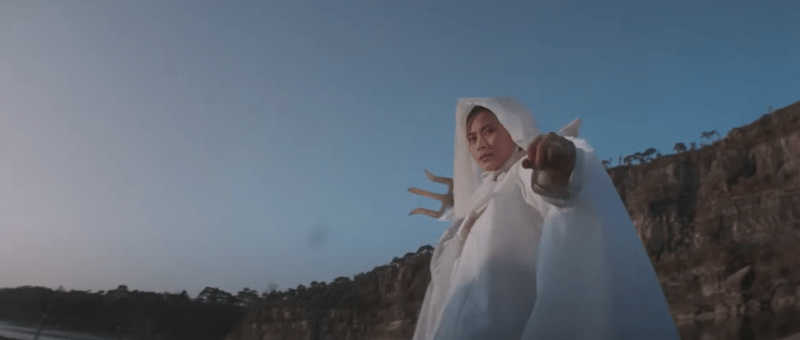
Okhwa arrives as a kind of inspector exposing the poisonous past of Gang family which after all probably did do something untoward in order to become prosperous which is why there’s a curse on it. We get the impression that she may have ulterior motives and almost certainly knows more than she’s letting on while otherwise looking for information. She is not in fact a shaman, though her mother was and a fairly legendary figure at that, but later becomes one and with it a kind of avenger mainly for women who suffer under this system but also for men like Samdol abused by the feudal class order and forever at its mercy. The shamaness is also of course a liminal figure who lives outside of conventional society which views her with suspicion as a woman with both power and independence.

But even Okwha is subject to the unwanted attentions of men who despite their insistence on a woman’s chastity believe themselves entitled to her body, not only the head of the Gang family (who is actually elderly and presumably survived the curse), but men in Western dress who snatch and rape her. Thus the hut also exists at the nexus of tradition and a seemingly destructive modernity ushered in by Japanese imperialism. After recovering from his illness following Okhwa’s guk exorcism, Seongmin insists he just got better on his own and there’s no such thing as ghosts. We’re told he studied abroad in Tokyo and in fact dresses in a Japanese-style student’s uniform complete with cape. He tells his mother that they’re making scientific advances in Japan and that it’s ridiculous to think a ghost could have killed the Old Madam and the head of the family who died in odd circumstances during the guk along with his uncle in Western dress who had raped Okhwa. He proves to her scientifically that someone could have merely set traps for each of them and points the finger at Okhwa as a likely murderess rather than a gifted spirit medium.

Perhaps we more “rational”, modern people might agree with him but the film seems certain that there are indeed vengeful spirits haunting the landscape, those who fell victim to the hut mentality and were deliberately cast out and left to die by their society who effectively exiled them in their death. Okhwa can’t exorcise the evil ghosts of patriarchy, classism, feudalism, or sexual repression but she can perhaps in part symbolically end their tyranny by dissolving the border and burning the whole thing down. 

Sunshine Family (Kim Tai-sik, 2019)

Sometimes it’s easy to lose track of what’s really important while chasing illusionary success, but you’ll remember soon enough if you hit a crisis. So it is for the members of the “Sunshine Family”, the Mapalads currently living overseas in Seoul where dad works for a travel company. The Mapalads are finally preparing to move back to Manila with a house already paid for, but when dad has an accident in his car it throws all of their plans into disarray. Yet in needing to come together to combat adversity, the family is in a sense repaired as they each come to appreciate each other for who they are while remembering that they have a collective responsibility. 

That “accident” occurs one Christmas while dad Don (Nonie Buencamino) is driving home after a work/leaving party. He’s had a little bit too much to drink and is distracted by a phone call from his boss when a woman suddenly jumps out into the road and collides with his car. Don is obviously upset, hugging the oversize snowman plushie he was travelling with for comfort as he stops to check on the woman who he is certain is either dead or at least in a very bad way. Frightened of getting into trouble he drives off and leaves her, calling his dependable wife Sonya (Shamaine Buencamino) for support. 

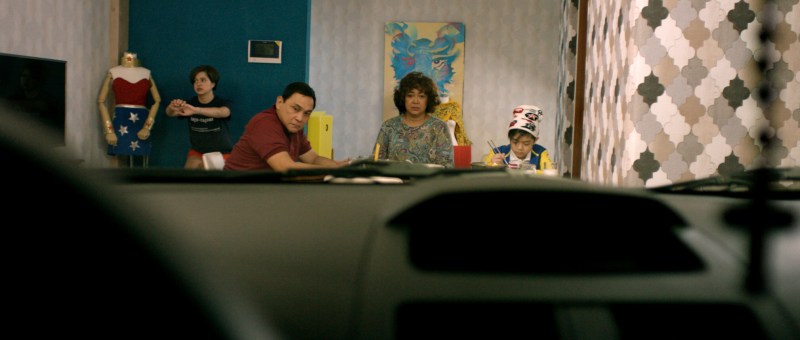
Sonya, understandably unamused, berates her husband for never having cared enough for his family. If only he hadn’t spent so much time drinking with colleagues, playing golf, and singing karaoke, he might not have got himself into this kind of mess. Sonya hijacks a passing forklift truck and shifts the damaged vehicle into their home through a window, planning to dismember it to hide the evidence of Don’s transgression so they can all go home together as planned. 

As in most family dramas, it’s Sonya who has a plan and is determined to ensure the survival of the family. Unlike the 1992 Japanese comedy Hit-and-Run Family which apparently inspired the film, the Mapalads are strangers in a strange land though they’ve also become estranged from each other while Sonya feels increasingly unappreciated seeing as her kids are growing up and her husband is always working. As Don later points out, the crisis gives her a new sense of purpose as she formulates a series of ingenious plans to cover up Don’s crime. “Nothing is important if we’re not together” she tells him. Family means leave no man behind. 

Don, meanwhile, is forced to confront a potential failure of paternity. It is indeed he who has endangered the integrity of his family through his carelessness, but he’ll also have to admit that he’s been neglecting his responsibilities in a mistaken belief that bringing home the bacon is all that’s required of a “good father”. He hasn’t noticed that his wife is lonely and unhappy, or that his children each have secrets of their own. His waking up to all of those facts is a gradual, not always positive process, but eventually leads him to realise that it’s time for him to be a “real” father which obviously means recommitting to his family. 

In perhaps a change from the norm, that’s also true for the kids who need to rediscover a sense of solidarity and acceptance in the family unit. Oldest and now grownup daughter Shine (Sue Ramirez) has been secretly dating a Korean policeman (Shinwoo), which presents a dilemma now that the family is set on moving back home. She’s worried her conservative father might not accept her new love, but the situation is of course further complicated by the ongoing crisis and his proximity to law enforcement. Meanwhile, little Max (Marco Masa) has been caught wearing lipstick at school. Sonya doesn’t understand why that’s a problem but the school seem to think it’s not appropriate and might cause offence to other pupils. Always keen to support her kids, Sonya puts on her Wonder Woman outfit to tell Max that it’s OK to be different, and in any case his family will always love him no matter what, while also doing her best to react to her daughter’s romantic crisis in a broadly supportive manner. 

In fact, the family also end up adding an additional member in the form of the old grandpa from next-door (Han Tae-il) who has mild dementia and keeps wandering off because his daughter-in-law (Park Se-jin) isn’t very invested in looking after him. Eventually, everyone is wearing overalls and helping to dismantle the car, a symbol of the empty consumerism which has divided them. Don, meanwhile, is torn about the best way to serve his family – do the “right” thing and turn himself in, or continue covering up his crime so they can all go home to the Philippines together. In predictable fashion, the crisis resolves itself with the help of benevolent law enforcement, while even the nosy neighbour from next-door seems like she might have learned some lessons about familial bonding or at least be about to move past a crisis of her own. Thanks to their brush with crime, the Mapalads have rediscovered the meaning of family and can finally go “home” at last. 


Sunshine Family was screened as part of this year’s Osaka Asian Film Festival.

Original trailer (English subtitles)

The Age of Success (성공시대, Jang Sun-woo, 1988)

Age of Success still 3“Love only matters when you can sell it” in the nihilistic world of Jang Sun-woo’s The Age of Success (성공시대, Seonggong shidae). The Korea of 1988 was one of increasingly prosperity in which the recently democratised nation looked forward to a new era of freedom, hosting the Olympic Games as a calling card to the world stage. Like everywhere else in the ‘80s however it was also a time in which greed was good, time was money, and compassion was for suckers. Jang’s narcissistic hero worships Hitler and offers a nazi salute to a mockup of a high value note with his own face on it as he leaves for work every morning, but his relentless pursuit of “success” is destined to leave him empty handed when he realises the only commodity he can’t sell is sincerity.

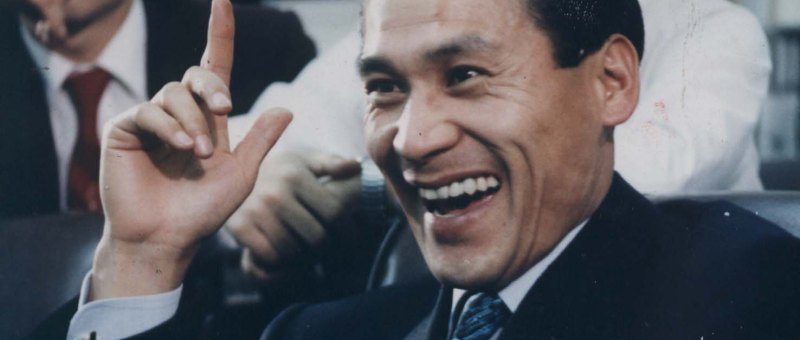
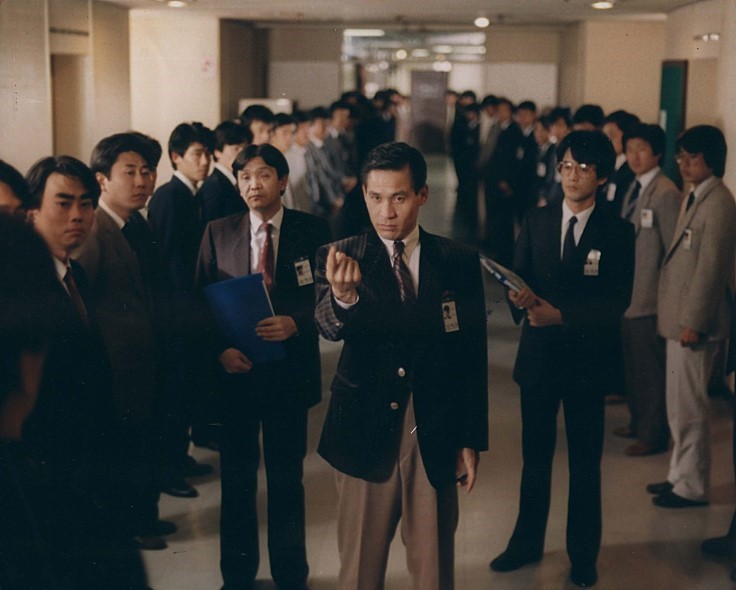
The executives of Yumi Foods, a subsidiary of Mack Gang (Mighty) corporation, are looking for a bright new face through a series of individual interviews. The panel asks each of the prospective new hires to prove their sales ability by convincing them to buy something inconsequential they happen to have in their pockets. Each of the young men fails, until the sharply suited Kim Pan-chok (Ahn Sung-ki), whose name literally means “sales promotion”, dazzles them with a show of intense charisma. He simply offers to sell them whatever is inside his clenched fist. Such is his conviction, the CEO finds himself emptying his wallet, pouring out his credit cards, and eventually borrowing from his friends until Pan-chok is satisfied he’s getting all he could possibly get at point which he opens his fingers and reveals his empty palm. The bosses are annoyed, but quickly convinced by Pan-chok’s explanation that what he’s sold them is “sales spirit” which is, after all, the most valuable thing of all (not to mention exactly what they were looking for). Pan-chok is hired.

Later, we find out that Pan-chok’s routine is an ironic inversion of his childhood trauma. A poor boy abandoned by a mother who became fed up with his father’s fecklessness, he waited alone every day for his dad to come home with something to eat. But his dad was an irresponsible drunkard who could never hold down a job. Like Pan-chok, he held out his fist and told the boy to open his fingers but he was always empty-handed. Hating his father’s incompetence, laziness, alcoholism, and violence, Pan-chok decided that he had to be strong. “Poverty makes you low and pathetic”, he insists. Love, pity, and mercy are for people with no power. “The important thing is to be strong, to win, succeed, possess, and to dominate. Only then will I be happy”.

Pan-chok is a corporate fascist wedded to ultra capitalist ideology in which the only thing that matters is strength and the ability to dominate. He lies, and cheats, and misrepresents himself to pull every underhanded trick in the book to try and get ahead. He goes to war, quite literally, with industry rival Gammi, intent on completely destroying them in order to dominate the market by whatever means possible. Coming up with signature product Agma, he irritably tells his development team that none of their work really matters because the quality of the product is largely irrelevant. Just as in his interview, all Pan-chok is selling is false promise wrapped up in marketing spin. His rival goes on TV to talk the value of tradition to defend himself against a smear campaign Pan-chok has engineered to suggest his products are a health risk, but eventually gets the better of him by playing him at his own game and making a late swing towards ultra modernity.

Pan-chok’s main gambit is seducing a local bar hostess, Song Sobi (Lee Hye-young), lit. “sexual consumption”, and using her as a spy to get info on Gammi’s latest products, but Sobi falls in love with him only to have her heart broken when she realises Pan-chok will discard her when he decides she is no longer useful. He tells her that love is only worth something when you can sell it, but is confounded when she later turns the same logic back on him after selling her charm to seduce the son and heir of the Gammi corporation as a kind of revenge.

Proving that he never learns, Pan-chok’s last big idea is that the only way to beat Gammi’s technological solution is to commodify nature, to repackage and sell back to the people the very things he previously rejected in human sensation. By this point, however, he is so thoroughly discredited that few will listen. His new boss has an MBA from an American university and no time for Pan-chok’s scrappy post-war snake oil salesman tactics. “Only success can set you free”, Pan-chok was fond of saying, but it belied a desperation to escape post-war penury. What he wanted was freedom from hunger, anxiety, and subjugation. He wanted to be a big man, not a small one like his father who always came home empty-handed, so that no one could push him around. What he became was a man without a soul, empty-hearted, consuming himself in pursuit of the consumerist dream. Korea, Jang seems to say, should take note of his lesson.


The Age of Success was screened as part of the 2019 London Korean Film Festival.