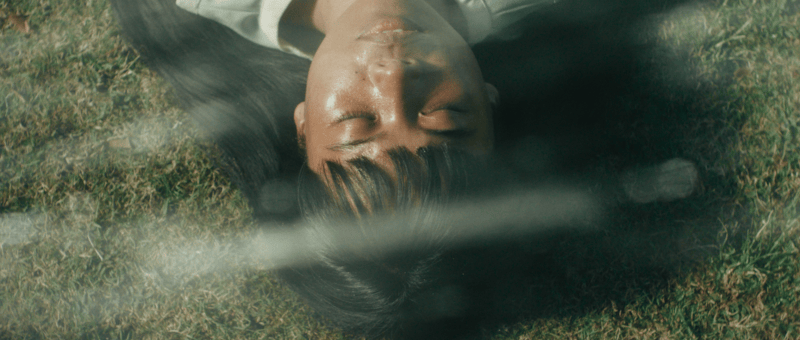
Filipiñana (Rafael Manuel, 2026)

“If one of them dies, it will be replaced,” a worker reassures a wealthy client, ostensibly talking about a dried-out tree, but it’s clear his comment extends even to the largely anonymous employees of an upscale Manila golf course in Rafael Manuel’s satirical drama, Filipiñana. 17-year-old country girl Isabel (Jorrybell Agoto) has come here from her rural hometown to become a “tee girl,” which is to say her job consists of sorting golf balls and placing them in front of the wealthy men who are the course’s main clientele.

The sunlight glints ominously off the club fondled by Renato (Carlos Siguion-Reyna), a golfing supplies magnate who has brought his niece Clara (Carmen Castellanos) to the resort in the hope of convincing her to come “back” to the Philippines from the US and join his company. Manuel’s sound design captures every thwack of the club with an eerie violence that hints both at the damage this place is doing to the natural world and social fabric, and the power and privilege wielded by men like Renato against young women like Isabel. Noticing that the man she’s teeing keeps mis-hitting his balls, Isabel fears one is going to hit her and asks another girl for advice only to be told that it doesn’t hurt that much really and the golfer will probably feel guilty and tip more.

Isabel is temporarily handed the club herself when charged with returning it to the course’s mysterious manager, Dr. Palanca (Teroy Guzman) whom she first saw snoozing with one of the caddies under a mango tree. The club gives Isabel a free pass to wander through the parts of the resort where she would not ordinarily be allowed to go and also grants her access to some of its grimmest secrets. It seems that Isabel might have come here with revenge on her mind, recounting how Dr. Palanca’s trucks arrived to turf her out of her hometown, which is also his hometown though it seems like it means something different to him. But at the same time, she doesn’t quite know what to do with this power that she’s temporarily been given, give it back to those who think it’s theirs, or use it to begin dismantling this system even if it requires violence to do so.

In that sense her dilemma might not be that different from Clara’s, despite the extreme differences between them. Clara is the only female golfer that we see in a world otherwise entirely set up for men. Ina (Isabel Sicat), Clara’s caddie, asks her if all the caddies in America are female too, but is surprised to learn that in America people mostly carry their own bags. Perhaps this might suggest a rather simplistic characterisation of America as an egalitarian paradise, yet America once colonised the Philippines and these golf courses, even if now mostly catering to Chinese tourists, are a legacy of its occupation. Towards the end of the film, Manuel inserts black and white photos of plantations on the grounds of which these courses have been built.

Clara makes a point of telling Ina that her uncle is “harmless,” which is something there wouldn’t be any need to say if she actually believed it. Like Isabel, she seems uncomfortable with the course and what it represents, values implied to be born of her US upbringing, yet it’s exactly this discomfort that her uncle weaponises in suggesting she change the system from the inside. He tells her that they urgently need to diversify their customer base seeing as all their clients are older men and they urgently need people like her do it, so this country can progress. By “progress”, he likely means in his favour preserving the power and privilege of men like himself, but couched in more compassionate language such as his attempt to pass the hat round for golfers to donate to a fund to support the caddies’ families during the drought, when the best way to do that would obviously be to turn the sprinklers off at the gold course.

In the opening scenes we a minibus carrying Chinese tourists to the hotel pass through a crowd of people waiting to collect their water ration under the blistering Manila sun. It’s as if the course itself has sapped the life out of the surrounding city, rendering all too tired to want to resist having internalised the status quo as just that. The wealthy golfers relentlessly cheat at the game and are allowed to get away with it, while the smallest transgression can spell disaster for an employee. “I should aim for the left,” Clara says while looking at a hole despite her uncle and Ina’s advice that it bends right, only for Renato to reassure her that she’s “still learning” as he pulls her towards accepting this privilege despite her misgivings over the excess and exploitation on which the golf course is founded. Somewhat bleak in its implications, Manuel subverts the film’s quirky production design to create a sense of uncanniness in its essential unreality as a ruling class seeks to recreate the idyllic pastorality of a bygone age that they themselves have largely destroyed while seeking to keep it purely for themselves.


Filipiñana opens in UK cinemas 20th November courtesy of BFI Distribution.

Trailer (English subtitles)
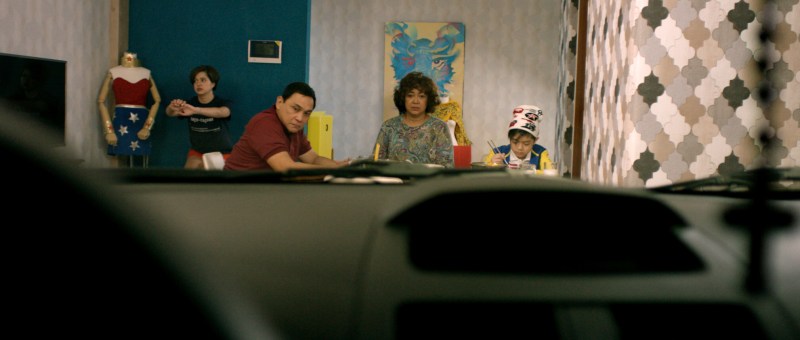
Sunshine Family (Kim Tai-sik, 2019)

Sometimes it’s easy to lose track of what’s really important while chasing illusionary success, but you’ll remember soon enough if you hit a crisis. So it is for the members of the “Sunshine Family”, the Mapalads currently living overseas in Seoul where dad works for a travel company. The Mapalads are finally preparing to move back to Manila with a house already paid for, but when dad has an accident in his car it throws all of their plans into disarray. Yet in needing to come together to combat adversity, the family is in a sense repaired as they each come to appreciate each other for who they are while remembering that they have a collective responsibility. 

That “accident” occurs one Christmas while dad Don (Nonie Buencamino) is driving home after a work/leaving party. He’s had a little bit too much to drink and is distracted by a phone call from his boss when a woman suddenly jumps out into the road and collides with his car. Don is obviously upset, hugging the oversize snowman plushie he was travelling with for comfort as he stops to check on the woman who he is certain is either dead or at least in a very bad way. Frightened of getting into trouble he drives off and leaves her, calling his dependable wife Sonya (Shamaine Buencamino) for support. 

Sonya, understandably unamused, berates her husband for never having cared enough for his family. If only he hadn’t spent so much time drinking with colleagues, playing golf, and singing karaoke, he might not have got himself into this kind of mess. Sonya hijacks a passing forklift truck and shifts the damaged vehicle into their home through a window, planning to dismember it to hide the evidence of Don’s transgression so they can all go home together as planned. 

As in most family dramas, it’s Sonya who has a plan and is determined to ensure the survival of the family. Unlike the 1992 Japanese comedy Hit-and-Run Family which apparently inspired the film, the Mapalads are strangers in a strange land though they’ve also become estranged from each other while Sonya feels increasingly unappreciated seeing as her kids are growing up and her husband is always working. As Don later points out, the crisis gives her a new sense of purpose as she formulates a series of ingenious plans to cover up Don’s crime. “Nothing is important if we’re not together” she tells him. Family means leave no man behind. 

Don, meanwhile, is forced to confront a potential failure of paternity. It is indeed he who has endangered the integrity of his family through his carelessness, but he’ll also have to admit that he’s been neglecting his responsibilities in a mistaken belief that bringing home the bacon is all that’s required of a “good father”. He hasn’t noticed that his wife is lonely and unhappy, or that his children each have secrets of their own. His waking up to all of those facts is a gradual, not always positive process, but eventually leads him to realise that it’s time for him to be a “real” father which obviously means recommitting to his family. 

In perhaps a change from the norm, that’s also true for the kids who need to rediscover a sense of solidarity and acceptance in the family unit. Oldest and now grownup daughter Shine (Sue Ramirez) has been secretly dating a Korean policeman (Shinwoo), which presents a dilemma now that the family is set on moving back home. She’s worried her conservative father might not accept her new love, but the situation is of course further complicated by the ongoing crisis and his proximity to law enforcement. Meanwhile, little Max (Marco Masa) has been caught wearing lipstick at school. Sonya doesn’t understand why that’s a problem but the school seem to think it’s not appropriate and might cause offence to other pupils. Always keen to support her kids, Sonya puts on her Wonder Woman outfit to tell Max that it’s OK to be different, and in any case his family will always love him no matter what, while also doing her best to react to her daughter’s romantic crisis in a broadly supportive manner. 

In fact, the family also end up adding an additional member in the form of the old grandpa from next-door (Han Tae-il) who has mild dementia and keeps wandering off because his daughter-in-law (Park Se-jin) isn’t very invested in looking after him. Eventually, everyone is wearing overalls and helping to dismantle the car, a symbol of the empty consumerism which has divided them. Don, meanwhile, is torn about the best way to serve his family – do the “right” thing and turn himself in, or continue covering up his crime so they can all go home to the Philippines together. In predictable fashion, the crisis resolves itself with the help of benevolent law enforcement, while even the nosy neighbour from next-door seems like she might have learned some lessons about familial bonding or at least be about to move past a crisis of her own. Thanks to their brush with crime, the Mapalads have rediscovered the meaning of family and can finally go “home” at last. 


Sunshine Family was screened as part of this year’s Osaka Asian Film Festival.

Original trailer (English subtitles)