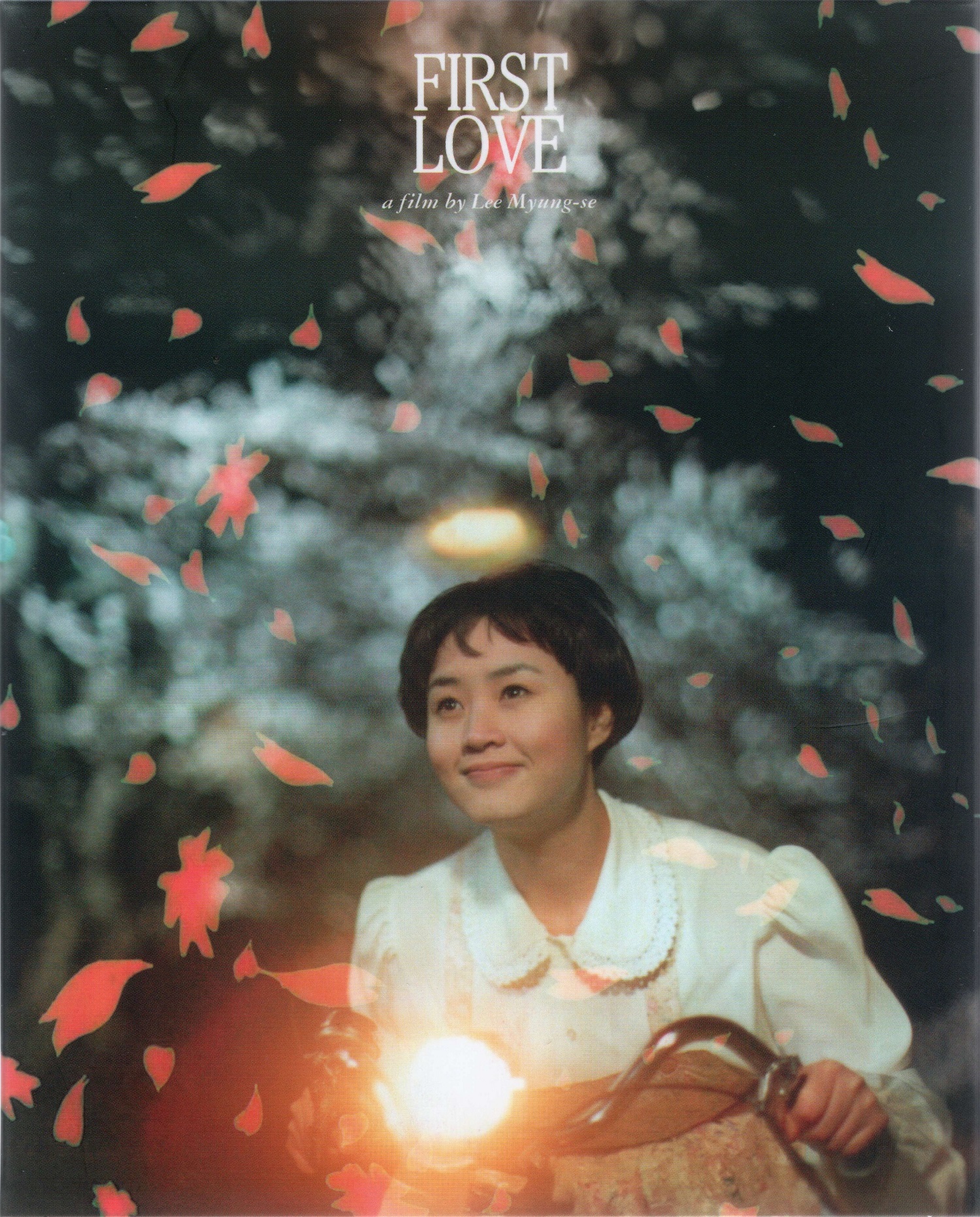
First Love (첫사랑, Lee Myung-se, 1993)

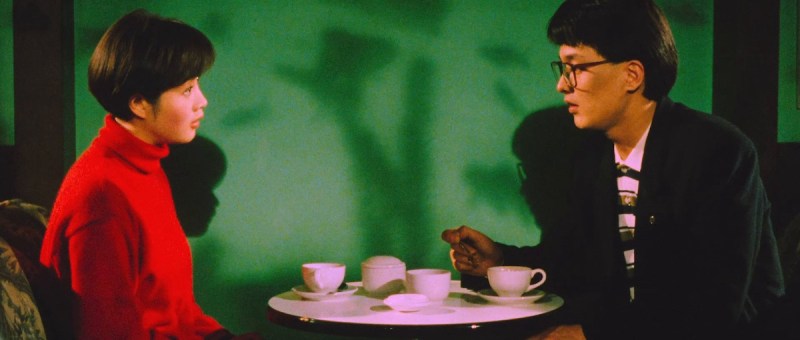
Expectations were high for Lee Myung-Se’s third film, First Love (첫사랑, Cheot Sarang), given that My Love, My Bride had been a runaway success. First Love proved to be, however, one of the worst box office disasters in Korean cinema history, selling fewer than 6000 tickets in Seoul during the Lunar New Year holiday. The film was however well received by the industry with star Kim Hye-soo picking up best actress at that year’s Blue Dragon Awards. Lee had originally intended to cast Choi Jin-sil, the female lead of My Love, My Bride, who had even turned down a TV drama series to do the film, but she apparently didn’t take to the personality of the character after reading the script and withdrew. Casting former child star Kim Hye-soo was seen as a left-field choice, but paid off in spades as Kim perfectly embodies the innocence and heartbreak of first love in charming fashion.

In some respects, the film is structured in a similar way to Thornton Wilder’s Our Town which first-year university student Young-shin’s (Kim Hye-soo) theatre club is performing. As the Stage Manager explains in the play, the first act will deal with everyday life, the second with first love, and the third with something else he assumes the audience will be able to guess, in case of the play, death. The film, however, ends with something more like continuity as the street where Young-shin lives turns from summer into autumn, winter, and then comes full circle into spring as one of the poems that pepper the screen pops up to remind us that everything begins and ends with nothing, or in other words, life goes on.

Set in the 1970s, the film opens with Young-shin taking a trip to Seoul from her rural hometown where she is a student in order to recruit a director for their play. She is immediately disappointed by Kang Chang-Wook (Song Young-chang), reflecting that she was expecting someone much more literary and poetic who in contrast to the local men wouldn’t smoke and drink excessively. Chang-wook even has an off-putting habit of rubbing his hair to shake the dandruff out which suggests poor hygiene. Nevertheless, her initial aversion to him soon transitions into attraction and an all-consuming, obsessive love, though she is only 19 and he 32. 

Much of the film takes place within her romantic fantasy and flights of fancy in which she develops superpowers such as invisibility or telekinesis while pursuing Chang-wook, her bicycle seemingly moving on its own under the vibrant cherry blossoms. She frequently addresses the camera directly to explain aspects of her life, particularly how boring it is in this rural town where the height of excitement is sending her younger sister out on an illicit late night mandu run. This thrill of romance is also, in that sense, a way of passing the time, though it’s often difficult to see what she sees in Chang-wook who is often patronising and has a bad drinking habit. When the pair go on a kind of date to a historical temple, he drinks so much that they miss the last train and Young-shin has to take him to a hotel, booking into a rent by the hour type place without realising and having to lie about her age on the register. 

But while she is experiencing her first love, so are others. Her childhood friend Moon-su (Jo Min-ki) is clearly in love with her, trying to declare his feelings by giving her a copy of Tugenev’s First Love, though this proves too obscure a clue for Young-shin who is still wrapped up in her own romantic drama. The deliberately artificial set design, mostly taking place on a studio set, evokes a strong sense of nostalgia for an idealised youth. Young-shin and her friend fancy Gregory Peck and Jean-Paul Belmondo, while there are posters for South Pacific in the background, echoing the ways in which Young-shin has also turned her life into a romantic melodrama. The saturated colour scheme also echoes the Technicolor past, golden light pouring in through the studio windows as Young-shin ponders her romantic dilemma. Only once are we reminded of the less cosy side of the ‘70s as the sirens blast to mark the start of the curfew, trapping Young-shin in the motel room with a passed-out Chang-wook waiting for the first train. Young-shin’s story may be tinged with melancholia as her romantic illusions are smashed by an unexpected discovery, but she still holds on to the memories of this magical time while knowing that there are other loves to still to come as time marches on.


Trailer (no subtitles)
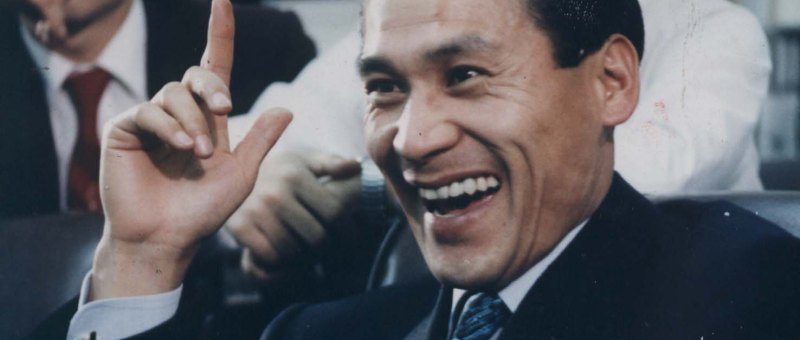
The Age of Success (성공시대, Jang Sun-woo, 1988)

Age of Success still 3“Love only matters when you can sell it” in the nihilistic world of Jang Sun-woo’s The Age of Success (성공시대, Seonggong shidae). The Korea of 1988 was one of increasingly prosperity in which the recently democratised nation looked forward to a new era of freedom, hosting the Olympic Games as a calling card to the world stage. Like everywhere else in the ‘80s however it was also a time in which greed was good, time was money, and compassion was for suckers. Jang’s narcissistic hero worships Hitler and offers a nazi salute to a mockup of a high value note with his own face on it as he leaves for work every morning, but his relentless pursuit of “success” is destined to leave him empty handed when he realises the only commodity he can’t sell is sincerity.

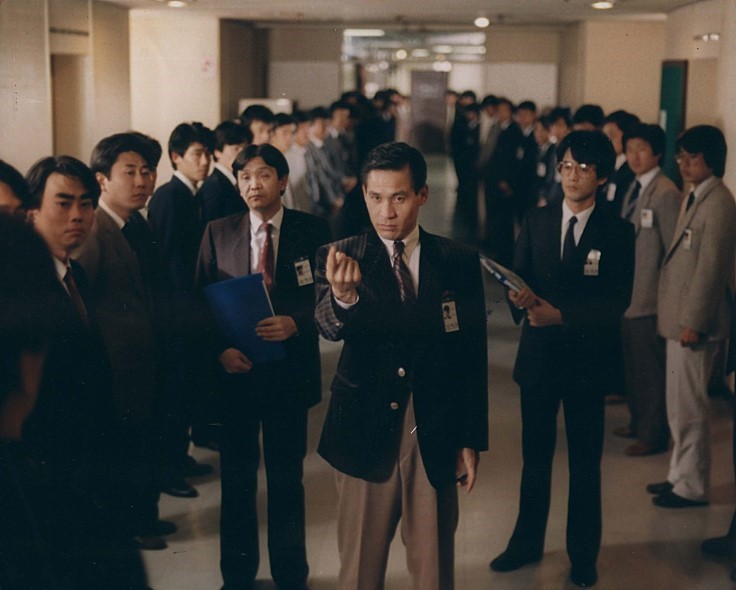
The executives of Yumi Foods, a subsidiary of Mack Gang (Mighty) corporation, are looking for a bright new face through a series of individual interviews. The panel asks each of the prospective new hires to prove their sales ability by convincing them to buy something inconsequential they happen to have in their pockets. Each of the young men fails, until the sharply suited Kim Pan-chok (Ahn Sung-ki), whose name literally means “sales promotion”, dazzles them with a show of intense charisma. He simply offers to sell them whatever is inside his clenched fist. Such is his conviction, the CEO finds himself emptying his wallet, pouring out his credit cards, and eventually borrowing from his friends until Pan-chok is satisfied he’s getting all he could possibly get at point which he opens his fingers and reveals his empty palm. The bosses are annoyed, but quickly convinced by Pan-chok’s explanation that what he’s sold them is “sales spirit” which is, after all, the most valuable thing of all (not to mention exactly what they were looking for). Pan-chok is hired.

Later, we find out that Pan-chok’s routine is an ironic inversion of his childhood trauma. A poor boy abandoned by a mother who became fed up with his father’s fecklessness, he waited alone every day for his dad to come home with something to eat. But his dad was an irresponsible drunkard who could never hold down a job. Like Pan-chok, he held out his fist and told the boy to open his fingers but he was always empty-handed. Hating his father’s incompetence, laziness, alcoholism, and violence, Pan-chok decided that he had to be strong. “Poverty makes you low and pathetic”, he insists. Love, pity, and mercy are for people with no power. “The important thing is to be strong, to win, succeed, possess, and to dominate. Only then will I be happy”.

Pan-chok is a corporate fascist wedded to ultra capitalist ideology in which the only thing that matters is strength and the ability to dominate. He lies, and cheats, and misrepresents himself to pull every underhanded trick in the book to try and get ahead. He goes to war, quite literally, with industry rival Gammi, intent on completely destroying them in order to dominate the market by whatever means possible. Coming up with signature product Agma, he irritably tells his development team that none of their work really matters because the quality of the product is largely irrelevant. Just as in his interview, all Pan-chok is selling is false promise wrapped up in marketing spin. His rival goes on TV to talk the value of tradition to defend himself against a smear campaign Pan-chok has engineered to suggest his products are a health risk, but eventually gets the better of him by playing him at his own game and making a late swing towards ultra modernity.

Pan-chok’s main gambit is seducing a local bar hostess, Song Sobi (Lee Hye-young), lit. “sexual consumption”, and using her as a spy to get info on Gammi’s latest products, but Sobi falls in love with him only to have her heart broken when she realises Pan-chok will discard her when he decides she is no longer useful. He tells her that love is only worth something when you can sell it, but is confounded when she later turns the same logic back on him after selling her charm to seduce the son and heir of the Gammi corporation as a kind of revenge.

Proving that he never learns, Pan-chok’s last big idea is that the only way to beat Gammi’s technological solution is to commodify nature, to repackage and sell back to the people the very things he previously rejected in human sensation. By this point, however, he is so thoroughly discredited that few will listen. His new boss has an MBA from an American university and no time for Pan-chok’s scrappy post-war snake oil salesman tactics. “Only success can set you free”, Pan-chok was fond of saying, but it belied a desperation to escape post-war penury. What he wanted was freedom from hunger, anxiety, and subjugation. He wanted to be a big man, not a small one like his father who always came home empty-handed, so that no one could push him around. What he became was a man without a soul, empty-hearted, consuming himself in pursuit of the consumerist dream. Korea, Jang seems to say, should take note of his lesson.


The Age of Success was screened as part of the 2019 London Korean Film Festival.

Seven People in the Cellar (지하실의 7인 / 地下室의 七人, Lee Seong-gu, 1969)

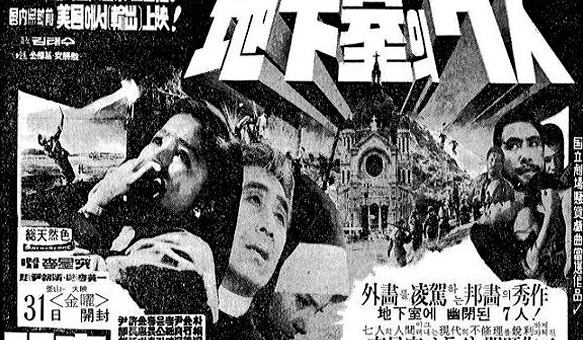
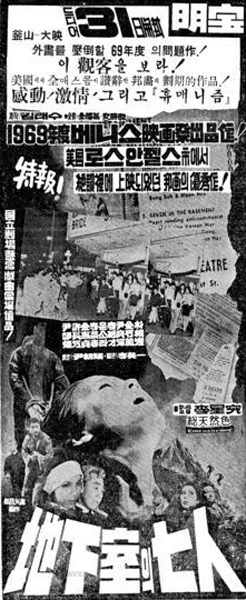
Seven People in the Cellar poster

The “literary film” was beginning to fall out of favour by 1969. The collapse of the quota system introduced under the 1962 Motion Picture Law, the exclusion of literary film from the “Domestic Films of Excellence” programme (which encouraged producers to produce high quality Korean films to qualify for distributing more lucrative foreign ones), and the rise of television all conspired to produce a shift towards the populist. Lee Seong-gu had made his name with a series of literary adaptations which enabled him to experiment with form in the comparatively more elevated “arthouse” arena but with horizons shrinking even he found himself with nowhere left turn. Seven People in the Cellar (지하실의 7인 / 地下室의 七人 *, Jihasil-ui Chil-in) is Lee’s last “literary film” and is adapted from a stage play by Yun Jo-byeong who was apparently unhappy with Lee’s adaptation in its abandonment of his carefully constructed ideological balance in favour of adhering to the typical rhetoric of the “anti-communist” film.

Set towards the end of the Korean War, Seven in People in the Cellar presents itself as a conflict between the godless and hypocritical forces of communism and the good and righteous Catholic Church. Accordingly, our hero is a priest, Father Ahn (Heo Jang-gang), who has just returned to his church after being forced to flee by the encroaching “puppet army”. Accompanied by a nun, Lucia (Yun So-ra), and a new curate, Brother Jeong (Lee Soon-jae), Father Ahn is glad to be reunited with his flock but there are dark spectres even here – Maria (Yoon Jeong-hee), a young woman Ahn was forced to leave behind when he fled, runs away from the priest on catching sight of him, apparently out of shame. Meanwhile, while Ahn was away, three rogue Communists began squatting in his cellar waiting for the “reinforcements” which are supposedly going to retake the town. Taking Sister Lucia hostage, the Communists force Ahn to feed them while keeping their existence a secret. To Jeong’s consternation, Ahn agrees but out of Christian virtues rather than fear – he feels the Communists too are lost children of God and have been sent to him so that he may guide them back towards the light.

Not a natural fit for the world of the anti-communist film, Lee does his best to undermine the prevalent ideology even if he must in the end come down hard with Ahn’s essential moral goodness. Thus, Communists aside, the conflict becomes one of age and youth, male and female, as much as between “right” and “wrong” or “North” and “South”. Jeong, youthful and hotheaded, lacks Ahn’s Christian compassion – he bristles when Ahn immediately sets about feeding the starving villagers with their own rations, and disagrees with his decision to harbour the Communists even while knowing that Lucia’s life is at stake if they refuse. Twice he tries to kill the communist “enemy”, threatened by their ideological opposition to his own cause – once when he enters the cellar and misinterprets an altercation between Lucia and sympathetic soldier Park (Park Geun-hyeong), and secondly when the troop’s female commander, Ok (Kim Hye-jeong), attempts to seduce him.

Sexuality becomes spiritual battleground with Christian chastity winning out over Communist free love. Ok, as unsympathetic a communist as it’s possible to be, is sexually liberated and provocative. She suggestively loosens her shirt and fondles her breast in front of a confused junior officer, later taking him into the forest and more or less ordering him to make love to her (which he, eventually, does). However, it is to her simply a matter of a need satisfied. Ok describes the moment she has just shared with her comrade as no different than sharing a meal. She was “hungry”, she ate. When she’s hungry again she will eat again but there’s no more to it than that and there is no emotional or spiritual component in her act of “lovemaking”, only the elimination of a nagging hunger. 

Ok’s transgressive and “amoral” sexuality is contrasted with that of the abused Maria who was tortured and later raped by the Communists’ commanding officer. Forced to betray a nun, she was robbed not only of her innocence but also of her faith. Maria is the “pure woman” corrupted by Communist cruelty. Her chastity was removed from her by force, and she sees no other option than to continue to ruin herself in atonement for her “sin”. Unable to live with the consequences of her actions, she sees no way out other than madness or martyrdom.

The fact that Maria’s torturer is another woman, and such an atypical woman at that, is another facet of the Communist’s animalistic inhumanity. As in The General’s Mustache, the Communists are seen to use innocent children as bargaining chips when ordinary torture fails, even this time killing one to prevent him telling the village about their hiding place. Yet the height of their cruelty is perhaps in their indifference to each other – Park, touched by Sister Lucia’s refusal to leave when he tried to let her go fearing that he would face reprisals, announces his intention to defect to the South and is shot dead by his commander in cold and brutal fashion. Park’s defection is a minor “win” for Ahn who sought restore the Communists’ sense of humanity and bring their souls to God, but it’s also born of misogynistic pique in his intense resentment of the “bossy” Ok who turns out to be an undercover officer from HQ on a special mission to spy against him.

With the one redeemed Communist dead, all that remains is for the others is to slowly destroy themselves. Ahn, cool and composed in absolute faith, waits patiently certain that the friendly South Korean soldiers will shortly liberate them. A hero priest, Ahn is the saintly opposite of the Communists’ cruelty in his compassionate determination to save them even at the risk of his own life. Lee keeps the tension high, creating siege drama that feels real and human in contrast with the often didactic and heavily stylised narrative of the “anti-communist” film, subtly muddying the essential messages but allowing Ahn’s compassion (rather than his “faith”) to shine through as the best weapon against oppressive inhumanity.


Seven People in the Cellar is the fourth and final film included in the Korean Film Archive’s Lee Seong-gu box set. Not currently available to stream online.

* In rendering the Hanja title, the landscape poster uses the arabic numeral 7 while the portrait version uses the Chinese character 七.