The Boy and the Heron (君たちはどう生きるか, Hayao Miyazaki, 2023)

Sales of Genzaburo Yoshino’s 1937 novel How Do You Live? (君たちはどう生きるか, Kimitachi wa Do Ikiru ka? went through the roof when it was announced that the no longer retired Hayao Miyazaki would be directing a new film with the same title. Predictably, Miyazaki’s film turned out not to be an adaptation at all, or at least not a literal sense, but was intensely interested in the question not so much how do you live but how will you? Will you allow the past to make you bitter and live in a world of pain and resentment, or will you choose to live in a world of peace and beauty free of human malice?

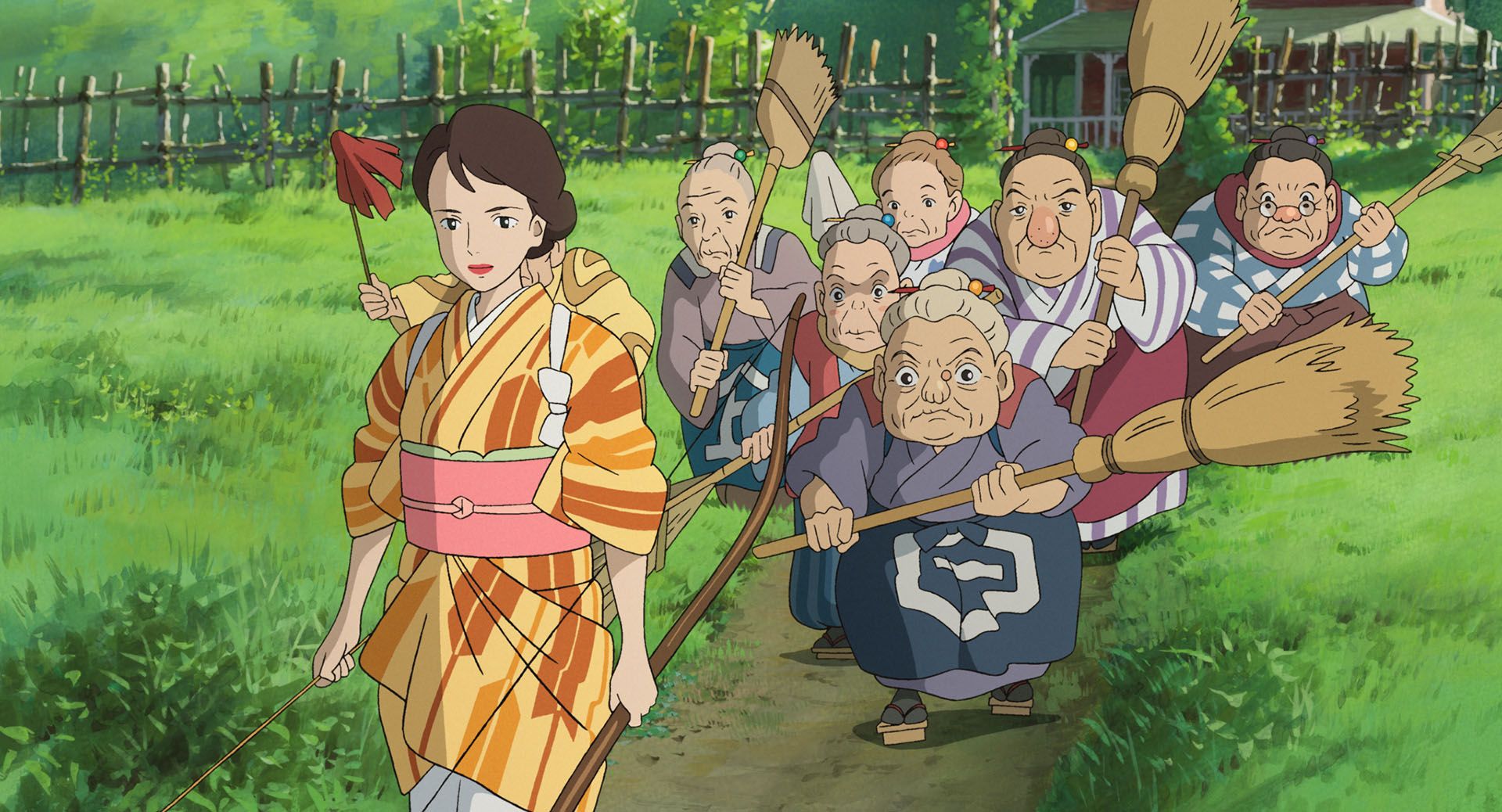
These are of course the questions faced by a post-war generation, the children of Miyazaki’s own era who came of age in a time of fear and suffering. Mahito (Soma Santoki), the hero, loses his mother in the firebombing of Tokyo. He runs through a world of shadows to save her from the flames but of course, he cannot. A year later everything has changed. His father has remarried, taking his mother’s younger sister Natsuko (Yoshino Kimura) as his new wife. Natsuko is now pregnant which suggests the relationship began some time ago though Mahito knew nothing of it and had no recollection of ever having met Natsuko before being sent to live in her giant mansion in the country more or less untouched by the war. 

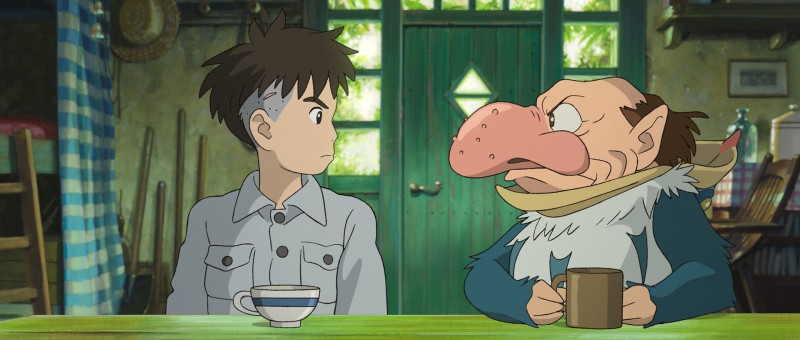
It’s here that Mahito’s own malice rises. He is polite, if sullen, but cannot warm to his new stepmother and resents his father’s relationship with her. Perpetually bothered by a grey heron (Masaki Suda) his first thought is to kill it, crafting a bow and arrow from bamboo and one of the heron’s own feathers. Shunned as the new boy at school he hits himself on the head with a rock while his father, Shoichi (Takuya Kimura), comically vows revenge and lets him stay home. As he points out, there’s not much “education” going on anyway with most of the students pulled away from their studies for “voluntary” labour in service of the war effort in this case agricultural. 

Shoichi has moved to the country to open a factory which it seems produces canopies for fighter planes which is all to say that he is profiting from the business of war, though transgressively referencing the failure in Saipan over breakfast with the mild implication that it might work out alright for him. There is after all a grim reason they’ll be in need of large numbers of aircraft parts in the near future. Mahito’s dark impulses are directly linked to those of militarism and the folly of war. When he finally enters the tower of madness apparently constructed by a great-uncle who went insane through reading too many books, he discovers that his enemies are an ever expanding clan of fascistic, man-eating parakeets led by a Mussolini-like despotic leader attempting to manipulate the Master of the tower. 

Inside the tower is a land out of time, a place for those already dead or in essence an eternal past. It’s here that Mahito is presented with a choice, how will he live? Will he choose malice and destruction, or will he choose to leave and build a new world of beauty and peace above? In many ways, the important point is that the choice is his as it is ours, that we are free to decide and that our choices create the world in which we live. Through his adventures in the tower, Mahito begins to come to terms with his situation and resolves to accept Natsuko as a mother and make friends of those he once considered enemies. When the tower itself crumbles, it takes with it the last vestiges of authoritarianism and tyranny.

Prompting his epiphany, Mahito discovers a copy of How Do You Live? in his room, a present from his late mother inscribed to the grown-up Mahito. He is surrounded by the world’s ugliness, forced into a surprisingly graphic fish gutting session that leaves him wiping away blood, recalling his profusely bleeding head injury and the scar it will forever mark him with. Pelicans imprisoned in the other world meanwhile tell him that they have no choice but to behave as they do for the Master of the Tower neglected to put enough fish in the rivers intending them to destroy rather nurture new life while their young too learn all the wrong lessons. Yet there is beauty and strangeness here too, along with kindness and humanity. Boundlessly inventive, Miyazaki couples surrealist visions of murderous birds and the hellish scenes of a city on fire with Mahito the only figure visible in his pale blue school uniform darting through the soot and the shadows. A vivid symphony of life, the film may in its way be about grief and the pain of moving on but finally discovers a kind of serenity in an accommodation with the present and the eternally unfinished question of how you yourself will live. 


The Boy and the Heron screened as part of this year’s BFI London Film Festival.
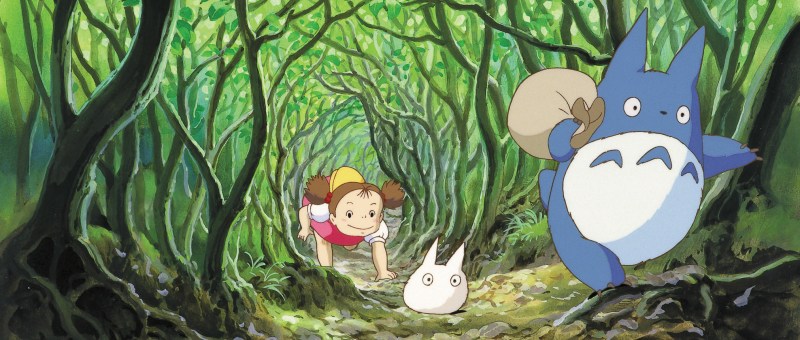
My Neighbor Totoro (となりのトトロ, Hayao Miyazaki, 1988)

© 1988 Studio Ghibli

“Trees and people used to be good friends” explains a father to his little girls newly arrived in the idyllic countryside of post-war Japan seeking respite from the destructive modernity that has made their mother ill. Released alongside the harrowing wartime drama Grave of the Fireflies, My Neighbor Totoro (となりのトトロ, Tonari no Totoro) is a charming tale of childhood adventure if not quite without its shades of darkness in which two sisters embrace the wonder of the natural world while trying to come to terms with mortality and the uncertainties of adulthood. 

Satsuki (Noriko Hidaka) and her younger sister Mei (Chika Sakamoto) have moved into a large, ramshackle house in a rural village on the outskirts of Tokyo for the benefit of their mother’s health while she remains in hospital a few miles away. Living with their cheerful father (Shigesato Itoi), a professor in the city, the girls rejoice in exploring their new environment learning of the dust bunnies that inhabited their home before they moved in. An old lady from the village (Tanie Kitabayashi) who’s come to help keep house until the girls’ mother returns home explains that she could see the “soot spreaders” too when she was a child but presumably not anymore. The idea that the soot speakers will soon move on appears to make the sisters sad, and everyone including the parents is quite excited about the idea of living in a “haunted house” even if it’s one that rattles a little in the wind. It’s younger sister Mei who later follows the trail of acorns that mysteriously appear in their home and encounters a series of strange forest creatures she names “Totoro” that eventually introduce the girls to a parallel world of magic and fantasy. 

Their father probably doesn’t believe them, but indulges the girls’ stories and adventures while encouraging them to embrace a sense of wonder in their environment along with something deeper and older than contemporary modernity. “You probably met the king of this forest” he explains to Mei, pausing to offer a word of thanks to the ancient tree he says first drew him to the house that will be their new family home. Whether Totoro is “real” or simply a childish fantasy he helps the sisters escape their anxiety over their mother’s absence, not least by introducing them to new life in the seeds the girls plant in their garden and patiently wait to grow. The oldest, Satsuki, is perhaps a little more aware, worried that her father might not have told her everything about her mother’s condition and processing the idea that there is a possibility she won’t come home to them. She wants to protect her sister from the same fears but perhaps can’t, eventually losing her patience with her and instantly regretful when Mei goes off in a huff and gets lost.

There is darkness in the village too, a floating sandal in a nearby lake giving rise to fears that a child may have fallen in and drowned, but there’s also the gentle strength of the community in the kindly old lady and her shy grandson Kanta (Toshiyuki Amagasa) along with all the other villagers who come out in force to look for Mei fearing she may have tried to visit her mother at the hospital on her own. The old lady prays furiously while muttering Buddhist sutras and it’s probably not a coincidence that Mei sits by a row of Jizo statues after realising that she’s lost not knowing what to do. The girls are always careful to offer thanks at the Jizo shrine just as their father thanked the tree though it’s Totoro and the Catbus that eventually bring them back together echoing a sense that in a just world kindness will always be repaid. 

The countryside is in many ways closer to that just world, largely free of the evils of modernity such as the pollution of industry that has corrupted the cities. Technology is often unreliable, dad’s train is late, telegrams bring bad news, and telephone calls result in anxious waits, but life in the village is peaceful and happy and the people help each other when times are hard. It may be an idealised vision of rural living, but there’s no denying its appeal. Evoking a sense of nostalgia in its beautifully painted backgrounds, Miyazaki’s gentle drama is like much of his work an advocation for the importance of nature as a source of healing but equally for wonder in the fantastical adventures of two little girls finding strength and possibility in the heart of the forest.


My Neighbor Totoro screens on 35mm at Japan Society New York on Nov.4 as part of the Monthly Anime series. Japan Society will also be hosting a talk with puppet artist Basil Twist on Nov. 10 delving behind the scenes of the Royal Shakespeare Company’s currently running stage adaptation.

Trailer (English subtitles)

Images: © 1988 Studio Ghibli

Princess Mononoke (もののけ姫, Hayao Miyazaki, 1997)

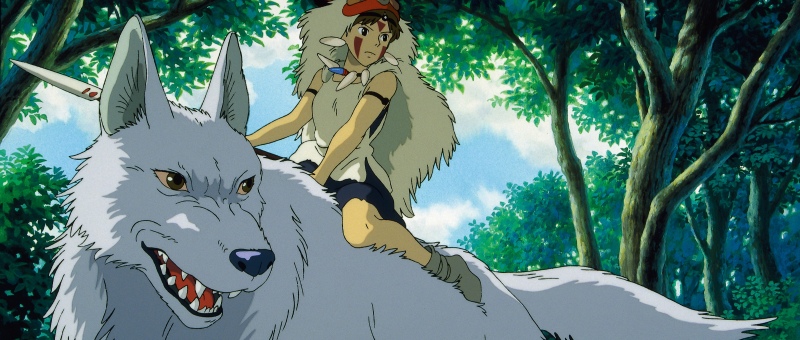
“So you say you’re under a curse? So what? So’s the whole damn world.” The world is indeed cursed in Hayao Miyazaki’s landmark 1997 animation Princess Mononoke (もののけ姫, Mononoke-hime). As the greedy monk insists, “there are angry ghosts all around us. Dead from wars, sickness, starvation. And no one cares”. Yet as an impassioned parable as it is about the destructive forces of industrialisation, Miyazaki’s mystical drama is really about balance and duality along with the necessity of harmony and co-existence with nature red in tooth and claw. 

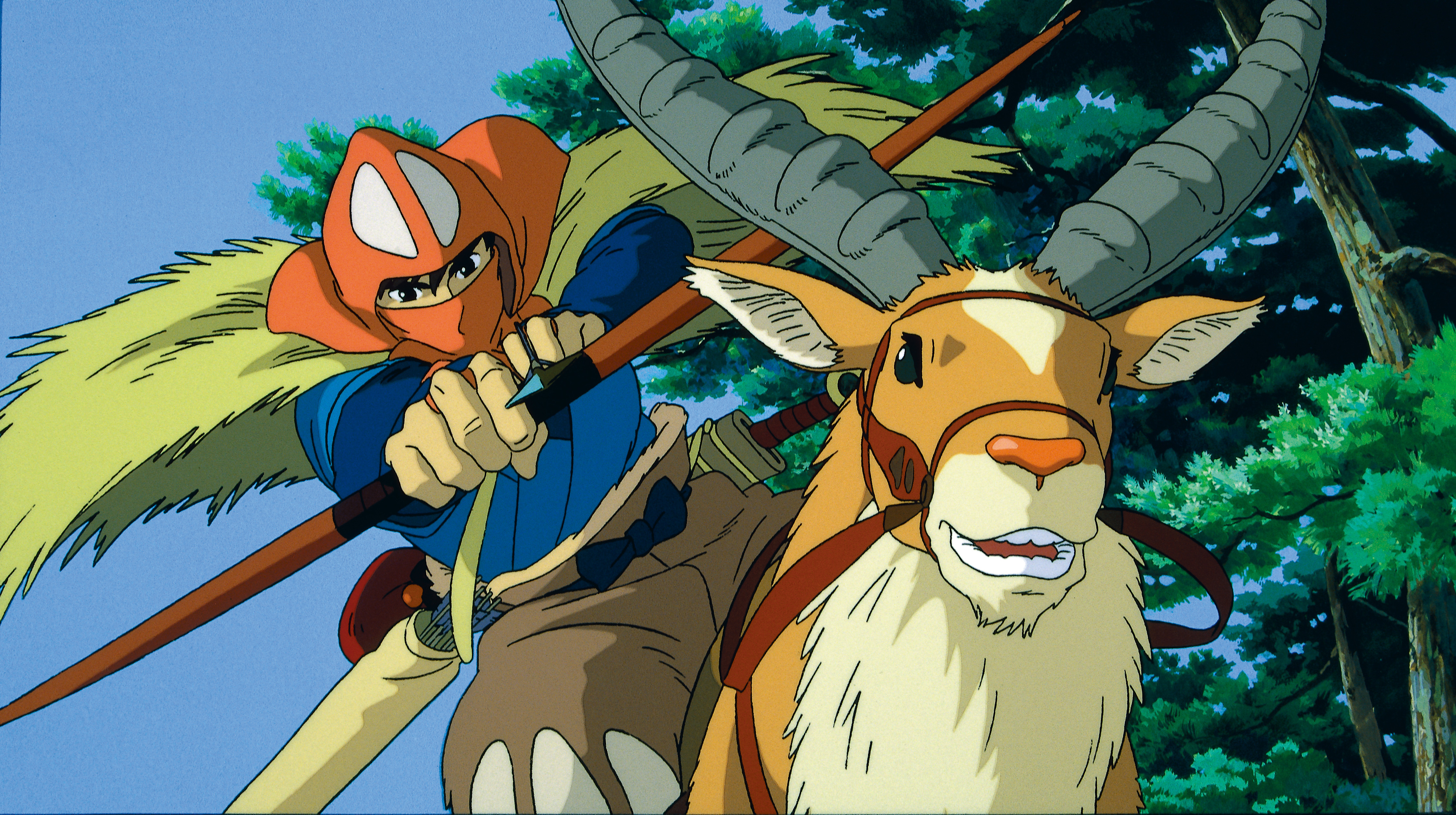
Young prince Ashitaka (Yoji Matsuda) already lives in what seems to be perfect harmony with the natural world, but his idyllic existence in an ancient clan long exiled by the emperor is disturbed one day by a marauding giant boar chased out of the forest having been turned into a demon consumed with hate and resentment. Ashitaka first tries reasoning with the beast, but is finally forced to put it out of its misery to protect the village and is infected himself in the process. Now unable to stay lest he endanger his community, Ashitaka ventures West in search of the corruption which sent the boar hurtling towards his home. 

What he eventually comes to is an industrial settlement, Irontown, ruled by Lady Eboshi (Yuko Tanaka) who ought by all rights to be a villain in her casual disregard of or active hostility towards unruly nature which her industrialisation pollutes. But then as we can see Lady Eboshi is a good and compassionate leader who has erected a community of the marginalised buying out the contracts of indentured sex workers and freeing them to labour in her ironworks while taking in lepers to manufacture her futuristic firearms. Uncharitably, one could also say that she’s chosen these people because they have little power and will be more likely to put up with hardship and exploitation without complaint because it’s better than the lives they lived before, but it does it does seem that she has her heart in the right place as far as her people are concerned determined to build a community of mutual solidarity between workers. 

Conversely, the titular Princess Mononoke, San (Yuriko Ishida), ought by rights to be the heroine but she and the wolf deities she lives with are also violent and unforgiving in their hatred of humans as determined to wipe out the threat presented by Lady Eboshi as she is them. Ashitaka was dispatched to be a peacemaker, to see with eyes unclouded by hate, in an attempt to find common ground and a way that the forest and humanity can live together because in reality one cannot survive without the other. He is by turns disappointed with each of them but holds compassion for both while a tertiary political threat lingers on the horizon in the machinations of shady priest Jigo (Kaoru Kobayashi) and the emperor who wants the head the of the Forest Spirit because he believes it will confer immortality. Lady Eboshi, who otherwise appears to reject the feudal order, intends to give the emperor the head in order to gain protection from overreaching lord Asano who hopes to capture the capitalistic potential of Irontown for himself. 

Jigo is an embodiment of humanity’s greed and its destructive potential, not caring that severing the Forest Spirit’s head will cause untold destruction in which any financial gain he might make would be all but irrelevant. His role is even more ironic given that he is a priest who has supposedly rejected material desire describing himself as a monk just trying to get by while seemingly willing to manipulate and betray almost anyone in his quest for gold. Lady Eboshi wants to improve conditions for her community while San essentially wants the same but Jigo just wants to improve things for Jigo and no one else. 

What Ashitaka wants is to cure his curse by restoring the balance between the human world and the natural in the creation of a society in which neither need be a threat to the other. Thus he pledges to help rebuild Irontown along less destructive lines while entrusting the forest to San to protect though she finds herself unable to forgive humanity for the destruction it has already wrought and may do again. Even so, as Ashitaka says, “it’s time for us both to live” hinting at a kind of rebirth and a new beginning free from the old authority be it the Forest Spirit or the emperor and the feudal order in a new world of freedom and equality. 


Princess Mononoke screens on 35mm at Japan Society New York on July 22.

Trailer (english subtitles)