Montages of a Modern Motherhood (虎毒不, Oliver Chan Siu-kuen, 2024)

A title card at the end of Oliver Chan’s Montages of a Modern Motherhood (虎毒不) dedicates the film to all women who chose not to become mothers, and it’s true enough that the picture it paints of contemporary child rearing is relentlessly bleak. Governments in much of the developed world are fiercely trying to encourage more couples to have children, but few are really addressing the reasons why they aren’t while the ways people live their lives have undeniably changed rendering commonly held notions about parenting incompatible with the contemporary reality.

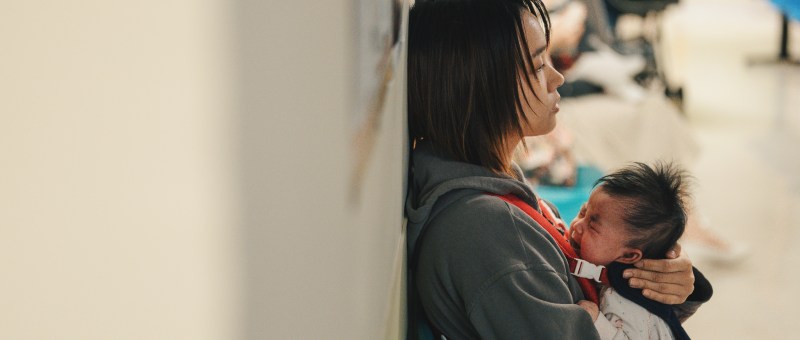
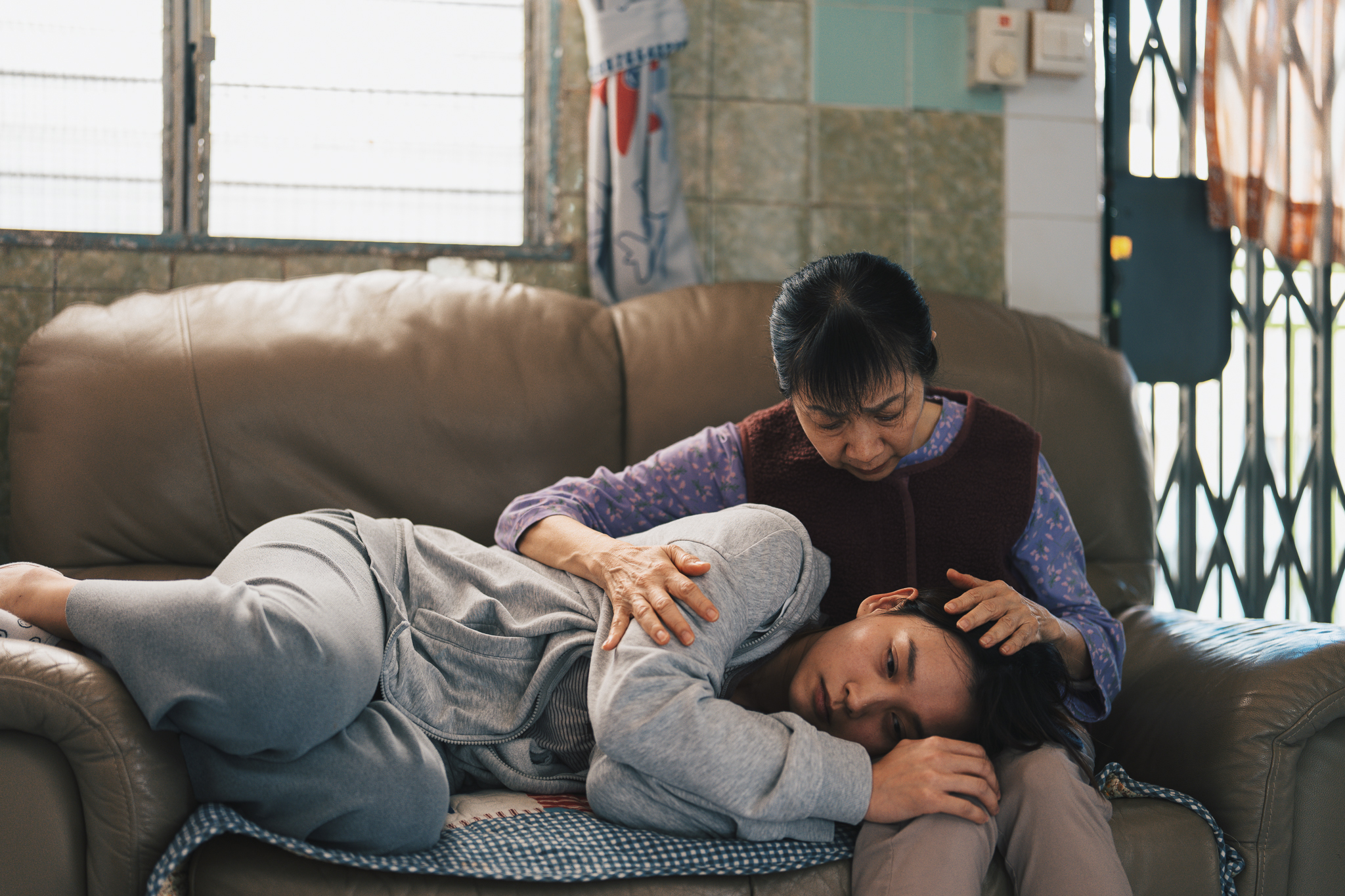
A case in point, Jing (Hedwig Tam) lives a long way from her birth family and is not surrounded by a supportive community network of other women in similar positions. Though her mother-in-law lives next-door and offers to help with the baby, it soon proves more trouble than it’s worth as she more or less takes over and runs Jing down in the process. Jing describes her to friends as “conservative,” and it’s clear that she disagrees with Jing’s parenting choices while also trying to exclude her from the family as if the baby were only her and her son’s. Ching, a fussy newborn who cries nonstop from morning to night, isn’t gaining weight and the mother-in-law immediately jumps straight to the conclusion that it’s because Jing’s milk isn’t good enough. According to her she doesn’t eat right, and going back to work may also have somehow caused a problem. Her unilateral decision to switch formula milk, tipping away all the breast milk Jing has been painstakingly expressing, without telling either of the parents is a huge overstepping of the boundaries and a betrayal of the trust Jing placed in her to look after her child, though of course the mother-in-law insists that she was only trying to do what’s best for the baby despite also having bathed her in burnt sutras.

The problem is compounded by the fact the in-laws seem to own the apartment they live in, which is why her husband, Wai, is reluctant to move closer to her family when she suggests it. As the oldest son, he is also supposed to be caring for his parents though in reality this of course also falls to Jing. As Ching’s crying is so loud and piercing, they begin receiving complaints from neighbours which eventually leaves Jing forced to take the baby outside in the middle of the night. This might not have been so much of a problem in the past before urban living environments became so cramped and people began having less children making the noise more obvious, but it’s nevertheless an unavoidable obstacle for the new parents who find themselves additionally pressured by the necessity of maintaining good relationships with their neighbours. 

To make matters worse, Jing’s husband Wai pats himself on the back for “helping” with the baby, which is after all also his responsibility so he should be doing his fair share. He still seems to operate with a patriarchal mindset that tells him the home and flat are Jing’s to take care of while his job is to earn the money. Both he and his mother seem to hold it against Jing that their baby is a girl. She asks him for more help, but he responds by getting a job that pays more but requires further hours. He spends evenings out with his friends and repeatedly fails to get the breast milk pump fixed despite frequent reminders before accusing her of “whining” too much when she tries to tell him how difficult it’s been for her stuck at home all day with the baby. Like his mother, his ideal solution is for her to give up work and devote herself to their home because they don’t “need” her money and her working is perhaps a suggestion that they might which offends his sense of masculinity.

But Jing wants to work for reasons of personal fulfilment and safety. As other women remind her, you need your own money in case there comes a time you need to leave, but also because some men keep a tight grip on the purse strings and often won’t give their wives enough housekeeping money. Jing was paying for a lot of the baby stuff herself out of the money from her job at a bakery, but after she loses it and her savings run out she has to ask Wai who isn’t keen to chip in. Ironically, her boss chooses to make her redundant when the bakery hits a bad patch because her colleague is single and at least she has her husband’s wage to rely on. Jing continues applying for similar jobs, but they all fall through when she reveals she is married with a newborn child. In the end, she lies that she’s single but the job only offers night work which is obviously no good for her situation.  

Her job was the last thing that Jing felt connected her to her old self. With no one to talk to but the baby, she fears the erasure of her identity and tells her mother that she misses the time that she was a daughter rather than a mother. She gets some support from a kind retired lady who looks after Ching and tries to encourage her, reminding her that it was different for their generation because they could just leave the kids in the house and ask a neighbour to check in on them and no one thought anything of it. But Jing still feels herself inadequate, as if she’s failing at motherhood or breaking a taboo by asking to have some sort of life for herself without being completely subsumed by the image of “motherhood”. The in-laws keep a little bird in a cage with which Jing seems to identify, even as its chirping adds to the noise and the constant thrumming of the breast pump raises her stress levels. Left with no real support, there is only really one way that Jing can escape from a world of sleeplessness and anxiety as she tries to find the smallest moment of peace and tranquility free of social expectation and the crushing guilt of maternity.


Montages of a Modern Motherhood screened as part of this year’s New York Asian Film Festival.

Trailer (Traditional Chinese / English subtitles)
Lost Love (流水落花, Ka Sing Fung, 2022)

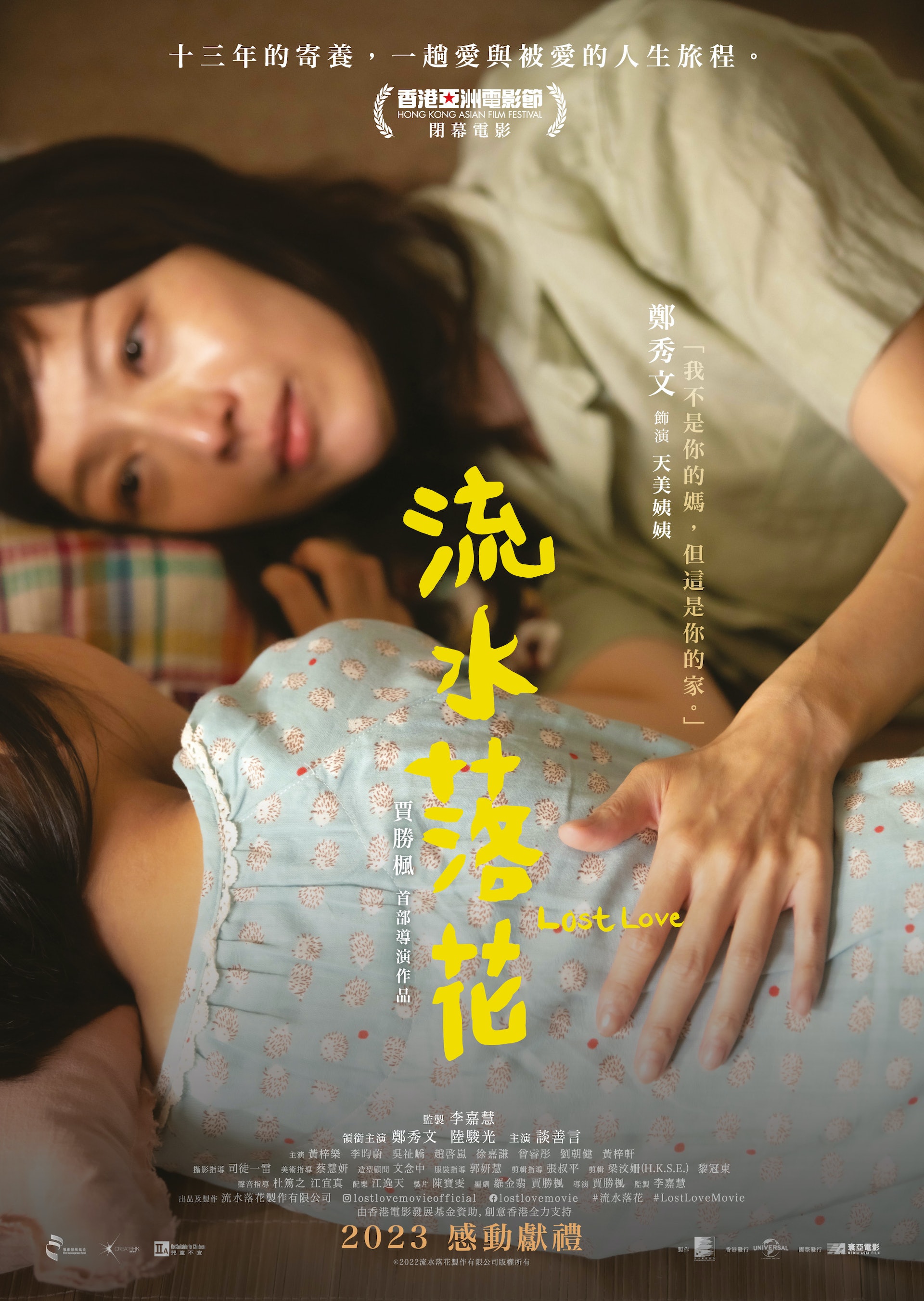
A grieving mother attempts to redefine her life by caring for the children of others in Ka Sing Fung’s poignant maternal drama, Lost Love (流水落花). Filled with boundless compassion, the film in part explores the sense of otherness felt by lonely children often rejected by the society around them, while allowing the wounded heroine to find a way to love again in the midst of her heartbreak, even if what she’s signed up for amounts to a cycle of perpetual loss. 

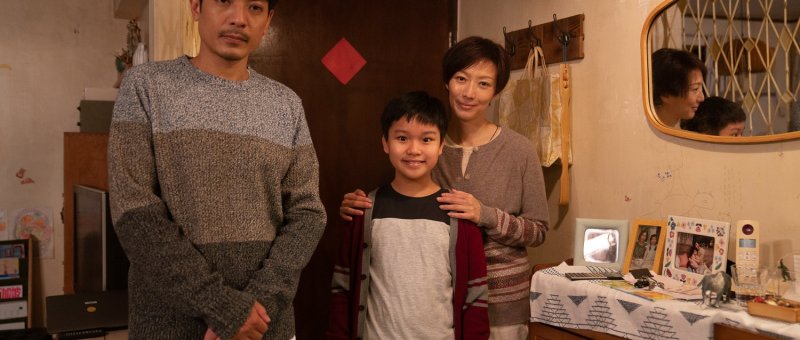
Mei (Sammi Cheng Sau-Man) lives an ordinary life working a series of unsatisfying and poorly paid jobs while her husband Bun works as a driver. Gazing at an empty room that might once have belonged to a child, we can feel a sense of loss and absence in the couple’s apartment while another young woman, Miss Mok (Hedwig Tam Sin-Yin), takes a cursory look around and seems to find everything in order pausing only to advise they give up smoking, at least in front of the children. Mei has decided that she wants to become a foster mother, but Bun does not seem entirely onboard complaining that he’s only really been “advised” of her decision rather than actively asked for his opinion. 

As is later revealed, Bun and Mei lost their three year-old son to illness and though Bun would have preferred to continue trying to have another child of their own, Mei is afraid to in case the same thing happens again. Yet the irony is that in becoming a foster mother she has signed herself up for repeated loss. The children who come to her do so temporarily and only until such time as they can be returned to their guardians or adopted by other families. After bonding with one little girl, Mei considers adoption but is told that it is not really permitted within the fostering system and she will have to resign herself to letting the child the go. 

Meanwhile, many of the children have specific needs and are often struggling to deal with the circumstances which led to them needing foster care. The first little boy Mei takes in, Sam, barely says a word and wets himself in stressful situations. When he stands up to a bully in school, he’s the one who gets into trouble with the teacher who makes prejudicial statements about “these kinds of kids” as if he’s already written him off. Sam poignantly reveals that the other kids were making fun of him for not having any parents leaving him additionally isolated and further damaging his already disrupted education. Another little girl, Hana, says something similar unwilling to go to school as the other children reject her because she has cleft palate. Ching, by contrast, is rejected by her own mother who seems to have remarried and had other children, palming her off on a grandmother who is unable to care for her while hospitalised. Two other children stay with Mei while their father is in prison, later describing Bun as the kindest man they’ve ever met while explaining that they were previously pushed from pillar to post bounced around between relatives who grew tired of caring for them. 

Even so, the foster care arrangement places a further strain on the couple’s marriage. Bun is at times resentful of the attention Mei gives to the children while still on the fence about fostering even at one point suggesting they simply get a dog instead. Yet despite everything Mei remains committed to caring for the children who come her way some of whom have no one else to care for them, helping them to gain the strength to keep living in the world and to feel less alone even in the face of unfair social prejudice. Ka tells her tale in elliptical fashion, pushing forward over a number of summers as different children occupy Mei’s spare room while she herself grows old but still determined to continue looking after kids in need. A repeated motif of falling petals hints at the temporality of all things, but also as they fall into the river a poignant sense of generational flow as Mei gently supports the children until they can support themselves and she can give no more leaving love behind her even in her absence.


Lost Love screens in Chicago April 1 as part of the 16th season of Asian Pop-Up Cinema.

Original trailer (Traditional Chinese / English subtitles)
Hong Kong Family (過時·過節, Eric Tsang Hing-Weng, 2022)

“It doesn’t matter how the food is cooked. Let’s just enjoy it in the presence of each other and not think too much” a regretful grandmother advises giving perhaps the best advice for how to survive an awkward family gathering in Eric Tsang Hing-Weng’s autobiographically inspired familial melodrama Hong Kong Family (過時·過節). Coloured with the shades of exile, Tsang’s melancholy exploration of a fragmenting family unit ponders the limits of communication between those who should be closest along with the lingering resentments and toxic legacies that poison otherwise loving relationships. 

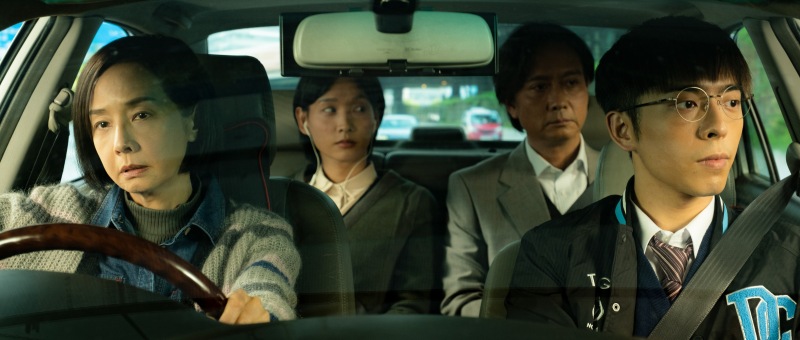
An opening sequence set eight years before the main action lays bare the tension between middle-aged housewife Ling (Teresa Mo Sun-Kwan) and her mild-mannered husband Chun (Tse Kwan-Ho) who sits silently in the back of the family car as she berates him for having recently lost his job and been unable to find another which is particularly inconvenient as they’ve just taken out a mortgage and bought a flat. 17-year-old Yeung (Edan Lui) sitting in the front passenger seat tries to keep the peace but refers to his parents as Mr & Mrs Chan, while his older sister, 20-year-old Ki (Hedwig Tam Sin-Yin), pretends not to hear escaping from reality by listening to music on her headphones. When they finally arrive at her mother’s home, a well appointed detached house out in the country, they are greeted by Ling’s brother Ming who has already fallen out with his mother (Alice Fung So-Po) in part because it seems she doesn’t like his wife who has declined to attend this Winter Solstice dinner. When his mother suspects him of stealing money, Ming angrily storms out vowing never to contact her again and provoking a similar row between Ling and Chun in which she asks for a divorce. Pushed past his limit, Chun starts hacking at a chair with a meat cleaver and eventually strikes peacemaker Yeung who then abruptly severs ties with his dad and moves out on his own. 

Yet eight years later it’s Yeung who seems to be looking for a way back to his family only he doesn’t know how to find it. He’s been working on a virtual reality “game” that would allow users to interact with AI versions of absent friends and relatives, helping them to communicate rather than offering an escape from reality though that may be in a sense what Yeung is doing in interacting with a simulacrum of his father rather than facing him directly. His parents did not divorce, but are clearly unhappy. Ling has found another simulacrum for familial life working as a housekeeper for a wealthy single father, while Chun is driving a taxi and secretly planning to start again by leaving for Mainland China and a job in a company set up by an old friend. According to grandma it seems their marriage may have been semi-arranged (by her) and years of trying have seemingly not improved their inability to communicate with each other. 

Ki, meanwhile, has been married and divorced since the fateful Winter Solstice dinner over which grandma kept trying to marry her off explaining that she married a random man to escape her family only to boomerang back two years later when it didn’t work out. She too is lying to her parents, pretending to go to work every day despite having lost her job and later drifting into an unexpected romance with a free spirited nomad from Malaysia who jolts her out of her sense of inertia in telling her to try to be true to herself. The return of Ming’s now teenage daughter Joy (Angela Yuen Lai-Lam) from exile in England offers the opportunity to repair their fragmenting bonds, but it seems some wounds run too deep to ever be fully healed. Chun is pulled towards the Mainland just as Uncle Ming had been pulled towards England, while Yeung just wants to go “home” but doesn’t know how and Ling frantically tries to preserve a sense of family just as Ki seems to have made her peace to go wherever her heart takes her.

That might be one reason that there are only women around the dinner table at another Winter Solstice, for some the first, each trying to salvage something and try to get along if only in a superficial show of togetherness while the men attempt to talk through their troubles agreeing to head towards the dinner table but in the end walking in circles. The elegantly lensed final scene may suggest that the family is in someways trapped by its history yet destined to scatter but echoes in its ambiguity offering the distant hope of a far off reconciliation but little promise of its arrival. 


Hong Kong Family is in UK cinemas now courtesy of Haven Productions.

Original trailer (Traditional Chinese / English subtitles)
The First Girl I Loved (喜歡妳是妳, Yeung Chiu-Hoi & Candy Ng Wing-Shan, 2021)

“I wonder how many people are like us, dare to like yet too frightened to love?” the heroine of Yeung Chiu-Hoi & Candy Ng Wing-Shan’s youth nostalgia romance The First Girl I Loved (喜歡妳是妳) reflects having made peace with youthful romantic disappointment. As the title implies, Yeung & Ng’s melancholy love story finds a young woman looking back on her first love while beginning to wonder if she may have misunderstood or overly mythologised her high school romance. 

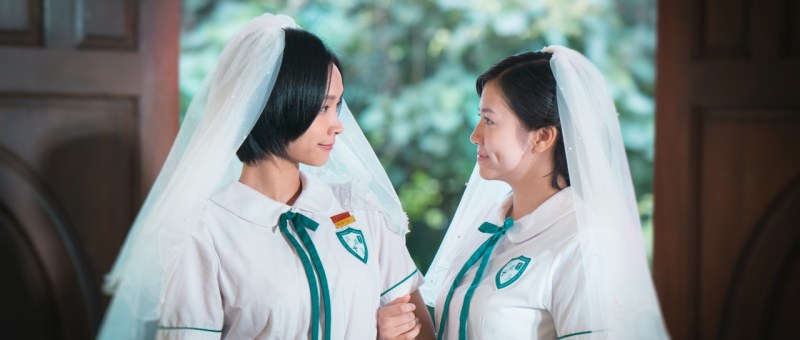
Now in her late 20s, Wing (Hedwig Tam Sin-Yin) is called back to the past by a phone call from her high school best friend Sylvia (Renci Yeung) who unexpectedly asks her to be the Maid of Honour at her wedding. Wing explains that she doesn’t like wearing dresses and would usually turn the invitation down but on this occasion she can’t because Sylvia was the first girl she ever loved. Long years of friendship eventually blossomed into teenage romance but while same sex relationships might have been more acceptable than they once were, they are not condoned by the private catholic girl’s high school the pair attend which calls their parents in after they’re spotted kissing on a bus by a passing teacher. 

Though Wing’s mother is a little taken aback, neither of the girls’ fathers thinks it’s a particularly big deal if for less than progressive reasons in that as Sylvia’s father puts it nothing “bad” can happen between two girls and he’d be much less relaxed if she’d been hanging around with a boy while Wing’s agrees that it’s probably just a phase and they “won’t look back” once they’ve met the right guy. The girls meanwhile seem to flit between despair and youthful romantic idealism, Sylvia who’d earlier been the more proactive in pursuing a relationship later conceding that perhaps it is a phase after all when her otherwise sympathetic father advises her to keep a low profile in order to avoid losing her scholarship because their family is poor. More secure in her middle-class comfort, Wing is minded to fight for love, saving up to buy a ring Sylvia had admired on a shopping trip and insisting that if growing up means denying their feelings for each other she’d rather remain a child. But then for unclear reasons Wing is the one who later betrays their love in agreeing to perform a public apology admitting that her relationship with Sylvia is “shameful and unacceptable” while Sylvia tears hers up and simply leaves having planned to take full responsibility while refusing to apologise for her feelings. 

The relationship between the two women continues to ebb and flow, leaving the older Wing wondering if they were ever really in the same story or if they simply remember their high school relationship differently. Perhaps to Sylvia they really were just admittedly intense “good friends” as she was fond of saying rather than the doomed lovers Wing has branded them as in her mind. Then again could it just be that Sylvia has chosen conventionality out of a lack of courage to fight for love, Wing wondering if Sylvia has decided to marry now in order to escape a pact they’d made to reunite if neither of them had married by 30 implying that Sylvia had never been able to let of the idea that anything other than a heteronormative marriage is necessarily a failure. 

Time does indeed seem to be a factor, the girls recreating the one minute scene from Days of Being Wild with a clock which has no second hand symbolising the timelessness of their youthful love while forever afterwards they seem to be haunted by ticking clocks implying that their romance has a shelf life. Even so, Yeung & Ng try to have their cake and eat it too, the climactic wedding taking place on a symbolic level between Sylvia and Wing echoing their mock high school wedding as they walk down the aisle together with Sylvia pained and conflicted in her choice while Wing reflects that they will always be “best friends” no matter what happens in the future having reclaimed her happy memories of her high school love reassured by Sylvia’s coded reactions that love is really what it was that existed between them. Replete with early 2000s nostalgia, Yeung & Ng’s tragic romance nevertheless ends on a hopeful note in managing to salvage the friendship from a faded love even if lacking the courage to fight for authenticity in an often conservative society.


The First Girl I Loved screens 13th/16th March as part of Osaka Asian Film Festival 2022

Original trailer (Traditional Chinese / English subtitles)

Weeds on Fire (點五步, Steve Chan Chi-Fat, 2016)

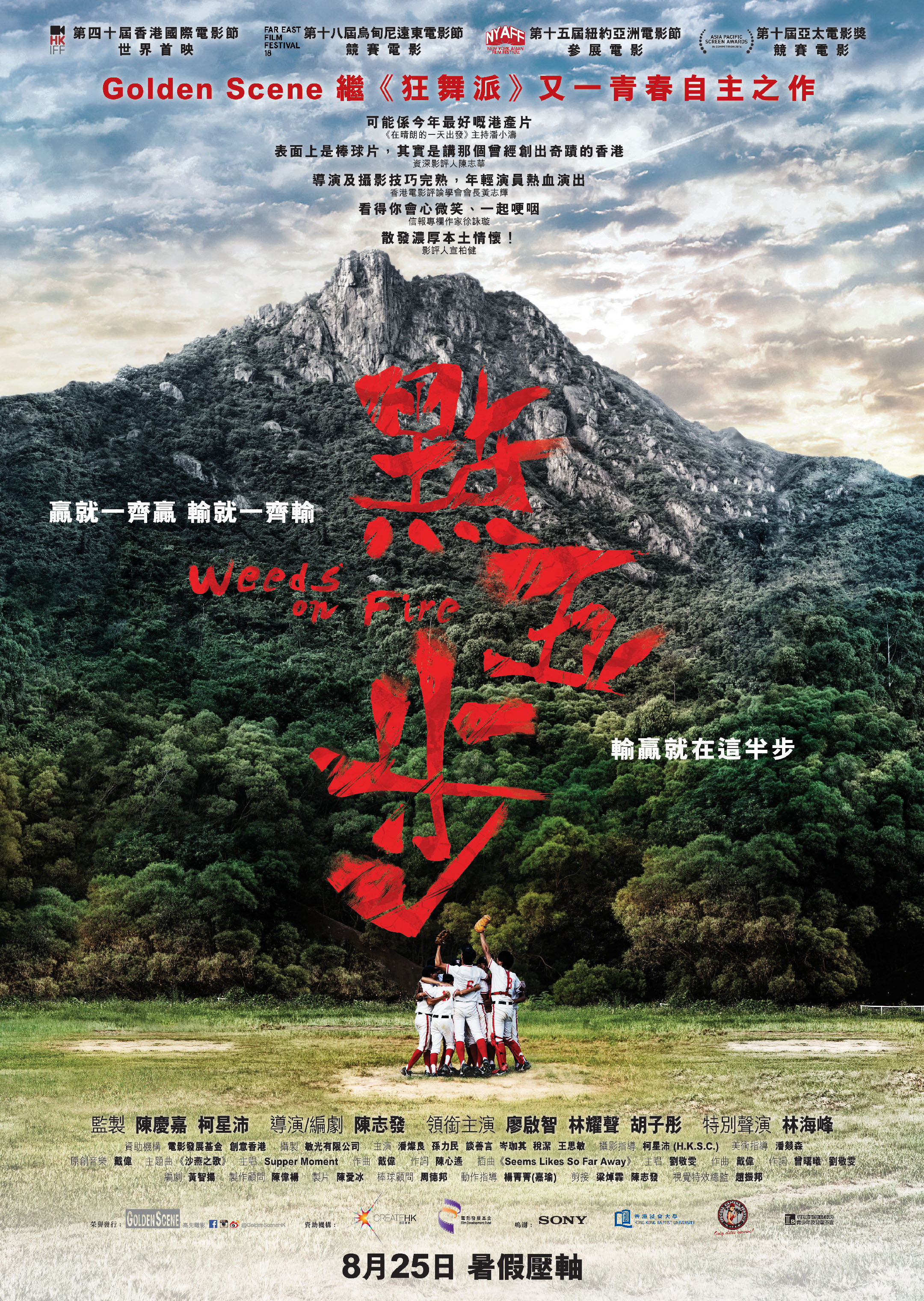
“Even though disappointed, do not lose hope” reads a piece of graffiti in the closing moments of Steve Chan Chi-fat’s nostalgic coming-of-age drama Weeds on Fire (點五步). Though touted as a baseball movie, as incongruous as that may sound given that the sport is a niche interest in contemporary Hong Kong, Chan’s strangely hopeful if quietly melancholy tale of ‘80s Sha Tin is bookended by scenes of the present day city in the midst of the Umbrella Movement protests the story the hero wants to offer seemingly intended for an audience of dejected youngsters as confused and disappointed as he once was in order to encourage them that what’s important isn’t winning or losing but staying the course and gaining the confidence to take the first step. 

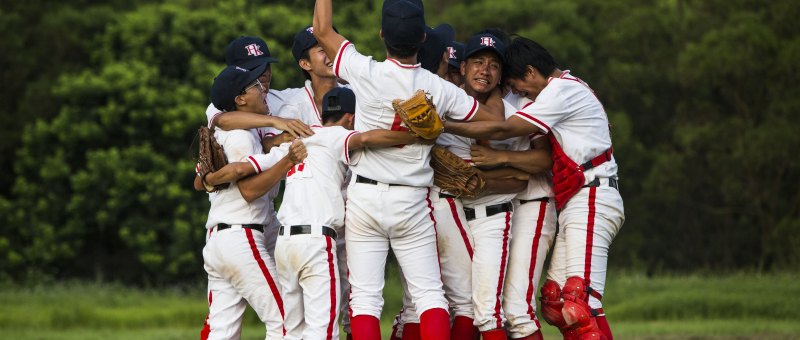
Now in his mid-40s, Lung (Lam Yiu-sing) casts his mind back to the Hong Kong of 1984 when he lived on a rundown council estate in Sha Tin and attended a high school with a less than stellar academic record. A shy and nerdy boy, he was often bullied but always had childhood friend Wai (Tony Wu Tsz-tung), physically imposing and with a confident swagger, at his back. When the city comes up with additional funding for schools to use in the promotion of sport their enterprising headmaster Lu Kwong-fai (Liu Kai-chi) hatches on the idea of starting the region’s very first local high school baseball team, recruiting both Wai and Lung in the hope of teaching them teamwork and discipline. Nevertheless, being teammates begins to place a strain on their friendship and it becomes clear that the boys are destined for different paths. Wai quits the team in a huff and leaves school, mooching round in pool bars and hanging out with triads while Lung steps up to the plate but is troubled by the loss of his friendship and the fracturing relationship between his unhappily married parents. 

Chan somewhat unsubtly ties Lung’s personal development to that of Hong Kong as he finds himself coming of age in era of anxiety. The world is literally changing around him, 1984 being as says the year that the redevelopment of Sha Tin began in earnest while it also marked the signing of the Sino-British Declaration paving the way for the transfer of power in the 1997 Handover. A young man, Lung wants to “change” himself in that he longs for the confidence to ask out a young woman he’s developed a crush on but is too shy and disappointed in himself for doing nothing when witnessing her being harassed by a drunken creep in the lift of the apartment block where they both live. Yet in other ways change frightens him and really he wants everything to stay the same believing that saying nothing will maintain the status quo only to realise that there are situations over which he has no real control. 

His headmaster and coach of the baseball team Lu admits that he set Wai and Lung against each other in order to encourage him to come out from his friend’s shadow embracing his own identity and discovering a sense of self-confidence. Yet Lung continues to struggle, a little lost unable to find clear direction in his life while everything changes around him occasionally consumed by a sense of despair as perhaps are the young protestors in believing their movement has failed. In baseball what he realises that it isn’t about winning or losing but having the confidence to step up to the plate, subtly telling the protestors to hang in there because there’s still time to turn this around. “I never said we had to win”, inspirational coach Lu reminds the boys, “but I did say never give up!”.

Loosely based on the real life story of the Shatin Martins though as the closing credit reel reveals the original team were primary school children rather than high schoolers, Chan shifts away from sporting drama towards the more familiar youth movie metaphor of two former friends heading in different directions, the good boy knuckling down while the “bad” becomes a victim of his own hotheaded arrogance even if managing to repair his fractured friendship with Lung before tragedy strikes. Filled with memories of Handover anxiety and a healthy dose of ‘80s nostalgia, the film’s incongruous jauntiness is perhaps at odds with the gravity of the tale though that is perhaps itself part of the message the older Lung has for the young. “This is the city where I grew up. It’s become increasingly unfamiliar” he laments striding through streets filled with tents occupied by student protestors, sympathising with their cause while offering them a note of melancholy hope in his own, sometimes painful, tale of finding his feet in a changing Hong Kong. 


Weeds on Fire streams in Poland until Nov. 29 as part of the 15th Five Flavours Film Festival.

Original trailer (English subtitles)

The Dishwasher Squad (洗碗天團, Shum Sek-yin, 2021)

“Help those in need, then what about me?” asks the cynical hero of screenwriter Shum Sek-yin’s directorial debut, The Dishwasher Squad (洗碗天團). Another in the recent series of films exploring attitudes to disability in contemporary Hong Kong, Shum’s breezy comedy sees two self-centred businessmen with some extremely outdated and often quite offensive views decide that the only way to recover from being scammed into buying a moribund business is by exploiting the vulnerable only to eventually reawaken to their humanity if only perhaps to a degree. 

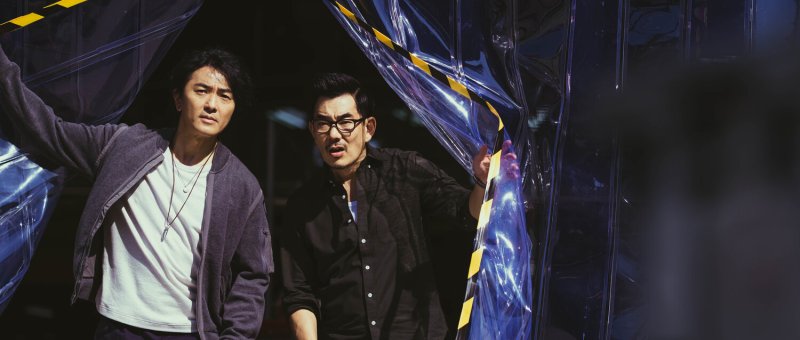
After Kyun’s (Richie Jen Hsien-chi) business fails, his best friend Lun (Ekin Cheng) comes up with a plan to buy out the industrial dishwashing plant owned by the friend of a friend who is apparently keen to sell because he wants to emigrate to Canada with his son who has learning difficulties. Strangely, on that very day, Kyun seems to find himself repeatedly running into disabled people for whom he seems to have little to no respect often using offensive language and even stealing an extra cookie from a young man with Down’s Syndrome collecting money for charity. Kyun seems fairly smug about each of these problematic encounters as if congratulating himself for getting one over on those he sees as lesser than himself. Unfortunately for him, however, while he thought he was conning the factory owner by telling him they planned to use the place to help the needy, the factory owner was actually conning him seeing as the business isn’t viable and is in fact riddled with debts. Not only that, all the staff were casual employees leaving Kyun and Lun with a huge problem seeing as they have legally binding contracts to fulfil and no staff to fulfil them. 

That’s one reason he eventually hatches on a cynical plan to take advantage of a government scheme to become a “Social Enterprise” in order to gain a subsidy by employing a majority of marginalised employees who might otherwise find it difficult to secure regular employment. Working with a local social worker (Hedwig Tam), he agrees to employ a young woman with autism and two men with learning difficulties along with another woman trying to rebuild her life after leaving prison. Aside from access to the subsidy, the main draw for Kyun is that he assumes he won’t have to pay them very much or even at all, getting the two men to work for free during their “probationary” period and thereafter attempting to fire one of them before it comes to an end. To bolster the work force, Kyun also recruits a series of undocumented South Asian migrants for much the same reasons assuming they will have little desire to make a fuss over their pay or conditions. 

Nevertheless, through close contact with each of his staff members Kyun finally begins to develop a sense of humanity though it’s unfortunate that his ability to recognise his employees as fellow humans only comes with a realisation that they are “useful” to him after all as they each and for varying reasons become attached to their new jobs and the atmosphere at the factory. It has to be said, however, that Shum’s otherwise positive message of people over profit is undercut by the series of fat jokes aimed at a female worker who at one point is seen eating from an automatic pet feeder, while a scene featuring an improvised stomach pump after an employee accidentally ingests detergent is also perhaps in poor taste even if hinting at the depths Kyun is prepared to sink to in order to protect his business interests.

Despite having bonded with his employees in a genuine sense of camaraderie, Kyun is still intent on exploiting his workforce and continues to see himself as superior if having developed a little more of a moral compass. Even so, he has perhaps developed the desire to run an honest business built on trust and compassion rather than greed and deception even if he hasn’t quite got there yet while reaffirming his friendship with Lun as they find themselves on a more even footing after a brief falling out. Mixing mild social issue themes regarding the difficulties faced by those marginalised by the contemporary society with lighthearted humour and a lot of heart, The Dishwasher Squad eventually argues for doing right by each other even if not everyone feels the same way. 


The Dishwasher Squad has its World Premiere on Oct. 17 at ChiTown Drive-in as part of the 13th Season of Asian Pop-Up Cinema.

Ready O/R Knot (不日成婚, Anselm Chan, 2021)

After two people have been together a significant amount of time, it might start occurring to others that really they ought to be married. Perhaps it even starts occurring to one or both of the two people too, but should you really make such a big decision based only on the fact that it’s the done thing rather than something you actively want to do? That’s a dilemma that presents itself to the young couple at the centre of Anselm Chan’s marital farce, Ready O/R Knot (不日成婚). While she would like a further degree of certainly in their relationship, he fears commitment along with a loss of freedom and authority as a family man with responsibilities perhaps greater than he feels he can bear. What ensues is an accidental battle of the sexes as each partner teams up with their respective allies to trick the other into going along with their plan. 

Guy (Carlos Chan Ka-Lok) and Ho-yee (Michelle Wai Si-Nga) have been together for five years after meeting at the wedding of Guy’s friend Grey Bear (Chu Pak Hong) and Ho-yee’s bestie Jen (Hedwig Tam Sin-yin). Grey Bear and Jen now have two children, but there is already an air of superficial duplicity in the relationship, Grey Bear using his friends to help him visit illicit sex services in Macao in rebellion against the tyranny of marriage. While the women quietly suggest to Ho-yee that it’s time they got married and left to his own devices Guy will continue to drag his feet, the guys are are determined to dissuade him viewing it somehow as a defeat of masculinity. They fear being tied down and mock other men for being in thrall to their wives while the women seem to fear that their men are duplicitous and unreliable and that therefore they need this additional level of protection. Nevertheless, the moment the marriage debate has begun, the relationship undergoes further strain and scrutiny even as each party descends into sometimes worryingly unethical levels of scheming in order to get their own way. 

It has to be said that for much of its run time, Ready O/R Knot reflects some extremely sexist, hopefully outdated social attitudes while making occasionally off-colour jokes about domestic violence and drugging one’s spouse without their knowledge or consent. At a low moment, Guy finds himself swallowing a morning after pill and thereafter gaining a sudden empathy for women on experiencing what he assumes is akin to period pain, lying on the sofa clutching a copy of Marie Claire while his friend who has also taken one in solidarity eats chocolate ice cream directly from the carton. Grey Bear thinks he was tricked into marriage by Jen’s plan to seduce him to forego protection thereby engineering an accidental pregnancy, which is why Guy has been avoiding intimacy with Ho-yee hoping to avoid being “trapped” in the same fashion. 

A perpetual man child, Guy resists the trappings of adulthood, reluctant to sell his two-person scooter and learn to drive a family car while remaining obsessed with football, his PS4, and hanging out with his sleazy, sexist friends. As the crisis intensifies, however, it leads Ho-yee towards a more progressive realisation, advised by her wise old grandmother (Siu Yam-yam) that she should learn to put herself first for a change and strive for her own happiness rather than that of her man. Guy begins to realise what he’s at risk of losing, but his late in the game epiphany isn’t in the end enough to repair the damage his diffidence has caused, returning agency once again to Ho-yee who has learned to ask for more, that her own hopes and desires are just as important as Guy’s, and that “marriage” is not in itself “the point”.

Buried underneath some of those sexist attitudes is a basic fear and tinge of toxic masculinity as Guy realises his reluctance is partly insecurity that he’ll fail as a husband, unable to “provide for” (apparently something he regards as a male responsibility, simultaneously mocking Grey Bear for living off his wealthy wife) Ho-yee or to make her truly “happy”. Only after undergoing a humbling and being willing to pursue the relationship on a more equal footing is he finally given a second chance, noting that Ho-yee should not be expected to sacrifice herself for their relationship to succeed while he has resolutely refused to invest in their mutual future by clinging to his individual past. Simultaneously cynical about the institution of “marriage” yet somehow eager to believe in the power of love and commitment, Ready O/R Knot takes a moment to make up its mind but in the end comes down on the side of equality in romance as its warring lovers eventually call a truce in rediscovering what it is that’s really important. 


Ready O/R Knot screens at Chicago’s Lincoln Yards Drive-in on May 2 as part of the 12th season of Asian Pop-Up Cinema.

Original trailer (English / Traditional Chinese subtitles)