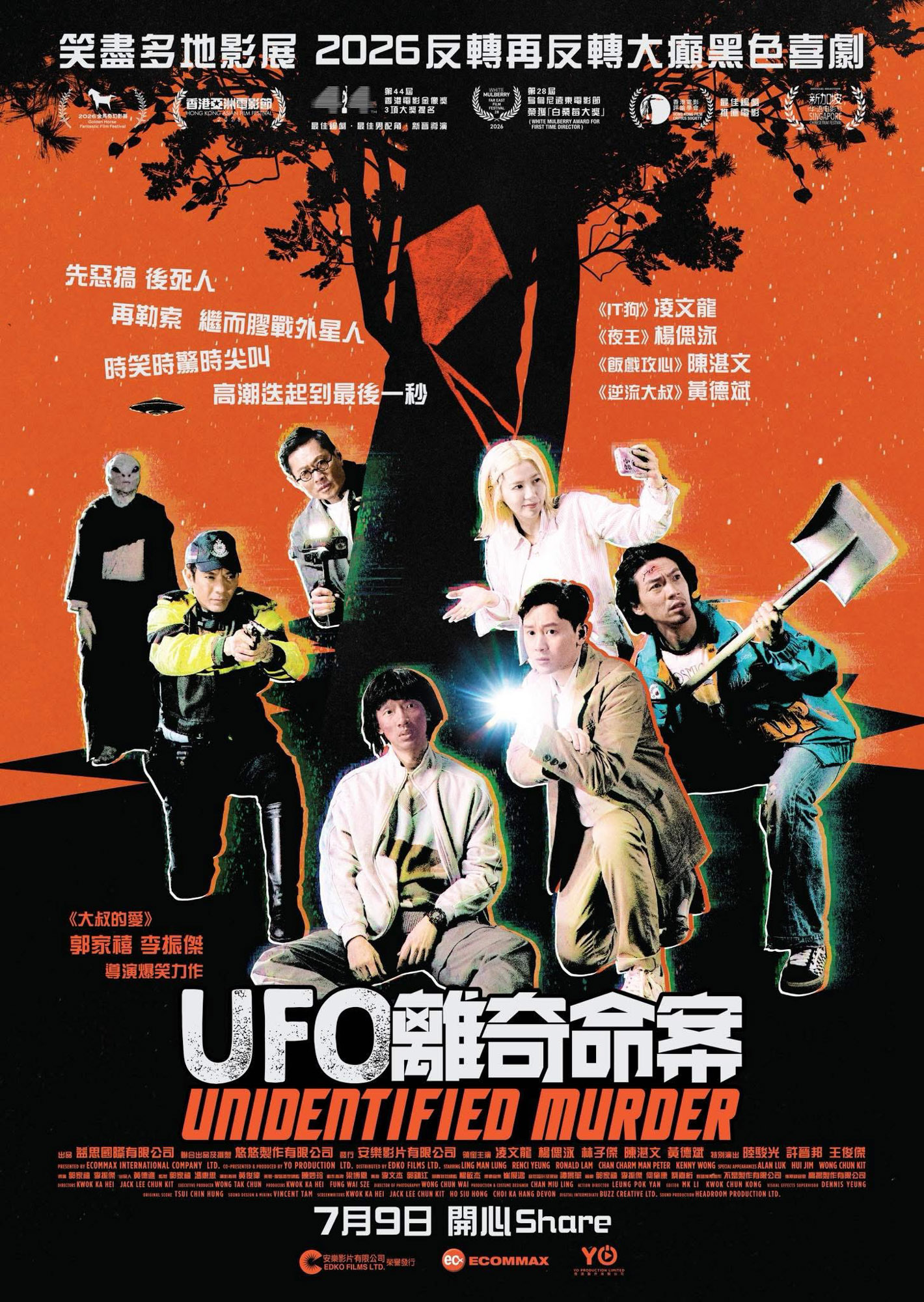
Unidentified Murder (UFO離奇命案, Kwok Ka-Hei & Jack Lee Chun-Kit, 2025)

The line between a prank and a scam maybe be necessarily thin in Kwok Ka-Hei and Jack Lee Chun-Kit farcical comedy Unidentified Murder (UFO離奇命案) in which nothing is quite as it first seems. Unfolding with an almost Rashomon-like structure, the film slowly peels back the layers of reality to reveal that pretty much everyone is playing a trick on someone, sometimes rooted in a childish sense of fun, but equally a desire for attention and the money that can be generated from it in today’s attention-obsessed society.

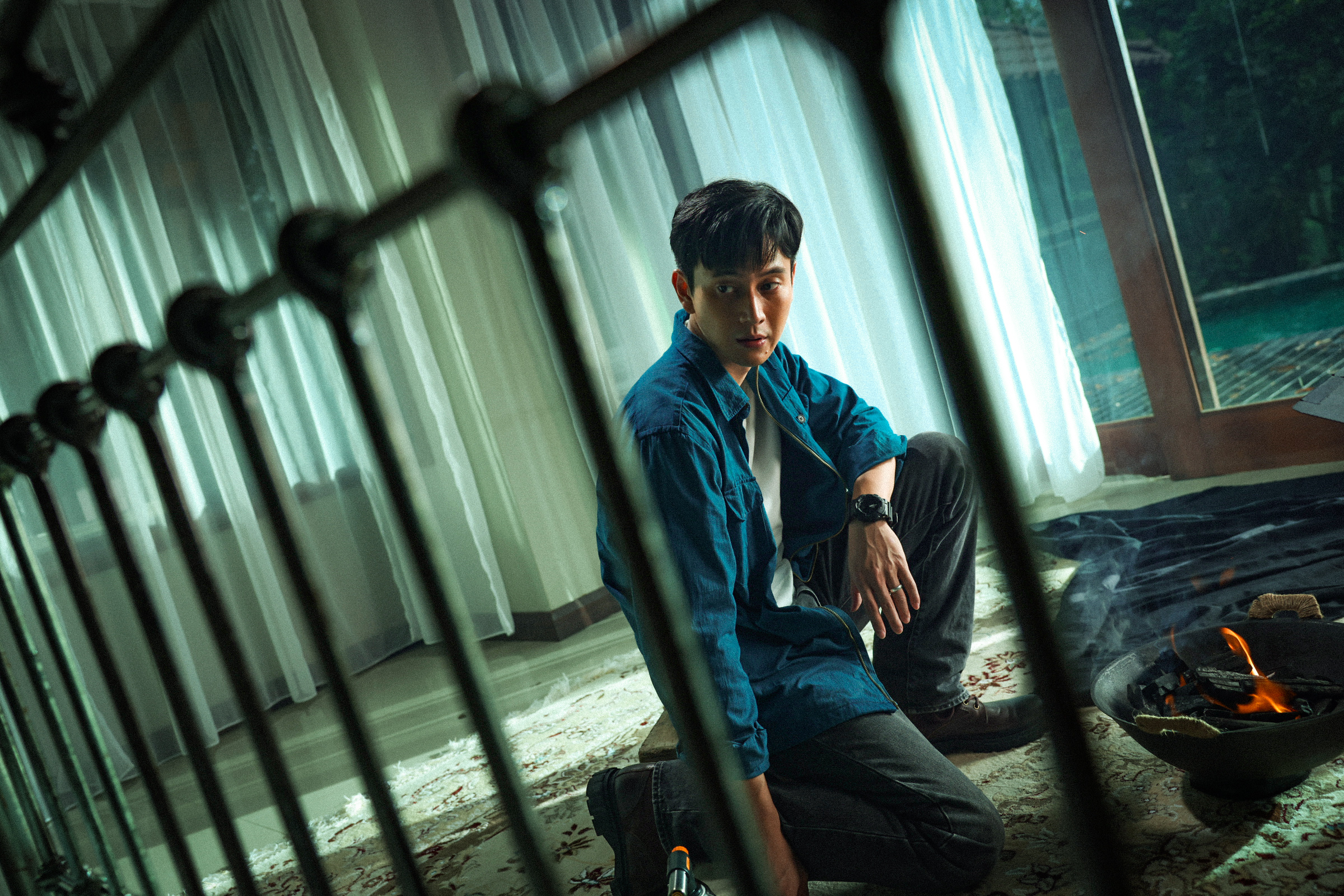
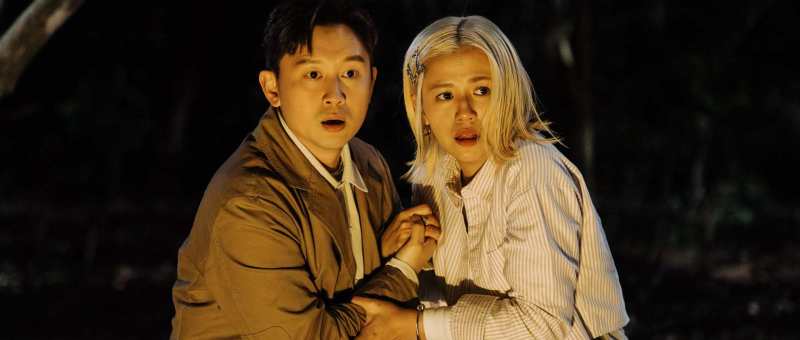
Twenty-five years ago, Kit (Ronald Lam Tsz-Kit) and Mark (Ling Man-lung) went up the mountain with their friend Ho but returned alone. Ho’s disappearance has apparently become a legendary local mystery with the boys claiming that Ho was abducted by aliens, though some seem to believe that their story is either a trauma-born fiction or a deliberate attempt to disguise their role in whatever may have happened to their friend. In any case, the film opens with an attempt by online content creator Man (Renci Yeung) of the “Prank My Boyfriend” video channel to play a trick on her boyfriend Mark by getting an actor, Kim (Peter Chan Charm-Man), to be the retuned Ho abruptly released by the aliens after 25 years. To begin with, this doesn’t seem like a very funny prank and could be crushingly insensitive. One might assume the now middle-aged men are carrying a degree of trauma about the failure to protect their friend, or else if they really were responsible for his disappearance in someway, it could turn out of be a dangerous situation for everyone. 

Nevertheless, Mark doesn’t seem to be particularly phased by Man’s prank and, on fact, sets out of prank her back by getting Kim onside to pretend that he and Kit kill him while planning to move Ho’s body due to the increased interest generated by the incident’s 25th birthday. This doesn’t seem like a very funny prank either, and it’s difficult to deny that this ultimately farcical situation began with a series of very bad decisions especially as this particular stunt is intended to work up to a marriage proposal. Unfortunately, however, nothing goes to plan and when it looks like Kim might be dead for real, the gang get a mysterious text trying to blackmail them threatening to release Man’s video of them murdering Kim online.

Or course, there’s a possibility that this is another prank too, or, to be frank, more of a scam. In this world, nothing really is certain and no one is really who they seem to be. A good friend might be playing a trick on you that could unwittingly be hurtful or insensitive though they may not mean it, while likewise they may be trying to con you out of a bit money to fight their own desperate circumstances. There’s a kind of childishness that underplays most of the trickery like a lie told by a child to get out of trouble that they then have to commit to for the rest of their lives. In this way a trick can become a shared secret, like an alternate reality that binds people together in ways few other things can. Others my be wilfully deceived by watching things like the Stardust Memories channel that purports to show evidence of aliens but may not be completely on the level. To that extent, at least Man’s channel is honest about its intentions even if it’s not clear to what extent Mark is already in on the joke.

Even if you regard it as harmless fun, these pranks too could wind up having devastating consequences and escalating to levels of death and violence all based on a series of misunderstandings. So confusing do things become while out in the mountain forest that Man even tries to grab the gun from a policeman and points it at her friends certain that they’re pranking her only to be shocked when the gun later goes off. But what could have unraveled a long-time mystery and exposed things best left buried or resulted in deadly consequences instead becomes another bonding exercise in which a group of people generate an unexpected friendship though all being in on the joke, each letting the incident end with good humour and no harm done. Filled with farcical comedy and an ironic cynicism the film seems to say that in this world where everything is grift being in on joke might be the only thing that makes life worth living.


Unidentified Murder screens as part of this year’s New York Asian Film Festival.

Trailer (English subtitles)
Behind the Shadows (私家偵探, Jonathan Li Tsz-Chun & Chou Man-Yu, 2025)

“At our age, we do what we have to do instead of obsessing over the good old days,” according to a put upon wife sick of waiting for her husband to make good on his promises. Jonathan Li Tsz-Chun and Chou Man-Yu’s Malaysia-set drama Behind the Shadows (私家偵探) is in its way as much about the disconnect in modern romance which has now been corrupted by capitalistic desires and frustrated notions of traditional masculinity as its central mystery. 

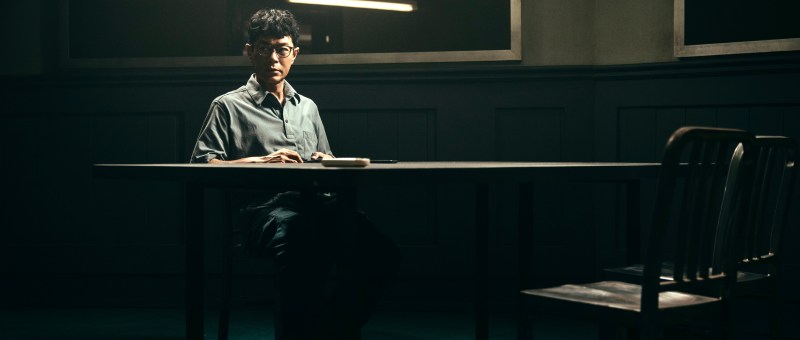
As someone says, in the old days women hired private detectives to chase their men, but now it’s the other way around. In someways, the parade of men rocking up at Wai-yip’s (Louis Koo Tin-lok) office to hire him to follow their wives, girlfriends, or women with whom they may not actually have much of a connection, all seem to be trying to regain control over their lives by asserting it over a lover they fear has betrayed them. Ironically, this is sort of true of Wai-yip too in that he’s taken to spending his evenings at his friend’s restaurant to escape his moribund marriage. When one customer brings him a photo of his own wife, Kuan (Chrissie Chau Sau-na), little knowing he’s the other man Wai-yip is irate but not as surprised as might be expected. Still, he hands the case off to a junior associate and tries to avoid thinking about it while otherwise passively seething about his wife’s potential betrayal.

But the ironic thing is that Kuan might only have done this to get Wai-yip’s attention and force him to confront their fracturing relationship. While Wai-yip hangs back, tries to act with maturity, and struggles to accept his wife’s decision, she privately wants him to fight back, to shout at her or punch her lover as a sign of manly love. She attacks his masculinity by berating him for being work-shy and refusing to have a child because they can’t afford it, though she can support them all on her salary, while Wai-yip remains hung up on the lost glory of his life in Hong Kong which he gave up to marry Kuan and move to Malaysia. The suggestion is that Wai-yip has been trapped in a kind of limbo, unable to let go of the past and embrace his new life and now Kuan is sick of waiting for him. 

The circumstances of his own marriage and the cynicism of 20 years spent chasing cheating spouses cause Wai-yip to be wary when a man comes and asks him to look for a runaway fiancée. He wonders if they’ve just had a tiff, if she’s left because the man was violent or unfaithful, or if the man is delusional and the woman doesn’t believe herself to be in a relationship with him and so is just happily living her own life. Along with all these anxieties is his sense of responsibility in knowing that this woman may be in danger if he finds her, as will Betty if Wai-yip manages to uncover evidence of her infidelity and relays it back to her gangster boyfriend. Like Kuan, Betty (Renci Yeung Sz-wing) says she just wants a man who will listen to her when she wants to talk and is half-minded to let Wai-yip send the video to find out if the gang boss cares about her enough to actually do anything about it. 

But the consequences of inaction are also brought home to Wai-yip when one of the women he’s following is murdered after he leaves his investigation to chase Kuan and her lover. Trying to makeup for his failure brings him into contact with a zombified cop, Chen (Liu Kuan-ting), whose wife is in a coma after a car accident. While Chen’s solicitous care and repeated pleading that his wife wake up may paint him as a lovelorn man, the marks on her arm that perfectly fit his fingers suggest a violent and controlling past along with a thinly concealed rage that she may have escaped him at last. “There’s nothing much the police can’t do,” he ominously tells Wai-yip while hinting at his desire for authoritarian control as mediated through the patriarchal institution of the police force and his rejection of a woman’s sexual freedom. Wai-yip feels similarly trapped as his own increasing sense of inadequacy deepens the gap between his wife and himself that leaves him unable to have an honest conversation with her about how he really feels and prevents him from healing the rifts within his own marriage even as he chases answers on behalf of other insecure men. What he indeed realises is that it’s time to move on from the past and live in the present, though as it turns out not even he may be strong enough to leave his insecurities behind. 


Behind the Shadows screened as part of this year’s New York Asian Film Festival.

Trailer (Traditional Chinese / English subtitles)

Ready O/R Knot (不日成婚, Anselm Chan, 2021)

After two people have been together a significant amount of time, it might start occurring to others that really they ought to be married. Perhaps it even starts occurring to one or both of the two people too, but should you really make such a big decision based only on the fact that it’s the done thing rather than something you actively want to do? That’s a dilemma that presents itself to the young couple at the centre of Anselm Chan’s marital farce, Ready O/R Knot (不日成婚). While she would like a further degree of certainly in their relationship, he fears commitment along with a loss of freedom and authority as a family man with responsibilities perhaps greater than he feels he can bear. What ensues is an accidental battle of the sexes as each partner teams up with their respective allies to trick the other into going along with their plan. 

Guy (Carlos Chan Ka-Lok) and Ho-yee (Michelle Wai Si-Nga) have been together for five years after meeting at the wedding of Guy’s friend Grey Bear (Chu Pak Hong) and Ho-yee’s bestie Jen (Hedwig Tam Sin-yin). Grey Bear and Jen now have two children, but there is already an air of superficial duplicity in the relationship, Grey Bear using his friends to help him visit illicit sex services in Macao in rebellion against the tyranny of marriage. While the women quietly suggest to Ho-yee that it’s time they got married and left to his own devices Guy will continue to drag his feet, the guys are are determined to dissuade him viewing it somehow as a defeat of masculinity. They fear being tied down and mock other men for being in thrall to their wives while the women seem to fear that their men are duplicitous and unreliable and that therefore they need this additional level of protection. Nevertheless, the moment the marriage debate has begun, the relationship undergoes further strain and scrutiny even as each party descends into sometimes worryingly unethical levels of scheming in order to get their own way. 

It has to be said that for much of its run time, Ready O/R Knot reflects some extremely sexist, hopefully outdated social attitudes while making occasionally off-colour jokes about domestic violence and drugging one’s spouse without their knowledge or consent. At a low moment, Guy finds himself swallowing a morning after pill and thereafter gaining a sudden empathy for women on experiencing what he assumes is akin to period pain, lying on the sofa clutching a copy of Marie Claire while his friend who has also taken one in solidarity eats chocolate ice cream directly from the carton. Grey Bear thinks he was tricked into marriage by Jen’s plan to seduce him to forego protection thereby engineering an accidental pregnancy, which is why Guy has been avoiding intimacy with Ho-yee hoping to avoid being “trapped” in the same fashion. 

A perpetual man child, Guy resists the trappings of adulthood, reluctant to sell his two-person scooter and learn to drive a family car while remaining obsessed with football, his PS4, and hanging out with his sleazy, sexist friends. As the crisis intensifies, however, it leads Ho-yee towards a more progressive realisation, advised by her wise old grandmother (Siu Yam-yam) that she should learn to put herself first for a change and strive for her own happiness rather than that of her man. Guy begins to realise what he’s at risk of losing, but his late in the game epiphany isn’t in the end enough to repair the damage his diffidence has caused, returning agency once again to Ho-yee who has learned to ask for more, that her own hopes and desires are just as important as Guy’s, and that “marriage” is not in itself “the point”.

Buried underneath some of those sexist attitudes is a basic fear and tinge of toxic masculinity as Guy realises his reluctance is partly insecurity that he’ll fail as a husband, unable to “provide for” (apparently something he regards as a male responsibility, simultaneously mocking Grey Bear for living off his wealthy wife) Ho-yee or to make her truly “happy”. Only after undergoing a humbling and being willing to pursue the relationship on a more equal footing is he finally given a second chance, noting that Ho-yee should not be expected to sacrifice herself for their relationship to succeed while he has resolutely refused to invest in their mutual future by clinging to his individual past. Simultaneously cynical about the institution of “marriage” yet somehow eager to believe in the power of love and commitment, Ready O/R Knot takes a moment to make up its mind but in the end comes down on the side of equality in romance as its warring lovers eventually call a truce in rediscovering what it is that’s really important. 


Ready O/R Knot screens at Chicago’s Lincoln Yards Drive-in on May 2 as part of the 12th season of Asian Pop-Up Cinema.

Original trailer (English / Traditional Chinese subtitles)