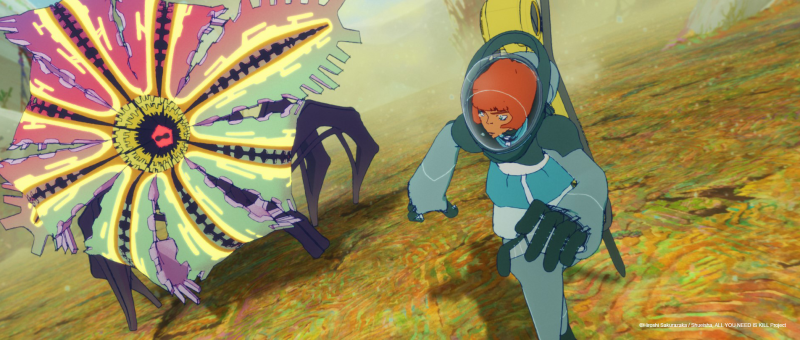
Ever get the feeling that every day is the same and nothing you do makes any difference? Rita’s (Ai Mikami) been feeling like that most of her life. Just going through the motions waiting for something to happen that would give her an excuse to change. And now she has her opportunity, because the world’s been invaded by a plant-like structure and no one yet knows quite why. All she and a team of other youngish people can do is poke around at the roots, but nothing really changes and no progress is made, which might be one reason Rita’s not really bothering. She’s sullen with her teammates and barely knows how to use her exosuit to the extent that even walking around in it is physically difficult.
When Darol suddenly turns evil and sends out plant-like soldiers to massacre humanity, Rita is powerless but unexpectedly wakes up the next morning to discover the day is repeating. Every day, she must go fight Darol again, get killed, and then wake up to do the same thing. Perhaps it’s not so different from the way things were before in which each day was filled only with labour to the extent that one was indistinguishable from another, but it’s also a maddening loop from which Rita fears she cannot escape. Though taking liberties with its source material, Kenichiro Akimoto’s anime adaptation of Hiroshi Sakurazaka’s light novel is another in a series of films expressing a sense of emptiness felt among the younger generation hamstrung by a stagnant economy and conservative society where self-fulfilment and satisfaction feel at odds with a commonly held notion of success. Rika goes to battle every day, but achieves nothing before everything resets and she has to start again.
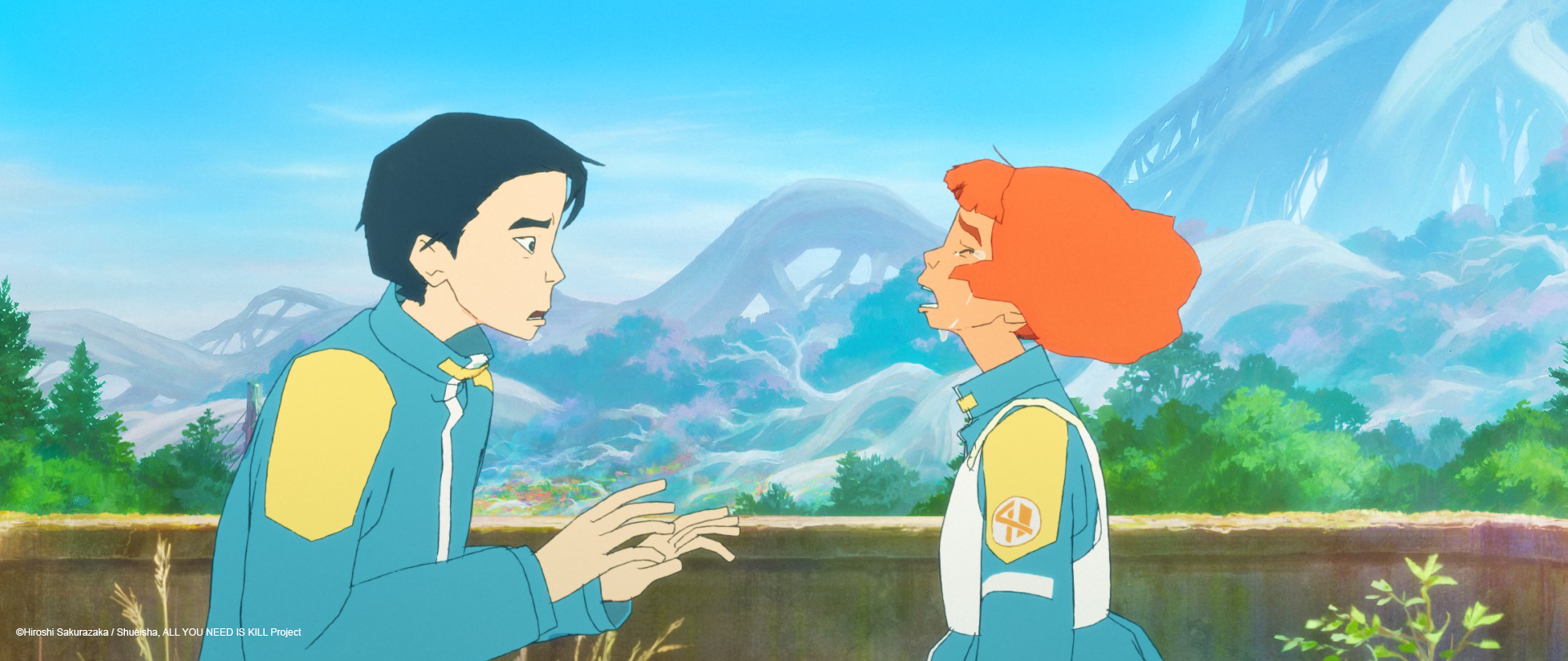
Just as she’s beginning to lose hope, she discovers another looper who has been secretly watching her exploits and supporting from the sidelines yet essentially hiding. Like her carrying childhood trauma and a sense of powerless inferiority, tech whiz Keiji (Natsuki Hanae) spent most of his first few loops trying to run away, which is understandable, only to be ironically inspired by Rita’s determination. She figures out not only that she needs a plan rather than just battling away on instinct alone, but also that she needs help. Her attempts to warn the others of Darol’s impending transformation fail, but looping with Keiji shows her the value of solidarity and the relief of sharing her burdens with someone else. As she says, she’d been selfish and self-involved, unable to see the meaning in anything until she finally realised that there was no point waiting around for the world to change. If she changed herself, the world would change around her if only that she would start to look at it differently.
These are the kinds of rebirth the pair are headed towards through their infinite karmic cycle of trying to figure out how to stop Darol and save the world. Nevertheless, the fact that Keiji is manipulating Rita’s suit and is able to programme his own to act in certain ways undercuts the notion of Rita being the arbiter of her own destiny, given that certain things are already being decided for her by an outside force other than the cosmic accident of the loop by which they are both connected. Then there’s also the implication that each of them are chosen ones that Darol particularly wants to absorb because they’re already strong, they just didn’t know it. But what really matters is that the pair begin to believe in the possibility of tomorrow enough to stop actively holding it back. Rita used to wish tomorrow would never come, and then it did stop coming, and that wasn’t any better. In fact, it was worse. At least now they each have the desire to proceed in the direction of tomorrow, together. Akimoto’s somewhat retro-inspired designs add to the sense of stopped time while the kinetic action sequences lean in to the feeling that Rita’s life is an inescapable slog against overwhelming odds and enemies that constantly respawn validating the nihilistic futility in which she is mired until finally realising that only she, with Keiji’s help, can break herself out of this cycle and finally find the way to a new tomorrow.
All You Need Is Kill is in UK cinemas from 27th February courtesy of Anime Limited.
Trailer (English subtitles)


 Windows on Worlds