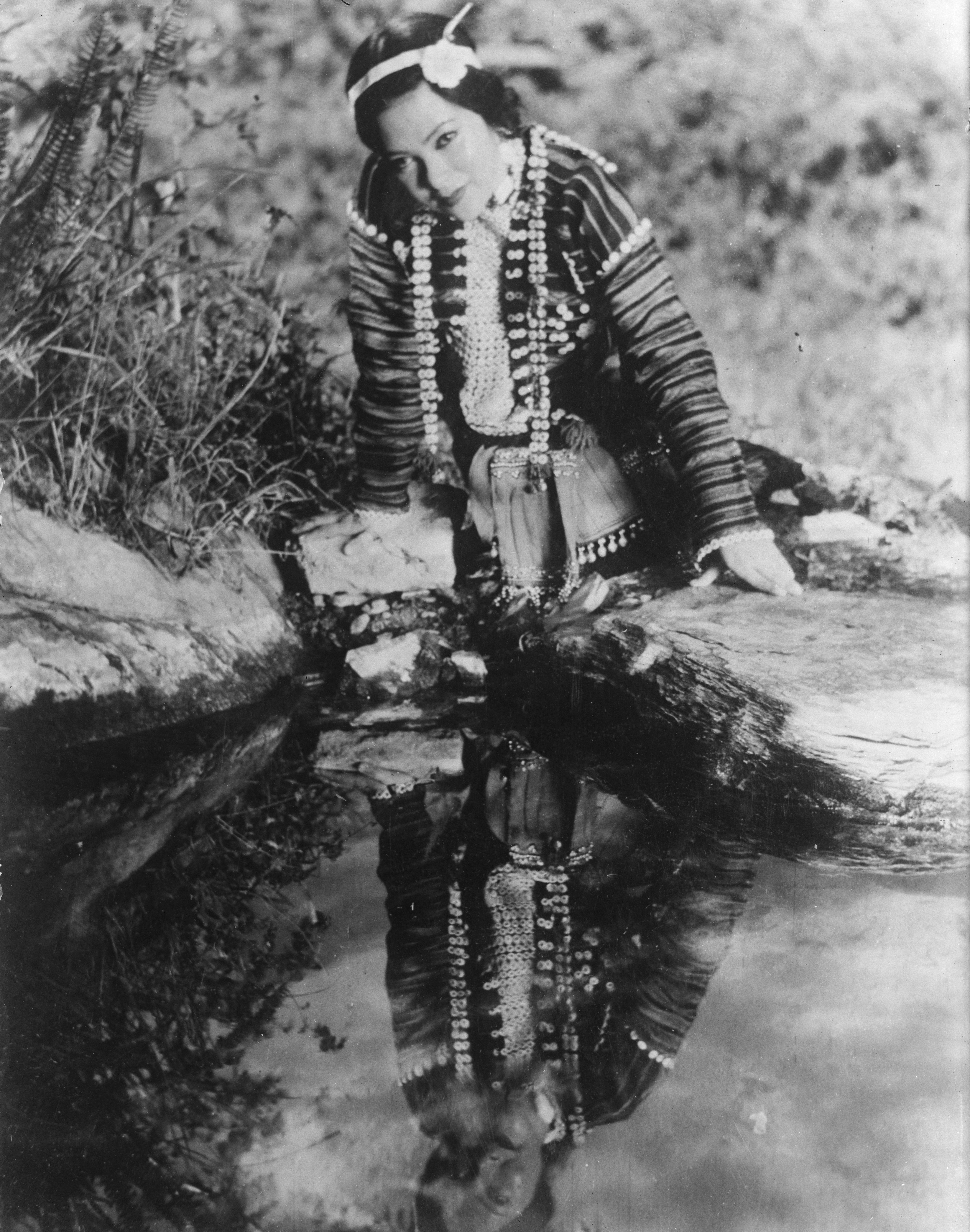
Sayon’s Bell (サヨンの鐘, Hiroshi Shimizu, 1943)

Like all directors of his era, Hiroshi Shimizu made a series of National Policy propaganda films though he was often able to circumvent their requirements by focussing on themes that interested him more directly such as teamwork or childhood. Sayon’s Bell (サヨンの鐘, Sayon no Kane) is however an unavoidably propagandist film filled with praise for the Japanese empire and to modern eyes incredibly problematic in its depictions of the indigenous peoples of Taiwan many of whom did “volunteer” to serve in the Japanese imperial army a notable example being that of Li Kuang-hui who was the last Japanese soldier to be discovered hiding in the Indonesian jungle in 1974 having been recruited from the Amis people.

The film opens with a lengthy series of title cards explaining that the film is dedicated to the Takasago Volunteers, “Takasago” being, aside from the title of a famous noh play, the name Japanese gave to the indigenous people of Taiwan believing them to have been “civilised” by Japanese rule. Thus in the opening sequences, we see the role of the Japanese military personnel as essentially paternal. They are policemen, doctors, teachers, instructors, and directors of construction who are dedicated to raising the aboriginal people to level of Japanese citizens through forced assimilation. 

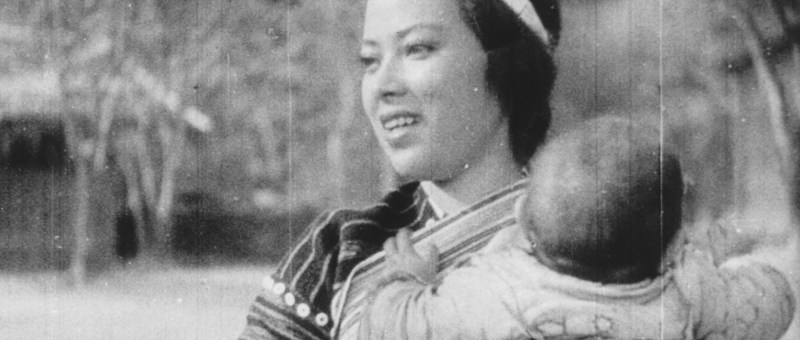
Inspired by a real life incident that also inspired a popular song of an indigenous woman who drowned in a river while carrying the belongings of a Japanese policeman, the film uses the titular Sayon as an arbiter of Japaneseness enhanced by the casting of Li Koran, later known as Shirley Yamaguchi/Yamaguchi Yoshiko, who was actually Japanese but presented as Chinese in the propaganda cinema of the time having been born in Machuria and fluent in Mandarin. Somewhat awkwardly given that Sayon is supposed to be an indigenous woman herself, she is the one schooling the local children in how to be Japanese reminding them that they should “use Japanese properly” rather than their indigenous language and praising one young boy for abandoning his indigenous name and adopting that of “Taro” instead. Japanese rule in Taiwan was not as oppressive as it was in the other parts of the empire and they did have some local support thanks to their investments in infrastructure and modernisation. Nevertheless, they did attempt to enforce the use of the Japanese language and the taking of Japanese names though it should also be noted that the KMT government did exactly the same thing only with Mandarin when it gained control of the island. 

That aside the indigenous people were often treated poorly in comparison to the rest of the of the population and we can see that the framing of them is often racist and derogatory such as when an abandoned baby is taken to the police and they remark that the indigenous community have too many children and they all look alike. The eligible men from the village, including Sayon’s love interest Saburo (Hatsu Shimazaki), have been sent to Japan for a kind of militarist re-education and are eagerly awaiting their opportunity to serve the emperor in the army. Though this may seem surprising, it apparently reflects a real fervour among indigenous men who were convinced to enlist by the money on offer and a campaign of rumours that suggested men who did not do so were unmanly and therefore unattractive to the local women. When the first round of volunteers is selected, a great amount of time is given to consoling the men who were not chosen many of whom protest and plead to volunteer their services. 

In an effort to inject some drama the film includes a love triangle between Sayon, Saburo, and Mona (Kenzo Nakagawa) who is said to be moody out of jealousy and unrequited love for Sayon but later reveals he was only jealous of Saburo in respect of playing second fiddle to him as a worthy man of the village again eager to serve the Japanese emperor. Led by Li Koran, there are several renditions of a patriotic war song singing the praises of the Taiwanese army that read that like a call to arms, though the audience for this film is certainly domestic and it seems unlikely that it would be screened in these mountain villages in Taiwan.

The first part of the film is basically ethnography featuring picturesque scenes of the local scenery and footage of the indigenous people living the “simple, peaceful life” patronisingly described in the opening titles while there is some exoticisation of the aboriginal culture in the elaborate costumes and scenes of indigenous rituals. Perhaps the most shocking aspect is that Sayon is encouraged to break a traditional taboo by entering a sacred lake where women are forbidden to go lest they anger the god Uttofu. With her new cultural re-education, Sayon thinks Uttofu is a myth and goes to the lake to help Saburo assess it because the Japanese are planning to drain it to create a rice paddy. For this she is expected to drown herself in the water to placate Uttofu and is urged to do so by the tribal elders with the Japanese basically agreeing with them deciding that they should catch an animal to sacrifice and if that doesn’t work, while it’s “unfortunate”, Sayon should indeed hurl herself into the lake if the for the good of the empire rather than Uttofu. 

It is quite odd to think that the Japanese military personnel would go along with human sacrifice rather than clamp down on a practice they would otherwise term backward, though in that light it’s impossible not to see her later death by drowning as a rejection of the “modernity” the colonial authorities represent and a re-assertion of indigenous culture. The bell referenced in the title refers to one given to the village to commemorate the incident bearing an inscription of Sayon’s name. When the KMT gained control of Taiwan, they erased the inscription on the bell and removed it as a symbol of Japanese rule though it was later restored after the end of martial law and the monument re-erected beside the bridge which was also named “Sayon’s Bridge” in a evocation of the complicated relationships between the three nations. The film is however rather uncomplicated in its themes which to modern eyes prove extremely unpalatable despite the often beautiful cinematography capturing the idyllic Taiwanese countryside.


Sayon’s Bell screens at the Museum of the Moving Image May 11 as part of Hiroshi Shimizu Part I: The Shochiku Years.

365 Nights (三百六十五夜, Kon Ichikawa, 1948)

For his second film at Shintoho, Kon Ichikawa had wanted to adapt a story by Ryunosuke Akutagawa that later inspired Rashomon, but was handed a standard melodrama to direct first. Ichikawa apparently did not think much of the novel the film was to be based on nor the script by Kennosuke Tateoka which he subsequently brushed up with the help of his new wife Natto Wada, and it’s not difficult to see why he might have felt he had an uphill battle. Melodrama is after all a genre that is founded on coincidence, though 365 Nights (三百六十五夜, Sambyaku-rokujugo ya) quickly strains credulity with the sheer number of unlikely events and surprise reappearances along with its rather strange take on the contemporary post-war society which is undoubtedly influenced by the demands of the Occupation censorship regime. 

Indeed, the setting itself seems reminiscent of 1930s cinema following the dashing hero Koroku, played by the equally dashing Ken Uehara, an architect who has walked away from his privileged upbringing as the son of a successful construction magnate. His problem is that he’s being aggressively courted by the haughty Ranko (Hideko Takamine), also the daughter of a successful but shady businessman, who to modern eyes is basically stalking him. Grinning with an evil glint in her eye, she tells her minion Tsugawa (Yuji Hori) that she’ll have seduced Koroku within 365 days which by melodrama standards seems to give her quite a lot of leeway.

Clueing us up to her villainy, Ranko is always seen wearing incredibly stylish Western outfits but otherwise behaves in a transgressively masculine fashion ordering her male employees about while set on the sexual conquest of Koroku who despises her for everything she is. It’s difficult not to see an inherent criticism of the new post-war woman and an anxiety regarding the power that comes with wealth being wielded by someone who is not a man. The contrast between Ranko and traditional femininity is rammed home by the fact that Teruko (Hisako Yamane), the daughter of the landlady in the house where Koroku finds new lodging after moving home to escape Ranko, is always dressed in kimono and otherwise naive and innocent. 

This positions Ranko, and her minion Tsugawa who is also in love with her, as the villains who are rebelling against the kind of earnestness expressed by Koroku and Teruko. From more humble origins, Tsugawa is deeply resentful of Kokoku’s class privilege and feels that he looks down on him which is one reason he seeks revenge by destroying his life along with his sexual jealously that Ranko pays him no attention yet is fixated on Kokoku perhaps precisely because he is entirely uninterested in her though it remains mystery why you’d want to be married to someone who strongly dislikes you. 

Yet for all his own earnestness, Koroku is almost betrayed by the capitalist father of whom he also seems to disapprove when he asks him to consent to an arranged marriage with Ranko to save his business. Meanwhile, it also transpires that Teruko’s father has been absent from her life because he two has a criminal past further tainting the legacy each of them bear. Ichikawa stages each evolution of their relationship at the same, noirish street corner that seems to exist as a kind of border between the illicit underworld that seeps out from Tsugawa’s bar into the post-war society, and the geniality represented by Teruko’s otherwise nice, middle-class home. 

It’s the this transgressive quality, of being caught between these two worlds, that starts to eat away at Koroku leaving him a broken and shabby man little better than a tramp. In a break with melodrama norms, though he is aware that he has led Teruko into Tsugawa’s trap he comes to believe that she has betrayed him while she clings fiercely to her love and in the end attempts to sacrifice it basically giving Koroku to Ranko whom she believes can better care for him in his now corrupted state. Though events become grim with a wedding that is staged like a funeral and takes place at a death bed, there is also the sense that something must come right that seems a little incongruous and perhaps a concession to the censors board as may be the coda implying that Ranko, despite having undergone a kind of redemption, will also have to pay for all her dodgy dealings. Though clearly hampered by the material, Ichikawa crafts some stunning images such as the final scene at Tsugawa’s bar along with a surprisingly energetic action sequence during which Koroku fights off burglars at Teruko’s home and wins her heart with his manliness. In any case despite the hints at redemption the implication remains that this is a world dark at its core in which not even the earnest can escape its creeping corruption. 


Record of a Tenement Gentleman (長屋紳士録, Yasujiro Ozu, 1947)

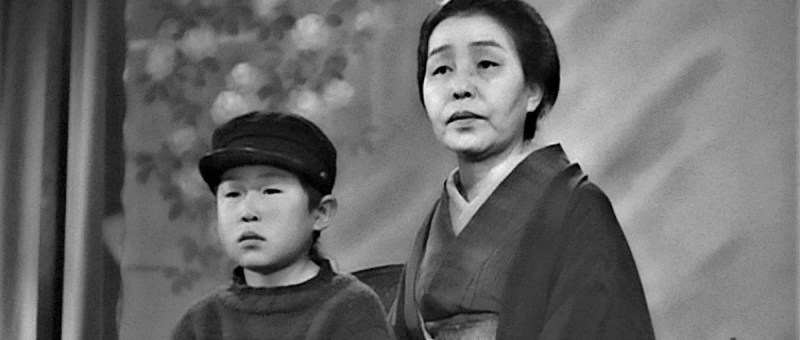
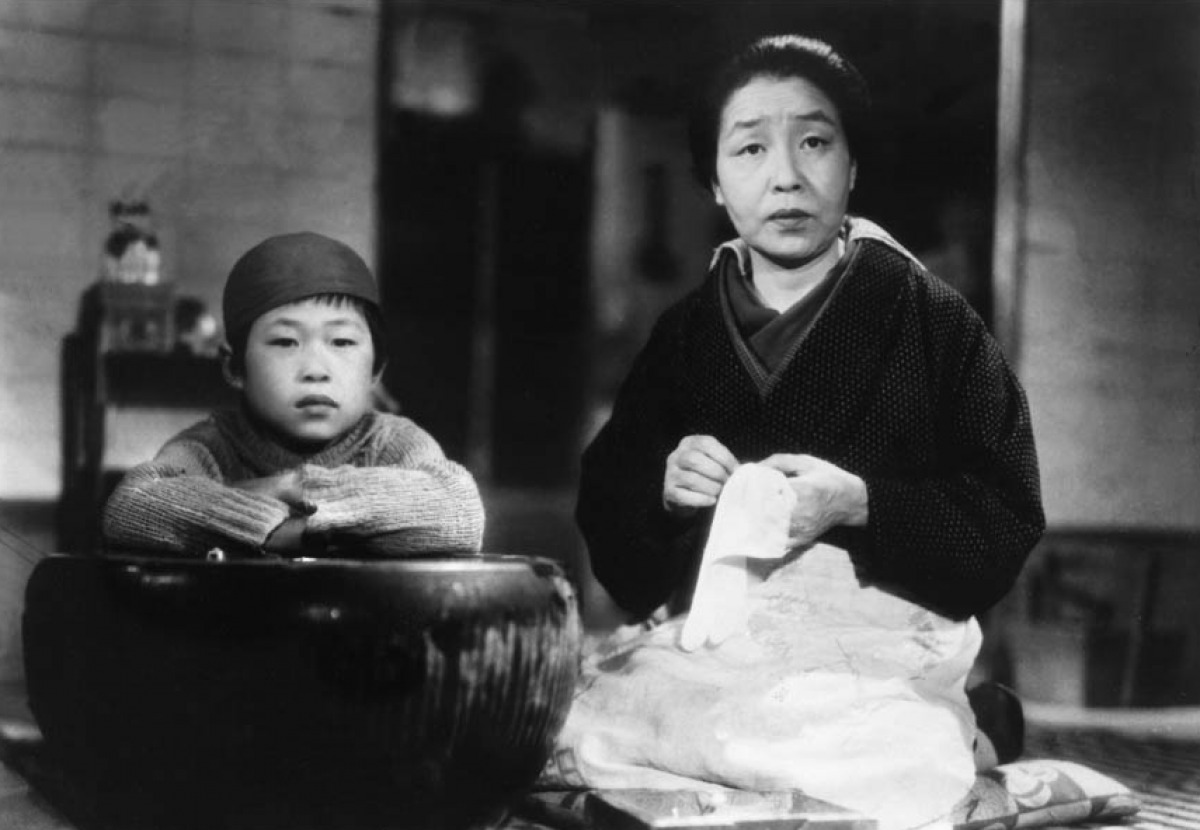
There are no real villains in the world of Ozu, though the immediate post-war world does its best to create them despite the best efforts of those quietly trying to live amidst the devastation. The misleadingly titled Record of a Tenement Gentleman (長屋紳士録, Nagaya Shinshiroku), the Japanese title a more ironic “a tenement who’s who”, is, like Hen in the Wind, a kind of manifesto statement for the postwar era only a much warmer one which looks forward to Ozu’s celebrated family dramas as its decidedly frosty heroine finds her emotional floodgates breached by the unexpected arrival of a problematic little boy. 

The little boy, Kohei (Hohi Aoki), is brought home by tenement gentleman Tashiro (Chishu Ryu) who found him wandering around in the town after becoming separated from his father. Tashiro’s roommate Tamekichi (Reikichi Kawamura) is unwilling to shelter the boy and so they decide to foist him on the grumpy old woman opposite, Tane (Choko Iida), who doesn’t want him either but is left with little choice. Tane is quickly angry with the boy because he wets the bed, ruining her spare futon, and tries to convince another neighbour who already has three children to take him in instead but is tricked into taking him back to the place he was previously living after Tamekichi rigs a game of straws. Travelling with him in the hope of finding his father, Tane wanders bombed out Tokyo and comes to the conclusion that Kohei’s dad has most likely abandoned him. 

A widow with no other family, or so it would seem, Tane is a cold and wily woman supporting herself with a small tenement shop. A sharp contrast is drawn when a childhood friend of hers, Kiku (Mitsuko Yoshikawa), arrives to ask about the best way to acquire a hose and shares some dorayaki sweets which have become a rare luxury in an age of rationing and privation. Kiku has married well and become a fine lady, not quite boasting but obviously very pleased with the walnut dressing table she had made with the mirror Tane helped her get on a previous occasion. Still, Tane is not embittered or especially unhappy just cynical and used to practicality. She didn’t see herself as the maternal type and had been intent mainly on ensuring her own survival.

Even so, she is touched and saddened to think a man might abandon his child even if she herself did not want to be burdened with him. She often scolds Kohei, frightening him with her stern expression, but later apologises when Tameshiro takes the blame for supposedly eating some of the persimmons Tane was drying at the window, even handing him the remaining fruit from the line. Talking with Kiku she recalls her own childhood as happy and carefree, tugging on her parents’ sleeves asking for pocket money while Kohei’s pockets are filled with cigarette butts and nails for the carpenter father Tane is sure has abandoned his son. This last fact is the one that finally touches her heart. Despite his fear and his hurt, Kohei has continued to think of his father and has been selflessly collecting little presents on his behalf to give to him when they are reunited. 

The innocence and selflessness of children is further emphasised by the son of a neighbour winning a prize in the lottery leading some of the other residents to insist that children are more likely to win precisely because they enter with a pure heart not with the intention of winning or monetary gain. Tane tries the theory out by making Kohei buy a lottery ticket with money Kiku had given him as a treat but of course he doesn’t win and Tane is upset, blaming him for not being as goodhearted as she’d assumed, but later giving him the money back when he bursts into tears (which is something he does often, perhaps understandably but out of keeping with the mentality of the times). Nevertheless, despite herself Tane becomes fond of the boy and even begins to think about adopting him as her own son. 

Eventually Kohei’s father returns, but Tane’s conversion is so complete and absolute that the tears she cries are not in lament for herself but in happiness to know that the boy’s father was not the awful man she thought he was but a doting parent distraught at the thought of his missing son. She is moved by the happiness they must feel in their reunion and realises that her time with Kohei has taught her many things, not least among them that she has allowed the times to cool her heart. The post-war world, the ruins and devastation we can glimpse beyond the tenement, has forced people to become self-interested, little caring if others starve so long as they aren’t hungry. She regrets that she wasn’t warmer to the boy when he arrived, and wishes we could all be more like children kind to others without thinking of ourselves. Cementing what would come to be his iconic signature style, Ozu ends, somewhat uncharacteristically, on a melancholy scene of street children, a crowd of war orphans abandoned by the society which created them through militarist folly. As much a chronicle of everyday life in the ruins of a major city, Record of a Tenement Gentleman is also an unsubtle argument for post-war humanism in a society it sees as in danger of failing to learn from past mistakes. 


Nobuko (信子, Hiroshi Shimizu, 1940)

vlcsnap-2016-12-09-01h11m57s027The well known Natsume Soseki novel, Botchan, tells the story of an arrogant, middle class Tokyoite who reluctantly accepts a teaching job at a rural school where he relentlessly mocks the locals’ funny accent and looks down on his oikish pupils all the while dreaming of his loyal family nanny. Hiroshi Shimizu’s Nobuko (信子) is almost an inverted picture of Soseki’s work as its titular heroine travels from the country to a posh girls’ boarding school bringing her country bumpkin accent and no nonsense attitude with her. Like Botchan, though for very different reasons, Nobuko also finds herself at odds with the school system but remains idealistic enough to recommend a positive change in the educational environment.

Travelling from the country to take up her teaching job, Nobuko (Mieko Takamine) moves in with her geisha aunt to save money. When she gets to the school she finds out that she’s been shifted from Japanese to P.E. (not ideal, but OK) and there are also a few deductions from her pay which no one had mentioned. The stern but kindly headmistress is quick to point out Nobuko’s strong country accent which is not compatible with the elegant schooling on offer. The most important thing she says is integrity. Women have to be womanly, poised and “proper”. Nobuko, apparently, has a lot to learn.

As many teachers will attest, the early days are hard and Nobuko finds it difficult to cope with her rowdy pupils who deliberately mock her accent and are intent on winding up their new instructor. One girl in particular, Eiko (Mitsuko Miura), has it in for Nobuko and constantly trolls her with pranks and tricks as well as inciting the other girls to join in with her. As it turns out, Eiko is something of a local trouble maker but no one does anything because her father is a wealthy man who has donated a large amount of money to the school and they don’t want to upset him. This attitude lights a fire in Nobuko, to her the pupils are all the same and should be treated equally no matter who their parents are. As Nobuko’s anger and confidence in her position grow, so does Eiko’s wilfull behaviour, but perhaps there’s more to it than a simple desire to misbehave.

Released in 1940, Nobuko avoids political comment other than perhaps advocating for the importance of discipline and education. It does however subtly echo Shimizu’s constant class concerns as “country bumpkin” Nobuko has to fight for her place in the “elegant” city by dropping her distinctive accent for the standard Tokyo dialect whilst making sure she behaves in an “appropriate” fashion for the teacher of upper class girls.

This mirrors her experience at her aunt’s geisha house which she is eventually forced to move out of when the headmistress finds out what sort of place she’s been living in and insists that she find somewhere more suitable for her position. The geisha world is also particular and regimented, but the paths the two sets of female pupils have open to them are very different. Nobuko quickly makes friends with a clever apprentice geisha, Chako (Sachiko Mitani), who would have liked to carry on at school but was sold owing to her family’s poverty. Though she never wanted to be a geisha, Chako exclaims that if she’s going to have to be one then she’s going to be the world’s best, all the while knowing that her path has been chosen for her and has a very definite end point as exemplified by Nobuko’s aunt – an ageing manageress who’s getting too old to be running the house for herself.

Eiko’s problems are fairly easy to work out, it’s just a shame that no one at the school has stopped to think about her as a person rather than as the daughter of a wealthy man. Treated as a “special case” by the teachers and placed at a distance with her peers, Eiko’s constant acting up is a thinly veiled plea for attention but one which is rarely answered. Only made lonely by a place she hoped would offer her a home, Eiko begins to build a bond with Nobuko even while she’s pushing her simply because she’s the only one to push back. After Nobuko goes too far and Eiko takes a drastic decision, the truth finally comes out, leading to regrets and recriminations all round. Despite agreeing with the headmistress that perhaps she should have turned a blind eye like the other teachers, Nobuko reinforces her philosophy that the girls are all the same and deserve to be treated as such, but also adds that they are each in need of affection and the teachers need to be aware of this often neglected part of their work.

Lessons have been learned and understandings reached, the school environment seems to function more fully with a renewed commitment to caring for each of the pupils as individuals with distinct needs and personalities. Even Chako seems as if she may get a much happier ending thanks to Nobuko’s intervention. An unusual effort for the time in that only two male characters appear (one a burglar Nobuko heroically ejects assuming him to be Eiko playing a prank, and the other Eiko’s father) this entirely female led drama neatly highlights the various problems faced by women of all social classes whilst also emphasising Shimizu’s core humanist philosophies where compassion and understanding are found to be essential components of a fully functioning society.


Ornamental Hairpin (簪, Hiroshi Shimizu, 1941)

ornamental hair pinShimizu goes on holiday! Again! Actually, when you think about it going on holiday is always inherently sad because just like everything else holidays end and you have to return to whatever it was that made you want to go on holiday in the place only with the painful reminder that a more cheerful world exists and you’re no longer in it. That rather depressing preamble out of the way, it’s time to join the temporary residents of a small hot springs resort in the picturesque countryside where a mislaid hairpin is about to kickstart a series of mini epiphanies in the diverse collection of guests.

We arrive at the inn in the company of Emi (Kinuyo Tanaka) and her friend Okiku (Hiroko Kawasaki) on a brief visit from the city. The inn is very full right now with a festival in town and everybody seems to want a massage! Another guest, the extremely grumpy professor Katae (Tatsuo Saito), is put out that the tour groups are sapping all the hotel’s resources and complains vociferously to his go partner who is staying at the inn with his two grandsons Jiro and Taro. Other guests at the inn include a mild mannered husband and his wife, Mr. (Shinichi Himori) and Mrs. (Hideko Mimura) Hiroyasu, and a recuperating soldier, Mr. Nanmura  (Chishu Ryu). Eventually the tour groups go home taking Emi and Okiku with them, but Emi discovers she’s left her ornamental hairpin behind and sends a letter offering to pay for the return postage if anyone should find it.

Mr. Nanmura finds it in his foot one day as he’s enjoying the hot springs and even though he’s not that bothered about it, complaining expert Professor Katae can’t make enough of a fuss about the supposedly shoddy conditions at the hotel. When the hotel owners write to Emi and explain to her what’s happened she jumps straight on a train to apologise in person.

Nanmura had actually been quite happy about getting skewered by the pin. He says he found it “poetic”, as if the atmosphere of the place had penetrated deeply into his skin. The supposedly learned Katae doesn’t quite understand the soldier’s poetic leanings and starts debating whether the owner of the pin will be pretty or not, as if that would make a difference to the soldier’s romantic construction of events. Emi is indeed very beautiful, through perhaps a little sad and obviously contrite about the pin. Everyone in the inn is quite invested in witnessing a true love miracle between the bizarrely crippled soldier and the wounded beauty from Tokyo.

Once again the inn is a constructed world, a safe haven far away from the trouble and strife which exists outside it. The guests indulge themselves in the tranquil atmosphere taking in the beautiful scenery and killing time on otherwise trivial pursuits which occasionally include projecting a kind of narrative on their new found friends. The two boys, totally bored by this deliberately unstimulating environment, turn everything into a competition – even cheering on their grandfather as snores along side the equally noisy professor with the result that pretty much no one else is getting any sleep. Later they help the injured soldier recover with a set of endurance games which see him trying to walk unaided from one tree to another and eventually across a bridge.

Further comic relief is provided by the Hiroyasus with the husband being the sort of mild-mannered man who has no idea what he actually thinks so he just goes along with everything everyone says (and later checks with his wife who has the ultimate authority). Hiroyasu often defers to the professor whose authoritative tone gets things done for him though he is in fact an extremely self centred prig who just loves to complain out of a desperate need to be validated. He’s the loudest snorer of all and is keeping everyone awake yet he constantly complains about the noise of the other guests and is quick to shout at the inn keeper when he can’t get a massage because they’ve been booked by the visiting tour groups the very presence of which also annoys him. Eventually he gets so grumpy he just goes home which is probably a win/win for everyone.

But what of Emi herself? She too is escaping from something. The loss of the ornamental hair pin and its rediscovery leading her to the inn and perhaps to Nanmura has pushed her into a further consideration of her life in Tokyo. She doesn’t want to go back, this brief respite has been too pleasant and she wishes it could go on like this forever, though she knows, of course, that it can’t. She doesn’t know what she’s going to do now, but at least while she stops at the inn the sun will light the way. This is 1941, Nanmura will probably be going back to the war, the future is uncertain for everyone, but in here everything is beautiful, calm, safe. It’s just a shame it can’t last.


Ornamental Hairpin (簪, Kanzashi) is the fourth and final film in Criterion’s Eclipse Series 15: Travels with Hiroshi Shimizu box set.

Clip of one of Nanmura’s “trials” (no subtitles):

https://www.youtube.com/watch?v=WojtILzbaBk