Suicide Troops of the Watchtower (望楼の決死隊, Tadashi Imai, 1943)

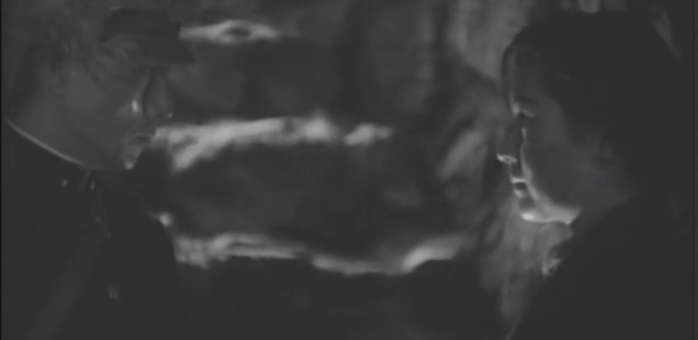
Produced by Toho and Chosun Film Production Corporation, Suicide Troops of the Watchtower (望楼の決死隊, Boro no kesshitai) was intended as a piece of imperial propaganda promoting a sense of unity between Koreans and the Japanese who had annexed their country in 1910 and thereafter ruled in an oppressive and often brutal fashion. Not that you would know any of that from the film which is directed by committed communist Tadashi Imai while equally surprisingly crediting Choi In-gyu as an “assistant director”, though Choi was already an established and successful director of colonial films such as Tuition (1940) and Angels on the Street (1941). 

Like Tuition the film is almost entirely in Japanese, Korean having been banned onscreen by this point, though small smatterings of Korean are heard in the background. The film is set in 1935, but there are signs visible at certain points reminding people to “use only the national language,” eg. Japanese, though one of the Japanese officers has apparently learned Korean to better communicate with the local community. Likewise, though Korean actors also appear in the film, they are mainly in smaller parts with the most prominent roles being played by well-known Japanese stars. Nevertheless, Korean characters have not generally taken Japanese names, but are referred to by the Japanese reading of the Chinese characters with which their names are written. Thus, the sister of the Korean border patrol officer who is killed is referred to as Eishuku (played by Korean actress Kim Shin-jae), rather than as Yong-suk. Meanwhile, another man remarks that if he called himself “Hayashi” he might feel more Japanese, while his wife has become accustomed to wearing Japanese kimono.

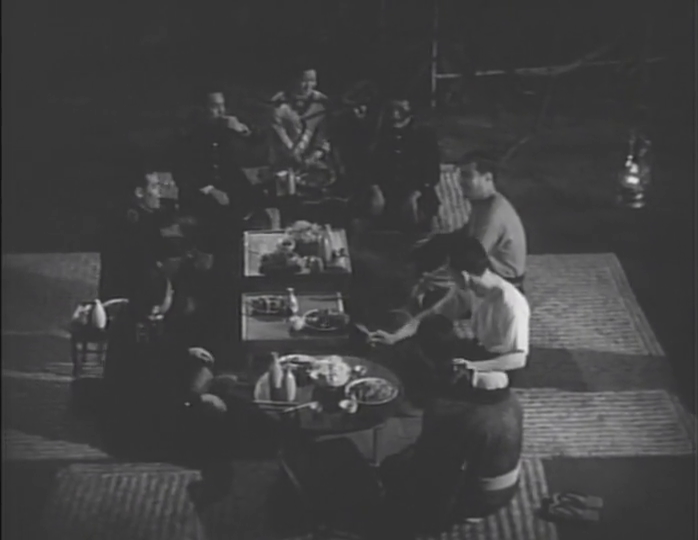
The earliest scenes of the film capture the idyllic pastorality of the Korean landscape and are intended to extend a degree of exoticism to the mainland Japanese audience who are likely less familiar with Korea or Korean culture. This is also true of the early scene in which members of the border patrol hold a welcome party for Asano (Hideo Saito) which takes place at a traditional Korean home. The men eat and drink outside sitting at low tables while the Japanese soldiers attempt to learn a Korean folksong taught to them by Kin. These scenes seek to paint colonial life as a more genial form of cultural exchange brokered by friendliness and respect even though in reality expressions of Koreanness are generally discouraged while the people are brutally oppressed and economically exploited. 

Unlike some similar films, however, Suicide Troops of the Watchtower presents Korean and Japanese people as equals who are fighting for the Japanese empire together. Though they are also portrayed as simple, rural people, the Koreans are never seen to be stupid or incapable and are overall honest and kind if grateful to the Japanese border patrol officers for protecting them from the bandits. In some surprising ways, the film at times presents a more progressive view of society than might be expected as the border patrol is universally supportive of Eishuku’s desire to become a doctor with one of the officers selling off his rice field to ensure she can continue her education after her brother’s death. The implication might be that this is an opportunity afforded to her by the “civilising” force of Japanese colonialism, but she is nevertheless encouraged to become an independent working woman who will also use her skills in support of the empire. 

On the other hand, the Chinese characters seen in the film are all played by Japanese actors and are generally viewed with a degree of suspicion. Cafe owner Wanryu (Ichiro Sugai) has crossed the border expressly to escape the violent bandits of Manchuria, but is still mistrusted by the border patrol despite repeatedly pledging his loyalty to them. When a man in stereotypical Chinese dress with a wounded arm turns up in Wanryu’s cafe and ends up killing officer Kin when challenged, suspicion falls on Wanryu. The Chinese population has essentially been characterised as the “other” and the force against which the Japanese and Koreans are unified, which somewhat undermines the final pronouncement that the bandit problem has been solved by the elimination of the border now that Japan has conquered Manchuria. 

Though they are described as “bandits” and it is said that they have been pushed into Korean territory by Japanese soldiers pursuing them, it easy to read these insurgents as Korean Independence fighters many of whom had gone into exile in China, particularly in Shanghai. Wanko, the estranged son of Wanryu, is not just a young man who ran off to live a life of banditry, but a guerrilla fighter resisting Japanese imperialism. His eventual conversion born the desire to avenge the death of his father at the hands of bandit leader Koryo who meant to kill Wanryu fearing he had betrayed them by warning his father of the imminent attack, is then depicted as a kind of homecoming as border patrol chief Takatsu (Minoru Takada) agrees to release him so that he can fight alongside them. 

To that extent, it might seem surprising that the film makes the bandits seem so powerful to the degree that they pose a genuine threat the security of the empire. Their assault is staged in a way that resembles Hollywood westerns. At the film’s conclusion, it really appears as if all is lost and the border patrol will be wiped out by the bandits, partly because they are clearly understaffed which would seem to be a strategic failure on the part of the authorities. Takatsu’s ever capable wife Yoshiko (Setsuko Hara) is seen lugging weaponry around bearing out the all hands on deck mentality. At the lowest moment, Takatsu gives his pistol to his wife with the intention that she use it on herself when they are overrun while the Korean residents make similar plans with a new mother preparing to smother her baby if the need arises. 

In the end they are saved by the timely arrival of reinforcements thanks to the efforts of the new arrival Asano who had been unable to cope with the harsh life on the border and was determined to quit. Even the one Korean who had subversively complained about being exploited as free labour by the entitled Japanese occupiers chips in to help so that the bandits are eventually defeated by the united force of Koreans and Japanese officers fighting side by side. Even so, the closing speech insists that the colonial authorities will now continue with their ideal of bringing “order” to Korea. Commander Takatsu proves his commitment by giving up  the opportunity to return home to see his dying mother, while his wife becomes a maternal figure to the local community. Released in 1943, the film is perhaps an advocation for unity born of increasing desperation as Japan suffered repeated defeat and domestic strain, preparing its audience for the necessity of defending themselves against a similar onslaught while suggesting that all must work together to save the nation.
Tomorrow There Will Be Fine Weather (明日は日本晴れ, Hiroshi Shimizu, 1948)

According to the driver aboard the bus at the centre of Hiroshi Shimizu’s Tomorrow There Will Be Fine Weather (明日は日本晴れ, Asu wa Nipponbare),  “that ridiculous war ruined everything”. Shimizu had directed a similar film in 1936, Mr Thank You, in which times had been hard for all but people tried to stay cheerful and help where they could. But here, by contrast, the atmosphere is much less jovial. Everyone is fed up, unhappy, dissatisfied, and irritated far beyond the inconvenience of being delayed on their journey.

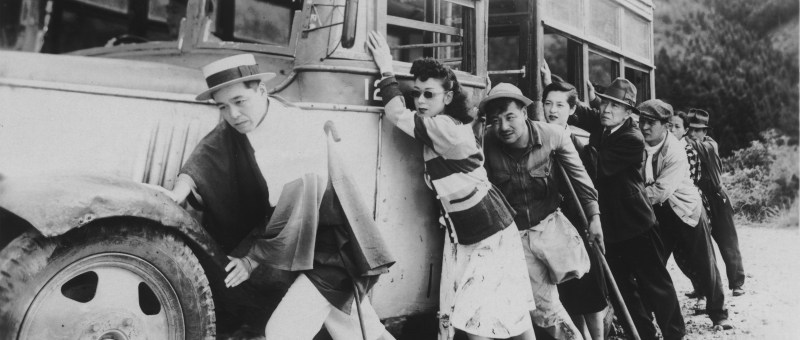
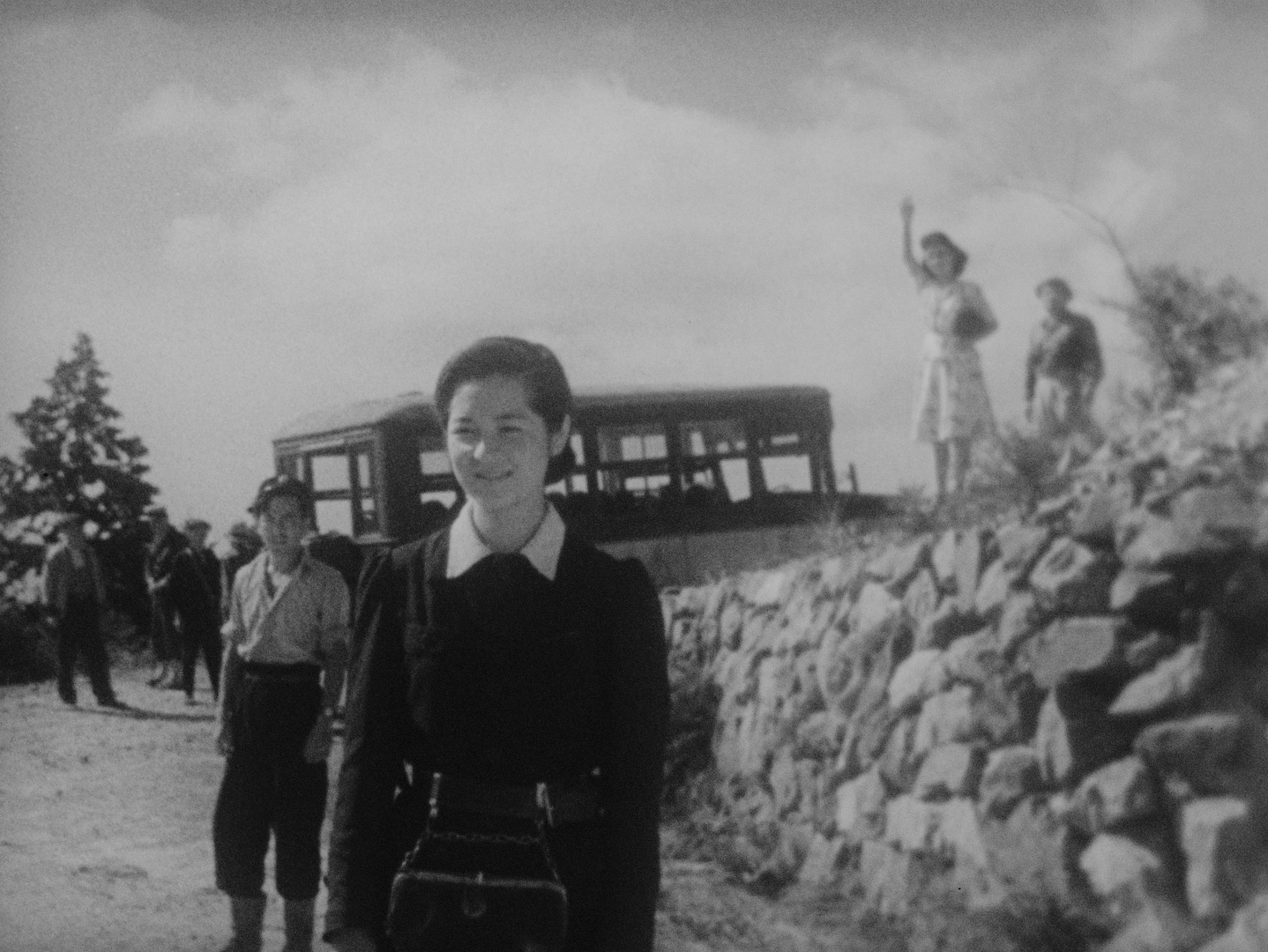
Once again shot on location, the film follows a bus on the outskirts of Kyoto making the journey along a mountain pass from the city to an onsen town before breaking down half way. It’s several miles across difficult mountainous terrain to the nearest town in either direction and many people aboard the bus are elderly or have disabilities that make simply walking the rest of the way a difficult prospect while no one can really say when help will come because they’re dependent on the arrival of the following service or some other form of transport that could get a message out for a mechanic or replacement bus. 

In any case, just as in Mr Thank You there is a diverse contingent aboard each of whom have particular reasons for travelling and for being upset about the delay. A trio of men begin by complaining that this journey which once took two hours now takes three while the bus itself has become worn down and unreliable. Even so, the fares are now much more expensive. What’s most surprising is that the men loudly and openly discuss their occupation as black market traders while simultaneously complaining about an increased police presence interfering with their work. An irritated, besuited man sitting across the aisle is the only one to challenge them, asking if they pay taxes on their clearly illegal earnings to which the answer is obvious though the men mostly complain about how it wouldn’t be worth their while if they did rather than outright denying a responsibility to pay. The man tells them that they’re part of the problem and that the future of the country is assured only if people pay their taxes, with which the men otherwise seem to agree. When the bus breaks down, one of them is most worried that his late arrival will cause concern for his wife who may assume he’s been caught and arrested.

But there’s a small drama playing out in the front of the bus too as the conductress gossips with the driver certain that the beautiful woman sitting half-way back is a well-known Tokyo dancer, Waka, who she’s heard is on her way to bury the ashes of her child seemingly born out of wedlock. The driver, Sei, grimaces slightly as if he didn’t want to have this conversation and as we later discover once knew Waka long ago before the war which has changed each of them. A blind man, Fuku, now working as a masseur after losing his sight in the war, once knew them both hatches a plan to try and get them to patch things up. But as Sei later says, they’ve both been through far too much and are no longer the same people. Nothing can be as it was before, but in a way that’s alright. There is still hope for the future on the broken bus that is post-war Japan if only someone can figure out how to get the engine going again. 

Nevertheless, the scars from this war are still very noticeable. One of the black-marketers has a missing leg and later lays into an old man who confesses that he was a military commander, hounding him for his responsibility for the folly of the war which men like him forced them to continue long after it was obvious that it was lost. Fuku is much more sanguine and after a minor misunderstanding able to find a way to communicate with an elderly man who is deaf despite the incompatibility of their disabilities as they help each other board the replacement bus to the new Japan. Sei, and the slightly younger conductress who is not so secretly in love with him, meanwhile remain stuck on the broken bus symbolically unable to move forward no matter how much Sei insists it’s time to “get over the war” and that he just wants to forget the past and start living again. Perhaps it’s for men like him who seem fine on the surface that the scars run deepest, overburdened by all that this “ridiculous war” took from them in unlived futures and broken dreams. Meanwhile Shimizu follows the other bus onward along the precarious and winding mountain roads hoping for better weather in the hot springs town ahead.


Tomorrow There Will Be Fine Weather screens at Japan Society New York on May 17 as part of Hiroshi Shimizu Part 2: The Postwar and Independent Years.

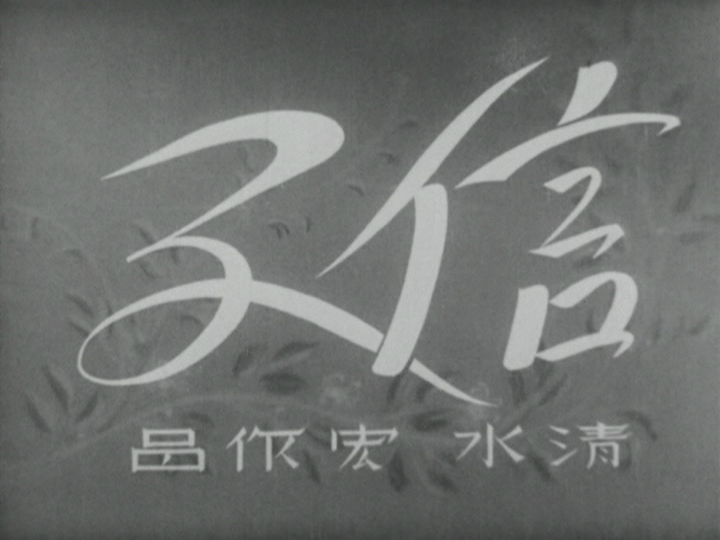
Nobuko (信子, Hiroshi Shimizu, 1940)

vlcsnap-2016-12-09-01h11m57s027The well known Natsume Soseki novel, Botchan, tells the story of an arrogant, middle class Tokyoite who reluctantly accepts a teaching job at a rural school where he relentlessly mocks the locals’ funny accent and looks down on his oikish pupils all the while dreaming of his loyal family nanny. Hiroshi Shimizu’s Nobuko (信子) is almost an inverted picture of Soseki’s work as its titular heroine travels from the country to a posh girls’ boarding school bringing her country bumpkin accent and no nonsense attitude with her. Like Botchan, though for very different reasons, Nobuko also finds herself at odds with the school system but remains idealistic enough to recommend a positive change in the educational environment.

Travelling from the country to take up her teaching job, Nobuko (Mieko Takamine) moves in with her geisha aunt to save money. When she gets to the school she finds out that she’s been shifted from Japanese to P.E. (not ideal, but OK) and there are also a few deductions from her pay which no one had mentioned. The stern but kindly headmistress is quick to point out Nobuko’s strong country accent which is not compatible with the elegant schooling on offer. The most important thing she says is integrity. Women have to be womanly, poised and “proper”. Nobuko, apparently, has a lot to learn.

As many teachers will attest, the early days are hard and Nobuko finds it difficult to cope with her rowdy pupils who deliberately mock her accent and are intent on winding up their new instructor. One girl in particular, Eiko (Mitsuko Miura), has it in for Nobuko and constantly trolls her with pranks and tricks as well as inciting the other girls to join in with her. As it turns out, Eiko is something of a local trouble maker but no one does anything because her father is a wealthy man who has donated a large amount of money to the school and they don’t want to upset him. This attitude lights a fire in Nobuko, to her the pupils are all the same and should be treated equally no matter who their parents are. As Nobuko’s anger and confidence in her position grow, so does Eiko’s wilfull behaviour, but perhaps there’s more to it than a simple desire to misbehave.

Released in 1940, Nobuko avoids political comment other than perhaps advocating for the importance of discipline and education. It does however subtly echo Shimizu’s constant class concerns as “country bumpkin” Nobuko has to fight for her place in the “elegant” city by dropping her distinctive accent for the standard Tokyo dialect whilst making sure she behaves in an “appropriate” fashion for the teacher of upper class girls.

This mirrors her experience at her aunt’s geisha house which she is eventually forced to move out of when the headmistress finds out what sort of place she’s been living in and insists that she find somewhere more suitable for her position. The geisha world is also particular and regimented, but the paths the two sets of female pupils have open to them are very different. Nobuko quickly makes friends with a clever apprentice geisha, Chako (Sachiko Mitani), who would have liked to carry on at school but was sold owing to her family’s poverty. Though she never wanted to be a geisha, Chako exclaims that if she’s going to have to be one then she’s going to be the world’s best, all the while knowing that her path has been chosen for her and has a very definite end point as exemplified by Nobuko’s aunt – an ageing manageress who’s getting too old to be running the house for herself.

Eiko’s problems are fairly easy to work out, it’s just a shame that no one at the school has stopped to think about her as a person rather than as the daughter of a wealthy man. Treated as a “special case” by the teachers and placed at a distance with her peers, Eiko’s constant acting up is a thinly veiled plea for attention but one which is rarely answered. Only made lonely by a place she hoped would offer her a home, Eiko begins to build a bond with Nobuko even while she’s pushing her simply because she’s the only one to push back. After Nobuko goes too far and Eiko takes a drastic decision, the truth finally comes out, leading to regrets and recriminations all round. Despite agreeing with the headmistress that perhaps she should have turned a blind eye like the other teachers, Nobuko reinforces her philosophy that the girls are all the same and deserve to be treated as such, but also adds that they are each in need of affection and the teachers need to be aware of this often neglected part of their work.

Lessons have been learned and understandings reached, the school environment seems to function more fully with a renewed commitment to caring for each of the pupils as individuals with distinct needs and personalities. Even Chako seems as if she may get a much happier ending thanks to Nobuko’s intervention. An unusual effort for the time in that only two male characters appear (one a burglar Nobuko heroically ejects assuming him to be Eiko playing a prank, and the other Eiko’s father) this entirely female led drama neatly highlights the various problems faced by women of all social classes whilst also emphasising Shimizu’s core humanist philosophies where compassion and understanding are found to be essential components of a fully functioning society.