Pressure of Guilt (白と黒, Hiromichi Horikawa, 1963)

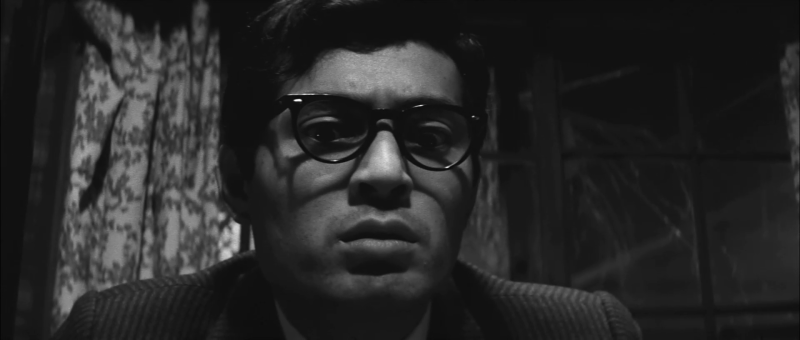
When a lawyer’s wife is found strangled at home, the police immediately arrest a “suspicious person” who is found to be carrying jewellery stolen from her room. Open and shut case, some might say, and prosecutor Ochiai (Keiju Kobayashi) agrees. But in reality nothing is really so black and white in the contemporary society of Hiromichi Horikawa’s crime drama, Pressure of Guilt (白と黒,, Shiro to Kuro). Perhaps ironically, the film opens in the same way as Tai Kato’s later I, the Executioner, with a man’s hands stretching around a piece of rope, and also features a law enforcement officer who is distracted from his duties by a bad case of piles he refuses to get treated.

Ochiai says his haemorrhoids are born of sitting down thinking too much, but the problem might be that he doesn’t think enough or that he suppresses thoughts which might prove inconvenient. There’s something that bothers him about the idea of Wakida (Hisashi Igawa) being the killer, but he shoves his doubts out of his mind and continues questioning him until he confesses. Some of this is born of prejudice. Wakida has a long criminal record mainly for burglary, and has been in and out of prison the whole of his adult life. Currently suffering from TB, he appears to be one of the young men who came to the city in search of work but found only exploitation and eventually had no option but to turn to crime. That he stole the jewellery is not in dispute, but Wakida continues to insist he didn’t kill Mrs Munakata (Koreya Senda). His lack of cooperation puzzles Ochiai, but it confuses him still more that Wakida keeps changing his story. He is, it seems, trying to tell him what he wants to hear, but finally becomes fed up with the whole thing after receiving a letter from his mother telling him to confess. She evidently thinks he did it too. Falling into hopelessness, Wakida declares that he no longer cares who did it and might as well be him because his life is essentially already over. In his condition he won’t last long in prison. There’s no prospect of turning his life around, either. So a death sentence won’t make any difference.

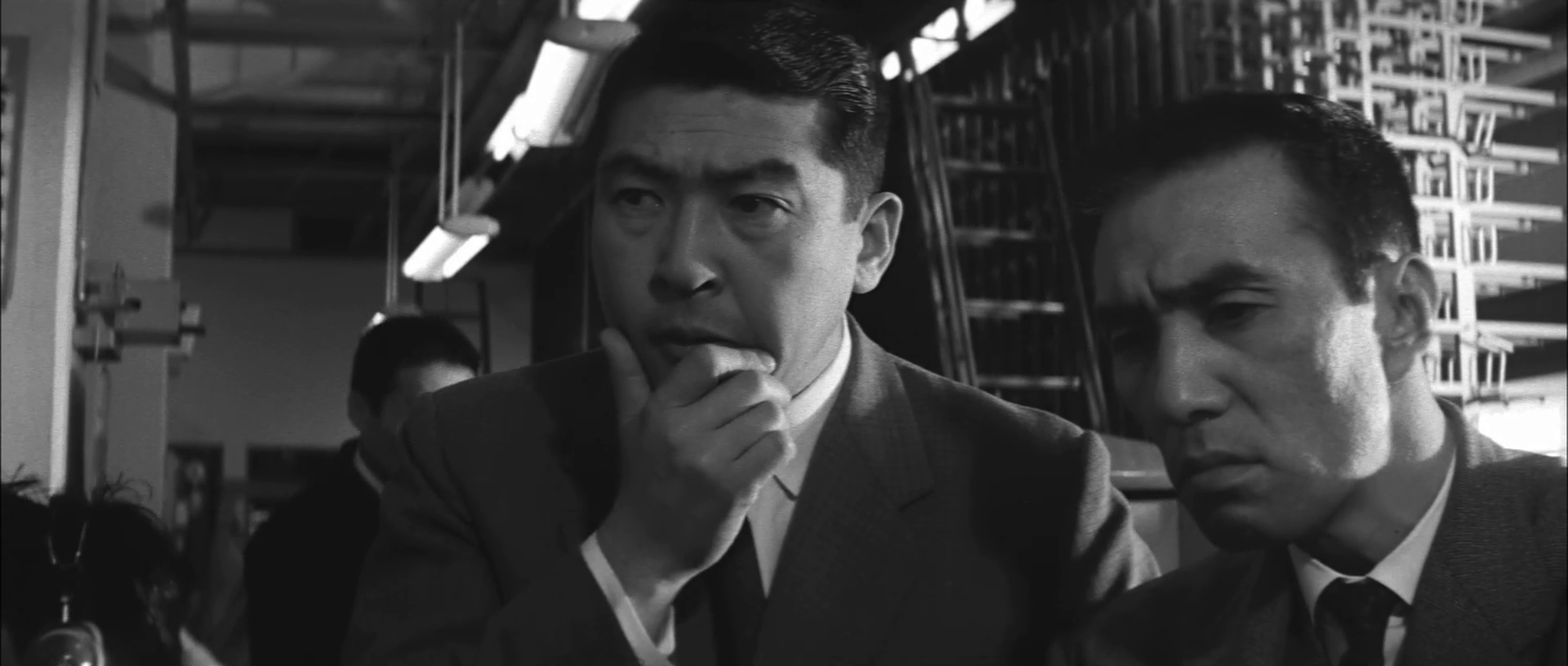
The funny thing is that it’s realising his fiancée must have figured out he did because she’s covering up for him that forces Hamano (Tatsuya Nakadai) into a confession. He’s plagued by guilt that Wakida might die for his crime, but not enough to exonerate him by coming forward. Nevertheless, he tries to talk Wakida round, asking why he confessed and if he was pressured by the prosecutors. The Japanese legal system places confessions above all else, but the issue is that Wakida’s confession is the only evidence that links him to the murder. Just because he stole the jewellery doesn’t mean he killed Mrs Munakata. Ironically enough, he’s defended by the victim’s husband (Koreya Senda), an anti-death penalty activist lawyer who agrees to represent him in part to vindicate his principles. Wakida only agrees to cooperate with Munakata and Hamano who is acting as his assistant when he confirms they’re not trying to help out of pity but only for their own self-interest. 

Yet Ochiai might have a point asking why Hamano is certain that Wakida didn’t do it, or why, on beginning to suspect him, he’s trying so hard to exonerate a man who was going to pay for his crime. It’s Hamano’s own suspiciousness that leads him to question his judgement about Wakida and ask himself if his thinking wasn’t too black and white and he should have investigated more thoroughly rather than pressuring Wakida into a confession and charging him. On realising he may have made a mistake, Ochiai puts the prosecution in a difficult position as his boss warns him of the potential reputational damage to the police and prosecutors if they’re shown to have made a mistake with the mild implication that, as he had assumed someone in Hamano’s position would want to, he should just keep quiet and let Wakida hang. 

Surprisingly, however, it only seems to improve the public’s view of the prosecution to be able to see them admit that they made a mistake and try to fix it rather than refuse to change their position. Mystery writer Seicho Matsumoto makes a cameo appearance as a TV pundit who says he admires Ochiai, while the film also uses a real TV show host to interview Ochiai boosting the sense of realism. As it turns out, there was more to the story than even Ochiai or Hamano thought, but still he declares that it’s better to be a fool than a hopeless idiot and that he was right to look for the truth even if it ended up biting him in the behind. The pressure of Hamano’s guilt, however, never really dissipates even as he struggles with himself, trying to find a way to save Wakida and avoid becoming a murderer twice over, without giving himself away. Nothing’s really that black and white after all, and this case wasn’t exactly open and shut, but the conviction that it had to be based on prejudice and circumstantial evidence might be the biggest crime at all no matter how it actually turned out.

The Eternal Rainbow (この天の虹, Keisuke Kinoshita, 1958)

Eternal rainbow poster 1Famously, towards the end of the war, Keisuke Kinoshita got himself into trouble with a dialogue free scene of a mother’s distress as she sent away the son she’d so carefully raised “for the emperor” towards an uncertain future in the midst of hundred of other, identically dressed faceless boys. Army might have showcased the director’s propensity for resistance, but one could also argue that there was just as much propagandistic intent in the post-war films as their had been in the militarist era even if the messages they were selling were often more palatable. 1958’s The Eternal Rainbow (この天の虹, Kono Ten no Niji) is a case in point. A portrait so positive one wonders if it was sponsored by Yahata Steel, The Eternal Rainbow is nevertheless conflicted in its presentation of defeated post-war hope, exploitation, and growing social inequality even as it praises its factory city as a utopian vision of happy industry and fierce potential.

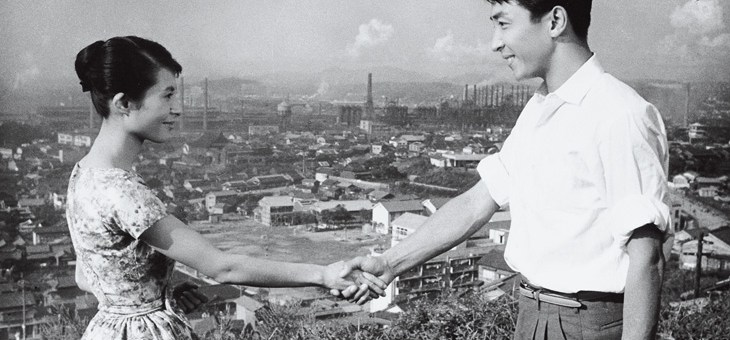
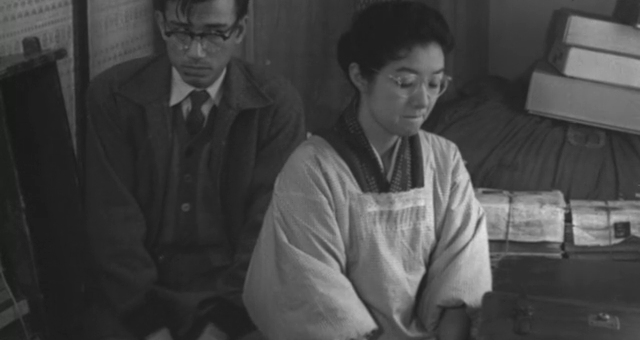
A lengthy opening sequence featuring voice over narration recounts the history of the Yahata Steel Works which began operations in 1901 in Northern Kyushu and now employs thousands of people, many of whom live nearby in the ever expanding company dorms the newer models of which feature bright and colourful modern designs in contrast to the depressing grey prefab of the traditional workers’ homes. Gradually we are introduced to our heroes – chief among them Mr. Suda (Yusuke Kawazu), a young man from the country who saw a factory job as his over the rainbow but is rapidly becoming disillusioned with its dubious gains. Rather than the company dorms, Suda rooms with the foreman, Kageyama (Chishu Ryu), and his wife Fumi (Kinuyo Tanaka) whose young son Minoru (Kazuya Kosaka) didn’t qualify for a factory job on account of his small frame and his been unable to stick at anything in the precarious post-war economy. Meanwhile, Suda has made friends with an older worker, Sagara (Teiji Takahashi), who has fallen for a secretary, Chie (Yoshiko Kuga), but her family are dead against her marrying a factory worker while she is also in a relationship with a college educated engineer, Machimura (Takahiro Tamura), but is beginning to doubt the seriousness of his intentions.

The drama begins when Sagara employs Kageyama to act as a go-between in a formal proposal of marriage to Chie’s parents, the Obitas. Kageyama didn’t really want to be a go-between because it’s gone badly for him before and he thinks this one is a non-starter too – women around here have their sights set on office workers, no one in the arranged marriage market is looking to marry someone on the shop floor. The Obitas feel much the same. Mrs. Obita is keen for Chie to marry up and is somewhat offended by the proposal, granting it only the customary consideration time to not seem rude in turning it down flat. Sagara is stoic about the matter, but the abruptness of the rejection greatly offends Suda who cannot stand for the Obitas snobbish put down of working people.

Herein lies the central conflict. Suda was a country boy who’d been sold an impossible dream. He believed that a job in the factory, for which he had to sit an exam and has been chosen out of thousands of other hopefuls, was his ticket out of rural poverty. Now that he’s working there he realises he is little more than a wage slave, working long hours for almost nothing with the only goal of his life being to earn enough to feed a family with a little (very little) left over for his old age. Minoru, the Kageyamas’ son, feels much the same and has already turned cynical and desperate. He can’t abide his father’s work ethic and wants more out of life than there perhaps is for it to give him. Suda repeatedly asks how people can learn to be happy in this sort of life, wondering if those that claim to be have simply given up their hopes and aspirations in resignation. When Minoru decides not to go to Tokyo it ought to be a victory, but then perhaps it is more that he has simply accepted that there is no hope there either.

Nevertheless, the depiction of Yahata as a place to work is ridiculously positive even as Kinoshita undercuts it with the disillusionment of both Suda and Sagara. A factory city, Yahata is characterised as a cornerstone of the burgeoning post-war economy, literally making the rails on which the new Japan will run. The works provides affordable accommodation for families, guaranteed employment, insurance, a “self service” supermarket right on site, social clubs, cultural activities, and festivals. They even get a large scale show from Tokyo every year.

Even so, an immense and seemingly unbridgeable gap exists between the steelworkers and the company men. Mrs. Obita might seem self serving and mercenary, but she’s had a hard life and perhaps it’s only natural that wants better for her daughter. Suda is angry to think a good man like Sagara who might be a bit old fashioned and unsophisticated but has taken the trouble to do things the “proper” way would be dismissed out of hand simply out of snobbery. His attitude is, however, somewhat problematic in that he begins bothering Chie to find out her reasons for declining the proposal, refusing to recognise that she doesn’t need to offer any reason besides her own will. Chie, meanwhile, is conflicted. A proposal of marriage from a man she doesn’t even really know is not something she was minded to consider in any case, but her feelings for Machimura are tested once she becomes aware that he is not quite in earnest and may have been messing around with his landlady while enjoying the attention he receives as an eligible bachelor around town.

Machimura, like Suda, Sagara, and Minoru, is somewhat listless and apathetic even if for the opposite reason in that his life is far too easy and he hasn’t had to make a lot of concrete decisions about his future. Chie doesn’t deny that his college education and urban sophistication are part of the reason she was attracted to him, but as she later tries to explain to Suda, she wasn’t simply angling to marry up – she just fell in love with someone who happened to be of a higher social class which isn’t the same as looking down on working people. She has a right to her feelings whatever political label an increasingly resentful Suda might like to put on them. Even so, if she had been trying to marry up who could really blame her for that? In a society in which women are still entirely dependent on a man, being largely prevented from pursuing a career in their own right, a marriage is effectively a job for life. Shouldn’t she pick the offer with the best benefits, just as Suda did when he chose to leave the country for a factory job?

Progressive factories are often presented as an ideal solution the problem of post-war poverty, but here Kinoshita does not seem so sure. Despite the emphatic tone of the infrequent voice over and the central messages that factory jobs are good jobs and looking down on manual work nothing more than snobbery, Suda and Sagara remain conflicted. This work is dangerous, pays little, and offers nothing more than false promise. If the vast cities like Yahata are the engines repowering the economic growth of a still straitened Japan, what will be the end result? Metropolis made flesh, the “eternal rainbow” is exposed as a self serving lie but what, Suda might ask, else is there for men like him in a society like this?


Original trailer (no subtitles)

Danger Stalks Near (風前の灯, Keisuke Kinoshita, 1957)

Keisuke Kinoshita is often regarded as a sentimentalist but he wasn’t completely immune to bitterness and cynicism as many of his farcical comedies bear out. Danger Stalks Near (風前の灯, Fuzen no Tomoshibi) begins in serious fashion as a trio of young toughs set on burgling the home of an elderly woman they assume has money but quickly descends into absurd dark humour as we discover there’s just as much money-grubbing thievery going on inside the house as out.

Two street toughs bully a nervous young man who needs money to get back to the country into joining them in a plot to rob a suburban house owned by a mean old woman whom they assume must be hiding a serious amount of cash inside. Having watched the place before, they know that it’s generally just housewife Yuriko (Hideko Takamine), her young son Kazuo (Kotohisa Saotome), and grumpy grandma Tetsu (Akiko Tamura) at home during the day after husband Kaneshige (Keiji Sada) has gone to work at his lowly job as a shoe salesman. Today, however, their aspirations towards crime will be thwarted because it’s all go at the Sato residence – flouncing lodgers, sisters with issues, tatami repair men, and mysterious faces from the past all mean that today is a very bad day for burglary but a very good one for entertainment.

Kinoshita deliberately upsets the scene by casting familiar actors Hideko Takamine and Keiji Sada in noticeably deglammed roles – she with a ridiculous pair of large round glasses and he with a giant facial mole designed to make them look “ordinary” but accidentally drawing attention to their star quality in the process. The Satos are, however, a very ordinary family in that they’re intensely obsessed with money and with their own precarious status in the improving but still difficult post-war economy. Tetsu is Kaneshige’s step-mother which is perhaps why he urges his wife to put up with her tyranny seeing as Tetsu is old and will probably not be around much longer, which means it’s just a waiting game until they inherit the house. Whatever else she may be, Tetsu is a mean old woman whose only hobbies are penny pinching and occasional trips to the cinema where she watches heartwarming dramas about filial piety. Her haughty attitude is perhaps why the crooks assume there is cash in the house but sometimes mean people are mean because they really don’t have money rather than just being stingy by nature.

Nevertheless, Tetsu’s iron grip is slowly destroying the family unit. Kaneshige (whose name ironically means “money multiplying” and uses a rather pretentious reading for his name kanji which are often misread by the postman etc) sneaks home to tell his wife he’s won second place in a competition, worrying that if Tetsu finds out she’ll expect her share of the prize money. The old woman is so mean that she even keeps her own stash of eggs in her personal cupboard along with tea for her exclusive use and takes the unusual step of locking the doors when Yuriko is out running errands because she feels “unsafe” in her own home – an ironic state of mind once we discover how exactly Tetsu was able to buy this house as a lonely war widow in the immediate aftermath of the defeat.

Tetsu is, in a fashion, merely protecting her status as matriarch in oppressing daughter-in-law Yuriko by running down her every move as well as those of her sisters whom she criticises for being dull despite their “cheerful” names but also chastises for lack of traditional virtues. Sakura (Toshiko Kobayashi) pays a visit to the Satos because she needs help – her husband has been accused of embezzlement, but is also hoping Yuriko is going to feed her in return for help with domestic tasks only the pair eventually fall out over a missing 30 yen and some crackers. Meanwhile, second sister Ayame (Masako Arisawa) also turns up but with a “friend” (Yoshihide Sato) in tow whom she hopes can become their new lodger after they ended up throwing the old one out because she burned a hole in the tatami mat floor through inattentive use of an iron. Neither Tetsu nor Yuriko could quite get their head around previous tenant Miyoko’s (Hiroko Ito) liberated, student existence of rolling in late after dates and lounging around reading magazines but a male lodger wasn’t something they had in mind either.

Persistent economic stressors have begun to wear away at family bonds – Tetsu is not a nice old woman, but it probably isn’t nice to be living in a house where you know everyone is just waiting for you to die. At least little Kazuo is honest enough to admit he only likes grandma when she gives him candy. Yuriko seems to be a responsible figure for both her sisters, but resents their relying on her for money while enjoying the various gifts they bring to curry favour including a large amount of fish cake from the prospective lodger/Ayame’s intended (if he doesn’t wind up being swayed by the dubious charms of the seductive Miyoko who insists on sitting in her empty room for the rest of the day because she already paid today’s rent). Meanwhile, Yuriko’s attempt to palm off a pair of unwanted tall geta that were a “present” from Kaneshige’s boss (who also heard about the prize money) leads to an accusation of attempted murder as if she hoped Tetsu might topple to her death after trying them on! The burglars have wasted all day sitting outside watching the ridiculous comings and goings as they bide their time waiting to strike only for the police to arrive on a completely unrelated matter. Turns out, inside and outside is not so different as you might think in a society where everything is a transaction and all connection built on mutual resentment.


Titles and opening scene (no subtitles)