Raffles Hotel (ラッフルズホテル, Ryu Murakami, 1989)

An actress gradually dissolves into her own image while wandering around Singapore in search of lost love in Ryu Murakami’s adaptation of his own novel, Raffles Hotel (ラッフルズホテル). Ryu Murakami may generally be more associated with the extreme revolving around transgressive sex and violence, yet like its namesake the film is a more elegant affair indulging in its own sense of mystery tinged with a melancholy eeriness in its heroine’s apparent instability. 

Moeko (Miwako Fujitani) later admits that she is no longer an actress, and therefore no longer quite herself uncertain who it is she’s meant to be. In one sense perhaps that’s why she’s come to Singapore though in another it’s someone else she’s looking for though to begin with we may think she’s there to escape him, and it could be that too. “Maybe I’d feel better if he were,” she muses when her tour guide, Yuki (Masahiro Motoki), explains that there are no Japanese people near the gravestones she’s just been looking at trying to assure her that the man she’s seeking is not dead. She thinks she sees him everywhere, dropped into typical Singaporean scenes appearing as a durian seller or a man restoring a church while more literally haunted by the spectre of a friend who apparently died in Vietnam while covering the war. Kariya (Jinpachi Nezu) later tells her that he can’t forget the jungle while she asks to be taken there with him and travels to a mountain lodge where they hunt wild game with a crossbow. 

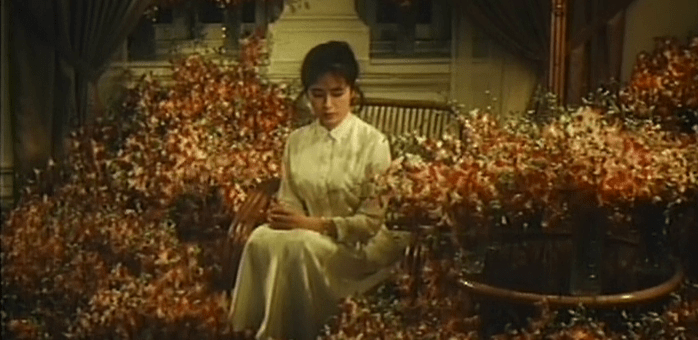
Yuki first becomes worried about her when her hotel room is filled with orchids she claims are from Kariya only to discover she ordered them herself when the orchid house contacts the hotel to complain that the bill has not been paid. Even so, she continues to believe they are from the man she’s looking for, even going so far as to thank him for them as if unable to process the gap between her realities. We often see her looking at photos from her photo shoots, while she later complains to Kariya that she wants to laugh when she wants to laugh and cry when she wants to cry as if making plain her disconnection with her self and desire to reassert her own identity over those she is forced to assume as an actress. 

This abstraction may also explain her words to Kariya that the sky is full of stars but that they are distant from each other and therefore the sky is only make-believe as if the image of Moeko that we see is only an illusion we’ve patched together from the various components available to us. It speaks of her alienation and loneliness, two qualities only deepened by her presence in an unfamiliar culture where she cannot speak the language. Acting as her guide, Yuki describes her as a polar opposite to his Singaporean girlfriend (Fawn Wong), the daughter of a wealthy family who is bold and confident, unafraid to chase her desires be they dancing or “Japanese hoods” as her father describes them. 

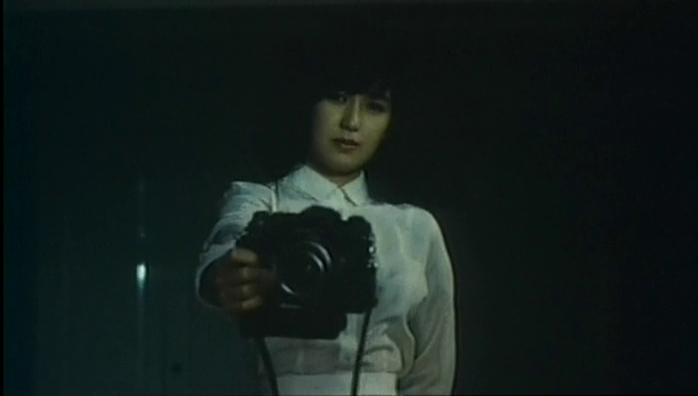
Murakami semi-exoticises Singapore if at times ironically in homing in on the portraits of famous authors in the bar and a man who always seems to be banging away on a typewriter. He sends Moeko all around the island and follows her as she takes in tourist sights, tries durian, and watches Chinese opera but lends an eerie quality to her place within the hotel implying finally that her room has in a way swallowed her as her name is added to the list of famous people who have stayed there even as she remarks that she feels as if the ceiling fan has become sentient in its movement. In any case, the camera is something that she both fears and craves as it both gives and takes her identity. She tries to pick it up herself but points it without looking, finally asking Kariya to take her picture only to find herself becoming one with her image just as Kariya is reduced to shadow as if her very essence had dissipated into the atmosphere as symbolised in a swimming pool full of orchids. “Lost in a fantasy” she may be, but so are we, led astray by a vision of a woman we can never really see. 

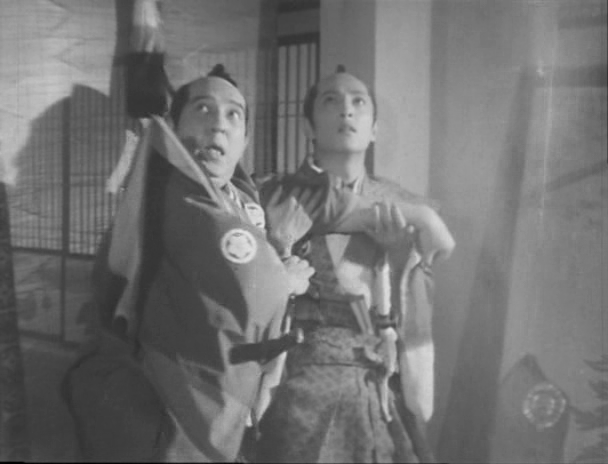
The Ceiling at Utsunomiya (怪異宇都宮釣天井, Nobuo Nakagawa, 1956)

Crime does not pay for a series of conspirators at the centre of Nobuo Nakagawa’s supernaturally-inflected historical tale, The Ceiling at Utsunomiya (怪異宇都宮釣天井, Kaii Utsunomiya Tsuritenjo). As the title implies, Nakagawa’s ominous jidaigeki is inspired by a historical legend in which a retainer supposedly attempted to assassinate the shogun through the rather elaborate device of a mechanical ceiling designed to crush him as he slept. In actuality no such thing took place, the shogun changed his route and subsequent investigations of Utsunomiya Castle found no sign of a false ceiling, yet the story took on a life of its own as local folklore. 

In this version of the tale, conspirators Councillor Kawamura (Ureo Egawa) and local yakuza Kagiya (Masao Mishima) are conspiring to depose Tokugawa Iemitsu (Yoichi Numata) in favour of his brother, manipulating Lord Honda (Shuntaro Emi) of Utsunomiya Castle by convincing him that his clan will prosper when the other retainers fall in behind the new shogun. The pair have arranged for nine talented craftsmen to be shut up in the castle to install “the mechanism” in time for the arrival of the shogun who is due to stay at the castle on his way to Nikko. Meanwhile, Kawamura is also intent on sleeping with the daughter of head carpenter Toemon (Yoji Misaki), Ofuji (Konomi Fuji), whom chief minion Tenzen (Tetsuro Tamba) is supposed to kidnap once the workmen have gone into isolation in the castle. Righteous samurai Ryutaro (Hiroshi Ogasawara) however, an undercover shogunate bodyguard, begins to disrupt their plan saving Ofuji while bonding with a friendly bar hostess, Onobu (Sachiko Toyama), and secret princess forest woman Oshino (Akemi Tsukushi). 

The plot represents in itself a malfunctioning of the feudal order in the essential weakness of Lord Honda, the ambition of his underling Kawamura, and the cruel greed of Kagiya. As the two men conspire, Kagiya jokingly laments that he isn’t a samurai while Kawamura reminds him that if the plan comes off he’ll be fantastically rich. Kagiya, a yakuza who sends his thugs to extort protection money from the local market, is representation of the threat of the rising merchant class whose financial power presents a challenge to the authority of the samurai. Toemon, meanwhile, a master craftsman, is manipulated into participating in the plan because he is in debt to Kagiya, later promised that he too will be “promoted” in being given permission to carry a sword little knowing that Kawamura and Kagiya not only plan to kidnap and rape his daughter but never intend to allow any of the craftsmen to live because they simply know too much. 

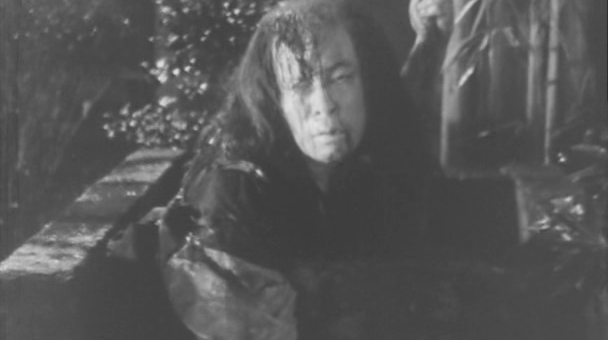
The Ceiling at Utsunomiya is not a ghost story in the manner for which Nakagawa is best known but it certainly plays like one, Kagiya eventually haunted by the figure of a betrayed Toemon which in turn leads him to a self-destructive attack on Tenzen and his eventual demise collapsed over his ill-gotten gains, a koban falling from his hand. Greed and violence will only repay in the same, the weak-willed Lord getting his comeuppance from the ever confident shogun even if he himself coolly stands back while others risk their lives to protect him. Even so, the eventual operation of “the mechanism” is intensely startling, the ceiling abruptly collapsing with alarming ferocity though one wonders what the advantage is in such an expensive, elaborate contraption aside from its ironic symbolism when the point of a sword will do. 

Then again, the heroic Ryutaro is almost assassinated while crossing a river via zip wire later fished out of the river by sullen forest woman Oshino, first encountered hunting birds with darts but later revealed to be the illegitimate child of samurai parents who fell foul of political intrigue. In a sense this revelation emphasises the restoration of the political order, Ryutaro permitted to fall in love with Oshino because they are of the same social class, while the romance between Ofuji and craftsman Yoshichi (Kotaro Sugiyama) also comes to fruition eliding the minor class difference between them in allowing the boss’ protege to marry the now orphaned daughter. Onobu meanwhile pays heavy price for her misplaced love for Ryutaro, denied romantic fulfilment in her liminal existence as a bar hostess. In any case, the corruption is exorcised and the normal order resumes reinforcing the hierarchical shogunate society with each of the players back in their rightful positions and possessing new hope for the future as Ryutaro and the shogun continue their tour while their former comrades kneel at the roadside.