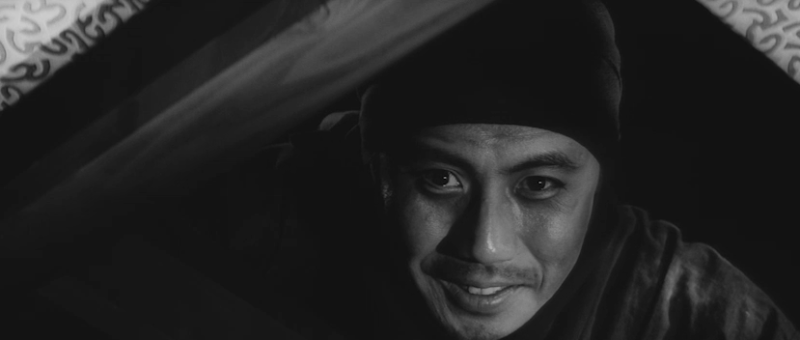
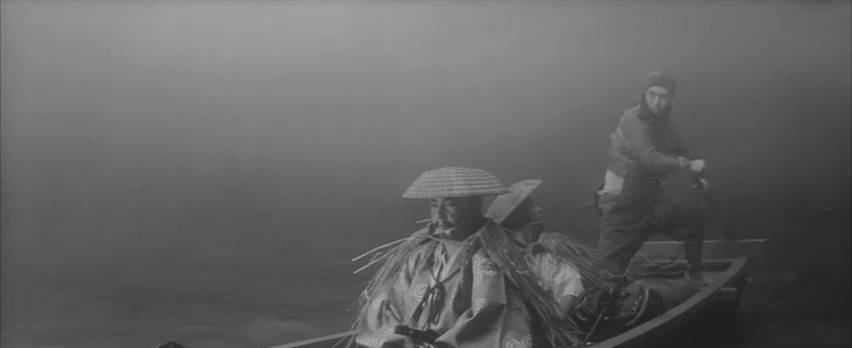
Shinobi No Mono 5: Return of Mist Saizo (忍びの者 続・霧隠才蔵, Kazuo Ikehiro, 1964)

At the end of the previous instalment, Saizo (Raizo Ichikawa) had escaped from the fall of Osaka Castle spiriting away Sanada Yukimura (Tomisaburo Wakayama) who, in contrast to what the history books say, did not die. The pair make their way towards Shimazu, where they are also not well disposed to Ieyasu (Eitaro Ozawa), but as Saizo is informed the Tokugawa clan will never die. Knocking off Nobunaga put an end to the Oda clan, getting rid of Hideyori took the Toyotomi out of the running, but killing Ieyasu will make little difference because another retainer will swiftly take his place.

As a reminder, that’s bad for Saizo because what he wanted was the chaos of the Warring States era back to restore the ninja to their previous status. Nevertheless, at the end of the previous film he claimed to have rediscovered a human heart in his devotion to Yukimura though it may of course be simply another ruse to meet an end. In any case, Ieyasu seems to be putting his ninjas to good use and is once again waiting it out apparently aware that Yukimura is alive and well in Shimazu.

Meanwhile, times are changing. Yukimura is convinced the future of warfare lies in firearms and whoever controls Tanegashima where the weapons are made will prove victorious. They think they can gain it by figuring out how they get access to high-quality iron when trading with anyone outside of Portugal is illegal and the Portuguese don’t have any. It’s access to foreign trade which is becoming a crunch issue as Ieyasu tries to solidify his power, later giving a deathbed order to ban Christianity to stop European merchants taking over the country. Saizo travels to Tanegashima to investigate and figures out that the secret is they’re trading with China, which is pretty good blackmail material, but also encounters two sisters who turn out to be the orphaned daughters of a Tokugawa ninja with vengeance on their mind.

In a surprising turn of events, it turns out that his main adversary is Hanzo Hattori (Saburo Date) but the fact he keeps outsmarting him eventually convinces Ieyasu that the ninja have outlived their usefulness. Hanzo becomes determined to kill Saizo to restore his honour, filling the palace with various ninja traps though unlike Goemon Saizo seems to be one step ahead of them. This lengthy final sequence is played in near total silence, and ironically finds Goemon just waiting, after dispatching several of Hanzo’s men, to see if his poison dart has taken effect and Ieyasu is on his way out. Only in the end Ieyasu just laughs at him. He’s 75. Saizo’s gone to too much effort when he could have just waited it out. Ieyasu has already achieved everything he wanted to. His control over Japan is secured given he’s just been appointed chancellor. He can quite literally die happy because nothing matters to him anymore. A title card informs us that when Ieyasu did in fact die, no one really cared. The Tokugawa peace continued. 

Here, once again, the Ninja too are powerless victims of fate despite their constant machinations. Yukimura tells Saizo to live and be human, advice he gives to the sisters in Tanegashima but does not take for himself staking everything on his revenge against Ieyasu which is, as he points out, pointless for Ieyasu was at death’s door anyway and his demise changed nothing. In his first of two entries in the series, Kazuo Ikehiro crafts some impressive set pieces beginning with a mist-bound underwater battle as Saizo and Yukimura make their escape by water to an epic flaming shuriken battle, though this time around the deaths are noticeably visceral. Men are drowned, stabbed, or caught on wooden spikes. Those who do not obey the ninja code are stabbed and pushed off cliffs while once again emotion is a weakness that brings about nothing more than death. Ikehiro’s frequent use of slow dissolves adds to the dreamlike feel of Saizo’s shadow existence even as the ninja themselves seem to be on the point of eclipse for what lies ahead for them in a world of peace in which there is no longer any need for stealth?
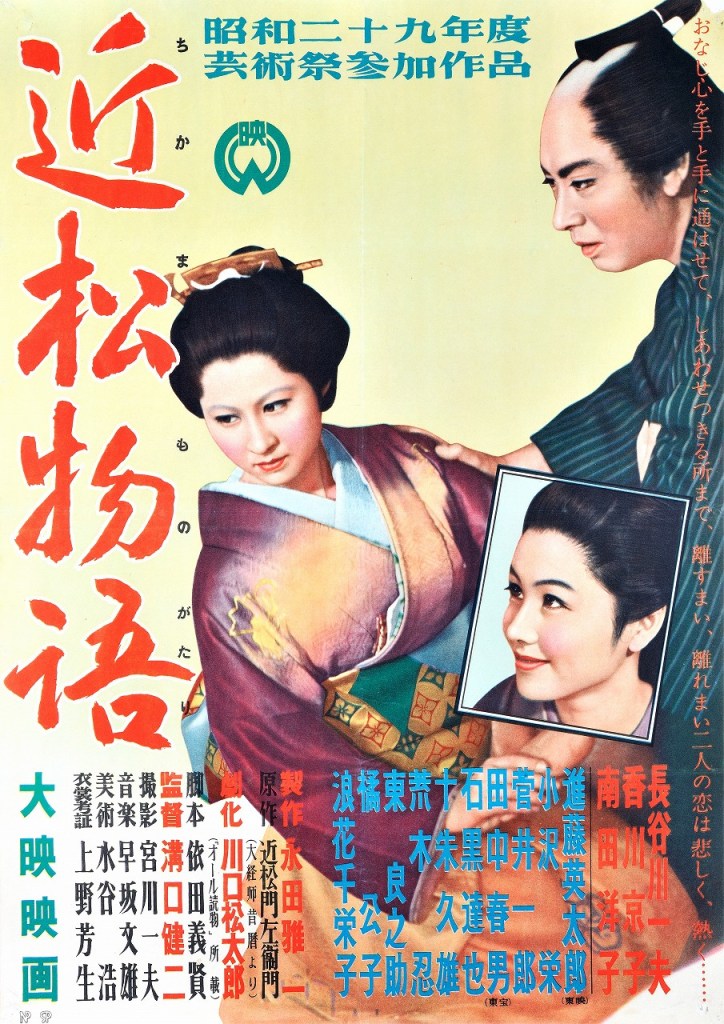

The Crucified Lovers (近松物語, Chikamatsu Monogatari, Kenji Mizoguchi, 1954)

E8BF91E69DBEE789A9E8AA9EB2Bunraku playwright Chikamatsu Monzaemon had a bit of a thing about double suicides which feature in a number of his plays. Though these legends of lovers driven into the arms of death by a cruel and unforgiving society are common across the world, they seem to have taken a particularly romantic route in Japanese drama. Brought to the screen by the great (if sometimes conflicted) champion of women’s cinema Kenji Mizoguchi, The Crucified Lovers (近松物語, Chikamatsu Monogatari) takes its queue from  one such bunraku play and tells the sorry tale of Osan and Mohei who find themselves thrown together by a set of huge misunderstandings and subsequently falling headlong into a forbidden romance.

Set in 17th century Kyoto, the story begins with a reminder that adultery is currently illegal and that the penalty is crucifixion of both parties. A samurai woman and a man servant are being paraded through the streets for having committed the double transgression of an extra-martial affair which also crosses class borders. We set our tale at the top printing house in the city where the most promising employee, Mohei, is being pulled from his sickbed to complete a particularly important order. At the same time, mistress of the house Osan receives an unwelcome visit from her brother who is once again in pecuniary difficulty. He wants her to ask her wealthy husband, Ishun, to lend him some more money to meet the latest mortgage payment on their family home. However, Ishun is a stingy old man and outright refuses. Mohei overhears the brother’s visit and offers to help but his idea to temporarily embezzle some of the money backfires when he’s caught.

To make matters worse, Ishun now has it in for Mohei as Ishun has been after the servant girl Otama who has been refusing his advances and finally lied to him by claiming that she and Mohei are secretly engaged. After Otama reveals Ishun’s true nature to Osan, they hatch a plan to confront him by swapping rooms so that when Ishun makes his nightly visit to Otama he’ll find his wife waiting for him instead and have to backdown for awhile. This backfires too when Mohei decides to escape and stops by Otama’s room to say goodbye only for another servant to find Mohei and Osan together there. Mohei flees but a rumour starts about his friendship with Osan and it’s not long before she’s stormed out too. Accidentally running in to each other the pair find themselves on the run and eventually falling in love, but this isn’t the sort of place where two people can just move to another town and disappear. The police and Ishun’s men are hot on their tail determined to try and prevent the impending scandal…

Life was pretty harsh in feudal Japan. In some ways Osan might be thought lucky – married off at a young age to a well connected and prosperous husband. Indeed, at the beginning of the film she doesn’t seem too unhappy though is obviously nervous to talk to her husband about her brother’s predicament. Ishun is not a good man though he is perhaps sadly typical of his petty samurai merchant class. He swaggers around complaining about having to pay for everything and won’t even lend any of his vast wealth to his own sister let alone his wife’s family. Though outwardly miserly he’s no problem promising fancy kimonos and even a house to Otama if she’d only consent to becoming his mistress. Something of a double standard then when his wife is accused of having affair with a servant merely by having been found in a compromising position alone in a room with another man.

Mohei, by contrast, is the archetypal loyal retainer. When ever a problem comes up he reminds himself that one needs to be a “good servant” – a sentiment he utters to Otama when she asks for his help to fend off Ishun. He doesn’t approve of the idea of her simply giving in, but thinks she ought to grin and bear it. Similarly when some of the female members of staff are sympathising with the samurai lady about to be crucified for love, Mohei agrees that he feels sorry for her but also that she’s broken a law and what is happening is simply a natural consequence. He’s the last sort of person you would expect this sort of thing to happen to, and yet, it does.

The irony is that nothing existed between the pair other than the loose friendship and loyalty of a mistress and a member of staff before this whole thing started. Their union is quite literally unthinkable, not only a relationship between a married woman and another man, but love across the class divides. Even if Osan were free, a marriage with Mohei would be considered a disgrace. When the pair face the hopelessness of their situation and decide on suicide, Mohei confesses his love which immediately changes Osan’s mind about dying. She’s fallen in love with him too, and now she wants to live. For her now there can be no life without Mohei. Though Mohei entertains the noble idea of handing himself in to the police and sending Osan back to Ishun who would doubtless be glad to cover up the affair and avoid a bigger scandal, he later finds himself unable to give her up. The pair cannot, and will not, deny their love even if it costs their lives. In this unforgiving world of harsh social justice, the only freedom left to Osan and Mohei is to ride proudly to their agonising deaths hand in hand and with beatific smiles on their faces.

In the end, two grand houses fall because of a series of coincidental misunderstandings and lapses of protocol. Envious of his position, another petty samurai is perfectly happy to manipulate the situation to take down Ishun fully knowing that it will mean the deaths of two people. In ordinary circumstances this passionate, romantic love would never be permitted to exist (or at least among this social class). Its blossoming is an impossible miracle that threatens the very foundation of the extraordinarily regimented society of the two people at its centre. Parents betray their children to protect these archaic laws and preserve their family “honour” but what honour could their possibly be in the denial of love and society that places standing above basic compassion?

Though not perhaps Mizoguchi’s most impressive effort, The Crucified Lovers is an impassioned attack on needlessly repressive social systems and the self centred shenanigans which perpetuate them. Unashamedly melodramatic and filled with a melancholy though passionate resilience, The Crucified Lovers is a tragic tale of true love torn asunder by a cruel and unforgiving world. It would be so easy to say this would never happen today, and yet…


The Crucified Lovers is available on blu-ray in the UK as part of Eureka’s Late Mizoguchi box set.

No trailer but here is a particularly beautiful scene from the film

And an introduction from Tony Rayns