Tokarev (トカレフ, Junji Sakamoto, 1994)

The discovery of a pistol concealed under a vending machine provokes a prolonged crisis of power and masculinity in Junji Sakamoto’s tense psychological drama, Tokarev (トカレフ). So named for the guns at its centre, the film roots itself in post-Bubble anxiety in the push and pull between two very different men mediated through the kidnapping of an innocent child who in the end pays a very heavy price for the anxieties and resentments that drive his parents’ generation.

That said, the kidnappers are actually very nice to little Takashi who looks strangely happy in the videotaped ransom note as the friendly voice of a youngish man encourages him to look towards the camera. They take him to an amusement park, buy him new shoes and ice cream, and even let him wave the gun around during the money drop but are it seems otherwise callously indifferent to his fate.

The boy’s father, Nishiumi (Takeshi Yamato), has just moved onto a danchi housing estate with his wife Ayako (Yumi Nishiyama). They seem very excited to start their new life, yet the danchi itself speaks of a post-war aspiration which now seems dated and largely absent in the contemporary society. Nishiumi drives the bus to the local kindergarten picking up the surprisingly large number of children from their block each morning. Meanwhile, their neighbour, Matsumura (Koichi Sato) seems irritated by their presence perhaps jealous of their happy family life as he returns home alone and angrily flips the cover over his motorbike before opening the door. 

On the morning in question, Matsumura has trouble kickstarting his bike yet Ayako seems strangely drawn to him perhaps attracted by a different and older kind of masculinity. Unlike her husband, Matsumura wears a suit to work everyday and carries a little salaryman-style purse yet he works a job that could be considered manual in a printing press where they produce newspapers. He later excitedly tells Ayako that he gets to read the news before anyone else, though his hands glide over notices of violent crimes including a shooting which may seem additionally exciting to him given that he is the man who discovered a gun under a vending machine in Christmas-set opening sequence. His cluttered home otherwise at odds with the sense of order he projects is full of old newspapers while he seems to listen to the same weather broadcast every day. 

The gun is later used by another man who fires it at Nishiumi before abducting Takashi from the kindergarten bus. It takes Nishiumi a few seconds to realise it’s Takashi who’s been taken, suddenly taking off at speed after him endangering the lives of the other kids. The sense of guilt and inadequacy slowly consumes him. “Takashi must be so disappointed,” he later laments to Ayako over the phone in his failure to live up to the socially defined codes of masculinity. His son was taken from him in front of his eyes yet he couldn’t do anything to save him. Matsumura meanwhile turns up near the crime scene having been shot in the shoulder claiming the kidnapper stole his bike. 

Perhaps it’s this uncanny proximity along with his odd expression and obvious effect on Ayako that leads Nishiumi to believe that Matsumura was somehow involved in the crime. In another instance of mid-90s technophobia, the clue is once again discovered via videotape as a guiltridden Nishiumi spots Matsumura in the crowd at his son’s sports day which is odd considering he has no children of his own and no reason to be there. The kidnapper also films the random drop on camcorder, black and white images capturing a crowded Shibuya presumably as some kind of insurance plan.

After being attacked and seriously injured, Nishiumi ends up in hospital where he ironically discovers a gun of his own stashed in the restroom by a visiting yakuza. As it had Matsumura, the gun gives him a new sense of power but also drives him into a frenzied obsession, dressing like a yakuza himself in a suit and dark glasses having alienated Ayako who eventually leaves him for Matsumura who has by this point usurped him as a man and patriarch, taking everything he ever had. No longer wishing to live, he embarks on a suicide mission to get his revenge on Matsumura. The pair of them essentially trade places, Matsumura now in check shirt and jeans while Nishiumi approaches in a suit each of them corrupted by the illusionary power of the gun. 

It later transpires that the kidnapper was also facing a crisis of masculinity in that his business was about to go bust, though Nishiumi was not a wealthy man or particularly good candidate for a ransom. The police, who are in fact completely useless, bungling their only opportunity to retrieve Takashi because they were caught off guard by the kidnapper giving him the gun, keep asking him if there’s anyone who might have held a grudge but as he points out there must have been thousands of incidents of petty annoyance that may have pushed someone over the edge dating all the way back to his childhood. The battle he finds himself in is one of vengeance to reclaim his wounded sense of masculinity while Matsumura in turn is determined to defend the new life he’s bought for himself or perhaps stolen from Nishiumi as a happy family man. Sakamoto keeps the tension high through the near wordless closing sequence in which the two men square off against each other with the intention of meeting their endgame each victims of the pervading sense of futility of the post-Bubble era.
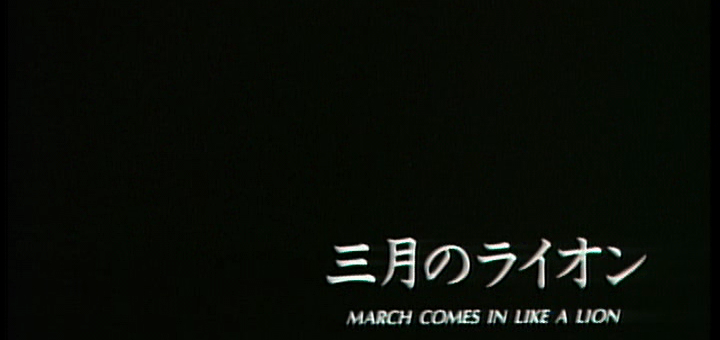

March Comes in Like a Lion (三月のライオン, Hitoshi Yazaki, 1992)

March comes in like a lionIce in the heart of summer pins its hopes on spring in the second feature from Hitoshi Yazaki. Afternoon Breezes, Yazaki’s debut, chronicled forbidden love becoming dangerous obsession as a naive young woman falls for her straight roommate but has no mechanism by which to expresses herself in a society that deems her feelings so taboo as to not quite have the words to describe them. March Comes in Like a Lion (三月のライオン, Sangatsu no Lion) again focusses on an illicit connection but this time an incestuous one in which a strange young woman realises a life long crush on her older brother by telling him that she is his girlfriend after he wakes up from a coma with amnesia.

Natsuko (lit. summer’s child) told her brother, Haruo (lit. boy of spring), that she would one day be his wife when she was just seven and he eight. Years later, Haruo (Cho Bang-ho) has been involved in a motorcycle accident and lost his memory. Natsuko (Yoshiko Yura) seizes her chance. Taking the name of “Ice”, she tells her brother that she is his lover and they live together in a barely furnished apartment on the upper floor of a tenement building. Maintaining the ruse, Ice nurses Haruo back to health, watching his progression day by day and dreading the moment he might finally remember who she really is.

Ice has rented the apartment for two months only – putting an expiry date on her true love dream. She’s done this mostly to avoid taking her brother back to their childhood home, fearing it might jog his memory and wanting avoid the prying eyes of friendly neighbours they’ve known all their lives. Her love is, by the common values of her society, against nature yet Ice surrenders to it anyway, fully expecting the “storm” of March between the seasons of ice and flowers. Flowers here may be warmth or death, but Ice is prepared to wait for her heart to melt and become the summer once again.

The early ‘90s was a time of walls falling, for good or ill, though the Tokyo Ice inhabits is a cold and frozen place. One of loneliness and confusion where busyness has given way to ennui and listless lethargy. Natsuko (and Ice too) has been surviving on casual prostitution, swiping the fashionable clothes of a client to give to Haruo and bestowing on him his curiously mad hatter-like appearance, as if he’d just stepped out of a silent movie. Ice walks around with all her worldly goods stored inside a giant cool box which emits dry ice every time she opens it. She has a compulsion for eating ice lollies and fondling the fridge freezer that is the only appliance in the sparse apartment apart from a circus-like ceiling lamp which rests on its top. Ice does not really want to melt, she tries to keep herself cool, resisting the heat of passion which may reduce her frozen paradise to watery tears, but knows that her present life is but a dream, a lingering state of limbo which must one day end.

While Ice keeps things cool, Haruo gets a job in demolition. Post-bubble the city is failing, crumbling ominously to the ground. Where once there was life and creation, now there is only death and decay. Mirroring his sister, Haruo takes things apart and throws them away but becomes oddly fascinated by the looking glass. Looking at himself, through himself, Haruo searches for the keys to his existence. As his relationship with Ice becomes physical, his mind begins to turn. Haruo regains the power of speech, remembers there was someone he loved, and awakens to the coming spring.

Ice wants to know her love can last – she looks for proof everywhere. An elderly couple – she cutting his hair while he remains less steady, still in love forty years later. The housewife next-door sending her husband off to work in the middle of the night and talking of children. Polaroids and fairy tales, white rabbits and magic girls – her world is fantasy, she is Alice adrift in Wonderland. Natsuko dares to dream a dream of love in a world which is collapsing before her eyes yet she does for a time at least win it. Filled with whimsical poetry and beautifully composed images and set to a nostalgic folk score by Bolivian Rockers, March Comes in Like a Lion is a tender, touching romance made all the stranger and sadder for its unusual genesis.


Short scene from the film (English subtitles)

Chokolietta (チョコリエッタ, Kazama Shiori, 2014)

ChokoliettaWhen examining the influences of classic European cinema on Japanese filmmaking, you rarely end up with Fellini. Nevertheless, Fellini looms large over the indie comedy Choklietta (チョコリエッタ) and the director, Shiori Kazama, even leaves a post-credits dedication to Italy’s master of the surreal as a thank you for inspiring the fifteen year old her to make movies. Full of knowing nods to the world of classic cinema, Chokolietta is a charming, if over long, coming of age drama which becomes a meditation on both personal and national notions of loss.

The story begins in the summer of 2010 when five year old Chiyoko (Aoi Morikawa) is involved in a car accident that results in the death of her mother. Flash forward ten years and Chiyoko is a slightly strange high school girl and a member of the film club. Her parents, as far as she knows, were both big fans of Federico Fellini – in fact the family dog is named “Giulietta” after Fellini’s muse and later wife Giuletta Masina. As a child, Chiyoko also received the strange nickname of “Chokolietta” from her mother which also seems to be inspired by the star. Sadly, their Giulietta has also recently passed away removing Chiyoko’s final link to her late mother and once again forcing her to address the lingering feelings of grief and confusion which have continued to plague her all these years.

At this point Chiyoko goes looking for the DVD of La Strada they watched in film club last year which leads her to the now graduated Masamura Masaoka (Masaki Suda). Masaoka is an equally strange boy with possible sociopathic tendencies though he does own a large collection of classic DVDs and the pair settle down to return to the world of Fellini. Eventually Masaoka convinces “Chokolietta” to star in a movie for him and the two take off on a crazy road trip recreating La Strada where Masaoka stands in for the strong man Zampanò and Chiyoko plays the fragile Gelsomina.

Thankfully, the partnership between Chiyoko and Masaoka is not quite as doom laden and filled with cruelty as that between Gelsomina and Zampanò. Though Masaoka often talks of the desire to kill and Chiyoko the desire to die, both appear superficial and are never presented as actual choices either will seriously act on. Masaoka is cast in the role of the strong man but he more closely resembles The Fool as he gently guides Chiyoko onto a path of self realisation that will help her finally learn to reach a tentative acceptance with the past and begin to move forward rather than futilely trying to remain static. Of course, he’s also forcing himself into a realisation that he doesn’t have to play the role he’s been cast in either and so it doesn’t follow that one has to behave in the way people have come to expect simply because they expect it.

Technically speaking the bulk of the story takes place in a putative future – around 2020, or ten years or so after the death of Chiyoko’s mother in 2010. 2010 is also a significant date as it’s the summer before the earthquake and tsunami struck the Japan the following March causing much devastation and loss of life as well as the resultant nuclear meltdown which has continued to become a cultural as well as physical scar. The journey the pair make takes them on a fairly desolate route past no entry signs into ghostly abandoned shopping arcades still strewn with the remnants of a former, bustling city life but now peopled only by a trio of silent, stick bearing men. This is a land of ghosts, both literal and figural but like most things, the only way out is through.

Taking a cue from Fellini, Chiyoko has frequent visions of her her deceased mother and fantastical sequences such as boarding a whale bus like the whale in Casanova or suddenly seeing Gelsomina and an entourage of dwarfs trailing past her. Her world is a fantastical one in which her daydreams have equal, or perhaps greater, weight to the reality. Her now empty indoor dog house comes to take on a symbolic dimension that represents an entirety of her past her life as if she herself, or the dog she claimed to want to become, had been hiding inside it all along. The film returns to La Strada in its final sequence only to subvert that film’s famous ending as where Zampanò’s animalistic, foetal howling spoke of an ultimate desolation and the discovery of a truth it may be better not to acknowledge, here there is a least hope for a brighter future with the past remaining where it belongs.

However, Chokolietta runs to a mammoth 159 minutes and proves far too meandering to justify its lengthy running time. Truth be told, the pace is refreshingly brisk yet the central road trip doesn’t start until 90 minutes in and there are another 30 minutes after it ends. It’s cutesy and fun but runs out of steam long before the credits roll and ultimately lacks the necessary focus to make the desired impact. That said there are some pretty nice moments and a cineliterate tone that remains endearing rather than irritating all of which add up to make Chokolietta an uneven, if broadly enjoyable, experience though one which never quite reaches its potential.


Unsubtitled trailer:

Bonus – here’s an unsubtitled trailer for La Strada (which is possibly the most heartbreaking film ever made).

Also the other two Fellini movies mentioned in the film:

Casanova

and Amacord (original US release trailer)