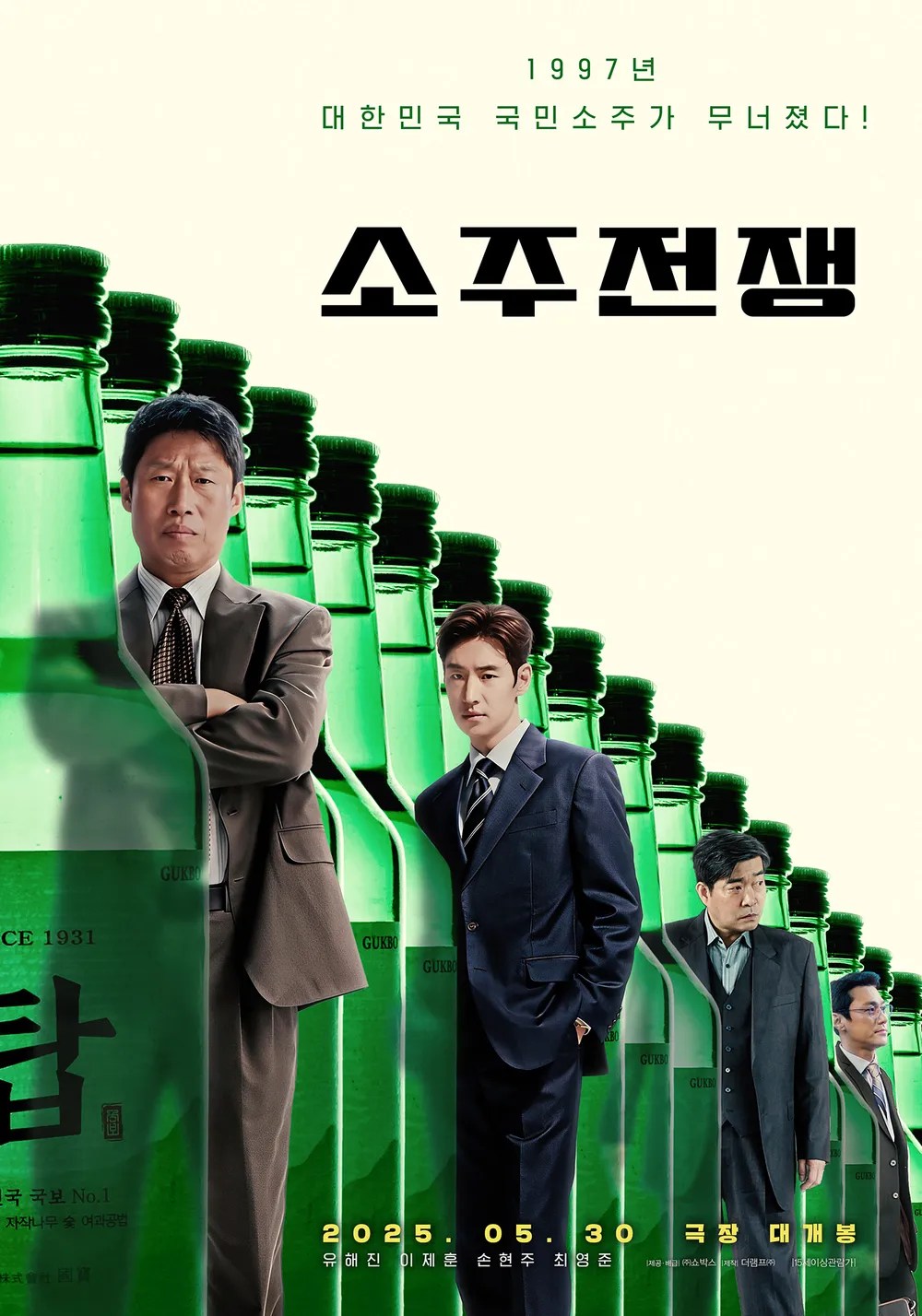
Big Deal (소주전쟁, Choi Yun-jin, 2025)

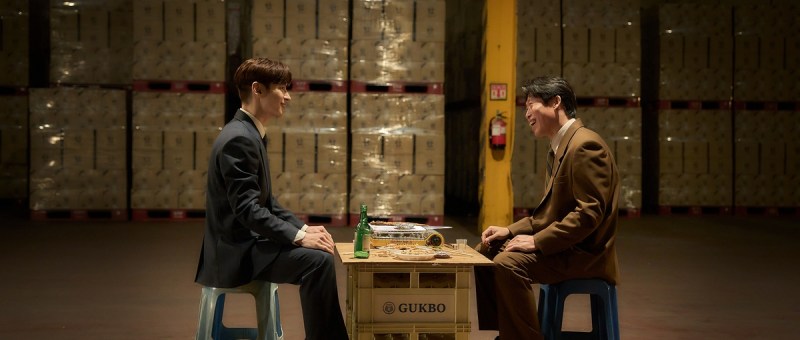
When Korea’s biggest Soju conglomerate, Gukbo, is on the verge of bankruptcy in the wake of the Asian financial crisis and the CEO’s mismanagement, it provokes a national outcry but also the attention of a hundred foreign firms all swarming over Korea like vultures eager to get a piece of the pie. Loosely based on a real life incident, Choi Yun-jin’s Big Deal (소주전쟁, Soju Jeonjaeng) is more evenhanded than one might expect at once decrying the amoral business practices of American corporate imperialism while pointing out that maybe things aren’t perfect in Korea either with its dynastic approach to company management and workaholic lifestyle that comes at the cost of familial bonds.

In fact it sort of implies that In-beom’s (Lee Je-hoon) desire to send Gukbo into bankruptcy so they can take it over and flip it is a kind of revenge against his own workaholic father who passed away 10 years previously, his death presumably hastened by stress and overwork though what In-beom resents more than anything else is that he was never really much of a father to him. That might be why Gukbo’s earnest financial officer Pyo (Yoo Hae-jin) comes to fill that role. In-beom complains that Pyo is stupid and naive, knowing nothing of how the world works, but also that his stupidity makes him feel like an arsehole because it forces him to realise that he’s doing something wrong. 

Caught between In-beom whose firm, Solquin, are pretending to consult on the administration process but in reality feeding into to their subsidiary to buy up shares, and the CEO, Pyo is the only one thinking about what’s going to happen to all their employees when the place goes bust. Like In-beom’s father, Pyo is also a workaholic whose wife and daughter left him because he was never there. He remains dedicated to Gukbo, but not to the extent of breaking the rules, even if he eventually goes along with it when the CEO suggests a dodgy plan to undercut Solquin and maintain control of the company his father founded. What becomes apparent is that Seok (Son Hyun-joo) is out of his depth and that the only qualification he has is being the boss’ son. It’s his fault the company got into trouble because of his reckless expansion plans while he tries to cover up his failings through cronyism, playing golf with the great and the good while leaving Pyo to clean up the mess he’s made.

Nevertheless, for good or ill, Gukbo comes to represent a Korea preyed upon by venal foreign influence. When the plan is exposed, Pyo is sure that the creditors won’t agree to bankruptcy because they won’t be able to stand such a typically Korean business being placed into foreign hands. In-beom thinks that’s ridiculous and no one has that kind of patriotic attachment to a company, but it turns out he’s right and Solquin have an uphill battle in front of them. Yet even In-beom begins to tire of his colleagues’ underhandedness. Though there are a handful of women working at the American investment firm, the culture is extremely macho and misogynistic with liberal and frankly unprofessional use of the F-word as In-beom’s male colleagues make obnoxious jokes about who is getting their dick sucked by whom. Pyo and his team may drink too much, but at least they’re collegiate rather than adversarial.

The question is really whether as In-beom says making money is just that and can’t be either sleazy or noble, while Pyo definitely thinks there are right ways and wrong ways to earn. Solquin is definitely wrong, while Gukbo isn’t entirely right either. In-beom may have a point when he challenges his old-fashioned salaryman mentality of putting the company first every time, but the conclusion Pyo seems to come to is to let all go and just be yourself. That doesn’t mean you have to stoop to their dishonest ways of doing business, but equally it doesn’t mean you have to let them walk all over you either. Capitalism is an inherently corrupt system, but there’s not a lot either of them can do about that even if eventually meeting somewhere in the middle as Pyo loses his faith in chaebol culture and In-beom realises he’s just as disposable when his American bosses chew up him and spit him out as soon as he’s served his usefulness. A closing title reminds us we’re still dealing with a lot of these problems 20 years later with companies that are too big to fail and inadequate regulation though Pyo at least seems to have found a happy medium doing what he loves on his own terms.


Trailer (English subtitles)

Choi Yun-jin directed this film, but her name was later removed from the credits after being fired by the production company who accused her of misappropriating the script.

Exhuma (파묘, Jang Jae-hyun, 2024)

The vengeful ghost of Japanese imperialism rises to take its revenge on its forgetful children in Jang Jae-hyun’s eerie supernatural horror, Exhuma (파묘, Pamyo). As in The Wailing, the supernatural threat is in this case not of Korean origin which causes a problem for otherwise powerful shaman Hwa-rim (Kim Go-eun). As a Korean exorcist, she is apparently not best placed to defeat an alien spirit while insisting that Japanese ghosts are more dangerous because they kill indiscriminately and cannot be reasoned with.

This is often true of ghosts in Japanese folklore. Their grudges become all-consuming. Revenge is often taken against society or humanity in general rather than a specific target and can even affect those the ghost once would not have wished to harm. In this case, it appears the supernatural entity in question has retained some of his selfhood while screaming for a hundred years having been sealed away in what one person describes as the worst burial plot in Korea. The ghost’s newborn great grandson won’t stop crying, apparently a family affliction, and so they want to do something about this apparent curse. But that requires digging into the past and unearthing its unpleasantness such as the fact the family’s immense wealth is thanks to the great-grandfather’s questionable politics as a full on militarist committed to the furthering of the Japanese empire. 

Meanwhile, the other ghost that haunts them is that of a giant samurai who was killed at the battle of Sekigahara, which of course means he could also have participated in Hideyoshi’s invasion of Korea only eight years previously. The film hints at backstories, never explaining why it is that Hwa-rim speaks fluent Japanese or what it was that happened in Japan except that she apparently found out that Korean shamanism doesn’t work that well on the average Japanese ghost. It all goes back to some kind of mad monk and fox diviner who did some black magic on the peninsula as a whole though it’s not clear exactly what it’s been doing for the last 70 years or so. 

These different kinds of spiritual practice and folklore beliefs jangle together seemingly without border or conflict. The funeral director (Yoo Hae-jin) who works with Hwa-rim and her geomancer friend (Choi Min-sik) is a Christian but apparently has no objection to witnessing shamanic rights nor disbelief in their power as if his twin belief systems simply sat next to each other. Even so, there does seem to be something entirely distinct about Hwa-rim’s practice that is different from Japanese Shintoism despite it its superficial similarities to the extent that her abilities have no effect on a Japanese spirit. 

Then again, this evil is older and deeper than the original ghost apparently wailing for a hundred years about his imprisonment and keen to take down all his descendants in self-destructive revenge. A grave digger spots what seems to be a snake with the head of a person, while no one seems to take the warnings about opening the coffin seriously. Everyone talks about grave robbers, ironically looking for riches among the dead, though the what the team find themselves doing is unearthing the buried past, trying to free themselves from it and perhaps the oppressive yoke of the colonialist legacy.

Jang heightens the sense of anxiety with faced paced, rhythmic editing coupled with scenes of extreme eeriness. He hints at a world beyond our own filled with vengeful spirits and lurking evil while the threats are largely supernatural rather than human even if the ghosts themselves did originate as ordinary people who were also fairly problematic before they died. In some ways, the film might be saying that it doesn’t do any good to go digging up the past but also that if you don’t you may have to live with a slowly festering evil that will visit itself on your children and your children’s children. Still, like the little boy who secretly kept grandma’s false teeth because he wanted something to remember her by, the past can be a difficult thing to let go of and simply re-burying it in a nicer place may not be enough to free yourself from the long buried generational trauma of an almost forgotten past.


US trailer (English subtitles)

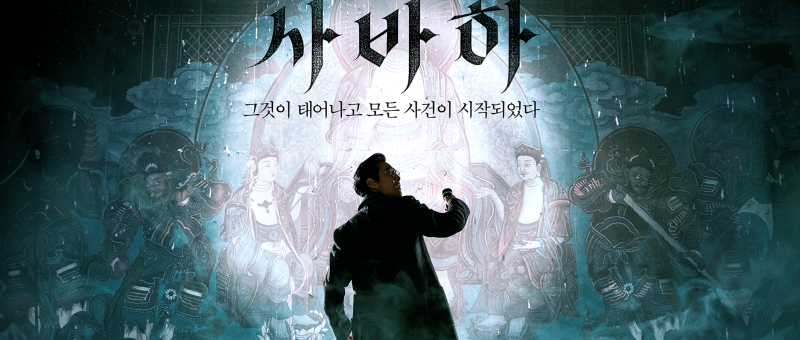
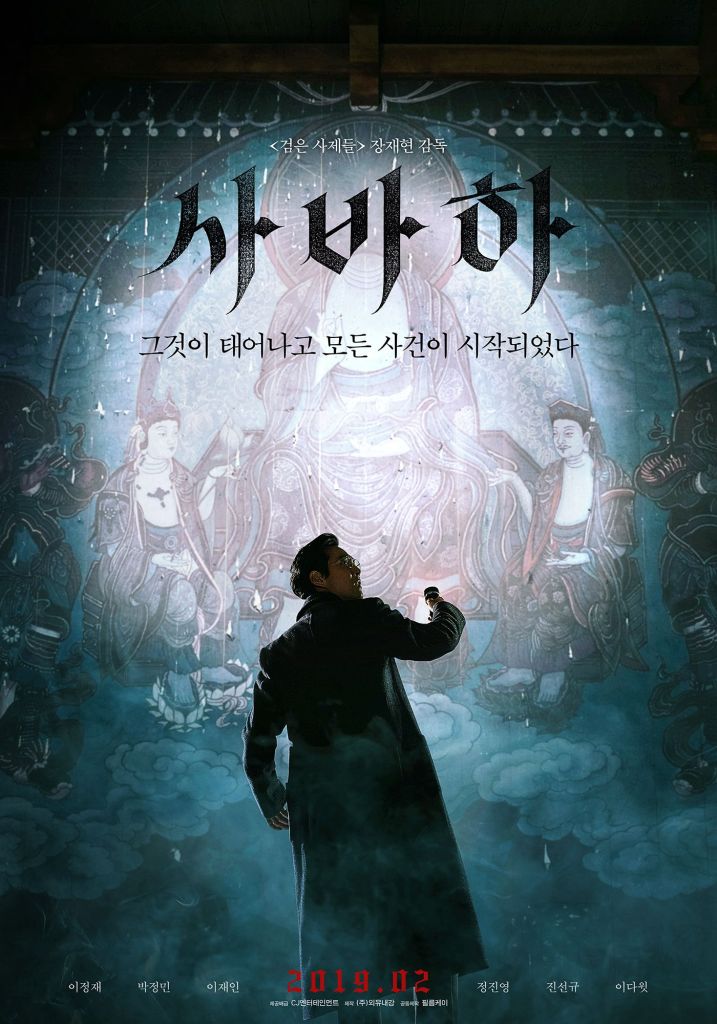
Svaha: The Sixth Finger (사바하, Jang Jae-hyun, 2019)

The thing about prophesies and the prophets who proclaim them, is that they only have power if people choose to believe in them. “Faith” can become a convenient cover for those who’d rather not explain themselves, a mechanism for manipulating sometimes vulnerable people looking for a greater truth or a purpose in their lives. Svaha: The Sixth Finger’s (사바하) dogged pastor is intent on investigating religious crimes and exploiting spiritual charlatans but he of course has his own agenda, that mostly being that he’s keen to get money off his clients who are in turn hoping to bolster their authority by rooting out “heresies”.

Leader of the Far Eastern Religious Research Institute, a kind of religious detective agency employing only himself, an undercover assistant, and a “deaconess” secretary, Pastor Park (Lee Jung-jae) makes his money flagging up dodgy and/or exploitative practices connected with organised religion. According to him, freedom of religion is “overly” protected, and he is alone on the frontlines of a spiritual war against unscrupulous cultists. Though some kind of protestant, he often works for/against the Catholic Church and is good friends with a Buddhist monk who gives him a tip off about a weird sect he can’t get a handle on, Deer Hill. 

Meanwhile, a young girl, Geum-hwa (Lee Jae-in), explains to us that she was born with an “evil” twin clamped to her leg. The twin wasn’t expected to survive, but is still living with Geum-hwa and her family who keep her locked up in a shed like a beast. Rightly or wrongly, Geum-hwa connects her sister with the deaths of her parents which occurred fairly soon after the children were born. Her grandfather, with whom Geum-hwa now lives, never even registered the birth of a second child out of fear and shame, never expecting her to survive this long. When a truck hits a bridge and exposes the hidden body of a murdered teenager, the police start investigating too, eventually leading them to two young men loosely connected with the shady Buddhist cult. 

“This world is one big muddy mess”, according to the cultists at Deer Hill. It’s not difficult to see why people might be looking for spiritual reassurance in such a chaotic world, but it’s exactly that need that places like Deer Hill may be seeking to exploit. Nevertheless, the only thing that Park’s undercover agent turns up is that there doesn’t appear to be anything untoward. Deer Hill doesn’t accept offerings from its members and even gives money away to the needy. Tellingly, the real nitty gritty to Park’s clients is in doctrinal deviation, they only really want to know what kind of Buddhism it is that they do and if it’s in line with broader teachings of the faith. 

A further tip off leads them to the mysterious Je-seok (Jung Dong-hwan), a legendary Buddhist priest who studied in Japan but apparently devoted himself to the Independence movement and is said to have achieved enlightenment. Je-seok’s teachings are dark in the extreme, “Pain is the fruit of faith” goes his mantra, “pain purifies your blood”. He believes that he is the “light” that will conquer the “darkness” by snuffing out “snakes”. One of his disciples, brainwashed as a vulnerable young man and encouraged to do terrible things in the name of good, begins to doubt his teachings when confronted with a possible hole in his logic and the very real human cost of his strategy. 

Not quite as cynical as he seems, Park retains his faith. It’s ironic that all this is taking place at Christmas and centres on the prophesied birth of a child that threatens someone’s sense of personal power. Unlike most, Park has always regarded Christmas as a “sad” holiday, unable to forget that Jesus’ birth was accompanied by the mass murder of innocent baby boys. He wonders where God is now and why he permits these things to happen. Park has faith that God sent Jesus into the world for the greater good, but Je-seok has convinced his followers that the same is true of him, that he has come to banish the darkness and that all their pain and suffering is fuel in a holy war. Their faith has been redirected and misused for the benefit of a false prophet, while his opposite number has been made to live a life of bestial misery solely because of superstitious prejudice. The police is a fairly irrelevant presence in this series of spiritual transgressions, but there is much less clarity to be had in “truth” than one might hope with “faith” the only solution in an increasingly uncertain world.


Svaha: The Sixth Finger is currently available to stream on Netflix in the UK (and possibly other territories).

International trailer (English subtitles)

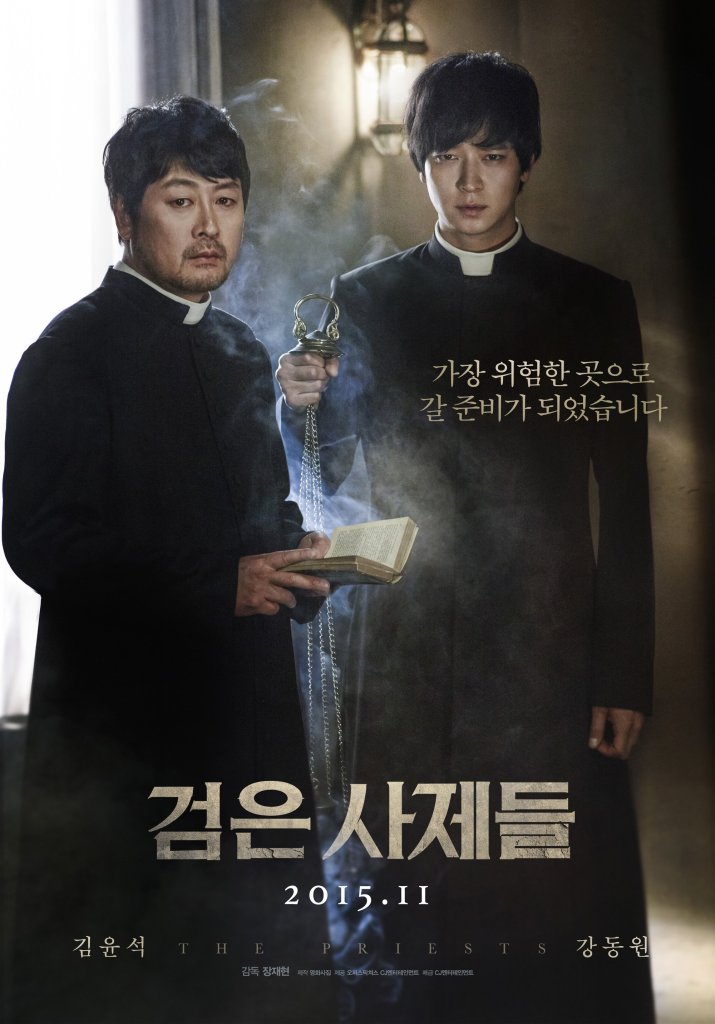
The Priests (검은 사제들, Jang Jae-Hyun, 2015)

The Priests PosterThe era of hero priests might be well and truly behind us but at least when it comes to the exorcism movie, the warrior monk resurfaces as the valiant men of God face off against pure evil itself risking both body and soul in an attempt to free the unfortunate victim of a possession from their torment. To many, the very idea sounds as if it belongs in the medieval era – what need have we for demons now that we posses such certain, scientific knowledge? There are, however, things far more ancient than man which are far more terrifying than our ordinary villainy.

The Priests (검은 사제들, geom-eun sa-je-deul) begins with two Italian clerics in the Vatican discussing the somewhat taboo subject of exorcism and demonic possession. They have been made aware of a serious case in Korea and, as they can’t get in touch with the Korean exorcism department, head out there themselves for a little pest control of their own. However, the enemy they were facing proves too strong for them as they become involved in a multi-car pileup allowing the demon they’ve trapped inside a small dog to escape and migrate to a better humanoid host.

Now we turn to the Korean church authorities who are also worried about a young girl who appears to be displaying the symptoms of demonic possession. Their leader repeatedly tells them he will not “officially” sanction any kind of action whilst making it clear he wants them to go ahead and deal with it. No one knows much about exorcism so they reluctantly turn to the maverick preacher Father Kim who, as it also turns out, is a friend of the girl, Young-sin. Matters have reached an impasse as the demon inside Young-sin tries to make her commit suicide by jumping from her hospital room window in order to migrate to a more robust host, leaving her in a comatose state.

Anyone with any basic knowledge of exorcism in the movies knows that you need a young priest and an old priest so Kim gets a sidekick in the form of the equally unusual Deacon, Choi, who is not exactly a model student at the seminary. Choi is initially quite excited to be assisting in such an arcane ritual even if his chief job title is “pig sitter” and his new “boss” is a gruff and world weary man who he has also been asked to spy on just in case this is all down to Kim acting “inappropriately” with an underage girl rather than a visitation from an even more ancient evil. Needlessly to say, Choi quickly discovers Father Kim has been speaking nothing but the truth and he is in way over his head.

Though this is a Catholic crisis bound up with Christian cosmology and centuries old rites, this is still Korea and so Eastern concerns seep into the Western religiosity. The night Kim has chosen for his final assault coincides with the Buddhist feast of the Hungry Ghost when the dead return to visit the living and one of the criteria that made Choi a prime choice for the role of the assistant is that he was born in the year of the Tiger and therefore supposedly more spiritually sensitive. In a quest to help the girl, all avenues are being explored so shamanistic rites are also performed (though with little success) and Kim seems to have a kind of professional respect for his shamanic counterpart even if the two obviously disagree on some quite fundamental things.

Thanks to its double layer of exoticised mysticism, The Priests quickly works up a supernaturally charged atmosphere though its eyes are strictly on entertainment rather than exposing any deep seated social concerns.The possessed girl calls forth animals, speaks in tongues offering bizarre and disturbing prophesies, and eventually projectile vomits blood and snakes all over a painting of the Virgin Mary yet the film never aims for the shock factor that defined Friedkin’s The Exorcist. Though tagged as horror, The Priests is not particularly frightening (jump scares aside) but does manage to evoke a kind of ever present dread in the face of this unfaceable threat.

Despite the heavy atmosphere, Jang is careful to allow the occasional comic episode providing a welcome break from the seriousness of the war against ancient evil. Impressive action sequences including the early serial car crash and later chase sequence add to the urgency of the situation whilst also alleviating some of the ever increasing tension. Though he visits some dark places, Jang’s world view is not as bleak as Friedkin’s as we’re left with a feeling of restitution, once the original threat removed, though we obviously know that other such threats remain. The heroic ending allows us to forget this for a moment as we enjoy the right and proper victory of good over evil, neglecting that this is but one of many battles in an eternal, celestial war.


Reviewed at a Teaser Screening for the upcoming London Korean Film Festival to take place in November 2016.

US trailer with English subs: