Following their recent series of foodie films, The Japan Foundation London is back with a few more tasty morsels this August.
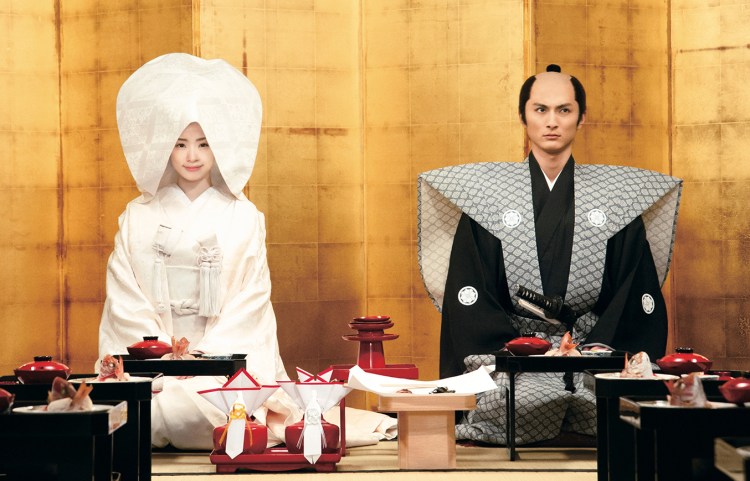
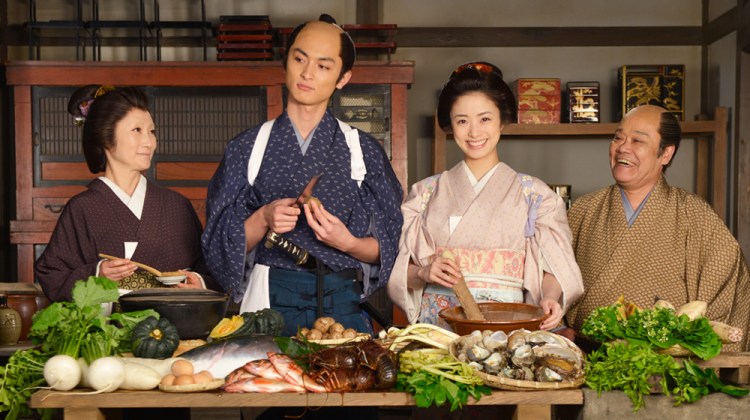
First up, A Tale of Samurai Cooking: A True Love Story proves that the way to a man’s heart is through his stomach (rather than through his chest with a sword). Headstrong Haru (Aya Ueto) gets “sent back” from her first marriage and then receives an interesting proposal from the Emperor’s own samurai cooks thanks to her awesome skills in the kitchen. Her husband to be, Yasunobu (Kengo Kora), is very unhappy about this seeing as he still wants to be a “real” samurai and is nursing a broken heart. Review.
A Tale of Samurai Cooking screens at Courthouse Cinema, 23rd August, 6.30pm.
Based on the writings of the real Jun Nishimura, Shuichi Okita’s The Chef of South Polar follows a put upon chef as he’s forced to leave his family and become the sole cook for seven research scientists marooned at the South Pole for a whole year. Despite the hazardous conditions Nishimura keeps churning out beautifully presented dishes while the guys all go slowly mad together. Review.
Chef of the South Polar screens at Courthouse Cinema on 24th August, 6.30pm
Naomi Kawase’s An (Sweet Bean) is a less comedic tale of inter-generational friendship, social injustice and continuing stigma towards those suffering illness, and a celebration of tradition passed from one era to the next. Masatoshi Nagase plays a struggling doriaki chef who gets a few tips from a strange old lady (Kirin Kiki). He originally turns her down for a job at his stand because of her age and gnarled hands, but tasting her bean paste, there is no way he can refuse.
An (Sweet Bean) screens at Rich Mix on Saturday 26th August, 12.45pm.
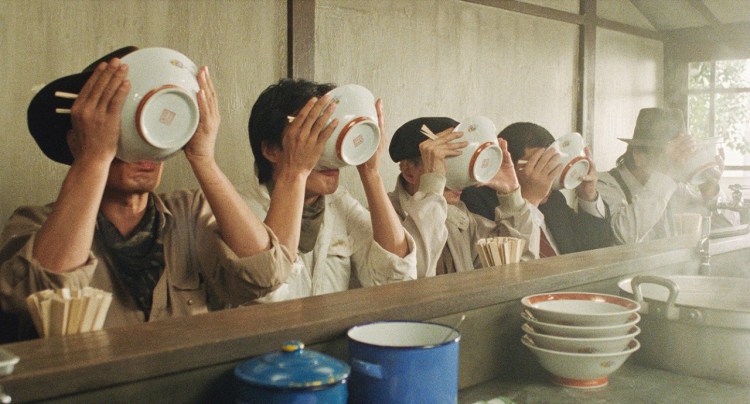
And finally the greatest food movie of them all – Juzo Itami’s Tampopo! This iconic comedy follows the titular widow as she tries to make a success of her ramen stand with the help of lonely truck drivers Goro and Gun. While Tampopo is busy with her noodles, Itami ventures off on a cultural odyssey to explore the various ways food is used and misused in Japanese society. Review.
Tampopo screens at Rich Mix on Saturday 26th August, 3.15pm.
You can find further details for all the films on the Japan Foundation London website. Tickets are free but must be reserved in advance and you can only register to attend two of the four screenings (if you apply for more than two you will be placed on the waiting list for the extra ones). A Tale of Samurai Cooking and Chef of the South Polar are currently fully booked but you can still apply to join the waiting list and be notified should spaces become available.
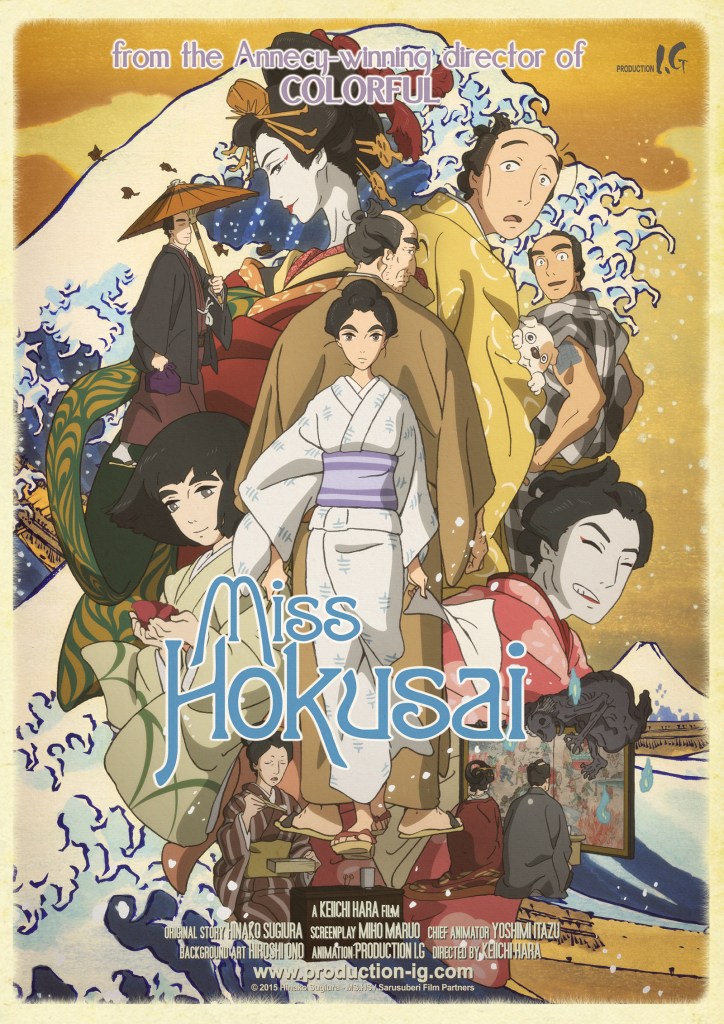
When it comes to the great Japanese artworks that everybody knows, the figure of Hokusai looms large. From the ubiquitous The Great Wave off Kanagawa to the infamous Dream of the Fisherman’s Wife, the work of Hokusai has come to represent the art of Edo woodblocks almost single handedly in the popular imagination yet there has long been scholarly debate about the true artist behind some of the pieces which are attributed to his name. Hokusai had a daughter – uniquely gifted, perhaps even surpassing the skills of her father, O-Ei was a talented artist in her own right as well as her father’s assistant and caregiver in his old age.
Miss Hokusai, based on the popular 1980s manga Sarusuberi by Hinako Sugiura, takes up O-Ei’s story towards the beginning of her career before her marriage and subsequent divorce, after which she returned to her father’s side to nurse him as his health declined. Like the manga, the film is a collection of scenes from Edo life loosely tied together by its overarching theme, but broadly follows O-Ei as she lives her life as a young woman with a level of forthrightness and determination which sets her apart from the women of the time. Determined to become an artist, she lives with her father in their studio where neither of them cooks or cleans but each devotes themselves solely to art. Also living with them at the time is an ex-samurai and aspiring artist, Zenjiro, who specialises in erotica which has its own particular qualities even if his skills aren’t on a par with Hokusai or O-Ei.
When not in her father’s studio, O-Ei likes to visit her younger sister who, ironically, was born blind and is being cared for by the local nuns. O-Nao’s blindness is a sore spot for her father who hardly ever visits her, feeling as if her lack of sight is some sort of cosmic slight against him – the master painter with the daughter unable to appreciate his art and therefore his entire life philosophy. O-Ei is not so rigid and delights taking the girl out on trips where she can experience the world through her richly developed other senses. O-Nao particularly likes visiting the bridge with its complicated soundscape from the river below to the vendors above and all the passersby. There’s also a lovely set piece in which a young boy who quickly figures out that O-Nao can’t see tries to entertain her by knocking snow off a tree. Miss Hokusai, though a story of visual art, has an especially intricate sound design which proves that you can paint with materials other than ink and makes a point of calling out the stubbornness inherent in the world view of someone like Hokusai whose singleminded vision has become his entire universe.
O-Ei has her fair share of troubles as a young woman, though living with her father as his assistant she is a relatively free and unsheltered one. Her father doesn’t hide any aspect of his work from her – she even assists him with his erotic pieces and is said to be a particularly fine painter of women though her male figures lack conviction. “Sensation” itself becomes a theme, art is something which must be felt and therefore must have feeling imbued within it. As an unmarried woman O-Ei is ill equipt to complete these kinds of assignments and some say perhaps she should not be given them though her determination would never permit her to turn them down leading to rather a strange interlude in which she tries to gain some “experience” in a presumably “safe” way which won’t have much effect on her later life.
Less successfully, the film also attempts to enter the realm of the supernatural as we learn a painting can have other effects on the viewer particularly if it isn’t completed in the proper fashion. From a possessed geisha to a woman driven mad by O-Ei’s suitably creepy painting which features terrifying scenes from hell, Miss Hokusai most definitely occupies a world where ghosts, spirits and demons are real things which co-exist with real people. Luckily, Hokusai is able to fix the problem with the disturbing painting by closing its symbolic imagery with a suitable addition whilst berating O-Ei for having cut corners and not properly complete her vision so as to leave the onlooker “haunted” in an unintended way. Again, the painter is parent to the painting which attains the kind of immortality impossible for its creator in this transient world.
Clearly bound-up with the notion of transience, Miss Hokusai makes a valiant attempt to bring ordinary Edo living with its geisha houses, dusty rooms and drinking songs to life in vivid detail. However, its message becomes slightly confused with the superimposition of the modern Tokyo in the final frame of the film. At this point, the rather bizarre choice of a modern, electric guitar based soundtrack, begins to make a degree of sense at least on a thematic level but nowhere near enough to mitigate its jarring presence throughout the film.
Animated by animation powerhouse Production I.G who have been responsible for some of the most beautifully made animated movies of recent times, Miss Hokusai is a giant step up from Hara’s previous film, Colorful, in terms of its execution and boasts a number of scenes which are remarkable in their technical proficiency. The sky in particular as well as the background in general takes on a dreamy, woodblock style which is perfectly fitting for the film’s themes. An interesting look at the young O-Ei, an inexperienced female artist still looking for her voice in a world where the only thing that counts is the signature, Miss Hokusai doesn’t quite succeed in breathing life into its disparate collection of tales but makes a valiant attempt all the same.
Another day another Sion Sono – review of Love & Peace from the London Film Festival up at UK Anime Network. Quite liked this one, shame it’s not out in time for Christmas.
Last time we met Sion Sono it was for a street style rap musical about gang warfare. Before that we’ve mostly been admiring him for his epic and irreverent tale of panty shot perverts and bizarre religion Love Exposure, bloody serial killer true crime thriller Cold Fish or poetic exploration of a woman looking for love in all the wrong places in Guilty of Romance, not to mention a tale of teenage rage and post Earthquake anxiety in Himizu or state of the nation address in Land of Hope. Recently prolific and varied enough to give even Takashi Miike a run for his money, it should come as no surprise that Sono’s latest effort is, essentially, a family film about a man’s love for his pet turtle.
Ryoichi Suzuki is a mild mannered office worker with dreams of becoming a rock star. Belittled by his colleagues, Ryoichi has no friends – that is until he falls hard for a tiny turtle sold by a strange man on a rooftop. Hatching plans together for Ryoichi’s rise to superstardom the pair become inseparable. However, after another round of humiliation at work Ryoichi flushes “Pikadon” down the toilet! Full of remorse, Ryoichi pines for his lost friend meanwhile, Pikadon arrives at the lair of a mysterious sewer dweller who rescues broken and discarded creatures. When Pikadon is given a “wish” pill by mistake, Ryoichi’s life soon begins to change!
In case it needs saying, Love & Peace is in no way a “serious” film – much as that may sound like a pejorative comment, all that means is that it’s delightfully absurd and heaps of fun and where it harks back to some of Sono’s key concerns it does so in a light hearted, even mocking manner. The plot maybe conventional in a lot of ways – down trodden loser suddenly makes something of himself with magical help but ends up becoming arrogant and forgetting his true self before being redeemed by a massive fall from grace but as usual Sono has managed to bring something new to even this comparatively tired tale.
Largely, that’s thanks to his bizarre side story of the land of misfit toys being cared for by a mysterious yet kindly old man who lives in a tiny alcove in one of Tokyo’s sewer complexes. Cheerfully harking back to some of those classic ‘80s kids movies, the strange collection of broken robots, damaged cat toys and lovelorn dolls do their best to tug at the heart strings with their stories of loss and abandonment while the mysterious old man keeps them going with tales of hope and magic pills which grant the power of speech or wishes.
However, as Ryoichi’s dreams grow bigger so does Pikadon himself and its not long before the cute little turtle’s devotion to his master becomes a dangerous threat to the entire city. Ryoichi chose the name “Pikadon” seemingly at random and without realising that it’s become a byword for the atomic bomb. Thus Ryoichi’s eventual ballad of love and regret for his lost turtle buddy is misunderstood as a lament for modern Japan and a pledge to “never forget” the wartime nuclear attacks. Of course, this “subversive political rock song” becomes a giant hit catapulting Ryoichi on the road to superstardom. However, there is more heartbreak for Pikadon to come as he’s continually betrayed by the ever more ambitious Ryoichi who’s only too quick to sell out his beloved friend to get ahead with cruel and potentially tragic consequences.
Of course, the one thing that needs mentioning is the amazing music in the film including the title song which is tailor made for waving a lighter in the air and is sure to become your latest ear worm. Ryoichi only writes a few songs but Sono also manages to throw in a musical self reference to a previous film that makes for a fun Easter Egg for his avid fans to find and the rest of the soundtrack is equally catchy too.
In short, Love & Peace is the Christmas themed punk rock kid’s movie you never knew you needed. Yes, it goes to some very dark places – the least of which is the accidental destruction of the city of Tokyo by the now colossal kaiju incarnation of Pikadon whose only wish is to make his best friend’s rockstar dreams come true, but it does so with heart. In true family film fashion, it addresses the themes of true friendship, the importance of being true to yourself and that the love of man and turtle can be a beautiful, if terrifying, thing. Strange, surreal and totally mad, Love & Peace is the ideal Christmas gift for all the family and Sono’s most enjoyably bizarre effort yet.
I wrote this review before I’d seen Tag which is also “enjoyably bizarre”, it has to be said. Love & Peace will be released in the UK in 2016 courtesy of Third Window Films.
Some other Reviews of Sion Sono movies written by me:
First of the Japan Foundation Touring Film Programme for this year up on UK-Anime.net. I’m going to do a general round-up later in the week but this was the best of the (impressive) bunch.
Kiwako has been having an affair with a married man who swears he’s going to leave his wife (just not right now) but now things have come to a head as she finds out she’s carrying his child. Despite her being desperately happy and excited about it – planning to call the child Kaoru and designing visions of the a domestic bliss, Kiwako’s married lover is decidedly less enthusiastic and persuades her to opt for a termination. However, complications from the procedure leave her unable to have any more children and she also begins being harassed by her lover’s wife who finally turns up on her doorstep one day, heavily pregnant, to taunt her – going so far as to remark that her ‘barren womb’ is a direct result of her immoral relations with her husband. One day Kiwako just snaps and in an act of madness abducts her lover’s newborn baby and raises the child as her own for four years until she is finally caught.
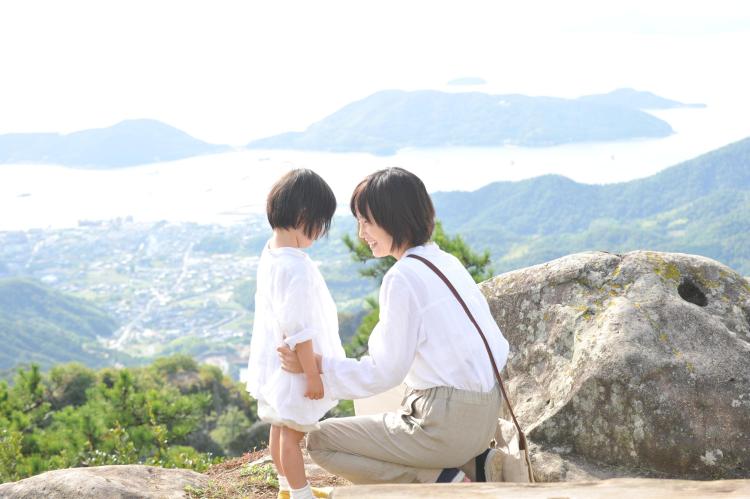
In the present day, Erina – who was Kaoru, raised by Kiwako for the first four years of her life, has grown up and is in college. She is deeply scarred by the traumatic events of her early childhood and seems to have difficulty with forming relationships with people, not that she seems to want to make any. After being returned to her birth parents she struggled to adapt to her new life and her birth parents struggled to come terms with everything that had happened. Now, as a young woman, Erina finds history begin to repeat itself in more ways than one and she’s forced to consider who she really is and what she wants out of life. In order to do that, she’ll finally have to confront her traumatic past and all of the complex questions and emotions that will inevitably arise.
In a Chalk Circle-esque way, Rebirth wants to ask a lot of questions about motherhood. Who is the mother of this child really? The woman who gave birth to it or the one who has cared for it all its life and who the child regards as its parent? It is obviously a terrible situation for all involved – the birth parents have lost their child, something truly awful, but the child now believes her abductor to be her mother and ‘returning’ her to a pair of ‘strangers’ she has no recollection of is beyond cruel. Being cruelly ripped away from everything she knew would be traumatic enough, let alone being dragged away from her ‘mother’ in a car park late at night and bundled into car by a harsh woman who tells her she’s being taken to her ‘mummy’ when her total understanding of that word is being handcuffed and taken away.
At only four years old you might think she’d be young enough to gradually ease back into her birth family, and you might be right had her natural parents been better equipt themselves to cope with the situation. Erina’s mother is very definitely of the ‘carry on as if nothing happened’ school so any allusion to the first four years of the girl’s life provokes a hysterical fit that only further exacerbates the confusion already ripping apart the poor child’s soul. So jealous is she that she’s effectively projecting all her resentment and bitterness towards Kiwako’s actions onto the child itself – as if she can’t forgive her for the crime of growing older or having spent so much time with the other woman. The child is a reminder of the trauma of its disappearance, of her husband’s infidelity, and subsequently of her own fear of not measuring up as a mother.
Izuru Narushima has crafted an intense and deeply layered character study that neatly sidesteps the risk of becoming as overblown or melodramatic as the plot description might sound. He approaches the subject matter with great sensitivity and with as even a hand as is humanly possible. His camera is incredibly non-judgemental and treats each of the characters with the same level of sympathy and understanding. Surprisingly, it is the birth parents that become the most difficult to sympathise with but even they are presented with a great deal of compassion.
Rebirth is certainly a very complex film that raises all sorts of uncomfortable moral questions from the nature of motherhood to the treatment of the women of society. If I had one criticism it would be that the male characters don’t come out of this well at all – which may be slightly unfair given the deliberate similarity between the two prominent male characters, but certainly the portrait it paints of masculinity is far from flattering. The performances are astounding, particularly those of Mao Inoue (probably still best known for Hana Yori Dango) as the damaged Erina and Hiromi Nagasaku as the desperately maternal Kiwako. Excellently shot and fantastically well conceived Rebirth is one of the best Japanese films of recent times.
Today the Japan Foundation played host to an evening with Japanese documentary maker Kazuhiro Soda, author of Campaign and Mental. Soda gave an informal, interactive talk about his documentary film work beginning with his leaving Japan for New York on a whim and enrolling in film school and then serendipitously seeing an advertisement for a filmmaker who knew Japanese and English which led him into making documentary films for NHK. He came to making his first feature length film on hearing that a friend from university had recently decided to run for public office, this was surprising as his friend has always been quite eccentric – having failed to enter university five times, he never attended classes (despite living on campus) and subsequently was held back three times, he met his wife on the internet and they decided to honeymoon in North Korea(!) – and not only was he standing for office he was doing so with the backing of the staunchly conservative JLPD (the party of Prime Minister Koizumi, in power at the time). Soda described his alienation from the TV documentary production methods he’d been used to – scripting/narration, shot lists, titles, music etc and his decision to make an observational film, to go in with no research, no preconceptions just to observe with camera and construct the film in the editing room. He then showed a clip from his second film, Mental, which centered around a very open and moving story from a women who’d suffered some truly terrible things and discussed the ethical difficulties of documentary film making. Although many of the patients at the clinic declined to participate in the film, luckily there were enough who accepted and Soda was very clear about obtaining permission before shooting, taking into account the very sensitive nature of the information. In other cases though it was possible that permission be sought afterwards where necessary, but permission is always sought and the subjects well being always a very important factor in the filmmaking process. The audience was then treated to a very special preview of Soda’s latest film, Peace, which is screening at the Sheffield documentary festival this weekend. Having intended to make a film about his wife’s grandmother which proved too sensitive and had to be abandoned, Soda was watching his father-in-law feed some stray cats when he noticed a male cat prowling around the circle of others and not being allowed in. The father-in-law explained that this was ‘thief cat’ who would look for an opportunity to steal the food for the others and was thus not very popular, the father-in-law had taken to putting a separate dish of food away from the other cats to stop this happening and thief cat eagerly, if somewhat suspiciously, lapped this up. It struck Soda that this would be a perfect scenario for a film commission he’d recently been offered which needed to reflect the them of peace and acceptance which he’d been unsure whether to accept. Luckily he’d had the camera rolling and decided to include the moment in his next film. The clip shown certainly looked very interesting and we can only hope the film will find an audience after its Sheffield screening.
 Following their recent series of foodie films, The Japan Foundation London is back with a few more tasty morsels this August.
 First up, A Tale of Samurai Cooking: A True Love Story proves that the way to a man’s heart is through his stomach (rather than through his chest with a sword). Headstrong Haru (Aya Ueto) gets “sent back” from her first marriage and then receives an interesting proposal from the Emperor’s own samurai cooks thanks to her awesome skills in the kitchen. Her husband to be, Yasunobu (Kengo Kora), is very unhappy about this seeing as he still wants to be a “real” samurai and is nursing a broken heart. Review.
 Based on the writings of the real Jun Nishimura, Shuichi Okita’s The Chef of South Polar follows a put upon chef as he’s forced to leave his family and become the sole cook for seven research scientists marooned at the South Pole for a whole year. Despite the hazardous conditions Nishimura keeps churning out beautifully presented dishes while the guys all go slowly mad together. Review.
 Naomi Kawase’s An (Sweet Bean) is a less comedic tale of inter-generational friendship, social injustice and continuing stigma towards those suffering illness, and a celebration of tradition passed from one era to the next. Masatoshi Nagase plays a struggling doriaki chef who gets a few tips from a strange old lady (Kirin Kiki). He originally turns her down for a job at his stand because of her age and gnarled hands, but tasting her bean paste, there is no way he can refuse.
 And finally the greatest food movie of them all – Juzo Itami’s Tampopo! This iconic comedy follows the titular widow as she tries to make a success of her ramen stand with the help of lonely truck drivers Goro and Gun. While Tampopo is busy with her noodles, Itami ventures off on a cultural odyssey to explore the various ways food is used and misused in Japanese society. Review.
 When it comes to the great Japanese artworks that everybody knows, the figure of Hokusai looms large. From the ubiquitous The Great Wave off Kanagawa to the infamous Dream of the Fisherman’s Wife, the work of Hokusai has come to represent the art of Edo woodblocks almost single handedly in the popular imagination yet there has long been scholarly debate about the true artist behind some of the pieces which are attributed to his name. Hokusai had a daughter – uniquely gifted, perhaps even surpassing the skills of her father, O-Ei was a talented artist in her own right as well as her father’s assistant and caregiver in his old age.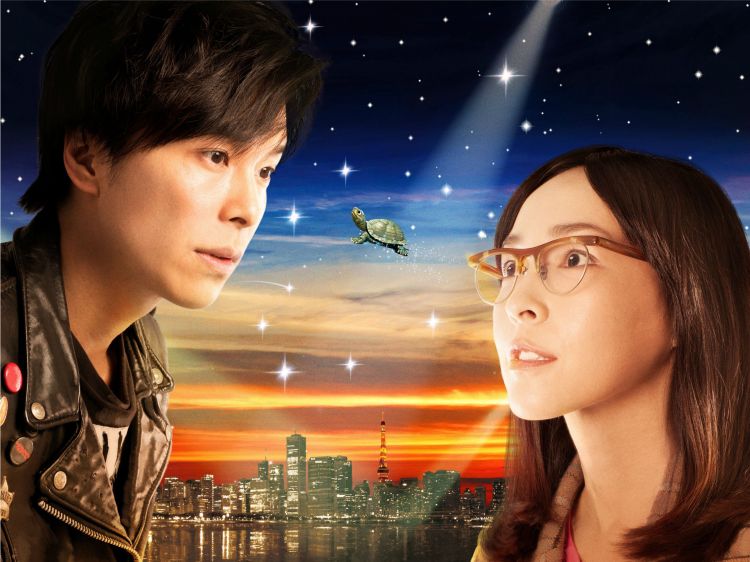

 Windows on Worlds