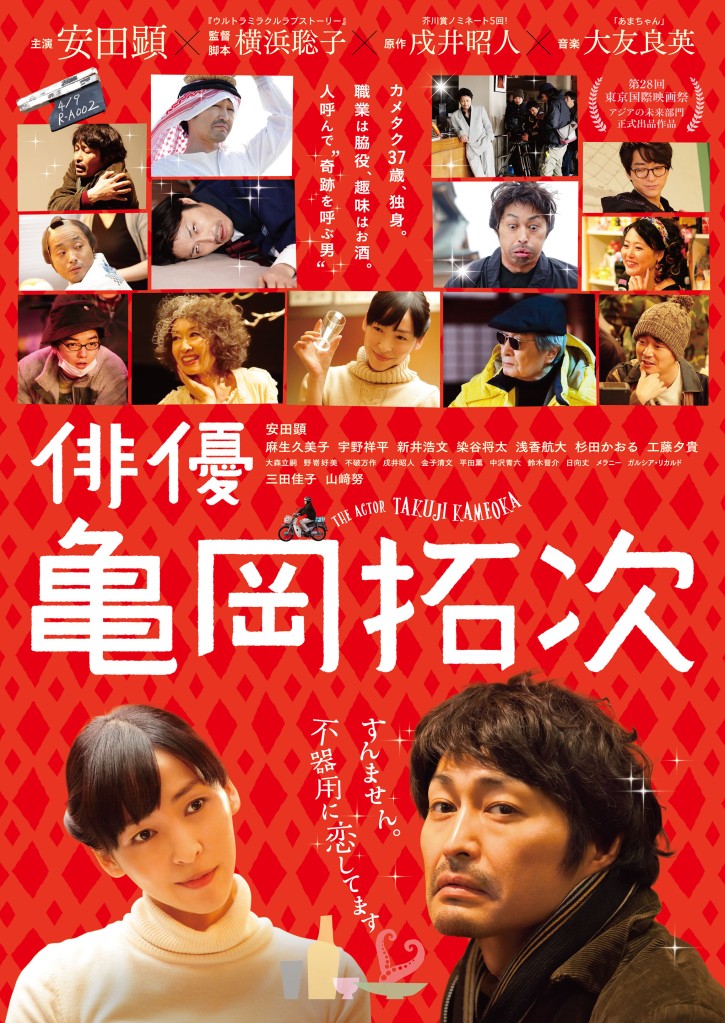
The Actor (俳優  亀岡拓次, Satoko Yokohama, 2016)

“There are no small parts, only small actors” according to the mantra of the bit part player, but perhaps deep down everyone wants to play the lead. Most jobbing actors will tell you that they’re happy to be working and if you work as much the dejected hero of Satoko Yokohama’s The Actor (俳優  亀岡拓次, Haiyu Kameoka Takuji), you can make a pretty decent living with a little more job security than a big name star whose career will inevitably hit the odd dry spell. Yet, who doesn’t want to at least feel that they’re the lead in their own life story? Spending all your time being other people can make you lose sight of who you really are and live your life with a sense of cinematic romanticism forever at odds with accepted reality. 

Takuji Kameoka (Ken Yasuda) is a classic background actor, turning up in small roles in TV dramas, often playing the villain of the week or appearing as a prominent extra. Meanwhile, his offscreen life seems to be lived in a booze-soaked haze, hanging out in his favourite bar surrounded by similarly dejected middle-aged men or occasionally meeting up with colleagues. Even his agent expects him to be sozzled when she rings to confirm new jobs though to be fair she doesn’t seem too bothered about it. 

Kameoka has perhaps made his peace with the kind of actor he is, but there’s also an inbuilt anxiety in waiting for people to ask what it is he does, knowing that it sounds glamorous and exciting when, to him at least, it’s anything but. Chatting with a pretty young woman, Azumi (Kumiko Aso), working behind a bar in a small town where he’s filming, Kameoka spins her a yarn about being a bowling ball salesman rather than be forced into a conversation about the life of a jobbing actor which might perhaps depress him more. Alone in the bar, the pair of them strike up a rapport over shared sake, but Kameoka forgets that in essence she’s just the same as him – acting, performing her role as the cheerful hostess, keeping him happy to sell more drinks. Later, she tells him that she’s switching roles, “recasting” herself as a good wife and mother, pointing again towards the unavoidable performative quality of conforming to socially defined labels such as “wife”, “mother”, “landlady”, “actor” or “man”. 

Everyone is, to some degree, acting, forced to perform a role in which they may privately feel miscast but are unable to reject. Kameoka is losing sight of who he is and so his life begins to feel increasingly like a movie, obeying narrative logic rather than that of “reality” while he often drifts off into flights of fancy in which he gets to play not the lead but a slightly bigger supporting part, recasts himself as the star of a favourite film, or finds himself momentarily in a film noir. Real or imagined, his directors have nothing but praise for him to the degree that it somehow feels ironic. He’s brought in to show the rookie leads how it’s done, an accidental master at dropping dead on camera, but as the landlady at his local says of another actor on TV, he just doesn’t have that leading man sparkle. Of course, not having that kind of presence is perfect for being a background player but a great shame when he has the talent to succeed, just without the burden of “star quality”. 

Then again, his talent is uncertain. Despite telling his agent that he doesn’t do stage, he agrees to work with a famous actress/director on an avant-garde theatre piece. Though she’s much harder on the young female star, Matsumura (Yoshiko Mita) rarely compliments his acting and eventually advises him that he’s unsuited to stage work because he has “film timing”. Privately, he might agree, but a job’s a job. Ironically enough, the performance that Matsumura failed to bring out in him is vividly brought to life during a very weird audition for a Spanish director who happens to be one of Kameoka’s favourites. He inhabits the role so strongly as to completely become it to the extent that its world rises all around him, but all too soon the audition is over with a simple “that’s great, thank you – we’ll be in touch”. Kameoka even suffers the indignity of crawling under the frozen shutters to exit the building while the next hopeful, a top TV actor he worked with on a previous job, makes his way inside. 

The woman in Kameoka’s audition fantasy is clearly Azumi, something that becomes clearer to him still during another flight of fancy that recasts him as a romantic hero making the grand gesture of a rain soaked dash, motorcycle filmed against rear projection, as he prepares for the inevitable “happy ending”. Reality, however, triumphs once again. Lovelorn, Kameoka declares himself lonely and indeed is always alone, not one of the “main cast” just a “bit player” hanging round until his scene and then moving on to the next project. He waves at women who weren’t waving at him, sympathises with a failed singer turned bar hostess, and celebrates the unexpected marriage of a friend but in a strange sense perhaps misses “himself”, gradually eclipsed by all the roles he plays onscreen and off. “Who are you?”, the Spanish director’s interpreter asks. “Takuji Kameoka, Japanese Actor”, is as good an answer as any. 


Screened as part of the Japan Foundation Touring Film Programme 2020.

Original trailer (English subtitles)
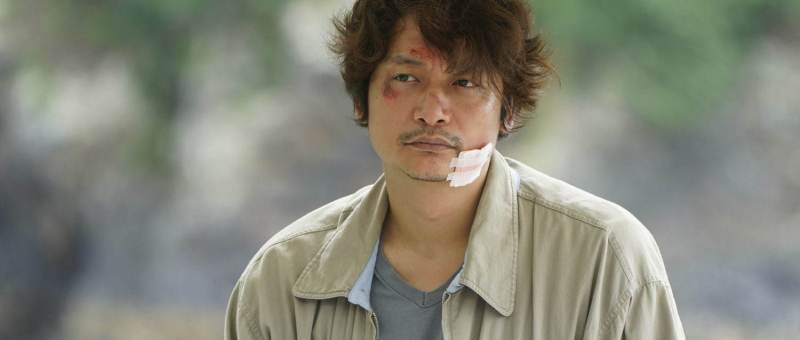
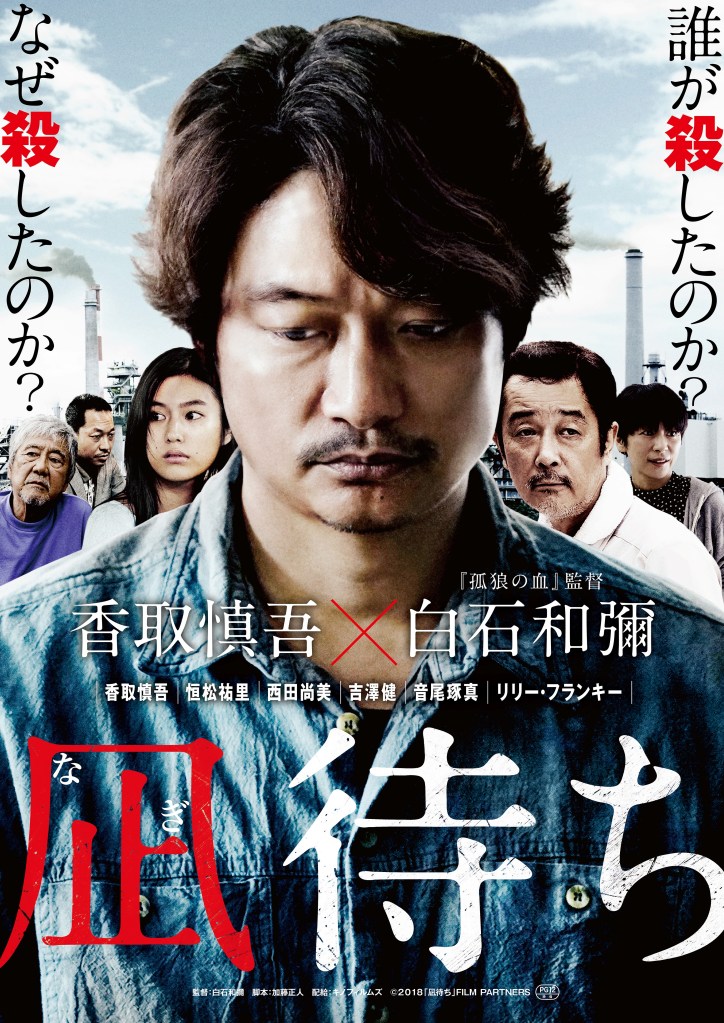
Sea of Revival (凪待ち, Kazuya Shiraishi, 2019)

“One bad thing leads to another” according to overprotective mother Ayumi (Naomi Nishida) in Kazuya Shirashi’s Sea of Revival (凪待ち, Nagi Machi). She’s not wrong, but breaking the chain proves harder than expected, especially as trouble has a way of following people around and the one thing you can never outrun is yourself. Yet, what might save you in the end is not so much self acceptance as that of others and finding your place along with a sense of belonging as member of a family in the knowledge they have chosen you as one of their own. 

Ikuo (Shingo Katori), the hero, certainly has plenty of demons he’s looking to leave behind. A devotee of the bicycle races, he’s just been laid off from his factory job and is preparing to move to his girlfriend Ayumi’s hometown where she plans to open a hairdressers and care for her ageing father Katsumi (Ken Yoshizawa) who has just been diagnosed with stage four cancer. Ayumi left rural Miyagi with her daughter, Minami (Yuri Tsunematsu) whose name is written with the characters for beautiful waves, after the tsunami which devastated the area and took her mother’s life. She hopes that it can be a new start for their family and that Ikuo will finally be able to shape up, knock his gambling habit on the head and ease back on the drinking. 

Things get off to a bad start, however, when Ikuo fails to bond with Katsumi who largely ignores him, while he discovers that Ishinomaki is much more conservative than Kawasaki and not everyone seems to approve of his liminal status in the Konno household. The fact remains that Ayumi and Ikuo, though they’ve been living together for five years, are not legally married and therefore in the eyes of some not a proper family, and more to the point Ikuo is an outsider with relatively little to recommend him. He does however try to make good on his promise, impressing the boss at a printshop where an overly helpful family friend, Onodera (Lily Franky), has found him a job, but quickly succumbs to old habits when a pair of ne’er-do-well colleagues introduce him to an illegal bicycle racing betting club run by local yakuza. 

Matters come to a head when Minami gets fed up with her mother’s overprotective conservatism and decides to pay her back by staying out late with new friends Ayumi doesn’t approve of. Flagging up their differing parenting styles, Ikuo tells Ayumi that she’s overreacting and should be happy for her daughter who is finally living something like a normal teenage life rather than shutting herself up in her room playing games like she did in Kawasaki where the other kids made her life a misery, calling her a “radioactive” transfer student from Fukushima. Ayumi fires back that Ikuo obviously isn’t very invested in Minami because, after all, he’s not her real dad and has no idea what family is. An extraordinarily hurtful thing to say in any circumstances, Ayumi’s words strike a nerve as Ikuo struggles to claim his place as a non-husband who has nevertheless become a father figure but is not recognised as a legitimate member of the family. 

Claim his place he does however when tragedy strikes, rushing into a police cordon shouting “I’m family” but being held back by the forces of social order while Minami cleverly evades them to see something no one should ever have to see. Old Katsumi meanwhile, apparently much like Ikuo in his youth, a fiery scrapper with a self-destructive streak, struggles to accept his failure either to save his wife or die by her side. Recognising something of himself in the younger man, he finally warms up to Ikuo, literally “redeeming” him from vengeful yakuza, offering only the explanation that he does so because “he’s my son”. 

Others such as the weirdly ever present Onodera may think it proper that Ikuo leave the Konno household because he has no more reason to be there, that his presence is now even more inappropriate than it was before. Minami is advised to move in with her birth father (Takuma Otoo) despite the fact Ayumi described him as abusive and that he has remarried and is currently expecting another child. Ikuo’s five years as her father count for nothing, because he was not married to her mother. During the car journey to their new home, Minami had playfully suggested to Ikuo that he should propose but he claimed he had no right to do so as an irresponsible man unable to contribute meaningfully to the household. Ayumi dreamed of the sea and of beautiful Caribbean islands to which Ikuo had promised but failed to take her. She ironically hoped to rebuild their lives in the ruined landscape of Ishinomaki where they’ve put up walls so tall you can no longer see the sea, still beautiful despite all its terrible ferocity. 

“A good wife makes a decent man” Ayumi’s ex bitterly fires back at her though others have found it to be true, Katsumi not least among them, but Ikuo’s problem is an internalised sense of masculine failure which keeps him on the edges of a family which is otherwise his by right. In a strange way, a piece of paper can make all the difference and no difference at all, both legitimate and not, in making it plain who is and is not accepted as “family”. Accepted by others, Ikuo learns to accept himself, still burdened by guilt and regret but also bound by it as he joins his chosen family on new a journey powered by those same beautiful yet destructive forces which have engendered so much grief and hope.


Screened as part of the Japan Foundation Touring Film Programme 2020.

Original trailer (English subtitles)
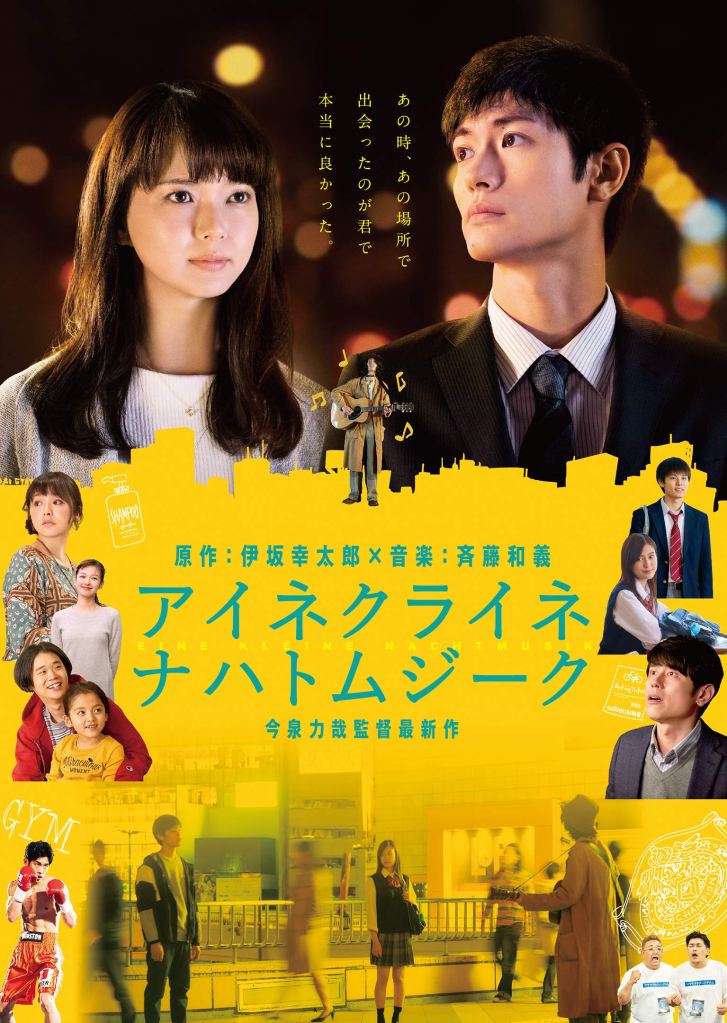
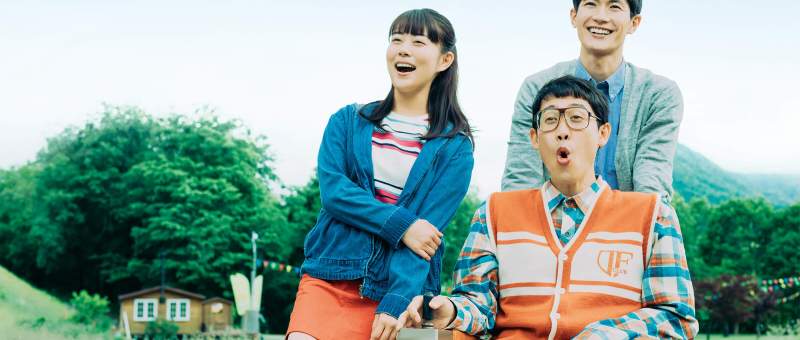
Little Nights, Little Love (アイネクライネナハトムジーク, Rikiya Imaizumi, 2019)

What is love? Is it an accident, cosmic destiny, or something that finally you have to choose? The romantically inclined hero of Little Nights, Little Love (アイネクライネナハトムジーク, Eine Kleine Nachtmusik) is convinced that romance is something that happens to you at an unexpected moment, but his friends worry that he’s letting life pass him by because of his bashful passivity. While the city is gripped by the upcoming world heavyweight boxing championship which might finally result in a Japanese underdog raising the belt, its citizens gain the courage to fight for love, but discover that love is less victory than mutual concession. 

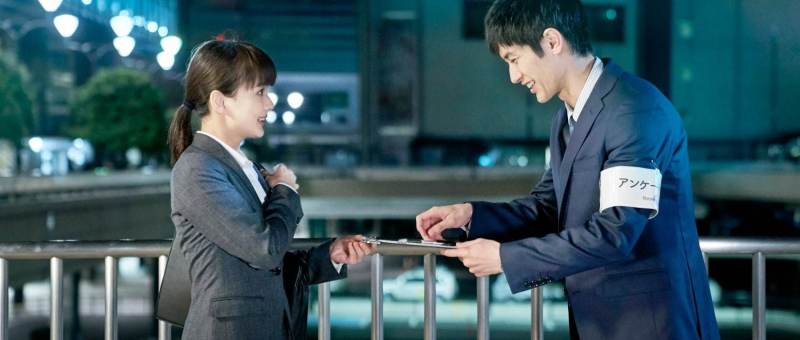
Sato (Haruma Miura), a hopelessly romantic salaryman, is forced to stand outside the station in the centre of Sendai conducting public surveys to make up the data that was lost when he accidentally spilt coffee on his colleague’s computer. Naturally shy, he’s not an ideal fit for the job but serendipitously bonds with a young woman, Saki (Mikako Tabe), when they are both captivated by the soulful song of a street musician. She agrees to fill in his form, and he notices she has “shampoo” written on her hand. He thinks it might be a sign, but she’s gone before he can do much about it. 

Sato’s college buddies Yumi (Erika Mori) and Kazuma (Yuma Yamoto), married young in a shotgun wedding but seemingly blissfully happy and parents to two adorable children, are quick to tell him that his romantic desire for serendipitous love is just thinly veiled cowardice and his essential passivity, refusing to put himself out there, is the reason he’ll end up alone. Meanwhile, Yumi is also trying to support her longterm single sister, Minako (Shihori Kanjiya), who is in a strange “relationship” with the younger brother of a client at her hairdressing salon. Despite talking regularly on the phone, he seems reluctant to meet because his job keeps him very busy which leaves her feeling confused and suspicious. 

Yumi and Kazuma think they ended up together out of necessity, but that necessity was in its own way chance. Secretly, Kazuma might wonder what might have happened if he’d been careless with some other girl, but has come to the conclusion that he’s glad it was Yumi and not someone else. Sato’s colleague Fujima (Taizo Harada), meanwhile, thought he had a cheerily romantic origin story for his relationship – a classic dropped wallet meet cute of the kind Kazuma insisted only happens in the movies, but now nearing 40 his wife has left him and the failure of his marriage has provoked a nervous breakdown. Sato asks him if he’s still glad it was his wife who dropped her wallet and not someone else, and if she’s glad that it was him who picked it up. Not only can he not quite answer, he doesn’t quite want to know. 

Meanwhile, Minako discovers that her diffident lover has decided to stake his romantic future on the championship match, that if the Japanese challenger wins he’ll finally have the courage to speak his heart. Minako is angry and disappointed, infuriated that he has so little courage that he has to vicariously channel the power of someone else to confess his feelings, but is as glued to the match as everyone else. 10 years on, the same thing happens again. Yumi and Kazuma’s daughter, Mio (Yuri Tsunematsu), is now a rebellious teen fed up with her father’s perpetually easygoing attitude and infuriated by a school friend, Kurume (Riku Hagiwara), who also pins his romantic hopes on the boxing match while inwardly resenting his overly spineless father (Yurei Yanagi) for becoming a mere cog in the great machine of capitalism. His refreshingly honest mother (Mari Hamada), however, reminds him that everyone thinks that when they’re 17 but really there’s no life without compromise and cogs at least have their place in keeping the wheels turning. Kurume finds this out by chance when his dad is able to save him from a sticky situation using classically meek, salaryman-style strategy. 

Perhaps what Kurume resents is the sense of impending powerlessness that comes of being a teenager squaring off against the salaryman straightjacket even if he’s still too diffident to put up much resistance. Meanwhile, the reverse is also true. The youngsters bond while staking out a bicycle parking garage to look for a thief who stole Mio’s 60 yen parking sticker and put it on his own bike, leaving her with the fine. They discover it’s an old man who wastes no time in yelling at the young whippersnappers while kicking off against his sense of impotence by gaming the system over a measly 60 yen he could have easily paid. The same thing happens again at Mio’s part-time job where a horrible old man decides to take out his frustrations with his place in the world on an innocent teenage girl. 

10 years earlier, Sato had saved a boy with hearing problems from being beaten up by bullying classmates, giving him new strength by introducing him to Japan’s boxing champ. The inevitable, however, happens, and even champion boxers have feet of clay. Things don’t always go to plan, or perhaps they do but that only makes you wonder if you’re really on the right path or merely settling for that of least resistance. The street singer’s song asks if you’re happy where you’ve ended up or if you still want more than ordinary happiness. Sato, still diffident, has to admit that perhaps he isn’t sure, while Saki does something much the same in wondering if they’re only still together out of habit and a misplaced belief in the narrative destiny of their serendipitous meeting. Another championship match sees them all ready for the fight once again, encouraged by the embattled boxer’s refusal to give-up on his fighting dreams, but perhaps still waiting for a “sign”. What Sato learns, however, is that they don’t always arrive quite as serendipitously as one might might think. “It builds up” Fujima warns him, waking up to the fact that his wife likely left him after years of small microagressions that killed their love through taking it for granted. But love can build up too, if only you build up the courage to fight for it with a willingness to be honest with your feelings, and what’s life if not lots of little nights filled with lots of little love, no grand romance but maybe not so bad after all. 


Screened as part of the Japan Foundation Touring Film Programme 2020.

International trailer (English subtitles)
The song – Chiisana Yoru by Kazuyoshi Saito

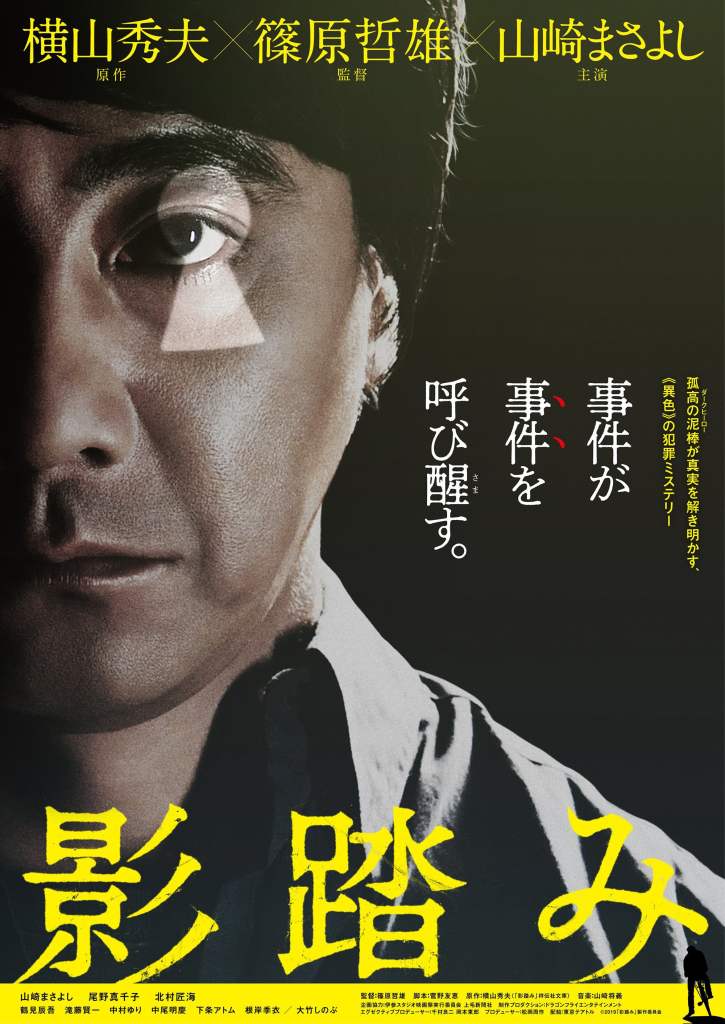
Shadowfall (影踏み, Tetsuo Shinohara, 2019)

Cinema has an odd preoccupation with twins. The uncanniness of seeing more than one person with the same face in the same frame injects a note of inescapable unease, not least because of the oddness of the techniques required to make one actor appear to be in two places at once. Shadowfall (影踏み, Kagefumi) adapted from the mystery novel by 64’s Hideo Yokoyama, places the “evil twin” motif at its heart but, perhaps a little uncomfortably, uses it as a metaphor for the shadow self as the conflicted hero attempts to find closure with past trauma and family legacy in order to reintegrate his two selves into one complete whole capable of living a life both spiritually and emotionally honest. 

As the film opens, ace cat burgler Shuichi (Masayoshi Yamazaki) is in the process of breaking into the home of a local politician. Whilst there, however, he discovers petrol pooled on the hall floor and the politician’s wife, Yoko (Yuri Nakamura), nervously grasping a cigarette lighter. He manages to snap the lighter shut before she can use it, saving her life (as well as that of the husband she was about to kill), but is then caught by a policeman, Sosuke (Pistol Takehara), who happened to be “just passing by” and is also, coincidentally, a childhood friend. Shuichi gets two years, and is met on his release by a young man, Keiji (Takumi Kitamura), dressed in incongruously old-fashioned, gangster-style clothes and adressing him as “Shuichi-ni” or “big brother Shuichi”. Together, the pair form a small crime fighting team determined to find out what became of Yoko while poking their noses into some conspiratorial corruption which links her with yakuza, police, and the judiciary. The situation is further complicated when Sosuke is found dead after a visit to Yoko’s bar, leaving Shuichi implicated in the possible murder of his old friend. 

Reflecting on the case, police detective Mabuchi (Shingo Tsurumi), who also knew Shuichi in his youth, remarks that twins are tied to each other like heaven is to hell. One will necessarily drag the other down. Later, he corrects himself, that if is that is true then the reverse must also be and one should be able to raise the other up. What we see, however, is largely the former. We discover that Shuichi had an identical twin who was “no good”, a petty teenage hoodlum always in trouble with the police where he was a top student preparing to study the law and become a prosector. Their mother (Shinobu Otake), a teacher, found herself a victim of social stigma as the mother of a criminal, asked to resign from her job because a woman who can’t raise her own son to be a law abiding citizen is not fit to educate those of others. Hisako (Machiko Ono), who had been friends with both the boys and is still carrying a smouldering torch for the “good” Shuichi, experiences something of the same when she’s targeted by a creepy stalker (Kenichi Takito) who leaks her “criminal associations” on the message board of the nursery school where she too teaches. 

Having waited for him all these years, Hisako is praying for the restoration of the Shuichi she once knew who was good where his brother was “bad”. Despite her deep and abiding love for him, she claims to have chosen Shuichi, rather than his brother, because loving the good is the safer, more responsible choice. Shuichi, meanwhile, describes himself as walking in his brother’s shadow, a darkened space into which Hisako wishes to be admitted but is wilfully denied. He tells himself he does this to keep her safe, but is in reality unable to step into that space himself and occupy it as a full and complete person. He claims that his criminality is an act of revenge when it is actually a kind of self-harm that ensures his two selves, the shadow self that is his departed brother, and the ghost self which is the cat burglar, will remain forever separate. 

Talking with another twin whose mirroring of his brother had even darker results, Shuichi confesses that to share a soul with another human being is a terrible curse and one he secretly longed to be released from. It’s this latent sense of guilt which haunts him, cleaving his soul in two. Only by dealing with the traumatic past, the memories inflamed by Yoko whose burden is a fear of an excessive “niceness” she too must learn to let go, can he reintegrate his two selves into one complete whole with only a single shadow. A noirish tale of haunting grief and unresolved regret, Shadowfall finds hope in the simple act of acceptance and the promised restoration of the imperfect whole. 


Screened as part of the Japan Foundation Touring Film Programme 2020.

International trailer (English subtitles)

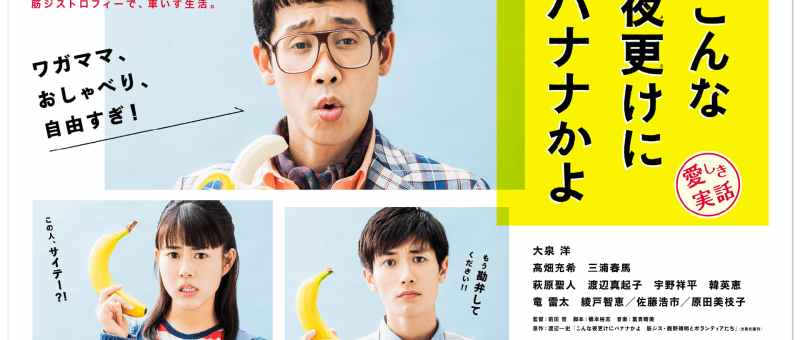
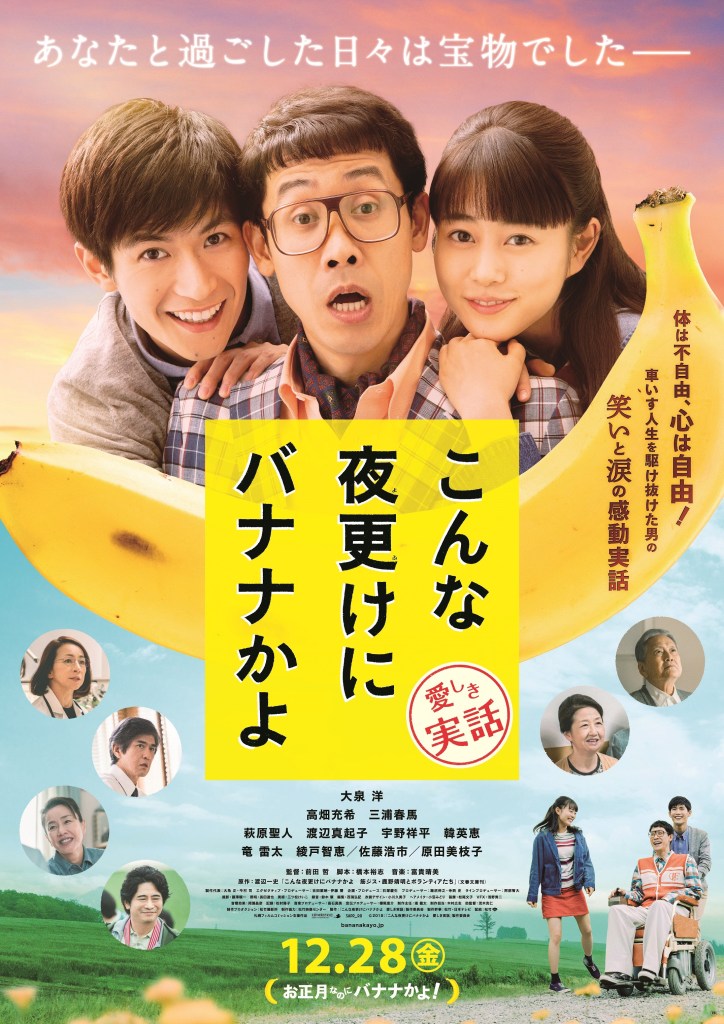
A Banana? At This Time of Night? (こんな夜更けにバナナかよ 愛しき実話, Tetsu Maeda, 2018)

Many people will tell you that if you’re having trouble sleeping, a banana is just the thing though if you’ve failed to properly prepare and have left it until 2.30am to try and buy one you might be out of luck. The hero of Tetsu Maeda’s A Banana? At This Time of Night? (こんな夜更けにバナナかよ 愛しき実話, Konna Yofuke ni Banana kayo: Itoshiki jitsuwa) is not proposing to go out and find one himself, but using his sudden desire for the potassium rich fruit as an excuse to dispatch one of his helpers in the hope of being left alone with the pretty young girl who’s just joined the team. Unbeknownst to him, the girl, Misaki (Mitsuki Takahata), is actually the girlfriend of the aspiring doctor, Tanaka (Haruma Miura), he was trying to get rid of, but the plan backfires when she takes the opportunity to go get one herself in order to escape an increasingly awkward situation. 

Inspired by Kazufumi Watanabe’s non-fiction book, A Banana? At This Time of Night? is the latest in a series of recent Japanese films dealing with the issue of disability in a society which often struggles to accommodate difference. The hero, Yasuaki Shikano (Yo Oizumi), has suffered with muscular dystrophy since the age of 12 and has survived to the age of 34 despite being told that he would likely never see 20. Determined to live an “independent” life, he relies on a small team of volunteers who assist him with day to day tasks he can no longer manage, and works as an activist for the rights of disabled people. 

Yasuaki is, however, by his own admission not always an easy person to get along with. He is often selfish and cruel to the volunteers who have given their time to help him out of nothing more than human kindness while deliberately sending them out on random errands to buy burgers  (or bananas) but finding fault when they return. Yet, he largely gets away with it because of his cheeky personality and the fact he is so robustly “honest” about his own behaviour. One of the major tenets of his activism is destigmatising the idea of asking for help so that younger disabled people in particular who might feel awkward about asking others to assist them so they can lead independent lives know that there is nothing wrong in being upfront about their needs. 

Of course, despite his “honesty”, there’s an essential contradiction in Yasuaki’s definition of independence in that he freely admits that he can only live an “independent” life because of the support he receives from the volunteers. Without them, his life would be impossible. In a further contradiction, we eventually realise that he’s only so mean to his mother (Chie Ayado) because he doesn’t want her to sacrifice the entirety of her life to look after him and wants his parents to be able to live their own lives while he lives his. Misaki, only originally volunteering to check up on her boyfriend, is horrified by Yasuaki’s attitude and vows never to return, only to be coaxed back by Tanaka awkwardly forced to take dictation of an apology/declaration of love when Yasuaki finds himself smitten by her boldness in defiantly standing up to him. 

Slightly embarrassed, Tanaka never explains that Misaki is his girlfriend, perhaps a little patronisingly allowing Yasuaki to play at romance he feels is impossible so that his feelings won’t be hurt. The central problem is, however, that both Misaki and Tanaka have their own failures of honesty which place their relationship at risk. Tanaka was under the impression that Misaki was studying to become a teacher, but her friends just said that to get her into a party with med students and she never bothered to correct him. When the relationship gets more serious, she comes clean, but he takes it badly, half-convinced she just wanted to meet a doctor and the whole relationship has been a lie. Meanwhile, he’s only studying medicine because his authoritarian father wants him to take over the family hospital and he’s beginning to wonder if it’s really what he wants to do with his life. Unlike either of them Yasuaki knows exactly what he wants – to go America and meet his idol which is why he’s been working hard learning English. 

Through their shared friendship with Yasuaki, both of the lost youngsters begin to find direction and the courage to follow it. Despite the many setbacks and difficulties he faces, Yasuaki never gives up on his dreams and boldly insists on the right to pursue them while living his life to the fullest. Which isn’t to say that his own story is merely inspirational fodder for his friends, but it does make the case for a better, more inclusive society built on mutual support in which all are free to live the way they choose spreading love and joy wherever they go. 


Screened as part of the Japan Foundation Touring Film Programme 2020.

International trailer (English subtitles)

Happiness is a State of Mind – The Japan Foundation Touring Film Programme 2020

bento harrassment still 2

The Japan Foundation Touring Film Programme is back for 2020 with another handpicked selection of recent (and not so recent) Japanese cinema hits. This year’s theme is “happiness”, encompassing not only life’s ups but also its down in the pursuit of fulfilment in contemporary Japan.

My Love Story!!

My Love StoryTakeo is a big guy with a big heart but awkward when it comes to romance. When he saves timid transfer student Rinko from a street harasser and falls in love at first sight, he is convinced she must have fallen for his super-handsome friend and determines to get them together in this charmingly innocent high school rom-com. Review.

Our Meal for Tomorrow

Our Meal for tomorrowAn introverted high school boy and outgoing girl grow closer after participating in a joint sack race, but their romance is threatened by a dark secret…
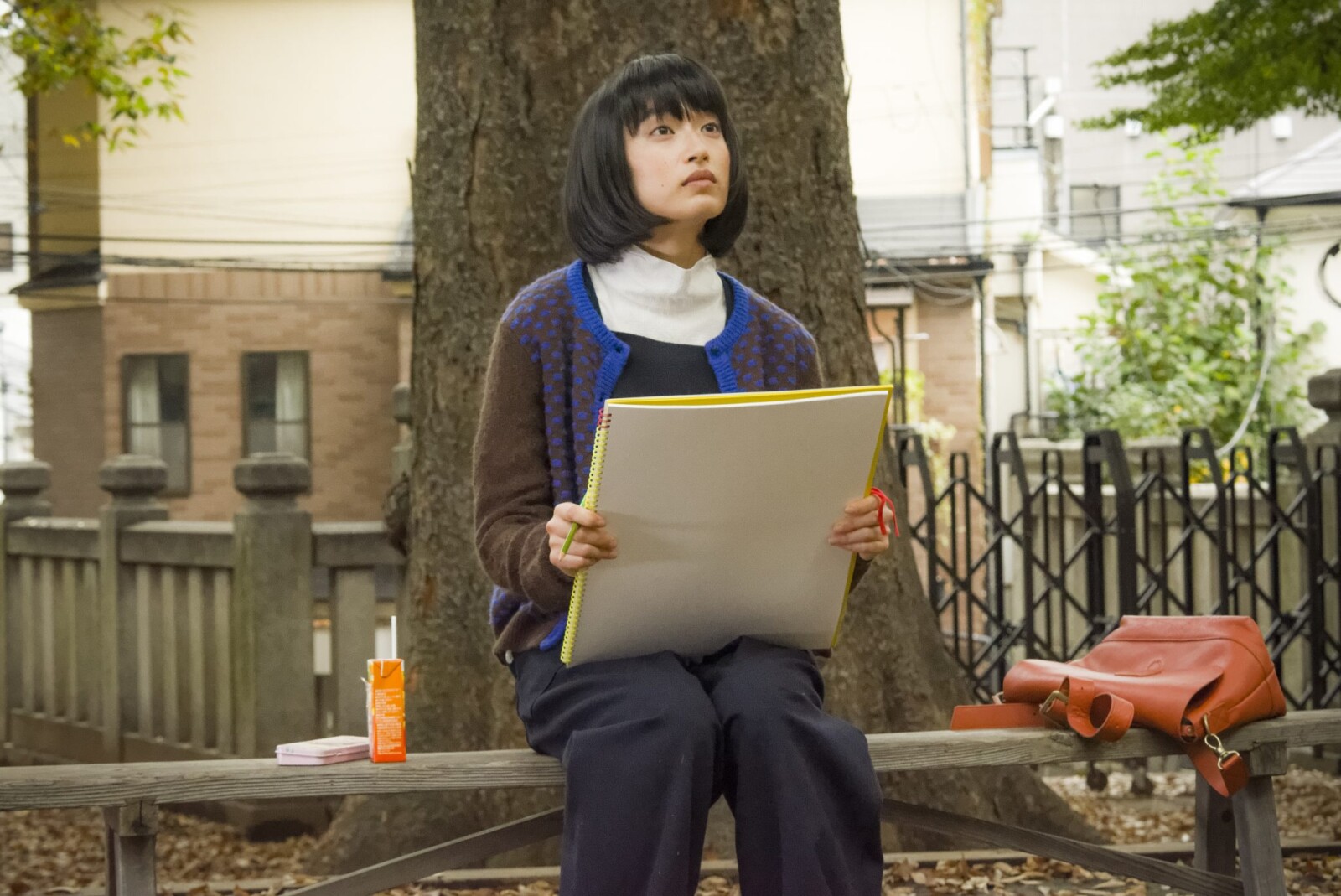
Her Sketchbook

Her sketchpadAn introverted otaku has become a virtual shut in so her father finds her a quiet job testing video games which doesn’t require much interpersonal interaction. Whilst there, she meets a sympathetic colleague who encourages her to express herself designing character illustrations for the games.
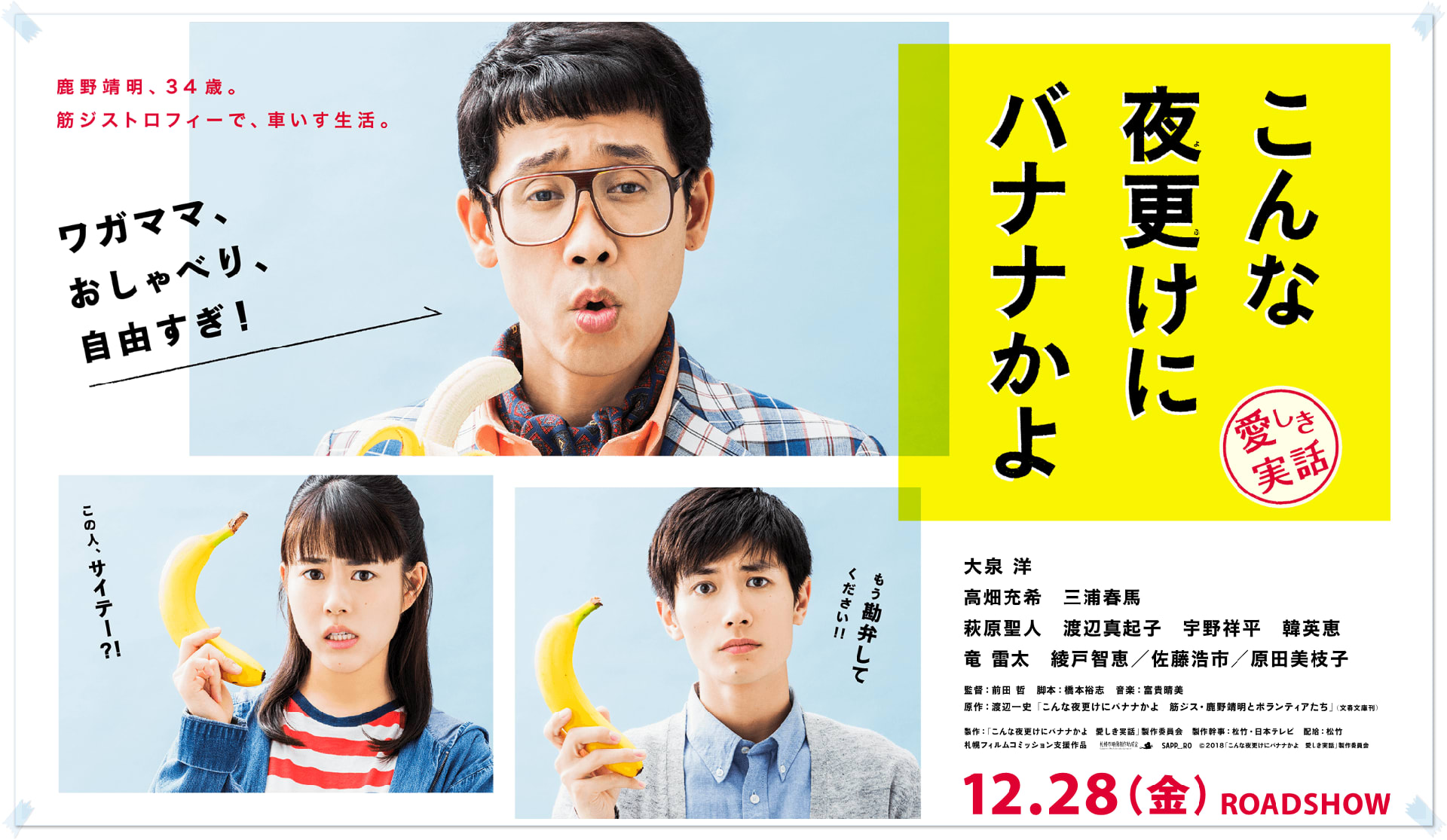
A Banana? At This Time of Night?

A banana at this time of nightYo Oizumi stars as a man with muscular dystrophy who is determined to live an independent life in his own home. After striking up a friendship with medical student Hisashi (Haruma Miura) he falls for volunteer carer Misaki and asks Hisashi to help him woo her little knowing she is his girlfriend.
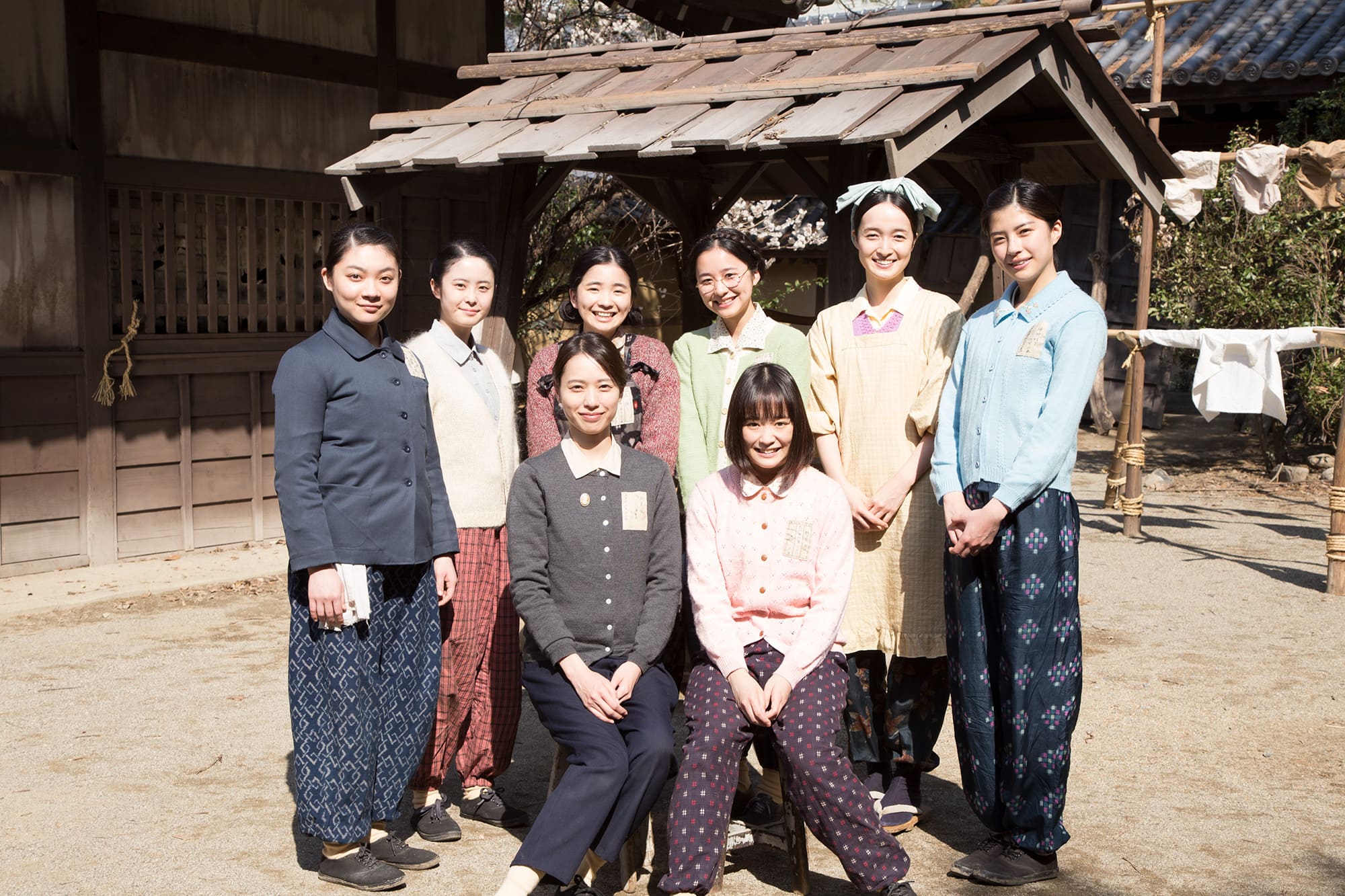
Organ

OrganWartime drama starring Erika Toda as a kindergarten teacher who evacuates her children to a nearby temple to try and protect them from the firebombing of Tokyo.
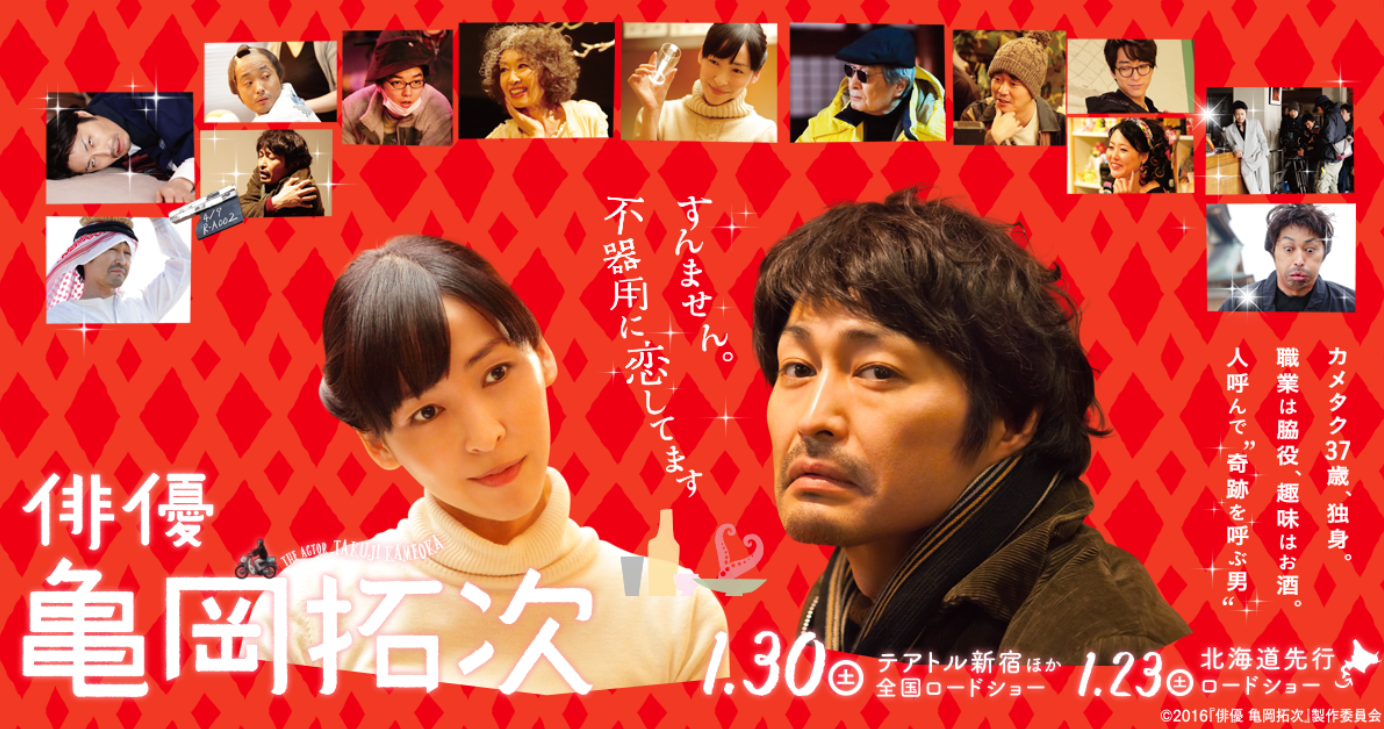
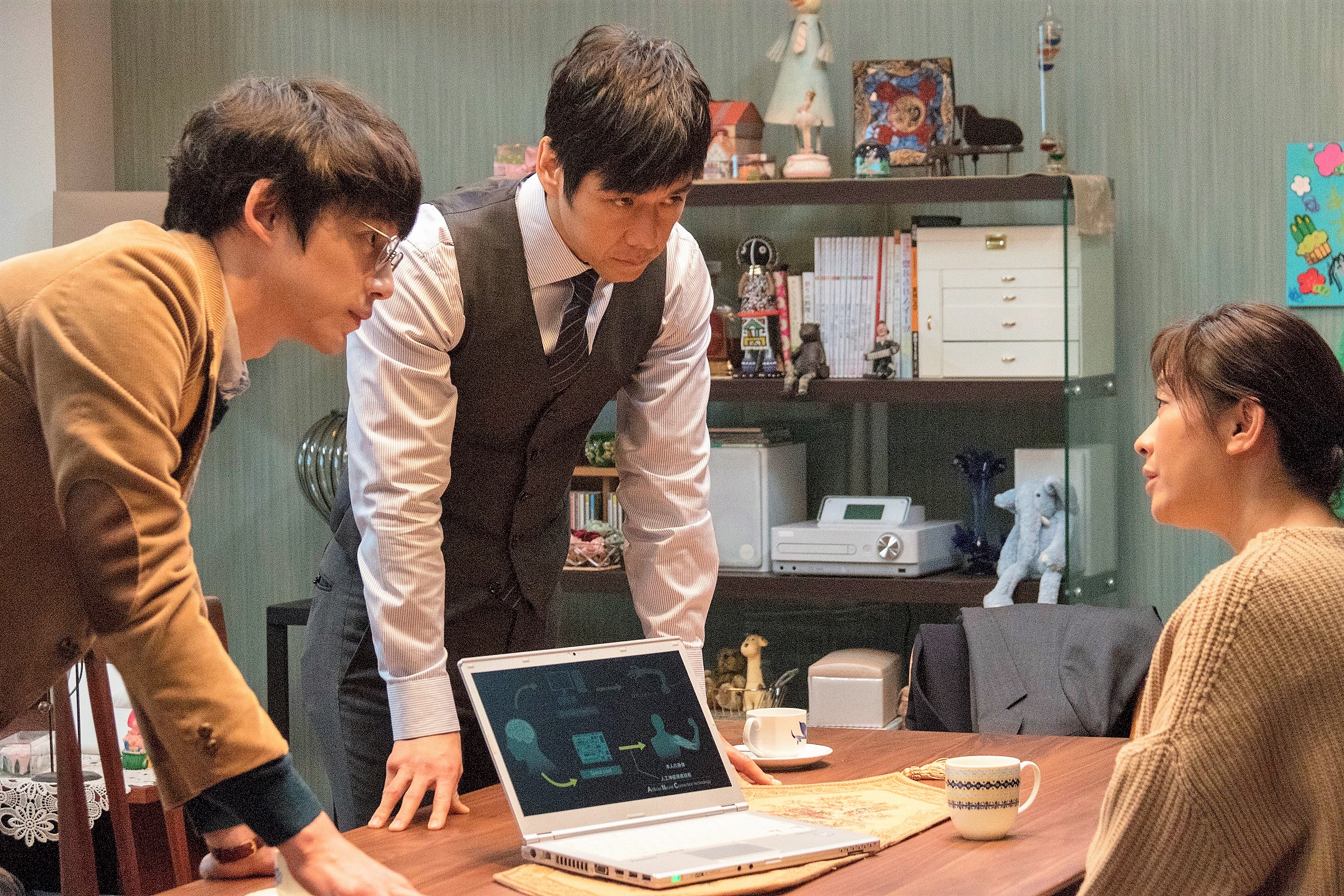
The Actor

the actorKen Yasuda stars as a jobbing actor experiencing a small revolution when he’s brought in for a big film role for a foreign director and falls for the pretty daughter of a local izakaya owner.

Little Nights, Little Love

little lights little love27-year-old Sato is patiently waiting for love. A chance encounter with a smartly dressed woman who agrees to fill in one of his questionnaires could be just what he’s been looking for…
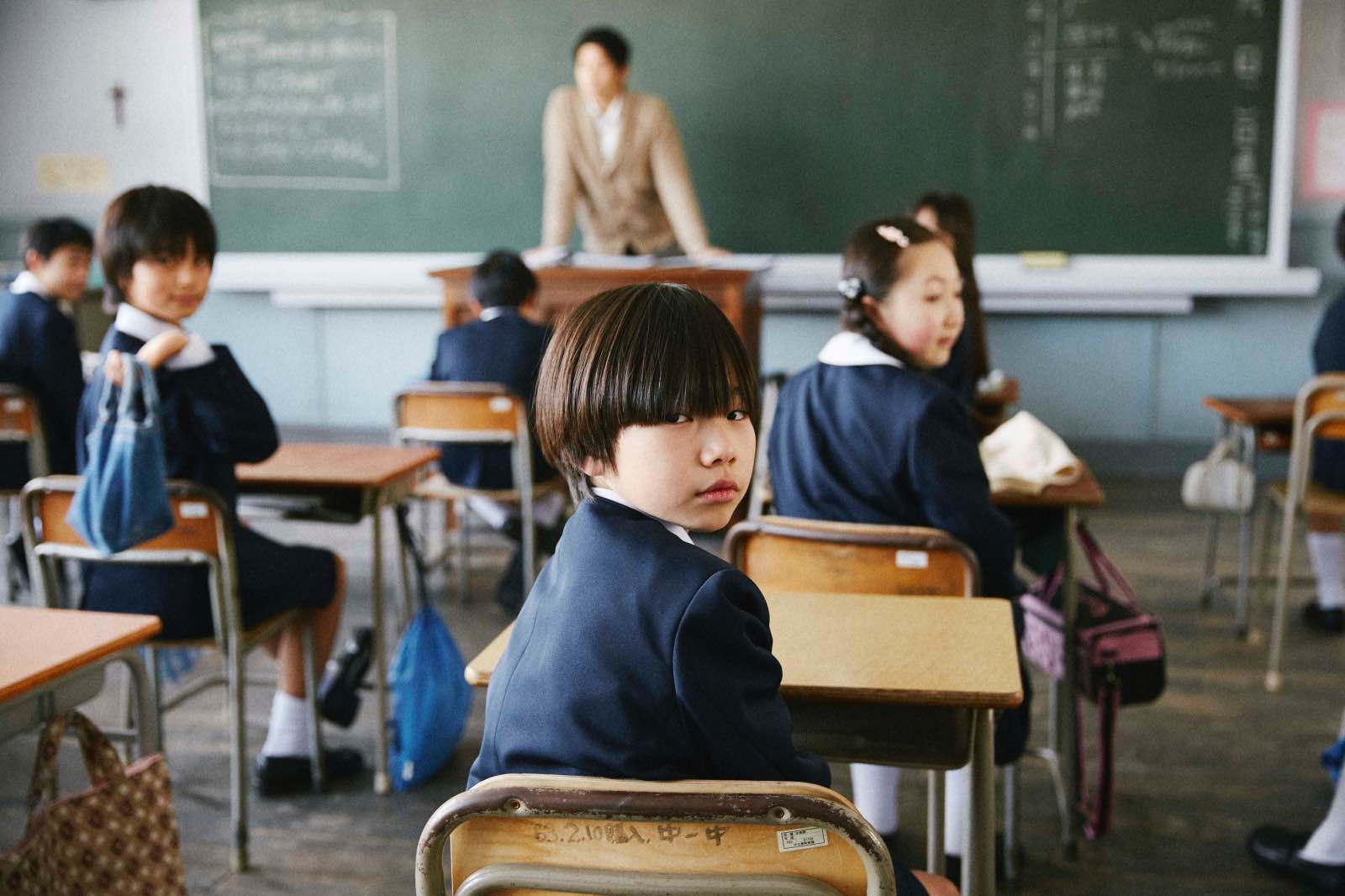
Jesus

jesus still 1A small boy is forced to relocate to the mountains after his grandfather dies. Though the family is not Christian, he finds himself doubly out of place having to attend a Catholic school where a little bit of religious confusion sees him befriended by a Tiny Jesus. Review.
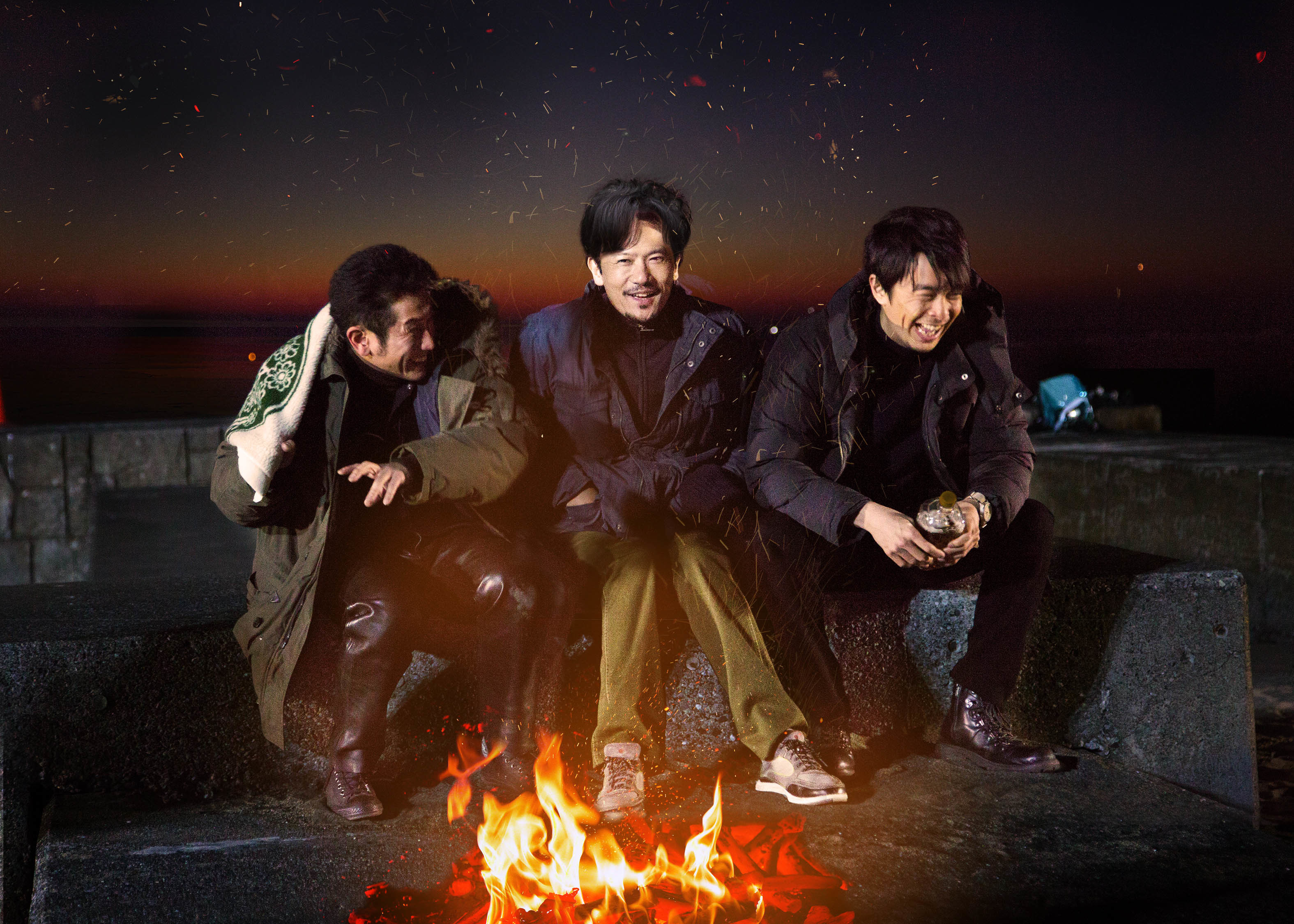
Another World

Another World still 1Three high school buddies reunite in their small-town home hoping to restore the easy bond of their adolescence while battling middle-aged disappointment in the latest from Junji Sakamoto. Review.
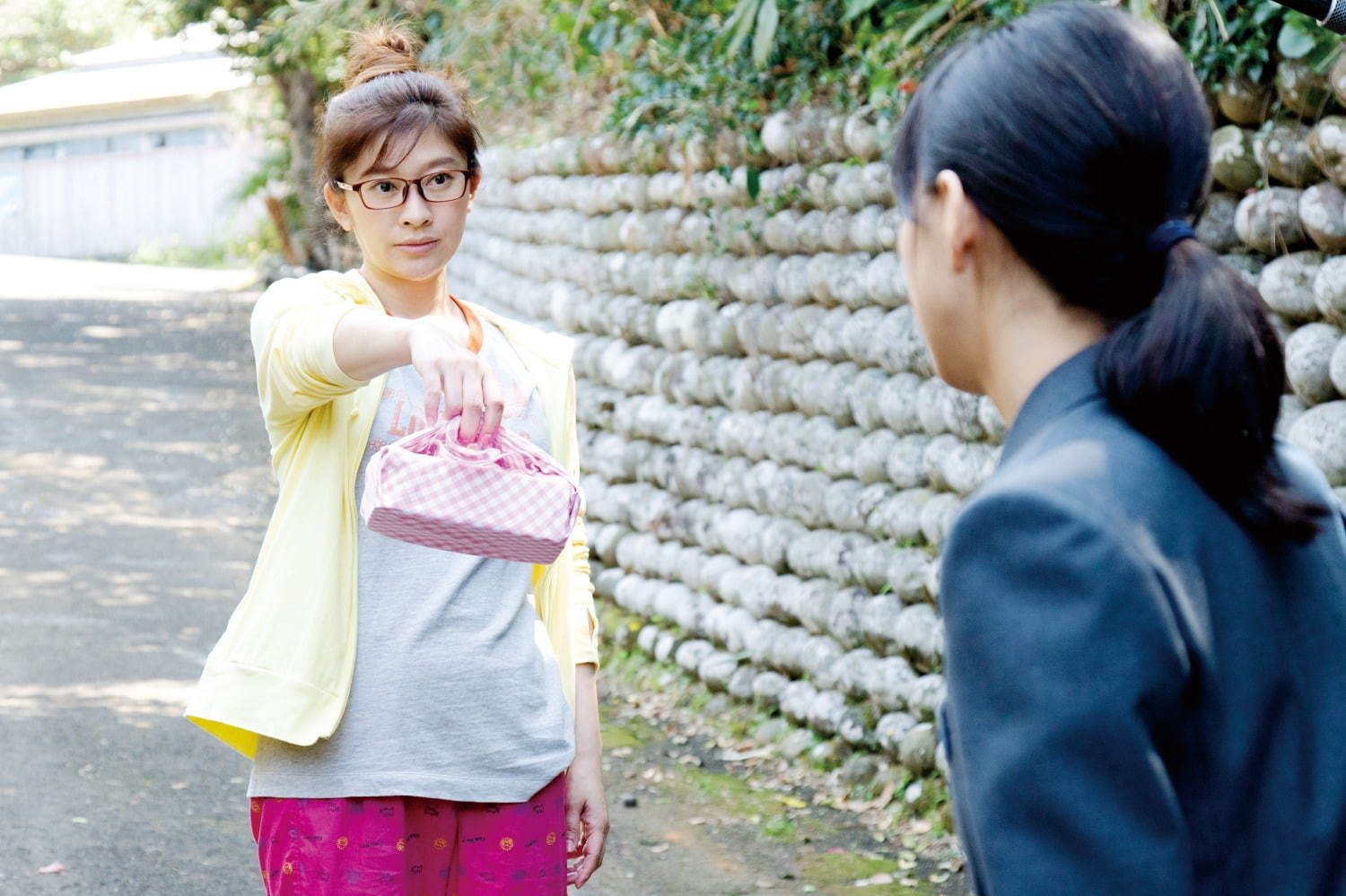
Bento Harassment

Bento Harrassment still 1Fed up with her teenage daughter’s moodiness, a single mother tries to communicate with her via passive aggressive bento in this charming family drama. Review.
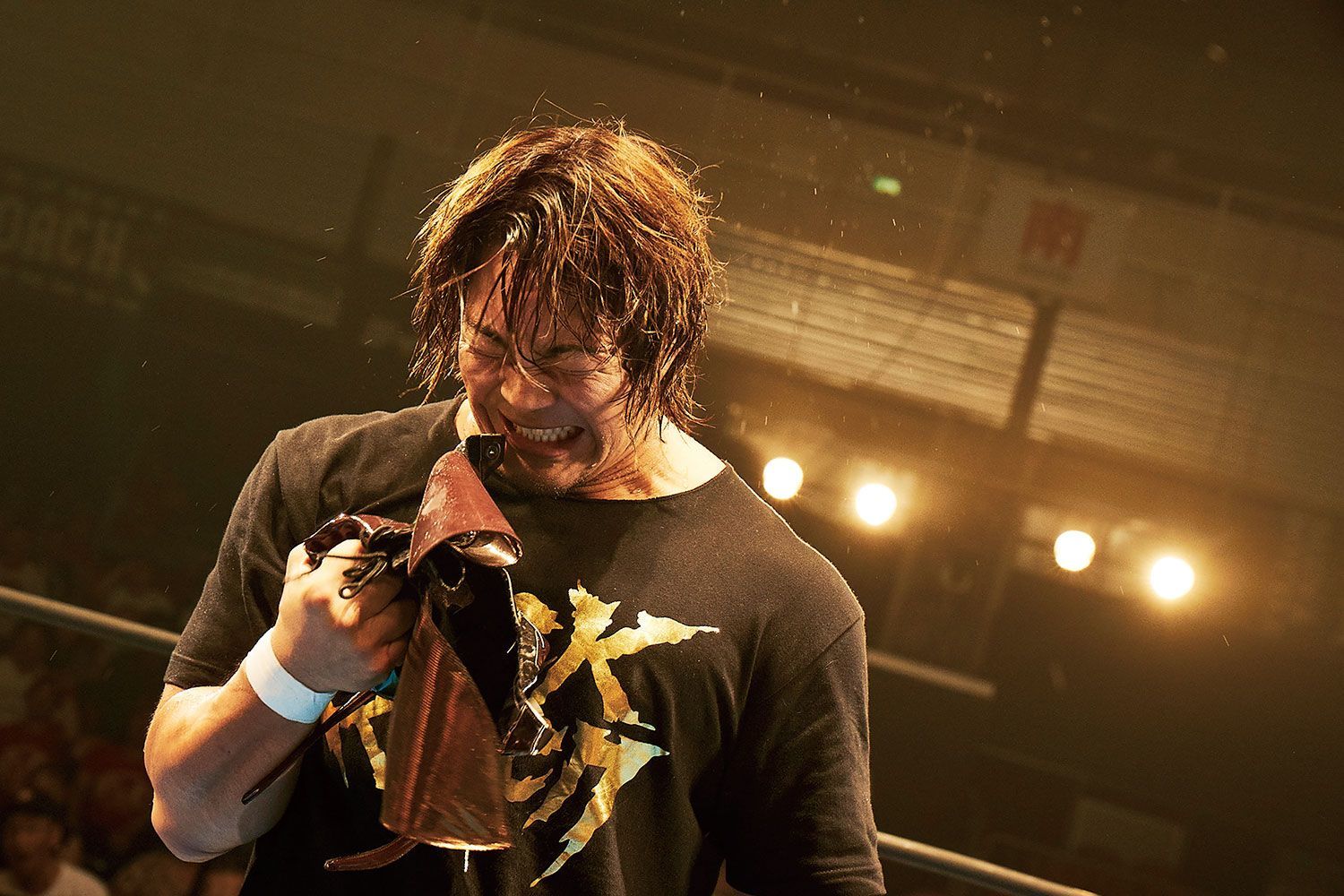
My Dad is a Heel Wrestler

My Dad is a Heel Wrestler still 1Former pro-wrestler Takashi Omura injured his knee and now makes a living playing a “heel” – a cockroach mask-wearing villain of the ring. Takashi’s 9-year-old son Shota had no idea what he does for a living until he snuck into the ring. Horrified to discover he’s such a loser, Shota tells his classmates that his dad’s the hero wrestler Dragon George…
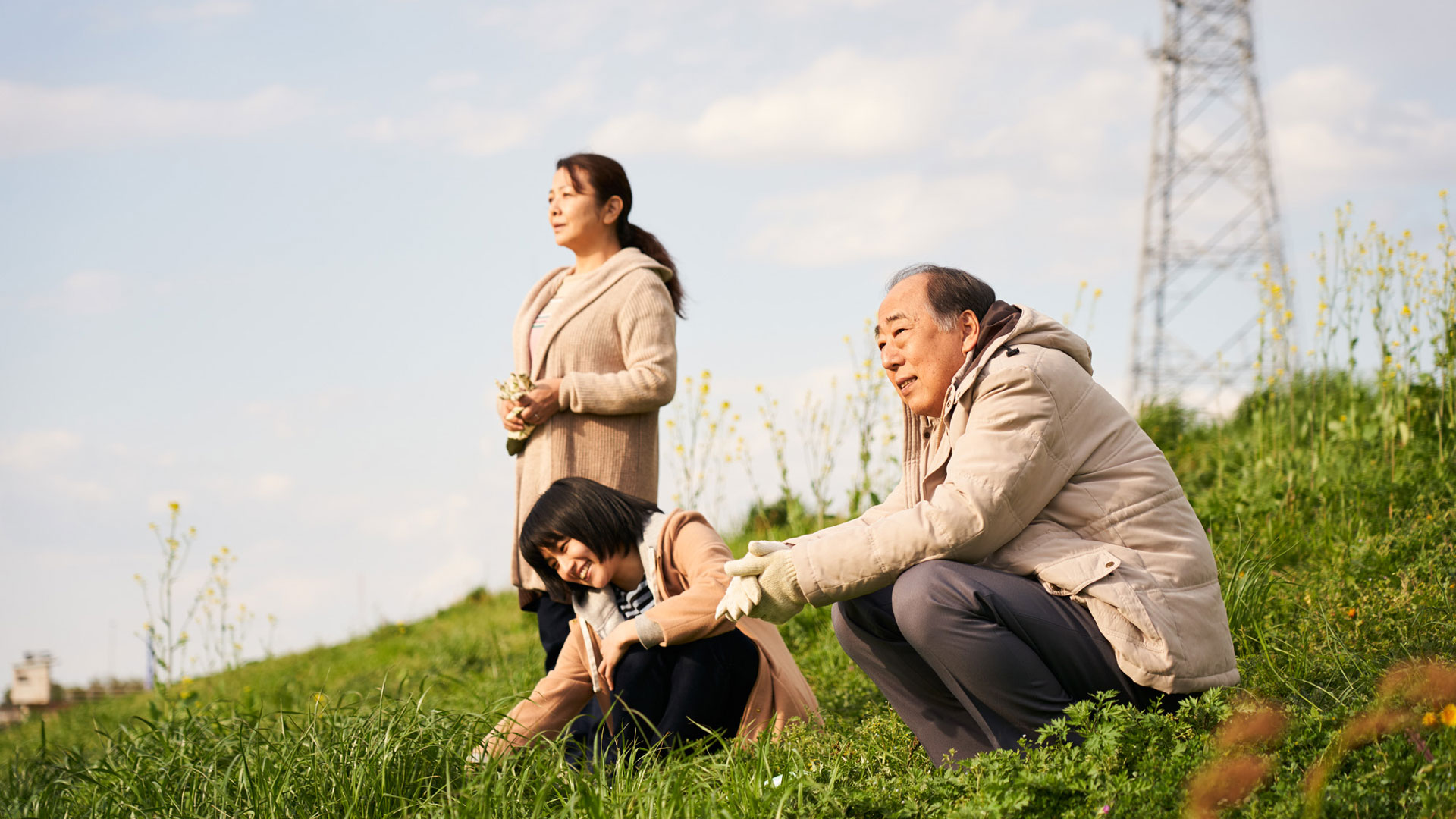
Lying to Mom

lying to mom still 1Yuko is knocked out trying to save her son who has hanged himself in his bedroom. Unfortunately he didn’t make it, but when she wakes up she has no memory of the incident and her family don’t have the heart to tell her what really happened, electing to keep up the elaborate pretence that he is alive and well and living in Argentina. Review.
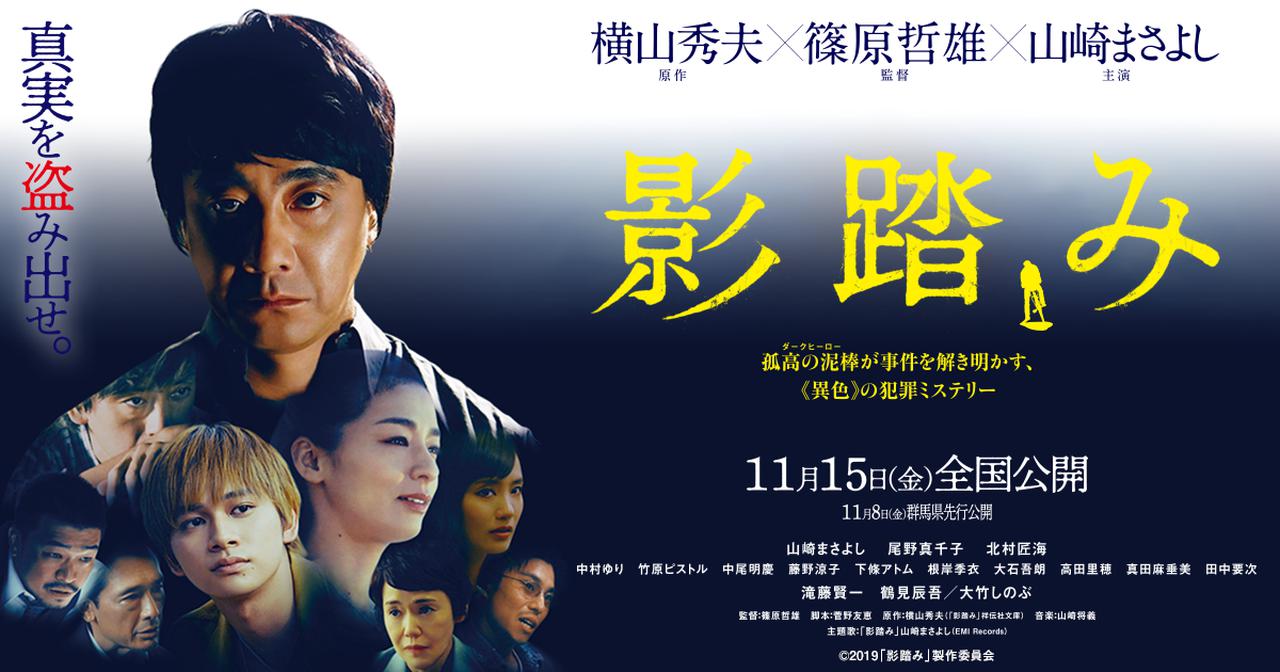
Shadowfall

Shadowfall bannnerA burglar gets a nasty surprise when he breaks into a house where a woman is preparing to commit a murder!
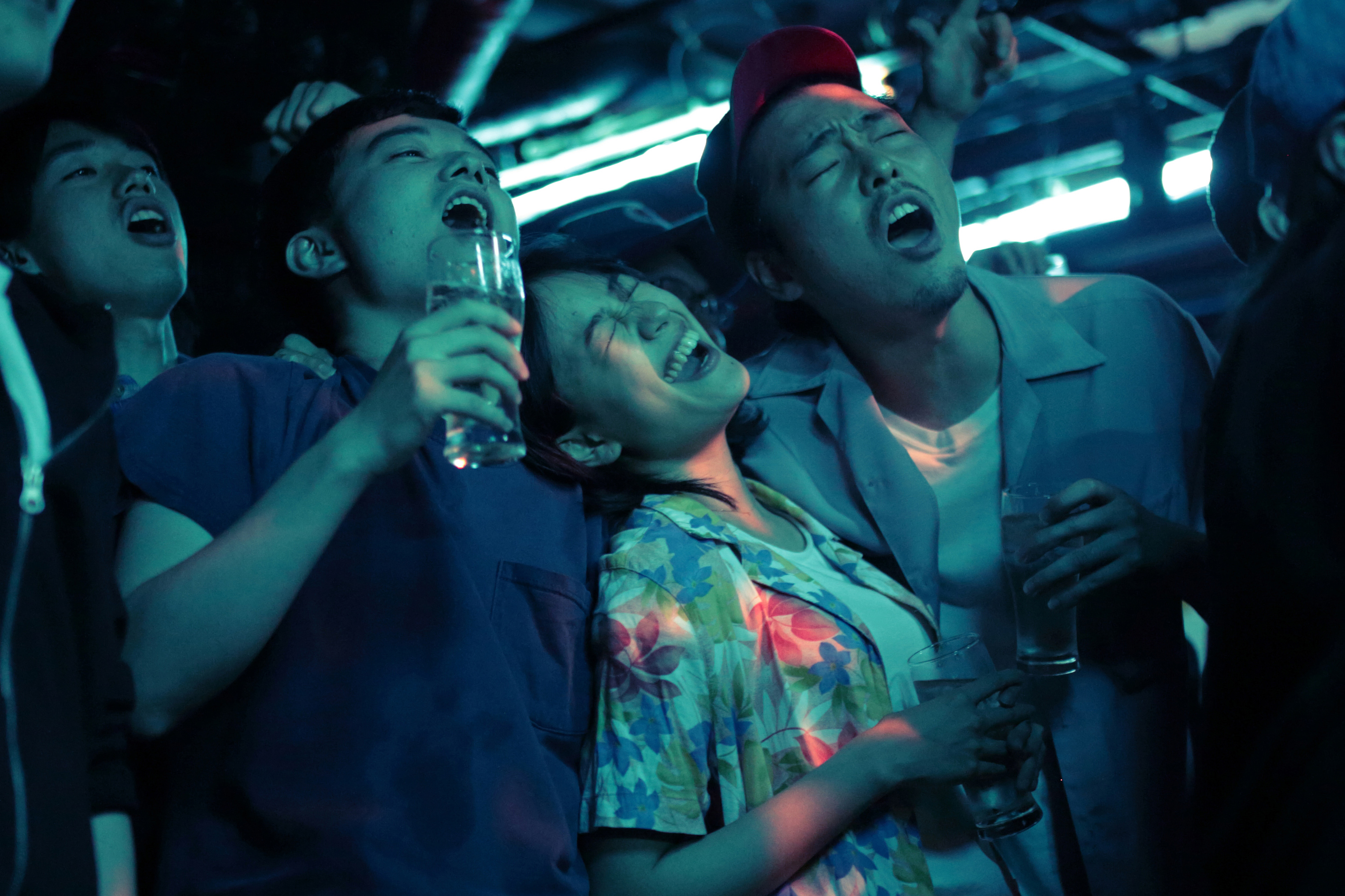
And Your Bird Can Sing

And your bird can sing still 1Three slackers struggle to accept love in modern day Tokyo in Sho Miyake’s contemporary adaptation of Yasushi Sato’s Akutagawa Prize-winning novel. Review.
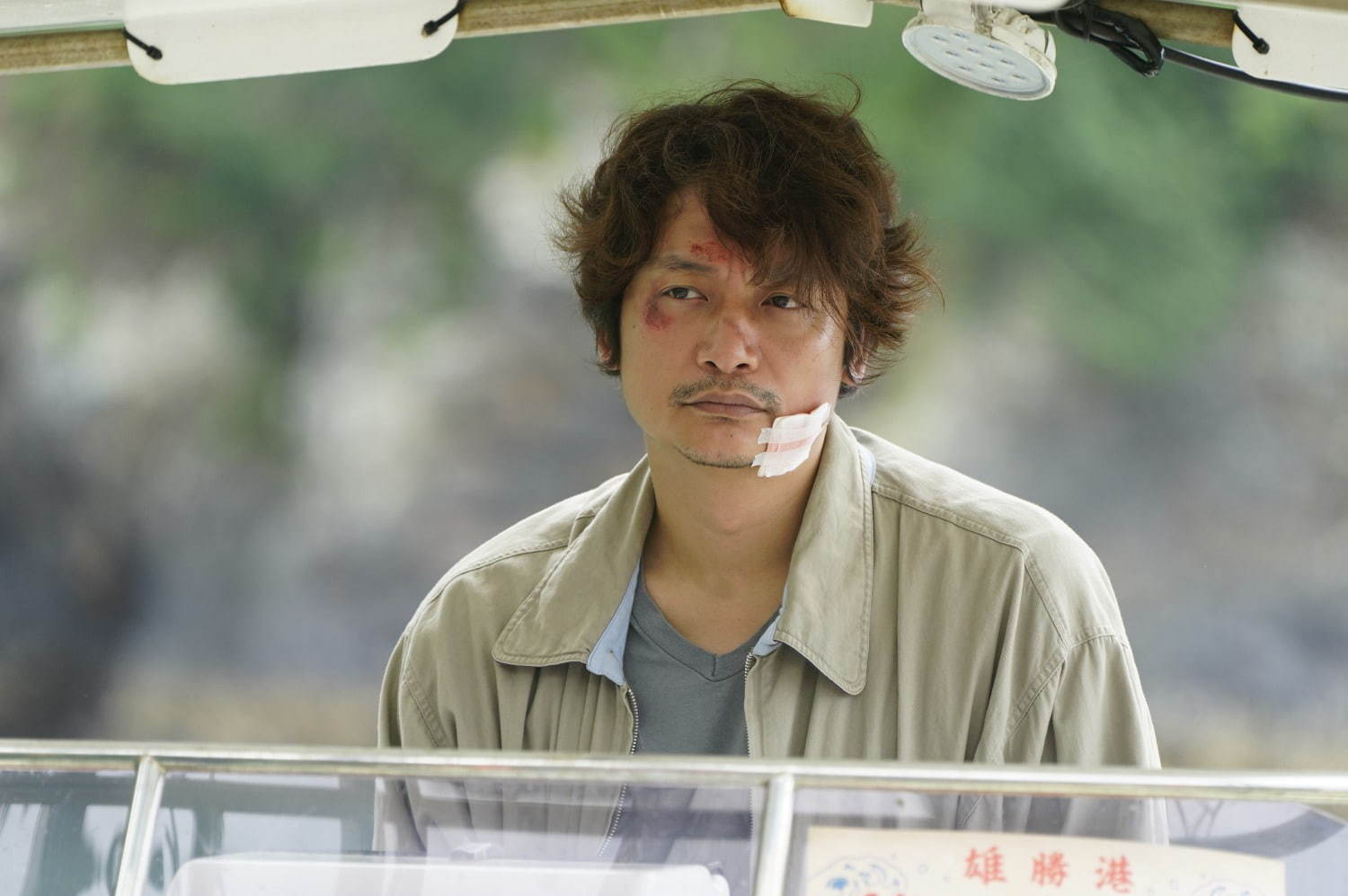
Sea of Revival

Sea of revival still 1A man moves to his partner’s hometown when her father falls ill, but tragedy follows him and his gambling addiction spirals out of control.
The House Where the Mermaid Sleeps

House where the mermaid sleeps still1Kaoruko is separated from her husband and has two small children. One day she gets a call to say that her daughter has drowned in a swimming pool and has been declared brain dead. She and her husband then have a difficult choice to make, donate her organs so another child can live, or wait until her heart stops beating.

Kakegurui – Compulsive Gambler

Kakegurui bannerIt’s high stakes high school in this adaptation of Homura Kawamoto & Toru Naomura’s gambling manga Kakegurui in which grades are decided at the gaming tables!
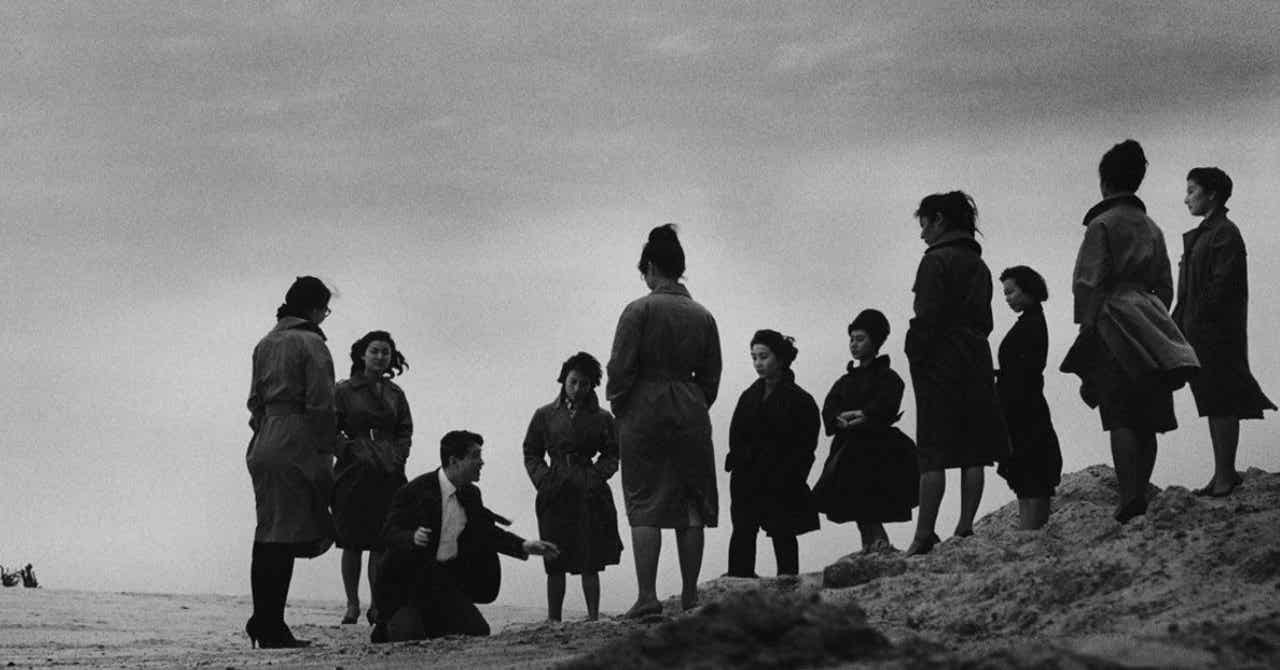
Ten Dark Women

10 dark womenKon Ichikawa’s classic black comedy in which a sleazy TV exec gets his comeuppance when his wife and nine mistresses team up to plot his death.

I Go Gaga, My Dear

I Go Gaga, My Dear bannerTV doc director Naoko Nobutomo follows her ageing parents as her mother’s Alzheimer’s-related dementia intensifies. Review.

Ride Your Wave

ride yourwave bannerThe latest feature from Masaaki Yuasa in which a surfer and fireman fall in love only for him to die in an accident at sea which convinces her to stay away from the water until…
The Japan Foundation Touring Film Programme 2020 runs at London’s ICA from 31st January to 16th February before touring to:

Full details for all the films are available on the official Touring Film Programme website. You can also keep up to date with all the year round events organised by Japan Foundation London via their main siteFacebook page, and Twitter account.

Born Bone Born (洗骨, Toshiyuki Teruya, 2018)

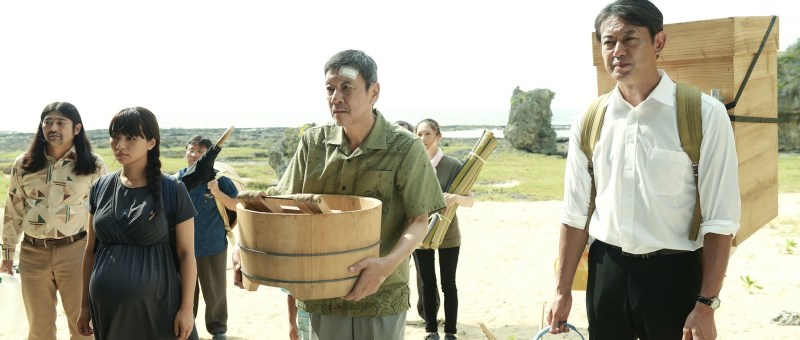
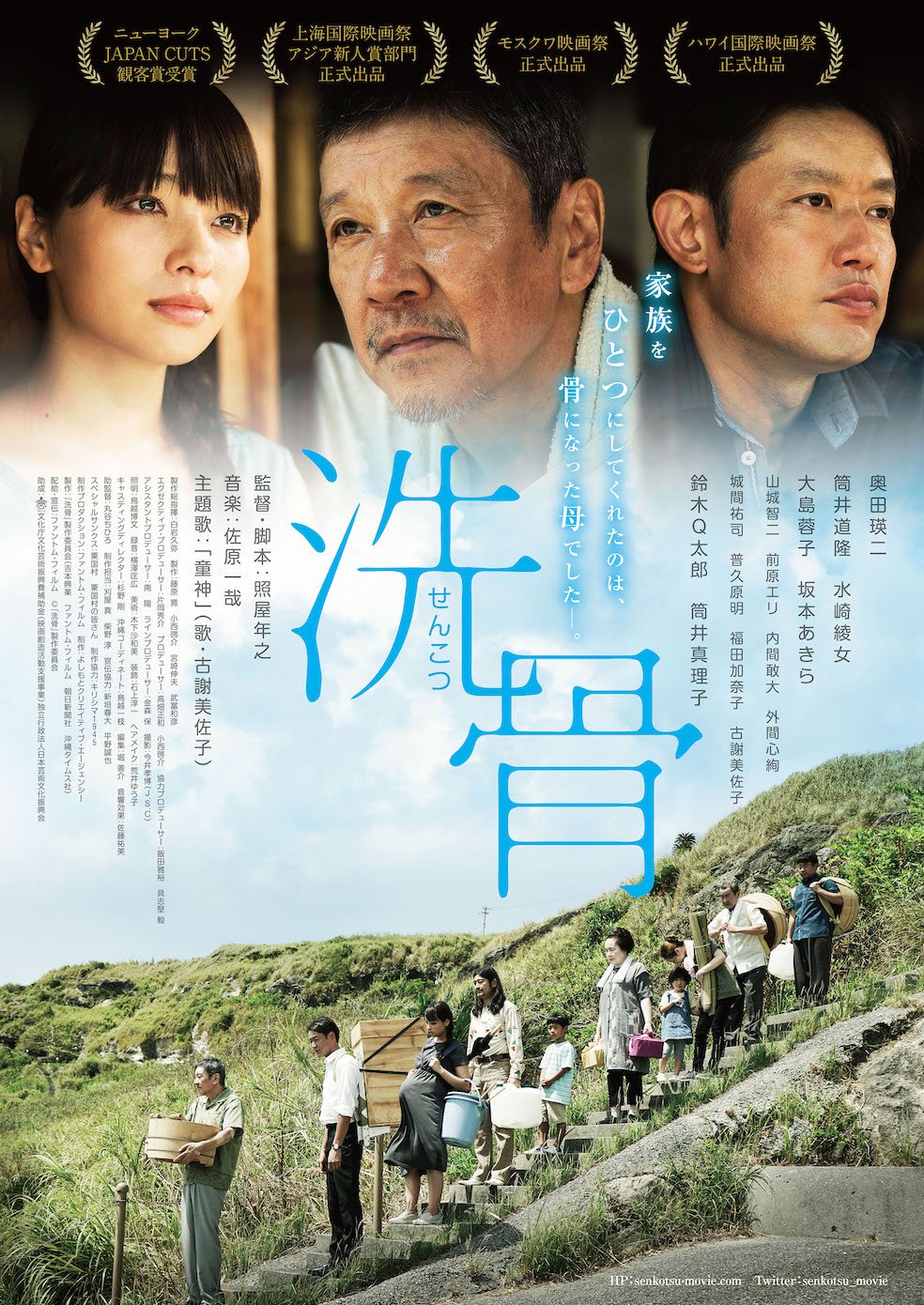
Bone Born Bone poster“Is this really Japan?!” asks the bemused boyfriend of the protagonist of Born Bone Born (洗骨, Senkotsu), only to be met with the reply “on paper, at least”. Comedian Toshiyuki Teruya, better known as Gori, returns to his native Okinawa for his second feature but to an island culture of which he was completely unaware. Aguni is one of the last on which the ancient ritual of “Senkotsu” or “bone washing” still takes place.

Beloved matriarch Emiko (Mariko Tsutsui) died four years ago. Now the time for her “senkotsu” is approaching. Daughter Yuko (Ayame Misaki) has come home, but with a secret. She is heavily pregnant and as yet unmarried, a fact she knows will scandalise the still conservative island community. Meanwhile, her her father Nobutsuna (Eiji Okuda) has retreated into drunken reverie, unable to accept his wife’s death or the many disappointments of his life. Yuko is waiting for her brother, Tsuyoshi (Michitaka Tsutsui), to arrive before explaining any further about the baby, but he even he is much less supportive than she hoped he might be and seems to be dealing with some troubles of his own which might explain why his wife and daughter have not accompanied him on this very difficult family occasion.

The island of Aguni practices open air burial, which is to say the bodies are enclosed in a wooden coffin and entombed in cave. Four years later the relatives return, retrieve the body and wash the bones before re-enclosing them in a smaller casket which will then be interred on the island’s “other world”. It is, of course, a difficult and frightening prospect to consider seeing one’s loved ones in such an altered state – so much so that many cannot bear to do it without getting roaring drunk which at least ameliorates the solemnity of the occasion. The human terror is in a sense the point as an exercise not only in memento mori but in acceptance of total loss and the finality of the physical.

Before all that, however, you still have to live and the Shinjos are having a fairly hard time of it. A small island somewhat trapped in the past, Aguni is intensely conservative and so the local old ladies can’t get their heads around Yuko’s unwed pregnancy. Yuko of course knew this would be the case but could hardly refuse to come and has braced herself for the worst of it. However, after the initial shock has worn off, she finds an unexpected ally in her stern aunt Nobuko (Yoko Ohshima) who assures her that if she finds it hard to raise the child on her own she can always come back to the island where she and Nobuko’s daughter will help if needed. Her father Nobutsuna, in boozy fog as he is, is also broadly supportive even if her brother shows little sign of coming round, engaging in unexpected small town conservatism as he accuses his little sister not only of shaming the family but of becoming a burden on it too.

In a motif that will be repeated, it’s the men who struggle to cope with loss while the women get on with life with stoicism and fortitude. Nobutsuna has remained unable to come to terms with Emiko’s death, drinking himself into oblivion while blaming himself for placing undue strain on her after their family business went bust. Nevertheless he is a good hearted man who wants the best for everyone even if his mild-mannered deference has Tsuyoshi sniping at the sidelines for his supposed fecklessness. He too blames his father for his mother’s death, but is also struggling with the elders’ expectation that he will return home to the island to take over as head of the family while there is evidently something else going on in his life which has left him irritable and judgemental.

If nothing else the Senkotsu ritual forces each of them to accept the fact of Emiko’s death, but also of her life and their own place within a great chain of humanity stretching both forward and back. In a sense, as Tsuyoshi puts it, it’s their own bones they’re washing in honour of the undying part of Emiko that exists in all of them and something of her kindly spirit certainly seems to be present on the beach that day as the family slowly repairs itself, emerging from their deep seated grief back to the friendly island solidarity as they resolve to treasure what they have in acknowledgement of what is to come.


Born Bone Born was screened as part of the 2019 Japan Foundation Touring Film Programme.

Original trailer (no subtitles)

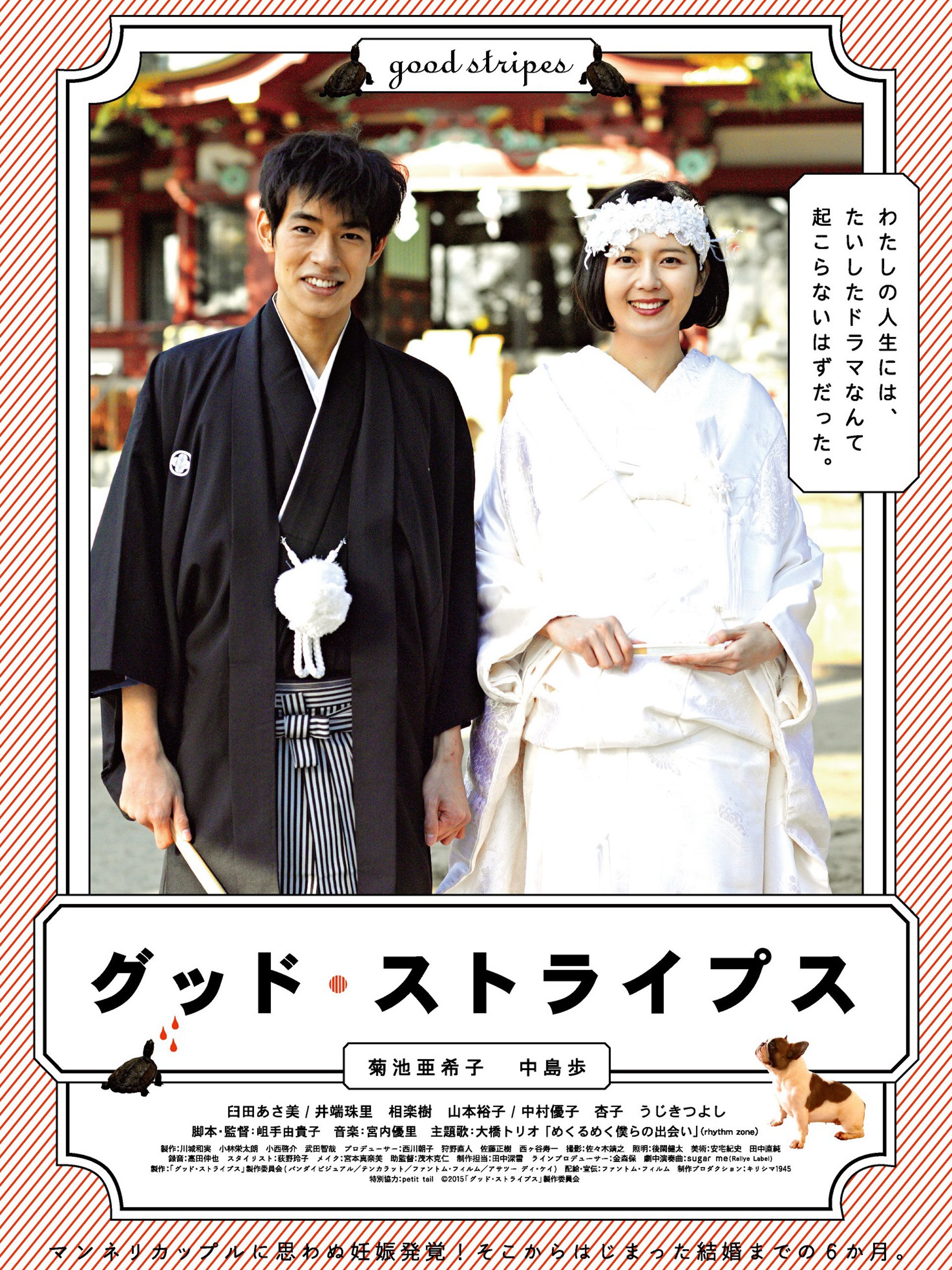
Good Stripes (グッド・ストライプス, Yukiko Sode, 2015)

Good stripes posterThe international media has become somewhat obsessed with the idea of Japan as a land of wilfully lonely singletons who’ve rejected the idea of home and family either in favour of the easier pleasures of one way virtual romance, or simply because a series of economic and social problems have made married life an unaffordable luxury. This is of course an exaggeration, but it is true enough that younger people have more choices which can, in some cases, lead to more worries and confusion. The young couple at the centre of Yukiko Sode’s Good Stripes (グッド・ストライプス) are in this sense a perfect encapsulation of their generation as they find themselves vacillating in the face of an unexpected crisis.

Midori (Akiko Kikuchi) and Masao (Ayumu Nakajima) have been together four years and truth be told the relationship seems to have run its course. Masao is about to jet off to India for three whole months yet Midori hardly seems bothered. While he’s away she stops responding to his messages, leaving him feeling even more isolated and alone so far away from home. Just when it seems the time has come to part, Midori realises she is pregnant, and as she’s already five months gone the most important decision has already been made for them. Wanting to do the “right” thing, Midori and Masao decide to marry and raise their baby in the conventional fashion yet they do so rather reluctantly and with a degree of mutual resentment.

The more we see of Midori and Masao, the more difficult it becomes to figure out how they got together in the first place. He is a typical middle class boy from a professional home (albeit a somewhat atypical one) and she a free spirit who grew up in the countryside. Midori doesn’t fit with Masao’s supercilious friends, one of whom is extremely rude and often makes a point of making fun of her while Masao eventually joins in rather than defend his girlfriend from what is really a little bit more than good natured banter. Reaching their late twenties they’re at the age where most of their friends are settling down, but they remain somewhat diffident, apparently not planning to stay together forever but not quite getting round to breaking up.

Things being the way they are, it’s all a little unplanned which is perhaps why Masao bristles when Midori finally moves into his well appointed apartment. He doesn’t have anywhere to put her things and is unwilling to shift any of his own, claiming putting up additional shelving would disrupt the balance of the room. Inviting someone else into your life must necessarily unbalance it, requiring at least a period of recalibration until a new equilibrium is reached, but Masao’s brief moment of resentment is perhaps understandable as he wrestles with being railroaded into a decision he isn’t sure he wanted to make.

Nevertheless, he tries to make the best of things by keeping quiet to keep the peace. Later when we meet Masao’s strangely “cute” doctor mother, she wonders if she made a mistake in the way that she chose to raise him. Having left Masao’s father when he was only five, she vowed to raise her son to be chivalrous – always carry the bags, be the first to apologise after a fight etc, but now wonders if she taught him to be superficially polite while inwardly seething with repressed anger and terrified of confrontation. Supportive to a point, Masao’s mother is also perhaps a little exasperated by the youngsters’ halfhearted attempt to embrace responsibility while quietly doubtful if they can really stay the course.

A meeting with Midori’s rowdy country family including her “difficult” spinster older sister and the equally free spirited younger one who makes fireworks for a living, proves eye opening for Masao as the only child of a sophisticated home but it’s an unexpected reunion with his own long absent father which eventually sets him on a course towards addressing his feelings of rootlessness and issues with intimacy. Resentful of his circumstances he begins having an affair with a pretty college friend only to come to hate himself during a torrid night in a hotel in which he suddenly realises what he’s getting up to is “all a bit animalistic”. Reconnecting with his father and realising that while they share certain similarities with each other they are all but strangers perhaps allows him to let go of his longstanding issues of abandonment and pursue his own desires which he’s fond of claiming to have abandoned altogether after discovering in childhood that nothing turned out the way he expected.

Midori and Masao may be two people railroaded into a future neither of them is quite sure they wanted, but in the end being forced to deal with a shared crisis does eventually bring them closer together if only in being forced to address their very separate issues both independently and as a couple. “Why take it out on me?” Midori snaps by accident, sensing Masao’s discomfort in dealing with some surprising revelations from his father, before thinking better of it and reverting to a more supportive position but her words do perhaps get through to her conflicted boyfriend even if he only really comes to accept his responsibility when forced to fish her out of a drainage ditch, reassured by her claims that there’s no need to worry because she’s the 100% boring sort of person that nothing ever really happens to. Giggling at the strangeness of it all, the pair vow their commitment to each other in the presence of the god of overcoming obstacles, together at last just as they prepare for their lives to be “unbalanced” all over again.


Good Stripes was screened as part of the 2019 Japan Foundation Touring Film Programme.

Original trailer (no subtitles)

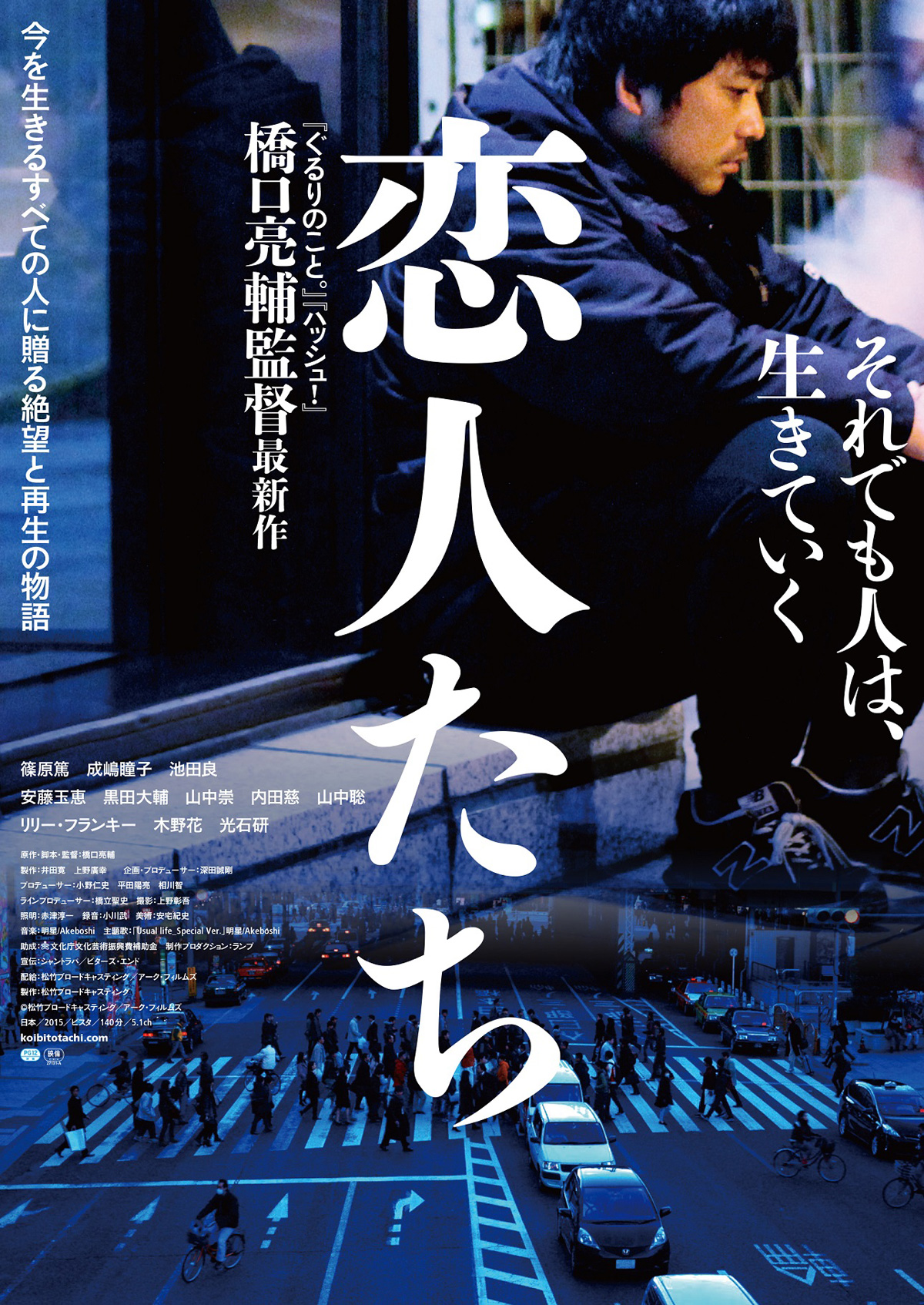
Three Stories of Love (恋人たち, Ryosuke Hashiguchi, 2015)

Three Stories of Love posterRyosuke Hashiguchi began his career with a collection of sometimes melancholy but ultimately hopeful tales of gay life in contemporary Japan. In 2008 he branched out with the finely tuned emotional drama All Around Us which followed an ordinary couple’s attempt to come to terms with the loss of a child. Three Stories of Love (恋人たち, Koibitotachi) finds him in much the same territory as he takes three very different yet equally burdened romantics and sets them on a path towards a kind of acceptance while suffering inside a system where everyone seems to be intent on exploiting other people’s unhappiness.

The first of our heroes, Atsushi (Atsushi Shinohara), is a bridge inspector whose wife was murdered in a random street attack three years previously. Ever since then he’s suffered with depression and found it difficult to hold down a job or a life and has become obsessed with getting personal revenge on the killer who pleaded the insanity defence and was committed to psychiatric care rather than to prison. Meanwhile, across town, listless housewife Toko (Toko Narushima) is trapped in a loveless marriage to a domineering husband and living with her snooty mother-in-law. Toko’s only outlet is compulsively rewatching a shaky video of the time she and her friends witnessed Princess Masako briefly exit a building. The third of our heroes, Shinomiya (Ryo Ikeda), is a self involved lawyer with a longstanding crush on his straight best friend from college who has since married and had a young son.

The three strands are only loosely interconnected, occurring as they do in the same city at the same time, though they do each share a sense of defeat and impossibility as each of our heroes struggles either to escape from or come to terms with their difficult circumstances. Atsushi’s case is perhaps the most extreme as he deals not only with his grief and anger but with the persistent stigma of being involved with violent crime. Visited by his bubbly sister-in-law he idly remembers to ask after the man she was about to marry last time they met only to be told that he abruptly dumped her after her sister’s death and not only that, all her friends abandoned her too. Getting revenge has become Atsushi’s only reason for living – he stopped paying his health insurance to get money together for fancy lawyers like Shinomiya who convinced him he could lodge a civil case but were only ever stringing him along to fleece him of money he never really had.

Shinomiya is, in a sense, our villain. He listens dispassionately to his wealthy clients – including one woman seeking a divorce (Chika Uchida) because her husband forgot to tell her he was burakumin until after they were married, but privately mocks them and is so unpleasant to his colleagues that someone eventually pushes him down a flight of stairs, breaking his leg. Intensely self-involved, he cares little for other people’s feelings save for those of his forlorn love Satoshi (So Yamanaka). Satoshi’s wife Etsuko, originally friendly and understanding, eventually takes against Shinomiya either because she doesn’t like the way he fiddled with her son’s ears or resents the two men cooing over the child and accidentally making her feel like an unwelcome outsider. Introducing his much younger boyfriend only seems to make matters worse, though the relationship does seem to have its problematic dimensions even if not in the way Etsuko decides to interpret them as Shinomiya takes pains to run down his partner in public and berate him at home. It’s difficult to resist the interpretation that Shinomiya prefers younger lovers because he can boss them around and, in truth, he doesn’t even seem very attached to this one, but he’s about to get a very rude awakening when it comes to learning that he’s not as permanent a part of everyone else’s lives as he seems to think.

Atsushi is fleeced by the Shinomiyas of the world and his heartless health insurers, but he’s wily enough to spot the obvious scam in the lovelorn office boy’s sudden enthusiasm for magical beautifying water which turns out to be part of a bar lady’s (Tamae Ando) nefarious scheme to resell the tapped variety with some of her own glamour shots attached to the front. Toko is wily enough to see it too, though she eventually succumbs when would-be-chicken-farmer Fujita (Ken Mitsuishi), whom she met at work during a difficult moment with her boss, delivers her some on spec. Lonely and insecure, Toko appreciates the unexpected interest but Fujita is not the white knight she first assumes him to be and is eventually exposed as yet another scam artist gunning for the little money she might have been able to hide away in her rabidly penny pinching home.

Shinomiya might feel himself proud to be among the fleecers rather than the fleeced, but he soon gets a comeuppance in realising he has wilfully pulled the wool over his own eyes, blinded in a sense by love. Toko, meanwhile, has learned to accept the latent feudalism of the modern society in her obsession with royalty though a brief attempt to transcend her feelings of innate inferiority seems destined to end in failure if perhaps engineering a mild improvement in her familial circumstances. Atsushi alone, a man whose job it is to assess the foundations, begins to find a degree of equilibrium thanks largely to nothing more than a good friend willing to listen and share his own suffering. Exploitation of others’ misfortunes and a series of social prejudices conspire against our three lovers but perhaps there is something to be said for learning to find the blue sky from whichever vantage point you happen to be occupying no matter how small and distant it may be.


Three Stories of Love was screened as part of the 2019 Japan Foundation Touring Film Programme.

Original trailer (no subtitles)

Tonight, at the Movies (今夜、ロマンス劇場で, Hideki Takeuchi, 2018)

Tonight, at the Movies posterThe romance of the silver screen is one that never fades. Cinema has long been in love with itself, wilfully trapped inside the nostalgia of its own origins and youthful glory days. Nevertheless, we love it too and it’s a rare film fan who can resist the allure of the golden age backlot. With Tonight, at the Movies (今夜、ロマンス劇場で, Konya, Romansu Gekijo de, AKA Color Me True) Hideki Takeuchi becomes the latest in a long line of directors including Koki Mitani and Yoji Yamada to pay homage to world of classic Japanese cinema only this time he opts for a double rainbow as his eternal dreamer hero laments the loss of ‘30s glamour in the declining movie world of 1960 while his older self looks back on the bygone pleasures of his youth.

In 1960, Kenji (Kentaro Sakaguchi) is an assistant director at Kyoei film studios. Well, AD is what it says on his payslip, but Kenji is a mild mannered sort who mostly ends up doing odd jobs like ferrying props around and painting backdrops, mostly because he’s too much of a soft touch to push for anything else. The shy and beautiful daughter of the studio chief, Toko Naruse (Tsubasa Honda) – note the name, has fallen for him, but Kenji only has eyes for the silver screen. He spends his evenings at the local rep cinema “Romance Theatre” where he watches the daily programme and then bribes the owner (Akira Emoto) to make use of the projection booth after hours to watch his favourite forgotten classic, “The Tomboy Princess and the Jolly Beasts”. After a freak lightning strike and power outage, Kenji is shocked to discover that Miyuki (Haruka Ayase), the Tomboy Princess herself, has escaped from the silver screen and ventured into the Technicolor world.

After opening within the world of the film within the film, Takeuchi hops us forward to the contemporary era of cellphones and an ageing society as a kindly nurse laments that no one ever seems to come and see her favourite patient, Mr. Makino (Go Kato), except his granddaughter who everyone agrees is unnecessarily cold towards him. Makino is something of a key name in Japanese movie history having belonged to Shozo Makino who is often regarded as the father of Japanese cinema, and to his son Masahiro who was best known for his jidaigeki but also for his love of song and dance as seen in such cheerful hits as Singing Lovebirds which seems to have in part inspired the brief musical number in The Tomboy Princess sung by her Jolly Beasts in true ‘30s style. As we assume, Mr. Makino is Kenji 50 years later though we quickly realise that he was not able to live up to the promise of his name and never became the top film director of his dreams.

This is (partly) because we meet Kenji at what is really the beginning of an end. By 1960, the golden age was drawing to a close and studios were beginning to feel the heat from the growing popularity of television. In 10 years time, Kenji’s studio will no longer exist and the industry will have undergone a series of seismic shifts that will forever change the cinematic landscape. Yet even now Kenji is looking back rather than forwards – he worships the world of twenty years previously with its cheerful if nonsensical musical adventures and most particularly that of the Tomboy Princess who dares to rebel against her destiny by leaving her life of comfort behind to seek adventure in a foreign land, ours.

As the voice over from the melancholy rep cinema manager reminds us, film is fleeting but even forgotten films have the magical power to bring colour to someone’s heart. Both Kenji and the cinema manager have a deep seated reverence for movie making and feel almost sorry for the myriad films lying dormant in rusty cans waiting for someone to find them. The heroine of just such a film, Miyuki in turn is a lonely cinema ghost whose era has long since passed.

In Kenji she has finally found an adoring audience though the pair remain separated by an invisible screen even as their fated romance proceeds along the expected lines. Taken as metaphor, Kenji’s all encompassing obsession with a character from an old movie is not especially healthy and later leads him to reject the possibility of a full and conventional romance with a woman who loves him as well as give up on his dreams of movie making. He has, in a sense, decided to marry “cinema” with all the questionable aspects of that decision. In this case, however, “cinema” has taken real physical form even if that form is not available to him physically. Kenji and Miyuki remain on two sides of an invisible screen, but it is clear that the love flows both ways and, perhaps crucially, causes them both pain in their inability to exist fully within the same physical space. 

Filled with a wealth of references to cinema classics from Japan and beyond, Tonight, at the Movies is a beautiful fairytale romance well worthy of its cinematic pedigree. Cinema is a theoretical paradox where permanence and impermanence meet thanks to the magic of the movies. Nostalgia may be a trap, but it’s a beautiful one to fall into.


Tonight, at the Movies was screened as part of the 2019 Japan Foundation Touring Film Programme.

Original trailer (no subtitles)