Tokyo Fist (東京フィスト, Shinya Tsukamoto, 1995)

tokyo-fist_still_7Following on from their excellent remastered Tetsuo set and the more recent Kotoko, Third Window Films have again brought us another classic film from the back catalogue of one of Japan’s most underrated auteurs – Shinya Tsukamoto.

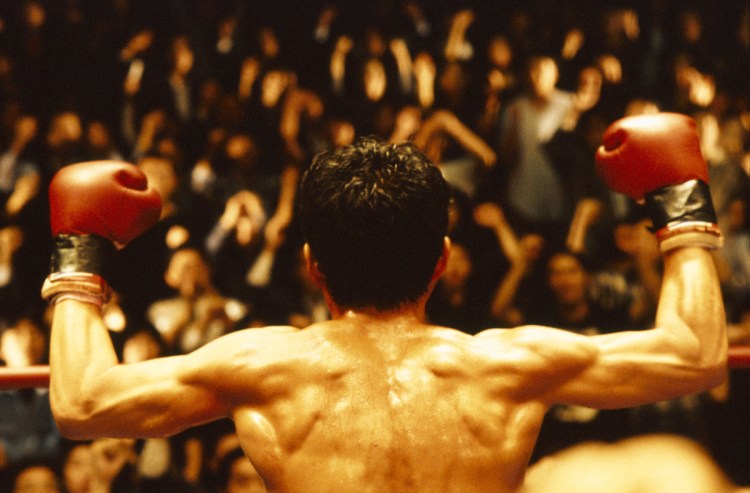
Tsuda (played by Shinya Tsukamoto himself) is a hard working insurance salesman in mid ‘90s Tokyo. He lives with a beautiful fiancée in a pretty nice flat and everything seems to be going pretty well for him except that he’s been so unbearably tired lately. Then, one fateful day a colleague asks him to deliver some money to a boxing club (which sounds kind of dodgy in itself) where he’s spotted by an old acquaintance, Kojima (played by Shinya Tsukamoto’s boxer brother Koji). Though it’s clear Tsuda doesn’t wish to resume a friendship with Kojima, somehow he still manages to worm his way into his life. This unwanted intrusion from the past begins to deeply unsettle the civilised life Tsuda and Hizaru had been living up to this point and sets them on a path of atavistic disintegration.

When you look at Tsuda at the beginning of the movie, it’s easy to think he’s ‘happy’ because the life he seems to be living is ‘normal’. He works hard, he lives with a woman he intends to marry and they seem settled and well matched. However, if you look more closely, you can see the cracks are all there even before Kojima turns up. His ‘tiredness’ is perhaps a symptom of the dissatisfaction he might not even realise he’s feeling with his boring, ordinary city life. When Hizaru, his girlfriend, asks him sensitively about his tiredness and suggests maybe he’s overworking and that she wouldn’t mind continuing to work even after they get married Tsuda’s reaction is quite telling. He doesn’t say anything particularly, he doesn’t argue, but it’s clear that he resents the suggestion and is clearly annoyed by it. This, and her subsequent comments to Kojima regarding Tsuda’s physique further undermine his masculinity and you can see that even before the catalyst of Kojima’s arrival, Tsuda’s mental state is quite fraught and his rage is already simmering quietly beneath thin layer of civility that is city life.

When Kojima finally does arrive, he does so like a pathogen infecting Tsuda first at the boxing club. Tsuda brings him home (inadvertently) to his girlfriend who is then also infected with a new strain of individualism. When Tsuda visits Kojima’s apartment to confront him about making a pass at Hizaru, what he finds is a lithe, glistening, insect-like physical force. His movements are uncanny, seemingly too fast for a human yet slightly jerky and lacking in grace. Despite the fact that everyone at the gym thinks Kojima is a terrible boxer (even when he actually wins a fight everyone seems bored) he possesses  the physical strength to knock Tsuda not only across the room but through a wall. The exaggerated, manga-like violence only further intensifies Kojima’s total dominance over Tsuda. Hizaru looks on with a curious expression which seems part way between wonder and disgust at Kojima’s increasingly bug-like appearance.

As a couple, Tsuda and Hizaru seem to have a fondness for watching old, subtitled European movies of an evening – Carol Reed’s The Third Man and Fritz Lang’s Metropolis. Both films, of course, that have something to say about ‘the city’. In The Third Man, Harry Lime’s crimes are only possible because of the unique situation of post-war Vienna. In Metropolis, famously, the city is an organism worked by an underclass of slave workers who are little more than cogs in the machine. The city assumes part of your own personality, strips you of your individuality and replaces it with a job title. It numbs you to the finer emotions and the only way left to re-assert your existence is to open yourself up to pain. In Tokyo Fist, the city is of course Tokyo, but really it could be any city any time. Living in such a codified way etches away at your humanity until barely a husk remains as you live out the day to day demands a city makes of its people. By the end of the film, the three central characters have been through an extended battle with this ‘city tax’ but whether the result is a death of the soul or a recovery is perhaps a matter for debate.

Tokyo Fist certainly a very rich film which repays repeat viewings and is open to a great number of interpretations. Like his earlier Tetsuo: The Iron Man, the film often works on a purely sensory level and needs to be experienced rather than considered but that isn’t to say it’s without plot or action. The fight scenes are intense and frenetic, captured in Tsukamoto’s trademark style, yet the boxing scenes do also have a very authentic ring to them. Tokyo Fist is a masterpiece of modern Japanese cinema that has long been underserved by sub quality releases. This remastered HD presentation from Third Window Films, supervised by Tsukamoto himself, finally restores the film to its rightful position with a truly outstanding blu-ray release. Tokyo Fist is a hugely intriguing and important film which richly deserves a place in any collection.


Available now on blu-ray in the UK from Third Window Films!

More Tsukamoto reviews:

First published on UK Anime Network in November 2013.

Obon Brothers (お盆の弟, Akira Osaki, 2015)

Obon BrothersReview of quirky comedy Obon Brothers (お盆の弟 Obon no Ototo) from this year’s Raindance up at UK Anime Network. I was also lucky enough to interview the director, Akira Osaki, while he was at Raindance to introduce the film which you can also read over at UK Anime Network.


Sometimes you think everything is going to be alright, but then several calamities arrive all at once. Down on his luck film director and stay at home dad Takashi has only been able to get one film made so far and it doesn’t look good for another any time soon. Right now he’s spending sometime apart from his wife and daughter as his elder brother Wataru is ill with colon cancer and as his brother never married, both their parents are dead and they have no other family Takashi has gone to look after him. However, Wataru is anything but grateful and proceeds to mope about the house repeatedly asking when Takashi plans to go home.

When he finally does go home, Takashi’s wife realises she liked it better when he wasn’t there and asks for a divorce. With nowhere else to go except back to Wataru’s, a confused and heartbroken Takashi goes home to Gunma where he reconnects with his screenwriting partner who’s finally met a girl through internet dating. Persuaded to come on a double date, Takashi strikes up a friendship with Ryoko despite still harbouring hopes for a reconciliation with his wife. No job, no home, no wife – what does the future hold for a mild mannered man like Takashi?

Like last year’s Raindance highlight And the Mudship sails away, Obon Brothers stars Kiyohiko Shibukawa though this “Takashi” is a little more sympathetic than the completely apathetic character from Watanabe’s film. With a sort of gentleness of spirit, Takashi is the sort of person who enjoys taking care of others like his ailing brother and cute little daughter and is just as happy keeping house as anything else. For his wife, his passivity becomes a major issue as she finds herself taking on a more independent role and comes to feel she needs someone with more drive at her side rather than the meek Takashi who’s content just muddling through.

Indeed, just muddling through ends up becoming an accidental theme of the film. Every morning, Takashi stops at the local shrine, throws a coin in the donation box and prays for everything to work out…and then goes home and waits for things to happen. However, things don’t just happen no matter how much you want and pray for them – at the end of the day you have to put the effort in which goes for all things in life from marriages to friendships and careers. If anybody gets anything at all out of Takashi’s religious practices, it’s ironically the older brother Wataru who thinks all this religious stuff is hokum – even going so far as to urinate into a sacred pond!

Also like Watanabe’s And the Mudship Sails Away, Obon Brothers is shot in black and white with a preference for long takes and static camera. Consequently it has an innately sophisticated indie comedy feeling which, coupled with its naturalistic tone, bring a kind of warmth and familiarity that it’s hard to resist. Though the film touches on some heavy themes – cancer, the breakdown of a marriage, it treats them all with a degree of matter of factness that never lets them overshadow the main narrative. After all, these things happen and life carries on while they do.

A loving tribute to the prefecture of Gunma from which many of the cast and crew originate including the director Akira Osaki, scriptwriter Shin Adachi and leading actor Kiyohiko Shibukawa, Obon Brothers has more than a little autobiographical content though it doesn’t reflect the actual circumstances of any of the creative team’s lives. It’s a gentle comedy, though one with shades of darkness creeping in around the edges, and moves at an equally gentle pace which gives you ample time to see into these characters and their lives. Osaki’s camera is unjudgemental, it gives equal sympathy and understanding to everyone and even the eventual end of Takashi’s marriage is accomplished with the utmost amicability. Whether or not Takashi has actually changed very much by the end of the film or has just gained a little more knowledge about who he is as a person, Obon Brothers gives you the feeling that it’s alright to start all over again – even if you’re just muddling though!


Obon Brothers is getting a UK release from Third Window Films next year(?) – highly recommended, especially if you like gentle, indie comedies!


Love & Peace (ラブ&ピース, Sion Sono, 2015)

UUqPRiT

Another day another Sion Sono – review of Love & Peace from the London Film Festival up at UK Anime Network. Quite liked this one, shame it’s not out in time for Christmas.


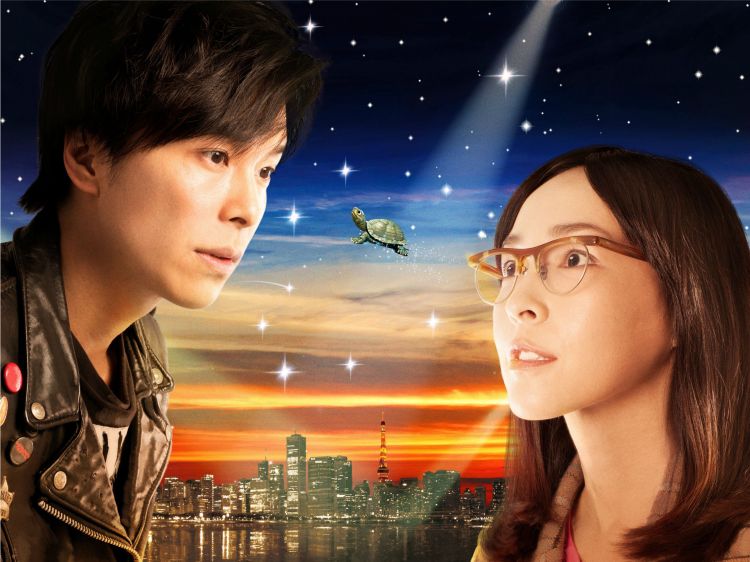
Last time we met Sion Sono it was for a street style rap musical about gang warfare. Before that we’ve mostly been admiring him for his epic and irreverent tale of panty shot perverts and bizarre religion Love Exposure, bloody serial killer true crime thriller Cold Fish or poetic exploration of a woman looking for love in all the wrong places in Guilty of Romance, not to mention a tale of teenage rage and post Earthquake anxiety in Himizu or state of the nation address in Land of Hope. Recently prolific and varied enough to give even Takashi Miike a run for his money, it should come as no surprise that Sono’s latest effort is, essentially, a family film about a man’s love for his pet turtle.

Ryoichi Suzuki is a mild mannered office worker with dreams of becoming a rock star. Belittled by his colleagues, Ryoichi has no friends – that is until he falls hard for a tiny turtle sold by a strange man on a rooftop. Hatching plans together for Ryoichi’s rise to superstardom the pair become inseparable. However, after another round of humiliation at work Ryoichi flushes “Pikadon” down the toilet! Full of remorse, Ryoichi pines for his lost friend meanwhile, Pikadon arrives at the lair of a mysterious sewer dweller who rescues broken and discarded creatures. When Pikadon is given a “wish” pill by mistake, Ryoichi’s life soon begins to change!

In case it needs saying, Love & Peace is in no way a “serious” film – much as that may sound like a pejorative comment, all that means is that it’s delightfully absurd and heaps of fun and where it harks back to some of Sono’s key concerns it does so in a light hearted, even mocking manner. The plot maybe conventional in a lot of ways – down trodden loser suddenly makes something of himself with magical help but ends up becoming arrogant and forgetting his true self before being redeemed by a massive fall from grace but as usual Sono has managed to bring something new to even this comparatively tired tale.

Largely, that’s thanks to his bizarre side story of the land of misfit toys being cared for by a mysterious yet kindly old man who lives in a tiny alcove in one of Tokyo’s sewer complexes. Cheerfully harking back to some of those classic ‘80s kids movies, the strange collection of broken robots, damaged cat toys and lovelorn dolls do their best to tug at the heart strings with their stories of loss and abandonment while the mysterious old man keeps them going with tales of hope and magic pills which grant the power of speech or wishes.

However, as Ryoichi’s dreams grow bigger so does Pikadon himself and its not long before the cute little turtle’s devotion to his master becomes a dangerous threat to the entire city. Ryoichi chose the name “Pikadon” seemingly at random and without realising that it’s become a byword for the atomic bomb. Thus Ryoichi’s eventual ballad of love and regret for his lost turtle buddy is misunderstood as a lament for modern Japan and a pledge to “never forget” the wartime nuclear attacks. Of course, this “subversive political rock song” becomes a giant hit catapulting Ryoichi on the road to superstardom. However, there is more heartbreak for Pikadon to come as he’s continually betrayed by the ever more ambitious Ryoichi who’s only too quick to sell out his beloved friend to get ahead with cruel and potentially tragic consequences.

Of course, the one thing that needs mentioning is the amazing music in the film including the title song which is tailor made for waving a lighter in the air and is sure to become your latest ear worm. Ryoichi only writes a few songs but Sono also manages to throw in a musical self reference to a previous film that makes for a fun Easter Egg for his avid fans to find and the rest of the soundtrack is equally catchy too.

In short, Love & Peace is the Christmas themed punk rock kid’s movie you never knew you needed. Yes, it goes to some very dark places – the least of which is the accidental destruction of the city of Tokyo by the now colossal kaiju incarnation of Pikadon whose only wish is to make his best friend’s rockstar dreams come true, but it does so with heart. In true family film fashion, it addresses the themes of true friendship, the importance of being true to yourself and that the love of man and turtle can be a beautiful, if terrifying, thing. Strange, surreal and totally mad, Love & Peace is the ideal Christmas gift for all the family and Sono’s most enjoyably bizarre effort yet.


I wrote this review before I’d seen Tag which is also “enjoyably bizarre”, it has to be said. Love & Peace will be released in the UK in 2016 courtesy of Third Window Films.

Some other Reviews of Sion Sono movies written by me:

Tag (リアル鬼ごっこ, Sion Sono, 2015)

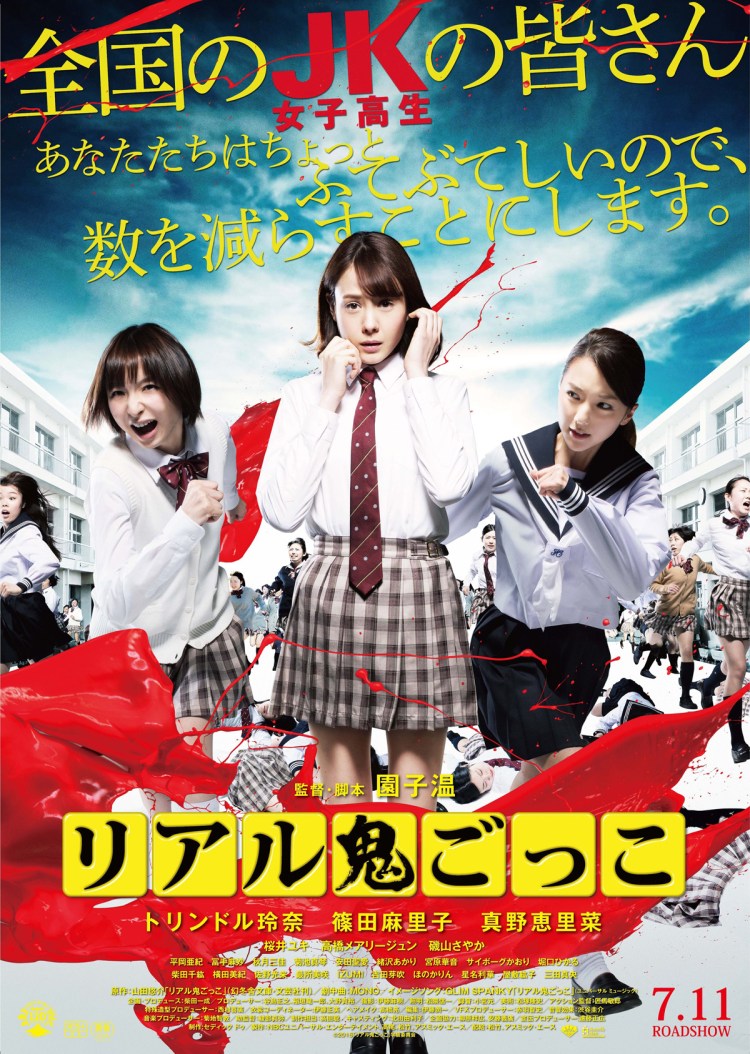
tag posterYou could say Sion Sono is back, though with six films released within a year it’s almost as if he just nipped out to make a cup of tea. At first look Tag (リアル鬼ごっこ, Riaru Onigokko) seems as if it might be towards the bottom of the pile – school girls running away from things for 90 minutes whilst contending with awkward gusts of wind, but this is Sion Sono after all and so there’s a whole world of craziness going on below the surface.

The action begins with a gaggle of school girls on a bus. Two of them start ribbing the girl on the opposite bank of seats, Mitsuko (Reina Triendl), because she’s always writing poetry. The pen gets knocked out of her hand and as she bends down to pick it up she notices a white feather stuck to the clip. Gazing at the improbable symbol, Mitsuko becomes the only survivor when a sudden gust of wind blows the top off the bus taking all of the other passengers’ heads with it. Mitsuko starts running, re-encountering the dreaded wind monster over and over again before stopping at a stream to wash the blood off her face and change into the cleaner set of clothes she finds abandoned there.

After this she finds herself ending up at an entirely different school where everyone seems to know her. Has she gone mad, had a psychotic break? If not then then she’s about to as an attempt to ditch class with some of the other girls results in yet another freak school girl apocalypse.

Running again, Mitsuko ends up at a police box where another woman seems to know her but insists her name’s Keiko (Mariko Shinoda). Oh, and it’s her wedding day today! That’s not even the last time that’s going to happen and it’s far from the weirdest thing that’s going to happen to Mitsuko today. As a friend of Mitsuko 2’s reminds us, “Life is surreal, don’t let it get to you”.

Answers come, after a fashion. Though Tag is nominally based on a novel by Yusuke Yamada (previously adapted into a long running film series), Sono apparently did not even read the book and has only taken its theme – everyone with the same surname being hunted down and exterminated, and repurposed it for his own ends. This time rather than a common surname, it’s an entire gender that is forced to live under constant threat as the plaything of a far off entity that is as invisible and ever present as the wind. It’s no accident that everyone we meet up until the half way point is female, and that the first (presumed) male we meet is wearing a giant pig’s head. Mitsuko and her cohorts have in fact been used as a literal toy by the men on the other side of the curtain. Their very DNA has been co-opted for the “entertainment” of the male world without their consent or even knowledge, and even if she had known, Mitsuko is powerless to resist.

The solution that is found is both very old and very profound. It’s far from an original ending to this kind of story though in these hands, and used in this way, it can, and has, caused offence. Tag wants to ask you about life, about death, about agency and misogyny – but it wants to ask you all those things whilst watching school girls get ripped apart by the same wind that keeps blowing their skirts up. Sono has his cake and eats it too. There will undoubtedly be those that feel that far from satirising mainstream attitudes to women, Sono has, in fact, indulged in the worst parts of them.

If all of that was sounding a little heavy, Tag runs (literally) at breakneck speed with barely any time for conscious thought between the first bizarre case of gore filled mass murder and the next. It’s also strangely beautiful with a hazy, dreamlike veneer full of repeated images and scenes of idyllic serenity. Is any of this real? Who could really say. The ultramodern, indie score also strikes a slightly hypnotic note lending to the feeling of freewheeling weightlessness.

In many ways, Tag has much more in common with early Sono hit Suicide Club thanks to a general thematic sensibility than to any of his more straightforward work since. That said, Tag never quite resolves itself in a wholly satisfying way and though its final moments are filled with a poetic sensitivity, there’s a certain barrier created by its ambiguity that feels unfinished rather than deliberate. Another predictably “not what it looks like” effort from Sono, Tag may just come to be remembered as his most considered effort of 2015.


First Published on UK Anime Network in November 2015.

Playing at the Leeds International Film Festival on 18th November 2015.

Other movies playing at Leeds include Assassination Classroom, Happy Hour, Our Little Sister and Love & Peace.

Can’t find a subtitled trailer for some reason but to be honest you’ll get the gist of it:

Assassination Classroom (映画 暗殺教室, Eiichiro Hasumi, 2015)

photo_4First Published on UK Anime Network in November 2015.


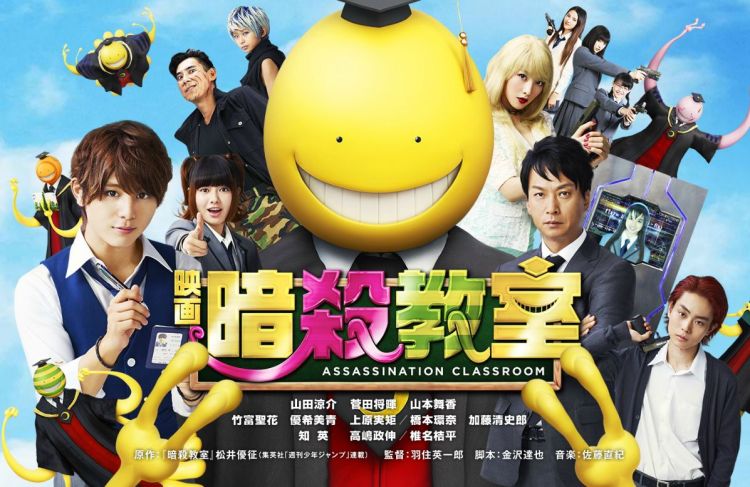
You might make the mistake of thinking that the E in class 3E just means it’s the 5th 3rd year class, or that it stands for “elite” and contains some of the top students in the school. You’d be wrong, “E” stands for “end” because these are the no hoper kids that everyone’s already written off as having no future. However, it’s precisely these kids that a mysterious extraterrestrial being insists on becoming the teacher of in return for not destroying the Earth (just yet). Nicknamed UT (unkillable teacher), the giant yellow octopus-like creature has already destroyed 30% of the moon just for kicks and has now set the challenge that if the boys and girls of class 3E fail to assassinate him before graduation he’ll destroy the Earth too.

The ironic thing is, UT is the best teacher they’ve ever had, but to pass the course (and save the world) they have to kill him. The high schoolers are also under the tutelage of a self defence forces officer for their military training and a sexy assassin who randomly ends up becoming their English teacher (and giving them one of the least appropriate English lessons ever recorded on film). Every morning they bow and then pull out their various kinds of firearms as UT takes the register whilst flitting about dodging bullets. Despite wanting to destroy the Earth, UT is 100% committed to training his students both in the arts of assassination and in the more regular subjects. Because of his super speed and ability to be in several places at once he has time for everybody and is quick to work out each of his charge’s specific weaknesses and help them work on those to become better people as well as ace students.

Still, the students are supposed to kill their teacher and there’s a little bit of sadness creeping in as they inevitably grow closer to UT and his quirky antics. Up ’til now everyone has given up on them and now they’re supposed to kill the one person who’s actually trying to help. Of course, even while this surreal situation is going on these are just regular high school kids undergoing regular high school stuff like wanting to sneak into the girls’ changing rooms or having a crush on someone who hasn’t even noticed you. Despite the impending end of the world, the kids of Class 3E are just enjoying their time trying to work out ever more complex ways of trying assassinate their seemingly invincible teacher.

UT himself is strangely adorable with his giant yellow smiley face style head and bizarre little laugh. He also changes color according to his mood and has a tendency to go off on tangents with one notable example which turns into a long form ‘80s style melodrama about abandoned single mothers before being politely shut down by the bored students. Assassination Classroom is undoubtedly bizarre, surreal and full of absurd humour but all the better for it. It’s just very silly but has an undeniably clever and very witty script that proves near impossible to resist.

To put it mildly, Assassination Classroom is just heaps of zany, crazy fun. It also manages to be genuinely heartfelt as we come to care for this rag-tag bunch of no hopers but also for UT himself as we start to hope the kids will somehow fail and succeed at the same time so we can save both the world and UT. The film drops us a few hints about UT’s backstory but stops short of offering a full explanation for the crazy goings on. Thankfully a sequel, Assassination Classroom: Graduation Day is already in production and even if it doesn’t offer any answers, Assassination Classroom is already one of the most enjoyably absurd offerings to come out of Japan this year.


Assassination Classroom receives its UK premiere at the Leeds International Film Festival on 15th November 2015.

Look out for a review of Tag which is also playing at the festival as it Happy Hour, and Our Little Sister.


Like Someone in Love (UK Anime Network Review)

Like_someone_in_love_quad_v5_HRFirst published on UK Anime Network in June 2013.


Like Someone In Love is only Iranian director Abbas Kiarostami’s second international venture after 2010’s Certified Copy but this time sees his familiar preoccupations with ambiguities and poetic imagery transported to modern day Tokyo. Although in this case all the characters are quite clearly drawn and presented somewhat unambiguously, the reasoning behind the decisions they make and the way they behave, however, remains oblique. The title implies someone is acting ‘like someone in love’ if not exactly ‘in love’ themselves but who is it, who or what are they (‘almost’?) in love with, and what exactly would that mean – these are all the gentle ambiguities that Kiarostami wishes us to think about in this perfectly excised cross section of modern life.

As the film opens we are placed statically looking onto a scene which appears to be some sort of bar, a woman’s voice can be heard speaking to someone – not us, this clearly isn’t a voice over, there is obviously someone else involved in this dialogue that we cannot hear. We search the screen for the owner of the voice and even though we can see that nobody else is speaking somehow the thought that the woman is off camera hasn’t quite occurred to us. Eventually we find a young woman has been talking on the phone, presumably to her boyfriend – ‘I’m not lying’ she says, though we know she is. The boyfriend suspects her and makes her go to the bathroom to count the number of tiles so he can come there later and compare to see if she’s telling the truth.

Shortly afterwards, an older man (Denden) starts talking to her and encourages her to break up with said jealous boyfriend ‘not just for business reasons’ but as fatherly advice. He wants her to visit ‘a very important man’, she doesn’t want to because she’s tired after cramming all night for an exam and anyway her grandmother is in town and she’d like to see her. The man makes it very clear he isn’t forcing her, but he leaves her no room to refuse and she goes anyway even though she doesn’t want to. He puts her in a taxi for an hour’s drive across the city – on the way she gets a message from her grandmother that she’ll be waiting outside the station until her train so Akiko (Rin Takanashi) asks the driver to pass the station twice just so she can catch a glimpse of her.

Fast asleep in the car she arrives at a rather nondescript little address behind a ramen shop where a retired sociology professor (now sometime translator), Watanabe (Tadashi Okuno), lives. As soon as they enter the phone rings and Akiko takes the opportunity to poke around – she finds some pictures of an older and a younger woman – a wife and daughter perhaps? Strangely they look a little like her, as does the woman trying to teach a parrot to speak in the famous print on one wall.  ‘I always thought the parrot was teaching the woman’ Akiko says and the professor laughs. Still tired she makes straight for the bedroom, undresses and gets into the bed. This wasn’t what the old man had in mind though – he’s cooked a full dinner and bought wine, soft music ‘Like Someone in Love’ is playing in the background. After trying to convince her to eat and failing the professor gives up and turns the light out to let her sleep.

The next morning he drives her to school only to witness an altercation with the jealous boyfriend, Noriaki (Ryo Kase) who’s been lurking in wait after not being able to get through on Akiko’s phone. It’s clear he’s angry, he grabs at her then sulks after she goes inside before trying to talk to the professor, mistakenly thinking he’s her grandfather. He of course keeps up the pretense simply by not (directly) correcting the mistake. It’s clear though that something is coming to head and the meeting of these three people is going to produce a fundamental change in one or all of their lives.

Like Someone in Love might be one of those films where the reaction to it says much more about the viewer than it does about the film. It’s so much more about what isn’t said, the things that one infers from brief snippets of possible backstory than it is about what is actually seen on the screen. We don’t know exactly why Akiko got into this line of work or why she does it or even how she really feels about it. It’s plain in the first scene that she doesn’t want to go, at least tonight, and that she’s refused to go before but when she arrives at Watabe’s house she’s anything but coy and seems every inch the seasoned pro ready to get down to business. She’s a cipher, the clearest thing you can say about her is that she’s defined by her own passivity. She says she won’t go and then bows to pressure and goes, she obviously wants to break up with her awful boyfriend but doesn’t, she wants to see her grandmother but obeys her pimp(?) instead. She seems to spend her entire life bowing to the whims of other people rather than making any sort of decision for herself.

The two men by contrast appear as virtual mirror images of each other. The elderly scholar Watanabe, contemplative and introspective and the violent, obsessively jealous high school dropout garage owning Noriaki. What is Watanabe’s interest in Akiko? Is this something he’s done often? it seems maybe not, perhaps this is a gift from his former student now Akiko’s ‘boss’. At any rate it seems he’s after some kind of romantic evening rather than a torrid few moments in bed with a girl young enough to be his granddaughter. He’s arranged things for her comfort – cooking her local dish, lighting candles, setting the dinner table etc just as someone in love might do. Perhaps he’s just lonely (though his phone is always ringing and he never answers it) and wants to relive fondly remembered memories of his wife. Noriaki by contrast seems much more territorial – he wants to own Akiko, he’s decided she’s useless on her own and needs his protection but he’s obviously terrified someone’s going to steal her out from under him. He’s also hugely over sensitive about the phone box card which looks like Akiko (because we know it is) maybe because he’s got a Madonna-whore conception of women to begin with.

The film ends as abruptly as it started which is inevitably going to be a problem for many viewers. This is not the end, but it is an end – perhaps the beginning of something new rather than the end of something old. An internal world is penetrated – like the intrusion of falling in love into an otherwise dull life, old securities prove inadequate and perhaps it’s harder to protect the things that are precious to you than you might hope (especially if you are old and your aggressor is not). In many ways we are like the old curtain twitcher whose sole entertainment is her window onto Watanabe’s doorstep – we can’t know what happened before our one and only window was opened, nor can we know what will happen once it’s closed but still we can’t help but wonder.


Available now in the UK from New Wave Films.

Asleep (白河夜船, Shingo Wakagi, 2015)

asleep posterBased on the third of three short stories in Banana Yoshimoto’s novel of the same name, Asleep (白河夜船, Shirakawayofune) is an apt name for this tale of grief and listlessness. Starring actress of the moment Sakura Ando, the film proves that little has changed since the release of the book in 1989 when it comes to young lives disrupted by a traumatic event. Slow and meandering, Asleep’s gentle pace may frustrate some but its melancholic poetry is sure to leave its mark.
Terako (Sakura Ando) is a young woman who sleeps a lot. Almost all the time, in fact. The kept woman of a married man whose wife, oddly enough, is in a coma following a traffic accident, Terako has been in a kind of limbo since her former roommate and good friend committed suicide by taking an overdose of sleeping pills. Prior to her death, Shiori had taken up an unusual occupation – she lies next to lonely strangers who just want to know that someone is watching over them while they sleep and will be there when they awake. This also meant that she rarely had the opportunity to sleep herself as her occupation demanded keeping a watchful eye over her charges and falling asleep on the job seemed like a lapse of professionalism.

Mr. Iwanaga, Terako’s boyfriend, is an enabler of the first order. He prefers that Terako not work so that she’s available for him whenever he feels the need to call meaning that she’s always at home, sleeping. She sleeps and sleeps but finds no relief from her exhaustion. Even her dates with Iwanaga feel “like the shadow of a dream”. The constant flashbacks and meandering timelines perfectly reflect someone trying to think through the distorted reality of fractured sleep where the boundaries between dream and reality have become impossibly blurred.

There’s an odd sort of triumvirate of sleeping women here – Terako herself who does little but sleep but is still constantly exhausted, Shiori who denied herself sleep until ultimately deciding to take enough sleeping pills to go to sleep forever and Iwanaga’s wife who’s trapped in coma. At one point, in a conversation which either happened some time ago or not at all, Shiori remarks that Iwanaga has Terako “on pause” because he’s afraid to move on from his wife (the fact of his having an affair while his wife is lying in a hospital bed even has Terako labelling him a cold, unfeeling man but then she says she likes that kind of thing anyway). It’s as if she’s waiting for someone to hit the spacebar to wake her up again, though Iwanaga is “on pause” too – torn between the choice of abandoning his wife who will likely never wake up and being labeled heartless, or sacrificing the rest of his life in devotion to a memory.

Help does come, in a way, through the intervention of a either a dream or a kind of cosmic transference – an impossible conversation between two women equally in need of it. Shingo Wakagi’s adaptation is more interested in psychology and existential questioning than it is in hard realities or concrete solutions. A vignette of a moment in a young woman’s life, Asleep gives us little in the way of backstory or explanatory epiphanies, and finally ends in the characteristically ambiguous way many Japanese novellas often do though there is a hint at a possible shift in Terako’s life offered by the final images. A poetic meditation on dream, memory, grief and loneliness, Asleep is beautifully framed, if appropriately distant, look at modern life in limbo.


Reviewed at Raindance 2015

First Published on UK Anime Network in 2015.

Makeup Room (メイクルーム, Kei Morikawa, 2015)

SBLEkl5First Published on UK Anime Network


It’s a little known fact that everyone seems to know, but the Japanese pornography industry is one of the most lucrative in the world producing countless hours of “AV” or “adult video” movies every year. No one expects the world of erotic filmmaking to be glamorous, but rest assured Makeup Room is not interested in exploring the dark side of the industry either. For the characters involved in this rather witty backstage drama it’s just another working day filled with personal concerns and petty office disputes.

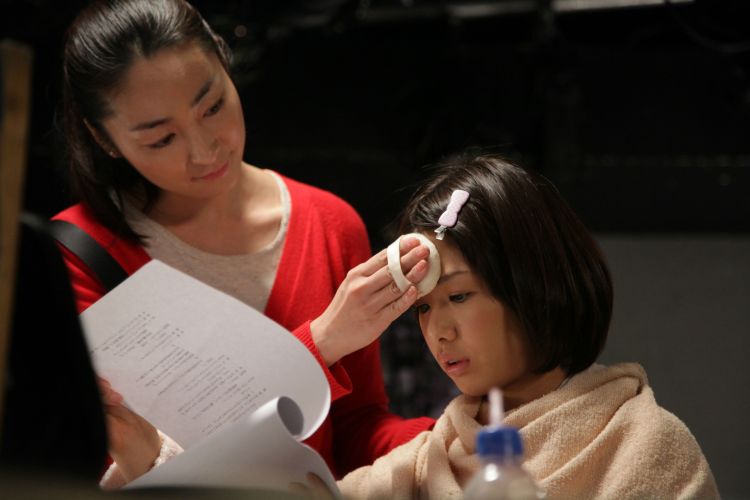
In fact, Makeup Room began as a stage play and occupies just the one set – the green room where the various starlets hang out before the performance. The star of the show in here is the veteran makeup artist, Kyoko, who is responsible both for creating whichever look the director has asked for from innocent school girl to sexy cop or dominatrix and for providing guidance and moral support as she chats away to the various divas and ingenues who occupy her chair. Porno shoots happen very fast, the team only have a brief amount of time in this location before the next crew arrive to shoot another porno so everything needs to go to plan. Today, nothing goes to plan. The lead actress is late, another actress has an undisclosed tattoo meaning she’ll have to switch roles requiring some hasty script edits, and the new girl who’s apparently an inexperienced nymphomaniac is having a few last minute jitters. The director’s stressed, the veteran actress is getting antsy and they’re all just lucky Kyoko is around to keep everything running smoothly!

Makeup Room starts with a rather worrying disclaimer to the effect that this was an extremely low budget shoot and that given the materials available, there is a degree of stuttering in the video which cannot be fixed. In actuality it isn’t that much of a problem but you’d have to admit Makeup Room is never a very pretty looking film. Perhaps appropriately it has a very cheap video look and a simplistic directing style using mostly static shots camera from different angles of its one set location.

However, the rather basic approach does allow the script and performances to shine. Undoubtedly witty, the dialogue both rings true and offers a fair amount of humour at the expense of the diverse cast and crew many of whom are played by real life AV actresses making their “debuts” in a purely narrative film. This is not a tale of fallen women forced into the sex industry through a series of traumatic events, each of the women is fine with their career choice and likes what they do. Though one character reveals that many of the people in her life don’t know what she does and not all of those who do approve, including her boyfriend who’s only just found out and not taken it well, mostly the women talk about the practicalities of their work. Whether that’s having a tattoo that’s much larger than your manager tells people it is, or having your nails done right before finding out you’re down for a lesbian scene meaning they’ll all have to be cut off, or chatting about the way your work is going to change as you get older, the kind of workplace problems that occur perhaps aren’t altogether different than those women experience in all industries.

Director Kei Morikawa has had a long career in the AV industry as well as in more mainstream fare and makes good use of his personal experience to create a film which at least feels very authentic as well as giving the impression of a group of friends getting together to send themselves up in classic style. Full of frank humour though very little explicit content, Makeup Room comes across as a warm and refreshingly straightforward look at the Japanese porn industry though its extreme low budget stylings are likely to put off viewers who prefer the glossier side of things.


Out now from Third Window Films

Fires on the Plain (野火, Shinya Tsukamoto, 2015)

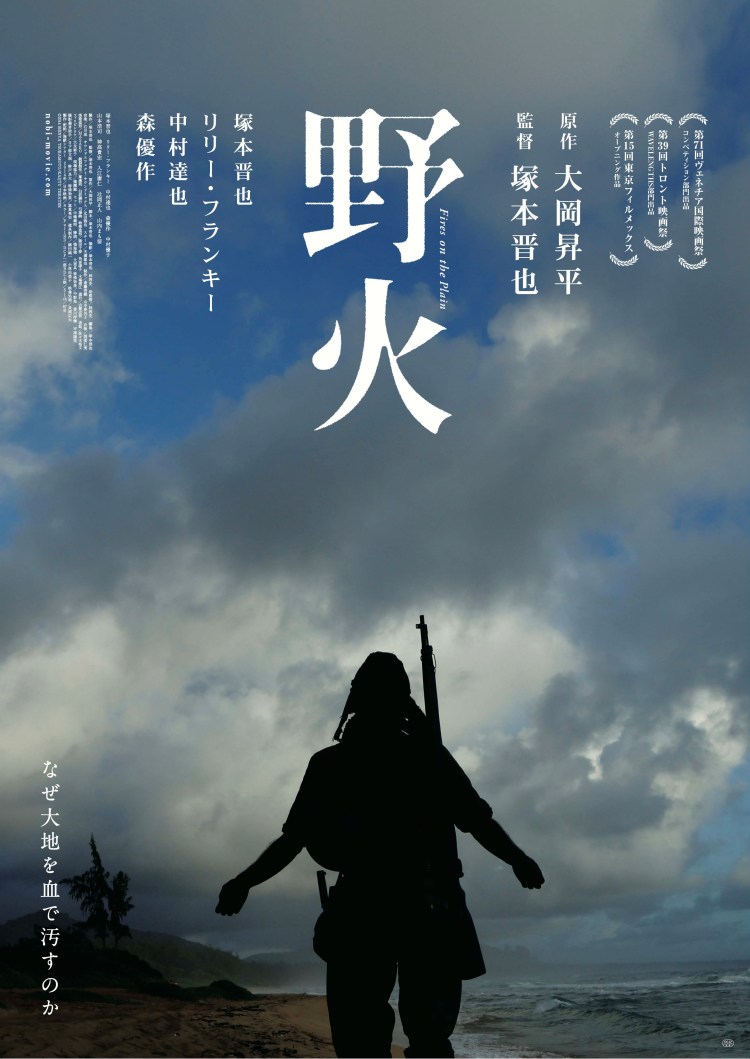
fires on the plain 2015 posterShinya Tsukamoto is back with another characteristically visceral look at the dark sides of human nature in his latest feature length effort, Fires on the Plain (野火, Nobi). Another take on the classic, autobiographically inspired novel of the same name by Shohei Ooka (previously adapted by Kon Ichikawa in 1959), Fires on the Plain is a disturbing, surreal examination of the effects of war both on and off the battlefield.
Late in the war when it’s almost lost though no one wants to admit it, Corporal Tamura (Shinya Tsukamoto) finds himself suffering with TB on the Philippine island of Leyte where supplies, and tethers, are running short. Shortly after being punched in the face by his commanding officer, he’s given five days’ worth of supplies and ordered to march to the field hospital for treatment as no one wants a sick man weighing down the unit. Only, when he finally arrives at the field hospital, they have their hands full (literally) with the battlefield wounded. Marching back to his unit again, Tamura is ordered back to the field hospital and told to use his grenade to ease the burden on his fellow soldiers if refused. So begins Tamura’s fevered, mostly solitary odyssey across the beautiful landscape of the Philippine jungle suddenly scarred with corpses, the starving and the mad.

Tsukamoto’s adaptation sticks closer to the original novel than Ichikawa’s 1959 version, though both eschew Ooka’s Christianity. Tamura is a man at odds with his fellow soldiers. Formerly a writer he’s “an intellectual” as one puts it, and a little on the old side for a corporal. Coughing and wheezing, he shuffles his way through just trying to survive. Unlike Ooka’s original novel in which the protagonist’s Catholicism makes suicide an unavailable option, it’s the memory of Tamura’s wife which stays his hand on the pin of his grenade. Tamura wants to go home, to escape this hellish island full of the walking dead, hostile locals and hidden clusters of enemy troops.

To get home, to survive, what will it cost? There was barely any food left to start with. The original five days’ worth of rations Tamura was given amounted to a handful of yams. On his second trip to the military hospital he was given nothing at all. There’s no wildlife, even if you manage to find some plant roots they’ll need cooking. Of course, there is one abundant source of food, except that it doesn’t bear thinking about. Tsukamoto’s version takes a less ambiguous approach to the idea of cannibalism than Ichikawa’s which removed Tamura’s moral dilemma by having his teeth fall out through malnutrition and rendering him unable to indulge in “monkey meat” even if he might have succumbed. Death feeds on death and there’s no humanity to be found here anymore where men prey on men like animals.

There’s no glory in dying like this. Half starved, half mad and baking to death in the heat of a foreign jungle abandoned by your country which cared so little for its men that it never thought to conserve them. When you make it home, if you make it home, you aren’t the same you that left. The things you had to do to get there stay with you for the rest of your life, and not just with you – with all of those around you too. Wars don’t end when treaties are signed, they survive in the eyes of the men who fought them.

A timely and a visceral look at the literal horror of war, Tsukamoto’s Fires on the Plain is a refreshingly frank, if stylised, examination of the battlefield. Limbs fly, heads explode, organs are exposed and brain fragments leak out of ruined corpses. At any other time, Leyte would be a paradise of lush vegetation, colourful flowers and beautiful blue skies but it’s corrupted now by the fruits of human cruelty. This is what it means to go to war. There’s nothing noble in this – just death, decay and eternal grief. Though the film often suffers from its low budget and some may be put off by the stark, hyperreal cinematography, Fires on the Plain is another typically troubling effort from the master of discomfort and comes as a warning bell to those who still think it is sweet and fitting to die for one’s country.


Reviewed at Raindance 2015.

Original trailer (English subtitles)

First published by UK Anime Network.

Happy Hour ハッピーアワー ( Ryusuke Hamaguchi, 2015)

get.doThere are a number of films which centre around an unexpected disappearance. The negative space of the missing person both in their physical and emotional absence brings with it its own mini black hole, sucking those left behind into a pit of confusion and despair which forces them to consider their own lives in more detail than they’d ordinarily be comfortable with. For the four women at the centre of Happy Hour, a five and a bit hour long film from Ryusuke Hamaguchi (The Depths, Touching the Skin of Eeriness) the sudden escape of the “lynchpin” Jun sends each of the women into a tailspin as they re-examine their stable, if unfulfilling, existence.

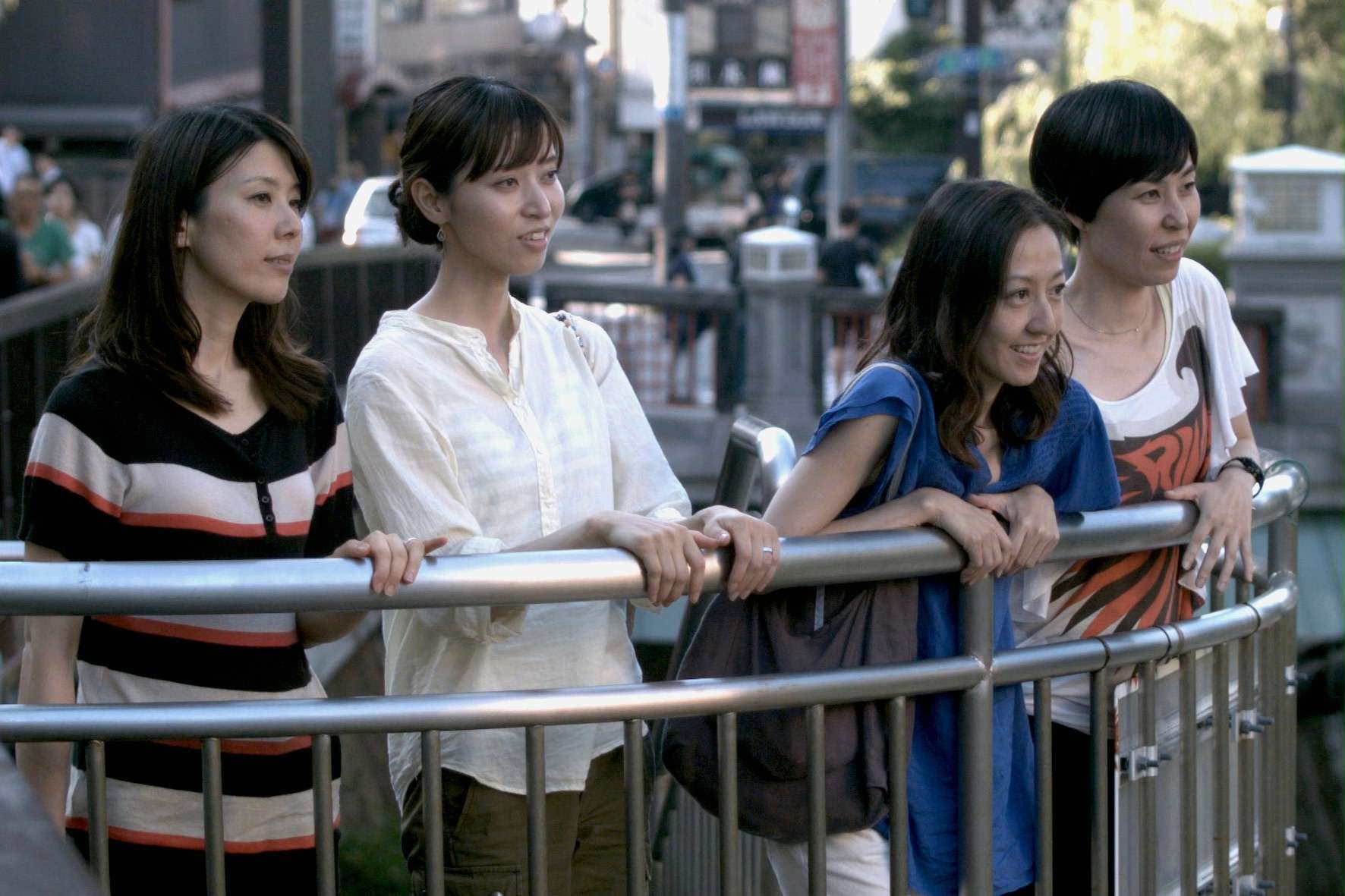
The four women are Sakurako – a housewife and mother to a teenage son, Jun – her best friend since middle school, Fumi – who works in events and is married to an editor, and Akari – a divorced nurse. The four became friends just because Jun thought they’d all get on so introduced Fumi and Akari forming the little quartet of late 30s ladies. They hang out together and talk about the general kinds of things women talk about – their husbands, jobs, children etc. However, Jun has a secret she hasn’t told the group. She’s in the middle of contesting a divorce from her emotionally abusive husband who refuses to consent, necessitating a long and nasty court battle. When the truth is revealed in an unwise way, it causes a rift in the group and brings the cracks in its foundations closer to the surface. When the gang enjoy one last trip to a hot spring, Jun stays behind and then never comes home. Without their binding thread, will the three women’s relationships to each other and to the other people in their lives be able to survive?

Each of the women in Happy Hour has her own particular sadness. Each in each, they’re all lonely or in some way dissatisfied with the way their lives have turned out. Sakurako married her high school sweetheart, has a nice home, a not unhappy marriage and a teenage son who’s doing OK until he gets himself into a more serious situation. However, her husband believes in a strict division of labour where he takes care of everything outside of the home (i.e. earning the money) and she the inside meaning he has little input into the raising of his son and refuses to help her when she really needs his support. She longs to be noticed again – as a woman, but also as a person outside of “wife” or “mother” which have begun to sound more like job titles or names of appliances rather than warm terms for the most important person in your life.

Fumi’s problem is similarly common – she resents her husband’s interest in another woman. Though Fumi and Takuya look like a model couple, they both work so much that they’re hardly ever together and are in danger of drifting apart. Takuya seems taken with a young novelist he’s working with and though Fumi says she doesn’t have a problem with it because she trusts him, she does and she doesn’t. Matters come to a head first at the hot springs resort where the women are taking a holiday while Takuya escorts Nose, the novelist, as she explores the resort for a series of onsen themed short stories. Later when Nose arrives for a book reading, Fumi’s frustration is palpable as Takuya’s clueless insensitivity continually places her in an awkward position.

Akari’s problems aren’t atypical either as finding herself divorced at 38 she’s the only one in her group of friends without a husband and perhaps worrying about running out of time to find one. She’s the loud mouth of the group, the one who isn’t afraid to speak her mind though she tends to speak without thinking and make the situation worse. However, her brashness is masking a deeper lack of confidence as she worries about being valued both inside and outside of work. Though we’re constantly told how important she is in her working environment both as a steady pair of hands and as a mentor to the younger members of staff, doubt seems to creep into her mind and she finds complements hard to believe.

The person we get to spend the least amount of time with is Jun, whose problems are a little more unusual. Married to a scientist with a cold and logical approach to life, her marriage has turned into a prison sentence with an unrelenting gaoler of a husband. Kohei’s love is selfish to the extreme, he says he loves Jun so he has to keep her even though he knows she doesn’t want him.

Occasionally, the four begin to feel like archetypes in somewhat contrived situations designed to help the film explore the contemporary lives of middle-aged women. Perhaps Jun really did select them for their complementary qualities – a little like a girl group with the fluffy one, the quiet one and the feisty one, but every so often it’s a little on the nose. Hamaguchi largely manages to make the extreme running time work for him by giving his characters the necessary breathing space, allowing key episodes the room to develop into deliberate tedium. Both the early workshop and later book reading, almost the two axes of the film, play out in essentially real time, pushing towards a particular kind of abstract realism.

Happy Hour fully justifies its mammoth running time but does undoubtedly stumble at certain stages. Still, it supplies ample room for exploring the everyday lives of its wide-ranging cast and more particularly of its central group of women each of whom, essentially, just want to be seen. Turning in surprisingly pleasing production values for its low budget approach, Happy Hour is an ambitious if not always successful film but even where it fails it’s never less than interesting.