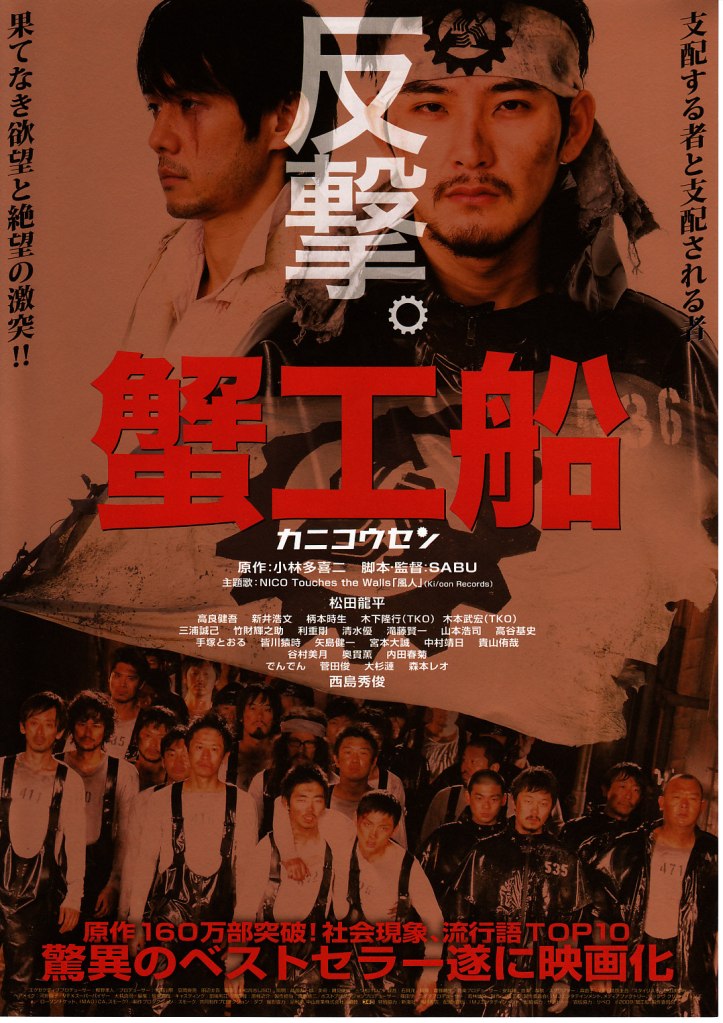
 Back in 2008 as the financial crisis took hold, a left leaning early Showa novel from Takiji Kobayashi, Kanikosen (蟹工船), became a surprise best seller following an advertising campaign which linked the struggles of its historical proletarian workers with the put upon working classes of the day. The book had previously been adapted for the screen in 1953 in a version directed by So Yamamura but bolstered by its unexpected resurgence, another adaptation directed by SABU arrived in 2009.
As in the book the film follows the lives of a group of men virtually imprisoned on a crab canning ship anchored near Russian seas in the 1920s. The men on the boat are of various ages and come from various different backgrounds but each is here out of necessity – nothing other than extreme poverty and lack of other options would ever persuade anyone to take on this arduous and often unpleasant line of work. Technically speaking the boat has a captain but it’s the foreman who’s in charge – dressed like a European officer in a white frock coat and riding boots and with a vicious looking scar across his left eye, Asakawa rules the waves, barking out orders and backing them up with a walking stick.
SABU films the workers’ struggles through the filter of absurdist theatre beginning with a darkly comic segment in which each of the men recount their poverty riddled circumstances and dreams for social advancement before one, Shoji, emerges and posits another idea. They will make a bid for everlasting freedom by committing mass suicide in protest to poor working conditions and consistent exploitation of their class by those above. Predictably, this fails when everyone realises they didn’t actually want to die in the first place. Later Shoji and another man are picked up by a Russian boat after being stranded at sea and after seeing how happy the Russian sailors seem to be, they return determined to enact the revolution at home.
Conveying the workers’ plight through production design, SABU opts for a packing room which is both oversized yet claustrophobic, filled with giant cogs and gears of the capitalist system in motion. The men are little more than fleshy gears themselves, just another piece of the production line to be thrown out and replaced once worn through. Gradually the workers start to realise that this system is only sustainable because of their own complicity. The foreman is, after all, only one man and the workers have made a decision to obey him – they also have the ability to decide not to. That said, the spanner in the works is that the foreman also represents the larger mechanism at play which is the imperial state itself and can call on its resources to defend himself against a potential mutiny.
Having decided to rebel and seen their revolution fail, the workers come to another realisation – that the only true path to social change is a movement for the people lead by the people as one, i.e. with no leaders and therefore no head which can be cut off to disrupt all their efforts. Hand in hand and with the bloody flag raised high do they march into battle to put an end to unfair exploitation of those without means by those that have. Ever since they’ve been on this boat, they’ve been told that they’re at war, that their services are necessary for the survival of the Imperialist state – and now so they are, engaged in the class war to end the imperialist hegemony.
In the end, SABU’s message is a little confused – he advocates collective action, but not the collective, as his revolution is born of individual choice rather than the workers linking hands behind a faceless banner. It works as a semi-effective call to arms, but more often than not undermines itself and has a tendency to pull its punches when it really counts. That said, even if it wasn’t perhaps quite what Kobayashi meant, the more general message that the revolution begins in the heart of the individual and that one has the possibility to choose to live in hell (as a slave of the state) or create a heaven for one’s self (as a free person) is one that has universal merit and appeal.
 Cyberpunk, for many people, is a movement which came to define the 1980s and continues to enjoy various kinds of resurgences and rebirths even into the new century. Beginning the the ‘60s and ’70s in dystopian science fiction afraid of the impact of advancing technologies in society, it’s not surprising that the genre began to actively embrace influences from the East and especially that of the more technologically advanced and economically superior Japan. However, when Japan made its own cyberunk cinema, the “punk” element is the one that’s important. These movies sprang from the punk music scene and often star punk bands and musicians as well as featuring high energy punk rock inspired scores.
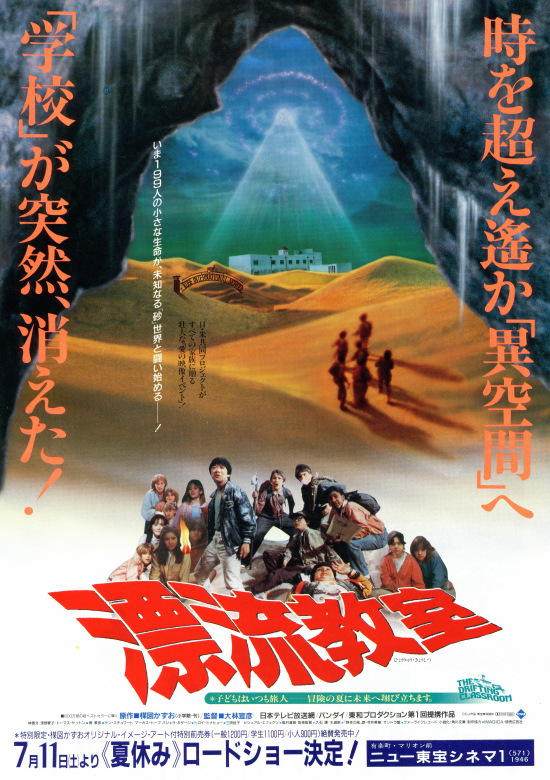 Nobuhiko Obayashi may have started out as an experimental filmmaker and progressed to a lengthy narrative film career but he remains best known for his “what the hell am I watching?” cult classic Hausu. Aside from his 1983 take on The Girl Who Leapt Through Time, very little of his other work has travelled outside of Japan. In the case of 1987’s The Drifting Classroom (漂流教室, Hyoryu Kyoshitsu), this is doubly surprising firstly because it’s based on a hugely popular manga by the godfather of horror comics Kazuo Umezu and secondly because it’s set in an international school so around 80% of the dialogue is in English.
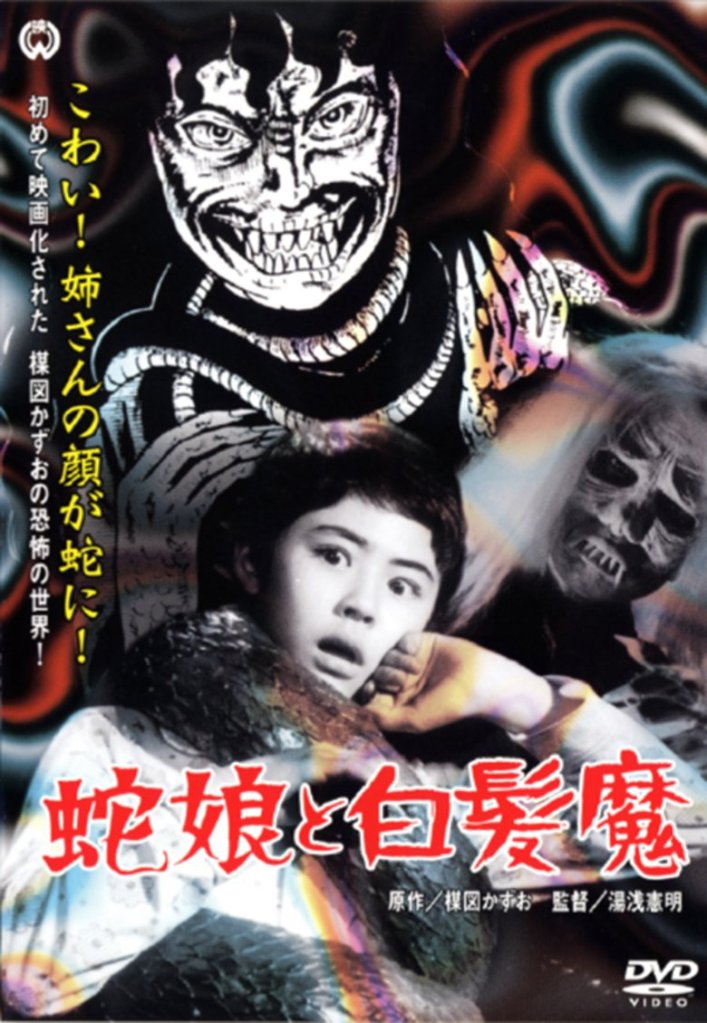 Little Sayuri has had it pretty tough up to now growing up in an orphanage run by Catholic nuns, but her long lost father has finally managed to track her down and she’s going to able to live with her birth family at last! However, on the car ride to her new home her father explains a few things to her to the effect that her mother was involved in some kind of accident and isn’t quite right in the head. Things get weirder when they arrive at the house only to be greated by the guys from the morgue who’ve just arrived to take charge of a maid who’s apparently dropped dead!
 How many times were you told as a child, someday you will understand this? There are so many things you don’t see until it’s too late, and children being as they are, are almost programmed to see things from a self directed tunnel vision. Such is the case for Mugiko – a young woman with dreams of becoming an anime voice actress who is suddenly reunited with her estranged mother of whom she has almost no memory.
 A late career entry from socially minded director Shohei Imamura, Dr. Akagi (カンゾー先生, Kanzo Sensei) takes him back to the war years but perhaps to a slightly more bourgeois milieu than his previous work had hitherto focussed on. Based on the book by Ango Sakaguchi, Dr. Akagi is the story of one ordinary “family doctor” in the dying days of World War II.
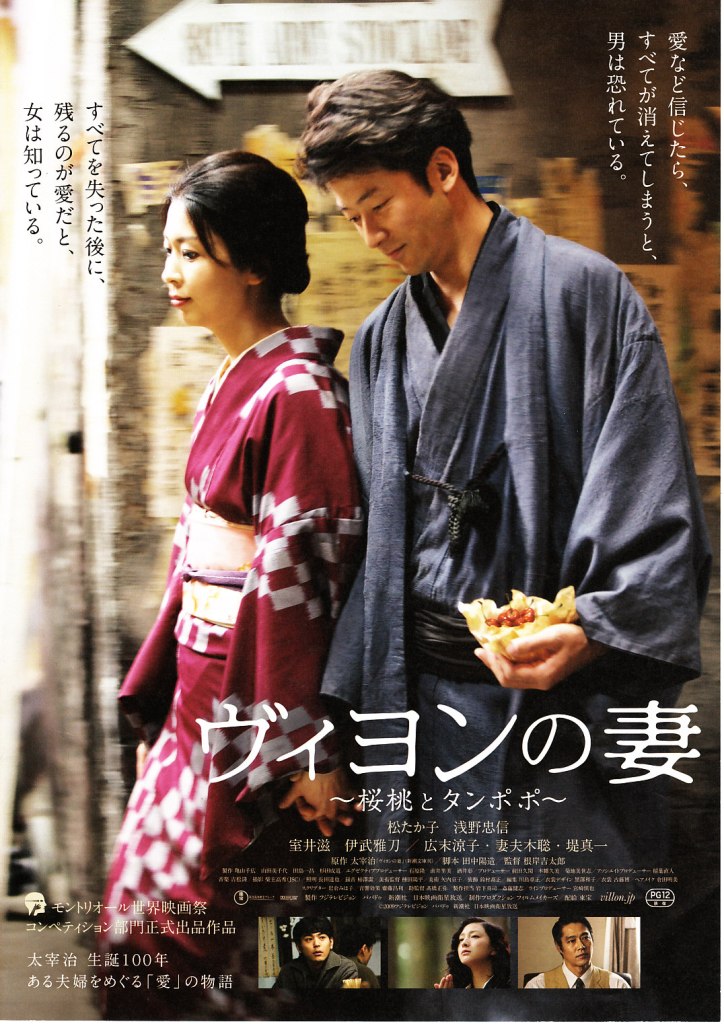 2009 marked the centenary year of Osamu Dazai, a hugely important figure in the history of Japanese literature who is known for his melancholic stories of depressed, suicidal and drunken young men in contemporary post-war Japan. Villon’s Wife (ヴィヨンの妻 〜桜桃とタンポポ, Villon no Tsuma: Oto to Tampopo) is a semi-autobiographical look at a wife’s devotion to her husband who causes her nothing but suffering thanks to his intense insecurity and seeming desire for death coupled with an inability to successfully commit suicide.
 It’s often posited that Japan rarely produces “science fiction” literature or movies and some say that’s because, well, they already live there. However, this isn’t quite true, there are just as many science fiction themed projects to be found in Japan as elsewhere you just have to look a little harder to find them. Depending on your point view, if you succeed in tracking down a copy of Cosmic Rescue -The moonlight generations- (コスミック・レスキュー ザ・ムーンライト・ジェネレーションズ), you may feel the quest was not entirely worth the effort.
