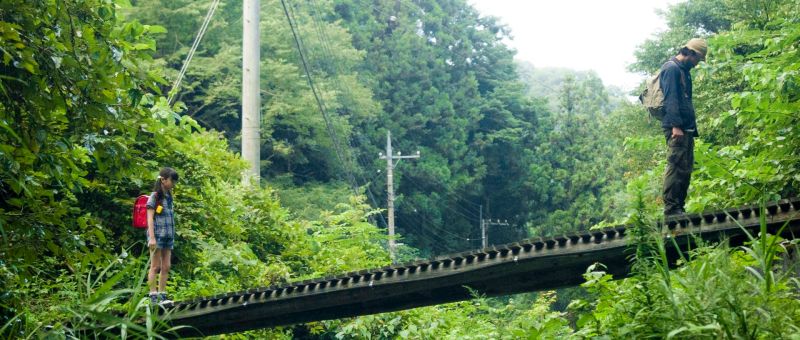
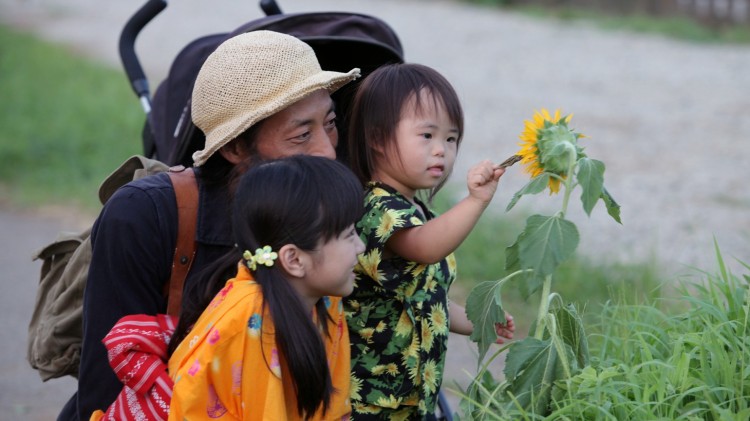
 When tragedy strikes the one thing you ought to be able to rely on is your family, but when the tragedy occurs within that sacred space which exits between you what is to be done? Yosuke Takeuchi’s The Sower (種をまく人, Tane wo Maku Hito) attempts to provide an answer whilst putting one very ordinary, loving and forgiving family through a series of tests and tragedies. Lies, regret, and despair conspire to ruin the lives of four once happy people but even in the midst of such a shocking, unexpected event there is still time to turn towards the sun rather than continuing in the darkness.
Mitsuo has just been released from a mental hospital where he received treatment for a nervous breakdown suffered as a direct result of his time as a relief worker after the Tohoku earthquake. Returned to the home of his brother Yuta and his wife Yoko, Mitsuo’s family welcome him with open arms and he is delighted to become reacquainted with his niece Chie as well as meet her younger sister, Itsuki, for the first time. Yoko’s mother was supposed to be coming to help out with the children but has let them down once again. Uncle Mitsuo seems like the perfect solution but tragedy strikes when he leaves the girls on their own to use the bathroom and comes back to discover that Chie has dropped her sister causing her to hit her head on a curb stone surrounding the play area. Mitsuo rushes to the hospital but Itsuki sadly passes away. Chie, overcome with guilt and fear hastily blurts out that her uncle dropped her sister while Mitsuo remains silent.
Chie’s claim sparks a series of consequences, the most serious being the intervention of the police investigating the case who are very keen to poke into each and every dark corner of this ordinary family. Despite the fact that Mitsuo has only been staying with them a few days, the police almost push Chie into accusing Mitsuo of abuse of herself or her sister, trying to paint him as some kind of deranged threat to children everywhere. Feeling guilty about her lie and fearing discovery Chie wisely says nothing, refusing to further incriminate her uncle save for a brief indication that he dropped Itsuki on purpose.
The police are confused, there is no evidence to support the idea of Mitsuo having behaved suspiciously towards either of the girls or anyone else for that matter. There would seem to be no motive for him to intentionally harm his niece, though they don’t want to accuse a grieving little girl of making things up, either. Conscious that making Chie give evidence in court, especially if she is going to lie, may have terrible consequences for her future the police urge Yuta to talk seriously with his daughter and try to get to the truth through more gentle means.
The swarm of tragedy has, however, already begun to drive a wedge between husband and wife. Even at the funeral, Yoko’s mother, forgetting that much of this is her fault for letting the family down in the first place, overtly criticises their decision to take in someone just released from a mental hospital and then leave him in charge of small children. Yuta loves his brother unconditionally, knows he is a good person and does not blame him for his daughter’s death. Yoko cannot bring herself to understand her husband’s reaction, accusing him of choosing his brother over their little girl. Mitsuo’s mental state is repeatedly offered as an explanation for what happened despite the fact that his condition is down to an excess of compassion rather than any violent or destructive impulses.
This same kindness means that he never speaks out or tries to appeal to Chie to tell the truth, shouldering the burden of her guilt and perhaps feeling responsible for having left her alone with her sister even if it was only for a few short minutes. Chie, terrified and remorseful, deeply regrets her original lie but is too afraid to tell the truth. When she finally does decide to confide in someone she is instantly told to keep quiet about it, placing an additional burden on this already fragile little girl in asking her to keep two terrible secrets perhaps for the rest of her life.
As the family falls apart, Mitsuo retreats to the woods, planting sunflowers which Itsuki loved in every conceivable place. Literally trying to plant the seeds of hope, Mitsuo spreads his sunflowers far and wide bringing colour and life to a landscape of desolation but it may take more than flowers to light the way out of this hellish, inescapable tragedy.
The Sower was screened at the 17th Nippon Connection Japanese Film Festival.
Original trailer (English subtitles)
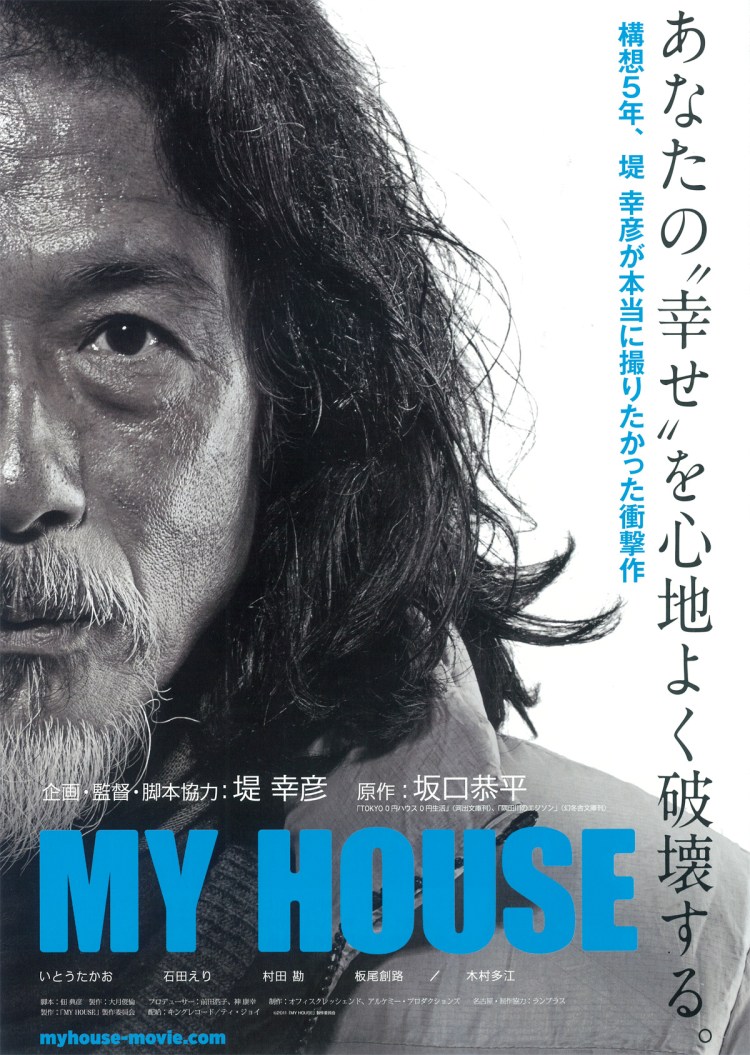 Yukihiko Tsutsumi has made some of the most popular films at the Japanese box office yet his name might not be one that’s instantly familiar to filmgoers. Tsutsumi has become a top level creator of mainstream blockbusters, often inspired by established franchises such as TV drama or manga. Skilled in many genres from the epic sci-fi of Twentieth Century Boys to the mysterious comedy of Trick and the action of SPEC, Tsutsumi’s consumate abilities have taken on an anonymous quality as the franchise takes centre stage which makes this indie leaning black and white exploration of the lives of a group of homeless people in Nagoya all the more surprising.
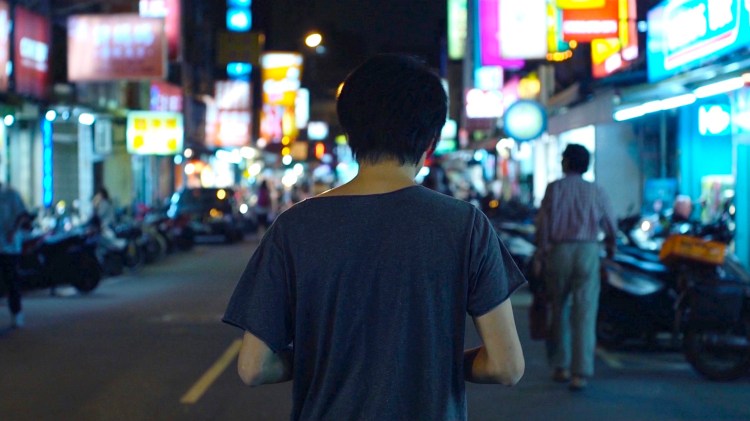 We don’t move forward in this dance, comments the lady currently being waltzed by a charming lost soul. Don’t worry, he says, that’s not a bad thing. Indeed, Out There, the first independent feature film from director Takehiro Ito exists in a fixed yet liminal space, here and not there as its protagonist finds himself without the proper place to be. Conceived as a way of salvaging some of the material collated for a documentary on the late Taiwanese director Edward Yang, Out There takes more of its cues from Tsai Ming-liang or even Lav Diaz in its preoccupation with the intersection between time, existence, and place. If that all sounds to weighty, there’s a little whimsy in here too, but the intent is a serious one as nationhood (or the lack of it), drifting cultures, love and history all conspire to confuse and distract the course of a young man in search of an identity which is entirely his own.
 Looking back, at least to those of us of a certain age, the late ‘90s seem like a kind of golden era, largely free from the economic and political strife of the current world, but the cinema of that time is filled with the anxiety of the young – particularly in Japan, still mired in the wake of the post-bubble depression. Toshiaki Toyoda’s Pornostar (ポルノスター, retitled Tokyo Rampage for the US release) (not quite what it sounds like), is just such a story. Its protagonist, Arano (Chihara Junia, unnamed until the closing credits), stalks angrily through the busy city streets which remain as indifferent to him as he is to them. Though his wandering appears to have no especial purpose, Arano seethes with barely suppressed rage, nursing sharpened daggers waiting to plunge into the hearts of “unnecessary” yakuza.
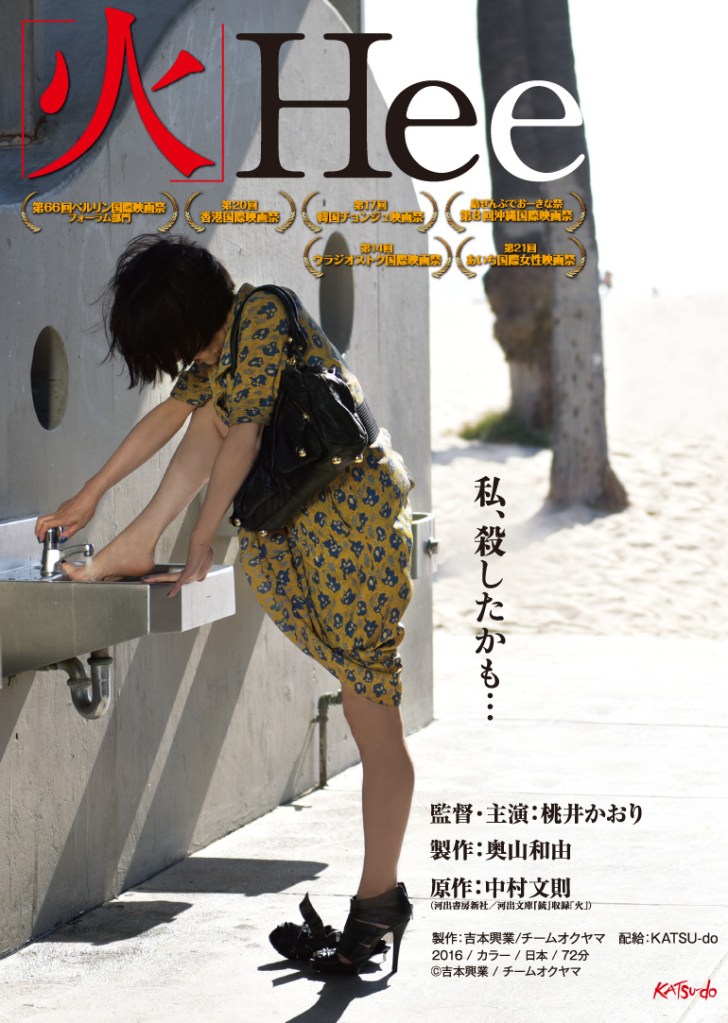 One of Japan’s best known actresses with a career spanning over forty years, Kaori Momoi is perhaps just as well known for her outspoken and refreshingly direct approach to interviews as she is for her work with such esteemed directors as Akira Kurosawa, Kon Ichikawa, Yoji Yamada, and Shohei Imamura. One of the few Japanese actors to have made a successful international career starring in Hollywood movies such as Rob Marshall’s Memoirs of a Geisha and international art house fare in Alexander Sukurov’s The Sun, Momoi currently lives in LA and is even reportedly preparing to play Scarlett Johansson’s mother in the upcoming US live action adaptation of Ghost in the Shell. It’s perhaps less surprising then that in choosing to adapt a short story by one of Japan’s best young writers, Fuminori Nakamura, Momoi has chosen to shift the story to LA whilst maintaining its Japanese characters.
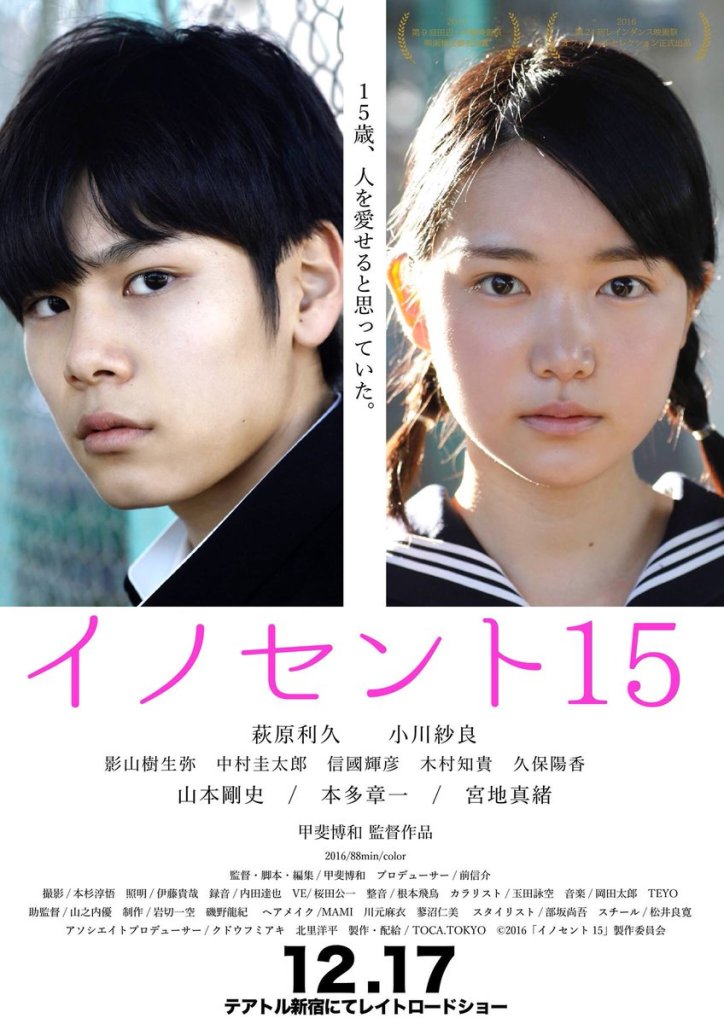 Innocence is a fairly nebulous concept and one often misused but if you were expecting an “innocent” tale of youthful romance, Hirokazu Kai’s Innocent15 (イノセント15) is out to wrong foot you from the get go. Kai does not shy away from the darker sides of human nature in examining abusive parenting and forced prostitution as well as the damage done when a secret is broken after long years of being unable to be honest about who you really are. This is a bleak tale, but one with with hope shining round the edges, even if uncertainly.
 Windows on Worlds