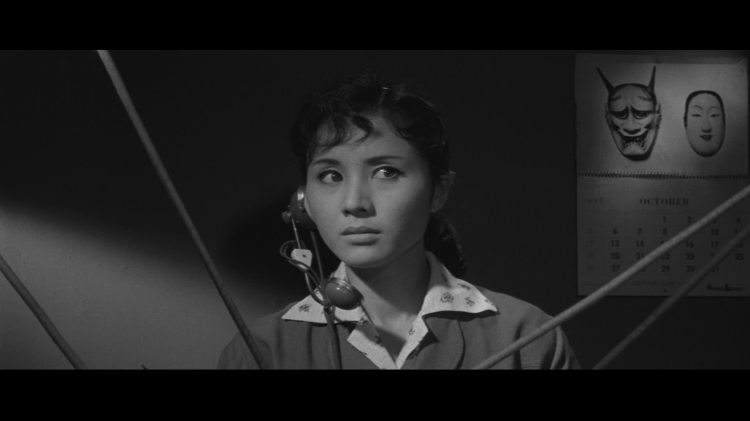
Make friends with this Oni mask – you will be seeing a lot of him throughout the film.
Seijun Suzuki might be best remembered for his surrealist pop art masterpieces from the late sixties or his even less comprehensible art films which followed his return to directing after settling his dispute with Nikkatsu, but everyone’s got to start somewhere and it comes as something of a relief to know that Suzuki was perfectly capable of making a straightforward movie if he wanted to. Voice Without a Shadow (影なき声, Kagenaki Koe) is exactly what it sounds like – a fifties style, US inspired noir however, Suzuki adds his usual flourishes and manages to wrong foot us pretty much the whole way through so that we never end up where we thought it was that we were going.
To begin with, our story is fairly straightforward. Reporter Ishikawa (Hideaki Nitani) provides our film noir style voice over as switchboard operator Asako (Yoko Minamida) accidentally dials a wrong number only have it picked up by a strange man who tells her she’s rung a crematorium then laughs hysterically. It turns out that the number was actually for a pawn shop which was in the process of being knocked over and the owner killed – Asako heard the perpetrator’s voice and thanks to her switchboard experience isn’t going to forget it. Ishikawa grows closer to Asako as the case becomes a media sensation but backs off after learning she’s already engaged.
Three years later Asako hears the voice again – a friend of her husband’s who keeps co-opting their living room for mahjong games that go on for days and cost everyone but him a lot of money. Before long Hamazaki (Jo Shishido) is found dead and Asako’s husband is the prime suspect but did he really do it? And if he didn’t, does Ishikawa really want to find out who did?
As you can see it’s a story that wouldn’t be out of place in any B movie noir from the fifties and the telephone set up is even a little reminiscent of Sorry, Wrong Number (though that film has a very different conclusion indeed). Based on a short story by Seicho Matsumoto, Voice, Voice Without a Shadow is full of the classic play of light and shadow that characterises the best film noir and the mood is ably supported by a suitably jazzy score from Hikaru Hayashi. If there’s a criticism to be made in this area, it’s that Nitani’s Ishikawa is a little too nice and pure hearted in comparison to the broken hearted heroes from the detective serials. He seems content to try and help Asako whilst uncovering the truth even if it ends up costing him in the end.
Although Asako herself is technically the leading character she quickly gets relegated to a more conventional woman in peril role. She is the one who recognises Hamazaki’s voice and the only clue linking him to the pawn shop murder three years ago but, while he’s alive anyway, Hamazaki is more interested in having fun terrorising everyone rather than trying to rub her out. In fact, the sudden demise of Hamazaki, played by an extremely young Jo Shishido, is one of the most surprising things about the film in which you’d expect him to remain the central antagonist right up until the grand finale.
Voice Without a Shadow is then a fairly conventional, noir inflected B movie which wears its Hollywood influences on its sleeve. However, there are glimpses of Suzuki’s individual style leaking through such as in his occasional and surprising use of double exposure, innovative composition and other modernist techniques which all help to lift the rather workmanlike script onto another level. In someways, it’s all a little too nice – even Hamazaki’s nasty lowlife activities are neatly skirted around almost like a film noir that’s been through a car wash though its strange pleasantness also has a nicely refreshing quality.
A minor film from the master of the surreal then, but an interesting one none the less. The mystery element proves satisfying even if it could do with a little more dirt under its fingernails and the committed performances also do their bit to enhance the mood. A prime example of its genre, Voice Without a Shadow is a notably restrained entry in Suzuki’s back catalogue but its classical style mixed with an offbeat, absurdist undercurrent make it one worth seeking out.
Voice Without a Shadow is the first film included in Arrow’s Nikkatsu Diamond Guys Vol. 1 collection.
What are you supposed to do when you’ve lost a war? Your former enemies all around you, refusing to help no matter what they say and there are only black-marketers and gangsters where there used to be merchants and craftsmen. Everyone is looking out for themselves, everyone is in the gutter. How are you supposed to build anything out of this chaos? Perhaps you aren’t, but you have to go one living, somehow. The picture of the immediate post-war world which Suzuki paints in Gate of Flesh (肉体の門, Nikutai no Mon) is fairly hellish – crowded, smelly marketplaces thronging with desperate people. Based on a novel by Taijiro Tamura (who also provided the source material for Suzuki’s Story of a Prostitute), Gate of Flesh has its lens firmly pointed at the bottom of the heap and resolutely refuses to avert its gaze.
A nervous young woman, clearly tired, starving and alone wanders through a marketplace in desperation before a yakuza offers to buy her something to eat. She is wary but has little choice. Soon after she meets toughened prostitute Sen who is the de-facto head of a small group of streetwalkers committed to supporting and protecting each other. They have few rules but the biggest one is no giving it away for free. Maya joins their “merry” band and things are going OK for them until they make the fateful decision to take in a wounded ex-soldier on the run from the American military police. Shin puts a great big wedge between the members of the group, deepening the cracks which were present all along. Sure enough, Maya starts to fall for this damaged man threatening to fall foul of the gang’s single taboo. When you’ve lived like this, without hope, without a future, can you ever go back to being a “real human being” ever again?
Make no mistake, this is a ruined world. Almost post-apocalyptic, it’s populated by the starving and the desperate. The sweet potato seller is king here – the working girls are depicted like packs of rabid animals, descending on any passing male ready to extract any amount of loose change which they immediately run out to thrust into the hands of anyone who has food. The great horror is hunger.
The other great horror is, of course, violence and particularly male violence against women. Maya is assaulted early on and a truck carrying two army officers and a priest tries to make a quick escape after noticing her lying wounded by the roadside. The Americans aren’t going to help her, she’s just another raped Japanese woman after all, but the priest stops and offers another kind of salvation shining from his dangling crucifix. He repeatedly turns up later and tries to convince Maya to come back to church but you can’t live on a communion wafer alone and eventually Maya puts a definite end to the idea of any kind of religious solution to her predicament.
Sex is business for the woman under Sen’s command. They sell their bodies, hence the prohibition on giving them away. Breaking the rules will get you cruelly beaten and humiliated before being thrown out of the group and it’s near impossible to survive alone. The other women have all been injured by the war, they’re all among those left behind. One of them, Machiko, stands a little to the side as a middle class war widow rigidly sticking to her kimono and dreaming of becoming someone’s wife again. Needless to say, she and Sen do not always see eye to eye as Machiko’s desire to return to a more innocent age conflicts with Sen’s hard nosed pragmatism.
This is Japan in defeat. The girls live in a warren of ruined buildings haunted by visions of the past. Shin has returned from the war to a land devoid of hope. He’s a broken man and, as the woman have been “reduced” to prostitution, he has been “forced” into crime. There aren’t any real people here anymore, just animals willing to do whatever it takes just to stay alive.
When Suzuki was given this assignment, they wanted him to make a soft-core exploitation pic full of the sleazy lives of the red light district. Suzuki doesn’t give them that, he gives them another round of beautifully composed, surrealist social commentary in which the downtrodden citizens of Japan are defeated for a second time by the corrupting influences of the American occupation. The final shot of the ascendant Stars and Stripes flapping in the wind while the Japanese flag lies drowned in the muddy river speaks for itself and though Suzuki shows us those defiantly trying to live his prognosis for them is not particularly hopeful. He uses multiple exposure here more than in any other film as the past continues to haunt the traumatised populace in quite a literal way where one scene of degradation leads on to another. Extended metaphor, surrealist examination of the post-war world and also the low level exploitation feature Suzuki was hired to direct (albeit in more ways than one) Gate of Flesh proves one of his most complicated and accomplished features even given his long and varied career.
Gate of Flesh is available with English subtitles on R1 DVD from The Criterion Collection.
And so, the saga finally reaches its conclusion. Final Episode (仁義なき戦い: 完結篇, Jingi Naki Tatakai: Kanketsu-hen) brings us ever closer to the contemporary era and picks up in the mid ‘60s where Hirono is still in prison and Takeda, released on a technicality, has decided to move the yakuza into the legit arena. The surviving gangs have united and rebranded themselves as a political group known as the Tensei Coalition. However, not everyone has joined the new gangsters’ union and the enterprise is fragile at best.
Hirono’s sworn brother, Ichioka, is one such antagonist and after the Coalition’s accountant is clumsily gunned down in the street, tempers start to flair. Though the Coalition is nominally headed by Takeda, an up and coming youngster, Matsumura, is winning a lot of respect for his level headed judgement and ability to form long term plans. He wants to move away from the image of the traditional yakuza with their missing fingers and bad attitudes to something a little more media friendly. However, the old guard including the veteran, Otomo (now played by Jo Shishido), aren’t willing to see the bigger picture and continue to behave in the old ways requiring swift and bloody justice for their fallen comrade. The older generation maybe on their way out, but that doesn’t mean they can’t cause a little trouble on their way. Despite the best efforts of the younger guys the cycle of violence seems set to continue, will anything ever change at all?
According to Fukasaku, almost certainly not. Though Matsumura is accounted to be a good guy by both of our “heroes” Hirono and Takeda, his yakuza revolution seems doomed to fail. This kind of coalition is completely pointless if not everybody joins and obviously not everybody is going to. Following the public outcry and subsequent police crackdown in the previous film, the yakuza feel the need to reform their image, keep the violence off the streets and appear generally less scary than the image they’ve hitherto cultivated. Now it suits them to conduct themselves in a more dignified manner, more like regular businessmen than thugs in flashy suits.
Meeting at the prison in the end of Police Tactics, Hirono and Takeda both agree that their era has passed. They still aren’t quite old men, but they aren’t young and this violent world isn’t for them anymore. Their resolutions are both that the general environment has changed making the way they’ve lived so far untenable, but also that if they attempted to live that way again they simply wouldn’t survive any longer (perhaps they are “better off” in jail). Hirono spends most of the movie off screen again, in prison, writing his memoirs. Before coming out he seems set on “retirement” but once released he decides to return to the yakuza world. It’s not until the end of the film when once again confronted by the senseless violence of gang warfare that he finally decides to retire. Matsumura may have been trying to change things, but more young guys are dying so fast there’s barely any point learning their names and what really does it get you in the end? Can you live freely, has the world really changed at all? From Hirono’s late middle age viewpoint, the answer is no.
Final Episode follows the same basic formula as the other films in the series with the narrative voice over, frenetic handheld camera work, captions and freeze frames. The violence may be a little less frequent but appears bolder in its execution. These youngsters are messier than their forebears – the gunning down of the Tensei accountant is a clumsy affair carried out by two amateurs in the middle of a crowded street. Random weapons are constructed with pretty much anything that’s lying around during a street fight. These young guys are a different kind of desperate and have no idea how to conduct themselves in a subdued way.
We’re almost up to the the contemporary era of the film. It’s getting on for 25 years since Hirono came home from the war and joined a different kind of battlefront. Japan’s development has been startlingly rapid – from post-war rubble to hosting the olympic games and a newly burgeoning prosperity. Hirono and those like him have found themselves riding the wrong wave as their fortunes continue to dwindle just as the legitimate world is coming into its own. When Hirono and Takeda were talking at the prison at the end of part four they knew something had come to an end. They had no place in this world anymore – unless you become a ruthless boss like the hated Yamamori (still harbouring dreams of domination well into his dotage), the yakuza life is a young man’s game. Once again we finish on a shot of the ruined dome and a reminder that the strong will always prey on the weak. Fukasaku’s prognosis for the future is grim but, it has to be said, accurate.
Final Episode is available on blu-ray in the UK as part of Arrow Video’s Battles Without Honour and Humanity: The Complete Collection box set.
Arrow double whammy up at UK Anime Network as I review both of Arrow’s recent Yasuharu Hasebe releases – Massacre Gun and Retaliation!
Tatsuya Fuji tests his gun out in Massacre Gun (and looks cool in the process)
Arrow have been turning up some hidden gems and neglected classics as they trawl through the world of the populist cinema from the Japanese golden age of the 1960s and 70s – they’ve already brought us the iconic Lady Snow Blood, the lesser known Blind Woman’s Curse, the anarchic Stray Cat Rock series and now, following on from their release of Seijun Suzuki’s famously crazy Branded to Kill they’ve turned their attention back to Nikkatsu Noir with Massacre Gun. The first of two releases from director Yasuhiro Hasebe who also directed three films in the Stray Cat Rock series (Retaliation will follow next month), Massacre Gun has everything any genre fan could wish for – depressed hit men, warring gangs, jazz bars, boxing clubs, stylish monochrome photography and the melancholic ennui that permeates all the best noir movies. Perhaps not quite as impressive as the greatest hits of Nikkatsu Noir such as the afore mentioned Branded to Kill or Nikkatsu’s other offerings like A Colt is My Passport, Massacre Gun is nevertheless another impressive entry in the studio’s short lived action output.
As the film begins, thoroughly dejected Kuroda has just been asked to carry out a hit on a woman who is in love with him – feelings which he may have have reciprocated but, but like any good lackey, Kuroda chose his boss over his heart and sent the love sick girl into a lake with a bullet in her chest. When Kuroda’s two younger brothers find out they do not approve and hot headed youngest brother Saburo who trains at a yakuza run gym hoping to become a a pro-boxer, decides to have a word with Kuroda’s boss, Akazawa. As might be expected things don’t go Saburo’s way and he’s brutally beaten to the extent his hands are all but crushed leaving him unlikely to box again. At this point, Kuroda wants out of the game – but for a yakuza hit man there is no out. His only option is to take down Akazawa’s empire and build one of his own.
Like most of Nikkatsu’s late ‘60s action output which would later retroactively become known as Nikkatsu Noir, Massacre Gun is heavily indebted to the American B-movie and particularly to the film noir. Its settings are those of “low culture”, Western bars and cafes where people drink expensive whiskey and wear sharp suits and sunglasses. In fact, the Kuroda brothers’ side business involves running a jazz bar with a half Japanese-half African American jazz singer playing piano in the corner and a pair of Western dancers doing some sort of scantily clad, artistic ballroom dancing routine in the middle. Most importantly it’s full of the classic Film Noir feeling of spiritual emptiness and existential ennui with the very depressed contract killer Kuroda at its centre.
A very male affair (perhaps the key missing element from a Film Noir is a femme fatale), the bulk of the film is the opposition between Kuroda on the one side and his former boss on the other. Other than the closeness with his two younger brothers and to a lesser extent the other workers at the club, Kuroda’s other most notable relationship is with his old friend Shirasaka who coincidentally married another woman Kuroda may have had feelings for. Though the two have enjoyed a close friendship up until now, Kuroda’s decision to leave Akazawa’s employ has meant Shirasaka has had to make a choice and he’s chosen Akazawa. The two are are now mortal enemies on opposing sides of a war – a fact which causes them both pain but which, nevertheless, cannot be otherwise.
Hasebe is best known for his striking use of colour which makes Massacre Gun a notable entry in his filmography as it’s the only one he made in black and white. Other than the perverse habit of sticking colours into the names of his leading characters and locations (the “Kuro” in Kuroda means “black”, the “Shira” in Shirasaka means “white” and the “Aka” in “Akazawa” means red making this one very complicated game of checkers), Hasebe still manages to make an oddly “colourful” film even in monochrome. Taking a cue from Suzuki, Hasebe has come up with a fair few arty and unusual compositions of his own though not quite to Suzuki’s absurd extremities and neatly retained the classic Nikkatsu Noir aesthetic in his superbly crisp black and white colour palate.
Coming as a late addition to the genre, Massacre Gun also takes a fairly unusual approach to violence with a far more explicit representation than would be expected from this period. Simply put – lots of people die in this film, many of them in quite exciting ways. Blood is everywhere and there are so many bullets fired you start to wonder if some one in the yakuza equivalent of the administration department isn’t having some kind of heart attack behind the scenes. Massacre Gun might not be the best entry in the Nikkatsu Noir series, but it is perhaps one of the most typical. Edgy and arty, exquisitely framed and perfectly photographed it brings out the effortless cool that came to symbolise Nikkatsu’s late ‘60s output. Aside from all that – it’s just fun as most of these films are. Another welcome release from Arrow who continue to root out these lesser known genre movies, Massacre Gun is a must see for fans of classic ‘60s action movies.
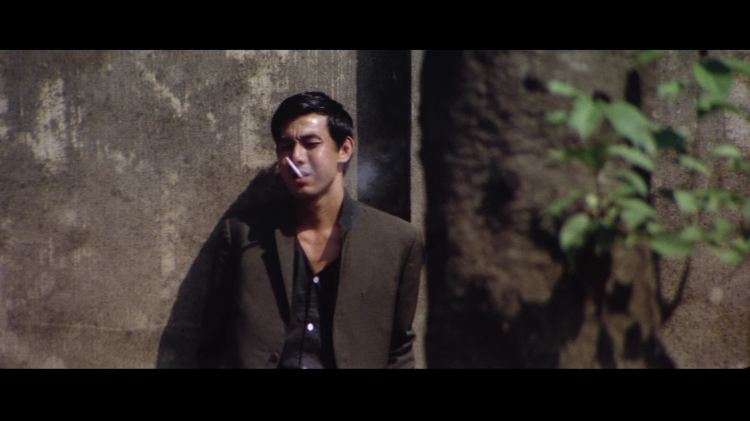
Jo Shishido smokes a cigarette in Retaliation (and looks cool in the process)
Arrow are back with another neglected classic of Japanese action cinema produced by Nikkatsu – Retaliation, a slightly later film from Yasuharu Hasebe director of Massacre Gun and three out of five of the Stray Cat Rock series. Unlike Massacre Gun (but like every other film Hasebe ever made), Retaliation is shot in colour and features Hasebe’s trademark use of it. Retaliation is very typical of its genre in someways and very not in others. It stands on something of a borderline seemingly symptomatic of Nikkatsu’s eventual slide into a producer of soft core pornography as their Roman Porno line of sex and violence based movies took over as their main production style. Not as strong as some of the other entries from around this time, Retaliation nevertheless marks itself out as an interesting addition to the genre.
Not one of the most exciting plots in yakuza movie history, Retaliation’s main mcguffin centres around trying to persuade some farming families to sell their ancestral land to developers who want to build a factory there. Having just been released from prison after taking the fall for gang murder, Jiro is offered the chance to head up his own group, however his patch is between two rivals and his best bet is to play the two off against each other as they both vie for this disputed farmland. One group is super old school and the other is the more modern type of thug who’ll do pretty much anything to get what they want – including abducting one of the farmer’s daughters and molesting her in the back of a car as a way to threaten her father. Jiro is given his own mini team to help out on his mission including an out of work actor and card shark, and another top yakuza guy who just happens to be the brother of the man he went to prison for killing and who has already vowed to killed Jiro in revenge. Jiro sometimes dreams of going straight and leading a different kind of life but gang loyalty still means something to him and those outside of the life aren’t always so understanding. Retaliation is the only way to stay alive in this new, empty yakuza world.
Retaliation starred three of Nikkatsu’s famed “Diamond Line” stars – Akira Kobayashi is the film’s lead leaving Jo Shishido playing second fiddle (his star had fallen a little at Nikkatsu and they didn’t see him as an actor who could carry a colour film as the leading man), and Hideki Nitani coming in third. Tatsuya Fuji and Meiko Kaji round out the almost famous section of the cast and each would soon find fame (or notoriety) in the new landscape of ‘70s Japanese cinema. There’s undoubtedly an air of everybody just doing what they do – it is after all what they’ve been employed for but at the same time no one’s really pushing themselves to do anything very notable. That said, you do have five of the biggest (or soon to be biggest) names of the time in one movie which gives it a feeling of a prestige project. However, in another move that anticipates the direction in which Nikkatsu was headed, the sex and violence quotient has been significantly upped.
Nikkatsu action films could already be shockingly violent for the time period, but Retaliation unfortunately adds a layer of sexualised violence against women which is undoubtedly being offered up as something for the viewer to enjoy. The early scene in which Meiko Kaji’s farmgirl is molested by a gang of thugs before being dumped at her parents’ house is unsettling on one level, but is shot with such a voyeuristic camera style that it’s difficult to not feel complicit in this fairly horrific act. There’s even another such sequence later in the film when one yakuza is forced to give up a girl he’s with so all his yakuza mates can have a go first which is again shot with a lingering camera often cutting back to the salivating gangsters. Of their time in one sense, these sadly salacious scenes of sexual violence against women filmed with an encouraging eye give the film an unwelcome sleazy quality from which it is hard to bounce back.
The other notable theme of the film is that it positions itself between the glamorous, modern samurai, gangster movies of the past and the grittier tales of modern thugs that were about to become the mainstream narrative. Jiro has been away for a long time, the yakuza world has moved on and his old clan would have died out if weren’t for another gang’s generosity. Jiro is the last of the honourable men who place loyalty above personal gain and seek to protect women and the put upon rather than exploiting them. Unfortunately, modern yakuza think differently and it’s no small irony that it’s a group of farmers they’re falling over themselves to ruin given that farmers are the very people old school yakuza, as the receivers of samurai values, would be expected to protect. Jiro and some of his cohorts still believe in these “old fashioned” ideas and are thought brave and noble. The other gangs who rape and torture women whilst forcing farmers off the land they’ve worked for centuries are not.
Again, it’s a fairly manly affair with women becoming little more than props to be used and abused throughout the film but the relationship between the two central guys Jiro and Hino takes on an oddly homoerotic context even ending with Shishido’s character getting rid of his girlfriend because he apparently falls in love too easily before telling Jiro that this is the first time it’s been with a guy. Considering their relationship began with Hino determined to kill Jiro, to end it with a quasi declaration of love (even half in jest) is a pretty steep character arc but one of the better things about the film.
Retaliation isn’t a perfect film, and it might not have the most exciting basis for its plot machinations but it certainly has its moments. Entertaining enough, the film is marred by its unpleasant treatment of women and takes a few dramatic missteps towards the end. The action is good however, as are the performances and production values. Perhaps not an essential Nikkatsu action movie but nevertheless a very interesting one from several different perspectives, Retaliation deserves a view from the genre’s committed fans.
Both available now in the UK on DVD & blu-ray from Arrow Films!
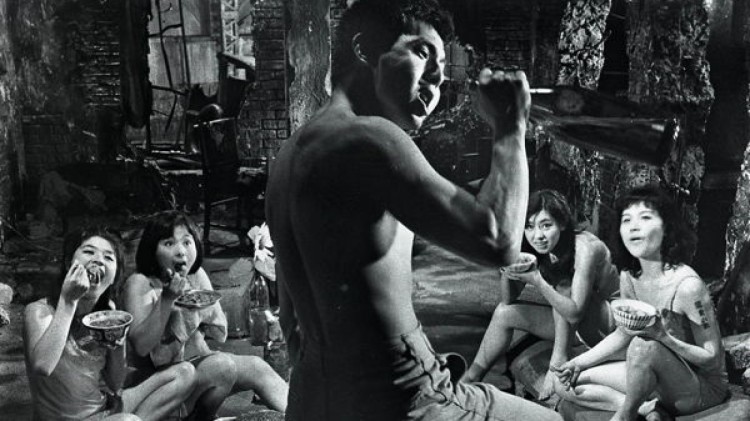 What are you supposed to do when you’ve lost a war? Your former enemies all around you, refusing to help no matter what they say and there are only black-marketers and gangsters where there used to be merchants and craftsmen. Everyone is looking out for themselves, everyone is in the gutter. How are you supposed to build anything out of this chaos? Perhaps you aren’t, but you have to go one living, somehow. The picture of the immediate post-war world which Suzuki paints in Gate of Flesh (肉体の門, Nikutai no Mon) is fairly hellish – crowded, smelly marketplaces thronging with desperate people. Based on a novel by Taijiro Tamura (who also provided the source material for Suzuki’s Story of a Prostitute), Gate of Flesh has its lens firmly pointed at the bottom of the heap and resolutely refuses to avert its gaze.
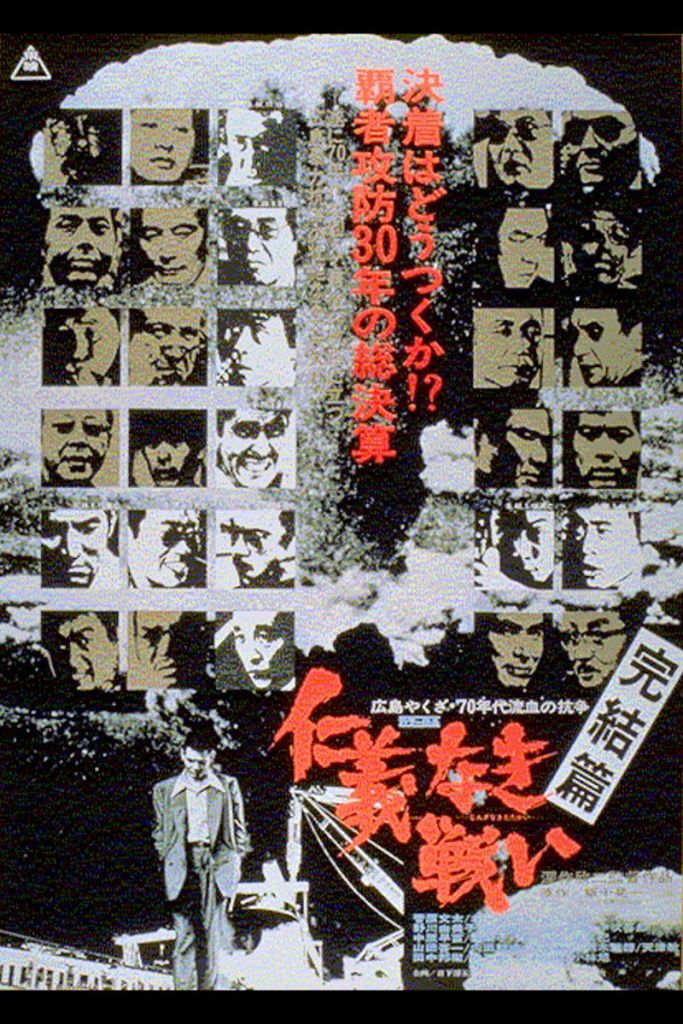 And so, the saga finally reaches its conclusion. Final Episode (仁義なき戦い: 完結篇, Jingi Naki Tatakai: Kanketsu-hen) brings us ever closer to the contemporary era and picks up in the mid ‘60s where Hirono is still in prison and Takeda, released on a technicality, has decided to move the yakuza into the legit arena. The surviving gangs have united and rebranded themselves as a political group known as the Tensei Coalition. However, not everyone has joined the new gangsters’ union and the enterprise is fragile at best.
 Windows on Worlds