Female Prisoner Scorpion: Death Threat (女囚さそり 殺人予告, Toshiharu Ikeda, 1991)

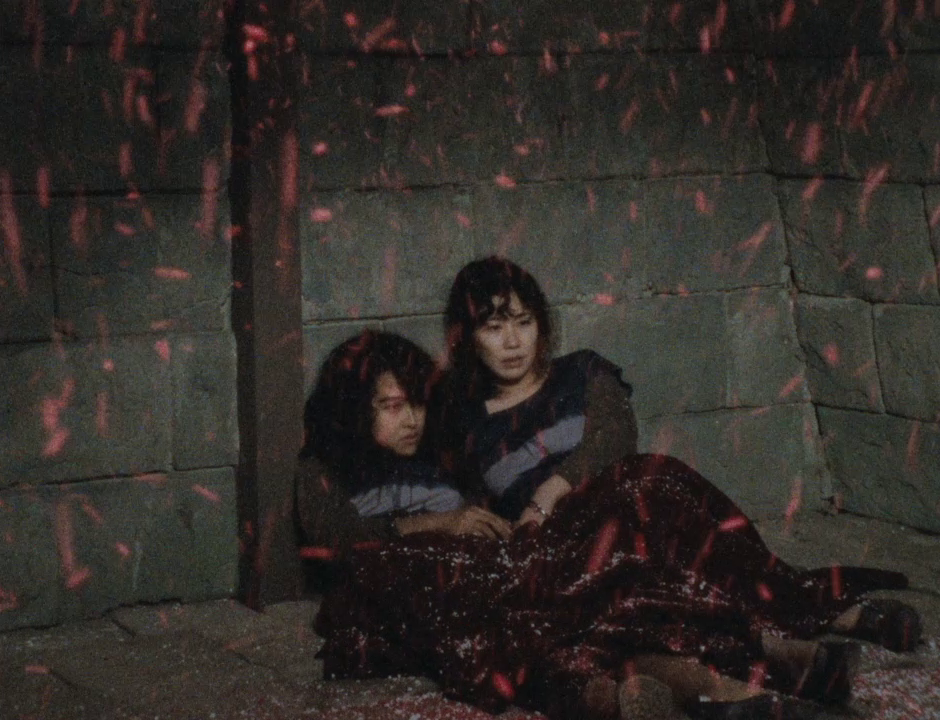
It had been 14 years since the conclusion of the rebooted Female Prisoner Scorpion series and 18 since the iconic Meiko Kaji had stepped away from the role when Toshiharu Ikeda decided to resurrect the iconic Nami Matsushima for Toei’s V-Cinema line. Ikeda was reportedly a fan of the original series and put his name forward to direct with the intention of getting Kaji to return as a now middle-aged Sasori but she turned him down flat so they instead embarked on a quasi sequel in which the original Nami has died and another woman slowly takes her place to become the next incarnation of the legend.

Consequently, Scorpion is not the protagonist of this film that otherwise bears her name. Cast in the lead role of a nameless hit woman, Natsuki Okamoto was then a popular pinup model known as “High Leg Queen”. The film opens with her emerging from a barrel of concrete after being dumped by a group of men who had gang raped and then left her for dead. She’s then rescued by a yakuza, Kaizu (Minori Terada), who teaches her how to kill and is effectively her handler. After posing as a bigger to knock off an obnoxious businessman, he’s recruited by Goda (Kenji Imai), the former warden prison stabbed in the eye (though not by Nami as he claims here) in the original trilogy but now a local councillor with aspirations of being elected to parliament. The prison is about to be redeveloped and Goda claims he’s been keeping Nami a prisoner in the dungeon for the last 20 years so he needs her knocked off before anyone bothers to have a look down there.

Of course, there are a few things that don’t make sense with this scenario and are out of continuity with the events of the original trilogy. In any case, now called 701 the assassin infiltrates the prison and knocks off a woman she’s been led to believe is the original scorpion but may not actually be. It seems Scorpion has already passed into legend and the woman has become less important than the idea or the inspiration she provides to the other inmates who are then minded to rebel against authority. By hiding Scorpion away, the authorities have made a rod for their own back in allowing her apotheosis into a goddess of vengeance of all women kind.

701 is in a way reborn as Sasori. Betrayed by the people who hired her, she’s crucified in the courtyard until rescued by fellow inmate and Sasori fan Shindo (Mineko Nishikawa) who helps her try to escape from the prison in an attempt to find out what happened to the “real” Nami. It’s she who first likens the fire in 701’s eyes to that of the Scorpion and begins to give her permission to take on her name and mission. A line is drawn between the two in Nami’s incasement in concrete and 701’s breaking out of it in the opening sequence. Though it would be wrong to call this horror film, Ikeda makes frequent use of ghostly techniques to imply Nami’s apotheosis such as the sound of her spoon scraping the concrete which she later bequeaths to 701 who then becomes the “new” Scorpion. 

The film was in fact a big hit for Toei video and theatrical sequel was planned as a co-production with Golden Harvest in Hong Kong though the project fell through when Okamoto took a break from show business ostensibly for health reasons though there were rumours she had objected to the requirements for nudity. Contrary to expectations for a straight to video release, there is not actually a lot of sexual content in the film which is mainly restricted to a single sequence in which two prisoners pretend to get it on in order to distract a guard to facilitate an escape attempt. Unlike other instalments in the series, the film doesn’t have a lot of women in prison elements either, though it does make space for Dump Matsumoto, a popular villain character from women’s wrestling, as a sadistic guard with a crush on another warden who is she says the only one who treated her like a woman. Instead, it focuses on 701’s passage towards becoming Scorpion and the fulfilment of her twin missions as an avenger of wronged women breaking free from the concrete dungeon of patriarchal oppression to take bloody revenge on the forces of corruption.


Trailer (English subtitles)

A Certain Killer (ある殺し屋, Kazuo Mori, 1967)

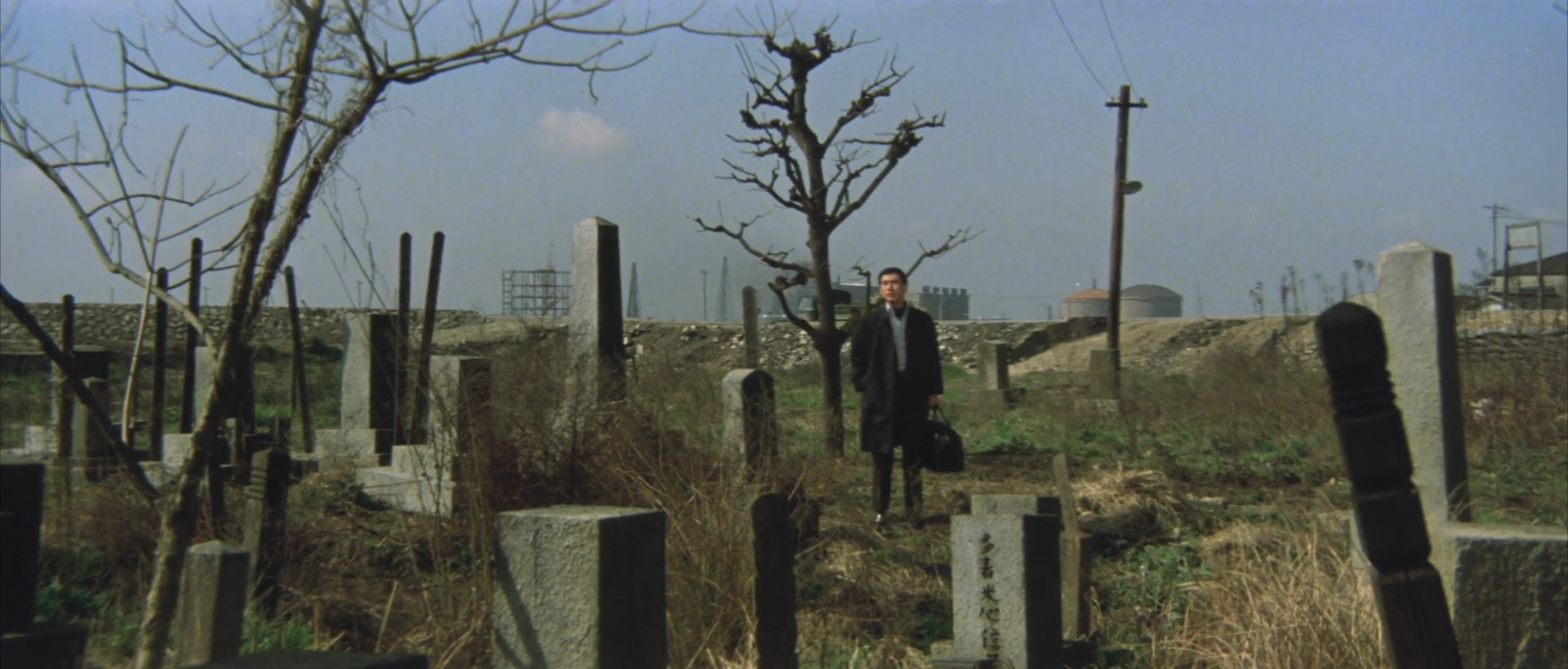
A nihilistic hitman safeguards the post-war future in Kazuo Mori’s chivalrous B-movie noir, A Certain Killer (ある殺し屋, Aru Koroshiya). Set against the backdrop of the Vietnam War with US airplanes flying constantly overhead, Mori’s crime thriller situates itself in the barren wasteland of a rehabilitated city in which betrayal, exploitation and duplicity have become the norm while a former tokkotai pilot turned killer for hire takes his revenge on social hypocrisy as a product of his society, a man who did not die but knows only killing. 

Shiozawa (Raizo Ichikawa) runs a stylish restaurant by day and supplements his income by night as a killer for hire, apparently highly regarded by the local underworld. As such, he’s approached by a yakuza underling, Maeda (Mikio Narita), on behalf of the Kimura gang who want him to off another gangster, Oowada (Tatsuo Matsushita), who double crossed them in contravention of the yakuza codes of honour. Shiozawa is resolutely uninterested in yakuza drama and so turns the job down but changes his mind when he’s paid a visit by boss Kimura (Asao Koike) himself who sells him a different kind of mission. Kimura characterises Oowada as a “bad” yakuza, one has subverted the traditional gangster nobility by dealing in the “dirty” sides of organised crime, corrupting the modern society by trafficking in illegal prostitution, drugs, and extortion, where as he is a “good” yakuza mostly running construction scams and therefore building the post-war future. His crime is, literally, constructive, where Oowada’s is not. 

Shiozawa doesn’t quite buy his justifications, but men like Oowada represent everything he hates. “They’re not worthy of this world. They’re nothing but cockroaches” he laments, recalling the young men who served with him and gave their lives because they believed in a country which betrayed them. He agrees to take the job in rebellion against post-war venality, but only at a price, asking for four times the original fee. Kimura is willing to pay, because his true aim is profit more than revenge. He plans to take over Oowada’s remaining business concerns. 

Fully aware of this, Shiozawa seems almost uninterested in the money despite having asked for so much of it. He runs his shop as a front for his side business and otherwise lives a quiet, unostentatious life keeping mostly to himself. He is not, it would seem, a cold blooded killer, often making a point of leaving those who get in his way incapacitated but alive. Targeted by a street punk for supposedly messing with his girl he cooly disarms him and walks away, only for the girl to follow attracted partly by his icy manliness and partly by the thickness of his wallet as glimpsed when he made the fatal decision to offer to pay for her meal in order to save the chef from embarrassment over her attempts to pay with things other than money. Unable to get by on her own, Keiko (Yumiko Nogawa) attaches herself to various capable men beginning with the pimp, transferring her affections to Shiozawa whom she petitions to marry her, and then to Maeda, eventually vowing to find a new partner and make lots of money. 

Both Maeda and Keiko chase Shiozawa and are rebuffed. Impressed by his cool handling of the Oowada affair, not to mention the amount of money he now realises you can make in his line of business, Maeda asks to become his pupil in order to become a “real man”. Shiozawa doesn’t regard his work as something “real men” do, and in any case prefers to work to alone. Maeda repeatedly asks to be allowed to accompany him even after plotting betrayal, only to be rejected once again as Shiozawa tells him that he doesn’t like people who don’t know the difference between the job and romance, flagging up the homoerotic subtext for those not paying attention. Maeda parrots his words back to Keiko with whom he had begun a halfhearted affair as joint revenge against Shiozawa’s indifference. 

Following the successful offing of the mob boss, Shiozawa finds himself coopted into another job robbing a drug handoff between Oowada’s former associates, the illicit narcotics ironically packaged inside cartons intended for baby powder. Shiozawa apparently doesn’t object to profiting off the drug trade himself, but later abandons the loot in protest while the remainder is lost or squandered during the final battle with the remaining gang members, Shiozawa’s cartons left sitting ironically on top of a gravestone taken by no one. Cool as ice, Shiozawa places himself above petty criminality, always one step ahead, trusting no one and looking out for himself but reacting as a man created by his times, forged by a war he was a not intended to survive while looking on at another cruel and senseless conflict across the sea. Adapting the hardboiled novel by Shunji Fujiwara, Yasuzo Masumura’s jagged, non-linear script (co-written with Yoshihiro Ishimatsu) is imbued with his characteristic irony but also coloured with nihilistic despair for the post-Olympics society and its wholesale descent into soulless capitalistic consumerism.


Update, 13th February 2025: now available to stream via Arrow Player.

Original trailer (no subtitles)

Red Angel (赤い天使, Yasuzo Masumura, 1966)

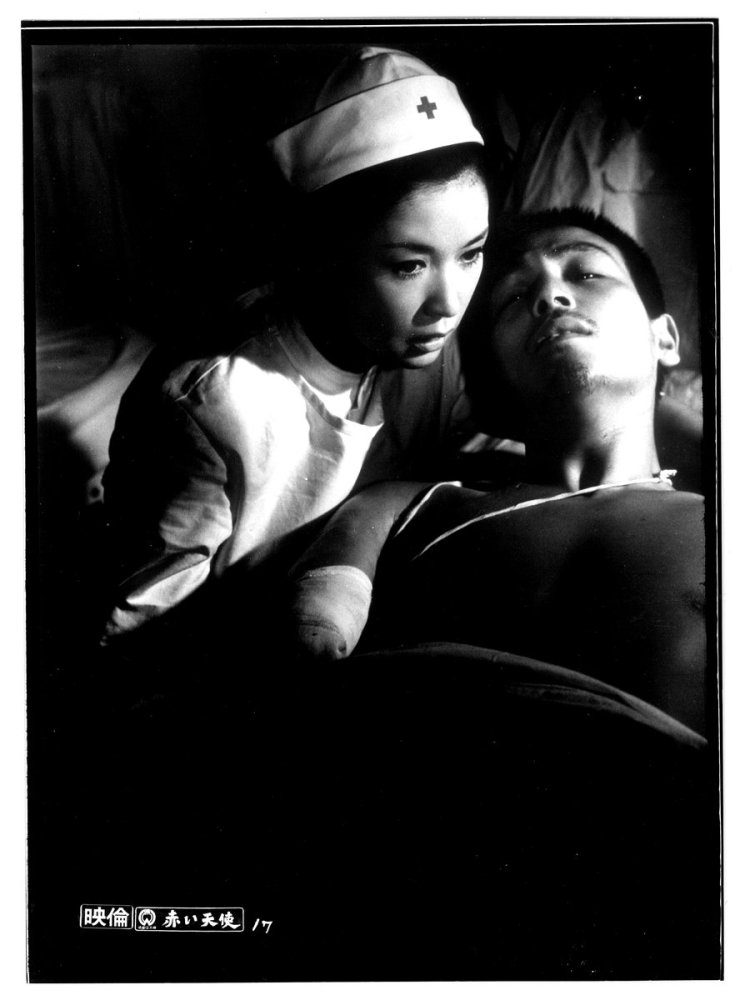
_1_image_size_900_xRed Angel (赤い天使, Akai Tenshi) sees Masumura returning directly to the theme of the war, and particularly to the early days of the Manchurian campaign. Himself a war veteran (though of a slightly later period), Masumura knew first hand the sheer horror of warfare and with this particular film wanted to convey not just the mangled bodies, blood and destruction that warfare brings about but the secondary effects it has on the psyche of all those connected with it.

The story begins as idealistic young nurse Sakura Nishi is sent to a military hospital in mainland China as the Japanese army continues its expansion into Manchuria. At this point the situation isn’t desperate, however, Nishi has barely settled into her new work when she’s grabbed by a patient who attempts to assault her. Far from coming to her rescue or raising the alarm, some of the other patients hold her down or guard the door while Nishi is raped. Reporting the incident to her superior the next morning, Nishi finds out she’s the third nurse this has happened to and only now the matron decides to have the patient (whom she brands a malingerer with mental problems) shipped back to the front lines. The soldier even has the audacity to say goodbye before he leaves whilst leering unpleasantly and if that wasn’t enough the friend also remarks that he enjoyed “the show” and is looking forward to “his turn”.

Things only get worse as Nishi is sent to the front line field hospital which is overrun with the dead and dying. The new patients are delivered by the truckload and the resident surgeon, Dr. Okabe, has to make split second decisions about who is most likely to survive and will receive treatment. Operations here generally result in amputations (whether strictly necessary or not) as this is the best way to prevent the onset of gangrene and other life threatening infections. Okabe was a top surgeon before the war but now he wonders if he’s even a doctor at all – let them die or mame them for life, these are his only options. Eventually, Nishi and Okabe develop a bond but in this desperate and dangerous environment, can you really trust anything or anyone or is every action simply part of the final death throws of those facing the ultimate horror of war?

The frontline field hospital is barely distinguishable from a charnel house as limbs are severed with terrifying efficiency by the conflicted Okabe. There’s little anaesthetic or even medication available and the men scream in agony, asking for their mothers until they finally pass out. Nishi retains some of her youthful compassion wanting to do the best for her patients but Okabe is already lost to a kind of fatalistic blankness.He knows the war itself is hopeless and repeatedly exclaims that China is just too big with too many people in it and they’ll make no impact at all here. At home at least he felt as if he could do something positive, save people’s lives, but here even if he manages to help someone they’ll be sent straight back to fight. They won’t even let the amputees go home for fear that the sight of so many limbless men will damage the nation’s morale.

Okabe, like most of the other men in the film, also has a preoccupation with sex and specifically how these men’s injuries may impact their later quality of life. As for himself, he’s been addicted to morphine for some time which has made him impotent and also places a barrier between himself and his developing relationship with Nishi. Perhaps for this reason he suddenly changes his mind about operating on a patient because it would mean interfering with an area of nerves directly related to sexual arousal and with so little time he’s worried it may be botched and ruin the man’s life so, as it’s likely he may survive without the surgery, he opts to leave it to the more capable hands of a homeland surgeon at a later date. Similarly, a sympathetic patient of Nishi’s who’s lost both of his arms later asks her to provide the “relief” that he is no longer able to supply for himself. Nishi comes to regard this as another of her duties of care and gives the man a few last minutes of comfort. However, this abundance of kindness proves to much for the man and only leaves Nishi feeling even more conflicted than before.

Despite the harshness of the environment, Nishi maintains her youthful and idealistic vision of the world. Okabe cautions her not to get attached to the patients and that the only way through is to view everybody as a stranger, she however refuses. Gradually, Nishi’s love and perseverance reawaken Okabe’s desire for life but in a world as chaotic and fragile as this one all human connections are fleeting and born of the proximity to death.

Red Angel plays out like a horror film full of blood and mangled bodies. Having opened with a series of broken skeletons, the film does not skimp on the macabre imagery and the scenes of buckets full of limbs and corpses being flung from sheets into mass graves are some of the most hauntingly authentic captured on screen. It’s raw and it’s grim, the frankness of its desire to address the murky sexual life of the wartime forces is also surprising from a film made in 1966. Yet there is passion and real connection here too. Throughout it all, Nishi never loses her desire to help or her commitment to love even in the darkest hours. She doesn’t, and cannot, win but her spirit remains unbroken. A harsh look at the animalistic nature of war and its destructive effect on basic human civility, Red Angel is one of the few films to deal with wartime sexuality in a frank way and is still, unfortunately, well ahead of its time.


Red Angel is available with English subtitles on R1 DVD from Fantoma and in the UK from Yume Pictures.

http://www.youtube.com/watch?v=6g8H7-x0gbY